Allergic Summary, Characters and Themes | Megan Wagner Lloyd
Allergic by Megan Wagner Lloyd, illustrated by Michelle Mee Nutter, is a middle-grade graphic novel about Maggie, a girl who wants a pet more than anything. On her tenth birthday, she hopes to adopt a puppy, only to discover that she has severe allergies to animals with fur and feathers.
The story follows her disappointment, loneliness, jealousy, and search for something that feels truly hers as her family prepares for a new baby. Through friendship, family conflict, and self-discovery, Allergic shows how painful changes can still lead to unexpected forms of love, belonging, and possibility.
Summary
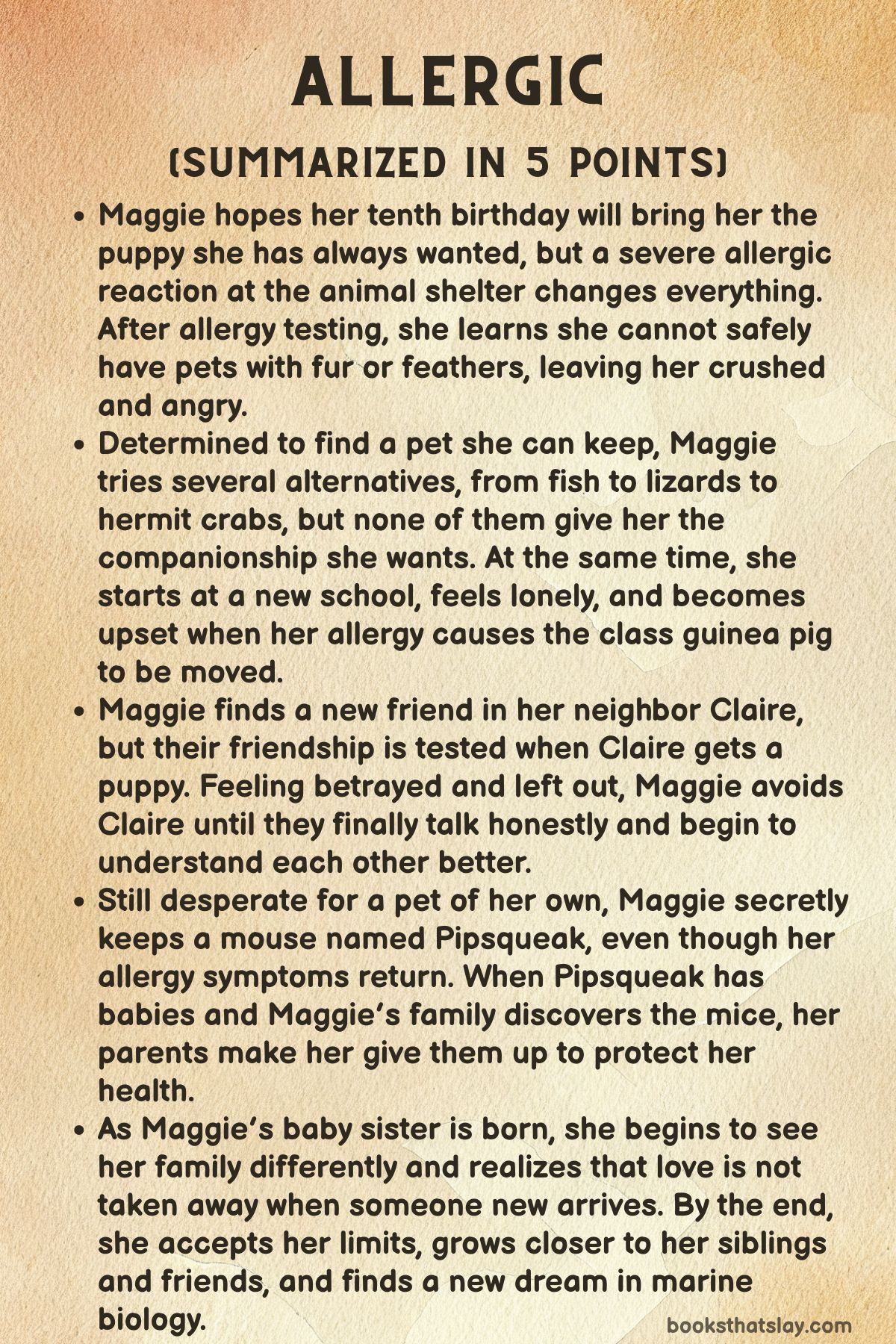
Maggie is turning ten, and she is certain this birthday will be the best one yet because her family is going to the animal shelter to adopt a puppy. She imagines the dog becoming her special companion.
Her twin younger brothers, Liam and Noah, always have each other, and her parents are busy preparing for a new baby. Maggie feels as if everyone around her already has someone, while she is left waiting for a friend of her own.
At the animal shelter, Maggie quickly finds the puppy she wants. The puppy licks her, and she begins imagining their life together.
But soon her eyes itch, her face swells, and her nose runs. Her family has to leave before the adoption is finished.
Maggie hopes this is only a temporary problem, but the next day at the allergy clinic, tests show that she has strong allergies to many animals, including dogs. The doctor explains that pets with fur or feathers are not safe for her, even ones described as hypoallergenic.
Maggie is devastated.
Still determined to have a pet, Maggie starts searching for animals that might work. Her parents agree to consider a pet without fur or feathers, as long as everything is settled before the baby arrives.
Maggie tries several possibilities. A fish dies, a lizard becomes more interesting to her brothers than to her, a snake would require feeding mice, frogs and toads cannot be handled much, turtles hibernate, tortoises live too long, and a hermit crab barely moves.
She learns a hedgehog is illegal in California, and she refuses to get a tarantula. Each failed attempt makes her feel more defeated.
At the same time, Maggie has to begin fifth grade at a new school because district boundaries have changed. She misses her old friends and feels alone on the bus and in class.
Things get worse when her new classroom has a guinea pig as a class pet. Maggie starts sneezing, and because of her allergy, the guinea pig has to be moved to another classroom.
Though she knows she did not choose to be allergic, she feels responsible when her classmates seem angry.
After school, Maggie meets her new neighbor, Claire, a sixth grader who has just moved in next door with her father. Claire is friendly, creative, and full of plans.
Maggie loves spending time at Claire’s quiet house, which feels calmer than her own busy home. They bake cupcakes, talk about their families, and imagine future projects.
Maggie enjoys having a friend who seems to choose her completely.
Maggie also notices differences between their lives. Claire’s parents are divorced, and her mother lives in New York, but Maggie sees Claire’s freedom and quiet house as exciting.
Claire, meanwhile, thinks Maggie’s brothers and soon-to-arrive baby sibling sound fun. Maggie cannot understand that.
To her, her house already has too many people and not enough space for her feelings.
Their friendship seems perfect until Claire gets a puppy. Maggie feels betrayed.
She had told Claire about her animal allergies and how badly she wanted a dog. Seeing Claire with the puppy feels unbearable, especially because Maggie’s brothers immediately want to play with it and remind Claire that Maggie is the reason their family cannot have a dog.
Maggie avoids Claire and decides she has lost both the puppy she wanted and the best friend she thought she had.
Maggie begins allergy shots, though they will not make it possible for her to own a furry pet right away. The shots may only reduce her reactions over time, and she will need them for years.
She is already upset about Claire’s dog and the coming baby, and the treatment makes her feel even more overwhelmed.
Eventually Maggie sees Claire crying through a hole in the fence and realizes she has only thought about her own hurt. She goes to Claire and explains why the puppy upset her.
Claire had misunderstood, thinking the allergy shots would solve the problem quickly. The two repair their friendship.
Claire changes clothes so she will not bring dog fur with her, and they spend time at Maggie’s house.
When Claire suggests that Maggie might not be allergic to every small furry animal, the girls decide to try a mouse. Maggie convinces her parents to put a lock on her bedroom door, then secretly brings home a pet mouse from the store.
She names the mouse Pipsqueak and hides it in her room. At first, Maggie is thrilled.
Pipsqueak feels like the pet she has been waiting for.
But Maggie’s allergies soon return. She sneezes, itches, and has swollen eyes, especially when she cleans the cage.
She tries to hide her symptoms by showering often and claiming she may be getting sick. At school, she befriends Sebastian, a boy who understands allergies because he has an egg allergy and carries an epinephrine pen.
Their conversations help Maggie see allergies as something real and serious, not just an unfair obstacle in her own life.
Then Maggie discovers that Pipsqueak was pregnant. The mouse has given birth to a litter of babies.
Maggie and Claire are excited but also worried. They learn that the babies cannot be handled right away and will eventually need to be separated.
Maggie continues caring for the mice while taking allergy medicine and trying to manage her worsening symptoms. Her allergist notices she is still reacting but does not know about the hidden mice.
Maggie’s stress grows. She is jealous when her mother calls the unborn baby “sweetie,” a name Maggie thought belonged to her.
She feels replaced before the baby is even born. She also lashes out at Claire, especially when Claire says she would love to have a baby sibling.
Maggie thinks Claire cannot understand because she does not live in a crowded house with noisy brothers.
The secret comes out when Liam and Noah tell their grandmother that Maggie has mice in her room. Maggie is furious at her brothers and at Claire.
Her parents explain that the mice cannot stay because they are making her sick. Maggie’s father tells her that his job is to keep her healthy, even when that means making a decision she hates.
Maggie finally admits that she wanted someone or something that was only hers. The twins have each other, and her parents have the baby.
She feels alone. Her father listens and reminds her that she used to help with the twins when they were babies, showing her that she has always had an important place in the family.
After the mice are taken back to the pet store, Maggie is miserable. Soon after, her mother goes into labor.
Maggie worries about her and is unsettled by the sudden change. That night, Liam becomes upset because he misses their parents, and Maggie stays with him.
They talk honestly, and Maggie realizes that even though Liam has Noah, he can still feel lonely too. Her brothers are not simply a team that excludes her; they have their own fears and needs.
The next morning, the family learns that the baby has been born and is a girl. Maggie, her brothers, and their grandmother make pancakes to celebrate the baby’s birthday.
Claire comes over, and she and Maggie apologize to each other. Maggie begins to understand that having siblings can be a gift, even when it feels messy and frustrating.
At the hospital, Maggie is nervous about meeting her baby sister. She even worries, irrationally, that she might somehow be allergic to the baby.
Her father calls her his favorite Maggie, reminding her that the new baby does not erase who she is. Her mother calls her “sweetie,” and Maggie realizes that the name still belongs to her too.
When Maggie holds the crying baby, she feels unsure at first, remembering the puppy she could not keep. Then she speaks gently to her sister and lets the baby hold her finger.
The baby calms, and Maggie feels a rush of love. She suggests the name June, and her parents love it.
In the months that follow, Maggie adjusts to life with June. She continues her allergy shots and grows braver about them.
She spends time with Claire, who makes sure Maggie has a safe space away from dog fur. Maggie also becomes friends with Sebastian.
Her relationship with her brothers improves, and she begins to enjoy caring for June.
By the following summer, Maggie and her family visit the beach and an aquarium. At the aquarium, Maggie realizes how much she loves ocean animals.
Since she cannot become the veterinarian she once imagined being, she discovers another dream: becoming a marine biologist. Her room changes too, now decorated with ocean life.
By the end of Allergic, Maggie has not gotten the furry pet she wanted, but she has found new connections, a new sense of purpose, and a wider understanding of what love and belonging can look like.
Characters
Maggie
Maggie is the central character of Allergic, and her story is shaped by wanting something that feels completely hers. At the beginning, she is hopeful, impatient, and emotionally intense, especially about getting a puppy for her birthday.
Her disappointment after discovering her animal allergies is not just about losing a pet; it feels to her like losing the one relationship that might have made her feel chosen. Maggie often sees her family through the lens of exclusion: her twin brothers have each other, her parents are focused on the coming baby, and she feels left alone in the middle.
This makes her jealousy, anger, and secrecy understandable, even when her choices are wrong. Hiding Pipsqueak shows both her desperation and her immaturity, because she wants comfort so badly that she ignores the danger to her health.
As the story progresses, Maggie becomes more aware of other people’s feelings. She realizes Claire was hurt too, Liam can feel lonely despite having Noah, and the baby is not replacing her.
Her growth is not shown through a sudden perfect transformation but through small moments of honesty, apology, care, and new understanding. By the end, Maggie has not received the pet she first wanted, but she has gained a broader sense of belonging and a new dream for her future.
Claire
Claire is Maggie’s new neighbor and quickly becomes an important friend. She is confident, imaginative, and energetic, and her arrival gives Maggie the companionship she has been craving.
Claire’s house offers Maggie a quiet escape from the noise of her own family, which makes Claire seem even more ideal at first. However, Claire is not simply a perfect best friend.
She sometimes misunderstands Maggie’s allergies and assumes that allergy shots will solve the problem faster than they actually will. Her decision to get a puppy hurts Maggie deeply because Maggie sees it as proof that Claire does not understand her pain.
Yet Claire’s reaction after Maggie pulls away shows that she has feelings of rejection too. She is not trying to betray Maggie; she is also trying to enjoy her new life after moving.
Claire’s family situation helps explain why she views Maggie’s siblings differently. Since Claire lives with her father and sees her mother only at certain times, Maggie’s crowded home looks warm and exciting to her.
Claire’s role in the story is to challenge Maggie’s assumptions. Through Claire, Maggie learns that someone can seem lucky and still have losses of their own.
Liam
Liam is one of Maggie’s younger twin brothers, and at first he appears mainly as part of the noisy pair that frustrates her. He and Noah tease Maggie, play roughly, and make the house feel chaotic.
Because the twins are so close, Maggie assumes they do not need anyone else, especially not her. Liam becomes more important when he shows vulnerability during their parents’ absence.
His conversation with Maggie reveals that being a twin does not mean he never feels lonely or overwhelmed. He admits that Noah can be too much for him, which surprises Maggie and helps her see him as an individual rather than only one half of a pair.
Liam also helps soften Maggie’s anger after the mice are discovered. Though he participates in telling the adults, his later apology shows remorse.
His character adds depth to the sibling relationships by showing that younger brothers can be annoying, loving, needy, and sorry all at once.
Noah
Noah, like Liam, is one of Maggie’s younger twin brothers and contributes to the lively disorder of the family home. He often functions alongside Liam, especially in scenes where the boys are playing loudly, teasing Maggie, or becoming excited about animals.
Noah’s closeness with Liam is part of what makes Maggie feel separate. From her point of view, the twins already have a built-in best friend, which makes her own loneliness sharper.
Noah’s role is less individually developed than Liam’s, but he remains important because he represents the family bond Maggie misunderstands. She sees the twins’ closeness as proof that they do not need her, but the story gradually shows that family relationships are not that simple.
Noah’s excitement about the baby and his involvement in family activities help show that he is not trying to push Maggie out. He is part of a noisy, affectionate household that Maggie must learn to see with more patience.
Maggie’s Mother
Maggie’s mother, Hannah, is caring but often distracted by pregnancy and the practical demands of family life. To Maggie, her mother’s attention to the baby feels like abandonment.
Small moments, such as her mother touching her pregnant belly instead of noticing Maggie reaching for her hand, become emotionally painful for Maggie because they confirm her fear that she is being replaced. Hannah does not intend to hurt Maggie, but the story shows how children can experience ordinary adult busyness as rejection.
She is also one of the main voices of caution in the family. She does not rush into pet decisions, and she understands that any animal must be safe for Maggie’s health.
Her love becomes especially clear near the birth of the baby, when she reassures Maggie that change can be good and later calls her “sweetie,” reminding Maggie that their bond remains intact. Hannah’s character represents the difficulty of parenting a sensitive child while also preparing for a new baby, managing the household, and trying to keep everyone safe.
Maggie’s Father
Maggie’s father is warm, playful, and emotionally steady. He often brings humor into family life, such as calling Maggie his favorite daughter before the baby is born.
This joke later becomes more complicated for Maggie when she worries about what will happen if the baby is a girl. His character is especially important in the scenes involving the mice.
Although he feels sorry that Maggie cannot have the pet she wants, he makes the difficult decision to remove the mice because her health must come first. His conversation with Maggie shows his strength as a parent: he does not dismiss her feelings, but he also does not let sympathy override responsibility.
He listens when she admits that she wanted someone of her own, and he reminds her of her earlier place in the family when the twins were born. He helps Maggie understand that love is not a limited resource.
His kindness at the hospital, when he calls her his favorite Maggie, gives her the reassurance she needs before meeting June.
June
June, Maggie’s baby sister, begins as a source of anxiety long before she is born. To Maggie, the coming baby represents change, lost attention, and possible replacement.
Maggie resents the baby’s nursery, the baby’s car seat, and even the affectionate names her mother uses for the unborn child. June’s importance lies in how she changes once Maggie actually meets her.
At the hospital, the baby is no longer an abstract threat. She is small, crying, and in need of comfort.
When Maggie holds her and soothes her, Maggie discovers that she can have a special role in June’s life. Naming her June is also meaningful because it allows Maggie to contribute to the family’s new beginning.
In later scenes, June becomes someone Maggie plays with, feeds, encourages, and loves. Through June, Maggie learns that a new family member does not erase existing love.
Instead, June gives Maggie a new way to belong.
Sebastian
Sebastian is Maggie’s classmate and becomes an important friend because he understands allergies from personal experience. His egg allergy is different from Maggie’s animal allergies, but he knows what it means to live with limits other people may not understand.
He helps Maggie feel less alone and less ashamed. When she blames herself for the guinea pig being moved, Sebastian tells her she did not choose to have allergies.
This is one of the clearest moments of emotional support Maggie receives outside her family. Sebastian is curious, factual, and thoughtful.
His habit of collecting facts gives him a distinct personality, and his knowledge about allergic reactions makes Maggie’s own condition feel more real and less like a personal failure. He also widens the story’s view of allergies by showing that some allergies can be dangerous in different ways.
As Maggie becomes friends with him, her world expands beyond Claire and her family, giving her another source of connection.
Grandma
Grandma is a steady family presence who helps care for Maggie and her brothers, especially when their parents are busy or at the hospital. She notices Maggie’s symptoms when the boys point out her swollen eyes, and she offers practical care, such as eye drops.
Grandma also brings warmth and continuity to the family. Her memories of Hannah’s pregnancy connect the present moment to the past, showing that the family has gone through changes before.
She is not as central to Maggie’s emotional transformation as her parents, Claire, or June, but she helps create the sense of a wider support system around Maggie. Her presence during the hospital visit also matters because she guides the children through an overwhelming moment.
Grandma represents dependable family care, the kind that may sit quietly in the background but becomes important when everyone else is anxious.
Dr. Idonjie
Dr. Idonjie is the allergist who explains Maggie’s condition and helps shape the practical limits Maggie must face. She is calm, professional, and direct, making it clear that Maggie’s allergies are serious and that pets with fur or feathers are not a good choice.
Her explanation of the immune system gives Maggie and readers a clearer understanding of what allergies are. Dr. Idonjie’s role is not only medical; she also represents the reality Maggie cannot negotiate with.
Maggie can be angry, hopeful, secretive, or determined, but her body still reacts. The doctor’s recommendation of allergy shots introduces a long-term path rather than an instant solution.
This matters because Maggie must learn patience and acceptance. Dr. Idonjie helps ground the story in real physical consequences, reminding Maggie that wanting something badly does not make it safe.
Pipsqueak
Pipsqueak is Maggie’s secret pet mouse and represents Maggie’s longing for a companion of her own. Maggie pours her hopes into Pipsqueak because the mouse seems like a possible answer after so many failed pet attempts.
For a short time, Pipsqueak gives Maggie joy, purpose, and a sense of private ownership. However, the mouse also exposes Maggie’s refusal to accept the full truth of her allergies.
Maggie’s reactions worsen, and she hides both the mouse and her symptoms. Pipsqueak’s surprise litter increases the emotional stakes because Maggie’s secret becomes bigger than she can control.
The mouse is not a villain or a simple plot device; Pipsqueak represents the painful difference between love and suitability. Maggie can care deeply for an animal and still be unable to keep it.
Losing Pipsqueak forces Maggie to face the limits of her situation honestly.
Themes
Living with Limits
In Allergic, Maggie’s animal allergies create limits that feel deeply unfair because they block something she loves before she has even had the chance to fully enjoy it. Her body becomes the source of rules she does not want: she cannot keep a dog, cannot safely stay around many furry animals, and cannot simply visit certain spaces without consequences.
The emotional force of this theme comes from the fact that Maggie’s allergy is not a small inconvenience to her. It changes her idea of her future, including her dream of becoming a vet.
The story treats these limits seriously rather than pretending they can be solved by positive thinking. Allergy shots may help, but they take time and do not give Maggie everything she wants immediately.
This teaches a realistic lesson about living with a condition that requires patience, care, and acceptance. Maggie’s growth comes partly from learning that limits do not erase possibility.
She cannot have the pet she imagined, but she can still love animals, visit the aquarium, and imagine becoming a marine biologist. The theme shows that accepting limits is not the same as giving up.
It can also mean finding a new path that still carries joy, curiosity, and purpose.
Jealousy and the Fear of Being Replaced
Maggie’s jealousy grows from her fear that everyone else already has a special place while hers is disappearing. Her brothers have each other, her parents are focused on the baby, and Claire gets the puppy Maggie wanted.
These situations make Maggie feel as though love and attention are limited, and if someone else receives them, there will be less left for her. The coming baby intensifies this fear because Maggie notices every sign of preparation: the nursery, the car seat, the conversations about names, and her mother’s affection toward the unborn child.
Even the word “sweetie” feels stolen when her mother uses it for the baby. Maggie’s jealousy is not presented as simple selfishness.
It comes from insecurity and loneliness, which makes her reactions more understandable even when she behaves badly. Her anger at Claire’s puppy and her secret decision to keep mice both show how jealousy can lead someone to act out instead of admitting hurt.
The turning point comes when Maggie realizes that others also have vulnerable feelings. Claire cries, Liam misses his parents, and June needs comfort.
Maggie slowly learns that love is not a prize handed to only one person. Her family can grow without pushing her out of it.
Friendship, Misunderstanding, and Repair
Maggie and Claire’s friendship develops quickly because each girl offers something the other needs. Maggie finds quiet, attention, and companionship with Claire, while Claire finds a nearby friend who makes her new neighborhood feel less lonely.
Their bond feels strong, but it is tested when Claire gets a puppy. Maggie sees the puppy as a betrayal, while Claire believes the allergy shots will make things manageable.
Their conflict shows how friendships can be damaged when people assume they understand each other’s experience without asking enough questions. Maggie retreats into silence instead of explaining her pain, and Claire is left confused and hurt.
The repair of their friendship becomes important because it requires honesty from both sides. Maggie has to admit why she was upset, and Claire has to recognize that her choice affected Maggie more than she realized.
Their friendship is not perfect after that; Claire’s mouse idea leads to more trouble, and Maggie later lashes out at her again. Even so, their apologies show that friendship is not measured by never hurting each other.
It is measured by the willingness to return, listen, take responsibility, and make safer space for each other. Claire’s dog-free clubhouse plan later shows friendship becoming more thoughtful and mature.
Family Change and Belonging
Maggie’s family is loud, crowded, and constantly changing, which makes her feel lost inside it. The new baby’s arrival seems to threaten the place she already has, especially because her parents are busy and her brothers take up so much space and energy.
Maggie wants a pet partly because she wants a relationship that is not shared or complicated by family noise. The story gradually challenges her belief that belonging means having someone who belongs only to her.
Her father reminds her that she once helped care for the twins, and Liam’s late-night honesty shows that her brothers are not as self-contained as she thought. The birth of June becomes the strongest test of this theme.
Maggie approaches the hospital room with fear, convinced that the baby might take something from her. Instead, holding June gives Maggie a new role.
She can soothe her, name her, care for her, and become important to her. Family change does not stop being difficult, but it becomes less frightening once Maggie experiences herself as needed rather than replaced.
The final family scenes show a more flexible form of belonging, where different relationships can exist side by side. Maggie can be a daughter, sister, friend, patient, and future scientist without losing herself.