Among the Bros Summary and Analysis
Among the Bros by Max Marshall is a true-crime investigation into fraternity culture, privilege, campus drug dealing, and the deadly rise of Xanax use among college students in Charleston, South Carolina. The book follows Mikey Schmidt, Rob Liljeberg, and others connected to a fraternity-linked drug network that expands from weed dealing to a large Xanax and cocaine operation.
Marshall uses interviews, police records, and personal reflection to show how wealth, loyalty, racism, hazing, and weak institutional accountability helped protect young men who caused serious harm while others paid a far heavier price.
Summary
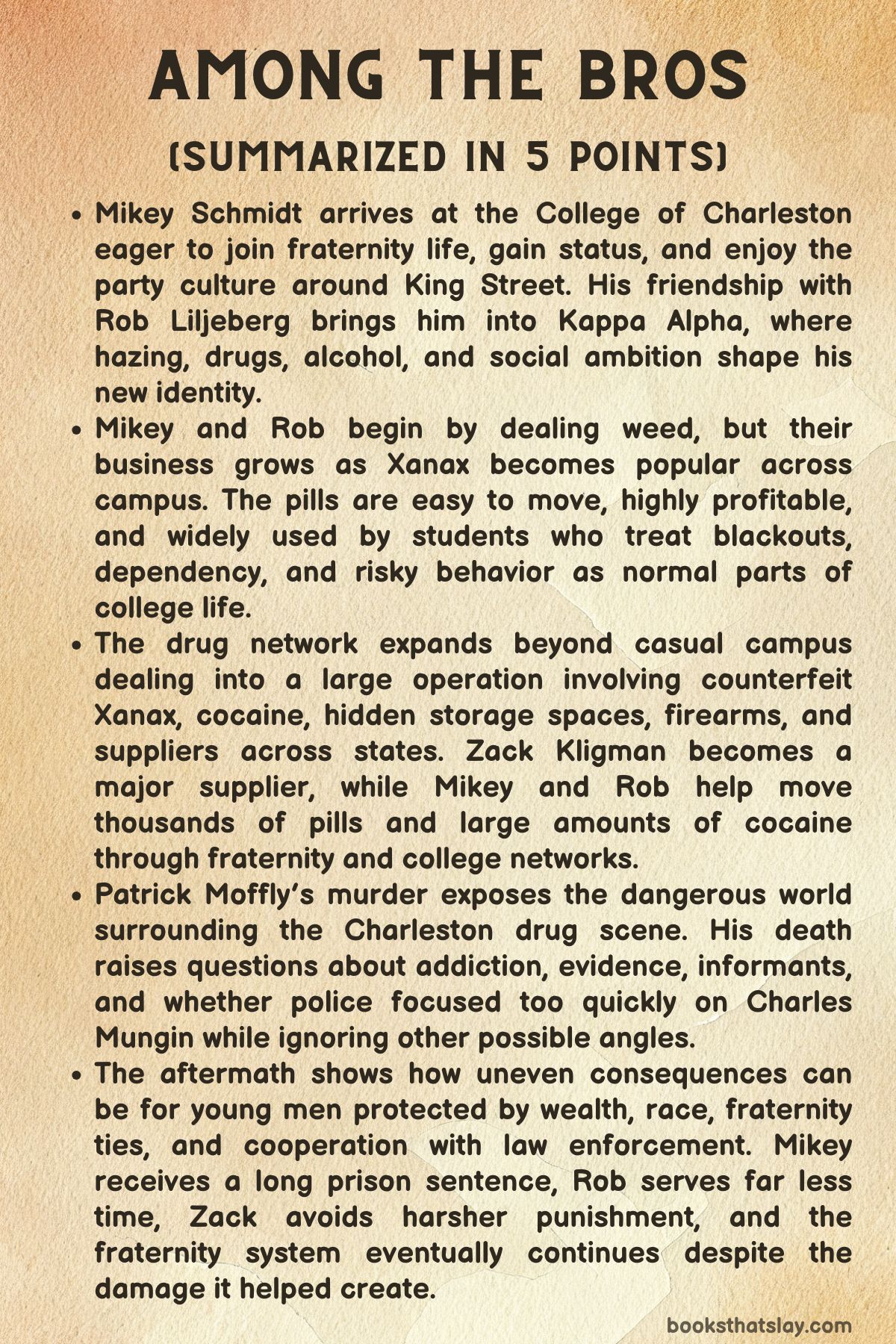
Among the Bros begins with journalist Max Marshall learning about a major drug bust in Charleston, South Carolina. The case involves Mikey Schmidt, a former College of Charleston student from Atlanta, and several other young men who look less like hardened criminals than wealthy, polished fraternity members.
Police seize large amounts of marijuana, cocaine, firearms, cash, and pills. The bust is also connected to the murder of Patrick Moffly, a college student whose death exposes a much larger world of drugs, privilege, and silence.
Mikey arrives at the College of Charleston eager to enjoy the party life and join a fraternity. He is small, social, ambitious, and drawn to the status that Greek life promises.
At first, he is interested in the most prestigious fraternities, especially the ones with money, connections, and access to parties. Then he meets Rob Liljeberg, a member of Kappa Alpha Order, and their friendship changes the direction of his college life.
Rob introduces Mikey to the fraternity’s off-campus social world, where parties, weed, alcohol, and social status shape everything.
Mikey joins Kappa Alpha and quickly learns that the fraternity’s public ideals do not match its private behavior. Officially, it presents itself as a chivalric order built on honor and brotherhood.
In reality, new members are forced through hazing, heavy drinking, sleep deprivation, humiliation, and physical discomfort. Mikey accepts the abuse because he wants the bond, the status, and the protection that fraternity membership seems to offer.
He becomes fully invested in the group and in the culture around it.
As Mikey becomes more comfortable in fraternity life, he and Rob begin dealing weed together. Mikey already has experience selling drugs and making fake IDs, while Rob has access to students and fraternity networks.
Their business grows because drug use is common around campus, and many students treat weed, alcohol, and pills as ordinary parts of college life. At the same time, other fraternity members are also dealing, and the campus market becomes more competitive.
The book shows how Xanax becomes central to this world. Students use it to calm anxiety, erase hangovers, enhance other drugs, or make partying easier.
Many do not understand how dangerous it is, especially when mixed with alcohol or cocaine. Some students take it casually, some slip it into drinks, and others become dependent.
Marshall connects this to his own memories of friends who struggled with Xanax misuse, making clear that the crisis is not limited to one school or one fraternity.
Mikey eventually leaves college after his grades fall, but he does not leave the fraternity world behind. He returns to Atlanta, works briefly as a valet, and misses the power and freedom he had in Charleston.
He stays close to Rob and begins building new connections through nightlife and the music scene. Meanwhile, in Charleston, Rob rises in Kappa Alpha and becomes a major figure in the campus drug trade.
Xanax is easier to move than weed because it is small, odorless, and profitable. Soon, Rob and Mikey are working together across state lines.
Their operation grows quickly. Rob buys Xanax from Zack Kligman, a major Charleston dealer, and sends pills to Mikey in Atlanta.
Mikey sells them through his own network and to other college campuses in the South. Together, they move thousands of pills each week.
Their profits increase, and so does their confidence. Mikey buys cars, hides cash, and builds an image of success.
Around them, more students black out, form dependencies, and treat dangerous behavior as normal.
Marshall also examines the racial history and culture surrounding Kappa Alpha. The fraternity’s reverence for Robert E. Lee and its attachment to Old South imagery are not presented as harmless tradition.
The book connects these symbols to the broader history of white supremacy, exclusion, and social power in Southern Greek life. Even as campuses become more progressive, some fraternities remain insulated spaces where racism, entitlement, and loyalty to the group survive with little meaningful challenge.
The drug network becomes more serious when Mikey and Rob begin selling cocaine. Mikey has a source in Atlanta, and Rob has buyers in Charleston.
Zack Kligman is also expanding his operation, making counterfeit alprazolam pills with black-market powder and storing large quantities of drugs away from his home. The scale of the business is no longer casual college dealing.
It is a major trafficking operation involving pills, cocaine, weapons, money, and informants.
Patrick Moffly enters the story as a troubled young man from a wealthy family. He has anxiety, uses drugs heavily, and becomes involved with people connected to the same Charleston drug scene.
He moves into a house tied to Zack’s operation and starts dealing. His friends worry about him as his dependence on cocaine and Xanax worsens.
After he is arrested for cocaine trafficking, his situation becomes more unstable. He fears losing trust within the drug network and struggles with depression and withdrawal.
Patrick is later shot at his house. Before he dies, he names people he believes were involved.
Police find pills and drug evidence at the scene, but people in the house try to clean up before and during the emergency response. Investigators focus on Charles Mungin, a young Black man connected to Patrick by phone records and witness descriptions.
Charles is arrested and charged with murder, though the evidence is largely circumstantial. Patrick’s family and friends believe Zack may have played a larger role, but police do not seriously pursue that theory.
As the investigation continues, the drug ring begins to collapse. Zack becomes an informant after police find drugs, weapons, and a massive amount of alprazolam connected to him.
Rob is also caught after a cocaine deal involving Mikey’s supply. Police pressure him, and he gives them information about Mikey’s operation.
Mikey, still trusting Rob, does not immediately realize that his closest friend has turned against him. When Mikey is arrested, he understands that Rob is the informant who helped build the case.
The legal consequences are uneven. Mikey faces a harsh sentence because he refuses to identify his suppliers, fearing violent retaliation.
Other people involved receive lighter outcomes, probation, or reduced punishment. Zack, despite the scale of his operation and repeated arrests, avoids the kind of punishment Mikey receives.
Rob serves less than two years and later rebuilds his life. Charles Mungin is convicted of Patrick’s murder and sentenced to life in prison plus additional time, even though doubts remain about the investigation and trial.
By the end of Among the Bros, Marshall shows that the scandal does not truly destroy the systems that allowed it to happen. Fraternities are suspended, but many return.
Students involved in serious misconduct often avoid lasting consequences. Greek life continues to attract huge numbers of students.
Mikey goes to prison, suffers withdrawal, reflects on betrayal, and wonders whether joining a different fraternity might have changed his life. The book closes with a bleak picture of loyalty, privilege, addiction, and punishment: some young men are protected by the culture that raised them, while others are left to carry the full weight of its damage.
Key People
Max Marshall
Max Marshall is both investigator and reflective narrator. His role is not limited to reporting arrests and legal outcomes; he also examines why the young men in the story felt familiar to him.
He recognizes their clothes, speech, college rituals, and fraternity habits because he came from a similar social world. This makes his voice uneasy and self-questioning rather than detached.
In Among the Bros, Marshall’s strength as a narrator comes from this tension: he is close enough to understand the appeal of brotherhood, status, parties, and secrecy, but distant enough to see how destructive those things became. He repeatedly questions whether fraternity loyalty is real friendship or simply protection until pressure arrives.
His conversations with Mikey also show his patience as a reporter. He listens, checks claims against records, and refuses to treat any single person’s version as the whole truth.
Marshall becomes a moral witness to a culture that often excuses young men as careless boys, even when their actions lead to addiction, violence, and death.
Mikey Schmidt
Mikey Schmidt is the central figure in the story and one of its most complicated personalities. He arrives at college wanting what many first-year students want: social access, popularity, sex, parties, and a place inside a powerful group.
His nickname, “Little Mikey,” suggests youth and smallness, but his ambitions are large from the beginning. He wants entry into a world where confidence, money, and connections matter more than academic seriousness.
Once he joins Kappa Alpha, he accepts hazing and humiliation because he believes membership will give him status and belonging. That need for acceptance becomes one of the forces that shapes his downfall.
Mikey is not simply pulled into crime by others. He already has experience selling weed and making fake IDs, and he understands how to turn social networks into business opportunities.
When he leaves college, he does not leave behind the identity that fraternity life gave him. Instead, he expands it into a drug operation that crosses campuses and state lines.
His intelligence, charm, and risk tolerance make him successful, but they also make him dangerous. He treats trafficking as a way to gain power, wealth, and independence.
At the same time, his later dependence on Xanax and his grief over his grandfather reveal a vulnerable side. Prison strips away much of his bravado, leaving him frightened, resentful, and reflective.
His betrayal by Rob wounds him deeply because he still sees brotherhood as something that should have meant loyalty.
Rob Liljeberg
Rob Liljeberg begins as Mikey’s guide into fraternity life, but he becomes much more than a social mentor. He is wealthy, well-connected, and able to move easily through Charleston’s elite student world.
His polished background contrasts sharply with his role in the drug trade. As a Kappa Alpha member and later a chapter president, he holds a position that should represent responsibility, but he uses that position to strengthen social influence and business access.
His leadership does not stop hazing or drug use; instead, his standing helps normalize the very culture he benefits from.
Rob’s relationship with Mikey is built on friendship, shared ambition, and mutual profit. He seems to admire Mikey’s boldness, while Mikey trusts Rob’s access to fraternity circles.
Yet Rob’s loyalty collapses when he faces serious legal consequences. His choice to become an informant is one of the story’s defining betrayals.
It shows that fraternity brotherhood, despite all its rituals and claims of lifelong loyalty, can disappear under pressure. Rob’s punishment is also important.
Compared with Mikey’s sentence, his outcome is lighter, and he eventually returns to ordinary professional life. That contrast makes Rob a symbol of protected privilege: he participates deeply in the same operation but finds a way back into respectability.
Patrick Moffly
Patrick Moffly is the tragic center of the murder case. He comes from wealth, but his privilege does not protect him from anxiety, drug dependency, or emotional instability.
His family’s resources help him avoid some earlier consequences, yet they cannot save him from the drug world he enters. Patrick is restless, troubled, and desperate to belong.
He parties heavily, uses cocaine and Xanax, and becomes involved with people who treat drugs as both social currency and business. His reputation for being reckless while high makes him vulnerable, and his worsening dependency leaves him less able to protect himself.
Patrick’s story also exposes the cruelty of the social world around him. Friends worry about him, but the party culture continues.
After his arrest for cocaine trafficking, he is cut off from parts of the drug network, which increases his fear and instability. His death is especially disturbing because of what happens around him: pills are scattered, housemates clean evidence, and people seem more concerned with protecting themselves than saving him or telling the full truth.
Patrick is not presented as innocent in every choice, but he is clearly a young man consumed by forces larger than his control: addiction, fear, male bravado, and a community trained to hide damage until it becomes impossible to ignore.
Zack Kligman
Zack Kligman is one of the most important figures in the drug network. Unlike some of the college students who drift into dealing through social circles, Zack appears more experienced and businesslike.
He becomes known as a major Xanax supplier in Charleston and eventually moves beyond resale into manufacturing counterfeit alprazolam pills. His operation is large, organized, and profitable.
He stores drugs away from his home, uses other locations, and supplies multiple dealers. This makes him less of a reckless student figure and more of a central operator in the larger criminal system.
Zack’s character is marked by ambiguity and suspicion. Many people connected to Patrick believe Zack may know more about the murder than he admits, and Patrick’s fear of him before his death deepens that suspicion.
Yet police focus on another suspect and use Zack as an informant. This makes him a symbol of the strange logic of criminal investigations, where someone deeply involved in dangerous activity can become useful to law enforcement and avoid harsher punishment.
His blank reaction after hearing about Charles Mungin’s conviction adds to his unsettling presence. Zack rarely appears as emotionally open; he is controlled, guarded, and difficult to read.
Charles Mungin III
Charles Mungin III is central to the legal aftermath of Patrick’s murder. He is arrested after police connect him to Patrick through a red car, phone records, and witness statements.
The case against him appears to rely heavily on circumstantial evidence, and his trial raises serious questions about fairness, race, and legal representation. Charles insists he did not commit the crime and refuses a plea deal, which shows either innocence, stubbornness, or a refusal to accept a story he believes is false.
His decision leads to a trial that ends in a severe sentence.
Charles’s place in the narrative contrasts sharply with the treatment of many white fraternity-connected students. While several young men involved in major drug activity receive lighter outcomes, Charles receives life in prison plus additional time.
His lawyer’s weak defense and the police’s limited interest in alternative theories make his conviction feel less like a clean resolution and more like a troubling conclusion. He becomes a figure through whom the book questions who receives doubt, who receives protection, and who is treated as disposable.
Jordan Piacente
Jordan Piacente is connected to Patrick near the end of his life and is one of the names he reportedly gives after being shot. Her role remains uncertain, which makes her significant in a different way from Mikey, Rob, or Zack.
She represents the unresolved parts of the murder case, the people who are near the center of events but never fully explained by the investigation. Patrick spends time with her shortly before his death, and her name appears in his dying account, yet she is not treated by police in the same way Charles is.
Jordan’s presence raises questions about selective investigation. The fact that she is not arrested, while Charles is charged quickly, suggests that investigators may have narrowed their theory too early.
She is less developed as a personality in the summary, but her importance lies in what remains unclear. She is part of the shadowed area between drug dealing, friendship, possible robbery, and murder.
Her role reminds the reader that the official version of a case is not always the complete version.
Ben Nauss and Russell Sliker
Ben Nauss and Russell Sliker represent the wider fraternity drug economy at the College of Charleston. They are not shown as isolated offenders but as part of a broader campus environment where dealing weed, Xanax, and other drugs can fit neatly beside parties, social status, and Greek life.
As SAE members, they belong to a fraternity world associated with wealth and prestige. Their involvement shows that drug dealing is not limited to one house or one friendship.
It moves through overlapping networks of students who know one another, party together, and understand the demand for pills and cocaine.
Their roles also help show how normalized the market becomes. When many young men are selling or buying, criminal behavior begins to look like ordinary college enterprise.
Ben and Russell are eventually arrested, but they do not dominate the narrative because they function as evidence of scale. They show that Mikey and Rob are not exceptions.
They are part of a larger system in which privilege, secrecy, and campus social life make drug trafficking easier to hide.
Tim Kulp
Tim Kulp, Mikey’s lawyer, is a practical and skeptical figure. He understands that the case against Mikey is not only about one young man’s choices but also about a much larger drug ring.
His suspicion that the operation crossed fraternities and states gives the investigation a wider frame. Kulp also raises doubts about Zack and the murder investigation, especially when he tries to challenge the prosecution’s reliance on informants.
He sees that if Zack’s credibility can be damaged, the case against Mikey may weaken.
Kulp’s role is important because he questions the official story. He does not accept the simplest version of events, especially when police appear uninterested in investigating Zack more deeply.
As a defense lawyer, he is naturally working for Mikey’s interests, but his concerns also point to real gaps in the case. He represents the legal counterforce to police and prosecutors, though he cannot ultimately prevent Mikey from receiving a long sentence.
Stephanie Linder
Stephanie Linder is the prosecutor who handles the cases against Mikey and others. She represents state authority and the demand for consequences.
Her approach to Mikey is severe because he refuses to name his suppliers. From her perspective, cooperation matters, and Mikey’s silence makes him more difficult to treat leniently.
This puts Mikey in a dangerous position: if he talks, he may face retaliation from violent suppliers; if he does not, he faces a harsher sentence.
Linder’s role shows how the justice system often rewards cooperation more than moral responsibility. The people who provide information can receive lighter punishment, while those who remain silent are punished more heavily.
Her treatment of Mikey may be legally understandable, but it also exposes a troubling imbalance. The final outcomes are not based only on who caused the most harm.
They are shaped by usefulness, strategy, evidence, and negotiation.
Patrick Moffly’s Parents
Patrick’s parents are loving, wealthy, and deeply shaken by their son’s death. Before the murder, their resources allow them to protect Patrick from some legal consequences, but that protection may also delay a full reckoning with the severity of his drug use.
They try to help him, hire lawyers, and remain involved, yet they cannot control the world he has entered. After Patrick is killed, they become important voices of doubt.
They do not fully accept the police’s narrow focus on Charles and believe Zack may have had a more important role.
Their grief gives the story much of its emotional weight. They are not simply background figures; they show the limits of money and influence when addiction and violence take over.
Their frustration with the investigation also raises the question of whether even wealthy families can be ignored when their concerns conflict with a convenient police theory. Through them, Patrick remains more than a case file.
He is a son whose death leaves unanswered questions.
Jonathan Reams
Jonathan Reams is a pledge driver who becomes involved in the logistics of the cocaine operation. His role shows how fraternity hierarchy can pull younger or lower-status members into dangerous situations.
As a pledge or subordinate figure, he is used to carry out tasks for older or more powerful members. Driving drugs from Atlanta to Charleston is not a harmless errand, but within the fraternity structure, obedience and usefulness are already expected.
Jonathan’s arrest helps trigger the collapse of Rob and Mikey’s operation. He is not the mastermind, but his participation shows how the system spreads responsibility across many people.
Fraternity culture trains pledges to serve, drive, run errands, and prove loyalty. In this case, those habits become useful to a criminal enterprise.
Jonathan’s character reveals how young men can be drawn into serious legal danger by wanting approval from those above them.
Biscuit
Biscuit helps Mikey enter Atlanta nightlife and the music world. He is not as central to the drug case as Rob or Zack, but he gives Mikey access to a different kind of social capital.
Through Biscuit, Mikey connects with rap shows, clubs, and performers, which strengthens his confidence and expands his sense of possibility. This matters because Mikey’s life after leaving college could have moved toward ordinary work, but instead he finds another scene where status, money, and access matter.
Biscuit’s importance lies in the way he helps Mikey reshape himself. Mikey does not want to be a valet treated like a servant.
He wants to be close to fame, movement, and influence. Biscuit gives him a path into that world.
The relationship supports Mikey’s ambition and helps him believe he can operate beyond college, beyond Charleston, and beyond normal rules.
Waka Flocka Flame
Waka Flocka Flame appears as a public figure connected to Mikey’s music-industry ambitions, but his role also highlights racism in fraternity culture. His cancellation of a fraternity performance after a racist chant surfaces becomes a sharp contrast between the entertainment world fraternities consume and the racism they may still practice.
Some students may enjoy rap music at parties while also participating in or excusing anti-Black traditions. Waka’s anger exposes that contradiction.
His role is not large in plot terms, but it matters thematically. He becomes a figure who refuses to treat racist fraternity behavior as a joke or youthful mistake.
The reaction from a news anchor who shifts blame toward rap lyrics shows how institutions and media can excuse white students while criticizing Black artists. Waka’s presence helps reveal the racial hypocrisy surrounding elite college party culture.
Hawkins, Spencer, and Ryan
Hawkins, Spencer, and Ryan are former Kappa Alpha members whose deaths haunt the background of the fraternity’s story. They are not developed as fully active characters, but their deaths reveal how much harm can be absorbed into the culture without meaningful change.
One struggles with substance dependency, another dies after falling from a roof, and another dies in his apartment. These losses should have forced serious reflection, but the fraternity continues partying.
Their importance is symbolic and moral. They show that warning signs existed before the major bust and before Patrick’s murder.
The culture had already produced danger, dependency, and death. Yet because these deaths happened off campus or after formal ties to the college had changed, institutions avoided responsibility.
These young men become evidence of a system skilled at separating itself from consequences.
Alexis
Alexis, Mikey’s girlfriend, represents the ordinary life Mikey might have had if he had moved away from the Charleston drug world. She appears while he is back in Atlanta, living with family and working a regular job.
Her presence gives that period a sense of possible stability, but Mikey remains emotionally tied to Rob, the fraternity, and the status he lost after leaving college.
Alexis is not described as a major driver of the plot, but she helps show Mikey’s inability to settle into a normal path. Even with family pressure, a job, and a relationship, he remains dissatisfied.
He wants more money, more excitement, and more recognition. Her role helps define what Mikey rejects: a slower, safer, less glamorous life.
Eric Hughes
Eric Hughes is connected to Zack’s counterfeit pill manufacturing. His role shows that the Xanax operation is not only about buying and reselling pills.
It has become a production business, with equipment, powder, storage, and planning. Eric’s involvement points to the industrial scale of the operation and the danger of counterfeit drugs entering college communities.
He is not presented with the same emotional complexity as Mikey or Patrick, but he matters because he helps reveal the seriousness of the crime. The operation is no longer a loose group of students passing pills around.
It includes manufacturing, bulk distribution, and hidden supply chains. Eric’s presence makes the drug economy feel more organized and more threatening.
Josh Bowman
Josh Bowman appears as one of Patrick’s connections during his decline. His role is limited, but he belongs to the social circle surrounding Patrick as Patrick becomes more deeply involved with drugs and unstable relationships.
Characters like Josh help show that Patrick was not isolated, even when he was spiraling. He was surrounded by people, parties, and drug activity, yet still lacked real protection.
Josh’s importance comes from the environment he helps define. Patrick’s world is crowded but emotionally unsafe.
People are close enough to party, use drugs, and share space, but not always close enough to intervene effectively. Josh is part of that larger social field where companionship and danger exist side by side.
Themes
Fraternity Brotherhood and Conditional Loyalty
The fraternity world in Among the Bros sells brotherhood as permanent, sacred, and worth suffering for. Hazing is justified as a test that creates loyalty, and young men accept pain, humiliation, and exhaustion because they believe it will bind them to one another.
Mikey’s experience shows how powerful that promise can be. He endures abuse because membership gives him identity, protection, and access to a social order he wants badly.
Yet the later betrayals reveal that this loyalty is often conditional. Brotherhood holds when it brings status, parties, money, and belonging, but it weakens when prison time becomes possible.
Rob and Mikey’s friendship is built through shared business, shared secrets, and fraternity culture, but Rob informs on Mikey when his own future is threatened. The rituals that once claimed to create lifelong bonds cannot withstand legal pressure.
This theme exposes the gap between fraternity language and fraternity behavior. The group asks young men to sacrifice dignity in the name of loyalty, but when consequences arrive, self-preservation takes control.
Privilege, Protection, and Unequal Consequences
Privilege shapes nearly every major outcome in the story. Many of the young men involved come from money, respected families, elite social networks, and institutions used to protecting their own.
That privilege does not prevent recklessness; in many cases, it makes recklessness easier. Students can party harder, deal drugs more openly, and assume that lawyers, family resources, or social status will soften the consequences.
The legal outcomes reveal how uneven accountability can be. Some people connected to serious drug activity receive probation or short sentences, while others face much harsher punishment.
Rob is able to return to ordinary life after serving a relatively short time. Zack, despite his large role in the drug supply, benefits from cooperation.
Mikey receives a long sentence partly because he refuses to name dangerous suppliers. Charles Mungin, a Black man convicted in Patrick’s murder case, receives life in prison plus additional time after a trial marked by troubling weaknesses.
The pattern suggests that punishment is not distributed only by harm caused. It is shaped by race, usefulness to prosecutors, legal strategy, money, and institutional comfort with certain kinds of young men.
Addiction and the Normalization of Harm
Xanax use begins in the story as something casual, even fashionable. Students use it to relax, sleep, recover from hangovers, or make parties easier.
Because it circulates inside a socially accepted college scene, its danger is minimized. The drug becomes part of the rhythm of fraternity life: passed between friends, mixed with alcohol, sold in bulk, and sometimes used without clear consent.
This normalization makes harm harder to recognize. Blackouts become funny stories, dependency becomes common, and withdrawal is misunderstood until it becomes terrifying.
Patrick’s decline shows the emotional and physical toll of addiction. His anxiety, cocaine use, Xanax dependence, and fear after arrest push him into a state of instability that others notice but cannot stop.
Mikey also experiences the destructive pull of Xanax, especially during grief and later in prison withdrawal. The theme is not only that drugs are dangerous; it is that a social world can make danger look ordinary.
When enough people participate, the culture protects the habit. Concern appears only after damage becomes public, legal, or fatal.
Racism, Southern Tradition, and Institutional Blindness
The story treats fraternity racism not as a side issue but as part of the social structure that allows certain young men to feel protected. Kappa Alpha’s reverence for Robert E. Lee, Confederate imagery, exclusionary attitudes, and Old South nostalgia are presented as more than outdated symbols.
They help maintain a hierarchy in which whiteness, masculinity, and inherited status are celebrated. Even as the college environment becomes more progressive, these fraternity spaces preserve older ideas under the language of tradition.
The racist chant involving another fraternity and the response from media figures show how easily blame can be shifted away from white students and toward Black culture. The murder investigation deepens this theme.
Charles Mungin becomes the central suspect, while concerns about Zack receive less attention. Whether Charles is guilty or innocent, the narrowness of the investigation raises serious questions about whose guilt is easiest to imagine.
Institutional blindness appears when colleges, fraternities, police, and legal systems fail to examine the culture beneath individual incidents. Racism is not only expressed in chants or symbols; it also appears in assumptions, investigative choices, and unequal mercy.