An Unfinished Love Story Summary and Analysis
An Unfinished Love Story: A Personal History of the 1960s by Doris Kearns Goodwin is part memoir, part political history, and part farewell to a remarkable marriage. The book follows Goodwin and her husband, Richard “Dick” Goodwin, as they revisit the boxes of papers, letters, speeches, and memories he saved from his years close to John F. Kennedy, Lyndon B. Johnson, Robert Kennedy, and the great struggles of the 1960s.
Through their conversations, disagreements, and shared grief, Goodwin turns national history into something intimate. The book is not only about presidents and speeches, but about love, memory, loyalty, loss, and how the past keeps speaking to the present.
Summary
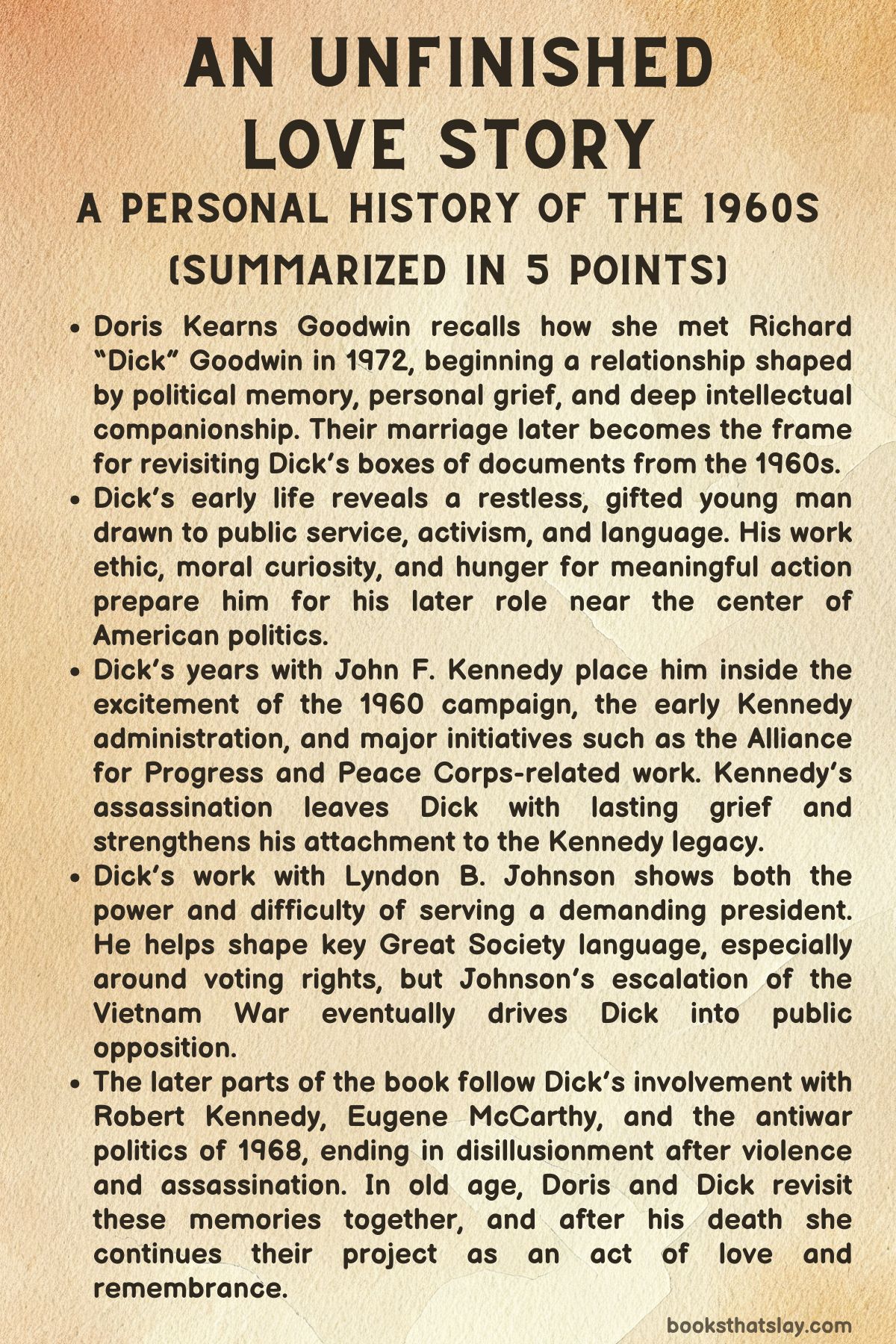
An Unfinished Love Story begins with Doris Kearns Goodwin remembering the first time she met Richard “Dick” Goodwin in 1972. He arrived at her Harvard office already carrying a large reputation: brilliant, restless, funny, difficult, and marked by his years as a speechwriter and adviser to John F. Kennedy and Lyndon B. Johnson.
Their first conversation lasted for hours and ranged across politics, literature, history, ambition, disappointment, and personal pain. Doris was drawn to his quick mind and his forceful presence, while Dick was curious about her life and work.
Their connection began as friendship, but from the start it had unusual depth.
Dick was still living with the consequences of the 1960s. He had been close to the center of power and had helped shape some of the most memorable language of the Kennedy and Johnson years.
Yet he had also broken with Johnson over Vietnam, a decision that cost him friendships and created lasting bitterness. His personal life was also troubled.
His wife Sandra had suffered from mental illness and later died, leaving Dick to care for their son. Doris became a steady presence in his life, helping him through grief and daily responsibilities.
Their relationship grew, faltered, and resumed before they married in 1975. Together they built a life in Concord, Massachusetts, raising children, writing books, debating history, and living among the memories of the American past.
Years later, as Dick’s health declined, he and Doris began opening the hundreds of boxes he had kept from the 1960s. The boxes held drafts, letters, notes, diaries, and official papers from the Kennedy and Johnson administrations.
For Doris, they became a way to understand not only the decade she had studied as a historian, but also the man she had loved for most of her life. The project also exposed an old divide between them.
Dick remained devoted to John F. Kennedy and Robert Kennedy, while Doris had a deep attachment to Lyndon Johnson, whose presidency she had studied and whose domestic achievements she admired. Their work together became a long conversation about history, loyalty, memory, and the way personal feeling shapes judgment.
The story moves back to Dick’s youth. Doris searches through his early letters and writings to understand the roots of his energy and moral drive.
As a young man, Dick was restless and self-critical, full of ambition but also uncertain about his path. He worked hard to support himself, took jobs as a salesman and fry cook, and entered Harvard Law School under financial pressure.
Even then, he was drawn to politics and social justice. His involvement in local activism and his later time in the army broadened his view of the world.
Letters from this period show a young man hungry for experience, full of humor, and eager to take part in public life. After returning to legal studies, he became involved in civil rights concerns, foreshadowing the role he would later play in national politics.
Dick first encountered John F. Kennedy in the late 1950s. His first impression was not especially strong, and he wondered whether working for the senator would lead nowhere.
But as Kennedy’s presidential ambitions became clearer, Dick saw his intelligence, confidence, and political promise. He joined Kennedy’s 1960 campaign as a junior speechwriter under Ted Sorensen.
The campaign became a demanding education. Dick learned to write quickly, absorb Kennedy’s voice, and turn policy themes into language that could move crowds.
He traveled on Kennedy’s plane, the Caroline, with a small group of aides who lived on little sleep and constant urgency. They wrote speeches, revised lines, planned strategy, and watched Kennedy sharpen his public appeal.
The 1960 campaign revealed Kennedy’s ability to inspire voters and frame the coming decade as a test of national purpose. Dick helped craft speeches on leadership, civil rights, and America’s role in the world.
Kennedy’s televised debates with Richard Nixon added to his momentum, while his decision to choose Lyndon Johnson as running mate reflected political necessity. Dick was disappointed at first, but he recognized the importance of Johnson’s strength in the South and Congress.
The Kennedy-Johnson alliance would alter the course of both men’s lives and eventually place Dick at the center of two very different presidencies.
Kennedy’s inauguration brought a sense of renewal. Doris and Dick later examine materials from that moment, including notes that show how famous phrases developed over time.
Dick watched Kennedy deliver his inaugural address from close range, feeling the power of its call to service. Yet the early Kennedy years were not only symbolic.
They were filled with practical challenges in civil rights, foreign policy, and global diplomacy. Dick helped develop the Alliance for Progress, an ambitious program meant to support democracy and development in Latin America.
He also became involved in cultural and humanitarian initiatives, including efforts connected to the Peace Corps and the preservation of the Abu Simbel monuments in Egypt. His ability to move across subjects earned him a reputation as a “supreme generalist,” someone who could handle policy, rhetoric, diplomacy, and culture with unusual range.
Dick also worked closely with Jacqueline Kennedy. He assisted with cultural projects and White House events that reflected the administration’s respect for art, history, and intellect.
One of the most memorable was a dinner honoring Nobel Prize winners, which symbolized the Kennedy White House’s desire to bring public life and intellectual life together. These efforts gave Dick a sense that politics could be imaginative and elevating.
At the same time, the administration faced the moral pressure of civil rights. Kennedy’s reaction to racial exclusion in the Coast Guard and the later admission of Merle Smith Jr. to the Coast Guard Academy became one example of how public symbolism could lead to institutional change.
The assassination of John F. Kennedy shattered that world. On November 22, 1963, Dick rushed to the White House, needing to be near others who shared the loss.
He became involved in planning the funeral, helping arrange details inspired by Abraham Lincoln’s funeral and shaped by Jacqueline Kennedy’s wishes. The work was urgent, practical, and emotionally draining.
He helped with the East Room arrangements, the procession, and the effort to create a ceremony that would express national grief. These days tied Dick even more deeply to the Kennedy family and to the memory of the fallen president.
After Kennedy’s death, Lyndon Johnson inherited the presidency. Dick’s relationship with Johnson was intense and complicated.
Johnson could be generous, persuasive, needy, cruel, funny, and visionary, sometimes within the same day. Dick saw many versions of him.
Johnson drew aides into his world, especially at his Texas ranch, where politics, family, power, and performance blended. Doris, who later came to admire Johnson’s domestic achievements, presents him as a figure of enormous flaws and enormous capacity.
He could wound those around him, but he also possessed a fierce desire to use government to improve lives.
Dick played a major role in Johnson’s Great Society agenda. He worked on speeches and policy messages concerning cities, conservation, the arts, and social reform.
His most important contribution came during the fight for voting rights after the violence in Selma. Johnson needed to address Congress and the nation, and Dick was asked to draft the speech on short notice.
The result was one of Johnson’s defining moments. When Johnson declared “We shall overcome,” he placed the authority of the presidency behind the civil rights movement.
The speech helped build support for the Voting Rights Act and stands as one of the clearest examples of Dick’s gift for turning moral purpose into public language.
Despite his admiration for Johnson’s domestic vision, Dick eventually wanted to leave the White House. Johnson resisted his resignation for months, using praise, pressure, guilt, and manipulation to keep him close.
Dick had promised himself he would stay until Johnson’s legislative program was moving, but the president did not want to lose a valuable aide. Their exchanges reveal Johnson’s dependence on talented subordinates and his fear of disloyalty.
Dick finally left, but the separation was not clean. Vietnam soon made the break deeper.
Outside the White House, Dick became closer to Robert Kennedy and Jacqueline Kennedy. He traveled with Robert Kennedy, helped shape his language, and contributed to the famous “Ripple of Hope” speech in South Africa.
The speech argued that individual acts of courage could challenge injustice, and it deeply affected many who heard it. At the same time, Dick grew increasingly opposed to the Vietnam War.
By 1966, he publicly criticized Johnson’s policy, accusing the administration of deception and moral failure. This choice changed his life.
It placed him against a president he had served and against former colleagues who believed he had betrayed them.
The late 1960s brought further turmoil. Dick wanted Robert Kennedy to challenge Johnson in 1968, believing Kennedy could unite antiwar voters, working-class voters, Black voters, and young people.
Kennedy hesitated, worried about party division and political risk. Eugene McCarthy entered the race first as the antiwar candidate, and Dick joined his campaign after Kennedy delayed.
The Tet Offensive, Johnson’s declining support, and McCarthy’s strong showing in New Hampshire changed the political landscape. Johnson eventually announced he would not seek reelection, but hope was short-lived.
Martin Luther King Jr. was assassinated, cities erupted, and the nation seemed to be coming apart. Robert Kennedy then gained momentum, winning important primaries and giving many Americans a renewed sense of possibility.
His victory in California appeared to open a path forward, but he was assassinated that same night. For Dick, it was another devastating end to hope.
The Democratic convention in Chicago became a final scene of disillusionment. Dick returned to McCarthy’s campaign and worked to push an antiwar plank into the party platform.
Outside the convention hall, police beat protesters and campaign volunteers. Inside, party leaders resisted the peace movement.
The plank failed, but the level of support it received showed how deeply the party had changed. Dick helped organize a candlelight procession to Grant Park, trying to answer violence with peaceful witness.
The convention confirmed for him that the old political order had lost moral authority.
In the later sections, Doris returns to her life with Dick in old age. They finish sorting the boxes from the 1960s and begin to see each other’s heroes with greater generosity.
Dick softens toward Johnson, while Doris gains a fuller appreciation of Kennedy’s promise. Their project becomes their shared talisman, giving purpose and rhythm as Dick faces cancer and declining strength.
After his death, Doris is overwhelmed by grief. She tries to escape it through work, then decides to leave their Concord home for Boston.
Yet she continues the project they began together. In completing the book, she preserves Dick’s memory, revisits the hopes and failures of the 1960s, and shows how public history and private love can remain unfinished in the most meaningful way.
Key People
Doris Kearns Goodwin
Doris Kearns Goodwin stands at the center of An Unfinished Love Story as both narrator and participant. She is not only recounting political history; she is also trying to understand her husband, her marriage, and the emotional meaning of the past they shared.
Her role in the book is deeply personal because she moves between the public world of presidents and speeches and the private world of love, illness, grief, and memory. Doris is curious, patient, and emotionally honest.
She approaches Dick’s boxes not simply as a historian looking for material, but as a wife trying to meet her husband again through the evidence of his younger self.
Doris’s character is shaped by her ability to balance affection with inquiry. She loves Dick, but she does not flatten him into an ideal figure.
She notices his brilliance, humor, loyalty, volatility, stubbornness, and pain. Her loyalty to Lyndon Johnson also gives the book much of its tension, because Dick’s devotion belongs more naturally to the Kennedys.
This difference between them is not a simple disagreement; it becomes a way for both of them to reconsider history through each other’s eyes. Doris is also portrayed as someone who carries grief with discipline.
After Dick’s death, she tries to keep moving through work, but the emptiness of their shared home forces her to face the depth of her loss. Her decision to continue their project shows her resilience and her belief that memory can become a form of love.
Richard “Dick” Goodwin
Richard “Dick” Goodwin is the emotional and historical subject of the book. He appears as a man of extraordinary intelligence, political energy, and moral intensity.
His career places him near some of the defining moments of the 1960s, yet the book presents him not as a distant public figure, but as a complicated human being whose ideals, loyalties, regrets, and private wounds remain alive long after the events themselves have passed. Dick’s preserved papers reveal a young man full of ambition and uncertainty, someone who worked hard, questioned himself, and searched for a life of consequence.
Dick’s greatest strength is his belief in the power of words to move history. As a speechwriter and adviser, he helps shape public language for John F. Kennedy, Lyndon Johnson, and Robert Kennedy.
His words are tied to civil rights, national service, antiwar conscience, and democratic hope. Yet he is not presented as simply noble.
He can be difficult, restless, defensive, and unwilling to surrender old grievances. His break with Johnson over Vietnam shows his moral courage, but it also leaves him isolated and wounded.
His love for the Kennedys sometimes makes him harsh toward Johnson, while Doris’s perspective gradually opens him to a more generous view. In old age, as he faces illness, Dick remains mentally alive, funny, stubborn, and fiercely attached to the past.
His boxes become an extension of himself: messy, brilliant, unfinished, and full of history.
John F. Kennedy
John F. Kennedy appears in An Unfinished Love Story as a figure of promise, elegance, ambition, and inspiration. For Dick, Kennedy represents the best possibilities of public life.
He is the leader who gave young people a sense that politics could be noble, exciting, and connected to service. At first, Dick is not fully impressed by him, but over time he comes to see Kennedy’s political gifts: his ability to absorb ideas, speak with grace, project confidence, and make citizens feel part of a larger national mission.
Kennedy’s character in the book is closely tied to language and image. His campaign plane, speeches, debates, and inaugural address all contribute to the sense of a leader who understood the emotional force of public performance.
Yet the book also makes clear that Kennedy’s presidency was not only symbolic. His administration faced urgent questions of civil rights, Cold War diplomacy, Latin America, and global development.
Kennedy’s reaction to racial exclusion in the Coast Guard shows a leader capable of turning a visible injustice into action. Still, his presidency remains marked by incompletion.
His assassination freezes him in memory as a figure of possibility rather than fulfillment. For Dick, this makes Kennedy almost impossible to separate from hope itself.
Lyndon B. Johnson
Lyndon B. Johnson is one of the most powerful and contradictory figures in the book. He is shown as overwhelming, needy, brilliant, manipulative, compassionate, insecure, visionary, and cruel, often in rapid succession.
Doris’s understanding of Johnson is more sympathetic than Dick’s, and this difference becomes one of the book’s central emotional and historical debates. Johnson is not easy to admire in a simple way, but he is impossible to dismiss.
His flaws are large, yet so are his achievements.
Johnson’s character is defined by his hunger to use power. He understands Congress, pressure, timing, loyalty, fear, and persuasion.
He can charm people at his Texas ranch and then wound them with sudden anger. He can show deep tenderness toward the vulnerable and then turn ruthless toward those who disappoint him.
His finest moments come through civil rights and the Great Society. The voting rights speech, with its direct moral appeal, shows Johnson at his most historically significant.
He is a president who knows that law can change lives. Yet Vietnam darkens his legacy and poisons his relationship with Dick.
Johnson’s tragedy in the book is that the same force that allowed him to achieve great domestic reform also fed his need for control, loyalty, and escalation.
Robert Kennedy
Robert Kennedy is portrayed as a figure of moral growth, sorrow, hesitation, and hope. He enters the book partly through Dick’s admiration and partly through the larger grief that follows John Kennedy’s assassination.
Unlike his brother’s polished public image, Robert Kennedy’s appeal rests on intensity, empathy, and a visible sense of suffering. He becomes especially important to Dick after the Kennedy presidency ends, offering a new possibility for political renewal during a time of war, racial conflict, and national exhaustion.
Robert Kennedy’s character is marked by tension between caution and courage. Dick wants him to challenge Johnson earlier, believing he can gather antiwar voters and restore moral purpose to politics.
Kennedy hesitates, aware of the risks of dividing the Democratic Party and uncertain about the timing. This hesitation frustrates Dick, who later sees it as a grave political mistake.
Yet once Kennedy enters the race, his ability to connect with different communities becomes clear. He speaks to poor voters, Black voters, young people, and working-class Americans with unusual emotional directness.
His assassination after the California victory turns him, like his brother, into a symbol of possibility cut short. In the book, Robert Kennedy represents both the promise of a more compassionate politics and the terrible fragility of that promise.
Jacqueline Kennedy
Jacqueline Kennedy appears as graceful, deliberate, historically conscious, and emotionally strong. She is not only the widow of a murdered president; she is also a guardian of memory.
Her careful preservation of documents, objects, and ceremonial details reveals a person deeply aware of how history is shaped. After John Kennedy’s assassination, her role in planning the funeral shows extraordinary composure under unimaginable grief.
She understands that the nation needs a public ritual equal to the scale of its loss, and she helps create one.
Her relationship with Dick is also important. She trusts his intelligence and taste, especially in matters involving culture, history, and public symbolism.
Their work on preserving the Abu Simbel monuments and planning major White House cultural events shows her commitment to art, beauty, and international heritage. Jackie’s character is quiet but commanding.
She does not dominate the book through speeches or arguments; instead, she shapes events through precision, memory, and symbolic judgment. Her presence reminds the reader that history is not preserved automatically.
It must be arranged, protected, and given form by people who understand what later generations will need to remember.
Sargent Shriver
Sargent Shriver is presented as energetic, welcoming, imaginative, and open to ambitious ideas. His connection with Dick becomes especially important when Dick leaves the more rigid atmosphere of the State Department and finds a freer environment at the Peace Corps.
Shriver’s leadership style contrasts with the bureaucratic resistance Dick faces elsewhere. He values creativity and action, and he gives Dick room to think broadly about international service and democratic cooperation.
Shriver’s character represents the hopeful institutional spirit of the early 1960s. Through him, public service feels practical, idealistic, and expansive.
He is not portrayed as a distant administrator, but as a leader capable of recognizing talent and encouraging bold proposals. His support helps Dick recover a sense of purpose after frustration with government bureaucracy.
In the book, Shriver embodies a version of politics that depends on trust, experimentation, and belief in young people’s ability to serve beyond national boundaries.
Ted Sorensen
Ted Sorensen plays a crucial role in Dick’s development as a political writer. As Kennedy’s close adviser and principal speechwriter, Sorensen becomes both mentor and standard-setter.
He teaches Dick the pressure, discipline, and precision required in campaign speechwriting. Under Sorensen, Dick learns that political language must be fast, clear, memorable, and suited to the speaker’s voice.
This apprenticeship shapes Dick’s future work and helps him enter the inner world of Kennedy politics.
Sorensen’s character in the book is associated with professionalism and control. He is demanding, but his demands help Dick sharpen his craft.
He represents the discipline behind Kennedy’s public eloquence. The speeches that seem effortless are shown to come from intense labor, revision, and collaboration.
Sorensen’s presence also reminds the reader that public greatness is often built by teams of gifted people working under pressure, with little sleep and little certainty that history will remember their names.
Bill Moyers
Bill Moyers appears as a thoughtful observer of Lyndon Johnson and the moral tensions of power. His description of Johnson as having many different selves captures one of the book’s most important insights into Johnson’s character.
Moyers understands the emotional difficulty of working for a president who can be inspiring, affectionate, suspicious, and punishing. His perspective helps frame the atmosphere of the Johnson White House, where loyalty and exhaustion often existed side by side.
Moyers also serves as a bridge between political idealism and political strain. Like Dick, he is drawn into Johnson’s huge domestic ambitions, but he also witnesses the personal cost of serving such a demanding leader.
His presence in the book helps show that Johnson’s staff members were not merely functionaries; they were people trying to reconcile their belief in public good with the pressure of proximity to power. Moyers’s reflections deepen the portrait of the administration as both productive and emotionally punishing.
Lady Bird Johnson
Lady Bird Johnson is portrayed with warmth, dignity, and quiet strength. Though she is not as central as Lyndon Johnson, her presence softens and humanizes the world around him.
She represents steadiness beside a man of enormous volatility. Her later connection to Doris also matters, especially when she expresses appreciation for Doris’s work on Abraham Lincoln despite her health challenges.
That moment shows her grace and her continuing engagement with history, friendship, and public memory.
Lady Bird’s character also reflects the personal side of political life. She is connected to the Johnson legacy, but she is not reduced to it.
Her kindness and restraint stand in contrast to her husband’s forceful personality. In the book, she becomes part of the circle of people through whom Doris and Dick continue to process the 1960s.
Her presence suggests that history is carried not only by presidents and advisers, but also by those who preserve relationships after the public drama has ended.
Sandra Goodwin
Sandra Goodwin, Dick’s first wife, appears mainly through the sorrow and disruption caused by her mental illness and death. Her role in the book is brief but significant because her suffering shapes Dick’s personal life before Doris becomes his partner.
Sandra’s illness leaves emotional scars and practical responsibilities, especially in relation to Dick’s son. Her death creates a period of grief, confusion, and vulnerability that affects Dick’s ability to commit fully to Doris at first.
Sandra is not developed as fully as the political figures, but her presence is important because she reminds the reader that Dick’s life was not only made of speeches, campaigns, and presidents. It was also marked by private pain.
Through Sandra, the book acknowledges the unseen burdens that shape public people. Dick’s grief, his responsibility as a father, and his difficulty entering a new life with Doris all become more understandable because of this loss.
Richard Goodwin Jr.
Richard Goodwin Jr., Dick’s son, represents the family responsibility that enters Dick’s life after Sandra’s death. His presence helps reveal a more vulnerable side of Dick.
The brilliant political writer and combative public man is also a father trying to care for a child during a period of grief and instability. Doris’s support in helping Dick care for him becomes part of the foundation of her relationship with Dick.
Richard Jr. is not a major public actor in the book, but his importance is emotional. He shows how the private lives of historical figures continue alongside national events.
While Dick is associated with presidents and movements, his role as a father grounds him in ordinary human duty. The presence of his son also helps Doris become part of Dick’s family life before their marriage, deepening the bond between them.
Eugene McCarthy
Eugene McCarthy appears as the antiwar candidate who gives political form to the growing opposition against Vietnam. When Robert Kennedy hesitates to challenge Johnson, McCarthy becomes the figure around whom many antiwar Democrats gather.
Dick joins his campaign because he believes the war must be opposed through politics, even if McCarthy is not his first choice. McCarthy’s campaign becomes a vehicle for protest, conscience, and party conflict.
McCarthy is portrayed as intelligent and principled, but also somewhat detached and disoriented after the shocks of 1968. He values Dick’s loyalty and compares him to a professional who plays hard without losing integrity.
His campaign attracts young volunteers and antiwar activists who believe they can force the Democratic Party to change. In the book, McCarthy represents the moral pressure building inside American politics.
He may not carry the full emotional force that Robert Kennedy does for Dick, but he becomes essential to the antiwar movement’s political expression.
Martin Luther King Jr.
Martin Luther King Jr. appears as a moral force whose life and death shape the book’s account of the 1960s. He is central to the struggle for voting rights, even when he is not always physically present in the narrative.
The violence in Selma and the pressure of the civil rights movement create the conditions for Johnson’s great voting rights address. King’s movement pushes the federal government to act, and Johnson’s use of “We shall overcome” publicly aligns the presidency with that movement’s moral language.
King’s assassination marks one of the book’s darkest moments. His death breaks a fragile sense of progress and leads to grief, anger, and riots across the country.
Johnson responds by pushing fair housing legislation as a way to honor King’s legacy. In the book, King represents moral clarity against the failures of American democracy.
His presence also shows that the greatest achievements of political leaders often come because activists and citizens force the nation to confront its own injustice.
Arthur Schlesinger Jr.
Arthur Schlesinger Jr. appears as a historian, Kennedy loyalist, and antiwar intellectual. He shares Dick’s growing alarm over Vietnam and becomes part of the circle that recognizes Johnson’s deepening commitment to the war.
His presence gives the book another example of how intellectuals close to power struggled with loyalty and conscience. Like Dick, Schlesinger must decide when public dissent becomes a duty.
Schlesinger’s character also reinforces the book’s concern with memory and interpretation. As a historian involved in politics, he understands how events are recorded, defended, and contested.
His friendship with Dick and his connection to the Kennedys place him within the same emotional and political world. In the book, he represents the educated liberal establishment confronting the limits of its influence as Vietnam transforms trust in government into suspicion.
Al Lowenstein
Al Lowenstein is important as a catalyst in the antiwar politics of 1968. While Dick hopes Robert Kennedy will enter the race, Lowenstein searches for another candidate willing to challenge Johnson.
His efforts help bring Eugene McCarthy into the campaign, changing the direction of Democratic politics. Lowenstein represents the organizing force behind dissent, the person willing to act while others hesitate.
His character shows that political history is not shaped only by presidents and famous speeches. It is also shaped by activists, organizers, and strategists who recognize a moment before the establishment does.
Lowenstein’s determination gives antiwar Democrats a candidate and forces the question of Vietnam into the presidential race. In the book, he is a figure of urgency, pressing the political system to respond to moral crisis.
Merle Smith Jr.
Merle Smith Jr. appears in connection with the Coast Guard Academy and the Kennedy administration’s response to racial exclusion. His admission becomes a concrete sign of institutional change.
The incident begins with Kennedy noticing the absence of Black faces in a Coast Guard detachment, but Merle Smith Jr.’s role gives that observation human consequence. He becomes part of the broader civil rights movement’s pressure on American institutions.
His character is not developed at length, yet he matters symbolically. He represents the individuals whose lives were directly affected by decisions made at the highest levels of government.
Through him, the book shows that civil rights policy is not abstract. It opens doors that had long been closed.
His presence connects presidential attention, administrative action, and personal opportunity.
Che Guevara
Che Guevara appears briefly but significantly through Dick’s controversial meeting with him. For Dick, the encounter becomes one of those unpredictable moments in public life where curiosity, diplomacy, and political risk collide.
The meeting later casts a shadow over his career, showing how a single episode can be interpreted suspiciously in the tense climate of Cold War politics.
Che’s presence in the book highlights the international pressures surrounding the Kennedy administration, especially in Latin America. Dick’s work on the Alliance for Progress was meant to offer democratic reform and social justice as alternatives to revolutionary movements.
The encounter with Che therefore reflects the larger ideological contest of the time. It also shows Dick’s tendency to move boldly, sometimes too boldly, into situations where political consequences could not be controlled.
Margaret Marshall
Margaret Marshall appears through the lasting influence of Robert Kennedy’s “Ripple of Hope” speech in South Africa. As someone deeply affected by that speech, she becomes an example of how political language can travel across time and shape later acts of justice.
Her later role in the Massachusetts gay marriage ruling connects the moral message of the 1960s to a different civil rights struggle decades later.
Marshall’s character matters because she shows the long life of public words. The speech Dick helped craft does not remain trapped in its original moment.
It enters the conscience of listeners and later reappears in decisions that expand equality. In the book, Marshall represents historical continuity: the idea that courage spoken in one generation can help inspire justice in another.
Themes
Memory as a Living Force
Memory in An Unfinished Love Story is active, demanding, and emotionally risky. Doris and Dick do not simply look back on the 1960s as a finished period; they reopen it through boxes of letters, drafts, notes, and personal records that still carry argument and pain.
The past becomes something they must handle together, almost like a living presence in their home. Each document has the power to revive admiration, resentment, grief, or wonder.
For Dick, the boxes contain proof of his younger self and his place near history. For Doris, they offer a way to understand the man she married more fully.
Their shared work shows that memory is never neutral. It is shaped by loyalty, disappointment, love, and the need to make meaning from loss.
The book also suggests that private memory and national memory cannot be fully separated. The assassination of leaders, the fight for civil rights, the Vietnam War, and the collapse of political hope all survive inside personal relationships.
By continuing the project after Dick’s death, Doris turns memory into an act of devotion. She preserves not only public events, but the conversation she and Dick never fully finished.
Love, Marriage, and Intellectual Companionship
Doris and Dick’s marriage is built not only on affection, but on argument, curiosity, shared work, and mutual correction. Their love is not presented as simple agreement.
In fact, some of the strongest energy in their relationship comes from disagreement, especially over Kennedy and Johnson. Dick sees Kennedy as the great source of inspiration, while Doris sees Johnson as the leader who turned many promises into law.
Rather than weakening their bond, this difference gives their marriage depth. They challenge each other’s certainties and slowly make room for more generous judgments.
Their relationship also shows how love changes over time. Early romance gives way to family life, professional partnership, aging, illness, and grief.
In later years, opening Dick’s boxes becomes a final shared labor, a way for them to remain intellectually alive together even as his health declines. Their companionship is tender, but it is also rigorous.
They read, debate, remember, and revise their views. The book presents marriage as a long conversation in which two people continue discovering each other.
Even after Dick’s death, Doris’s decision to finish their work suggests that love can continue through memory, writing, and the responsibility to carry forward what two people began together.
The Promise and Failure of Political Idealism
The 1960s in the book are filled with extraordinary hope and severe disappointment. Kennedy’s campaign and presidency create a sense that politics can call citizens to service, intelligence, and shared national purpose.
The Peace Corps, the Alliance for Progress, cultural projects, and civil rights initiatives all suggest that government can be imaginative and morally serious. Johnson’s Great Society carries this idealism into law, especially through voting rights, social reform, and the use of federal power to confront injustice.
Yet this same political world becomes damaged by Vietnam, assassination, racial violence, and party collapse. Dick’s journey captures the emotional cost of believing deeply in politics and then watching it betray its own promises.
His break with Johnson over the war is not only a policy disagreement; it is a rupture in faith. The deaths of John Kennedy, Martin Luther King Jr., and Robert Kennedy intensify the sense of promise repeatedly destroyed.
Still, the book does not treat idealism as foolish. Instead, it shows that political hope can produce real change, even when it is incomplete.
Voting rights, fair housing, public service, and moral language matter. The tragedy is not that idealism existed, but that it had to survive power, fear, violence, and human weakness.
The Power and Burden of Public Language
Words carry unusual weight throughout the book. Dick’s life is shaped by his ability to write language that leaders can speak at decisive moments.
Campaign speeches, inaugural phrases, civil rights addresses, antiwar statements, and memorial language all show how public words can clarify a national mood or push citizens toward action. The book pays close attention to speechwriting because it treats rhetoric not as decoration, but as a form of political action.
Kennedy’s language gives Americans a sense of purpose. Johnson’s voting rights speech gives presidential authority to the moral demand of the civil rights movement.
Robert Kennedy’s “Ripple of Hope” speech reaches listeners far beyond its original setting and influences later struggles for equality. Yet public language is also burdensome.
Words can inspire, but they can also expose their speakers and writers to criticism, suspicion, and consequence. Dick’s antiwar statement marks a personal turning point because once spoken publicly, his opposition to Vietnam cannot be taken back.
The book shows that language matters most when it is joined to moral risk. Speeches do not change history alone, but they can name what people feel, sharpen what they believe, and give public form to private conscience.