Antihero by Gregg Hurwitz Summary, Characters and Themes
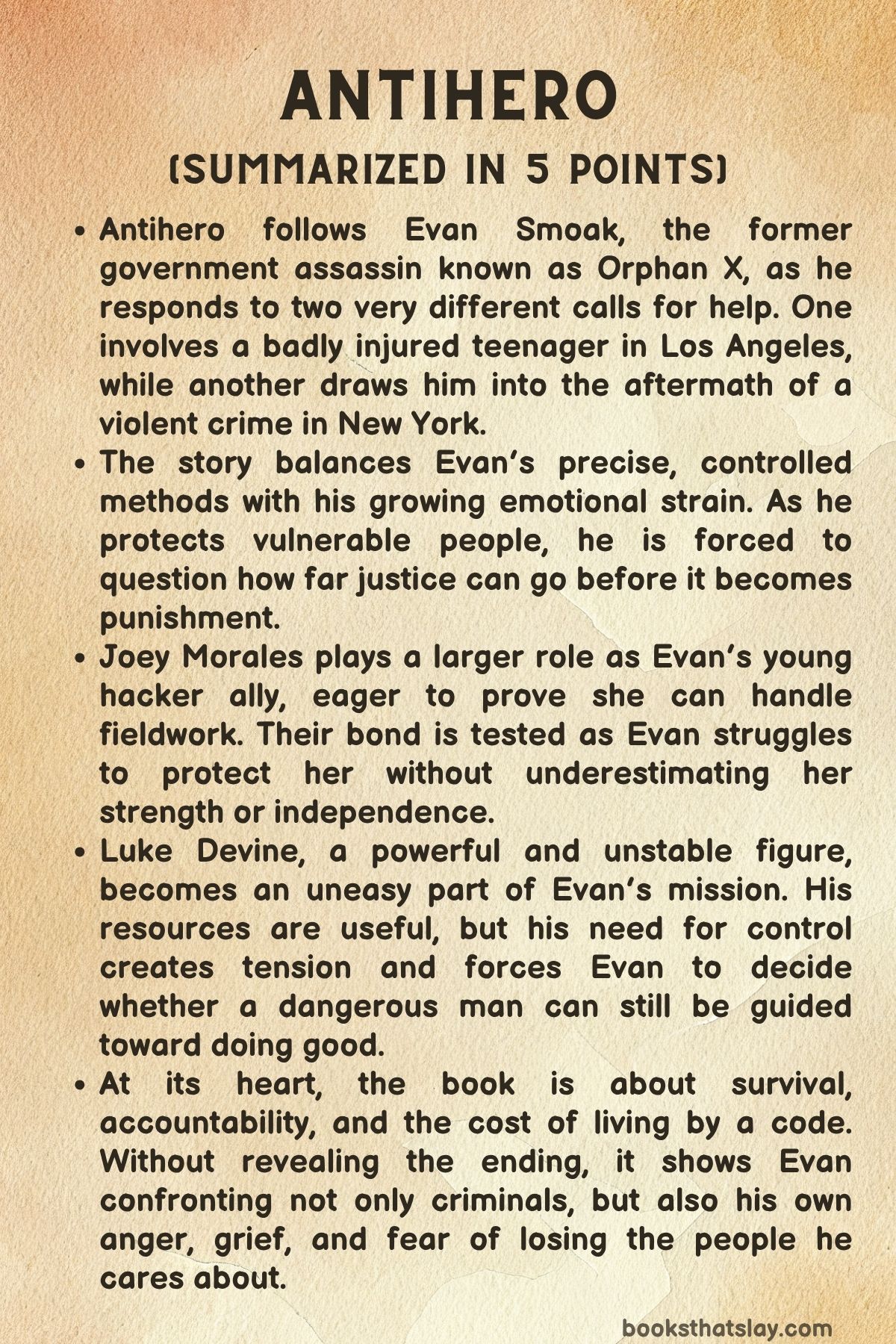
Antihero by Gregg Hurwitz is a high-stakes thriller centered on Evan Smoak, also known as Orphan X and the Nowhere Man, a former government assassin who now uses his skills to protect people with nowhere else to turn. In this installment, Evan is pulled into a case involving a brutal assault, online exploitation, and a powerful man losing his grip on control.
The novel balances action with moral pressure, showing Evan not just as a weapon, but as a man struggling to keep his code intact while protecting the vulnerable and confronting the limits of justice. It’s the 11th book in the Orphan X series.
Summary
Evan Smoak’s story begins in East Los Angeles, where he crosses paths with fifteen-year-old Lesandro Candella during a violent gang attack. Lesandro has been mistaken for a rival by members of the Trinitarios, and by the time Evan finds him, the boy has suffered terrible injuries, including the loss of part of his arm and a finger.
Evan stops his armored truck just in time to avoid hitting him, then immediately shifts into action. He protects Lesandro, disables the attackers without drawing his gun, and provides emergency medical care with the calm precision of someone trained for impossible situations.
He makes a tourniquet, starts fluids, alerts emergency services, and makes sure Lesandro’s severed finger can be recovered. When help arrives, Evan vanishes before anyone can identify him.
The violence leaves Evan unsettled, and that night he wakes from a nightmare in his penthouse. In the dream, he has been captured, tortured, judged, and prepared for execution, yet refuses to betray the rules that define him.
The nightmare reflects his constant struggle: he is a man built for violence, but his identity depends on restraint, loyalty, and a private moral code.
The main crisis begins with Anca Dumitrescu, a young Romanian-American woman living with severe seizures. She is riding the subway late at night in Manhattan when she senses a seizure coming.
Because she cannot afford ambulance care, she carries a laminated plan asking strangers to help keep her safe without calling emergency services. She asks a young woman nearby to stay with her.
The woman tries briefly, then leaves the train because she has to reach a helicopter sent by Luke Devine, a rich and powerful operator with deep influence and many hidden agendas. Before leaving, she places Anca’s seizure plan where others can see it.
Anca becomes helpless as the seizure takes over, and a group of young men enters the subway car. One notices her condition, and the situation turns predatory.
The woman from the subway, Monica, later reaches Devine’s estate in the Hamptons. Devine is in a dangerous manic state, surrounded by staff, alcohol, drugs, and the fallout from political and criminal schemes.
Monica tells him that a girl may have been taken after she left the train. Devine, shaken by his own loss of control, calls Evan because he does not know who else can help.
Evan is outside the memorial service for Tommy Stojack, his dead friend and weapons expert. He cannot make himself go inside, so he listens from his truck.
Devine’s call pulls him away from grief and into the new emergency. Evan arranges travel with help from Aragón Urrea and brings Joey Morales, his teenage hacker ally, despite her frustration that he still treats her like someone who needs protection.
On the flight, Joey jokes and pushes for more responsibility, but Evan warns her that Devine is dangerous in a different way. He can read weaknesses and use them.
At Devine’s mansion, Evan and Joey find chaos. Devine’s staff is frightened and overworked, while Devine rants in his suite, trying to appear in command though he is clearly unraveling.
He targets Joey with psychological insight, trying to unsettle her, but she holds herself together. Evan demands that Devine surrender control if he wants help.
Devine resists, insults him, and forces Evan to leave. Only when Evan is truly walking out does Devine apologize and admit he needs him.
Evan returns, stabilizes Devine physically, and eventually gets him to hand over his black command box, a symbol of Devine giving up control.
Monica explains what she saw: Anca was carried away by four men near the 125th Street station. Joey begins tracking footage through Devine’s surveillance system, known as The Brain, while Evan goes into Manhattan and retraces Anca’s path.
He finds a scrap of her dress near a basement apartment, then discovers the place where she was assaulted. Evidence inside includes peroxide, a marker, a mask, and signs of an effort to destroy DNA evidence.
Evan tracks the apartment rental through a man named Osman at a strip club and forces him to reveal a payment username. Joey uses that lead and video footage to identify Anca.
Anca, meanwhile, wakes in the basement apartment after being raped. Her belongings are mostly gone, her body is injured, and she is disoriented.
She manages to leave, but strangers dismiss her as homeless or disruptive. Her phone is locked, her face is too swollen for facial recognition, and she cannot remember the code.
Using the camera, she sees that a degrading word has been written on her face. The humiliation deepens the trauma.
Evan finds Anca at her Bronx apartment and helps her only as much as she allows. He respects her boundaries, waits outside when she needs space, and gradually persuades her to go to the hospital.
There, she receives medical care and evidence collection. Evan calls Candy McClure, another dangerous survivor, to help protect her.
Anca later insists on riding the subway again and makes clear that she does not want Evan to kill the men who hurt her. She wants justice, but not murder in her name.
Evan promises not to kill them, though he still intends to make them answer.
Anca’s faith and community become part of her recovery. At her Romanian Orthodox church, she has a seizure on the steps and remembers a tattoo on one attacker’s chest.
Inside, her community receives her warmly. Evan, who is skeptical of religion, later argues with her about faith, but Anca challenges him, saying human failure should not be confused with faith itself.
Evan accepts the point quietly.
The assault was also recorded and uploaded online through RedLite, an exploitation platform. Joey works with Devine to erase the video from the internet, but copies remain on RedLite’s servers, forcing Evan to plan a physical infiltration of the company’s Los Angeles headquarters.
At the same time, Anca must decide whether to give a formal federal statement. She is exhausted, frightened, and angry at being treated as helpless, but once she understands the attackers may hurt others, she chooses to speak.
Evan’s emotional control begins to fray. He lashes out at Joey over her clothing and behavior during an operational meeting, not because she truly failed, but because Anca’s assault has made him terrified of what could happen to Joey in the field.
He later realizes he has wounded her. He also answers a Nowhere Man call from Kenzie, a teenage girl being sextorted by a boy named Tyler Russell.
Evan finds Tyler, baits him into swinging a bat, then beats and terrifies him. Although he protects Kenzie, Evan knows he used the situation to punish someone and crossed a line.
Anca gives her statement to federal authorities, refusing to be defined as a victim and saying instead that she was victimized. Afterward, she and Evan are ambushed on a marsh road.
A boy in a yellow raincoat is used as bait, and Evan is stabbed with a fentanyl-filled syringe. Three attackers emerge, including Dirty Pete Macmanus.
Evan fights while the drug takes hold, refusing to kill because of his promise to Anca. He disables the attackers through brutal but nonlethal means, and Anca helps finish the fight by kicking Pete unconscious when he crawls toward them.
Evan then treats his own life-threatening chest injury with improvised medical supplies, with Anca helping him survive.
The investigation identifies more of the attackers: Finley Jacowski, Michael Macmanus, Taswell Kinley, and Brandon Burke, known as B-Roll. Evan confronts Finn-Finn and Michael, injuring them badly and forcing names from them.
He then finds Taswell, who is frightened and disconnected but helps Evan when a message reveals that B-Roll has lured another schoolgirl, Blanca, to his apartment. Evan rushes there, rescues Blanca, traps B-Roll in his own restraint device, and sends the authorities the evidence and location.
By the end, the attackers are arrested and held without bail, and RedLite is close to being destroyed. Evan tells Anca that the men are in the hands of the law.
Their goodbye is quiet and respectful. Anca leaves with dignity, still hurt but moving forward on her own terms.
Evan also reconciles with Joey, admitting that his fear for her made him act harshly. Their bond remains awkward, loving, and unfinished.
Evan later returns Devine’s black box, freeing him from Evan’s temporary control, though Devine is quickly drawn back into another crisis. Lesandro, the boy from the opening, is not forgotten either; Devine agrees to help him get a prosthetic.
As Evan flies home on Aragón’s private jet, he reflects on Joey, Candy, Mia, Anca, Naomi, and the never-ending calls for help. The novel closes with Evan suspended in motion, still bound to his mission, still trying to remain human while living as the Nowhere Man.
Characters
Evan Smoak
Evan Smoak is the central force of Antihero, a man defined by discipline, trauma, violence, restraint, and a strict moral code that he struggles to preserve under pressure. Known as Orphan X and the Nowhere Man, Evan operates as a protector of people who have nowhere else to turn, and his intervention in Lesandro’s attack immediately shows his combination of lethal skill and controlled mercy.
He does not simply defeat the gang members; he treats Lesandro’s wounds, preserves his chance of recovery, contacts emergency services, and disappears before recognition can attach itself to him. This makes Evan more than a vigilante figure.
He is a man who uses extreme violence, but he also tries to place that violence in service of repair, rescue, and justice.
Evan’s deepest conflict in the book lies in the tension between punishment and protection. Anca’s assault pushes him toward rage, and the suffering he witnesses makes him want to destroy the men responsible.
Yet Anca’s refusal to let him kill on her behalf forces him to confront the limits of his own instincts. His promise not to kill the attackers becomes one of the story’s strongest tests of character, especially when Dirty Pete and the others ambush him.
Evan’s survival depends on brutality, but his humanity depends on restraint. The fact that he fights while honoring Anca’s demand shows that his code is not merely personal pride; it is capable of being shaped by the people he protects.
Evan is also emotionally guarded, but not emotionless. His grief over Tommy’s death, his worry for Joey, his awkwardness with Mia, his intimacy with Candy, and his tenderness toward Anca reveal a man who is slowly being pulled back into human connection.
His problem is that he often mistakes control for care. With Joey, he becomes harsh because he is afraid for her, but his fear comes out as criticism.
With Anca, he wants to solve everything through action, money, punishment, and surveillance, but she repeatedly teaches him that survival also requires dignity, choice, faith, and self-definition. Evan’s arc is therefore not about becoming stronger; he is already strong.
It is about learning when strength must step back so another person can reclaim power.
Anca Dumitrescu
Anca Dumitrescu is one of the most emotionally important characters in the book, and her journey is built around suffering, dignity, faith, trauma, and self-possession. She is introduced as vulnerable but not weak: a young woman living with severe seizures, carrying a laminated plan because she has learned that the world may not help her unless she instructs it how.
Her seizure on the subway exposes her physical helplessness in that moment, but the deeper cruelty lies in how easily others abandon her. Monica leaves, strangers fail her, and later people dismiss her as homeless or inconvenient when she is visibly injured and desperate.
Anca’s assault and its aftermath are handled as a shattering violation of body, safety, identity, and public dignity. The word written on her face becomes a symbol of how her attackers try to define her through humiliation.
Yet Anca’s character resists that imposed identity at every stage. She refuses to be reduced to a victim, insists that she was victimized, and repeatedly demands agency in decisions about medical care, money, work, faith, and justice.
Her refusal to let Evan kill the attackers is especially powerful because it asserts that even righteous revenge can become another way of taking control away from her.
Anca’s faith is central to her character. Her Romanian Orthodox church is not merely a place of worship; it represents community, continuity, and belonging after a violation that has isolated her.
Her argument with Evan about religion shows her moral clarity. She understands hypocrisy as a human failure, not proof that faith itself is empty.
Her compassion also survives trauma, as seen when she accepts the dandelion from the neglected child and later gives her shawl to a homeless man. These moments show that Anca’s recovery is not portrayed as simple healing or sudden strength.
It is a hard, uneven movement toward reclaiming herself while still choosing kindness.
Joey Morales
Joey Morales is Evan’s teenage hacker ally, surrogate daughter figure, and one of the clearest signs that Evan’s isolated life is changing. She is brilliant, irreverent, technically gifted, and eager to be treated as more than a protected child.
Her desire to enter the field is not simply recklessness; it comes from wanting Evan to see her as capable, useful, and emotionally equal to the dangerous world they inhabit. Her professional suit, her jokes about commandments, and her work inside Devine’s surveillance system all reveal someone trying to define herself as an operator in her own right.
Joey’s relationship with Evan is tender but strained by his fear. Evan loves her, and he says so directly, but he does not always know how to express love without turning it into control.
When he criticizes her clothing and field behavior in New York, the hurt lands deeply because Joey is not merely being corrected; she feels misunderstood. She wanted to experience the city, to be seen, and to exist as a young person outside mission parameters.
Evan’s inability to recognize that at first exposes one of his emotional blind spots.
Despite her youth, Joey is vital to the story’s justice work. She tracks abductors, breaks into systems, attacks RedLite’s infrastructure, wipes abusive footage, identifies perpetrators, and supports Evan’s missions from behind the screen.
Yet her importance is not limited to technical skill. She forces Evan to confront the emotional cost of trying to protect someone by limiting them.
Their later reconciliation shows both characters growing: Joey begins to understand the source of Evan’s fear, and Evan begins to understand that love cannot become imprisonment.
Luke Devine
Luke Devine is one of the most morally unstable and fascinating characters in the story. He is wealthy, powerful, manipulative, politically connected, and accustomed to controlling people, systems, information, and outcomes.
His mansion, Tartarus, reflects his inner condition: luxurious, fortified, excessive, and chaotic. When Evan and Joey arrive, Devine is collapsing under drugs, alcohol, paranoia, and the pressure of multiple schemes.
This collapse strips away the image of mastery he tries to project.
Devine’s defining trait is control, but the book shows that his control has become self-destructive. He believes he can manage crises, staff, politics, intelligence connections, and personal appetites through dominance.
Evan’s confrontation with him is effective because Evan does not challenge Devine through moral lectures; he dismantles the illusion of competence by pointing out errors, sloppiness, and dangerous lapses. When Devine hands over the black command box, it becomes a symbolic surrender.
For a man like Devine, admitting that someone else must take control is a profound humiliation and a necessary act of survival.
Yet Devine is not portrayed as purely useless or evil. Evan sees that he has a code, however warped, and that his power can be redirected.
Devine helps Joey erase footage of Anca’s assault, later assists with RedLite’s destruction, and agrees to help Lesandro obtain a prosthetic. These actions do not make him innocent, but they complicate him.
He is a dangerous man whose resources can cause harm or serve justice depending on who guides him and whether he can resist the intoxication of power.
Candy McClure
Candy McClure is a fierce, wounded, capable character whose presence deepens the story’s exploration of trauma and control. She understands violence and survival not as abstractions but as lived experience.
Her past sexual abuse in foster homes and her brutal training history give her insight into Anca’s condition in ways Evan cannot fully access. While Evan wants to act, punish, and fix, Candy knows when presence matters more than pressure.
Her comforting of Anca during the night terror is one of the most emotionally grounded moments in the story because she offers safety without demanding performance.
Candy’s relationship with Evan is layered with attraction, guilt, danger, and recognition. Their intimacy is not treated as simple romance; it is shaped by scars, history, and mutual caution.
When she shows Evan the damage on her back, caused by acid from a previous conflict involving him, the moment forces both of them to acknowledge the violence that exists between and around them. Yet Candy refuses to be defined by damage.
She makes clear that she is not an object and will not perform a role for Evan’s expectations.
Candy also functions as a mirror to Evan. Like him, she has been trained by pain and survival.
Unlike him, she often has a sharper emotional understanding of what a traumatized person needs. Her decision to leave on her own mission after receiving a call for help shows that she is not merely Evan’s companion or support figure.
She has her own code, her own direction, and her own version of the Nowhere Man’s work.
Lesandro Candella
Lesandro Candella is the first major person in danger whom Evan rescues in the story, and his ordeal establishes the book’s moral landscape. At fifteen, he is attacked not because of who he is but because gang members mistake him for someone else.
The violence done to him is random, brutal, and life-altering. His severed forearm and missing finger make his vulnerability immediate and physical, while his desperate escape through the streets shows a young life suddenly thrown into terror.
Lesandro’s role is brief but important. Through him, the story shows Evan’s precision as both fighter and protector.
Evan does not merely stop the attackers; he works to preserve Lesandro’s future by applying a tourniquet, starting fluids, and making sure emergency workers can retrieve the severed finger. Lesandro’s presence also returns near the end when Devine agrees to help him obtain a prosthetic.
This matters because it shifts the idea of rescue from immediate survival to long-term restoration. Lesandro is not just someone saved from death; he is someone whose life must continue after violence.
Monica
Monica is a morally conflicted character whose fear and self-interest have devastating consequences. On the subway, she begins by responding to Anca’s plea for help, but she abandons her because she is focused on reaching Devine and catching the helicopter arranged for her.
Her decision does not make her the direct perpetrator of the assault, but it places her within the book’s larger pattern of bystanders who fail Anca when she is most helpless.
Her guilt later becomes the reason Devine calls Evan. Monica is disturbed enough by what she saw to report it, but the delay matters.
She embodies a painful kind of human weakness: she knows something is wrong, yet she chooses convenience and fear in the moment. Her trauma afterward suggests that she is not indifferent, but the story does not let emotional distress erase responsibility.
Monica’s role is important because Anca’s suffering is not caused only by predators; it is enabled by people who look away.
Naomi Templeton
Naomi Templeton represents institutional justice at its most careful and humane. She works within the legal system, but she is not coldly procedural.
Her handling of Anca’s federal statement shows respect for trauma, language, and agency. She arranges a trauma-informed interview environment with support staff, a prosecutor, and an advocate, allowing Anca to speak without being reduced to evidence.
Naomi also provides Evan with a counterweight to vengeance. She understands his rage, especially his anger at how many people ignored Anca, but she reminds him that justice is built through patient work as well as confrontation.
Her presence shows that the law, though imperfect and often slow, can become meaningful when guided by people who treat survivors as human beings rather than as cases. She is one of the few characters able to stand near Evan’s anger without being swallowed by it.
Aragón Urrea
Aragón Urrea serves as Evan’s adviser, fixer, and moral sounding board. He helps arrange private transportation, but his larger function is conversational.
Aragón understands Evan’s world well enough to speak bluntly, including advising him to kill Devine. Yet he is not merely a practical criminal contact.
His later advice about Joey shows insight into Evan’s emotional patterns. He recognizes that Evan may be projecting fear onto her and that perfectionism can damage the very person Evan wants to protect.
Aragón’s importance lies in his ability to challenge Evan without trying to control him. Evan often operates as the most competent person in any room, but Aragón gives him perspective from outside the immediate crisis.
His counsel helps expose Evan’s blind spots, especially where love, fear, and training overlap.
Jack Johns
Jack Johns appears through Evan’s memories, but his influence is foundational. As Evan’s old handler and trainer, Jack shaped the code that still governs Evan’s life.
His lessons about control, restraint, respect, and staying human are not decorative memories; they are the moral architecture Evan relies on when violence threatens to become rage.
Jack’s significance in the book comes from the way his teachings continue to live inside Evan. Evan’s promise to Anca, his refusal to kill Dirty Pete despite extreme danger, and his constant struggle to remain disciplined all connect to Jack’s training.
Jack represents both the origin of Evan’s lethal abilities and the source of his resistance to becoming merely a weapon.
Tommy Stojack
Tommy Stojack is dead before the central action unfolds, but his absence strongly affects Evan. Evan’s inability to attend Tommy’s memorial openly reveals grief, shame, and emotional limitation.
He listens from outside rather than participating, showing how badly he wants connection and how deeply he fears the vulnerability that comes with it.
Tommy’s role as Evan’s former armorer also matters symbolically. He belonged to the hidden infrastructure of Evan’s life, the world of weapons, preparation, and trust.
His death leaves Evan more isolated, and that isolation shapes Evan’s emotional volatility throughout the story. Tommy’s absence becomes one of the quiet pressures behind Evan’s difficulty with Joey, Mia, and Candy.
Rawlings
Rawlings is Devine’s chief of staff and one of the few people capable of functioning inside the chaos of Tartarus. He is controlled, observant, and accustomed to managing Devine’s extremes.
Unlike the guards and staff who orbit Devine’s power nervously, Rawlings appears to understand both the danger and the machinery of Devine’s world.
His role becomes especially important when Evan takes operational control. Rawlings helps provide access, context, and continuity within Devine’s systems.
He also handles geopolitical concerns while Devine is recovering, showing that he is not just a servant but a manager of consequences. In a story filled with violent action, Rawlings represents the quieter power of administration, information, and crisis management.
Osman
Osman is a morally corrupt opportunist who enables violence while pretending distance from it. By renting out the basement apartment for others’ use, he provides the physical space where Anca is assaulted.
His refusal to identify the client shows that profit and self-protection matter more to him than the suffering caused by his choices.
Osman is not one of the direct attackers, but his role is essential to the crime. The book uses him to show how predatory violence depends on networks of enablers: people who provide rooms, payment channels, silence, and plausible deniability.
Evan’s confrontation with Osman strips away that deniability and forces him to reveal the digital trail that leads closer to the perpetrators.
Manny Llorente
Manny Llorente is connected to the porn operation and becomes a link between sexual exploitation, organized abuse, and digital circulation. His arrest reveals the scale of the criminal ecosystem surrounding Anca’s assault, including kidnapping, assault, and underage material.
He represents a form of villainy that profits from turning human suffering into content.
Manny’s panic in jail shows that he is cowardly when consequences reach him. Rather than taking responsibility, he calls for help and warns others about Anca’s dangerous friend.
His actions continue to endanger her, proving that men like Manny are not merely passive participants in exploitation. They actively preserve the networks that allow abuse to continue.
Taswell Kinley, also known as Taz
Taswell Kinley, or Taz, is one of Anca’s attackers, but he is written with a degree of internal hesitation that distinguishes him from the others. He is frightened, disconnected, and heavily attached to his phone, suggesting moral emptiness mixed with dependency and cowardice.
His private hesitation about hurting another girl shows that he retains some awareness of wrong, but that awareness is weak and easily overpowered by group pressure.
Taz’s most important moment comes when he briefly helps Evan by giving him Brandon Burke’s address after seeing that Blanca is in danger. This does not redeem him, but it complicates him.
He is guilty, damaged, and cowardly, yet not entirely unreachable. The book uses him to show that moral hesitation means little unless it becomes action, and by the time Taz acts, immense harm has already been done.
Brandon Burke, also known as B-Roll
Brandon Burke, known as B-Roll, is one of the clearest predators in the story. He is associated with filming, streaming, and exploiting assault, making him a symbol of cruelty amplified by technology.
His plan to lure Blanca by pretending she will meet his little sister reveals his manipulative nature and his willingness to target young girls through deception.
Evan’s punishment of B-Roll is deliberately theatrical. By locking him in his own pillory and livestreaming his fear, Evan turns Brandon’s method back on him without crossing into murder.
This confrontation exposes Brandon’s cowardice. He is powerful when controlling helpless victims, but terrified when made vulnerable.
His character represents the ugliness of performance-based cruelty, where harm is not enough unless it is recorded, shared, and consumed.
Finley Jacowski
Finley Jacowski is one of the identified attackers and part of the group responsible for Anca’s assault. His role emphasizes the collective nature of the crime.
He is not portrayed as a lone monster but as part of a pack that finds confidence in numbers, anonymity, intoxication, and digital exploitation.
When Evan confronts Finley and Michael at the diner, Finley becomes a source of information under pressure. His naming of Taswell and Brandon helps Evan complete the chain of accountability.
Finley’s character matters because he shows how quickly group violence collapses into self-preservation once consequences arrive.
Michael Macmanus
Michael Macmanus is another of Anca’s attackers and part of the broader violent circle connected to Dirty Pete. His surname links him to Peter Macmanus, suggesting a surrounding environment where brutality is familial, social, and normalized.
Like Finley, Michael participates in the assault and later becomes vulnerable when Evan finds him.
Michael’s character functions less through individuality and more through what he represents: the ordinary face of collective violence. He is one of the men who helps turn Anca’s helplessness into entertainment and humiliation.
His eventual arrest contributes to the book’s insistence that accountability must reach every participant, not just the most visible predator.
Peter Macmanus, also known as Dirty Pete
Peter “Dirty Pete” Macmanus is a physically terrifying antagonist and one of the most direct tests of Evan’s promise to Anca. He is introduced as Big Mikey’s violent cousin, someone brought in to handle Evan and possibly Anca.
His ambush using a child decoy and a fentanyl syringe shows his cruelty and tactical viciousness.
Dirty Pete’s fight with Evan is significant because Evan must survive without killing him. Pete’s size, violence, and persistence make him a brutal opponent, especially after Evan is drugged and badly injured.
When Anca finally kicks Pete unconscious, the moment carries symbolic force. She is not transformed into a killer, but she does act decisively to protect Evan and herself.
Dirty Pete therefore becomes the physical embodiment of predatory violence that must be stopped without allowing it to corrupt the moral terms Anca has set.
Big Mikey
Big Mikey is part of the criminal social environment surrounding the attackers. His house becomes a gathering place where the gang discusses Anca, Evan, and possible retaliation.
Though he is not as central as Brandon, Taz, or Dirty Pete, his presence shows how easily violence grows in spaces where men encourage one another’s worst impulses.
Big Mikey’s importance lies in his connection-making role. By bringing up Dirty Pete, he escalates the danger from concealment to direct attack.
He represents the enabling friend, the person who helps transform fear of consequences into a plan for more harm.
Kenzie
Kenzie is a teenage girl who calls the Nowhere Man because she is being sextorted by Tyler Russell. Her situation broadens the story’s focus from Anca’s assault to the wider pattern of young women being threatened, exploited, and controlled through sexual humiliation.
Kenzie is frightened and desperate, but she also has enough courage to seek help.
Her refusal to pass on Evan’s number is important. She is grateful, but she cannot bear the responsibility of directing desperate people to someone she understands may be an assassin.
This response reveals moral awareness and emotional limits. Kenzie is not simply a rescued girl; she is someone who recognizes the terrifying weight of Evan’s world and chooses not to carry it further.
Tyler Russell
Tyler Russell is a young abuser whose crime exposes Evan’s dangerous slide toward vengeance. Tyler sextorts Kenzie, using shame and fear as weapons.
When Evan confronts him, Tyler is clearly guilty and cruel, but Evan’s response becomes excessive. By allowing Tyler to swing a bat first, Evan creates the permission he needs to punish him brutally.
Tyler’s character is important because he is not a hardened criminal mastermind. He is a teenager whose entitlement and cruelty have already made him dangerous.
Evan’s reaction to him shows how Anca’s trauma has destabilized Evan’s judgment. The scene is not just about stopping Tyler; it is about Evan recognizing that righteous anger can become self-serving violence if he is not careful.
Mia
Mia represents the possibility of ordinary emotional life for Evan. Her invitation to a real date suggests warmth, patience, and interest in him beyond his secret identity.
She belongs to the domestic world of Castle Heights, a world of neighbors, relationships, and everyday choices that contrasts sharply with Evan’s missions.
Mia’s significance comes from what she offers rather than what she knows. Around her, Evan must consider who he might be without constant crisis.
His uncertainty over what to wear and how to present himself shows vulnerability. Mia draws out the part of Evan that wants connection but does not trust himself to live safely inside it.
Peter
Peter, Mia’s son, adds another layer to Evan’s connection with ordinary life. His presence makes Evan’s relationship with Mia more complicated because it is not merely romantic; it touches family, responsibility, and emotional risk.
Evan’s interactions around Peter suggest that any move toward Mia’s world would require honesty and gentleness that Evan is not sure he possesses.
Peter also reflects Evan’s protective instincts in a non-mission context. Unlike Lesandro, Anca, Kenzie, or Blanca, Peter is not introduced through a crisis.
He represents innocence in daily life, which may be even harder for Evan to approach because there is no enemy to defeat and no operation to complete.
Blanca
Blanca is a schoolgirl targeted by Brandon Burke, and her rescue becomes one of the clearest examples of Evan preventing another assault before it happens. Brandon’s deception shows how predators manipulate trust, especially by using the imagined presence of a younger sister to make the situation seem safe.
Blanca’s danger reinforces the urgency of Evan’s mission against the attackers.
Her brief time with Evan is meaningful because he gives her the Nowhere Man number and asks her to pass it to someone else who needs help. This makes Blanca part of the chain of rescue that defines Evan’s work.
She is not developed as deeply as Anca, but her role shows that stopping one predator is never enough; the need for protection continues beyond a single case.
Melinda
Melinda is mentioned near the end as part of Evan’s larger emotional landscape. Though she does not play a major active role in the provided events, her inclusion in Evan’s reflections suggests that his life is shaped by many relationships, obligations, and unresolved emotional ties.
She belongs to the wider network of people who complicate Evan’s solitude.
Her importance is therefore subtle. She reminds the reader that Evan’s missions do not occur in isolation from his inner life.
Every connection he has, whether central or peripheral, presses against his old identity as a lone weapon and pulls him toward a more human existence.
Themes
Survival and the Fight to Reclaim Selfhood
Anca’s journey gives this theme its emotional weight because survival is shown as more than staying alive after violence. Her body is injured, her face is marked, her privacy is violated online, and even ordinary public spaces become threatening.
Yet the story refuses to reduce her to what was done to her. Her insistence on returning to the subway, going to church, buying what she needs, giving a statement, and correcting others when they call her a victim all show a slow, painful rebuilding of agency.
Survival here is not presented as sudden strength or easy healing. It appears in small acts: accepting help without surrendering control, walking through fear, choosing language that defines her experience, and deciding that justice matters because the attackers may harm others.
In Antihero, trauma does not erase identity; it challenges the characters to defend it. Anca’s recovery is incomplete, but that is what makes it honest.
She moves forward while still frightened, showing that courage often exists beside pain rather than after pain disappears.
Control, Restraint, and Moral Discipline
Evan’s power is never in doubt, but the story repeatedly tests whether power without restraint becomes another form of harm. His old training taught him precision, control, and respect, yet his anger keeps pushing against those limits.
The promise he makes to Anca not to kill her attackers becomes a moral boundary that forces him to act differently. He can still hunt, fight, and expose the guilty, but he must do so without turning vengeance into justice.
This theme becomes especially clear when he attacks Tyler Russell. Evan recognizes that he provoked the boy in order to justify punishment, and that realization unsettles him because it shows how easily righteous anger can become personal release.
Devine, too, must surrender control before he can be useful, proving that command without self-mastery is weakness. The story presents discipline not as coldness but as the difficult work of remaining human while facing cruelty.
True control means knowing when not to use the full force one possesses.
Responsibility Toward the Vulnerable
The narrative places repeated emphasis on people who need help and the many bystanders who fail them. Lesandro is hunted through the street, Anca is abandoned on the subway, ignored after the assault, and later exposed through digital abuse.
These moments create a harsh picture of public indifference, where suffering becomes inconvenient to witnesses who look away. Evan’s role as the Nowhere Man stands against that failure.
He steps in where institutions, strangers, and communities have broken down, but the story does not suggest that one man can repair everything alone. Joey’s cyberwork, Naomi’s legal process, Candy’s emotional care, Anca’s church community, and even Devine’s resources all become necessary.
Responsibility is therefore shown as collective, not heroic in a simple way. Helping someone means protecting their body, preserving evidence, removing online harm, respecting consent, and making space for their voice.
The theme asks what people owe one another when someone is defenseless, and it answers through action rather than speeches.
Healing Through Connection
Isolation defines many of the characters at the beginning of their struggles. Evan sits outside a memorial because grief is too difficult to face directly.
Joey wants to be treated as capable but feels wounded by Evan’s fear. Candy carries scars from abuse and violence, while Devine hides collapse behind wealth and command.
Anca’s trauma could easily leave her cut off from everyone, yet the story gradually shows healing through difficult, imperfect connection. Candy comforting Anca through panic, Evan waiting outside rather than forcing help, Joey and Evan repairing their bond, and Anca being welcomed by her church all show that recovery depends on trust.
In Antihero, connection does not erase damage or offer a neat cure. Instead, it gives characters enough steadiness to continue.
The most meaningful relationships are built through respect: allowing Anca to choose, admitting mistakes to Joey, accepting Candy’s boundaries, and recognizing that even powerful people can break. Healing begins when characters stop treating pain as something to master alone.