Archer’s Voice Summary, Characters and Themes
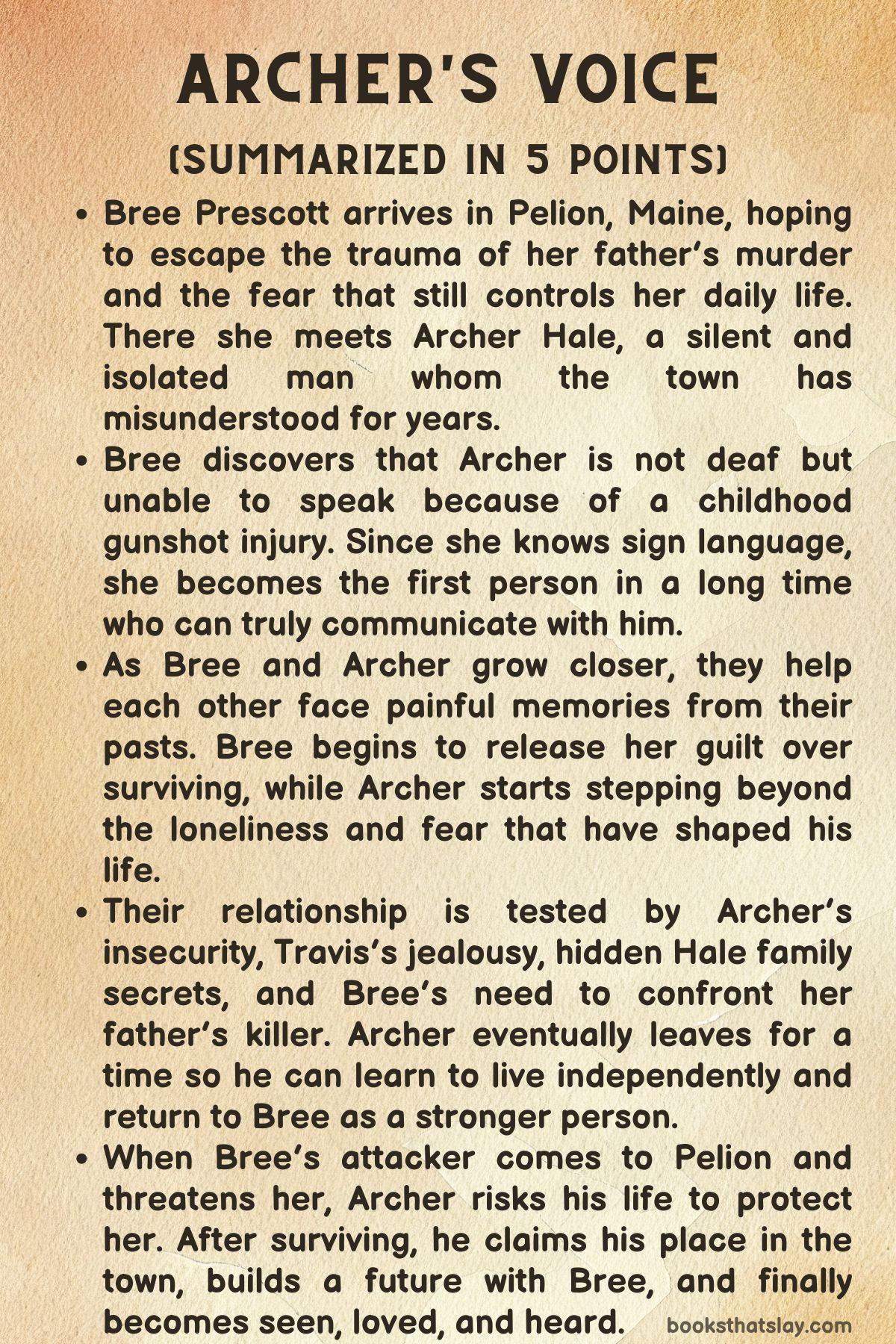
Archer’s Voice by Mia Sheridan is a contemporary romance about trauma, isolation, trust, and the healing power of being truly seen. Set in the lakeside town of Pelion, Maine, the book follows Bree Prescott, a young woman running from a violent loss, and Archer Hale, a silent, misunderstood man whose childhood tragedy left him physically and emotionally scarred.
Their connection grows through sign language, patience, and quiet honesty. At its center, Archer’s Voice is about two wounded people learning that love is not a rescue, but a choice to stand beside each other.
Summary
Bree Prescott arrives in Pelion, Maine, with her small dog, Phoebe, after driving for two days from Cincinnati. She rents a lakeside cottage almost on impulse, drawn by childhood memories of the town and by her need for distance from the life she left behind.
Pelion seems peaceful, but Bree is carrying deep pain. Her father was murdered during a robbery at their deli, and the attacker also tried to assault her before fleeing.
Since then, she has lived with daily panic, flashbacks, guilt, and a sense that her old life has been taken from her.
Bree begins settling into town. Her elderly neighbor Ann welcomes her warmly and helps her find work at Norm’s diner, where Bree quickly becomes useful and liked.
She also meets Melanie and Liza, friendly sisters who tell her about the people of Pelion. One of the first locals to catch Bree’s attention is Archer Hale, a quiet, unkempt man who helps her pick up groceries after her bag breaks outside the pharmacy.
Bree tries to speak to him, not realizing that he does not respond aloud. When she later learns that he is believed to be deaf and that he keeps almost entirely to himself, she feels embarrassed and curious.
Archer is the subject of town gossip. As a child, he lost his parents and uncle in a violent family tragedy, and he has lived apart from the community ever since.
Most people assume he is strange, unstable, or incapable of ordinary interaction. Bree, however, learns that the truth is more complicated.
Archer is not deaf. He can understand others, but he cannot speak because he was shot in the throat when he was seven.
He knows sign language, though no one in Pelion uses it with him. Bree knows sign language because her father was deaf, and this gives her a way to communicate with Archer that no one else has offered him.
Bree slowly enters Archer’s world. She visits his property after Phoebe runs through his open gate and discovers that behind the overgrown public image is a well-kept home, garden, and private life.
Archer is wary at first, unused to kindness and suspicious of being observed, pitied, or mocked. Bree keeps returning, and they begin speaking through signs.
Their exchanges are awkward, funny, tense, and tender. Archer shows Bree a mother dog and her puppies, and they agree that when his gate is open, she may visit.
This simple arrangement becomes the start of a relationship built on trust.
Both Bree and Archer have been shaped by violence. Bree’s flashbacks come every morning, often triggered by water, storms, or sudden sounds.
She feels shame because she froze when her father was killed and when the attacker threatened her. Archer helps her see that surviving was also a form of fighting.
His quiet acceptance allows Bree to reveal the full truth of what happened to her, including details she has never told anyone else. In return, Archer begins sharing parts of his own past, though he is slower to open up.
Bree learns that his uncle Nathan raised him after the accident, but Nathan was paranoid and isolated, keeping Archer away from town and teaching him to distrust the outside world.
As Bree and Archer grow closer, their attraction becomes impossible to ignore. Archer is inexperienced in every part of romance and physical intimacy, but he is honest, eager to learn, and deeply affected by Bree.
Bree is patient with him, though she sometimes pushes him toward things he is not ready for. Their relationship becomes passionate, but it also exposes Archer’s fears.
He has never believed he could be loved, and he worries that Bree will eventually choose someone easier, more confident, and more socially accepted.
Travis Hale, Archer’s cousin, complicates matters. Travis is a police officer and the son of Connor Hale, the town’s former police chief.
He is charming and popular, and he shows interest in Bree soon after she arrives. Bree goes on a date with him, but she feels more deeply drawn to Archer.
Travis warns Bree that Archer is unstable, and his mother Victoria also tries to frighten Bree away by painting Archer as dangerous. Their warnings are not purely protective.
The Hale family history is full of secrets, jealousy, and betrayal, and Victoria has her own reasons for wanting Archer ignored.
The past gradually comes into focus. Archer’s mother, Alyssa, was trapped in an abusive marriage to Marcus Hale, though she had once loved Connor.
Connor planned to take Alyssa and young Archer away from Marcus. On the day they fled, Marcus rammed their car.
Alyssa died in the crash, and Marcus confronted Connor with a gun. Connor revealed that Archer was actually his son.
In the chaos, Marcus shot Archer in the throat, and Connor and Marcus killed each other. Victoria arrived afterward and blamed the injured child.
Later, when Archer might have had surgery to restore his voice, Victoria manipulated Nathan into refusing it, ensuring that Archer would remain unable to speak and unable to challenge the public version of events.
Bree’s presence begins to change Archer’s life. He shaves, cuts his hair, visits the diner, orders coffee, and lets others see him as more than the silent man behind the gate.
The town is shocked, but some people respond with warmth. Maggie, Norm, Ann, and others begin to understand how badly Pelion failed Archer by forgetting him after the tragedy.
Bree is proud of him, but Archer’s growth is uneven. When Travis takes him out under the pretense of bonding and brings him to a strip club, Archer feels humiliated and powerless.
Bree is hurt when he returns drunk with a mark on his neck, but once she learns the truth, they reconcile. Their love deepens, and Bree decides that Pelion can become her permanent home.
Bree must return to Ohio after police receive new information about her father’s murderer. Her friend Natalie and former friend Jordan come to Pelion to accompany her.
Jordan once forced a kiss on Bree after her father’s death, damaging their friendship and adding to her reasons for leaving Cincinnati. Archer feels threatened by Jordan and terrified that Bree’s old life will pull her away.
His fear grows when Travis tells him that Bree may see him as only a temporary escape. Bree reassures Archer that she chooses him, but he still struggles with the idea that love can exist without possession or panic.
In Ohio, Bree identifies her father’s killer, Jeffrey Perkins, in a lineup. She returns to Pelion eager to be with Archer, but a simple accident causes her phone to stop working on the drive back.
Archer, unable to reach her, spirals into terror and wrecks his house in a state of abandonment and grief. Bree comes back and comforts him, but the incident forces Archer to see that his dependence on her is dangerous for them both.
Soon after, during a public confrontation, Bree accidentally reveals that Archer is Connor’s son, meaning he is the rightful Hale heir connected to the town’s leadership. Archer leaves Pelion, explaining in a note that he needs to learn who he is without Bree and prove to himself that he can survive alone.
Bree is devastated. She stays in Pelion, works at the diner, cares for Archer’s house, and waits through the holidays without hearing from him.
On New Year’s Eve, Archer returns. He has spent his time away learning how to live beyond the limits others placed on him.
He found work, made a friend, learned new ways to communicate, and gained confidence. Bree is hurt by his silence but understands why he had to go.
Archer promises not to leave her that way again, and their reunion marks a healthier beginning. He is no longer loving her from fear alone; he is learning to love her as an equal.
Archer decides to claim his role in Pelion and stop Victoria’s plan to reshape the town with developments that would destroy its character. Before he can fully step into that future, Bree’s past arrives in the form of Jeffrey Perkins.
After being released on bail, Jeffrey comes to the diner with a gun, furious that Bree identified him and ruined his future. He shoots at her, and Archer steps in front of the bullet.
Travis shoots Jeffrey, killing him, while Bree holds Archer and begs him to live.
Archer falls into a coma, and Pelion rallies around him. The town finally sees the man it ignored for years.
Travis later tells Bree that Victoria overheard details about the case and told Jeffrey where to find her. Though there is not enough proof to prosecute Victoria, Travis forces her to leave town.
Archer survives and eventually takes his place as a leader. With an interpreter, he addresses the people of Pelion and promises to serve the town with honesty and openness.
Years later, Bree and Archer are married and have built a family. Archer runs Pelion in a way that protects its small-town spirit, and Bree is pregnant again while their twin sons, Connor and Charlie, grow up signing with their father.
Travis becomes police chief and remains part of their lives, though Archer never fully forgets the past. The story closes with Archer secure in the life he once thought impossible: loved, respected, heard, and home with Bree.
Characters
Bree Prescott
Bree Prescott is the emotional center of Archer’s Voice, a young woman who arrives in Pelion carrying the weight of fear, grief, and survivor’s guilt. Her move to Maine is not a carefully planned new beginning but an act of self-preservation.
After witnessing her father’s murder and surviving a sexual threat from the same attacker, Bree is left with daily flashbacks, panic, and a deep belief that she failed because she did not fight in the way she thinks she should have. This guilt shapes many of her early choices.
She tells herself she is okay, but the book shows that her strength is not in being untouched by trauma; it is in continuing to live while carrying it.
Bree’s kindness is active rather than passive. She does not simply pity Archer from a distance; she learns him, respects his silence, and communicates with him in the language that most of the town has never bothered to use.
Her knowledge of sign language becomes a bridge between two isolated people, but her relationship with Archer is not only about helping him. Bree also needs a place where she can tell the truth without being judged.
With Archer, she finds safety because he does not demand that she explain herself before he offers comfort. When she reveals the details of her father’s death and the attempted assault, she is not treated as broken.
Archer’s response helps her begin to see survival as courage.
At times, Bree’s compassion can become impatient. She wants Archer to join the world, speak to others, reconnect with Travis, and experience ordinary life.
These desires come from love, but they also show her misunderstanding of how deep Archer’s isolation runs. The book does not present Bree as perfect; it allows her to make mistakes, especially when she pushes Archer toward situations before he is ready.
Her growth lies in learning that love cannot be rushed into healing. By the end, Bree becomes more grounded.
She chooses Pelion not as a hiding place but as a home, and she chooses Archer not as someone to rescue but as someone to love, challenge, and stand beside.
Archer Hale
Archer Hale is one of the most wounded and misunderstood figures in the book. As a child, he survives a family tragedy that kills his mother, the man he learns is his real father, and the abusive man who raised him as a son.
The gunshot that damages his throat takes away his physical voice, but the larger loss is social and emotional. Pelion does not simply fail to understand Archer; it leaves him behind.
Raised by his paranoid uncle Nathan, Archer grows up on the edge of town, cut off from ordinary relationships, education in social life, and the basic experience of being known.
Archer’s silence is often mistaken for emptiness, but the novel shows that he has a rich inner life. He reads, maintains his property, cares for animals, builds things, observes people, and feels deeply.
His isolation has made him wary, but not cruel. He is gentle with Bree when she is caught in the trap and has a panic attack, and his response to her pain reveals his instinctive tenderness.
At the same time, Archer’s trauma has left him insecure and frightened of abandonment. Because Bree is the first person to truly reach him, his love for her initially carries panic as well as devotion.
He fears losing her so intensely that moments of jealousy and possessiveness emerge.
Archer’s journey is not just about romance; it is about selfhood. Bree opens a door, but Archer must decide to step through it.
His visit to the diner, his attempts to interact with others, his time away from Pelion, and his eventual decision to claim his place in town all mark stages in his movement from hidden survivor to public man. His departure hurts Bree, but it is also necessary for him to learn that he can exist without depending completely on her presence.
By the end of Archer’s Voice, Archer’s voice is not limited to speech. It exists through sign, action, leadership, love, and the life he builds after years of being treated as invisible.
Travis Hale
Travis Hale is a complicated character because he is neither a simple villain nor a fully innocent rival. As Connor Hale’s public son and a police officer in Pelion, Travis occupies the place that Archer was denied.
He is charming, confident, attractive, socially accepted, and comfortable in town life. At first, his interest in Bree seems like ordinary flirtation, but his attitude toward Archer reveals jealousy, resentment, and a need to feel superior.
He calls Archer strange, minimizes him, and later manipulates him under the appearance of cousinly bonding.
Travis’s treatment of Archer at the strip club is one of his lowest moments. He claims to be helping Archer gain experience, but the act is humiliating and selfish.
It exposes Travis’s insecurity more than Archer’s weakness. Travis wants to believe that Archer is less capable, less worthy, and less likely to be chosen.
His rivalry with Archer is sharpened by the Hale family legacy, even before he knows the full truth about Archer’s parentage. Bree’s anger forces Travis to confront his behavior, though his growth is uneven and never entirely clean.
What makes Travis interesting is that he is capable of shame and change. He apologizes to Bree, later shows regret for how he has treated Archer, and ultimately acts decisively when Jeffrey attacks Bree.
His relationship with Archer remains damaged, and the book does not pretend that all wounds between them vanish. In the future, Travis becomes Chief of Police and loves Archer’s children, but Archer still cannot fully trust him.
This unresolved quality makes Travis feel more human. He is someone who does harm, recognizes some of it, and tries to become better without completely escaping the consequences of who he has been.
Victoria Hale
Victoria Hale functions as one of the book’s clearest examples of bitterness turned into cruelty. Her choices are shaped by jealousy, humiliation, and a desire to control the Hale legacy.
She resents Alyssa, Connor, and Archer because they represent the love and family structure she could not fully possess. Her cruelty toward Archer begins when he is a child, and it is especially disturbing because it targets someone already traumatized and physically injured.
By manipulating Nathan into refusing surgery that might have helped Archer speak, Victoria helps preserve Archer’s silence for her own benefit.
Victoria’s power comes from social polish. She is not presented as chaotic or openly monstrous in public; she knows how to use reputation, influence, and insinuation.
She warns Bree away from Archer by portraying him as violent and unstable, trying to turn Bree’s own history of trauma into a weapon against her. This shows how skilled Victoria is at emotional manipulation.
She understands what people fear, and she uses those fears to protect her own interests.
Her role in the later danger Bree faces confirms the depth of her malice. By passing information to Jeffrey, she endangers Bree and indirectly causes Archer to be shot.
Even when direct legal consequences are limited, Victoria loses her place in Pelion because Travis forces her to leave. Her exit is significant because it marks the collapse of the false Hale order she tried to preserve.
Victoria spends much of the novel trying to keep Archer powerless, but her actions ultimately help reveal the truth she wanted buried.
Connor Hale
Connor Hale is central to the emotional history of the novel, even though much of his role exists through memory and revelation. He is first seen as Archer’s uncle, a policeman who cares deeply for Alyssa and wants to protect her and Archer from Marcus’s abuse.
Later, the truth that he is Archer’s biological father changes the meaning of the entire Hale tragedy. Connor represents the life Archer might have had: a loving father, a safer home, and a future not defined by isolation.
Connor’s love for Alyssa is complicated because she is married to his brother, but the book frames their bond as rooted in genuine care rather than casual betrayal. He sees Alyssa’s suffering and tries to help her leave.
His decision to take Alyssa and Archer away becomes the turning point that leads to the fatal crash and shooting. The tragedy is not caused by Connor’s love itself but by Marcus’s possessiveness and Victoria’s interference.
For Archer, Connor becomes both a lost father and a symbol of stolen possibility. Learning that Connor was his real father gives Archer a clearer sense of identity, but it also deepens his grief.
He was not only robbed of his mother and his voice; he was robbed of the chance to know the parent who loved him enough to stand between him and danger. Connor’s memory later becomes public through the town’s memorial and through Archer’s claim to his rightful place.
In that sense, Connor’s legacy passes to Archer not as power alone, but as a responsibility to protect rather than possess.
Alyssa Hale
Alyssa Hale is a tragic figure whose choices are shaped by abuse, fear, love, and limited options. Married to Marcus, she lives in a violent household where even young Archer understands that his father hurts his mother.
Alyssa’s relationship with Connor reveals her longing for safety and tenderness, but she is trapped by the consequences of the past and by the threat of Victoria’s retaliation. Her life shows how abuse can narrow a person’s choices until escape feels both necessary and dangerous.
As Archer’s mother, Alyssa is remembered through love. Archer associates her with comfort, warmth, and the gestures that later shape how he comforts Bree.
When he kisses the top of Bree’s head to calm her, he is repeating the care he once received from his mother. This detail gives Alyssa’s presence lasting emotional force.
Though she dies early in Archer’s life, her tenderness survives in him.
Alyssa’s story also exposes the destructive nature of the Hale family’s secrets. Her marriage to Marcus is tied to manipulation, pregnancy, obligation, and social pressure.
Her love for Connor never fully disappears, and the truth of Archer’s parentage becomes one of the hidden facts that shape the entire novel. Alyssa is not given the future she seeks, but her attempt to leave with Connor and Archer is an act of courage.
She tries, at last, to choose safety and love for herself and her child.
Marcus Hale
Marcus Hale is the embodiment of violent entitlement in the book. He abuses Alyssa, cheats on her, and treats her not as a person but as something he has the right to control.
His rage when Connor attempts to take Alyssa and Archer away comes from possession, not love. Marcus cannot accept that Alyssa might choose freedom or that Archer might not truly be his son.
His response is destruction.
The crash and shooting reveal Marcus at his most dangerous. He follows, attacks, and kills because he would rather destroy the people around him than lose control over them.
Shooting Archer in the throat is both physically and symbolically brutal. It silences a child who has already witnessed too much and sets the course for years of isolation and misunderstanding.
Marcus’s role is also important because his violence does not end with his death. The consequences of his actions shape Archer’s body, reputation, childhood, and adult relationships.
Bree’s attacker is a separate threat, but Marcus belongs to the same moral world of men who use fear and force to dominate others. Through Marcus, the novel shows that abuse is not a private flaw; it creates lasting damage that spreads across families and communities.
Nathan Hale
Nathan Hale is a strange and sad figure whose care for Archer is mixed with serious harm. After the tragedy, he becomes Archer’s guardian, and in practical terms he gives Archer shelter.
He is not portrayed as malicious in the same way Victoria or Marcus are. He loves Archer in his limited way and sometimes offers words that contain real wisdom, such as reminding Archer that cruel people do not truly know him.
Yet Nathan’s paranoia shapes Archer’s life in damaging ways.
Nathan’s fear of the outside world leads him to isolate Archer rather than help him heal. He sets traps around the property, believes animals may be spies, and keeps Archer cut off from ordinary community life.
His mental state makes him vulnerable to Victoria’s manipulation, especially regarding the surgery that might have restored Archer’s ability to speak. Because Nathan fears capture and danger, he accepts the idea that silence is protection.
The tragedy of Nathan is that he both protects and imprisons Archer. He is not uncaring, but his care is distorted by trauma and paranoia.
The book uses him to show how love without clarity can still cause harm. Archer inherits not only Nathan’s property but also the emotional burden of having been raised in fear.
Part of Archer’s adult journey is learning to separate Nathan’s warnings from reality.
Ann Cabbott
Ann Cabbott is one of Pelion’s gentlest and most important supporting characters. As Bree’s neighbor, she offers immediate warmth without demanding explanations.
Her porch becomes one of the first places in town where Bree feels welcome and safe. Ann’s kindness is quiet, but it has real influence.
She helps Bree find work, shares local history, and gives her a sense that Pelion can become more than a hiding place.
Ann also serves as a moral memory for the town. She remembers Archer as a sweet child and openly admits that Pelion failed him.
This matters because many townspeople treat Archer’s isolation as if it were simply his own choice. Ann recognizes that forgetting a traumatized child was a collective failure.
Her view helps Bree understand Archer with more compassion and context.
Her later conversations with Archer also show her importance. She becomes one of the people who begins reaching toward him after years of silence.
Her heart attack frightens both Bree and Archer, but it also brings hidden feelings and fears to the surface. Ann represents the type of community Pelion should have offered Archer all along: observant, kind, honest, and willing to care.
Maggie and Norm
Maggie and Norm provide Bree with work, routine, and a form of chosen family in Pelion. Maggie is warm, practical, and openly appreciative of Bree’s help at the diner.
She gives Bree employment without making her prove herself through suspicion or judgment. Norm seems gruff at first, but his love for Maggie and his later care for Bree reveal a softer nature beneath his rough manner.
The diner they run is more than a workplace. It becomes a social center where Bree meets people, hears local stories, and watches Archer slowly enter public life.
When Archer comes in, orders coffee, and sits among others, the diner becomes the stage for one of his first steps into the community. Maggie’s memory of Archer’s mother bringing him there as a child connects his present return to a lost past.
Maggie and Norm also help anchor Bree after Archer leaves. They include her in holiday life and offer stability when she is grieving his absence.
Norm eventually walking Bree down the aisle confirms that they have become family figures to her. Their role is not dramatic in the same way as the Hale family conflict, but they represent the ordinary goodness that allows wounded people to rebuild.
Melanie and Liza Scholl
Melanie and Liza bring friendship, humor, and social connection into Bree’s life. When Bree first arrives, she is isolated and unsure of her place in Pelion.
The sisters help her enter the town’s social world by inviting her out, sharing local information, and treating her as someone worth including. They are lively and curious, sometimes nosy, but their warmth helps Bree feel less alone.
Their early comments about Archer reflect the town’s limited understanding of him. They are not cruel, but they repeat what they have absorbed from Pelion’s gossip: Archer is strange, distant, and unknowable.
As Bree gets closer to him, the contrast between rumor and reality becomes clearer. Through characters like Melanie and Liza, the book shows how a community can participate in someone’s isolation without consciously intending harm.
They also serve an important role when Bree is grieving Archer’s absence. Their effort to pull her out of sadness and take her to the New Year’s Eve party leads to Archer’s return.
In this way, they represent friendship as ordinary but necessary support. They cannot solve Bree’s pain, but they refuse to let her disappear into it.
Natalie
Natalie is Bree’s connection to her old life in Cincinnati. She is concerned about Bree’s sudden departure and worries about her mental health, which shows genuine care.
Unlike the new people Bree meets in Pelion, Natalie knows parts of Bree’s history and understands that Bree is not simply taking a casual break from home. Her presence reminds the reader that Bree’s past has not vanished just because she has moved away.
Natalie’s reaction to Archer is protective but limited. She worries that his isolation may make him emotionally unstable, and while her concern is not completely unreasonable, it also shows how easy it is for outsiders to reduce Archer to his circumstances.
Natalie does not know him as Bree does, so she sees risk before she sees tenderness. Her doubts force Bree to confront questions she has also carried privately.
Natalie’s value lies in her loyalty. She flies to Pelion and accompanies Bree back to Ohio when Bree must face the police lineup.
Even when she does not fully understand Bree’s attachment to Archer, she supports Bree through a painful step toward justice. Natalie represents the part of Bree’s old life that can still offer love, even as Bree chooses a new home.
Jordan
Jordan is a painful figure from Bree’s past because he turns friendship into pressure at the worst possible time. After Bree’s father dies, Jordan confesses romantic feelings and forces a kiss when Bree does not return them.
This betrayal adds to Bree’s sense that her old life is no longer safe. He does not cause her trauma in the same way as her father’s murderer, but he contributes to her need to leave Cincinnati.
When Jordan comes to Pelion, he wants to apologize and repair what he damaged. His presence creates tension because Archer sees him as a romantic threat.
Jordan’s attempt to make peace with Bree is important because it allows her to close one part of her past. She can acknowledge that he hurt her without remaining trapped in that hurt.
Jordan also plays a quiet but meaningful role by buying Archer a cell phone. This gesture gives Bree and Archer a new way to communicate while she is away.
It suggests that Jordan is capable of remorse and kindness, even if his earlier actions were selfish and harmful. He is not central to Bree’s future, but his apology helps mark her movement away from unresolved pain.
Jeffrey Perkins
Jeffrey Perkins is the direct source of Bree’s trauma. He murders her father during a robbery and then threatens Bree in a sexually violent way before escaping.
His attack destroys Bree’s sense of safety and leaves her with guilt, panic, and grief. For much of the book, he exists as a memory and a fear rather than an active presence, but that absence makes him no less powerful in Bree’s life.
When Bree identifies him, the past becomes concrete again. Jeffrey is not a nameless nightmare anymore; he is a privileged man who expected to escape consequences.
His anger at Bree shows his moral emptiness. He sees her identification of him not as justice but as an attack on his future.
This selfishness is what brings him to Pelion with a gun.
Jeffrey’s final act of violence nearly kills Archer, but it also leads to his own death and the end of his control over Bree’s life. His role in Archer’s Voice is not only to create external danger.
He represents the way trauma can follow a survivor even after escape, and his defeat allows Bree to move into a future no longer organized around fear.
Amanda Wright
Amanda Wright, also called Mandy, adds important context to the Hale family past. As Alyssa’s former best friend, she knows details that many others either ignored or buried.
Her conversation with Bree helps reveal the darker history behind Alyssa’s marriage, Marcus’s behavior, and Victoria’s possible involvement in the tragedy. Through Amanda, the book shows how truth can survive in memory even when a town chooses silence.
Amanda is also marked by regret. She wishes she had been more present in Archer’s life after Alyssa’s death.
This regret echoes the larger failure of Pelion, but Amanda’s willingness to admit it makes her different from those who simply judged Archer from afar. She recognizes that Archer was abandoned not only by family circumstances but by people who should have cared.
Her decision to make an effort with Archer helps expand the circle of people willing to see him clearly. Amanda is not as central as Bree or Ann, but she contributes to the restoration of Archer’s place in the community.
She helps bring buried truth into the open, and that truth becomes part of Archer’s path toward recognition.
Themes
Trauma and the Long Work of Survival
Trauma in Archer’s Voice is shown as something that continues long after the violent event has ended. Bree’s father’s murder is not confined to the night it happened; it returns through flashbacks, morning panic, storms, running water, and the guilt she carries in her body.
Archer’s childhood tragedy is similarly ongoing. The bullet damaged his throat, but the greater wound came from abandonment, secrecy, and years of being treated as strange or unreachable.
Both characters survive, but survival is not presented as simple recovery. It is repetitive, exhausting, and often invisible to others.
The book makes an important distinction between being alive and feeling safe. Bree leaves Cincinnati because distance seems like the only way to breathe, yet Pelion cannot erase what happened to her.
Archer remains in Pelion, but his home is also a kind of shelter built from fear. Their relationship matters because each recognizes pain in the other without demanding a performance of strength.
Archer tells Bree that living through terror was a form of fighting, and Bree helps Archer see that the world outside his gate does not have to remain closed forever. Healing comes through trust, but it also requires time, honesty, setbacks, and personal choice.
Neither character is magically repaired by love; instead, love gives them a safer place from which to begin the harder work of living.
Silence, Communication, and Being Heard
Archer’s inability to speak gives the story one of its most powerful emotional structures. His silence is physical, but it is also social.
Pelion treats him as if the absence of a spoken voice means the absence of thought, desire, intelligence, or feeling. People speak about him instead of to him, and their assumptions become a second form of silencing.
Bree’s knowledge of sign language changes this pattern because she does not require Archer to become someone else before she communicates with him. She meets him where language already exists.
The book expands the meaning of voice beyond sound. Archer’s voice appears in his signs, his writing, his care for animals, his work on his home, his protection of Bree, and eventually his leadership in Pelion.
His growth does not depend on becoming conventionally verbal. It depends on being recognized as a full person whose thoughts matter.
Bree also needs to be heard. Her trauma has trapped her in shame, and telling Archer the truth about her father’s murder becomes one of her first real acts of release.
Communication in the novel is therefore not just conversation; it is dignity. To be heard is to be acknowledged as real.
To listen well is to give another person room to exist without fear of dismissal.
Love Without Possession
The romance between Bree and Archer is tender, but the book does not ignore the danger of love becoming tangled with fear. Archer has been deprived of affection, family, community, and ordinary human closeness for most of his life.
When Bree enters his world, she becomes precious to him in a way that is both beautiful and frightening. His devotion is sincere, yet his terror of losing her sometimes turns into jealousy, possessiveness, and emotional dependence.
The story treats this not as proof of passion alone, but as a sign that Archer still has healing to do.
Bree also has to learn how to love without turning Archer into a project. She wants him to experience the world, make peace with Travis, and become part of Pelion, but her hopes sometimes move faster than his readiness.
Their relationship matures when both understand that love cannot be based on rescue, control, or fear of abandonment. Archer’s decision to leave Pelion for a time is painful because it wounds Bree, but it also allows him to discover that he can survive independently.
When he returns, his love is steadier. He can choose Bree without clinging to her as his only source of identity.
The novel’s idea of lasting love is not ownership; it is freedom joined with commitment, where two people stay because they choose each other, not because fear leaves them no other option.
Community, Neglect, and Responsibility
Pelion is charming on the surface, but the town’s treatment of Archer reveals a serious moral failure. After the Hale tragedy, the community allows a traumatized child to disappear into isolation.
People remember the scandal, repeat rumors, and label Archer as odd, yet very few make the effort to understand what happened to him or what he needs. This neglect is not loud or dramatic, but it is deeply damaging.
The book suggests that harm can come not only from direct cruelty but also from collective inaction.
As Archer begins to reenter public life, Pelion is forced to face what it ignored. His appearance at the diner, his relationship with Bree, and the revelation of his true parentage all challenge the town’s comfortable assumptions.
Characters like Ann, Maggie, Norm, and Amanda show that community can change when people choose care over gossip. Their support does not erase the past, but it helps create a future where Archer is no longer hidden.
His eventual role as a town leader completes this reversal. The man Pelion once forgot becomes someone responsible for protecting its character and guiding its future.
The theme is not simply about belonging; it is about the duty people have to notice those who have been pushed aside. A healthy community is measured by how it treats the quietest and most wounded among its members.