Aristotle and Dante Dive into the Waters of the World Summary, Characters and Themes
Aristotle and Dante Dive into the Waters of the World by Benjamin Alire Sáenz is a coming-of-age novel about love, fear, family, grief, and the hard work of becoming yourself. It continues Ari and Dante’s story as they learn what it means to love each other in a world that often refuses to make space for them.
Set during the late 1980s, with the AIDS crisis and anti-gay prejudice in the background, the book follows Ari as he grows from guarded and lonely into someone braver, more open, and more willing to be loved. It is also a story about parents, friendship, memory, and finding a future. Being the 2nd book of the Aristotle and Dante series, it’s the sequel to Aristotle and Dante Discover the Secrets of the Universe.
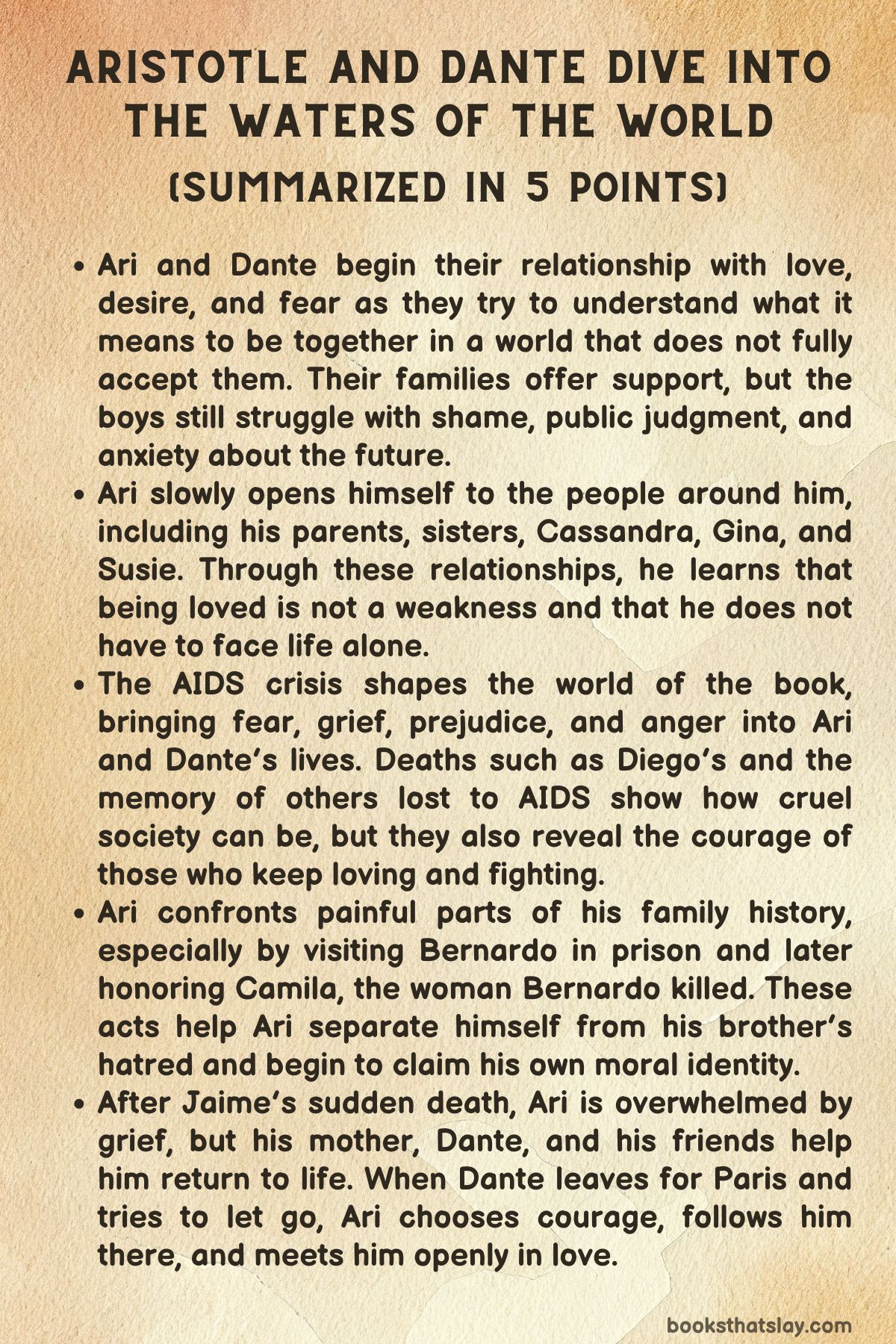
Summary
After finally admitting their love for each other, Ari and Dante begin the difficult work of understanding what that love means. Their relationship is tender and exciting, but it also brings fear.
Ari feels desire in a new way, and Dante, who has always been more open with his feelings, wants reassurance that Ari will love him forever. They both know that the world around them does not easily accept two boys in love.
Dante even says he wishes he were a girl, not because he dislikes being a boy, but because then he and Ari could marry and be together without hiding.
Ari’s parents respond to his sexuality with warmth and protection. His mother, Lilly, tells him that their home is a place of belonging, not exile.
She encourages him to think of himself and Dante as cartographers, people who must learn to map out a new world. Ari is moved by her acceptance, though he doubts his ability to make such a map.
His father, Jaime, is quieter, but he also begins opening himself to Ari. Their relationship, once marked by silence, slowly grows more honest.
Ari remains haunted by fear. He worries about Dante’s safety after the attack Dante survived, and he struggles with guilt for not protecting him.
The AIDS crisis also weighs heavily on both boys. They see news reports, hear cruel opinions, and understand that many people are afraid of gay men.
Ari senses that he and Dante need to talk about AIDS, but the subject feels too large and frightening.
As summer ends, Ari and Dante spend more time together. They kiss at the movies, talk about being Mexican and American, joke with each other’s families, and dream about being alone.
Dante’s mother is pregnant, and Dante hopes the baby will be a boy, partly because he imagines that a straight brother might give his parents the easier life he cannot. Ari notices Dante’s sadness and insecurity, and he begins to see that even Dante, who seems so sure of himself, carries pain.
Ari starts keeping a journal, often writing as if he is speaking to Dante. In it, he records his confusion, his desire, his fears, and his thoughts about family.
He also reconnects with his sisters, Emmy and Vera, who accept him without hesitation. Their love helps Ari understand that his world has been smaller than he knew.
He begins learning how to let others care for him.
Before school starts, Ari and Dante go camping. The trip gives them the private world they have been longing for.
At White Sands and later at their campsite, they feel free from the rules and eyes of society. They kiss, talk, drink stolen bourbon, and become physically intimate.
For Ari, the experience changes something deep inside him. He feels more alive, more aware of his body, and more certain of his love for Dante.
The trip also brings them to an art gallery, where they meet Emma, the mother of a gay artist who died young. She gives them one of her son’s paintings, telling them that they matter more than they know.
The meeting leaves a lasting mark on Ari.
When they return home, ordinary life resumes, but Ari is different. He thinks more about AIDS, about his parents, and about what it means to be gay in a hostile world.
His father becomes emotional while watching news coverage of AIDS activists, defending them as citizens whose lives matter. Ari sees a side of Jaime he rarely saw before: a man shaped by war, sorrow, and compassion.
Ari also witnesses his mother’s strength when Mrs. Alvidrez visits and asks Lilly to oppose a church funeral for Diego Ortega, a young gay man who died of AIDS. Lilly is furious and throws her out.
Ari later goes with his parents to Diego’s family to offer condolences. There he reconnects with Cassandra Ortega, Diego’s sister, whom he has disliked for years.
When Ari tells her he is gay, she changes immediately and becomes honest with him about her brother, her father’s abuse, and her grief. Cassandra becomes one of Ari’s closest friends and encourages him to let other people love him.
Ari then reaches out to Gina and Susie, girls who have wanted to be his friends for years. With Dante beside him, he comes out to them.
They respond with love, tears, humor, and acceptance. Ari’s social world grows.
At school, he now has friends, support, and a place to sit. He no longer feels as invisible or alone as he once did.
School brings challenges too. Ari defends a boy named Rico from bullies and meets Danny, who helps him fight them off.
Teachers notice Ari’s bruises and his changes. He also stands with Susie when a teacher makes a racist comment about Hispanic students.
Ari’s growing sense of justice is sometimes messy, but he is learning to speak instead of disappearing.
Ari continues to struggle with his brother Bernardo, who is in prison for murdering a transgender woman. Bernardo has haunted Ari’s family for years, and Ari decides he must see him to close that part of his life.
His parents are worried, but they understand. On the trip to the prison, Ari and Jaime grow closer.
Jaime tells stories about Lilly, about Vietnam, and about a young soldier who died in his arms. Ari begins to know his father not only as a parent, but as a wounded, loving man.
The prison visit is painful but freeing. Bernardo is cruel, hateful, and unrepentant.
He insults their mother and speaks viciously about the woman he killed. Ari tells Bernardo that he is gay, and Bernardo responds with contempt.
Ari leaves knowing he does not need anything from him anymore. Bernardo will no longer rule his dreams.
Soon after, tragedy strikes. On one of the last days of the year, Jaime has a heart attack at home and dies in Ari’s arms.
Ari is shattered. The house fills with grief, family, friends, and neighbors.
Lilly asks Ari to write the obituary and give the eulogy. Reading his father’s journals, Ari finds advice Jaime never got to give him: never do anything just to prove that he is a man.
At the funeral, Ari honors Jaime as a kind, scarred, decent man who believed in the sacredness of life. Afterward, Ari breaks down, and Dante and Ari’s friends hold him up.
Ari’s grief is heavy. He returns to school feeling numb, drives into the desert alone, and scares those who love him.
Lilly reminds him that honoring his father means learning to live again. With time, support, and love, Ari begins to return to himself.
He and Dante continue loving each other, and Ari’s friends remain close. Stories, laughter, and shared routines slowly help him breathe again.
As graduation approaches, Ari learns he wants to be a writer. Lilly wins teacher of the year, and Ari sees how deeply she has affected her students.
He also asks his mother about the woman Bernardo killed. Lilly gives him her name and burial place.
Ari visits the grave, brings flowers, and writes a note. Though the grave bears a male name, Ari chooses to remember her as Camila.
He apologizes for what his brother did and promises to carry her name with him.
The end of high school brings joy and change. Cassandra becomes valedictorian and gives a speech about compassion, AIDS, and the worth of every life.
Dante is also named valedictorian at his school. Ari helps another boy, Julio, come out to his friends, and the group later celebrates in the desert, dancing until sunrise.
Ari and Dante dance together openly among people who love them.
After graduation, Dante is accepted into an art program in Paris. He does not want to go because he wants the summer with Ari, but Ari insists he accept the opportunity.
Dante is hurt, and they stop speaking for a while. When Dante finally comes to Ari, he says he is leaving the next day.
Ari tells him he loves him, but Dante leaves.
Dante later sends Ari a painting of the two of them in Ari’s truck under the desert sky, along with a letter saying he loves Ari but does not think they can be together forever. Ari’s friends think Dante may be letting go, but Ari refuses to accept that as the end.
With Lilly’s support, he gets a passport and travels to Paris.
In Paris, Ari meets Gerald, a friend of the Quintanas, and sees AIDS activists near the Eiffel Tower. Speaking through Gerald, Ari tells one young activist that loving in the face of death is beautiful.
Ari realizes how much he has changed. The old lonely, fearful boy is gone.
Ari meets Dante at the Louvre, in front of The Raft of the Medusa, the painting they both love. They stand together quietly, then Dante takes Ari’s hand in public.
When Dante asks Ari to kiss him, Ari does. In that moment, Ari’s journey reaches a place of courage: he has crossed grief, fear, shame, and distance to claim love openly.
Characters
Aristotle “Ari” Mendoza
Ari is the emotional center of Aristotle and Dante Dive into the Waters of the World, and his growth gives the book much of its power. At the beginning, he is still learning how to live with the truth that he loves Dante.
He has moved beyond denial, but acceptance is not simple for him. Ari’s mind is full of questions about desire, masculinity, religion, family, and danger.
He is sensitive, but he often protects that sensitivity with silence, anger, or distance. His journal becomes one of the clearest signs of his development because it allows him to speak honestly when he cannot yet say everything aloud.
Ari’s journey is not only about coming out; it is about learning to receive love without suspicion. He slowly understands that his parents, sisters, friends, and Dante are not trying to trap him or judge him.
They are trying to know him. His grief after his father’s death shows how deeply he feels, and his decision to go to Paris shows how much courage he has gained.
By the end, Ari is no longer the lonely boy who believed he had to carry everything alone. He becomes a young man willing to love, mourn, remember, forgive, and move toward the life he wants.
Dante Quintana
Dante is expressive, artistic, emotional, and often more open than Ari, but the book also shows that his openness does not mean he is free from fear. He loves words, painting, poetry, swimming, and beauty, and he often responds to the world with wonder.
His love for Ari is intense and sincere, yet he also carries anxiety about what that love will cost them. Dante wishes they could live publicly without fear, and his sadness about marriage, family, and the future reveals how deeply social rejection has entered his imagination.
He sometimes seems confident, but he can also be insecure, stubborn, and emotionally impulsive. His desire for a younger brother who might be straight shows his complicated worry that he has disappointed his parents, even though they love him.
Dante’s decision to go to Paris creates conflict because he fears distance and loss, but his art also needs room to grow. His painting for Ari becomes one of the book’s strongest expressions of love: beautiful, fearful, generous, and unfinished.
Dante is not written as a perfect romantic figure. He is loving and gifted, but also difficult, wounded, and sometimes unfair.
That complexity makes him feel human.
Lilly Mendoza
Lilly Mendoza is one of the strongest sources of love and moral clarity in the novel. As Ari’s mother, she gives him a home where he does not have to earn belonging.
Her response to Ari’s sexuality is not passive acceptance; it is active protection. She tells him that he and Dante must map a new world, and she shows him that family can be a shelter against a hostile society.
Lilly is intelligent, funny, principled, and deeply respected as a teacher. Her reaction to Mrs. Alvidrez’s cruelty over Diego’s funeral shows her fierce belief that gay lives deserve dignity.
At the same time, Lilly is not only a mother figure. The book allows Ari to see her as a full person: a woman with grief, memories, humor, pride, anger, and a love story of her own.
After Jaime’s death, her sorrow is immense, but she does not collapse into bitterness. She teaches Ari that grief must be carried, not hidden from.
Lilly’s tenderness is never weak. It is disciplined, brave, and rooted in a clear sense of justice.
Jaime Mendoza
Jaime Mendoza is quiet, wounded, loving, and shaped by the trauma of war. For much of Ari’s life, Jaime has seemed distant, and Ari often interprets his silence as emotional absence.
As the story develops, Ari begins to understand that his father’s silence comes from pain rather than lack of love. Jaime’s experiences in Vietnam have marked him deeply, especially his memory of a dying soldier whose final message he carried back to the soldier’s parents.
Jaime believes life is sacred because he has seen how easily it can be destroyed. His defense of AIDS activists shows his compassion and his anger at injustice.
His growing closeness with Ari is one of the most moving parts of the book. Their trip to visit Bernardo allows them to speak with rare honesty, and Jaime’s stories about Lilly, war, and regret help Ari see him clearly for the first time.
His sudden death is devastating because it comes just as father and son have found each other. Jaime’s final written advice to Ari about not proving manhood becomes a lasting moral inheritance.
Soledad Quintana
Soledad Quintana is warm, direct, loving, and emotionally perceptive. As Dante’s mother, she worries about him, not because she rejects him, but because she understands the cruelty of the world he must face.
Her pregnancy adds another layer to her character and to Dante’s fears. Dante’s hope that the baby will be a boy, and perhaps straight, reveals how much he worries about burdening his parents.
Soledad’s relationship with Dante is playful but also honest; she holds him accountable when he behaves badly, such as when he steals liquor or acts rudely after the camping trip. She treats Ari with affection and makes him feel welcome in the Quintana home.
Her presence shows that parental love can be both gentle and firm. She does not pretend that life will be easy for Dante and Ari, but she does not withdraw her love from them either.
In a story filled with fear about rejection, Soledad represents a kind of steady domestic grace.
Sam Quintana
Sam Quintana is thoughtful, kind, and quietly supportive. As Dante’s father, he wants to understand his son and protect him, even when he does not have all the answers.
He talks to Dante about famous gay men in history, a gesture that shows both acceptance and concern. Sam’s love is intellectual as well as emotional; he tries to give Dante a sense of belonging in history, not just within the family.
His friendship with Jaime becomes especially meaningful after Jaime’s death. When Sam breaks down while holding baby Sophocles, Ari sees the depth of his grief and understands that adults suffer in ways young people do not always recognize.
Sam also supports Ari’s trip to Paris, helping him with practical information and sending love to Dante. He is not a loud presence, but he is a deeply humane one.
His steadiness helps make the Quintana family feel like an extension of Ari’s own home.
Cassandra Ortega
Cassandra Ortega begins as someone Ari dislikes, but she becomes one of his most important friends. Her transformation in Ari’s eyes is one of the book’s strongest examples of how people can be misunderstood when seen only through old grudges.
Cassandra is sharp, defensive, intelligent, and wounded by the death of her brother Diego. When Ari comes out to her, the wall between them falls, and she responds with immediate empathy.
Her grief has made her fierce, but it has also made her capable of recognizing pain in others. She encourages Ari to trust Gina and Susie and tells him that he must learn to be loved.
Cassandra’s friendship with Ari is intimate without being romantic, which is important because it shows Ari forming deep bonds beyond Dante. She becomes a running partner, a confidante, and later the valedictorian whose graduation speech honors Diego and challenges prejudice.
Cassandra represents strength that has been formed through suffering, but she is never reduced to her pain.
Gina Navarro
Gina is one of Ari’s loyal friends and part of the circle that helps him come out of isolation. She is lively, observant, and honest, and she brings humor and warmth into Ari’s life.
Along with Susie, she has wanted to be close to Ari for years, even when he kept people at a distance. Her acceptance of Ari and Dante is immediate and sincere.
Gina’s friendship matters because it gives Ari a daily experience of belonging. She studies with him, spends time at his house, joins the group outings, and helps create a social world in which Ari does not have to hide everything.
Gina also challenges Ari when needed. Her presence shows that friendship is not only dramatic loyalty in moments of crisis; it is also the ordinary comfort of lunch tables, jokes, studying, car rides, and shared routines.
Through Gina, Ari learns that being known can be safe.
Susie Byrd
Susie is sensitive, outspoken, and morally brave. She has long wanted to be Ari’s friend, and her emotional reaction when he finally invites her into his life reveals how deeply she has cared from a distance.
Susie is also one of the clearest voices against racism in the school setting. Her confrontation with Mrs. Livermore shows that she is not willing to stay silent when authority figures humiliate Mexican and Hispanic students.
She has a strong sense of justice, but she is also tender. The cross necklace she and Gina give Ari shows her concern for his spiritual fear and her desire to remind him that God does not hate him.
Susie’s friendship helps Ari separate religion from shame. She is affectionate, funny, brave, and loyal, and her acceptance gives Ari another reason to believe that his life does not have to be lived in secrecy.
Bernardo Mendoza
Bernardo is mostly absent physically, but his shadow hangs over Ari and the Mendoza family. He represents violence, shame, secrecy, and unresolved family pain.
Ari has grown up with Bernardo as a kind of mystery, a brother whose crime was so terrible that the family struggled to speak of him. When Ari finally visits him in prison, Bernardo’s cruelty confirms that Ari cannot find healing through brotherly reconciliation.
Bernardo’s hatred toward the transgender woman he killed, and his contempt when Ari comes out, expose him as someone trapped in brutality and prejudice. Yet his role in the book is not simply to be a villain.
He also forces Ari to confront what has haunted him for years. Ari’s decision to see Bernardo is an act of self-liberation.
By leaving the prison without needing love or approval from him, Ari takes back part of his own life.
Camila
Camila, the transgender woman murdered by Bernardo, is not alive during the events of the story, but her presence becomes morally significant. For much of Ari’s life, she has been hidden behind the fact of Bernardo’s crime.
Later, Ari asks for her name and visits her grave. This act matters because Ari refuses to let her remain only a victim in his family’s history.
He imagines her beauty, apologizes for what Bernardo did, and promises to carry her name with him. Through Camila, the book asks readers to think about whose lives are remembered, whose identities are erased, and whose deaths are treated as worthy of grief.
Ari’s visit to her grave is not about absolving himself; it is about recognition. He cannot undo the violence, but he can refuse silence.
Camila becomes part of Ari’s moral awakening.
Diego Ortega
Diego Ortega is Cassandra’s brother, and his death from AIDS exposes the cruelty faced by gay men during the crisis. Although he is not present as a living character, his life and death deeply affect the story.
His funeral becomes a test of community, faith, and compassion. Some people, like Mrs. Alvidrez, want to deny him dignity because he was gay.
Others, including Ari’s family, show up because they understand that funerals matter and that grief deserves witnesses. Diego’s suffering also shapes Cassandra, whose anger and pain come from loving a brother who was mistreated by both illness and prejudice.
Through Diego, the book shows that AIDS is not an abstract historical background. It is personal, local, and devastating.
His death helps Ari understand the danger around him, but it also helps him form new bonds with people who are willing to stand against fear.
Mrs. Alvidrez
Mrs. Alvidrez represents social judgment, religious hypocrisy, and the kind of cruelty that hides behind respectability. Her visit to Lilly after Diego’s death reveals her willingness to deny dignity to a dead young man because of his sexuality.
She is not simply rude; she is morally dangerous because she tries to turn prejudice into community action. Lilly’s anger toward her is justified because Mrs. Alvidrez wants others to participate in exclusion.
Yet the book later allows a small moment of complexity when she comes to pay respects after Jaime’s death, and Lilly chooses forgiveness. This does not erase what Mrs. Alvidrez did, but it shows Lilly’s capacity to act with grace even toward someone who has caused harm.
Mrs. Alvidrez functions as a reminder that prejudice often comes from ordinary people in ordinary homes, not only from obvious enemies.
Mr. Blocker
Mr. Blocker is one of Ari’s most important teachers because he sees beyond Ari’s surface. He notices Ari’s bruised hands and recognizes something of his own younger self in Ari’s tendency to use violence when words fail.
His past as a boxer gives him credibility when he speaks to Ari about anger and struggle. He does not shame Ari, but he does not romanticize fighting either.
Later, when he finds Ari’s journal, he handles the situation with care and tells Ari not to let anyone make him ashamed of who he is. That moment matters because Ari’s private writing contains his most vulnerable self.
Mr. Blocker protects that vulnerability rather than exploiting it. He represents the rare adult at school who combines authority with kindness.
Ari’s farewell gift of miniature boxing gloves shows that Mr. Blocker has helped him move beyond the need to fight his way through pain.
Mrs. Ardovino
Mrs. Ardovino is a minor but memorable figure because she teaches Ari that adults can be insecure, embarrassed, and unsure of themselves. At first, she seems formal and distant, but when Ari apologizes after a classroom exchange, she reveals unexpected honesty.
She admits that she may not have been ready to return to teaching and that her husband worried she would make a fool of herself. Ari is surprised by this openness because he is beginning to see adults as full human beings rather than fixed roles.
Mrs. Ardovino’s importance lies in that shift. She helps Ari understand that adulthood does not mean having everything solved.
People can be old, educated, and still frightened. Her vulnerability adds to Ari’s growing awareness that everyone carries private uncertainty.
Mrs. Livermore
Mrs. Livermore represents the everyday racism that Ari and his friends encounter in school. Her comments about Hispanic students are insulting because they are delivered through the authority of a teacher.
She expects her prejudice to be treated as observation, not harm. Susie challenges her directly, and Ari and others support Susie, making the classroom a place where students refuse to accept humiliation quietly.
Mrs. Livermore’s role in the story is important because she shows that discrimination does not only target Ari and Dante as gay boys. The book also examines Mexican American identity, cultural belonging, and the insults that students face from people who are supposed to educate them.
The later cricket prank connected to her class adds humor, but it does not erase the seriousness of what she represents.
Danny
Danny is a strong supporting character who helps Ari defend Rico from bullies. He is physically brave, but his importance goes beyond the fight.
He understands that anti-gay violence is wrong, even when the victim is not someone powerful or popular. Danny’s willingness to stand beside Ari creates immediate trust.
Through him, the book shows another kind of masculinity: one based not on domination, but on protection and loyalty. He is also connected to Cassandra, who respects him, and his quiet presence at Rico’s funeral suggests depth beneath his tough exterior.
Danny helps Ari see that allies can appear in unexpected places, and that strength can be used to defend rather than harm.
Rico
Rico is a vulnerable gay boy whose mistreatment at school shows the danger that Ari and Dante fear. His bullying is not treated as harmless teasing; it is part of a larger pattern of cruelty toward boys who are seen as different.
Ari’s decision to defend him shows Ari’s growing willingness to act, even when it costs him physically. Rico’s later death adds sadness and seriousness to the story’s treatment of gay youth.
He represents those who do not always have enough protection, enough voice, or enough time. His presence reminds Ari and the reader that survival cannot be taken for granted in a hostile world.
Julio
Julio appears later as a young man quietly carrying the fear of being gay. At the graduation party, he breaks down because he feels like a freak and believes no one will understand him.
Ari’s decision to come out to Julio in that moment is generous and important. Ari becomes for Julio what others have been for him: proof that he is not alone.
When Julio then tells Elena and Hector, and they respond with love, the book offers a small but meaningful vision of how honesty can spread safety. Julio’s character shows the ongoing cycle of fear and support.
Ari has been helped by others, and now he can help someone else.
Elena and Hector
Elena and Hector are classmates who become part of the wider social world around Ari. Their importance is clearest when Julio comes out to them.
Their response is loving, natural, and sad only because Julio felt he had to hide. They represent the possibility that friendship can survive truth.
In a story where so many characters fear rejection, Elena and Hector show that acceptance can be immediate and uncomplicated. They also help expand the book’s sense of community.
Ari’s life is no longer limited to his family and Dante; he is surrounded by classmates who can surprise him with kindness.
David “Cricket” Brown
David, nicknamed Cricket, brings humor and outsider energy into the story. His prank with the crickets in Mrs. Livermore’s class is mischievous, but it is also inspired by Ari’s story about Lilly and the lizards.
David is not a central character, yet his moment of being celebrated in the desert is meaningful. Ari recognizes that David may not be used to being honored or noticed with joy.
The group’s chant for him turns a prankster into someone included. David’s role shows how Ari’s circle keeps widening, making room for people who might otherwise remain on the edges.
Emma
Emma is the mother of a gay artist who died young, and her meeting with Ari and Dante gives the book one of its quiet emotional turning points. Through her, Ari sees adult grief in a new way.
She carries the pain of losing her son, but she also preserves his art and memory. When she gives Ari and Dante her son’s painting, she is not only giving them an object; she is giving them a blessing from one generation of queer life to another.
Her son’s art becomes a bridge between loss and survival. Emma’s kindness tells the boys that their love matters, even in a world where many people deny that truth.
Gerald
Gerald appears in Paris as a friend of the Quintanas and a guide for Ari. He is an older gay man who recognizes the courage in Ari’s journey.
His role is brief but important because he gives Ari a model of gay adulthood beyond fear. In El Paso, Ari’s imagination of the future has often been limited by danger, secrecy, and AIDS.
Gerald’s life in Paris suggests that there are wider worlds and older survivors who can help younger people find their way. He also helps Ari speak to the AIDS activist near the Eiffel Tower, allowing Ari to express solidarity across language and nationality.
Gerald represents guidance, experience, and the larger community Ari is beginning to enter.
Sophocles Bartholomew Quintana
Sophocles is a baby, so he does not shape events through choice, but his birth carries symbolic weight. He arrives on Thanksgiving, bringing new life into a story shadowed by AIDS, grief, fear, and death.
Dante had hoped the baby would be a boy, and Sophocles’s arrival answers that wish, though not in a simple way. His middle name honors a friend of the Quintanas who died of AIDS, connecting birth and mourning in one name.
Sophocles reminds the families that life continues, but not by forgetting the dead. He represents continuity, hope, and the responsibility of memory.
Themes
Love as Courage
Love in Aristotle and Dante Dive into the Waters of the World is not treated as a private feeling alone. It asks for action, risk, honesty, and endurance.
Ari and Dante love each other deeply, but their love exists in a world that makes them afraid. They cannot kiss freely in public, imagine marriage easily, or plan the future without considering danger.
This makes their love both beautiful and difficult. Ari’s growth comes from learning that love is not proven by silence or self-protection.
He must learn to say what he feels, let others care for him, and finally cross an ocean when he believes Dante is slipping away. Love also appears in families and friendships.
Lilly and Jaime love Ari by making room for his truth. Gina, Susie, and Cassandra love him by staying close when he is afraid, grieving, or unsure.
The book shows that love is not always gentle in a simple way. Sometimes it pushes, confronts, forgives, waits, or travels.
Love becomes courage because it asks characters to live openly in a world that often rewards hiding.
Identity, Shame, and Self-Acceptance
Ari’s struggle with identity is one of the story’s deepest concerns. He knows he loves Dante, but knowing does not immediately free him from shame, fear, or confusion.
He worries about God, masculinity, sex, family, and whether being gay means a future filled with loss. His questions are intensified by the time period, when AIDS and anti-gay hatred shape public attitudes.
Dante also struggles with identity, though differently. He is more openly emotional and artistic, but he still wishes society would allow him and Ari to belong without explanation.
The story also connects sexuality with Mexican American identity. Ari and Dante both feel the pressure of not being Mexican enough, American enough, or straight enough for the world around them.
Ari’s movement toward self-acceptance happens gradually. He comes out to Cassandra, Gina, and Susie; he writes honestly in his journal; he helps Julio feel less alone; and he stops letting Bernardo’s hatred define him.
Self-acceptance in the novel is not a single declaration. It is a series of choices to live without apologizing for one’s existence.
Family, Inheritance, and Chosen Support
Family in the book is both a source of pain and a source of rescue. Ari’s family has been shaped by Bernardo’s crime, Jaime’s war trauma, and years of silence.
For a long time, Ari feels separated from the people closest to him because so much has gone unsaid. As the story progresses, he begins to understand his parents as complicated people with histories beyond their roles as mother and father.
Lilly gives him fierce love and moral guidance, while Jaime slowly opens the door to emotional intimacy. Jaime’s death is devastating partly because Ari has only just begun to know him.
The Quintanas also become family to Ari, offering affection, shelter, and support even when his relationship with Dante is uncertain. Beyond biological family, Ari builds a chosen circle with Cassandra, Gina, Susie, Danny, and others.
These friendships teach him that belonging is not limited to blood. The book suggests that inheritance is not only trauma or grief.
It can also be advice, stories, recipes, songs, jokes, paintings, dog tags, and the courage passed from one person to another.
Grief, Memory, and Learning to Live Again
Death is everywhere in the story, but the book does not treat grief as one single emotion. Diego’s death from AIDS brings anger, shame, public judgment, and community conflict.
Camila’s death forces Ari to confront the violence hidden inside his family history. Jaime’s death brings shock, numbness, and a sorrow so heavy that Ari nearly disappears into it.
Through these losses, the story asks what it means to remember the dead responsibly. Ari does not want Jaime reduced to a funeral or Bernardo’s victim reduced to a secret.
He writes, speaks, visits graves, listens to stories, and keeps names alive. Memory becomes an ethical act.
At the same time, the book insists that grief cannot become the whole of life. Lilly tells Ari that honoring his father means learning to live again, and this becomes a turning point.
Ari slowly returns to friends, running, writing, love, and desire. The story does not suggest that grief ends neatly.
Instead, it shows that living after loss means carrying the dead while still choosing the future.