Bone of My Bone Summary, Characters and Themes
Bone of My Bone by Johanna van Veen is a historical horror novel set during the Thirty Years’ War, when religious conflict, disease, famine, and military violence have devastated ordinary lives.
The story follows two women whose search for a miraculous relic gradually becomes a struggle against supernatural manipulation, inherited guilt, and systems that deny women control over their bodies and choices. Combining religious imagery, revenant folklore, necromancy, romance, and psychological trauma, the novel examines how love can inspire both healing and terrible sacrifice. Its world is brutal, yet its central relationship offers companionship, consent, and chosen devotion amid widespread suffering.
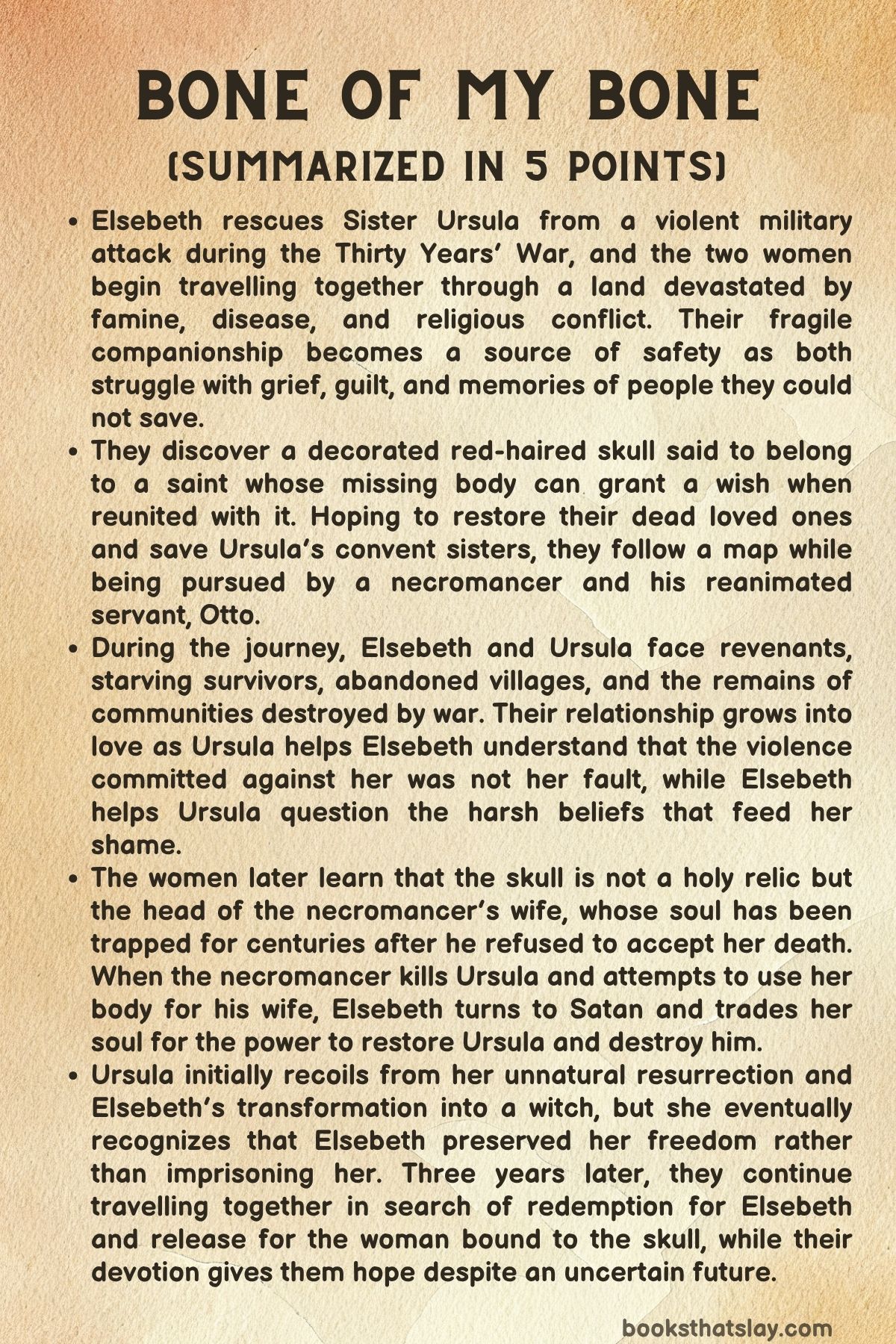
Summary
As a child, Elsebeth witnesses the public execution of three accused witches. One condemned woman refuses to repent, claiming that she willingly gave herself to the devil after discovering that faith and obedience offered poor women no protection from starvation, violence, or exploitation.
While the other prisoners quickly die in the flames, the woman appears to escape the pyre and stare directly at Elsebeth with yellow, animal-like eyes. Although the crowd eventually kills her, Elsebeth remembers her as a woman who flew rather than fell.
Years later, Bavaria has been ravaged by the Thirty Years’ War. Elsebeth, now nineteen, encounters Sister Ursula during an attack on a group of refugees.
Ursula freezes as soldiers murder and assault the people around her, but Elsebeth pulls her into the forest. When a soldier catches Ursula, Elsebeth kills or severely wounds him with a rock and leads Ursula to safety.
Ursula conceals the fact that she is a Catholic nun, while Elsebeth admits that she was raised Protestant but has lost most of her faith after the destruction of her family. Despite their religious differences, the women decide to travel north together in search of surviving relatives and protection.
They soon find a dying man whose possessions include an ornate reliquary containing a decorated skull with red hair and painted glass eyes. The man claims that the skull belongs to a saint and that anyone who reunites it with its missing body will receive a wish.
Ursula believes the relic may save her scattered convent sisters and release Sister Hildegard from purgatory. Elsebeth doubts the tale, but the possibility of restoring her murdered family persuades her to join the quest.
Elsewhere, the mercenary Otto Kreuzler encounters a mysterious man with goat-like eyes. The stranger is a necromancer searching for the skull, which Otto’s companion Gottfried had lost in a game of dice.
When Otto refuses to cooperate, the necromancer kills him and then binds his consciousness to his corpse. Otto remains aware but loses control over his body, becoming an unwilling servant who must obey every command.
As Ursula and Elsebeth travel, Elsebeth realizes that Ursula is a nun. Ursula explains that she fled her convent with Sister Hildegard when soldiers approached, but Hildegard later died under circumstances that Ursula cannot fully discuss.
The women shelter in an abandoned village, where Ursula secretly punishes herself by burning her wrist. She also becomes strangely fascinated by the skull, kissing and almost biting it before recovering control.
That night, Elsebeth speaks about her sister Margarethe, whom she abandoned only after Margarethe ordered her to flee from approaching soldiers. Ursula admits that she believes she caused Hildegard’s death, making both women dependent upon the possibility of a miraculous wish.
The skull begins appearing in Elsebeth’s dreams. It warns her that the necromancer is following them and that Ursula is in immediate danger.
Elsebeth awakens to discover Ursula missing. Following bloodstains and a broken rosary, she finds that Ursula has been taken by a Nachzehrer, a corpse that imitates human speech and feeds upon the living.
Elsebeth drives the creature away with fire and rescues Ursula. Her relief turns into anger because Ursula opened the door out of compassion without considering how her death would affect the person travelling beside her.
Their argument ends in a passionate kiss. Ursula welcomes the intimacy, but Elsebeth panics when the contact awakens memories she cannot yet explain.
While following the skull’s trail, the necromancer forces Otto to confront his history as a mercenary. Otto insists that he did not personally commit every crime committed by his comrades, but the necromancer argues that witnessing rape, torture, and murder without intervening made him responsible.
The necromancer also uses Otto to kill former companions and other victims. Otto’s punishment mirrors the condition he once imposed upon others: he has become a body controlled by someone more powerful, with no ability to refuse.
Elsebeth and Ursula repair their relationship after Ursula unintentionally dismisses Elsebeth’s suffering with a religious reassurance. Elsebeth explains that memories of violence sometimes make her feel as though she is already dead and living in Hell.
Ursula comforts her through gentleness rather than doctrine. Their growing affection gives both women a sense of safety they have not experienced for years.
Their journey is interrupted when an Aufhocker, the corpse of a dead boy, attaches itself to Elsebeth’s back. The child will strangle her unless she carries him home.
The women eventually discover that the boy’s starving parents abandoned him because they believed their remaining food could not sustain the entire family. His mother has also survived by eating parts of her dead husband.
Elsebeth buries the boy beside his father, allowing the revenant to rest. The experience strengthens her desire to use the promised wish to restore the people she lost.
As Ursula combs Elsebeth’s hair, Elsebeth realizes that she loves her. Before she can speak the words, the necromancer and Otto arrive at the cottage.
The necromancer orders Otto to kill the starving woman and seize the reliquary. Elsebeth prepares to fight, but Ursula voluntarily surrenders the skull because resistance would cause both women to be tortured or killed.
Ursula later condemns herself for cowardice. Elsebeth argues that her decision saved their lives and therefore cannot be treated as betrayal.
Elsebeth then reveals her history with Gottfried. After finding Margarethe’s mutilated body, she joined an imperial baggage train, where Gottfried gave her food and protection but repeatedly raped her while claiming that her dependence made her his property.
Elsebeth believes she participated in her own violation because her body sometimes responded involuntarily. Ursula explains that physical response is not consent and that Gottfried alone bears responsibility for his actions.
Ursula also reveals the complete truth about Hildegard. While hiding from dangerous men, she covered the feverish nun’s mouth to stop her from making noise and accidentally suffocated her.
Recognizing their shared guilt, Ursula leads Elsebeth into a freezing river and reenacts one of Elsebeth’s folk stories about cleansing a corrupted body. She washes Elsebeth with water and sand, then strikes her skin with twigs at Elsebeth’s request.
The ritual cannot erase the past, but it allows Elsebeth to release some of the shame forced upon her. Ursula then reclaims Elsebeth’s body through consent, tenderness, and patience, and the women become lovers.
The skull appears to Ursula in a dream and identifies herself as Saint Columba. She commands Ursula to recover her from the necromancer, although contradictions in her story cause Ursula to question whether she is truly a saint.
Ursula remembers that she still possesses the map showing the location of the skull’s body. She and Elsebeth decide to construct a false relic and exchange it for the genuine skull while the necromancer sleeps.
They remove the head of the dead Aufhocker’s mother and clean the bone. They then travel to Ursula’s convent to obtain silk, glass eyes, and other materials needed to make the replica convincing.
At the convent, they discover six nuns dead from plague. The seventh, Sister Junius, has hanged herself after being left alone among the bodies.
Ursula is devastated because Junius trained and loved her. She also fears that suicide has condemned the woman, increasing Ursula’s determination to obtain the promised wish.
Elsebeth finishes the counterfeit skull using red hair, silk, and glass eyes taken from the supposedly incorruptible remains of Sister Anna. While removing the eyes, Ursula discovers that Anna’s hidden face has decayed and that one natural eye remains impossibly alive.
The women locate the necromancer’s camp and attempt to replace the true skull with their replica. Otto is awake and warns them that the relic is not a saint’s skull and that no wish exists.
Because the necromancer’s control prevents Otto from allowing them to escape, he strikes Ursula and catches the skull. Elsebeth attacks him, cutting his leg and stabbing his decaying body before fleeing with Ursula and the relic.
The necromancer recognizes the false skull immediately. Otto, whose remorse has deepened, refuses to help pursue the women because he no longer wishes to cause suffering.
The necromancer finally releases Otto from his corpse. Otto dies completely after choosing compassion over continued existence, although his final decision cannot erase the harm he committed and permitted during his life.
Ursula and Elsebeth reach the crossroads shown on the map. Beneath seven black stones, they uncover a headless skeleton whose white bones appear to match the decorated skull.
Before Ursula can reunite the remains, the necromancer arrives and cuts her throat. Ursula dies in Elsebeth’s arms.
The necromancer explains that the skull belongs to his wife. Centuries earlier, he had been a devout man who turned to Satan after God refused to restore his dead beloved.
His bargain gave him necromantic power but could not return his wife’s corpse to genuine life. Horrified by her unnatural existence and her husband’s damnation, she escaped.
Villagers later captured and decapitated her, burying her body at a crossroads and sending her head away for exorcism. Over time, people mistakenly began treating the decorated skull as a saint’s relic.
The woman manipulated Ursula and Elsebeth through dreams because she wanted to be physically reunited with her remains while remaining beyond her husband’s control. The necromancer now intends to place his wife’s soul inside Ursula’s fresh corpse.
He reanimates Ursula and commands her body to attack Elsebeth. Unable to destroy the body of the woman she loves, Elsebeth calls upon Satan after concluding that God has ignored every desperate prayer she has offered.
Satan appears as a black snake. Elsebeth negotiates carefully, asking for Ursula’s soul to be returned to her preserved corpse, for Ursula to retain the freedom to die whenever she chooses, and for enough power to destroy the necromancer.
In exchange, Elsebeth signs away her soul. She then kills the necromancer and restores Ursula.
Ursula initially reacts with horror, believing that Elsebeth has damned herself and turned Ursula into an abomination. Elsebeth argues that she spent her own soul willingly and ensured that Ursula would never become a prisoner inside her body.
The skull’s woman later explains that Ursula’s freedom distinguishes her condition from the imprisonment the necromancer imposed upon his wife. Ursula begins to see the bodiless woman as another victim rather than simply a liar.
Ursula returns to Elsebeth and reasons that truly infinite divine love cannot permanently exclude any soul. She chooses to remain with Elsebeth, promising to seek redemption for her and release for the woman trapped within the skull.
Three years later, the women continue travelling through a country devastated by war. Ursula enters churches and shrines searching for salvation, while Elsebeth remains outside because consecrated ground rejects her.
Elsebeth has used her necromantic power only to restore Ursula. Her transformed eyes frighten soldiers and other predators, giving the women protection that ordinary laws and religious institutions never provided.
They have not found a way to save Elsebeth’s soul or free the skull’s woman. Elsebeth nevertheless refuses to regret her decision, declaring her love for Ursula three times and accepting that a life beside her beloved is worth the uncertain judgment that may follow.
Characters
Elsebeth
Elsebeth is the emotional center of Bone of My Bone, carrying within her the combined effects of war, hunger, sexual violence, religious disillusionment, and survivor’s guilt. Her strength is visible from the moment she rescues Ursula, yet that courage exists beside profound psychological injuries that shape nearly every decision she makes.
She understands violence in practical terms rather than through distant moral teachings. Her knowledge of revenants, hunger, soldiers, and desperate survival allows her to recognize dangers that Ursula’s sheltered religious life has not prepared her to face.
Elsebeth’s protectiveness toward Ursula is partly an expression of love and partly an attempt to correct her inability to save Margarethe. She gradually treats Ursula as someone who belongs to her, but the story carefully distinguishes her possessiveness from the controlling claims made by Gottfried and the necromancer.
Her desire is not to remove Ursula’s freedom but to prevent another unbearable loss. This tension reaches its greatest intensity when she sells her soul to restore Ursula, acting without Ursula’s permission while also ensuring that Ursula retains the right to choose death.
Elsebeth’s trauma surrounding Gottfried affects her ability to accept intimacy. She interprets involuntary physical responses as evidence of guilt until Ursula helps her understand that the body’s reactions do not excuse coercion or transform violence into consent.
Her relationship with Ursula gives her an opportunity to experience touch as chosen, patient, and safe. Love does not erase what happened to her, but it allows her to form memories that are not controlled by her attacker.
Elsebeth’s final bargain also completes the connection between her and the witch she witnessed as a child. She rejects the belief that powerless women must wait for divine or social authorities to rescue them and instead takes forbidden power for herself.
The decision is morally unsettling because it risks eternal punishment and interferes with Ursula’s death. Nevertheless, it grows from a world in which obedience repeatedly fails to protect women, while supernatural power offers the first effective defense Elsebeth has ever possessed.
Sister Ursula
Ursula’s development in Bone of My Bone begins with paralysis and ends with a more compassionate, independent understanding of faith. She initially views herself as a coward because fear causes her to freeze, yet the book repeatedly shows that bravery is not the absence of terror but the decision to act despite it.
Her life in the convent taught her discipline, healing, obedience, and devotion, but it also taught her to distrust doubt. This conditioning makes her vulnerable to the skull, whose commanding language resembles the religious authority Ursula has been trained to obey.
Ursula’s guilt over Hildegard reveals her tendency to judge herself without mercy. Although Hildegard’s death was accidental and occurred while Ursula was trying to protect them both, Ursula treats the event as evidence that she is morally corrupt.
Her compassion is sincere but sometimes reckless. Opening the door to the Nachzehrer shows her willingness to help strangers, yet Elsebeth forces her to recognize that self-sacrifice can injure the people who love and depend upon her.
Ursula becomes Elsebeth’s emotional healer without pretending that trauma can simply disappear. Her cleansing ritual gives Elsebeth a controlled means of expressing pain, and her explanation of consent directly challenges the shame Gottfried imposed.
Her sexual relationship with Elsebeth also transforms her understanding of purity. Rather than viewing desire as automatically sinful, she comes to see loving, consensual intimacy as compatible with tenderness, responsibility, and spiritual meaning.
Ursula’s resurrection creates her greatest crisis. She initially sees herself as an unnatural object and condemns Elsebeth’s bargain, but she gradually realizes that Elsebeth preserved her freedom rather than enslaving her.
By choosing to live, Ursula rejects a rigid system that defines salvation only through rules and punishment. Her final belief that divine love must be greater than human doctrine allows her to remain faithful without abandoning the woman she loves.
Otto Kreuzler
Otto begins as a man who believes restraint is enough to separate him from the worst mercenaries. He did not commit every rape or murder around him, but he protected the men who did, benefited from their crimes, and sometimes participated through smaller acts of cruelty.
His transformation into a conscious corpse forces him to experience the condition of those treated as objects. The necromancer controls his movements, uses his body for violence, and denies him the right to refuse, creating a direct parallel with the victims Otto previously ignored.
Otto’s punishment is not limited to physical decay. He must remember and confess the atrocities he survived by suppressing thought, including torture, theft, assaults on civilians, and the murder of children.
His repeated claim that he merely stood by becomes impossible to defend. The story uses his condition to argue that refusing to intervene can become active support when silence protects the powerful and abandons their victims.
Elsebeth’s history with Gottfried also changes Otto’s perspective. He once accepted the description of her as a willing companion, but his own enslavement teaches him that dependence and possession cannot create consent.
Otto’s final refusal to pursue Elsebeth and Ursula marks genuine moral growth. He chooses their safety even though the necromancer threatens to leave him conscious inside a ruined and immobile corpse.
His redemption remains incomplete because remorse cannot restore the dead or heal those he harmed. Even so, his final act proves that he has recovered part of the humanity he surrendered during years of war.
The Necromancer
The necromancer is both a supernatural antagonist and a distorted reflection of Elsebeth. Like her, he loses the person he loves and refuses to accept death, but his response is based on ownership rather than devotion.
He once considered himself deeply religious. When prayer failed to restore his wife, he treated God’s silence as a personal betrayal and turned to Satan for power.
His tragedy begins with grief but becomes monstrous because he refuses to respect his wife’s horror or desire to escape. He values her continued presence more than her freedom, reducing love to the preservation of an object he believes belongs to him.
His control over Otto reveals the same attitude. Otto’s body, voice, memories, and actions become tools that the necromancer uses without regard for the consciousness trapped within them.
The necromancer frequently exposes the moral failures of others, particularly Otto’s complicity in wartime atrocities. His accusations are often accurate, but his insight does not make him righteous because he uses truth as another form of domination.
He functions as a warning about grief without consent. His inability to release his wife destroys the person he hoped to recover, condemns his own soul, and spreads suffering across generations.
His accusation that Elsebeth forced him to kill Ursula also reveals his refusal to accept responsibility. Like abusive men throughout the story, he treats his choices as consequences created by the resistance of others.
The Necromancer’s Wife
The red-haired woman within the skull initially appears to be either a saint or a malicious supernatural deceiver. Her true identity reveals a woman trapped between physical death, her husband’s obsession, religious violence, and her own desperate manipulation of strangers.
After her husband restores her soul to a corpse, she rejects the existence he created for her. Her escape demonstrates that she values freedom more than bodily reunion and refuses to interpret imprisonment as proof of love.
The villagers who capture her continue the same pattern of control through torture, execution, and dismemberment. Her head is decorated and transformed into a sacred object, replacing her personal identity with a religious story created by others.
She manipulates Ursula and Elsebeth by pretending to be Saint Columba and promising a wish. Her deception places them in danger and exploits their grief, but it arises from centuries of isolation and her terror of being reclaimed by her husband.
Her longing for skin, touch, and physical wholeness makes her sympathetic even when her actions are selfish. She is another woman whose body has become a site of conflict among men, religious institutions, supernatural powers, and desperate survivors.
Her conversation with Ursula clarifies the difference between resurrection and captivity. She cannot end her existence without the necromancer’s permission, while Ursula retains the power to decide when her renewed life should end.
Margarethe
Margarethe never appears alive in the central timeline, yet her memory governs Elsebeth’s actions. Her death represents both the personal devastation of war and Elsebeth’s belief that survival was a betrayal.
Margarethe was disabled and therefore less able to escape approaching soldiers. She understood the danger and ordered Elsebeth to leave, even striking her sister when Elsebeth resisted.
This decision was an act of protection, but Elsebeth interprets it through guilt rather than love. Finding Margarethe’s mutilated body convinces Elsebeth that she abandoned someone who depended upon her.
Elsebeth’s intense commitment to Ursula grows partly from this unresolved grief. Protecting Ursula becomes a second opportunity to save a beloved woman from soldiers, monsters, hunger, and death.
Margarethe also represents the countless civilians whose suffering is reduced to an unavoidable consequence of war. Her fate demonstrates that the destruction of a person continues within survivors long after the immediate violence has ended.
Sister Hildegard
Sister Hildegard embodies the accidental nature of guilt. She dies not because Ursula wishes to harm her but because Ursula tries desperately to keep both of them hidden from dangerous men.
Her fever and confusion make silence impossible. When Ursula covers her mouth, fear and urgency turn an act of protection into suffocation.
Ursula’s inability to forgive herself transforms Hildegard into an imagined spiritual burden. The promised wish becomes attractive because Ursula hopes it can repair an event that ordinary confession and prayer have not relieved.
Hildegard’s death also challenges simple moral categories. Ursula performs an action that causes death, but intention, circumstance, fear, and the threat surrounding them make the event different from deliberate murder.
Through Hildegard, the novel questions systems that offer punishment more readily than understanding. Ursula needs compassion and honest recognition of the circumstances, yet she initially possesses only doctrines that deepen her self-condemnation.
Sister Junius
Sister Junius was Ursula’s teacher in the convent infirmary and the nun she loved most deeply. Her influence survives in Ursula’s medical knowledge, practical compassion, and instinctive responsibility toward suffering bodies.
Her death by suicide devastates Ursula because it conflicts with the religious rules governing salvation. Ursula imagines that Junius’s final act has condemned her, even though prolonged isolation, plague, and despair shaped that decision.
Junius exposes the cruelty of moral judgments that ignore extreme suffering. Alone among the bodies of her sisters, she appears to have reached a state in which fear and grief overwhelmed the teachings she had followed throughout her life.
Ursula protects her by concealing the suicide. This choice shows that Ursula’s loyalty to a beloved individual has begun to outweigh her obedience to institutions that might reduce Junius’s life to the manner of her death.
Junius also strengthens Ursula’s attachment to the promised miracle. The desire to save her becomes one more reason Ursula ignores inconsistencies in the skull’s story and continues pursuing the relic.
Gottfried
Gottfried represents coercion disguised as generosity. He feeds and shelters Elsebeth after the destruction of her family, then treats that assistance as payment granting him access to her body.
His violence demonstrates how dependence can be manipulated into supposed consent. Elsebeth’s lack of alternatives allows Gottfried to describe exploitation as an agreement, even though refusal would threaten her survival.
The psychological consequences of his abuse remain after she escapes. Elsebeth blames herself for involuntary pleasure, fears physical intimacy, and believes that Gottfried permanently claimed part of her.
Gottfried’s absence from the main journey emphasizes the durability of trauma. He does not need to remain physically present because his language and actions continue shaping Elsebeth’s relationship with her own body.
Ursula directly opposes his claim by separating bodily response from consent. Her patient affection allows Elsebeth to experience desire without obligation, fear, or exchange.
Gottfried is therefore not only an individual attacker but also a representative of systems in which food, military authority, religious judgment, and economic dependence give powerful people control over vulnerable bodies.
Themes
Love, Possession, and Consent
Bone of My Bone repeatedly distinguishes love from possession by examining what happens when devotion ignores the freedom of the beloved. The necromancer claims to love his wife, yet he restores her against her wishes, binds her soul to a decaying body, and spends centuries attempting to reclaim her after she escapes.
His attachment is based upon the belief that love gives him authority over her continued existence. Because he cannot accept her death or independence, his devotion becomes imprisonment.
Gottfried follows a similar pattern on a human scale. He treats food and protection as payment that entitles him to Elsebeth’s body, turning assistance into a weapon of control.
Ursula and Elsebeth attempt to create a different form of intimacy. Their relationship develops through mutual comfort, apology, patience, and a growing respect for boundaries.
Ursula stops when Elsebeth recoils and later helps her understand that involuntary physical response is not consent. Their eventual sexual relationship allows Elsebeth to experience desire without being treated as property.
Elsebeth’s resurrection of Ursula complicates this distinction because she acts without Ursula’s permission. However, she negotiates for Ursula’s freedom to choose death, refusing to create the kind of endless imprisonment suffered by the skull’s woman.
The story therefore does not present loving motives as automatically moral. Love becomes humane only when the beloved retains autonomy, including the right to refuse, leave, change, or die.
Faith, Doubt, and Religious Authority
Faith offers Ursula structure, purpose, and compassion, but it also teaches her to distrust her own questions. The skull manipulates her successfully because its demands resemble the language of sacred authority, rewarding obedience and condemning doubt.
Ursula’s desire for forgiveness makes her especially vulnerable. She wants clear evidence that Hildegard, Junius, and the other sisters can be saved, so she accepts the promise of a miracle despite growing inconsistencies.
The supposedly holy relics at the convent further weaken the boundary between sacred wonder and horror. Sister Anna’s concealed decay and living eye suggest that religious institutions may disguise disturbing truths beneath beautiful appearances.
Elsebeth’s experience produces a different spiritual crisis. She sees prayers go unanswered while soldiers, hunger, disease, and powerful men destroy innocent people.
Her final appeal to Satan follows repeated divine silence. The bargain gives her practical power, but it may also condemn her, leaving the moral meaning of her choice unresolved.
Ursula ultimately rebuilds her faith around compassion rather than rigid law. She reasons that infinite divine love cannot be weaker than human mercy or permanently exclude someone who sacrificed herself for love.
The novel does not settle whether salvation is possible. Instead, it suggests that honest doubt may be more spiritually meaningful than obedience that suppresses conscience, experience, and empathy.
Trauma, Guilt, and the Possibility of Healing
Elsebeth and Ursula both carry guilt for events shaped by circumstances beyond their control. Elsebeth believes she abandoned Margarethe, while Ursula believes that Hildegard’s accidental death makes her a murderer.
Their guilt becomes destructive because each woman treats survival as proof of moral failure. Instead of recognizing the impossible conditions surrounding their choices, they imagine that different actions could have prevented every loss.
Elsebeth also carries shame created by sexual violence. Gottfried’s manipulation convinces her that bodily response made her responsible for his actions, leaving her unable to separate physical sensation from consent.
Ursula challenges this belief without minimizing the damage. Her cleansing ritual does not magically erase memory, but it gives Elsebeth control over pain, touch, and vulnerability.
Healing appears as a gradual process built through repeated acts of trust. Sharing food, learning plant names, telling stories, apologizing after conflict, and sleeping safely beside another person become forms of restoration.
Otto’s development presents the harsher side of moral awareness. Unlike Elsebeth and Ursula, he genuinely participated in atrocities, and his suffering forces him to recognize responsibility rather than escape it.
The story therefore distinguishes imposed shame from earned remorse. Survivors need freedom from blame that belongs to their attackers, while perpetrators must confront the choices they previously dismissed or concealed.
Power, Gender, and Survival
The world of the novel gives ordinary women few reliable forms of protection. Religious institutions demand obedience, armies treat civilians as resources, and hunger reduces moral choices to desperate calculations.
The witch at the beginning argues that poor women must seize whatever power is available because respectable systems do not protect them. Her words initially seem blasphemous, but Elsebeth’s life repeatedly confirms their practical truth.
Margarethe, the necromancer’s wife, the starving mother, Ursula, and Elsebeth all experience bodies controlled or judged by others. Their suffering differs, yet each woman confronts expectations created by men, war, religion, or poverty.
Elsebeth’s transformation into a witch gives her the power to frighten soldiers and prevent further attacks. The snake-like eyes that mark her possible damnation also make her safer than she has ever been.
This power carries a severe cost. Satan does not liberate Elsebeth freely, and her inability to enter consecrated spaces shows that protection can produce new forms of exclusion.
Ursula’s role is equally important because she refuses to abandon Elsebeth after the bargain. Rather than treating power as proof of corruption, she judges how Elsebeth chooses to use it.
Elsebeth uses necromancy only to restore Ursula and then restrains herself. Her decision suggests that forbidden power is not automatically more destructive than socially approved authority, especially when official institutions have already permitted war, assault, persecution, and abandonment.