Cool Machine Summary, Characters and Themes
Cool Machine by Colson Whitehead is a crime novel centered on Ray Carney, a successful Harlem furniture dealer whose respectable life remains connected to the criminal instincts and relationships of his past.
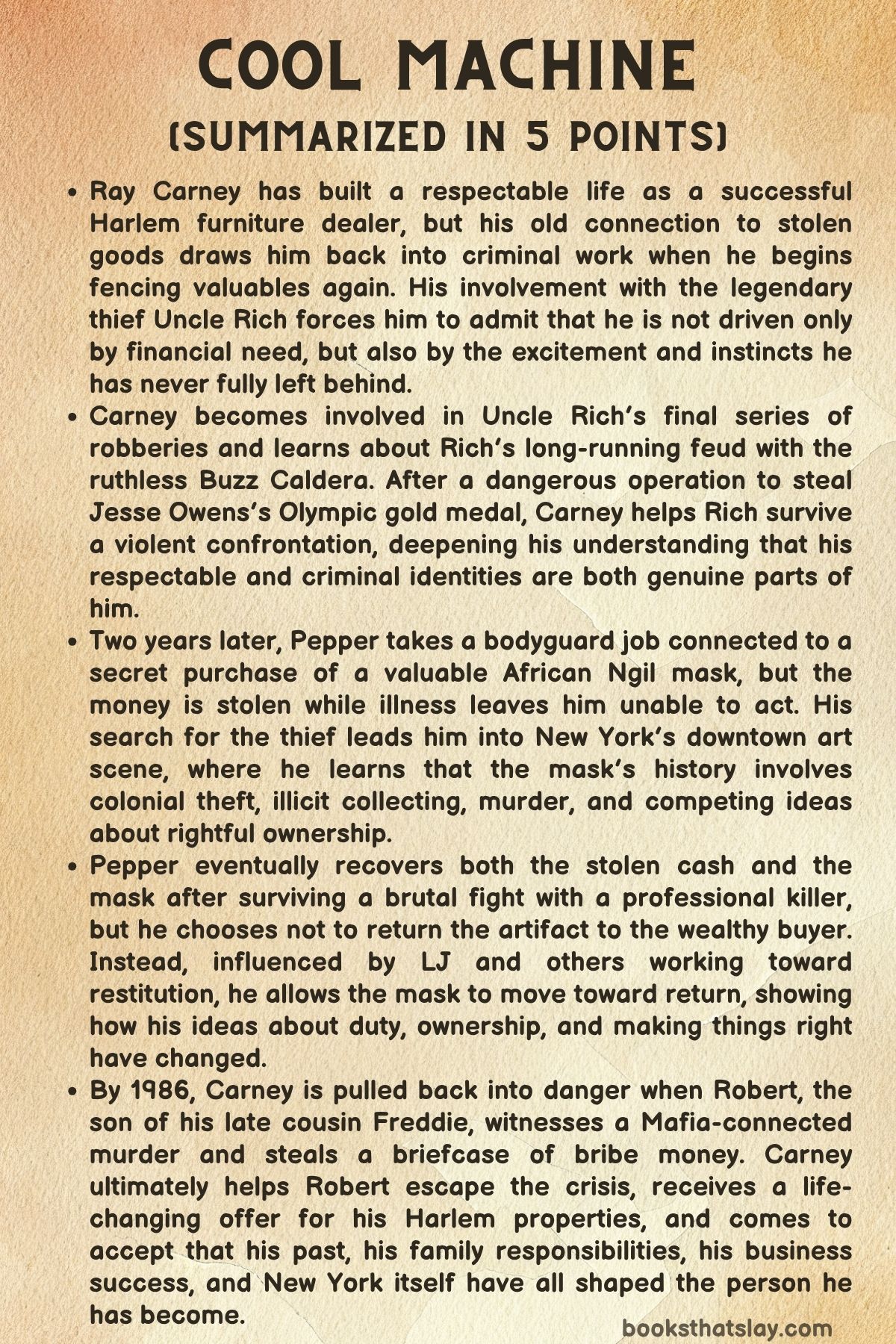
Across the early and mid-1980s, Carney, his wife Elizabeth, and the aging enforcer Pepper confront theft, corruption, organized crime, art trafficking, family obligation, and the cost of survival. The book is also a portrait of New York in constant transition, where neighborhoods, businesses, criminal networks, technologies, and social identities repeatedly change while people struggle to decide what parts of themselves can change with them. It’s the the final installment of his Harlem Trilogy after Harlem Shuffle and Crook Manifesto.
Summary
By 1981, Ray Carney has achieved the kind of respectability he once believed might permanently separate him from the criminal world. His furniture business is successful, his rebuilt store receives industry recognition, and his public image is that of a hardworking Harlem businessman who survived adversity through determination.
Yet the respectable version of Carney remains incomplete. His wife Elizabeth has started her own travel agency and proves highly capable, but banks repeatedly refuse to finance her expansion despite her qualifications, collateral, and strong credit.
Carney wants to help her, and he begins accepting illicit merchandise again. Although he tells himself that he needs the extra money for Elizabeth, the truth is less comfortable: criminal business still excites him.
A thief named Flinch Wilson brings Carney a valuable Cartier necklace and later introduces him to an older, highly sophisticated criminal calling himself Dwayne. Dwayne offers Carney expensive merchandise, including a remarkable sapphire, and Carney accepts the opportunity.
When Carney takes the sapphire to gem broker Martin Green, he discovers Green beaten and held by two armed men named Buzz Caldera and Orson. Buzz reveals that Dwayne is actually Uncle Rich, a legendary criminal who disappeared years earlier after a spectacular feud involving valuable sapphires.
Buzz orders Carney to lure Rich into a trap. Instead, Carney secretly contacts Rich and is guided through Harlem to a temporary headquarters where Rich and his crew are preparing a series of robberies.
Rich explains that he once believed the ideal criminal should operate like a muskrat: quietly, cleverly, and without seeking recognition. Years earlier, however, his vanity caused him to reveal himself to Buzz while planning a major Los Angeles jewel robbery.
Buzz betrayed him by carrying out the robbery early and taking the proceeds. Rich retaliated by stealing the stolen sapphires from Buzz, beginning a vendetta that has lasted for years.
Rich has now returned to New York to complete six final robberies before retiring. Before Carney can hear the full plan, Buzz’s men attack the headquarters, proving that they have followed Carney.
Rita, one of Rich’s younger associates, helps Carney escape. The violence forces Carney to recognize something he has avoided admitting: he did not return to fencing solely for Elizabeth’s benefit.
He could have supported her legally. He returned because the crooked side of life remains part of his appetite.
Rather than withdraw, Carney joins Rich on a robbery involving newly valuable communications cable. Rich sees technological change before most people do and understands that the infrastructure of the future can be as profitable as jewels.
Rich also reveals a more personal target: one of Jesse Owens’s 1936 Olympic gold medals, being held for an auction. For him, some robberies are simply money jobs, while others concern objects that possess meaning beyond their market price.
Carney agrees to join the operation. Rich’s crew enters the hidden infrastructure beneath Grand Central and reaches the Waldorf-Astoria through forgotten service routes.
They successfully acquire the medal, but Buzz has anticipated Rich’s movements. Underground, Buzz and his men trap the crew.
The confrontation turns when people living beneath the city intervene, creating enough confusion for Rich and Carney to escape. Buzz eventually corners Carney at gunpoint, but Carney distracts him with an absurd comment about a beautiful coffee table.
The strange diversion gives Rich enough time to shoot Buzz. Rich recognizes Carney’s trick as proof that Carney possesses the indirect, adaptive criminal instinct Rich admires.
Afterward, Rich disappears from Carney’s life. Carney returns to his business, but the experience leaves him unable to maintain the simple belief that he is either respectable or crooked.
Two years later, attention shifts toward Elizabeth and Pepper. Elizabeth has become a successful businesswoman and, while attending an art exhibition, becomes deeply interested in a painting by Diane Jackson showing a Black girl standing with her mother at a street corner.
Elizabeth originally intends to buy something for Carney but keeps the painting for herself. Her decision reflects an independence that has grown alongside her professional success.
Through her social connections, Elizabeth recommends Pepper for a bodyguard job protecting wealthy businessman Wade Patterson. Pepper, once known for remarkable physical toughness, is older now and increasingly troubled by poor health.
Patterson intends to make a secret cash purchase involving an African Ngil mask. During the transaction, a young man called Void steals Patterson’s briefcase containing about eighty thousand dollars.
At the worst possible moment, Pepper becomes violently ill. For a man whose identity depends on competence and physical control, losing the money is an intense humiliation.
Determined to repair the failure, Pepper searches for Void. A young woman named LJ offers to help him navigate the downtown art, music, and club scene.
Pepper initially finds her world strange, but he gradually realizes that the younger generation’s methods are not entirely unfamiliar. The fashions and language have changed, yet bargaining, opportunism, loyalty, and deception follow patterns he understands.
The case becomes more dangerous when Pepper learns that the Ngil mask has moved through an illicit art market shaped by questionable ownership and colonial theft. Before Pepper can recover the money from Void, he finds the young man murdered.
Pepper soon collapses because of his worsening illness, and LJ takes care of him. Their practical alliance slowly becomes a relationship based on trust and protection.
Meanwhile, a highly efficient professional killer is hunting everyone connected to the missing mask on behalf of wealthy businessman Jurgen Roos. Gallery dealer Nando Schmidt is murdered, LJ’s apartment is searched, and Pepper understands that their investigation has become potentially fatal.
LJ introduces Pepper to Aaron Flood, also known as Zippo, who is involved in efforts to return looted African cultural objects. Pepper has little patience for fashionable explanations, but the basic idea of restitution makes sense to him: if something was wrongly taken and can be returned, there may be an obligation to return it.
Pepper eventually locates the stolen mask in a rehearsal room connected to Void. The professional killer arrives at the same time.
A brutal fight follows. Pepper is older, sick, and physically diminished, but his decades of survival experience compensate for what he has lost in speed and strength.
He survives and recovers both Patterson’s money and the mask. Recovering the cash can restore his reputation, but the mask creates a moral decision that cannot be settled by the terms of his job.
Pepper ultimately gives the object to LJ so that it can enter the restitution process rather than return to private ownership. He decides that making something right matters more than completing the original transaction exactly as promised.
By 1986, Carney and Elizabeth have risen even further. Their businesses have prospered, their children have grown, and the couple can afford experiences that once would have seemed unreachable.
Yet age and memory increasingly shape Carney’s thinking. He begins having dreamlike encounters with his dead cousin Freddie, whose reckless life and death remain central to Carney’s unresolved guilt.
The past becomes immediate when Ellen, Freddie’s former lover, arrives with frightening news. Her son Robert, who is also Freddie’s son, has disappeared after the murder of his employer, attorney Edward Garrity.
Carney tracks Robert down and learns that the young man witnessed Garrity being murdered by Carmine Lombardi Jr. Garrity had been involved in corrupt political and business arrangements, and Robert knows enough to threaten the people behind them.
Robert is in even greater danger because he took a briefcase containing roughly one hundred thousand dollars in disputed bribe money. Carney realizes that hiding him cannot permanently solve the problem.
He turns again to Pepper, who has supposedly retired. Pepper agrees to help because Robert’s connection to the Carneys makes the crisis personal.
On the other side stands Carlo “Rabbit” Blasi, an aging Mafia enforcer and uncle to Carmine Lombardi Jr. Rabbit understands that his nephew’s impulsive murder has created a disaster that could attract law-enforcement attention and destroy the retirement Rabbit has spent years trying to reach.
Carney’s visions of Freddie grow increasingly severe. They force him to confront the fact that he cannot repair Freddie’s life by saving Freddie’s son, yet he still feels compelled to act differently from the way he once did.
Rather than attack Lombardi as a gangster, Carney approaches him as a salesman. He returns the stolen money and attempts to persuade Junior that accepting repayment is more sensible than creating additional murders.
Junior refuses. He still intends to kill Robert and Carney.
Before Junior can carry out his plan, Rabbit shoots his own nephew. Junior’s recklessness has become a greater threat to Rabbit than family loyalty can justify.
Robert survives and leaves New York for California. Carney gives him money and the opportunity to begin again.
Soon afterward, Carney and Elizabeth receive an enormous offer for their Harlem properties from Van Wyck Realty. After years of watching thieves and hustlers chase life-changing scores, Carney discovers that his largest financial reward may come from patient property ownership rather than crime.
The money could allow the couple to retire almost anywhere, but Carney cannot easily imagine leaving New York. By the end, he no longer treats the businessman and the criminal as two unrelated versions of himself.
Both belong to the same life. His final understanding is not that he escaped the city or his past, but that New York’s ambition, danger, reinvention, corruption, energy, and constant change helped create the man he became.
Characters
Ray Carney
Ray Carney is the central figure through whom Cool Machine examines respectability, criminal instinct, family duty, and self-knowledge. He has spent much of his adult life constructing a legitimate identity as a successful furniture dealer, but his pride in that achievement repeatedly collides with the fact that he still understands and enjoys the hidden economy of thieves, fences, corrupt businessmen, and professional criminals.
His most important development comes from abandoning the excuse that crime merely happens to him because of family pressure or financial need. When he returns to fencing while trying to help Elizabeth, he eventually admits that legitimate money was available and that excitement played a major part in his choice.
Carney is also driven by responsibility toward other people. His willingness to risk himself for Robert is tied to guilt over Freddie, but the decision becomes larger than guilt: he wants to prove that he is capable of choosing responsibility even when failure is possible.
By the end, Carney does not purify himself by eliminating one side of his personality. His maturity comes from accepting that the salesman, father, husband, businessman, fence, strategist, and survivor have always belonged to the same person.
Elizabeth Carney
Elizabeth Carney is far more than the stabilizing wife of a complicated husband. Her successful creation of Carney Travel establishes her as an ambitious, intelligent entrepreneur who faces barriers created by racism and sexism without allowing those obstacles to define the limits of her aspirations.
Her difficulty obtaining financing is especially important because it complicates the idea that respectable success automatically produces fairness. Elizabeth does everything expected of a responsible business owner and is still denied opportunities that weaker applicants might receive.
She also possesses a private interior life that Carney cannot completely access. Her decision to keep Diane Jackson’s painting for herself rather than give it to Ray suggests that marriage does not erase individual identity.
Elizabeth therefore parallels her husband in an important way. Both have parts of themselves that remain private, although her secrecy grows from emotional independence rather than criminal activity.
Pepper
Pepper is one of the most revealing characters in Cool Machine because his aging body forces him to reconsider an identity built almost entirely around competence, toughness, and survival. For decades, he has handled dangerous situations through physical confidence and an instinctive understanding of violence.
His illness during Patterson’s assignment is devastating because it attacks the foundation of that identity. Losing the briefcase is not simply a failed job; it tells Pepper that his body no longer obeys the rules by which he has lived.
His relationship with LJ gradually reveals qualities that his hard exterior normally conceals. He becomes protective of her, accepts her knowledge when it proves useful, and eventually respects a moral argument that he initially regards as art-world foolishness.
Returning the Ngil mask through restitution rather than giving it back to Patterson demonstrates genuine development. Pepper still values professional responsibility, but he becomes capable of deciding that a larger obligation can outweigh the narrower terms of a paid assignment.
Uncle Rich
Uncle Rich, initially known to Carney as Dwayne, represents professional criminality practiced as craft, philosophy, and personal identity. His muskrat metaphor captures his belief that the best criminal succeeds through observation, patience, indirection, and an absence of unnecessary vanity.
Yet Rich’s own history demonstrates the danger of violating that philosophy. His decision to reveal himself to Buzz is an act of pride, and that single choice produces years of pursuit and danger.
Rich also introduces Carney to the distinction between theft for profit and theft involving personal meaning. The cable robbery is valuable because Rich understands the future economic importance of communications infrastructure, while Jesse Owens’s medal matters because it carries symbolic weight that cannot be reduced to a resale figure.
His disappearance after Buzz’s death is consistent with his deepest values. Rich does not seek a public final triumph; he simply leaves, allowing the legend to remain behind while the man escapes.
Rita
Rita initially challenges Carney’s assumptions because he underestimates her. During the attack on Rich’s headquarters, she reveals herself as capable, disciplined, and dangerous, guiding Carney through a situation in which hesitation could be fatal.
Her presence also broadens the book’s idea of what a professional criminal looks like. She is not treated as an accessory to male criminals but as an operational member of Rich’s crew with practical responsibilities.
Her later return as a pregnant woman shopping for a crib gives her character additional meaning. To strangers she appears to belong entirely to an ordinary domestic future, while Carney knows that this surface identity coexists with memories of gunfire, robbery, and criminal work.
Rita therefore becomes evidence for one of Carney’s final realizations: people can move into new lives without erasing the earlier selves that helped create them.
Jeff
Jeff is presented as technically skilled, disciplined, and intellectually capable. His important role in opening the safe during the Waldorf operation shows that serious criminal work in the story depends on specialized knowledge as much as force.
Along with Rita, Jeff disrupts Carney’s inherited expectations about professional thieves. His background and technical competence suggest a generation of criminals shaped by different politics, technologies, and forms of expertise.
Jeff’s value to Rich’s crew comes from precision rather than spectacle. He demonstrates that the criminal world changes alongside the legitimate economy, requiring new kinds of knowledge from those who hope to survive inside it.
Cliff
Cliff is less individually developed than Rita or Jeff, but his place in Rich’s crew helps establish the collective professionalism surrounding Uncle Rich. He participates in the group’s preparations, confinement, conversation, and criminal work as part of a team that operates with the familiarity of coworkers who know one another’s habits.
His presence matters most in the atmosphere he helps create. Through Cliff and the other crew members, Carney briefly experiences criminal belonging as something almost ordinary, making his attraction to that life easier to understand.
Buzz Caldera
Buzz Caldera is Uncle Rich’s most dangerous opposite. He shares Rich’s professional criminal background but lacks Rich’s preference for restraint, indirect action, and controlled ego.
His original betrayal of Rich begins when he carries out their planned robbery without him. The act establishes Buzz as a man who treats partnership as disposable whenever personal advantage becomes available.
His long pursuit of the stolen sapphires reveals both persistence and obsession. Buzz does not merely want property returned; he wants to settle a wound to pride and dominance.
His death is therefore fittingly produced by the very kind of lateral thinking he fails to respect. Carney’s ridiculous coffee-table distraction defeats a man who expects danger to arrive in a more obvious form.
Orson
Orson functions mainly as Buzz’s armed associate and helps establish the immediate danger surrounding Martin Green and Carney. His presence turns Buzz’s threats into something concrete because Carney can see that Buzz commands people willing to carry out violence on his behalf.
Although the book gives Orson less individual psychological development, he represents the structure that makes powerful criminals dangerous. Men such as Buzz do not operate only through personal brutality; they maintain networks capable of extending their reach into other people’s lives.
Martin Green
Martin Green occupies the unstable border between respectable ambition and criminal opportunity. As Carney’s gem broker, he helps convert illicit valuables into usable money, making him part of the system that allows stolen property to move toward legitimate markets.
The beating he receives from Buzz’s men exposes the physical consequences hidden behind apparently controlled fencing arrangements. Green and Carney both realize that they became careless because profit encouraged them to ignore questions about where the sapphire came from.
Green’s response differs from Carney’s. The experience convinces him that his criminal involvement threatens the suburban, respectable future he wants, and he appears ready to leave that world.
He therefore serves as a useful contrast with Carney, who reaches the same understanding about danger and responds by going deeper.
Flinch Wilson
Flinch Wilson is the small-time thief who opens the path back into serious criminal work for Carney. His questionable story about the Cartier necklace is so obviously unreliable that Carney’s willingness to purchase it exposes Carney’s own responsibility for what follows.
Flinch matters less as an individual personality than as a test. Carney could reject the necklace and return fully to legitimate business, but he chooses otherwise.
Through that choice, the book shows that major consequences often begin with small permissions people give themselves. Flinch does not force Carney back into fencing; he merely provides the opportunity Carney is already prepared to accept.
LJ
LJ initially appears to Pepper as a representative of a younger downtown culture he finds irritating and difficult to read. Her clothes, language, social networks, and familiarity with clubs place her inside a New York that has developed beyond Pepper’s usual territory.
Yet her bargaining ability immediately earns some of his respect. He realizes that beneath unfamiliar surfaces she understands exchange, leverage, risk, and survival.
LJ also becomes the person who expands Pepper’s understanding of the stolen Ngil mask. Through her connections to restitution efforts, the object becomes more than expensive property involved in a failed transaction.
Her care for Pepper after his collapse is equally important. The older enforcer begins the case believing he should be the protector, but LJ becomes the person who protects him when his body fails.
Wade Patterson
Wade Patterson is wealthy, arrogant, and accustomed to having money solve practical problems. His secret attempt to purchase the Ngil mask demonstrates how elite respectability can coexist comfortably with markets dependent on questionable legality and ownership.
Patterson is primarily concerned with completing a purchase and recovering his money. His position reduces the mask to an object of possession and financial value.
This makes him an important contrast with the restitution argument that develops later. He may have the money to purchase the artifact, but the story asks whether financial ability alone can create moral ownership.
Void
Void is the young downtown figure whose theft of Patterson’s briefcase triggers Pepper’s investigation. At first he seems like an opportunistic thief who has chosen the wrong victim at the wrong moment.
His murder changes the meaning of his role. Void becomes evidence that the struggle surrounding the mask involves people with resources and methods far beyond ordinary street theft.
His connection to music later helps Pepper discover the hiding place. Even after death, details of Void’s identity matter because Pepper succeeds by thinking about where a drummer might choose to conceal something important.
The Melancholy Hitman
The professional killer pursuing the mask is defined by a strange contrast between emotional emptiness and occupational efficiency. He experiences life through deep melancholy, yet violence gives him a temporary field in which procedure, control, and expertise take over.
His conflict with Pepper creates a confrontation between two generations of professional violence. The younger man has physical advantages, while Pepper possesses accumulated instinct and a willingness to use every part of the environment.
The killer’s character also prevents professional competence from being romanticized. His skill has not produced fulfillment, meaning, or peace; it has made him effective without making him whole.
Jurgen Roos
Jurgen Roos represents the wealthy end of the criminal chain surrounding the Ngil mask. Unlike street thieves or hired muscle, he can distance himself from direct violence by purchasing the services of someone else.
His power comes from money, which allows retaliation to be treated as an administrative decision. People can be threatened or killed because he wants property recovered and wants his reputation protected.
Roos therefore complicates the distinction between respectable wealth and criminal brutality. The violence may occur far from him, but his financial authority makes it possible.
Nando Schmidt
Nando Schmidt is a frightened gallery dealer caught between money, art, and dangerous clients. He tries to discuss the missing mask as though the problem can be repaired through refunds, markups, and business arrangements.
His fear reveals that financial language cannot protect him from the consequences of the trade in which he participates. Once killing begins, his position as a supposedly respectable intermediary becomes meaningless.
Schmidt’s murder demonstrates that middlemen often benefit from morally questionable systems while believing they remain safely removed from their harshest consequences. The book strips away that illusion.
Aaron Flood, or Zippo
Aaron Flood, known from his earlier life as Zippo, is shaped by artistic ambition, experimentation, compromise, and regret. His involvement in restitution grows partly from his recognition that he participated in cultural systems he later came to question.
His importance lies in what he does with regret. He does not pretend that later good actions can erase earlier choices, but he uses his money and connections to change what happens next.
That principle becomes meaningful to Pepper because it converts moral theory into action. Restitution is no longer abstract when it means taking an object out of another private collection and helping it move toward the community from which it was removed.
Freddie
Freddie is dead during the 1986 events, but he remains one of the strongest emotional forces in Carney’s life. He represents childhood attachment, family loyalty, recklessness, criminal temptation, failure, and unresolved grief.
Carney’s imagined encounters with Freddie reveal that success has not settled their relationship. Carney still wants to defend his own choices, apologize for his failures, and imagine that a different decision might have saved his cousin.
The final visions are especially important because they force Carney to admit the limits of responsibility. Loving someone does not give one person complete power over another person’s fate.
Saving Robert cannot rewrite Freddie’s story. What Carney can do is make a different choice when another family member stands in danger.
Robert
Robert carries some of Freddie’s recklessness while also receiving a possibility Freddie never secured for himself. His employment with Garrity places him close enough to corruption that he becomes both witness and participant.
Taking the briefcase of bribe money makes his situation considerably worse. He is no longer merely an innocent observer who saw a murder; he has made a dangerous decision of his own.
Yet Robert also demonstrates the ability to follow advice when survival demands it. He hides, listens to Carney, and eventually leaves New York rather than returning to the environment that nearly destroys him.
His escape to California gives the family history an alternative ending. He does not have to repeat his father’s path simply because he inherited some of the same impulses.
Ellen
Ellen connects Carney’s unresolved past with Robert’s immediate crisis. As Freddie’s former lover and Robert’s mother, she brings Carney information he cannot dismiss without confronting what family obligation means to him.
Her fear is grounded in practical danger rather than nostalgia. She knows her son is missing after a murder and turns to someone who understands both respectable Harlem life and its criminal underside.
The attack on her apartment further demonstrates that Robert’s situation threatens everyone around him. Ellen’s vulnerability increases the moral pressure on Carney and Pepper to act.
Edward Garrity
Edward Garrity is dead before much of the 1986 investigation unfolds, but his activities create the crisis. As an attorney involved in political favors, cash transfers, and questionable associates, he occupies the space where public institutions, private business, and corruption meet.
His murder occurs because the relationships he helped manage are built on money and coercion rather than trust. Once one part of the arrangement fails, professional negotiation is replaced by violence.
Garrity’s death also exposes Robert to a world he had only partially understood. Working near corruption may appear manageable until the rules protecting its participants suddenly collapse.
Carmine Lombardi Jr.
Carmine Lombardi Jr. is dangerous largely because he mistakes aggression for control. He wants the status and profit of modern legitimate business while retaining the violent habits inherited from organized crime.
His company, Viso-Tech, benefits from the growing communications economy, showing that Junior is not simply an old-fashioned gangster. He understands where money is moving, but he lacks the discipline required to protect what he has built.
Killing Garrity creates the very exposure that experienced criminals try to avoid. His insistence on killing Robert and Carney compounds the original mistake.
Junior’s death at Rabbit’s hands therefore results from his inability to understand limits. Family protection can cover many failures, but not when one man’s recklessness threatens everyone around him.
Carlo “Rabbit” Blasi
Rabbit is a brutal professional whose age has changed his ambitions without making him gentle. He has spent years around organized crime and understands that survival often depends on avoiding unnecessary attention rather than proving one’s toughness.
His deepest goal is remarkably ordinary: he wants to retire with enough money to enjoy the years he has left. Junior’s behavior threatens that future.
Rabbit’s decision to kill his nephew is terrible but internally consistent. He concludes that continued loyalty to Junior would likely produce more deaths, federal scrutiny, and the destruction of his own future.
He therefore mirrors Pepper in an unsettling way. Both are aging men shaped by violence, both are pulled back into dangerous situations by younger people, and both eventually make choices based on what kind of life they still hope to preserve.
Henry Pierce
Henry Pierce represents a younger generation inheriting institutions built by older men. As the son of Carney’s late lawyer and friend Calvin Pierce, he provides Carney with information about the political and business corruption surrounding Garrity and Lombardi.
His role demonstrates that corruption does not simply disappear when personalities change. New professionals inherit systems, connections, compromises, and expectations created long before they entered the room.
Henry is useful to Carney because he can interpret a newer political environment that Carney no longer understands as naturally as he once did.
John and May Carney
John and May remain relatively distant from the central criminal events, but their lives measure the success Carney and Elizabeth have achieved as parents. John is working at UMass, while May is able to travel in France, possibilities that stand far from the instability of Carney’s own childhood.
Their independence also changes Carney’s emotional situation. As his children establish adult lives elsewhere, he is forced to think more directly about aging, marriage, retirement, and who he is when he is no longer occupied with raising them.
The limited space given to their personal conflicts is itself meaningful. Carney has worked to create a life in which his children’s futures do not have to revolve around the dangers that shaped his own.
Ramona
Ramona is Robert’s girlfriend and initially matters because her existence reveals that Ellen does not know everything about her son’s life. Like several relationships in the story, Robert’s connection with Ramona demonstrates that adulthood creates private spaces even inside close families.
Her eventual decision to leave New York with Robert strengthens the possibility of a genuine break with the past. Together they choose distance rather than returning to the same pressures and relationships that endangered him.
Blossom
Blossom is only briefly discussed, but her importance lies in what she reveals about Pepper. By 1986, Pepper is no longer the solitary man whose identity can be reduced to violent work.
He now has attachments, places where he belongs, and people he wants to return to. Blossom therefore helps explain why age changes the meaning of risk for him.
Survival matters differently when a person has built relationships that give survival a destination.
Daily Newz
Daily Newz appears near the end of the art-centered section as a graffiti artist searching Manhattan for a wall on which to create another headline. His belief that the whole city is a newspaper turns urban space into a record of ordinary people, public events, vandalism, art, and historical change.
He reinforces the idea that New York is constantly being written over without ever becoming completely new. Buildings, signs, paintings, crimes, businesses, and reputations all become temporary marks on a city that will soon produce another version of itself.
Themes
Respectability, Criminality, and the Divided Self
Carney’s life repeatedly challenges the idea that respectability and criminality can be placed into separate moral compartments. In Cool Machine, his furniture business, family home, professional awards, and financial success are genuine achievements, but they do not erase the skills, pleasures, instincts, and relationships developed through fencing stolen property.
The crucial issue is not that Carney secretly remains a criminal beneath a false respectable exterior. That interpretation would simply replace one oversimplification with another.
Both identities are real. He genuinely loves legitimate business, takes pride in selling furniture, supports his family, and values what he has built, while also enjoying the calculation and danger involved in crooked work.
His development therefore requires self-recognition rather than purification. The muskrat idea interests him because it names a quality he already possesses: the ability to move indirectly, understand hidden systems, and find solutions other people overlook.
His final confrontation with Lombardi is especially revealing because Carney survives not by choosing between businessman and crook but by using the habits of both. He enters as a salesman while fully understanding the criminal logic governing the room.
The book consequently treats identity as cumulative. Earlier selves do not disappear when circumstances improve; maturity depends on deciding how those selves will be used.
Value, Ownership, and Restitution
Money constantly determines how objects are treated, yet the story repeatedly asks whether price can actually explain value. Uncle Rich separates ordinary money jobs from thefts involving objects with personal or historical meaning, making Jesse Owens’s medal important for reasons no resale figure can fully describe.
The Ngil mask pushes this question further because its market price exists beside a history of colonial extraction. Patterson can afford to purchase it, collectors can assign it prestige, dealers can add markups, and criminals can kill to control it, but none of those actions automatically establish rightful ownership.
Pepper begins with a straightforward professional equation: Patterson lost money while under his protection, so recovering the money will repair the failure. His thinking changes as he understands that the mask itself represents an older loss.
Restitution then becomes a different form of repayment. Giving the mask back to Patterson would satisfy a contract, while sending it toward return addresses a historical wrong that existed before Patterson entered the story.
Even Carney’s furniture obsession contributes to the theme. A coffee table can be ridiculous, beautiful, useful, collectible, or emotionally significant depending on who sees it.
Value is therefore presented as a relationship between objects, history, memory, desire, and obligation rather than a number attached to a sale.
Aging, Survival, and the Changing Meaning of Strength
Age changes the goals of characters who once measured themselves by danger. Pepper’s body becomes the clearest example because illness and injury confront him with limits that no amount of toughness can permanently defeat.
His collapse during Patterson’s assignment humiliates him precisely because his identity has depended on physical reliability. Later, defeating the younger hitman proves that Pepper remains dangerous, but the victory does not magically restore youth.
Rabbit experiences aging from a different position. He is still capable of terrible violence, yet his main ambition is no longer criminal glory.
He wants to collect his pension, retire, and survive long enough to enjoy what he has accumulated. Junior’s reckless violence threatens that modest future more than any rival criminal empire does.
Carney also faces age through quieter changes. His children are adults, longtime employees are retiring or slowing down, and he begins to consider whether the furniture business that structured his adulthood is approaching its final stage.
Strength gradually becomes less connected to domination and more connected to judgment. Pepper learns when returning an object matters more than obeying a client, Rabbit chooses survival over destructive family loyalty, and Carney accepts that he cannot control everyone he loves.
The older characters remain capable of action, but experience teaches them that knowing what not to pursue can be as important as winning.
New York, Change, and Reinvention
New York is never merely the location of the story. Its changing neighborhoods, businesses, technologies, art scenes, criminal networks, political systems, and social classes continually force the characters to reconsider the knowledge by which they once navigated life.
Pepper feels this most strongly while searching the East Village. Styles and cultural codes initially make the younger downtown world appear almost foreign to him, but he gradually recognizes familiar patterns beneath unfamiliar surfaces.
Carney experiences the same process in Harlem and in the criminal world. Old bars disappear, corrupt police networks change, new forms of political corruption develop, communication technology creates new fortunes, and once-familiar neighborhoods adopt defensive habits suited to a harsher era.
Yet the city does not simply replace old systems with new ones. Older forms survive inside modern structures.
Viso-Tech represents technological progress while depending partly on kickbacks and criminal connections. Expensive art circulates through elite galleries while carrying histories of theft.
Carney’s eventual refusal to imagine another city as a true replacement for New York therefore comes from recognition rather than simple nostalgia. The city has frustrated, endangered, rewarded, and educated him.
Its constant reinvention mirrors his own life: change does not erase what came before but builds another layer over it.