Wrath of the Dragons Summary, Characters and Themes
Wrath of the Dragons by Olivia Rose Darling is an epic fantasy romance centered on Elowen and Cayden as they move from damaged trust and political necessity toward a marriage they actively choose, all while preparing for war against the rulers who shaped their lives through cruelty.
Dragons, ancient gods, dormant magic, royal succession, rebellion, and competing kingdoms give the story its large political scale, but its emotional core remains deeply personal. Elowen must decide what kind of queen she wants to become, while Cayden must learn that protecting someone requires vulnerability as much as violence. Their victory eventually comes at a devastating cost that transforms the story into a confrontation with death itself.
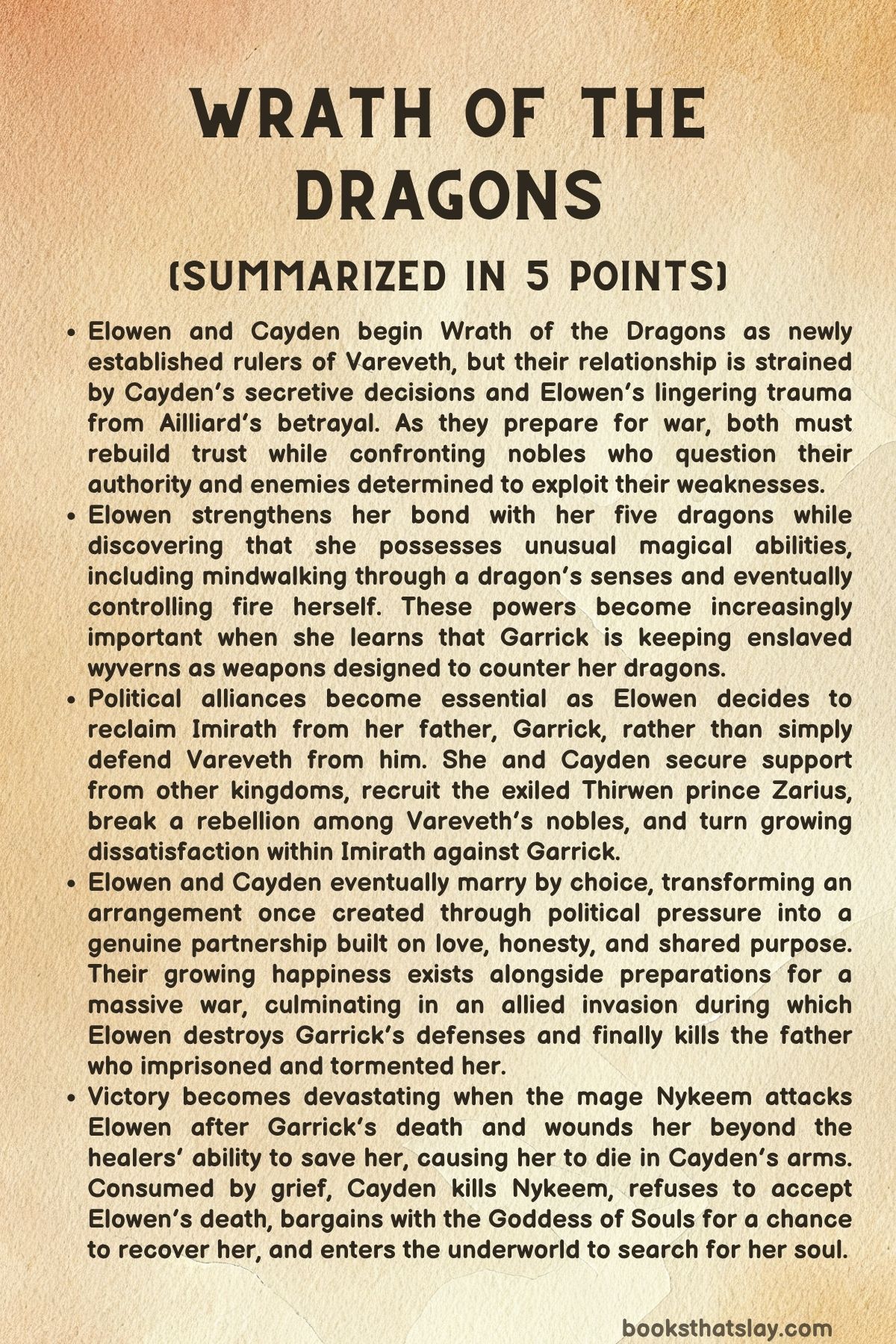
Summary
Cayden begins his rule of Vareveth under immediate pressure from nobles who regard him as a usurper. He refuses to behave like the easily manipulated king who preceded him, openly threatening Lord Xantheus when the noble insults Elowen and making it clear that House Veles will not tolerate attacks on its future queen.
Elowen, meanwhile, is struggling after Ailliard’s betrayal and death. She hides her pain behind humor, wedding preparations, and plans to celebrate the birthdays of the five dragons whose childhoods she missed, but Cayden recognizes that she needs somewhere to exist without performing strength for others.
He secretly provides her with a cottage in Ladislava where she can read, work with healing herbs, study dragons, or simply be alone. The gesture affects Elowen because it gives her something she has rarely possessed: a space belonging entirely to her, without expectations attached.
Cayden has his own methods of dealing with guilt. He returns to the underground fighting ring he owns beneath the Demon’s Den and fights as the Viper, deliberately accepting pain because physical punishment temporarily quiets the memories of how badly he has hurt Elowen.
Their relationship remains strained because Elowen sees Cayden’s marriage clause as another form of manipulation imposed when she was emotionally vulnerable. Cayden insists that he acted to keep Garrick from reclaiming her and because he genuinely wants a future with her, but Elowen cannot simply ignore the fact that he withheld information capable of determining the course of her life.
Gradually, they begin rebuilding what was damaged. Cayden helps treat the injuries Ailliard left on Elowen, gives her a sapphire ring connected to his past, and begins showing through everyday choices that he is willing to change rather than merely make dramatic promises.
Elowen spends increasing amounts of time training with Calithea, Venatrix, Sorin, Delmira, and Basilius. She refuses to view them as disposable weapons, remembering that they were imprisoned and tortured because of their bond with her and deciding that revenge will never justify treating their lives as sacrifices.
Her distrust of old loyalties deepens when Jarek, Esme, Nessa, and Zander are captured. They admit that they never truly intended to oppose Garrick and withheld information from Elowen even while she desperately searched for her imprisoned dragons, forcing her to accept that many relationships she once considered safe were built on silence and divided loyalties.
As the political conflict expands, Elowen and Cayden prepare Vareveth for war against Garrick’s Imirath and the allied kingdom of Thirwen. Elowen’s status as Garrick’s legitimate heir becomes increasingly important because discontented soldiers and citizens may prefer her claim to his continued reign.
The couple travels to Aestilian to evacuate survivors, and Elowen discovers that the people there still recognize her as their ruler. Their public loyalty proves that her authority does not depend solely on inherited blood or possession of a throne; people who know what she endured have chosen her because of the person she became.
Returning to her former Aestilian home forces Elowen to face the influence Ailliard still holds over her thoughts. She ultimately burns his belongings, choosing not to preserve reminders of a man whose manipulation taught her to distrust her own judgment.
Cayden and Elowen finally speak honestly about why their relationship broke down. He begins to understand that secrecy can make Elowen emotionally unsafe even when his intentions are protective, while she admits that part of her fear comes from believing that every person she loves will eventually betray her.
Their progress is interrupted when netherwraiths attack Aestilian during the evacuation. Elowen, Cayden, Finnian, Ryder, Saskia, and the dragons fight to keep civilians alive long enough to escape through a portal, revealing that the coming conflict may involve dangers far older and stranger than the political war between kingdoms.
Back in Vareveth, captured Imirath soldiers are offered a choice between Garrick and Elowen. Several swear blood oaths to her, creating the possibility that opposition to Garrick can spread through his own military and making Elowen’s eventual return to Imirath far more realistic.
Garrick responds by preparing to remarry, potentially producing another heir who could weaken Elowen’s succession claim. Rather than allowing others to decide her future, Elowen eventually makes the choice herself: she will claim Imirath and end Garrick’s rule.
That decision follows one of the most important developments in her relationship with Cayden. After discovering him fighting at the Demon’s Den, Elowen demands the same openness he expects from her, and Cayden finally tells her about his abusive childhood, his mother’s death, his violent escape, and the survival instincts that shaped the man he became.
Understanding his history changes Elowen’s view of his secrecy and violence without erasing his mistakes. At Veles Manor, the sapphire ring is revealed as one of the few surviving connections to Cayden’s mother, and Elowen understands that giving it to her was an act of extraordinary trust.
Cayden then proposes again, this time without political pressure or legal conditions. Elowen accepts because she is making the decision freely, turning a marriage once created through necessity into one grounded in mutual choice.
Their political problems continue when evidence reveals that Lord Xantheus and other Vareveth nobles are conspiring with Thirwen. Elowen chooses public exposure rather than secret executions, allowing citizens and soldiers to see the evidence before Cayden destroys the conspiracy and forces the remaining noble houses to declare where their loyalty lies.
At the same time, Elowen discovers that her unusual connection with the dragons may be part of a larger magical inheritance. With Cayden acting as her anchor during a dangerous ritual, she enters Basilius’s mind and sees through his eyes, discovering that Garrick is keeping wyverns captive for use against her dragons.
Her awakening powers continue developing as wedding preparations proceed. Elowen and Cayden finally marry through ancient blood rites involving the sleeping gods, and mysterious golden markings appear afterward, suggesting that their vows have created a bond extending beyond ordinary marriage.
The wedding also brings diplomatic opportunities. Feynadra agrees to neutrality, while information from Prince Hale and Princess Lethia introduces Zarius, a disinherited Thirwen prince who could replace King Fallon and destroy Garrick’s alliance from within.
Before those plans can mature, Vareveth launches an assault near Port Celestria. Enslaved wyverns are forced into battle against Elowen’s dragons, and Cayden is nearly killed by a magical explosive.
Elowen participates in a dangerous ritual to save him and discovers that her magical abilities are much stronger than she imagined. After Cayden stabilizes, she uses dragonfire to tear apart enemy wards and publicly declares that she is coming for Garrick’s throne.
The couple then travels toward Galakin in search of military support. Their voyage gives them time to resolve lingering fears, and Cayden finally admits that he loves Elowen so completely that losing her terrifies him more than death.
In Galakin, they locate Zarius and his protector, Ser Rhys Froydin. Zarius is disillusioned and dependent on alcohol, but he possesses a legitimate claim to Thirwen and powerful illusion magic, making him central to their plan to remove Fallon.
Negotiations with Galakin are difficult because Queen Cordelia once expected Elowen to marry Prince Zale. Nevertheless, Elowen begins training her own fire magic with Zale, while Cayden uses far less conventional methods to force King Erix into an agreement involving ships, trade, and military cooperation.
A seer named Mae gives Elowen warnings suggesting that the conflict surrounding her reaches beyond Garrick. Elowen later discovers an ancient temple where starfire responds directly to her presence, strengthening the possibility that her birth, dragons, and growing power are connected to ancient divine forces.
Thirwen then attacks Galakin. Zarius begins accepting the responsibilities of kingship by persuading captured soldiers to swear themselves to him and executing those who refuse, while Galakin formally joins House Veles in the war.
During the voyage back, Zarius demonstrates that his illusion magic can conceal an entire fleet. The alliance also encounters a kraken that strangely spares Elowen while attacking enemy ships, adding another unexplained sign that ancient creatures respond differently to her.
When the allied armies finally approach Imirath, Elowen discovers that Garrick’s citizens have not forgotten her. Blue ribbons and House Veles banners appear throughout the settlements, and people welcome the woman Garrick spent years portraying as a dangerous traitor.
The final battle begins with Cayden using Zarius’s illusions and the cult mages to conceal an enormous trench, destroying much of the enemy cavalry before his own soldiers suffer major losses. Elowen attacks from the air, joined unexpectedly by rebels from the Southern Isles who have also turned against Garrick.
She reaches Imirath’s castle and destroys its defenses with her dragons. After breaking through the magical ward protecting Garrick, Fallon, and the remaining royals, she isolates her father and finally confronts the man who imprisoned and brutalized her.
Elowen kills Garrick and brings his reign to an end. Yet her victory immediately turns disastrous when Nykeem attacks her magical connection with Sorin and uses glowing projectiles to wound her during the battle.
Sorin catches Elowen after she falls from the sky, but her injuries cannot be healed. Cayden reaches her and desperately describes the ordinary future they were supposed to share, but Elowen dies in his arms despite every effort to save her.
Her death awakens dormant power within Cayden. Shadows and water answer his rage, and he uses them to destroy Nykeem before returning to Elowen’s body, completely unable to accept that winning the war should mean losing the person for whom that victory mattered.
When others begin discussing funeral rites, Cayden refuses. He carries Elowen to an ancient temple, summons the Goddess of Souls, Mercy, and Destiny, and demands a way to retrieve her.
The goddess offers him a terrible bargain. Elowen’s soul exists somewhere within the ten levels of the underworld, and Cayden may search for her, but failure will leave him trapped there forever.
He accepts immediately, kills his own mortal body with Elowen’s dragon dagger, and awakens at the gates of the underworld. The book ends with Cayden raising his sword against whatever waits in the darkness and beginning a journey through death itself to find the woman he refuses to surrender.
Characters
Elowen Veles
Elowen is the emotional and political center of Wrath of the Dragons. She begins the book carrying the consequences of imprisonment, betrayal, lost childhood years with her dragons, Ailliard’s manipulation, and the knowledge that Garrick has spent much of her life trying to control or destroy her.
Her strongest quality is not fearlessness but her refusal to let fear make every decision for her. She repeatedly questions herself, particularly when memories of Ailliard convince her that she may be misjudging Cayden or that Garrick’s blood could eventually shape her into someone cruel.
Her development as a ruler is equally important. Elowen learns that leadership is not proven by possessing a crown but by gaining loyalty, protecting civilians, understanding public opinion, negotiating realistically, and accepting responsibility for the lives affected by her choices.
Her relationship with her dragons also reveals her moral boundaries. She loves them as individuals rather than as extensions of her power and refuses to sacrifice them casually even when destroying Garrick remains one of her greatest goals.
Magic changes Elowen’s understanding of herself without replacing her practical abilities. She remains a healer, rider, fighter, strategist, and political negotiator even after discovering mindwalking, independent fire magic, unusual ritual powers, and a connection to ancient forces.
Her final confrontation with Garrick completes her transformation from imprisoned daughter to sovereign queen. The tragedy is that she achieves the freedom she fought for only to be killed by Nykeem moments later, leaving her future unresolved in the mortal world but potentially recoverable through Cayden’s journey into the underworld.
Cayden Veles
Cayden is one of the most complicated figures in Wrath of the Dragons because love, violence, control, loyalty, trauma, and ambition all coexist within him. He is capable of extraordinary tenderness toward Elowen while also responding to threats with brutality that few other characters can match.
His childhood explains much of his behavior without excusing every choice. Abuse taught him that vulnerability creates opportunities for others to hurt him, while survival through theft, fighting, assassination, and criminal work taught him that control is safer than trust.
That worldview produces the central mistake in his relationship with Elowen. Cayden believes securing her through the marriage clause is an act of protection, but he eventually understands that making decisions for her recreates the very powerlessness from which she is trying to escape.
His growth appears most clearly when he begins choosing restraint. He refuses intimacy when Elowen wants to use it to avoid emotional conflict, allows her to make political decisions he would handle more violently, and finally reveals the childhood memories he has spent years refusing to discuss.
Cayden is also a capable ruler because his brutality is accompanied by intelligence. His intelligence network, knowledge of ordinary soldiers, criminal connections, military instincts, and understanding of public legitimacy allow him to defeat enemies through planning rather than strength alone.
Elowen’s death destroys the emotional balance he has only recently learned to accept. His newly awakened magic becomes an expression of grief, and his decision to enter the underworld confirms the defining truth of his character: once Cayden gives someone his loyalty, he considers even death an obstacle rather than an ending.
Finnian
Finnian represents one of Elowen’s most durable chosen-family relationships. Their connection predates much of the royal and military conflict, and he understands her as a person rather than primarily as a queen or dragon rider.
His gratitude toward Elowen reveals that their relationship has saved both of them in different ways. He sees her not simply as someone he must protect but as the person who helped give his life purpose after his own childhood losses.
Finnian also brings emotional warmth to the central group. His loyalty is unquestioned, but he retains enough humor and familiarity with Elowen to prevent their relationship from becoming stiff simply because her political status increases.
His reaction to betrayal and danger shows how personally he takes threats against her. He is part friend, part family, and part warrior, embodying the kind of bond Elowen chooses for herself after blood relatives repeatedly fail her.
Ryder
Ryder is one of Cayden’s oldest companions and therefore provides important evidence that Cayden possessed compassion long before he was willing to admit it. His memories of receiving shelter, food, medicine, and training from Cayden reveal the foundations of the chosen family surrounding House Veles.
His loyalty carries an intense sense of responsibility. When Cayden is injured protecting him, Ryder becomes consumed by guilt because he interprets Cayden’s sacrifice as a debt he should somehow have prevented.
Ryder’s relationship with Saskia also helps humanize him beyond warfare. His protectiveness toward her is obvious during dangerous situations, while his banter with the others gives the group the familiarity of people who have survived difficult years together.
He is not merely Cayden’s follower. Ryder is a trusted friend capable of challenging him, assisting in covert missions, participating in military decisions, and helping preserve the stability of the group when personal emotions threaten to overwhelm strategy.
Saskia
Saskia combines practical intelligence with emotional perception. She notices Elowen’s suffering beneath her humor, understands Cayden’s feelings before he is comfortable naming them, and frequently recognizes interpersonal tensions before the people involved admit them.
Her interest in magic becomes increasingly important as Elowen’s abilities begin developing. Saskia helps connect Thirwen traditions, sensory deprivation rituals, and dormant magical potential to Elowen’s experiences.
She also functions as a grounding presence within the chosen family. Saskia can participate in dangerous missions and political planning while still caring about wedding details, friendships, and the ordinary concerns that keep the characters connected to lives beyond war.
Her growing interactions with Zarius suggest another role for her in the larger series. She is one of the few people willing to challenge his drinking and self-destructive behavior directly rather than treating him delicately because he is a prince.
Finnian, Ryder, and Saskia as a Chosen Family
Together, the three characters create the social structure that neither Elowen nor Cayden received from their biological families. Their affection is expressed through teasing, arguments, protection, shared danger, and a willingness to say difficult things when necessary.
They also ensure that the central romance does not exist in isolation. Elowen and Cayden are surrounded by people whose loyalty is freely given, reinforcing the book’s repeated distinction between relationships created through blood and relationships created through trust.
Sorin
Sorin has one of the closest individual bonds with Elowen among the dragons. He remembers their old games, encourages her to experience joy again, senses supernatural disturbances before the humans understand them, and repeatedly risks himself to protect her.
His rescue of Elowen during her fall is particularly significant. Even while wounded and affected by Nykeem’s interference, Sorin dives after her and catches her before they crash into the forest.
Sorin therefore represents more than magical power. His relationship with Elowen demonstrates mutual devotion, memory, and trust between rider and dragon.
Venatrix
Venatrix, the bloodfury, is closely associated with Elowen’s identity as a warrior. Elowen frequently rides her into battle, including during the final advance against Garrick’s forces.
Venatrix is powerful enough to kill wyverns and destroy enemy positions, yet the story never treats that strength as making her expendable. Elowen’s concern for the dragons ensures that Venatrix remains a living companion rather than simply an aerial weapon.
After Elowen’s death, Cayden leaves on Venatrix when he carries her body to the ancient temple. That act places the dragon directly inside Cayden’s refusal to accept the finality of Elowen’s death.
Basilius
Basilius is the enormous thunder-wraith whose extraordinary vision becomes central to Elowen’s discovery of mindwalking. She chooses him for the awakening ritual and successfully enters his consciousness from a great distance.
Through Basilius, Elowen discovers Garrick’s captive wyverns without crossing the border herself. His role therefore marks the moment when the bond between Elowen and her dragons becomes something even more powerful than communication.
His presence during the ritual also emphasizes trust. Elowen can only use this new ability because the relationship between rider and dragon is strong enough to allow their senses to overlap without destroying either identity.
Calithea
Calithea is the star-eater among Elowen’s five dragons and participates directly in the destruction of Garrick’s defenses. Her silver fire helps break the magical protection surrounding Garrick and the Thirwen rulers during the final assault.
She later carries captured royals away, allowing Elowen to confront Garrick alone. Calithea therefore becomes part of the mechanism through which Elowen removes every remaining shield between herself and her father.
Her presence also contributes to the distinct magical spectrum surrounding Elowen. Each dragon possesses different characteristics, and Calithea’s fire helps demonstrate the extraordinary range contained within the group.
Delmira
Delmira, the sky-striker, receives less individual focus than Sorin or Basilius but remains important within the collective bond. She participates in Elowen’s training and in the coordinated aerial force that makes the five dragons so difficult for enemy armies to counter.
She also leads Elowen toward the Demon’s Den, indirectly causing Elowen to discover Cayden’s secret fighting life. That moment helps force a necessary conversation about unequal vulnerability in their relationship.
Delmira therefore influences both the military and emotional story. Her actions help Elowen understand something Cayden has deliberately hidden.
Garrick
Garrick is the central human source of Elowen’s childhood suffering and Cayden’s long-term desire for revenge. His rule is built on fear, imprisonment, manipulation of public narratives, dynastic control, and the assumption that blood gives him permanent authority over his daughter.
His greatest mistake is repeatedly underestimating Elowen’s ability to survive. He believes he can erase her legitimacy by controlling information, remarrying, producing another heir, and turning military strength against her.
The growing defections in Imirath expose the weakness beneath his authority. Soldiers and citizens eventually respond to Elowen because they no longer accept Garrick’s version of her disappearance or his claim that the kingdom belongs to him regardless of how he rules it.
His death is intentionally personal. Elowen does not simply defeat him as an enemy monarch; she forces him to experience the helplessness he imposed on her before ending his life.
Ailliard
Ailliard remains psychologically important even after his death. His betrayal wounds Elowen so deeply because he was someone whose approval and protection helped shape her sense of safety.
The damage he leaves behind extends beyond physical injuries. He teaches Elowen to distrust her instincts, making her question whether Cayden’s love hides manipulation and whether the people closest to her will eventually turn against her.
Burning Ailliard’s belongings becomes an important act of self-liberation. Elowen cannot erase what he did, but she can refuse to let his voice continue deciding how she interprets every future relationship.
Zarius
Zarius begins as a disinherited prince who has replaced political responsibility with alcohol, gambling, and emotional avoidance. His usefulness to House Veles comes from his claim to Thirwen, but his development gradually makes him more than a convenient political instrument.
He possesses powerful illusion magic capable of changing appearances, hiding himself, and eventually concealing an entire fleet. The ability gives the alliance one of its greatest strategic advantages during the war.
His emotional development is slower. Zarius must accept that reclaiming a crown means taking responsibility for people who may die in his name and confronting soldiers still loyal to his father.
His execution of captured soldiers who refuse to join him demonstrates that he is beginning to understand the cost of sovereignty. Whether that acceptance makes him a good king remains unresolved, but he is no longer merely the drunken exile the group first encounters.
Ser Rhys Froydin
Rhys is Zarius’s protector and one of the most experienced warriors introduced in the later political story. His reputation as the Vulture immediately earns Cayden’s respect because both men understand violence without needing to romanticize it.
The possibility that Rhys is Zarius’s biological father gives his loyalty additional emotional weight. His protection is not simply professional duty but appears connected to a secret relationship with Zarius’s mother.
Rhys also acts as a warning figure for Cayden. His observations about fate taking away what a person loves strike directly at Cayden’s fear of losing Elowen.
Prince Zale
Zale is more reasonable than Elowen expects from Galakin’s royal family. Although his mother once imagined him as Elowen’s future husband, he does not treat her marriage to Cayden as a personal betrayal.
His most important role is helping Elowen discover that she possesses fire independently of the dragons. He guides her toward locating the power within herself and respects the physical boundary she establishes when she becomes uncomfortable.
Zale also provides access to Mae and the prophetic material surrounding Elowen. His cooperation turns him into an important diplomatic and magical ally rather than a discarded romantic possibility.
Queen Cordelia
Cordelia initially views Elowen through dynastic expectations. Her disappointment over Elowen marrying Cayden reflects the way royal families often treat marriages, heirs, and women’s futures as tools for political planning.
Her attitude changes once circumstances force Galakin to reconsider its interests. She eventually offers cooperation and becomes part of the diplomatic coalition opposing Garrick and Fallon.
Cordelia therefore represents a pragmatic form of royal power. Personal disappointment matters to her, but survival, trade, military balance, and Galakin’s future ultimately matter more.
King Erix
Erix is cautious about committing Galakin to war and must be forced toward cooperation through Cayden’s unconventional diplomacy. His resistance reflects a rational concern about exposing his own kingdom to conflict that initially appears centered elsewhere.
Cayden ultimately secures his agreement by using secrets and pressure rather than ceremonial negotiation. Erix’s eventual cooperation becomes crucial because Galakin’s naval strength significantly changes the allied campaign.
Asena
Asena is one of the primary figures connecting Elowen to the returning magical traditions of Ravaryn. She believes Elowen may have been touched by the Goddess of Flames and helps guide rituals that reveal the unusual nature of Elowen’s abilities.
She is especially important during Cayden’s near-fatal injury. Her participation in the soul ritual helps Elowen save him and reveals that the bond between the couple may operate according to rules even experienced magical practitioners do not understand.
Asena represents belief without possessing complete answers. Her faith gives her a framework for interpreting events, but the magical phenomena surrounding Elowen repeatedly exceed even her expectations.
Ophir
Ophir represents the water traditions among the returning cults and becomes both a magical and political ally. His blood oath strengthens House Veles while also linking the rulers more closely to powers associated with the sleeping gods.
His abilities have practical military value, particularly during travel and naval operations. Like Asena, he demonstrates that magic in the story is moving from forgotten tradition into active political power.
Nyrinn
Nyrinn is connected to Elowen’s identity as a healer and to the community she once knew in Aestilian. Her affection for Elowen provides another relationship unaffected by royal ceremony or political usefulness.
Cayden’s decision to offer Nyrinn the healing cottage also shows his willingness to support people important to Elowen. Nyrinn later becomes critically important when she attempts to save Elowen after Nykeem’s attack.
Her failure is not caused by lack of skill. The magical nature of Elowen’s wounds exceeds ordinary healing, making her presence during the death scene especially painful because practical medicine can no longer solve the problem.
Alexus
Alexus is Cayden’s spy and one of the most useful members of his intelligence network. His infiltration of House Baelyn produces the evidence needed to distinguish ordinary noble dissatisfaction from treason.
His work allows Cayden and Elowen to destroy their domestic opposition without appearing to execute rivals merely for disagreeing with the new dynasty. Alexus therefore contributes directly to the political legitimacy of House Veles.
General Braxton
Braxton is a reliable military figure within Vareveth and part of the structure that allows Cayden and Elowen to function as rulers rather than attempting to personally manage every security problem. His responsibilities range from protection to delivering urgent military intelligence.
Hints of possible affection between Braxton and Nyrinn also give him a small personal dimension beyond military service. Elowen’s interest in the possibility reflects her growing habit of imagining futures for people rather than seeing everyone only through war.
Lord Xantheus
Xantheus embodies aristocratic resistance to the new House Veles regime. He considers Cayden illegitimate and treats Elowen with contempt, assuming established noble status gives him protection from consequences.
His cooperation with Thirwen transforms arrogance into treason. Elowen’s decision to expose him publicly ensures that his death strengthens rather than weakens the crown.
His fate also demonstrates the difference between Cayden and Elowen’s political instincts. Cayden wants immediate punishment, while Elowen recognizes that allowing an enemy to condemn himself publicly can be more useful than killing him privately.
Lord Drystan
Drystan shares the conspirators’ contempt for Elowen and openly reduces her value to producing an heir. His attitude exposes the gendered assumptions within Vareveth’s aristocracy even after Elowen has proved herself in battle and politics.
Cayden kills him during the council after revealing the conspirators’ threats and treason. His death signals that the old nobles can no longer speak about the queen as though she has no authority of her own.
Nykeem
Nykeem becomes the most devastating antagonist at the end because he succeeds where Garrick fails. Garrick spends years attempting to break Elowen, but Nykeem actually kills her after she has already won her throne.
His ability to interfere with Elowen’s dragon bond makes him especially dangerous. He attacks not only her body but one of the deepest magical relationships in her life.
His death at Cayden’s hands is therefore extraordinarily violent. Cayden does not view him as an ordinary defeated enemy but as the person responsible for destroying the future he and Elowen had only recently begun imagining.
King Fallon
Fallon is politically important as Garrick’s ally and as the ruler whose removal could break Thirwen away from Imirath. His treatment of Zarius and Queen Ruella contributes to the rebellion developing against him.
Although he receives less personal attention than Garrick, his decisions shape the regional war. Supporting Garrick ultimately exposes his dynasty to Zarius’s rival claim and to the combined military strength of House Veles and Galakin.
Queen Aveline
Aveline appears primarily as part of Thirwen’s ruling structure and the final group protected by magical wards during Elowen’s attack on Imirath. Her capture instead of immediate execution separates her fate from Garrick’s personal confrontation with Elowen.
Her presence reinforces the larger dynastic scale of the conflict. The war is not simply between individuals but between ruling houses whose alliances have reshaped Ravaryn.
Prince Hale
Hale becomes useful because he possesses information unavailable to Elowen’s immediate circle. His knowledge of Zarius gives House Veles a potential method of dismantling the alliance between Garrick and Thirwen.
His willingness to share that information also shows that royal families are not politically unified simply because their rulers maintain formal alliances. Personal loyalties and family grievances create openings that Elowen can use.
Princess Lethia
Lethia forms an immediate emotional connection with Elowen because both understand what it means for royal women to be treated as pieces of dynastic strategy. Her relief at discovering the real Elowen rather than the figure described through rumors creates a rare relationship based on shared experience.
She also gives a human dimension to the political information Hale provides. Her suffering under royal power helps explain why members of their own family might oppose alliances that appear stable from the outside.
King Lycidias and Queen Nasha
Lycidias and Nasha represent Feynadra’s cautious approach to the war. Their attendance at the wedding gives House Veles diplomatic legitimacy, but Lycidias is unwilling to risk his army in a conflict that could weaken his own kingdom.
Elowen’s response demonstrates her growing political maturity. Instead of demanding full support and receiving nothing, she accepts neutrality, preventing Feynadra from strengthening Garrick while avoiding an unnecessary diplomatic failure.
Mae
Mae, the Galakin seer, expands the story beyond the immediate war. Her cryptic references to Cayden’s memories, Elowen’s birth, ancient destruction, strange sight, and blood-marked imagery suggest that the defeat of Garrick may be only one part of a much older conflict.
Elowen’s reaction to Mae is equally important. She listens but refuses to surrender her choices to prophecy, having already seen how dangerous it can be when people justify harmful actions by claiming destiny demanded them.
Themes
Choice, Control, and the Right to Decide One’s Future
The struggle between choice and control shapes nearly every major relationship in Wrath of the Dragons. Elowen’s childhood under Garrick teaches her what it means to have her movement, identity, relationships, and future controlled by someone who believes blood gives him ownership over her.
That history explains why Cayden’s marriage clause hurts so deeply. His intentions may differ from Garrick’s, but Elowen experiences the decision through the perspective of someone who has repeatedly been told that other people know what should happen to her better than she does.
Cayden’s growth depends on understanding that protection without consent can still become control. His second proposal matters precisely because it gives Elowen the choice she did not possess during their earlier arrangement.
Political power follows the same pattern. Elowen does not reclaim Imirath merely because she was born into House Atarah; she chooses to fight for it after deciding what Garrick’s continued rule means for the people living beneath him.
Even Zarius reflects this theme. He is offered the possibility of a throne but must decide whether he is willing to accept the responsibilities attached to it rather than allowing others to use him as a convenient claimant.
By repeatedly contrasting imposed futures with chosen commitments, the story argues that freedom involves more than escaping captivity. Genuine freedom requires the ability to decide what relationships, responsibilities, identities, and sacrifices a person is willing to accept.
Love, Trust, and Vulnerability
Elowen and Cayden love each other long before they know how to make that love emotionally safe. Their conflict demonstrates that devotion alone cannot repair a relationship when secrecy, trauma, and fear prevent genuine trust.
Elowen responds to betrayal by questioning her own judgment. Because Ailliard manipulated her and Garrick spent years controlling her, she fears that trusting Cayden could simply place her under the influence of another powerful man.
Cayden has the opposite problem. His childhood taught him that love creates vulnerabilities enemies can exploit, so he expresses affection through protection, possession, money, violence, planning, and physical presence rather than open emotional disclosure.
Their reconciliation therefore requires more than attraction. Cayden must reveal the childhood he hides from almost everyone, while Elowen must begin speaking her fears instead of allowing memories of Ailliard to define what she assumes Cayden intends.
Small gestures become as important as dramatic declarations. Cayden stops smoking because Elowen dislikes the smoke, creates a private cottage for her, preserves records of the dragons’ lost years, and eventually refuses intimacy when he believes it would allow them to avoid unresolved emotional damage.
The result is a relationship in which vulnerability slowly becomes a form of strength. By the time Elowen dies, both characters have finally admitted how completely they love each other, making Cayden’s decision to challenge death a continuation of trust rather than simple possession.
Chosen Family Versus Inherited Blood
Blood relationships repeatedly fail the central characters. Garrick imprisons and abuses his daughter, Cayden’s father brutalizes his family, Ailliard uses emotional closeness as a tool of manipulation, and several royal families treat children primarily as extensions of political dynasties.
Against that background, chosen family becomes one of the story’s strongest sources of stability. Finnian, Ryder, Saskia, the dragons, Nyrinn, and eventually the broader House Veles circle provide loyalty that does not depend on shared ancestry.
Elowen’s fear of Garrick’s blood is especially revealing. Other characters repeatedly suggest that being his daughter may mean carrying some inevitable part of his cruelty, and she worries that future children could inherit the same darkness.
Cayden rejects that logic. His own life proves that ancestry does not determine morality, because he has spent years refusing to become the people who abused him.
The political story reinforces the same idea. Elowen may possess a hereditary claim to Imirath, but citizens support her because they believe she can offer something better, while Cayden earns military and popular loyalty despite lacking the conventional pedigree expected of a king.
The dragons provide perhaps the clearest example. Elowen’s bond with them is not based on domination. They choose one another repeatedly, making their relationship stronger than many of the biological families controlling Ravaryn.
The story therefore treats blood as history rather than destiny. Identity is ultimately shaped more powerfully by loyalty, responsibility, and repeated choice.
Power, Leadership, and the Moral Cost of Victory
Power appears in many forms throughout the story: inherited crowns, military strength, public loyalty, magical abilities, intelligence networks, dragons, religious authority, economic resources, and control over information. Possessing any one of these does not automatically make someone a legitimate ruler.
Garrick has a throne, soldiers, and dynastic authority, but gradually loses the loyalty of his own kingdom. Elowen begins with no secure throne at all, yet refugees, soldiers, citizens, and foreign rulers increasingly accept her because her actions give them reasons to believe in her.
The treatment of the rebellious Vareveth nobles demonstrates Elowen’s growing sophistication. She understands that killing enemies is not enough; rulers must consider how punishment will be interpreted by the people who survive.
War repeatedly complicates moral certainty. Elowen and Cayden must kill controlled wyverns despite recognizing that the creatures are enslaved victims rather than willing enemies.
Elowen also struggles with the deaths caused by her decision to reclaim Imirath. Even when soldiers support her cause, she understands that victory will still leave families mourning people who would have lived if the war had never happened.
Cayden rarely pretends warfare can remain morally clean. He accepts brutality when he believes it necessary, but his treatment of the dead wyvern shows that recognizing necessity does not require celebrating suffering.
Victory over Garrick therefore never becomes simple triumph. Elowen gains the throne and destroys the man who terrorized her, only to die almost immediately afterward, making the cost of victory impossible to ignore and transforming the final question from who controls a kingdom into whether love can challenge death itself.