Craving Revenge Summary, Characters and Themes
Craving Revenge by Michelle Heard is a dark mafia romance that follows Yuki Tanaka, a young woman forced to live as her brother’s male double for the Japanese underworld. Altered, controlled, and watched since childhood, Yuki grows up with no real identity and no freedom.
Across the world, Augusto Vitale is a Sicilian mafia leader whose family becomes caught in a violent incident in Tokyo. When retaliation spirals into war, Yuki and Augusto collide in the worst possible way—through captivity, guilt, and a marriage deal meant to stop bloodshed. What begins as survival slowly turns into trust, choice, and a hard-earned new life.
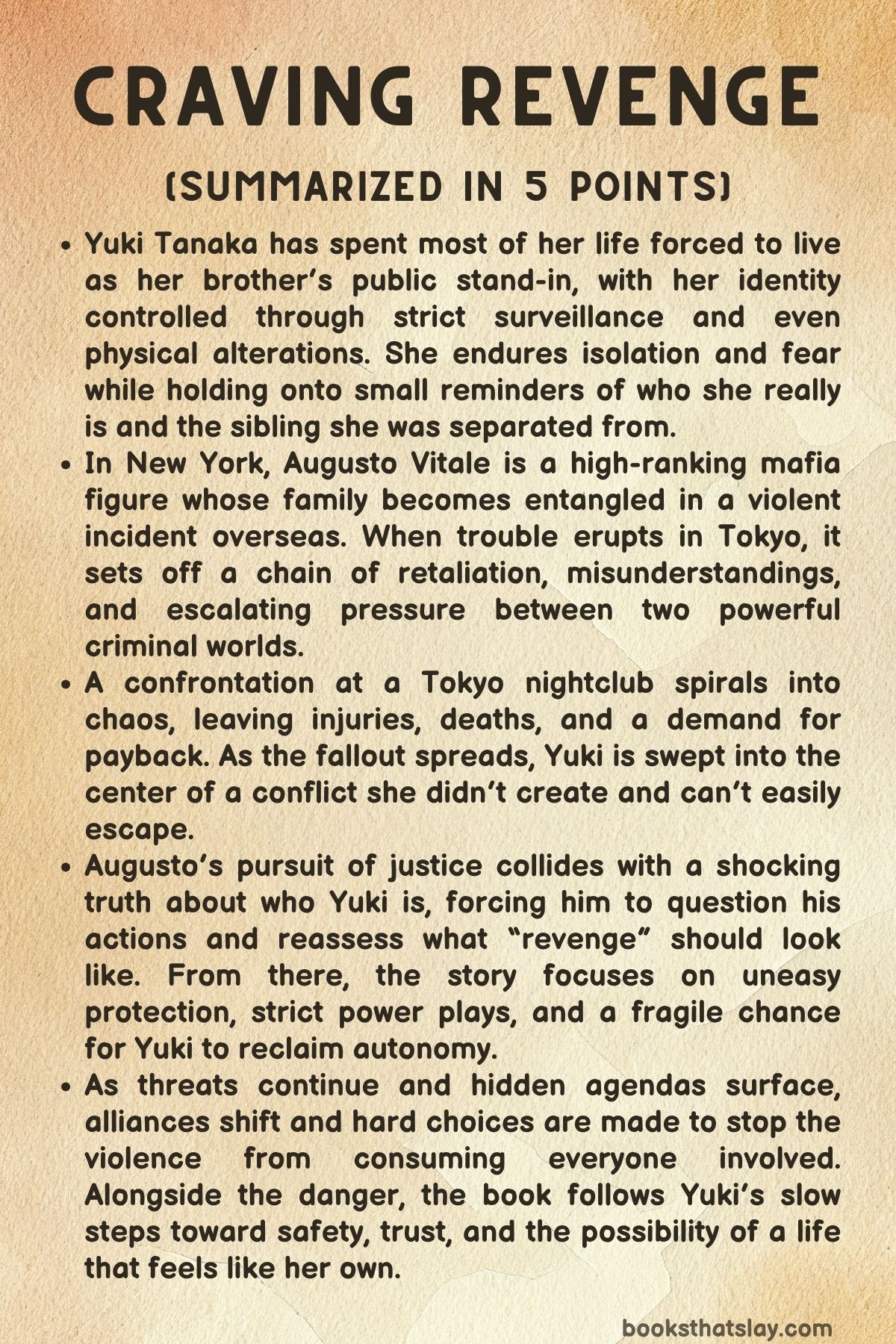
Summary
Yuki Tanaka has spent most of her life pretending to be someone else. At twenty-two, she is still forced to impersonate her older brother, Ryo, the heir to her father’s Yakuza empire.
Her body is managed like an asset: injections to sharpen a masculine look, binders to hide her chest, clothes designed to make her seem broader, and guards who control where she goes and what she says. The lie began when she was eleven.
She and Ryo were children playing by a stream when men sent by her handler, Masaki, came for them. Yuki was taken because she was small enough to reshape and obedient enough to break.
Ryo was dragged away to be trained in secret for leadership. Before he disappeared, he promised he would come back for her.
Years later, Yuki lives under constant surveillance, bruised by the physical toll of maintaining the disguise and the emotional toll of losing herself. She keeps small proof of who she really is hidden away—letters she wrote to Ryo, a broken bamboo sword from childhood—then hides it again, because hope hurts too much to hold openly.
She has already survived an assassination attempt that left scars on her body. Even when she is allowed a short break to heal from procedures, she is never truly alone.
Across the ocean in New York, Augusto Vitale attends a mafia wedding: his younger brother Riccardo is marrying Gianna Falco, binding powerful families together. Augusto is protective by nature and by position, and he publicly vows that Gianna will be safe under the Vitale name.
The celebration ends, business resumes, and soon Riccardo and Gianna leave for Japan on their honeymoon with security at their side.
In Tokyo, Yuki is taken to Molecule, a club tied to Yakuza interests. Her job is to perform the role of a careless, entitled male heir in public, giving her father a visible “son” while the real heir remains hidden.
She sits in the VIP section, detached and numb, until she notices a Western couple nearby—Riccardo and Gianna—laughing, touching, enjoying each other in a way that feels unreal to her. Yuki stares too long, drawn to what she has never been allowed to have: affection without fear.
Riccardo confronts her, furious that this stranger is watching his wife. One of Yuki’s guards, Kentaro, escalates it immediately, demanding apologies and then pushing for humiliation.
The situation turns ugly fast. Weapons come out.
People rush in. The club erupts into chaos.
Gunfire follows. Riccardo is shot, and Gianna drops beside him, pressing her hands to his chest, screaming for help while blood soaks through her fingers.
Others go down as well. Yuki calls emergency services and flees, shaken and sickened by how quickly violence took control.
In the aftermath, the Vitals treat it as an attack on their family, not a bar fight gone wrong.
Augusto arrives in Japan in a rage and finds Riccardo recovering under heavy guard. Gianna recounts what happened and insists the man who stared at her tried to grab her afterward, prompting her to slap him.
Augusto’s hacker ally, Rosie, pulls club footage and identifies key players: the shooter is dead, Kentaro started the confrontation, and “Ryo Tanaka,” the son of Yakuza boss Masato Tanaka, was present. Augusto decides the culprit is Tanaka’s heir and vows revenge.
If the Yakuza brought blood into his family’s honeymoon, he will return it.
Yuki, still under Yakuza control, meets Masaki and Kentaro afterward. Masaki warns that Kentaro will face punishment and that mafia retaliation is coming.
Before any internal discipline can happen, attackers strike. Masaki is killed.
Kentaro is injured. Yuki is chased, beaten, and taken.
Her captor is Augusto Vitale.
Augusto’s vengeance is brutal. He captures Yuki believing she is the Yakuza heir.
Kentaro is executed in front of her. Yuki tries to run and is beaten, her shoulder dislocated.
Augusto demands access to her phone and tries to force a call to Tanaka. She can’t comply.
She doesn’t have the authority he thinks she does. His men treat her as a dangerous enemy, and she is tortured for days—starved, denied water, pushed until she can barely breathe.
She holds on through sheer stubbornness and fear, finally begging only when she believes rape is coming.
That moment changes everything. As Yuki struggles to breathe, Augusto rips away the bulky padding designed to disguise her body.
Underneath is a woman—bindings, bruises, and a truth he never considered. The room freezes.
Augusto is horrified. He realizes he has been torturing a woman who was never the target.
The guilt hits him hard, and it doesn’t soften with excuses. He gets her medical care, has his man reset her shoulder, and promises she will not be violated.
When she wakes, she admits she’s not the heir at all. She is a body double, forced to play a role since childhood.
She begs to be released.
Before he can secure her safety, the Yakuza track her down at the hospital. Augusto rushes in and sees Yakuza men dragging her away.
A firefight breaks out; people are injured; bodies drop. Augusto confronts Yutaro Kano, Tanaka’s underboss, demanding Tanaka contact him.
Kano is wounded, but the Yakuza outnumber Augusto’s team and manage to take Yuki back.
Now that Yuki has been exposed as female, her father’s cruelty becomes more personal. Tanaka punishes her for “failing,” treating her body as something to correct and repurpose.
He orders procedures to reverse the masculinizing work, repairs damage from the beatings, forces weight loss, and sets a deadline: three months to remake her into a submissive bride. The training is humiliating and controlled, built around obedience—household duties, presentation, and explicit lessons meant to erase resistance.
Yuki endures it because she has no choice and because she has learned what happens when she fights.
During those three months, a violent conflict rages between the Yakuza and the Cosa Nostra. Augusto kills many, loses men, and refuses to let the situation end without answers.
Eventually, Cosa Nostra leadership arrives in Japan to force a meeting. Tanaka confirms Yuki is his daughter and presents her as proof of his power, making her kneel and apologize to Augusto for the club incident as if she caused the war.
Augusto refuses to accept that lie. He demands Tanaka take responsibility.
Tanaka, unwilling to bow, offers a “solution” designed to keep control while stopping the bloodshed: Augusto must marry Yuki.
It’s not a request. It’s a trade.
Yuki is trapped either way. Tanaka uses her humiliation to prove ownership, even tearing away her dignity in front of men to remind her she belongs to him.
Augusto, furious, covers her with his jacket and storms out, but he returns with a decision that stuns everyone: he agrees to the marriage, insisting it happen in New York. He tells himself it’s to end the war and keep her from being handed to someone worse.
Underneath that, he also knows he owes her protection after what he did.
Back in New York, the wedding happens quickly under heavy security. Yuki is threatened into compliance by Kano’s gun, still terrified that disobedience will lead to punishment.
At the reception, she collapses under fear and keeps apologizing as if that is the only language she knows. Augusto’s family, especially his mother Samantha, responds with unexpected warmth.
Samantha comforts Yuki and makes it clear she isn’t being judged. It’s the first time in years Yuki is treated like a person rather than a tool.
When they return to Augusto’s home, Yuki expects violence. Instead, Augusto draws firm boundaries: no consummation, no touching without consent, and a separate bedroom if she wants it.
He apologizes for what he did to her in captivity, not once but repeatedly, and he tries to give her control in small ways—privacy, choice, money, time. Yuki’s body, weakened by starvation and stress, struggles to handle normal meals.
A doctor is called, and she requires careful treatment and nutrients to recover safely. Samantha stays close, becoming a steady presence while Yuki rebuilds strength.
As weeks pass, the home becomes calmer. Augusto keeps his distance to avoid frightening her, but he also quietly changes the environment—adding Japanese touches, reshaping the garden into a Zen space, and ensuring guards are present but not suffocating.
When Yuki asks if she can go outside, he says yes, with protection. In the garden, he apologizes again and promises he will never hit her.
He admits he married her to stop the war, to protect her, and to atone. Yuki cries in his arms, confused by gentleness after so many years of control.
When he asks what she wants—to live as a man or a woman—she finally says the truth: she wants to be a woman, and she wants love like the kind she saw between Riccardo and Gianna.
Augusto listens. He doesn’t treat it as weakness.
He treats it as identity.
Yuki begins to taste normal life in small, careful steps. She shops with Samantha for modest clothes that feel like her.
She meets the women in Augusto’s circle, learning that not everyone speaks through threats. She returns to an old comfort by working with clay, and Augusto supports it by getting her supplies.
Trust grows slowly, built on consistency: he asks permission, he keeps promises, and he doesn’t punish her for fear.
Outside their home, danger keeps circling. Augusto is attacked by a sniper, and a message on a bullet frames it as revenge for the Yakuza.
Soon after, a warehouse fire damages their operations. Augusto suspects someone is trying to reignite war.
Yuki fears the fragile peace will collapse and that she will be dragged back into her father’s grasp. Their emotional connection sharpens under pressure.
They share their first real kiss, and the pull between them becomes harder to deny.
Augusto eventually takes Yuki on a private date in New York, giving her an evening that feels like a choice instead of an assignment. They talk honestly.
He offers to help find Ryo, but Yuki refuses, terrified that searching could put her brother in danger and bind Augusto further to Tanaka. By the end of the night, Yuki decides she wants intimacy with Augusto on her terms.
He moves carefully, checking consent and responding to her reactions. For Yuki, it’s not only sex—it’s proof that her body can belong to her again.
The moment also triggers Augusto’s rage toward those who trained and harmed her, especially Yutaro.
Soon after, Yuki is abducted from Augusto’s home by a disguised attacker. In the van, she realizes the impossible: it’s Ryo.
After eleven years, her brother is alive, scarred, hardened, and furious. He believes Augusto hurt her and intends to kill him.
Yuki urgently explains the truth—she was the forced double, and Augusto didn’t know who she was when he captured her. Ryo reveals he has been behind the recent attacks, trying to push Augusto into killing Tanaka so Ryo can take power and reclaim Yuki.
He wants to annul her marriage and take her back to Tokyo “for her own good.” Yuki refuses. She says she loves Augusto and chooses her life in New York.
Ryo brings her back anyway, and the confrontation nearly turns fatal. Augusto almost shoots Ryo, and a fight breaks out until Yuki is accidentally hit while trying to stop them.
Furious, she forces them to stand down. The negotiation that follows is tense but clear: Ryo must return to Japan to face Tanaka, and he cannot do it alone.
Augusto agrees to help kill Tanaka and capture Yutaro, with conditions that tie the Yakuza’s future to his business interests. Ryo accepts because he needs the alliance and because Yuki’s choice has changed the equation.
For Yuki’s sake, they reach a truce and plan the strike.
In Tokyo, Augusto and Ryo scout and prepare, then assault Tanaka’s mansion in a coordinated attack. The fight is swift and bloody.
They corner Tanaka and Yutaro. Ryo kills Tanaka, ending the source of Yuki’s captivity with his own hands.
Augusto takes Yutaro for himself, determined to punish him for the cruelty inflicted on Yuki. Evidence of Yutaro’s abuse appears, and Augusto is physically sickened by what he sees.
Still, he finishes what he came for. Yutaro is tortured and killed, and Augusto destroys the recording so it cannot haunt Yuki.
With Tanaka dead, Ryo assumes control of the Yakuza under the protection and pressure of the Cosa Nostra, stabilizing the new balance. Augusto returns to New York earlier than expected, needing Yuki more than he wants to admit.
When he comes home, their reunion is immediate and raw. Yuki tells him she forgives him, not because what happened was small, but because she refuses to live chained to it.
They build a new normal surrounded by family and allies, with Yuki hosting gatherings, sharing her pottery, and claiming a place among people who treat her with care.
Years later, Yuki’s life looks nothing like the medical table where her story began. She is a mother, holding her newborn son, surrounded by the Vitale family and by Ryo, who returns as an uncle rather than a distant ghost.
The underworld still exists around them, but Yuki is no longer a tool inside it. She is loved, protected, and finally allowed to be herself.
Characters
Yuki Tanaka
In Craving Revenge, Yuki Tanaka is the emotional core of the story, defined by a life stolen from her at an age when identity should have been forming freely. Forced to impersonate her brother Ryo from childhood, Yuki’s character is built around enforced performance: the binders, padded clothing, fillers, and the constant surveillance turn her body into a battleground where control is exercised physically as well as psychologically.
What makes Yuki compelling is not only the trauma she endures, but the quiet endurance with which she carries it—she survives humiliation, starvation, beatings, and captivity without being allowed the dignity of being fully seen as herself. Her longing when she watches Riccardo and Gianna’s affection is a crucial window into her inner world: she is not simply yearning for romance, but for permission to exist as a whole person.
Even after she becomes Augusto’s wife, her instinct to apologize, kneel, and “perform duties” reveals how deeply she has been conditioned to equate safety with obedience. Yet Yuki’s strength shows in her gradual reclaiming of selfhood—choosing feminine clothing, returning to small joys like pottery, and slowly learning that gentleness can be real rather than transactional.
By the time she faces the collision between the two dominant men in her life—Ryo and Augusto—she asserts a moral authority neither of them initially possesses, forcing them into restraint and negotiation. Her growth is ultimately about agency: moving from being used as a symbol for others’ power to becoming someone who can define love, safety, and identity on her own terms.
Augusto Vitale
Augusto Vitale in Craving Revenge is introduced as a mafia heir shaped by responsibility, reputation, and the brutal logic of retaliation, and much of his arc revolves around what happens when that logic collides with conscience. He begins from a position of certainty—family must be protected, enemies must pay, and fear is an acceptable currency—yet his certainty fractures the moment he realizes the “enemy” he tortured is not only innocent of the crimes he’s avenging, but also a woman forced into disguise.
That discovery produces one of his defining traits: guilt that does not vanish through rationalization. Augusto’s character is built around an internal contradiction—he is capable of cruelty within the rules of his world, yet he is also capable of profound tenderness once he understands the human cost.
His response is not passive remorse; it becomes active reparative behavior, expressed through practical protection, emotional boundaries, and repeated efforts to return control to Yuki. Importantly, his protectiveness is not immediately pure: it begins partly as penance and partly as strategy to end war, but evolves into devotion that challenges his own identity as a man who believed he could keep emotion separate from duty.
His willingness to delay intimacy, offer therapy, redesign his home for her comfort, and insist on consent marks a shift from ownership to partnership. At the same time, Augusto never stops being dangerous, and the story uses that danger as a double-edged trait—his violence is terrifying, but it becomes directed outward at those who exploited Yuki, making him both redeemer and executioner.
His love is ultimately framed as a choice to restrain power rather than simply wield it, which is what makes his evolution feel like more than romance; it is a moral transformation inside a world that rarely rewards morality.
Ryo Tanaka
Ryo Tanaka embodies the tragedy of a sibling bond severed and twisted into something weaponized by the environment that raised him. Taken away to be shaped into a future leader, Ryo becomes hardened, secretive, and strategic, but his core motivation remains tied to Yuki—he defines protection as possession because he never learned another model.
His return is not a purely heroic rescue; it is a collision between love, ambition, and trauma. Ryo’s scars and severity signal how thoroughly he has been forged by Yakuza expectations, and his decision to orchestrate attacks on Augusto exposes a ruthless willingness to sacrifice broader peace to achieve his personal objective of reclaiming Yuki and seizing control from their father.
What makes Ryo nuanced is that his wrong choices come from a place that is emotionally understandable: he believes Yuki has been harmed by a Sicilian captor, he believes he is the only one who can save her, and he believes leadership is the only way to prevent her from being used again. Even when Yuki explains the truth and resists him, he struggles to adapt because her autonomy threatens his self-concept as her protector.
His eventual acceptance of Augusto is not simply surrender; it is a recalibration of loyalty, where he begins to recognize that love for Yuki must include respecting what she wants rather than imposing what he thinks is best. By the end, Ryo functions as both survivor and successor—still a man of violence and hierarchy, but one who carries genuine gratitude and an altered sense of responsibility, suggesting that leadership for him may finally be anchored less in ego and more in safeguarding the people his father treated as property.
Masato Tanaka
Masato Tanaka represents authoritarian control taken to its most intimate extremes, using family not as something to protect but as something to exploit. His cruelty is not impulsive; it is systematic, designed to erase individuality and replace it with usefulness.
By forcing Yuki into impersonation, Masato turns identity into an instrument of political optics, making her body a masquerade that preserves his future power. What distinguishes him as an antagonist is how completely he denies Yuki’s humanity—her pain is irrelevant unless it threatens his image, and her gender is treated as a liability to be punished rather than a truth to be accepted.
When Yuki is exposed, his response is not concern but “correction,” escalating from physical alteration to psychological breaking through degradation and forced training. His later performance of presenting her as a “beautiful” woman in negotiations shows his defining trait: everything is theater meant to demonstrate dominance.
Even the marriage arrangement is not a peace offering but a display of ownership, a way to relocate Yuki like an asset while humiliating both her and Augusto. Masato’s role in the story is to embody generational rot—an old world where power is absolute and cruelty is routine—making his removal feel like the necessary destruction of the system that created Yuki’s suffering.
Masaki
Masaki operates as the cold facilitator of Masato’s will, and his character is defined by obedience to hierarchy rather than personal malice, which makes him disturbing in a different way. He supervises Yuki’s forced transformation and compliance with an almost administrative detachment, treating her pain like maintenance work required for the Tanaka image.
His authority over Yuki is the kind that comes from proximity to power: he is not the architect, but he is the mechanism that keeps the machine running smoothly. When he warns of retaliation and manages fallout, it reinforces that he sees people primarily through strategic consequence—what matters is risk, optics, and control.
His death during the ambush is narratively significant because it creates a vacuum and triggers Yuki’s capture, but it also exposes the fragility of enforcers who rely on the protection of the system; once chaos escalates, they are as disposable as the victims they helped manage. Masaki is less a complex moral figure than a portrait of complicity—someone whose loyalty enables atrocities while allowing him to avoid thinking of himself as the true villain.
Yutaro Kano
Yutaro Kano is one of the clearest embodiments of predatory power, functioning as an enforcer who turns punishment into personal gratification. He is not merely loyal to Masato; he is energized by the opportunity to dominate Yuki, and the story uses him to show how systems of control attract individuals who enjoy cruelty for its own sake.
His involvement in dragging Yuki from the hospital and overseeing her “corrections” reveals a particular brand of violence: intimate, humiliating, and designed to strip dignity rather than simply inflict pain. His “training” of Yuki into submissive wifehood is especially sinister because it weaponizes domesticity and sexuality as tools of submission, teaching her that her body exists for others’ use and judgment.
Even when Yuki says she was not touched directly inappropriately, the implication of coercive sexual conditioning still marks him as a corrupter of consent and safety. His end is framed not only as revenge but as symbolic justice, because he represents the ongoing threat that survives even when a king like Masato falls—the underlings who carry the worst impulses of the regime and would continue the cycle unless forcibly stopped.
Kentaro Araki
Kentaro Araki is a volatile extension of Yakuza entitlement, and his character illustrates how small ego can ignite large-scale catastrophe. His aggressive escalation at the club, including provoking Riccardo and targeting him for humiliation, shows a man who uses proximity to power to compensate for insecurity.
Unlike higher-level players who strategize, Kentaro acts out dominance in public, turning a tense encounter into a combustible situation that leads to shootings, injuries, and ultimately war. His later capture and death at Augusto’s hands is narratively sharp because it underscores how disposable men like Kentaro become once their recklessness creates consequences too large to contain.
Kentaro’s role is to demonstrate how violence doesn’t always begin from grand plans; sometimes it begins from a petty desire to be feared, and then spirals until the people who started it can’t survive the fallout.
Sho Otake
Sho Otake functions as the trigger point for the story’s initial bloodshed, embodying the lethal impulsiveness of armed loyalty. His decision to pull a gun during the club confrontation shifts the conflict from intimidation to irreversible violence, creating the event that draws Augusto into Japan and ignites the revenge campaign.
Sho is less emotionally developed than the central figures, but his presence matters thematically because he shows the danger of systems where weapons and pride are interchangeable. In a world where status is enforced by threat, someone like Sho doesn’t need deep motivation beyond allegiance and readiness, and his death reinforces the story’s recurring message that violence escalates faster than anyone can control once guns enter the equation.
Riccardo Vitale
Riccardo Vitale is positioned as both catalyst and contrast: his honeymoon tenderness with Gianna is what Yuki longs for, and his injury is what compels Augusto into war. He is characterized by open affection and fierce protectiveness, reacting instinctively when he believes Gianna is being threatened.
Riccardo’s love is uncomplicated in a way that highlights how deprived Yuki has been—he embodies a relationship model rooted in mutual joy rather than coercion. At the same time, his role in the mafia family means his vulnerability becomes political currency; his hospitalization isn’t just personal tragedy but an insult demanding response.
Riccardo’s presence helps define Augusto’s motivations, because protecting Riccardo is both genuine brotherly love and a reinforcement of Augusto’s identity as the family’s shield, setting the stage for how far Augusto will go when he believes family has been attacked.
Gianna Falco Vitale
Gianna Falco Vitale represents resilience under threat and serves as a social mirror for Yuki’s longing and later healing. Her happiness with Riccardo in the club scene is not merely romantic background; it becomes the moment that exposes Yuki’s internal ache for normalcy, affection, and being seen.
Gianna is also perceptive and active under pressure—she calls for help discreetly and moves strategically when violence erupts, showing she is not naïve even within celebration and love. Later, her recounting of events shapes Augusto’s understanding of what happened and reinforces why vengeance feels justified from his perspective.
Gianna’s significance deepens when Yuki meets the Vitale women and begins to experience kindness; Gianna becomes part of the environment that teaches Yuki she can exist without being punished for every breath, contributing to Yuki’s slow recalibration of what safety can look like.
Samantha Vitale
Samantha Vitale is one of the story’s most important stabilizing forces, acting as the maternal counterweight to the abusive parenthood Yuki endured. She initially resists Augusto’s sudden marriage decision, which shows she is not blindly loyal to mafia logic, but once she understands Yuki’s suffering, she shifts into fierce, protective compassion.
Samantha’s care is practical—staying beside Yuki during refeeding, monitoring her recovery, offering comfort without demanding gratitude—and that consistency becomes the foundation upon which Yuki can begin to trust the Vitale household. Her willingness to offer a maternal identity, culminating in Yuki being invited to call her “Mom,” symbolizes the emotional adoption Yuki never had the chance to experience.
Samantha is also crucial because she holds Augusto accountable in a way that doesn’t shame him into defensiveness but pushes him toward responsibility, helping transform guilt into genuine protective action.
Franco Vitale
Franco Vitale represents the older generation of mafia authority, but unlike Masato Tanaka, his power is framed through family cohesion rather than domination as spectacle. He is capable of violence and control, yet his priorities remain grounded in protecting the Vitale structure, intervening when Augusto’s rage risks turning inward on his own men.
Franco’s reaction during the abduction aftermath—stopping Augusto from continuing to assault Aldo and tending to Yuki—shows an ability to place stability above uncontrolled fury. When he accepts Yuki calling him “Dad,” it marks a thematic reversal of what fatherhood meant in her life: the title becomes associated with protection and belonging rather than exploitation.
Franco’s presence reinforces that the story is not simply mafia versus Yakuza, but also a comparison of what family power can look like when shaped by care versus cruelty.
Lorenzo
Lorenzo serves as Augusto’s steady operational anchor, the kind of loyal lieutenant who functions as both backup and restraint. He moves through the story as competence embodied—helping manage business crises, guarding during tense moments, and remaining alert when emotions run high.
His relationship to Augusto emphasizes that Augusto does not rule alone; he is supported by men who trust him, and that trust is tested by war, assassination attempts, and the high stakes of marrying into an enemy structure. Lorenzo also provides a subtle bridge between the violent world outside and the domestic world forming inside the house, because he is present during negotiations with Ryo and the lead-up to Tokyo, showing that even moments framed as family decisions remain inseparable from security realities.
Raffaele
Raffaele functions as a loyal enforcer with a sharper edge of practicality, often present at the moments where action must be taken quickly and without sentiment. His role in resetting Yuki’s shoulder while she is unconscious highlights the paradox of the Vitale men at that stage: they are responsible for her suffering, yet also the only ones positioned to keep her alive once the truth emerges.
His injury during the hospital firefight underscores the cost Augusto’s inner shift demands from his people—protecting Yuki isn’t just emotional labor, it becomes an operational risk. Raffaele’s presence emphasizes that redemption arcs in this world are not clean; they unfold while violence continues, and allies like Raffaele help carry the practical burden of Augusto’s decisions.
Enzo
Enzo, Gianna’s brother, represents the impulsive family protector whose loyalty turns quickly into cruelty when he believes a loved one has been threatened. His attack on Yuki during captivity reflects how easily moral boundaries collapse in revenge logic—if someone is labeled guilty, pain becomes permissible.
Enzo is important because he shows that not only leaders perpetuate violence; even family members who see themselves as righteous can become brutal when fear and anger take control. His role reinforces the story’s central critique of vengeance: the belief that retaliation restores justice often creates fresh injustice, especially when the target is misunderstood.
Rosie
Rosie acts as the modern intelligence engine behind Augusto’s campaign, using hacking and surveillance to turn suspicion into actionable certainty. She is significant not simply as a “helper,” but as a character who shifts power away from brute force and into information control, repeatedly changing what Augusto believes is true—first by identifying who started the club fight, then by revealing hospital activity and van routes.
Rosie’s role highlights that the war is not won purely through guns; it is shaped through knowledge, footage, tracking, and interpretation. She also indirectly influences the moral trajectory of the story because her findings help expose that Yuki is not the villain Augusto believed she was, which becomes the turning point that converts revenge into protection.
Bianca
Bianca contributes to Yuki’s healing through social normalization, representing the blunt, lively honesty of the Vitale women’s circle. By directly questioning Yuki about her feelings toward Augusto, Bianca forces Yuki to confront her internal contradictions—fear and attraction, gratitude and uncertainty—without allowing her to hide behind politeness.
Bianca’s presence matters because she treats Yuki like a person rather than a fragile object, offering a form of acceptance that doesn’t require Yuki to perform perfection. In a story where Yuki has long been forced into roles, Bianca’s straightforwardness becomes a small but meaningful permission for Yuki to be real.
Sienna
Sienna functions as part of the supportive environment that replaces Yuki’s isolation with belonging. Her role is less confrontational than Bianca’s and more rooted in companionship, reinforcing that Yuki is allowed to have friends, routines, and moments of lightness without fear of punishment.
The significance of characters like Sienna is cumulative: each interaction teaches Yuki that safety can be consistent rather than conditional, and that women can exist around her as allies rather than rivals or witnesses to her humiliation.
Christiano
Christiano represents the larger governing structure of the Cosa Nostra beyond the Vitale family, stepping in as a force that turns chaotic war into formal negotiation. His arrival in Japan with other leaders signals that violence has reached a scale where hierarchy must intervene, and his presence reinforces that Augusto’s actions are not just personal vendetta—they carry political consequences within an organized criminal network.
Christiano functions as the pressure that forces Masato Tanaka into the meeting where Yuki is displayed and the marriage bargain is proposed, demonstrating how power in this world ultimately consolidates at the top when lower-level conflict becomes too costly.
Takeru Mashima
Takeru Mashima in Craving Revenge is a quiet but influential figure as the monk who trained Ryo, representing discipline, austerity, and the shaping of identity through controlled hardship. His presence in Ryo’s life helps explain the severity and restraint Ryo carries, even when he acts violently.
Takeru also symbolizes the pathway Ryo took between innocence and criminal leadership: the monastery did not erase the Yakuza destiny waiting for him, but it molded the kind of man he would become when he finally stepped into that world.
Themes
Identity as a Controlled Performance
From the first scene, Yuki’s body is treated like a public document that must match what powerful men want the world to read. Fillers, Botox, binding, padded clothing, coached behavior—none of it is about her preference, comfort, or safety.
It is compliance made visible. The story keeps returning to the psychological cost of living as a substitute: Yuki is not only prevented from expressing herself, she is trained to erase herself reflexively.
That erasure becomes a survival skill so ingrained that even when she is finally seen as female, she cannot immediately believe it will be allowed to last. She apologizes constantly, anticipates punishment, and tries to earn peace through usefulness, because she has been taught that her existence must be justified.
The performance is also social. Yuki has to act like a careless male heir in public spaces, with guards enforcing the illusion through intimidation.
The club incident shows how dangerous that performance becomes when it collides with someone else’s boundaries and pride. Her gaze at a couple’s affection is treated as provocation because her role leaves no room for innocent longing.
Later, when Augusto discovers the truth, the shift is not only physical—clothes, hair, and softness—but ethical and relational. The narrative uses that shock to highlight how gender assumptions govern who is granted basic mercy.
The book also challenges the idea that identity is simply revealed; for Yuki, it is reclaimed through repeated proof that her preferences matter, that her “no” is respected, and that her body is not a tool for someone else’s legacy. Even as she steps into womanhood outwardly, the internal work is heavier: learning to desire without fear, to be looked at without bracing for harm, and to believe she can belong as herself rather than as a replacement for her brother.
Power, Ownership, and the Body as Territory
Control in Craving Revenge is exercised through the most intimate channels: medicine, food, movement, and sexuality. Yuki’s father treats her body as territory he can reshape and redeploy, first by forcing masculinization and later by forcing feminization.
That reversal exposes a brutal consistency: her gender presentation is never about who she is, only about what benefits his strategy. The punishments are framed as “corrections,” a word that captures the logic of ownership—if she deviates from his plan, the response is to “fix” her the way one fixes a disobedient asset.
Starvation, forced training, and humiliation are not random cruelty; they are methods designed to strip agency and produce a person who anticipates orders before they are spoken.
The mafia side mirrors this territorial thinking through vengeance and leverage. Augusto’s campaign in Japan is fueled by the belief that his family has been violated and must reassert dominance.
Torture is presented as part of that world’s toolkit, justified by loyalty and retaliation, until the moment it collides with mistaken identity. That mistake is revealing: it shows how easily violence becomes procedural when the target is reduced to a label.
Once Augusto recognizes Yuki as a person rather than “Ryo Tanaka,” the moral frame shifts, and the book interrogates whether remorse can exist inside a system built on domination. The marriage bargain is the clearest example of bodies used as treaties.
Yuki is offered like a contract clause to end a war, and the men around her debate terms as if negotiating cargo routes. Even Augusto’s acceptance, though motivated by a desire to protect her, still begins within a coercive structure where her consent is not required for the arrangement.
What changes over time is not that power disappears, but that the terms of power become contested. Augusto starts using his influence to limit harm, create safety, and insist on consent, and the narrative makes that contrast deliberate: the same kind of authority that once enabled violence is redirected to enforce boundaries and security.
Yet the theme remains uneasy on purpose. Safety comes through another powerful man, not through dismantling the system that produced her suffering.
The book keeps the reader aware that tenderness in a violent world is still shaped by hierarchy, and that Yuki’s recovery happens inside guarded spaces because the broader environment remains predatory.
Trauma, Survival Strategies, and the Long Aftermath
Yuki’s suffering is not treated as a single event that ends when the bruises fade. The book shows trauma as something that reorganizes behavior, expectations, and even digestion.
Her instinct to kneel, apologize, and offer service is not personality—it is conditioning. The fear of being alone with Augusto after the wedding, her collapse when privacy arrives, and her constant scanning for danger reflect a nervous system trained by captivity.
Her body also carries consequences in concrete ways: refeeding becomes a medical crisis, a realistic reminder that prolonged deprivation does not resolve through willpower. Recovery is presented as slow, requiring routine, patience, and repeated experiences of safety that contradict past patterns.
Survival, in Yuki’s case, often means silence. During torture, she endures without giving information because she has none, but also because making noise has never protected her.
Later, she fears intimacy even when she wants connection, because her training in Japan framed sex as duty and performance rather than mutual desire. The narrative emphasizes the difference between acts that resemble consent and consent that is freely given.
Augusto’s insistence on permission, pacing, and aftercare becomes part of her healing, not because it erases what happened, but because it offers a new set of associations: touch that does not lead to punishment, attention that does not demand repayment.
The theme also includes the way trauma can distort choices. Yuki initially believes pleasing Augusto is the safest route, which risks recreating the same dynamic under a kinder surface.
The book complicates this by letting her desire grow alongside fear, showing how someone can genuinely want intimacy while still being influenced by survival logic. Her refusal to have Augusto search for Ryo is another trauma-shaped decision—she calculates danger as inevitable and assumes any action she initiates will trigger consequences for someone else.
Even after safety improves, her mind expects the past to return, which is why she experiences hope cautiously, in small increments. By the end, the story suggests healing is not forgetting; it is building a life where the past no longer dictates every move.
The epilogue’s family stability functions as proof of sustained change, but it also underlines the effort it took to reach a place where ordinary affection does not feel like a trap.
Revenge, Justice, and the Moral Weight of Retaliation
Violence in Craving Revenge is not just action; it is a language the characters use to communicate loyalty, grief, and authority. Augusto’s initial pursuit is framed as protection of his brother and sister-in-law, and within his world, revenge is presented as duty.
The book explores how that duty can flatten nuance: once the target is named, methods become acceptable, and escalation feels inevitable. The torture of Yuki is the darkest illustration of revenge’s moral hazard—pain is inflicted not because it is necessary, but because anger has been granted permission to act.
The narrative then pivots to examine guilt as a counterforce. Augusto’s sickness after learning Yuki’s identity pushes him into a different version of justice, one that includes accountability and repair.
But the book does not romanticize his transformation as instant purity. He remains capable of extreme violence, and he continues to justify killing as order-maintenance.
The question becomes less “Will he stop being violent?” and more “Who is violence for, and what does it cost?” His later decision to keep Yutaro alive for punishment shows revenge turning into ritual, something meant to balance scales emotionally rather than simply remove a threat. The assault on Tanaka’s mansion culminates in executions that are both strategic and cathartic, and the story invites the reader to sit with that discomfort: satisfaction is offered, but it is not clean.
Ryo embodies a different angle of revenge—revenge as destiny. He orchestrates attacks not only to punish Augusto but to manipulate events so he can reclaim Yuki and seize leadership.
For him, violence is a tool of liberation and ambition at once, which exposes how revenge can masquerade as rescue. Yuki, caught between these forces, becomes the moral anchor.
She wants the harm to stop, not because she is naïve about danger, but because she understands that endless retaliation keeps her father’s logic alive. When she forgives Augusto, it is not approval of what happened; it is a choice to end a cycle that otherwise continues claiming bodies as payment.
By resolving the central conflict through the father’s death and Yutaro’s punishment, the book delivers the expected genre closure, yet it also leaves an implicit critique: justice achieved through violence still leaves psychological wreckage. The “win” is not that the system becomes humane, but that Yuki finally gains allies strong enough to outmatch the people who owned her.
Revenge, in this story, functions as both a weapon and a bridge—bringing enemies to negotiation, forcing truths into the open, and creating the conditions for protection—while never letting the reader forget that it began with misrecognition and disproportionate suffering.
Chosen Family, Caretaking, and Safety as a Daily Practice
A striking shift in Craving Revenge happens when the story moves from battlefield logic to domestic rhythm. Safety is not portrayed as a declaration; it is shown through repeated, ordinary acts—quiet rooms, patient medical care, permission to rest, and boundaries that are honored.
Samantha becomes essential here, offering a model of love that does not demand performance. Her constant presence during Yuki’s recovery creates a maternal shelter that Yuki has never had, and the narrative uses that relationship to show how care can be reparative without being romantic.
It is not grand speeches that begin to heal Yuki, but someone sitting with her, feeding her safely, helping her choose clothes, and speaking to her without threat.
The Vitale household also demonstrates a communal form of protection. Guards exist, but they are reframed as support rather than imprisonment.
The garden redesign, the pottery supplies, the invitation to call Samantha “Mom” and Franco “Dad”—these are not superficial comforts. They are identity-granting gestures, signals that Yuki is not a bargaining chip anymore but a person with preferences, creativity, and a place at a table.
Importantly, the book does not make this acceptance automatic. Yuki initially cannot trust it; she expects the kindness to be conditional and temporary.
The family’s consistency is what changes her mind, and that consistency is portrayed as deliberate effort, not sentimental coincidence.
Augusto’s role in this theme is complicated because he is both the source of trauma and the architect of her safety. The story acknowledges that protection can feel threatening when it comes from someone with a history of harm.
What shifts the dynamic is his willingness to relinquish entitlement—separate bedrooms, no consummation without readiness, and repeated apologies without demanding forgiveness on schedule. Their relationship grows through negotiated closeness rather than conquest, and that becomes a form of caretaking too.
Yuki’s own caretaking emerges as she heals; cooking, making pottery gifts, hosting gatherings—these acts begin as “duties” but gradually become expressions of choice and belonging.
The final picture of family, including Ryo’s eventual participation and the child in the epilogue, positions chosen family as an alternative to bloodline tyranny. Yuki’s father represents lineage used as a weapon; the Vitale family represents affiliation used as refuge.
The theme suggests that healing does not require erasing the past but requires a community that refuses to replicate it. Safety becomes something maintained through attention, protection, and emotional honesty—a daily practice rather than a single rescue.