Dream Count Summary, Characters and Themes
Dream Count by Chimamanda Ngozi Adichie is a contemporary novel that explores the inner lives of four African women whose stories unfold across Nigeria and the United States. Set partly during the COVID-19 pandemic, the book reflects on memory, relationships, migration, identity, and the choices people make in love and life.
Through the perspectives of Chiamaka, Zikora, Kadiatou, and Omelogor, the narrative examines how personal histories shape the present. Each woman carries regrets, hopes, and unresolved experiences that influence the way she understands herself. The novel focuses on friendship, womanhood, and the search for meaning while confronting issues such as power, injustice, cultural expectations, and loneliness.
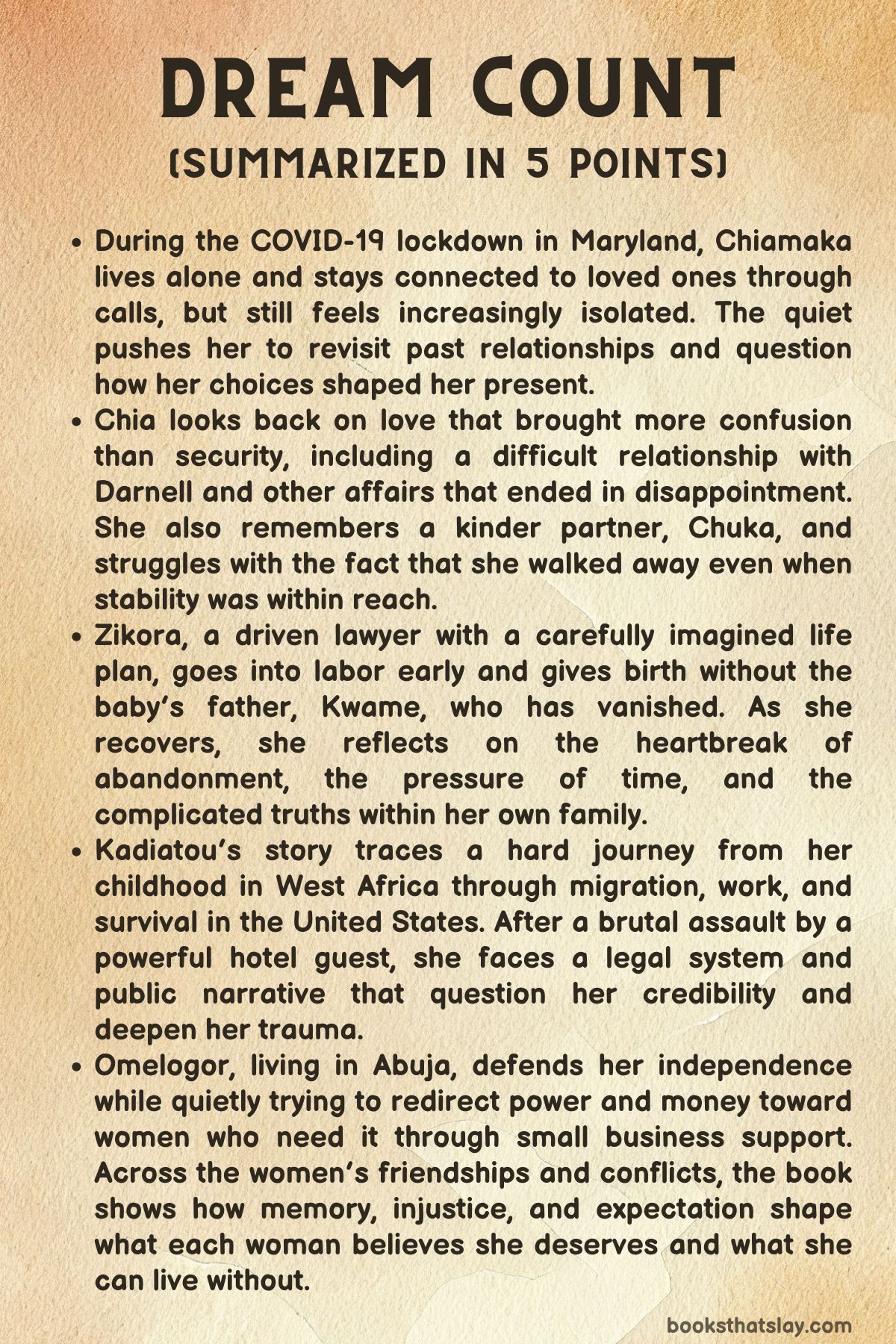
Summary
The story begins during the early days of the COVID-19 pandemic. Chiamaka, often called Chia, lives alone in Maryland.
When lockdown begins, she tries to structure her days with exercise, rest, and self-care. Very quickly, however, isolation begins to affect her emotionally.
Her main contact with others happens through phone calls and online conversations with family and friends.
Chia regularly speaks with her best friend Zikora, who lives in Washington, DC. They discuss shortages in grocery stores and the confusion surrounding the virus.
She also talks to her parents in Nigeria and to her brothers, but these conversations sometimes become tense when disagreements about the pandemic arise. Chia also connects with her cousin Omelogor, who recently returned to Nigeria after living in the United States.
Their calls vary between long discussions and quiet moments where they simply keep each other company online.
Although she communicates frequently with others, Chia continues to feel alone. The quiet time forces her to look back at her past, particularly the romantic relationships that shaped her life.
She begins reflecting on the men she loved and the choices she made.
One of the most significant relationships she remembers is with Darnell, an African American intellectual she met at a party. At first she felt excited by his attention and hoped he would truly understand her.
Over time, however, she realized that he often dismissed her feelings and treated her with indifference. He ignored messages, focused intensely on his academic work, and sometimes mocked her concerns.
Chia tried to adjust herself to suit his expectations. She hid parts of her personality and interests because she wanted him to see her as someone worthy of his respect.
Meanwhile she worked on writing projects and eventually began building a career as a travel writer. Her wealthy family supported her financially, which sometimes became a source of tension with Darnell and his friends, who criticized her privilege.
During a trip to Copenhagen for one of her assignments, Darnell accompanied her but behaved coldly throughout the journey. Their relationship continued to deteriorate.
Later, when Chia discovered messages from another woman on his phone, their connection fractured further. Although she briefly separated from him, she eventually returned to the relationship before finally ending it when they traveled together to Paris.
After Darnell, Chia began seeing another man named Chuka. Unlike her previous partner, Chuka was kind, responsible, and genuinely supportive.
He listened to her struggles about her writing career and offered encouragement when she felt discouraged. Chia believed that she might eventually marry him.
Despite his kindness, she hesitated when he started talking about marriage. She realized she did not feel ready to commit to the life he envisioned.
When she told him she could not move forward with the wedding plans, he ended the relationship, leaving her to question whether she had rejected a stable and loving future.
Before Chuka, Chia had been involved with an English travel writer whom she met in London. At first their connection felt exciting and romantic.
Eventually she discovered that he was married. Even after learning the truth, she continued the relationship in secret for some time because she hoped he would leave his wife.
He never did, and the affair ended painfully.
While Chia reflects on these memories, the narrative shifts to Zikora’s experience. Zikora is a successful lawyer who unexpectedly goes into labor two weeks early.
Her mother is the only person present at the hospital because the child’s father, Kwame, has disappeared from her life. During the painful hours of labor, Zikora remembers the events that led to this moment.
She recalls meeting Kwame at a social event where they bonded over jokes about food descriptions. Their relationship developed quickly and seemed joyful.
He was affectionate and attentive, and their cultural backgrounds as West Africans helped them connect easily.
Before meeting him, Zikora had carefully planned her life. She moved to the United States, completed law school, and built a strong career.
Yet she worried constantly about time passing without marriage or children. Dating had been disappointing, and she feared she might never have the family she wanted.
When she discovered she was pregnant with Kwame’s child, she expected happiness and commitment from him. Instead he reacted with confusion and disappeared from her life.
His silence left her feeling ashamed and abandoned.
Throughout her pregnancy she struggled with loneliness but tried to remain strong. Friends such as Chia and Omelogor supported her emotionally.
During labor she confronts both physical pain and emotional grief about Kwame’s absence.
Eventually Zikora gives birth to a baby boy. Although she continues to think about Kwame, she also begins to accept that she will raise the child on her own.
Conversations with her mother reveal complicated family history, including secrets about fertility and marriage that shaped her parents’ lives. These revelations deepen Zikora’s understanding of the pressures placed on women.
The story then turns to Kadiatou, a woman who once worked for Chia’s family and now lives in Maryland with her daughter Binta. Her story begins in West Africa during her childhood.
She and her sister Binta grew up in a village where their father died in a mining accident. Their uncle took responsibility for raising them, and traditional expectations shaped their upbringing.
Kadi admired her sister, who was more interested in education and independence. Both girls eventually underwent a cutting ritual meant to prepare them for marriage.
The experience left Kadi confused and angry because no one explained what would happen beforehand.
As she grew older, Kadi fell in love with a young man named Amadou and dreamed of building a future with him in America. Family pressure, however, forced her into marriage with another man named Saidou.
Their marriage was unhappy. After the death of their infant child and the sudden death of Saidou himself, Kadi fled the accusations of his relatives and began rebuilding her life.
Eventually she reunited with Amadou and traveled with him to the United States. Their relationship changed over time, and she eventually discovered he had another child with a different woman.
Despite this disappointment, she continued building a new life and eventually worked in hospitality while raising her daughter.
Her life takes a devastating turn when she is sexually assaulted by a wealthy hotel guest while cleaning his room. She reports the crime and undergoes medical examinations and police questioning.
Although some people support her, the legal process becomes painful and humiliating. Her lawyer questions her honesty, and media coverage portrays her negatively.
The stress leaves her feeling isolated and betrayed. Friends including Chia and Zikora attempt to help her navigate the situation, but the legal battle continues to weigh heavily on her life.
Another perspective in the novel comes from Omelogor, Chia’s cousin. Omelogor lives in Nigeria and appears confident and independent, though she also faces criticism for remaining unmarried.
She runs a financial career that eventually leads her to question the ethics of the political and corporate systems around her.
In response, she secretly redirects money from corrupt accounts into a fund that supports women’s small businesses. Her actions reflect her belief that wealth and power should help those with fewer opportunities.
Omelogor also runs an online platform where she responds to men’s questions about relationships and sexuality. Her personal life is marked by brief relationships rather than long commitments.
She once had a serious connection with a man named Arinze but ended it because she felt unable to provide the kind of commitment he wanted.
While living in Nigeria during the early spread of COVID-19, Omelogor stays in contact with Chia and Zikora and follows news about Kadi’s legal case. Her reflections reveal both confidence in her independence and uncertainty about the direction of her life.
As the pandemic continues, Chia remains alone in Maryland and continues reviewing memories of past relationships, including one with a Dutch man named Luuk and another with a German traveler named Johan. These memories help her consider how her expectations of love shaped the decisions she made.
Eventually lockdown restrictions ease and Chia reconnects with Zikora in person. They discuss their lives and the many experiences that shaped them.
Zikora struggles to understand Chia’s habit of measuring life through memories and imagined alternatives.
The novel ends with difficult news: prosecutors decide to drop the charges against the man who assaulted Kadi. They claim her story lacks credibility.
Chia brings the news to Kadi, expecting despair. Instead, Kadi expresses relief that the painful case will finally end.
For her, moving forward matters more than continuing the battle.
Through the lives of these four women, Dream Count portrays different paths shaped by love, loss, cultural expectations, and personal resilience. Each character confronts the distance between the life she imagined and the one she actually lives, learning in different ways how to continue despite disappointment and uncertainty.
Characters
Chiamaka (Chia)
Chia is the novel’s reflective center, someone whose outward comfort—family money, education, mobility—does not protect her from loneliness or self-doubt. In Dream Count, the lockdown becomes a mirror that forces her to sit with herself without distractions, and what rises is a long backlog of emotional accounting: the relationships she tolerated, the versions of herself she performed, and the time she fears she wasted.
She is driven by a deep desire to be chosen and understood, and that longing often pulls her toward men who offer attention without care. With Darnell, she repeatedly reshapes herself to fit what she thinks he respects, accepting contempt as if it were a normal cost of intimacy.
Yet Chia is not merely passive—she notices the harm in real time, argues with herself about it, and still returns, showing how habit, hope, and fear can bind a person more tightly than romance. Her work as a travel writer reveals another core trait: she wants a life that feels wide, but she also wants a love that feels safe, and she struggles to reconcile those wants without sacrificing one to the other.
Even her better relationships expose her difficulty with commitment when it requires surrendering imagined possibilities. Chia’s growth is subtle: she does not become a different person overnight, but she begins to name her patterns more clearly, which is the first step toward living with less self-deception.
Zikora
Zikora is defined by competence and control, and Dream Count shows how quickly those qualities can be shaken when the body and life refuse to follow a plan. She is ambitious, disciplined, and accustomed to earning stability through effort—law school, career, independence—yet her private life carries an ache she rarely allows herself to express.
Her desire for marriage and motherhood is not casual; it is tied to an internal timeline and a fear that time will run out, which turns dating into a high-stakes evaluation rather than exploration. That urgency makes her vulnerable to men who take without committing, leaving her feeling as if she is always paying for someone else’s comfort with her own future.
Kwame’s disappearance is devastating not only because it is cruel, but because it confirms her worst suspicion: that love can vanish without explanation, leaving a woman to absorb the social judgment alone. During childbirth, Zikora’s anger and panic expose the limits of her usual composure; she is forced to experience dependency, fear, and pain without the language of control she normally uses.
Her relationship with her mother is equally revealing—full of love, pressure, shame, and inherited rules about what women are allowed to admit. When her mother confesses the hidden story of her infertility and marriage, Zikora’s worldview widens: she sees that even the women who seemed unbreakable were surviving by concealment.
By the end, Zikora remains sharp and strong, but she is also altered—less sure that life can be engineered, and more aware that endurance sometimes means accepting what cannot be fixed.
Omelogor
Omelogor is the novel’s most openly defiant presence, a woman who resists traditional scripts not by accident but by decision. In Dream Count, she represents a different form of ambition than Zikora’s: she is not chasing social approval but building a life she can stand to live in.
She enjoys her independence, her home, her routines, and her authority, yet she is not immune to doubt—especially when family voices try to reframe her satisfaction as denial. Her work life reveals both her brilliance and her moral struggle.
She thrives in finance, understands power, and knows how systems move, but she is also disturbed by how success can depend on exploiting the vulnerable. The creation of her secret funding channel for women’s businesses is not a simple act of charity; it is a private attempt to rebalance a world she has helped profit from, and it shows her belief that ethics must be practiced, not merely discussed.
Omelogor’s intimacy is complicated: she is drawn to intensity, avoids long commitment, and often ends relationships when they demand emotional surrender. Her frustration with men can sound dismissive, but it is rooted in experience with entitlement and retaliation, especially when she refuses sexual access.
Her friendship with Jide highlights her capacity for loyal, longstanding connection, while her bond with Atasi exposes her contradictions—care mixed with guilt, responsibility mixed with control, affection mixed with unease about the power difference between them. Omelogor’s sections make clear that independence is not the absence of longing; it is often a choice made in full awareness of loneliness, and she carries that tension with a sharp, unsentimental honesty.
Kadiatou (Kadi)
Kadi is the novel’s emotional and moral anchor, a character whose life demonstrates how survival can require both silence and reinvention. In Dream Count, her past is marked by forces that treat her body and choices as communal property: family authority, cultural rituals, economic need, and male violence.
As a girl, she learns early that girlhood is policed, and the cutting ritual becomes a turning point that teaches her how completely adults can normalize harm. The loss of her sister Binta removes her main source of companionship and meaning, leaving Kadi with grief that hardens into endurance.
Her coerced marriage and the deaths that follow create a chain of trauma that makes love feel risky, yet she still hopes—especially through Amadou, whose return offers the promise of a different life. Immigration does not deliver that promise cleanly.
In America, Kadi encounters a new set of pressures: isolation, precarious work, dependence on others’ goodwill, and a partner whose devotion fades into selfishness and secrets. Still, she builds a home for her daughter and forms real bonds, especially with Chia’s family, where her labor is recognized and her presence matters.
The assault at the hotel is portrayed as a violation not only of her body but of her hard-won belief that she could finally live without fear. The aftermath reveals a second violence: institutions that treat her as unreliable, media narratives that degrade her, and professional “help” that becomes interrogation.
Kadi’s response—her exhaustion, panic, nightmares, and need to protect her daughter from the full truth—shows how trauma spreads into daily life. Yet her final relief when the case is dropped is deeply telling.
It is not joy that injustice won; it is the relief of someone who has learned that fighting can sometimes prolong suffering, and that survival may mean choosing peace over validation.
Kwame
Kwame functions less as a fully drawn interior character and more as a catalyst who reveals Zikora’s vulnerabilities and the social realities around single motherhood. In Dream Count, he first appears as charming, culturally familiar, and emotionally available, someone who makes Zikora feel desired and chosen in a way that aligns with her hopes.
His disappearance after learning about the pregnancy exposes a stark divide between romantic performance and real responsibility. What makes his behavior particularly destabilizing is not only that he leaves, but that he offers no coherent explanation—no argument to respond to, no closure to process—only silence and avoidance.
By blocking Zikora, he asserts control over the narrative, trying to erase the consequences of his own actions while leaving her to manage the physical, emotional, and social weight alone. Kwame embodies a pattern the novel critiques: the ease with which some men can opt out, and the way that opting out is often framed as confusion or fear rather than cruelty, even when it produces lasting harm.
Darnell
Darnell is portrayed as intellectually posturing yet emotionally stingy, a man who uses distance as power and contempt as a shield. In Dream Count, his relationship with Chia reveals how emotional manipulation can operate without overt drama: delayed replies, disappearances, mockery, and a steady implication that she is never quite enough.
He polices what counts as intelligence, taste, and seriousness, and he punishes Chia whenever she fails to mirror his standards. His criticisms of her wealth and background could have been honest conversations about class and history, but they become weapons used to shame her and keep her off balance.
Darnell’s social circle amplifies this dynamic, turning Chia into an outsider who is expected to prove herself while he refuses to defend her. His infidelity and evasiveness are consistent with his larger pattern: he wants access without accountability.
Through him, the novel examines how someone can appear principled and “aware” while behaving in ways that are casually cruel, and how a partner can confuse that cruelty for complexity or depth.
Chuka
Chuka represents steadiness and emotional maturity, but his role also highlights how compatibility is not guaranteed by goodness. In Dream Count, he offers Chia what she often claims to want: seriousness, support, and a clear intention toward commitment.
He listens to her frustrations about her work, reassures her when she feels unseen, and integrates into her social world with relative ease. His warmth exposes a fear in Chia: that accepting stable love might also mean narrowing her imagined life, letting go of the idea that passion must arrive as lightning or that certainty must feel dramatic.
When he starts planning a future, Chia’s hesitation is not simply indecision; it is a conflict between gratitude and desire, between being cared for and feeling fully chosen in the way she fantasizes about. Chuka’s reaction—ending the relationship after she declines marriage—also shows his limits.
While understandable, it suggests that his clarity can harden into a fixed timetable too, leaving little room for ambiguity. He becomes a measure of what Chia loses when she cannot step into a life that is available and kind.
Luuk
Luuk is charming and attentive, and his relationship with Chia initially feels like a relief after experiences of secrecy and contempt. In Dream Count, he flatters her, includes her, and seems genuinely curious about her life and family.
Yet his openness contains boundaries he does not fully disclose until they become unavoidable. His continued entanglement with his ex-wife, and especially his admission that she would react badly to knowing he is with a Black woman, forces Chia to confront the racial realities beneath his cosmopolitan surface.
Luuk is not written as a simple villain; he appears capable of tenderness and honesty, particularly in the story he shares about his family’s history. But his comfort with protecting his white domestic world while keeping Chia emotionally sidelined reveals how racism can operate through avoidance and “peacekeeping,” not just slurs.
With Luuk, Chia experiences what it means to be loved in a way that still places her outside the center of a man’s life.
Johan
Johan appears as a seemingly easy companion for Chia, someone who shares her interest in travel and conversation. In Dream Count, the relationship changes when she encounters his social world and recognizes attitudes she finds disturbing, especially around Jews and the legacy of the war.
Johan’s defining trait is not that he says the worst things in the room, but that he does not challenge them. His silence becomes a form of agreement, or at least complicity, and it signals to Chia that she cannot trust the “nice” surface of a relationship without seeing how a person behaves when values are tested.
Their breakup is relatively calm, but it leaves Chia with a sharper awareness that comfort without moral courage is its own kind of danger.
Atasi
Atasi is a complicated figure shaped by vulnerability and by the power imbalance at the center of her relationship with Omelogor. In Dream Count, she lives partly within Omelogor’s household and benefits from Omelogor’s financial support, which began after Omelogor accidentally injured her as a child.
That origin story matters: it means the relationship carries guilt, duty, and rescue from the start, not simply friendship. Atasi’s interest in beauty ideals, body alteration, and thinness reflects both youth culture and the way social value is often tied to appearance, especially for young women seeking security.
She is not portrayed as shallow; rather, her preoccupations hint at anxiety, self-measurement, and the desire to control what feels controllable. Atasi also represents a quiet challenge to Omelogor: her presence forces Omelogor to confront what it means to be a benefactor, how money can blur affection, and whether support can ever be free of ownership.
Hauwa
Hauwa is bold, confrontational, and socially fearless, and in Dream Count she pushes against Omelogor’s boundaries in ways that are both energizing and unsettling. She introduces Omelogor to spaces of pleasure and excess—parties with drugs, sexual performance, and open commentary on bodies—that Omelogor experiences as invasive rather than liberating.
Hauwa’s insistence that Omelogor explain herself, especially about her repeated visits to the village, frames friendship as entitlement to full access. She becomes a test case for what Omelogor will tolerate from women, because Omelogor is used to managing men’s advances but finds herself more destabilized by a female friend who refuses restraint.
Hauwa highlights the novel’s interest in different models of womanhood: one that treats freedom as constant expansion, and another that treats freedom as the right to say no without having to justify it.
Jide
Jide is Omelogor’s longtime friend, and his character brings warmth, humor, and a grounded sense of loyalty into her sections. In Dream Count, his joking suggestion of marriage carries real weight beneath the comedy, because it reflects the pressure of family expectations and the compromises queer people may consider simply to reduce conflict.
Jide’s desire to leave Nigeria also reveals the double bind of seeking safety: he worries about racism abroad while also living with social constraints at home. His friendship with Omelogor is one of the story’s steadier connections, showing that intimacy does not always require romance, and that trust built over years can offer a kind of shelter that passion often cannot.
Aunty Jane
Aunty Jane embodies blunt cultural pressure, especially around marriage and motherhood. In Dream Count, she speaks with the certainty of someone who believes there is one correct life path for women, and she treats deviation from that path as denial or failure.
Her insistence that Chia should pursue motherhood immediately, and her later confrontation of Omelogor’s choices, show how social expectations are enforced not only by men but also by older women who have internalized those standards. Aunty Jane is not simply cruel; she is an agent of a worldview that measures female success by reproduction and partnership, and her role is to sharpen the conflict between individual desire and communal judgment.
Krystal
Krystal, the sexual assault nurse, appears briefly but carries major thematic weight. In Dream Count, she is one of the few institutional figures who treats Kadi with steady respect, care, and patience.
Her gentleness contrasts sharply with the detectives’ aggression and the later coldness of legal professionals. Krystal represents what support can look like when it is grounded in dignity rather than suspicion.
Even in a small role, she becomes a reminder that compassion is a practice, and that the way a system treats a harmed person can either reduce suffering or multiply it.
Shaquana
Shaquana, Kadi’s coworker, is another secondary character who matters because of what she does when it counts. In Dream Count, she responds immediately to Kadi’s distress, helps her report the assault, and guides her through decisions that Kadi is too shocked to make alone.
Shaquana’s presence shows the importance of ordinary solidarity—someone without power or prestige choosing to believe a colleague and act quickly. Her support stands against the later public narratives that try to discredit Kadi, proving that belief and care can exist even when systems fail.
Themes
Time, Memory, and the Life Not Lived
Lockdown functions like a sealed room where time becomes impossible to ignore, and Chia’s solitude turns memory into both companion and judge. In Dream Count, the past is not treated as a neat sequence of events but as a living force that keeps resurfacing, especially when the present grows quiet enough to hear it.
Chia measures her life by looking backward: the relationships she chose, the ones she tolerated, the ones she ended too late, and the ones she ended too early. Her recollections are not only nostalgia; they operate like an audit of emotional decisions.
The point is not simply that she remembers, but that her remembering becomes a way of testing who she was in each moment. She keeps circling the same questions: Did she accept less than she deserved because she wanted to be loved?
Did she confuse attention with care? Did she mistake intensity for commitment?
The title’s idea of a “dream count” suggests a private inventory of experiences, the moments a person stacks up as proof that a life has been fully lived. Yet the novel shows how unstable that inventory is.
Zikora’s skepticism about wanting to redo life highlights the tension between two ways of relating to time: one that treats the past as fixed and one that treats it as a series of forks that still haunt the mind. Chia’s mind keeps returning to former lovers not because she is simply stuck, but because each memory contains a version of her that she cannot fully forgive.
The book also suggests that memory is selective in emotionally strategic ways. When Chia almost forgets certain relationships until someone mentions a name, it reveals how the mind edits its own archive to reduce pain, and how that editing fails under pressure.
Across the four women, time is not just chronological; it is felt as urgency, as regret, as fear of running out, and as a longing to reclaim agency. What emerges is a portrait of adulthood where the future keeps shrinking, the past keeps expanding, and meaning comes from how a person chooses to interpret the space between the two.
Gendered Expectations, Motherhood, and the Pressure of “Timelines”
Social expectation does not arrive as one loud command; it appears as repeated comments, family suggestions disguised as concern, and the silent arithmetic of age and status that women are trained to do. Dream Count shows how gendered pressure reshapes desire until it becomes difficult to tell what a woman wants versus what she has been taught to want.
Zikora’s story captures this with painful clarity. She is accomplished, disciplined, and successful, yet her sense of self is continually pulled toward a single measuring stick: partnership, marriage, and motherhood on schedule.
Her inner “timeline” is not just personal ambition; it is a script that promises social legitimacy if followed correctly. When she reaches her early thirties without the expected markers, the disappointment is not only romantic but existential, as if time itself has accused her of failure.
Pregnancy intensifies that scrutiny. Kwame’s disappearance exposes a harsh asymmetry: women are expected to carry consequences publicly while men can vanish and still be treated as peripheral to the moral story.
Zikora’s labor scenes make that imbalance physical. Her pain happens under institutional observation—doctors, nurses, protocols—while her emotional reality contains abandonment, fear, and anger.
Even her mother’s presence carries pressure: the demand to be stoic, the policing of “proper” womanhood, the generational habit of treating reproductive suffering as something to endure silently. The argument over circumcision and the naming dispute add another layer: motherhood is not portrayed as a private bond alone but as an arena where culture, family authority, and personal autonomy collide.
Chia’s experience presents a different angle on the same theme. Her aunt’s insistence on IVF and the constant interrogation about children reveal how quickly a woman’s romantic life becomes public property.
Her desire to be in love before motherhood is framed as impractical, even childish, because the culture around her prioritizes outcome over emotional truth. Omelogor, meanwhile, serves as a counterpoint: she has a life she enjoys—work, independence, pleasure, friendship—yet she is treated as incomplete because she has not complied with the expected route.
The novel’s power lies in showing that even women who resist the script still feel its weight. The “timeline” is not merely external; it becomes internalized, shaping shame, fear, and urgency.
The book ultimately exposes how these expectations reduce women’s complexity into a checklist, and how each woman negotiates the cost of refusing to be summarized by it.
Power, Credibility, and the Machinery of Injustice
Kadiatou’s storyline reveals how power operates through institutions that claim neutrality while quietly protecting those with status. In Dream Count, the aftermath of assault becomes a second violation: not only the harm done to her body, but the systematic effort to control the story of what happened.
The hotel’s concern is not centered on her safety; it is centered on the reputation of an elite guest and the risk to the business. The police questioning, especially when aggressive, reflects a structure built to test a victim’s consistency rather than to understand the experience.
Kadi is forced to repeat her account again and again, and each retelling becomes a performance under suspicion. The process demands emotional control, yet the trauma makes such control difficult, creating a trap where natural distress is treated as unreliability.
The role of media intensifies the imbalance. Once the story becomes public, Kadi loses ownership of her own narrative.
Strangers reframe her identity, assign motives, and turn her into a symbol for arguments she never agreed to represent. The damage is not only reputational; it is psychological and social, as her life becomes exposed to gossip and judgment.
The portrayal of her as a prostitute or liar shows a predictable pattern: when the accused holds power, the public imagination often searches for reasons to disqualify the accuser. This isn’t presented as an abstract critique; it is shown through Kadi’s isolation, her nightmares, her inability to eat, and the way safety feels impossible even at home.
Immigration status and past vulnerability compound the problem. Her asylum history becomes a weapon used to discredit her, as if surviving one system of scrutiny makes her permanently suspicious in the next.
The coldness of the lawyer she is supposed to trust exposes another reality: representation can become extraction, where a client’s pain is mined for inconsistencies rather than protected. Even well-meaning friends cannot fully shield her, because the real fight is with a process designed to favor certain kinds of people—those who speak the “right” way, who have the “right” background, who are assumed credible before they even open their mouths.
The case being dropped is not framed as a simple plot twist; it is the logical conclusion of a system that values risk management over justice. What makes Kadi’s reaction so striking is that relief is believable.
After months of being doubted, exposed, and forced to relive violence, ending the legal battle can feel like survival. The novel’s treatment of injustice is therefore not only about what is fair, but about what people can endure, and how the cost of seeking justice is often placed on the harmed person rather than on the harm-doer.
Love, Self-Respect, and the Long Learning Curve of Emotional Agency
Romantic relationships in Dream Count are less about finding “the one” and more about watching each woman negotiate dignity, desire, fear, and self-protection. Chia’s history shows how easily longing can become a reason to accept disrespect.
With Darnell, she repeatedly reshapes herself to fit what she thinks he values, hoping that compliance will be rewarded with tenderness. Instead, his withholding becomes a kind of training: she learns to expect inconsistency, to treat crumbs as proof of possibility, and to blame herself for wanting clarity.
The emotional economy is skewed from the start—he is positioned as the evaluator and she as the applicant. When he insults her work, mocks her feelings, or ignores her, the relationship continues not because she doesn’t see the harm, but because hope is persuasive.
The novel captures a specific kind of romantic self-betrayal: knowing something is wrong and still staying because leaving would mean admitting the dream was built on emptiness.
The Englishman relationship adds another dimension: when deception is revealed, the question becomes why the betrayed person remains. Chia’s choice to continue, even after learning he is married, exposes how desire can override moral clarity, especially when a person is already emotionally invested.
What’s important is that the book doesn’t reduce her to weakness; it shows the logic of attachment, the way people bargain with themselves, the way they accept half-truths because the alternative is loss. Chuka complicates the pattern by offering steadiness and genuine care.
Chia’s refusal to marry him is not presented as cruelty but as a recognition that safety alone is not the same as readiness. Her conflict shows that self-respect is not only about leaving harmful love; it is also about refusing to commit when the internal “yes” is missing, even if others insist she is making a mistake.
Zikora’s relationships underline how emotional agency becomes distorted by urgency. When time feels like an enemy, a partner can start to resemble a solution rather than a person.
Her desire for marriage and children is real, but the pressure around it makes her vulnerable to men who take without committing. Kwame’s disappearance forces her to confront the difference between intimacy and responsibility, and to rebuild her self-respect in the aftermath of rejection.
Omelogor, by contrast, chooses short, intense relationships and avoids long commitment, but that avoidance is not framed as freedom without cost. Her history suggests a different challenge: protecting herself so thoroughly that love becomes difficult to sustain.
Across all four women, the book argues that emotional agency is learned over time, often through painful repetition. Self-respect is not a single triumphant decision; it is a slow practice of noticing patterns, naming harm, resisting scripts, and accepting that loneliness can be healthier than attachment that erodes the self.