Five-Star Summer Summary, Characters and Themes
Five-Star Summer (published in the UK as Brave New Summer) by Sarah Morgan is a contemporary novel about two women whose professional lives become inseparable from questions of identity, family, friendship, and belonging.
Set largely around a struggling luxury hotel on the Cornish coast, the story follows Evie Hamilton, an acting manager fighting to prove herself, and Abby Jones, a Boston executive sent to investigate the property without revealing her true position. Their growing friendship becomes complicated by secrecy, while the hotel also forces Abby’s formidable mother, Alexandra Strong, to confront a past she has avoided for decades.
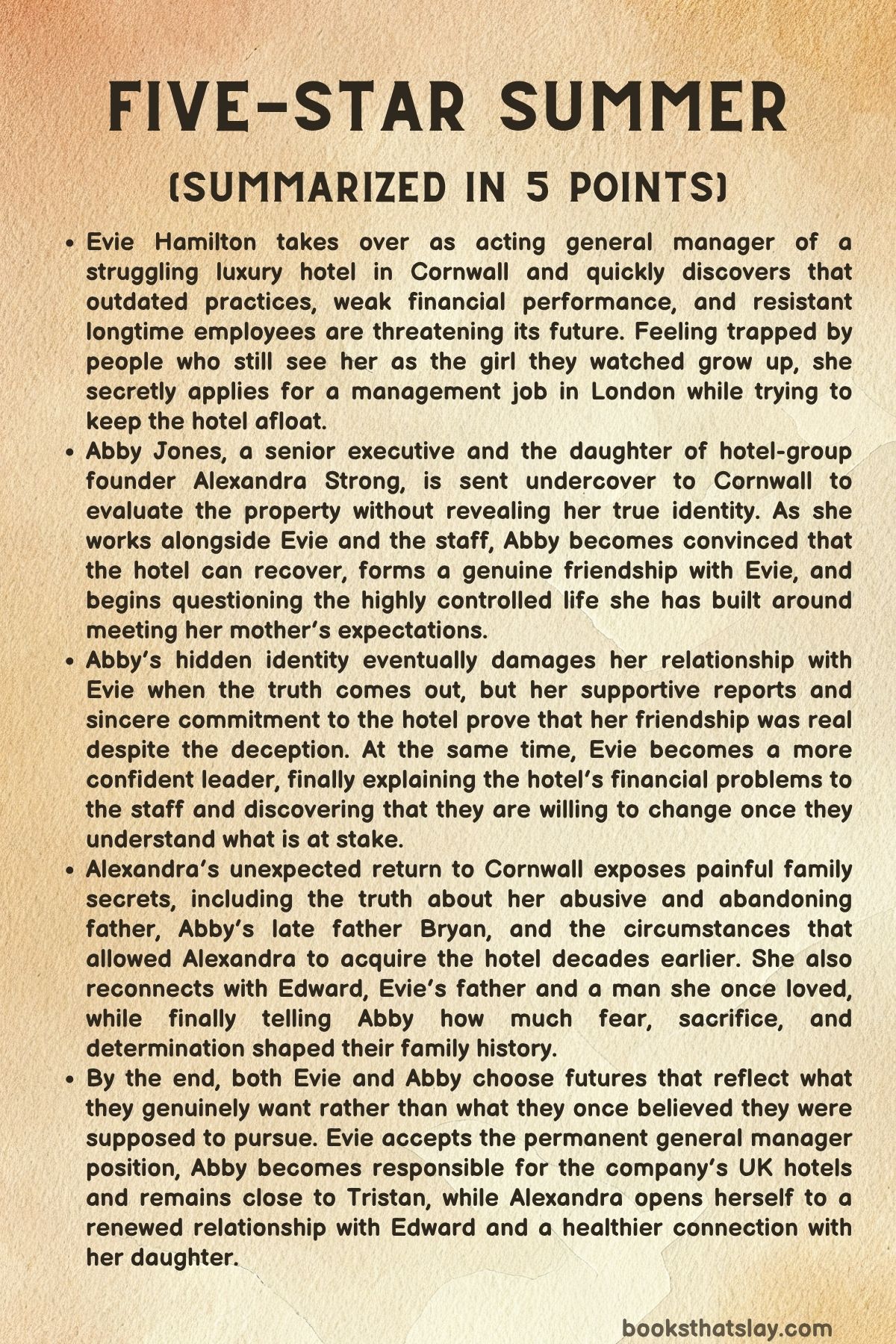
Summary
Evie Hamilton unexpectedly finds herself acting as general manager of The Alexandra, a five-star hotel on the Cornwall coast, after longtime manager Gerald suffers a serious heart attack. The promotion should be the opportunity she has always wanted, but she quickly realizes that the hotel is financially unstable, operating practices are outdated, and many employees remain resistant to change.
The greatest difficulty is that most of the staff have known Evie since childhood and still think of her as the girl they watched grow up. Their affection is genuine, but it prevents them from fully recognizing her authority, leaving Evie caught between protecting personal relationships and making the difficult decisions required to save the business.
Head office has offered little meaningful assistance, while Evie becomes increasingly concerned that the hotel could be sold. A developer has already inspected the property under suspicious circumstances, and although the restaurant is improving thanks to talented chef Luca, Evie worries that she will never receive the authority or support necessary to make the hotel successful.
Exhausted by the struggle, Evie secretly applies for a management position in London. She feels guilty about possibly leaving her father Edward, the hotel staff, and the community that raised her, yet she also longs to discover whether she can succeed somewhere people do not constantly remember her as a child.
In Boston, senior executive Abby Jones presents a grim assessment of the Cornwall hotel. Selling the property appears financially sensible, but company founder Alexandra Strong unexpectedly refuses and instead sends Abby to Cornwall for the summer to investigate operations from inside the hotel.
The assignment comes with an uncomfortable condition: Abby must hide the fact that she is Alexandra’s daughter and a senior company executive. Abby reluctantly accepts because she has spent her career wondering whether colleagues respect her abilities or simply tolerate her because of her powerful mother.
Alexandra has another connection to Cornwall that Abby barely understands. Long before creating an international hotel business, Alexandra worked at the same property as a young woman struggling with poverty, family responsibilities, and emotional loss, and she has spent decades avoiding the memories attached to the place.
When Abby arrives, she is immediately impressed by the hotel’s beauty and by Edward, Evie’s observant father and longtime concierge. Watching him care for guests makes Abby recognize that hospitality cannot always be measured through revenue figures because the strongest relationships between a hotel and its guests often depend on attention, memory, and genuine human concern.
Evie welcomes Abby openly and quickly begins trusting her. She explains the hotel’s problems, her frustration with head office, and her worries about the developer, while Abby becomes increasingly ashamed that she is receiving such honesty from someone who does not know the truth about her.
As Abby begins working across departments, she discovers that Evie is far more capable than senior management has recognized. She also learns that Evie repeatedly asked head office for help and was ignored, raising serious questions about Jack, the executive responsible for the company’s British properties.
Abby proves valuable almost immediately. When a badly damaged guest room threatens an anniversary booking, she works alongside housekeeper Mandy and motivates her through respect rather than authority, showing Evie that longtime staff can change when they feel their expertise is valued.
The two women soon become genuine friends. They run together, discuss their childhoods, share professional frustrations, and talk about Evie’s growing attraction to Luca, while Abby experiences a kind of ordinary companionship she has rarely enjoyed in Boston.
Luca gradually becomes important to Evie as well. During their first proper dinner together, she admits that her previous relationship with Martin left her frightened of village gossip and suspicious of romance, but Luca helps her understand that Martin rejected the very qualities that make Evie valuable: loyalty, openness, ambition, and attachment to her community.
Meanwhile, Abby becomes increasingly connected to Cornwall. She rediscovers her love of playing the piano, develops feelings for Tristan Penrose, and realizes that she is happier working alongside hotel employees than she has ever been among executives who treat her primarily as Alexandra Strong’s daughter.
The pressure of maintaining her false identity eventually becomes unbearable. After drinking too much one evening, Abby leaves Alexandra an emotional message saying she intends to reveal the truth, while Tristan overhears enough to understand that she has been concealing something serious.
The following morning, Abby confesses to Evie that she is a senior executive and Alexandra’s daughter. Evie feels humiliated because she shared both professional concerns and private details with someone she believed was simply a colleague and friend, and Abby can offer no excuse that removes the betrayal.
The confrontation has an unexpected effect on Evie. Anger finally pushes her to speak plainly to employees such as Donna, explaining how serious the hotel’s financial problems have become and making clear that resistance to change could cost them the place they all love.
Abby, devastated by the damage she has caused, goes swimming and becomes involved in a frightening emergency when a young girl named Holly disappears near dangerous rocks. Abby risks herself to reach the child and helps bring her back to shore, where lifeguards successfully revive her.
Evie later reads the reports Abby sent to Alexandra and discovers that Abby consistently defended her. Rather than blaming local employees, Abby criticized senior management for neglecting the hotel and repeatedly praised Evie’s judgment, dedication, and potential as a leader.
That discovery allows Evie to distinguish between Abby’s dishonesty and the sincerity of the friendship that developed afterward. Combined with news of Abby saving Holly, it helps the two women begin repairing their relationship.
The staff also surprise Abby by accepting her return. Although they know she deceived them, they remember that she worked beside them, treated them with respect, and became genuinely invested in preserving the hotel rather than simply evaluating its financial value.
The situation changes dramatically when Alexandra arrives in Cornwall herself. Her appearance is already extraordinary because Abby knows how determined her mother has been to avoid the place, but an even greater shock follows when the persistent developer approaches Alexandra with obvious familiarity.
The developer is Alexandra’s estranged father. His interest in purchasing the property has little to do with reconciliation; his own finances have deteriorated, and obtaining the hotel would benefit him commercially.
Alexandra finally reveals why she severed their relationship. When she was a child, her father had been drinking and intended to drive, and when Alexandra’s mother tried to stop him, he struck her with the car and fled, leaving young Alexandra to summon help.
Her mother survived but suffered permanent injuries, leaving Alexandra with enormous responsibilities at a young age. Her father eventually abandoned them completely, and Alexandra built her later identity partly around rejecting the weakness and selfishness she associated with him.
Evie simultaneously learns that Edward has his own long history with Alexandra. After Evie’s mother Phoebe died, Edward was a grieving new father struggling to find work compatible with caring for a baby, and Alexandra gave him a job at the hotel while arranging practical support for him.
Their children therefore spent time together when they were very young, explaining Abby’s vague memories of the hotel. Evie also realizes that Edward’s affection for Alexandra carries traces of a relationship far more significant than a simple employer-employee connection.
Alexandra finally tells Abby the rest of her past. Abby’s father, Bryan, was an older married man who claimed his marriage was effectively over, but when Alexandra became pregnant, he accused her of trying to trap him and later died in an accident.
Alexandra eventually discovered that Bryan had never truly left his wife. Surprisingly, his widow behaved with generosity toward Alexandra and the unborn Abby, arranging for Alexandra to receive the struggling Cornwall hotel because she believed Abby should not suffer because of Bryan’s choices.
Alexandra transformed that failing hotel into the foundation of her entire business. Abby finally understands that she was never an unwanted responsibility; instead, her existence gave Alexandra a powerful reason to build security, independence, and a future neither of them could lose.
Alexandra also admits that sending Abby undercover had a personal purpose beyond evaluating the hotel. She knew her daughter was lonely and wanted Abby to experience a workplace where nobody judged her through her connection to the company founder.
The method was ethically questionable, but the result changed Abby profoundly. Cornwall gave her friendship, music, affection, freedom, and a clearer understanding of what she actually wants from life.
Alexandra also reconnects with Edward, acknowledging that they once loved each other and never completely replaced what they shared. Rather than viewing the reunion purely as a conclusion to the past, they begin considering whether there might still be room for a future together.
Abby reaches a similar decision about her own life. She no longer wants to return permanently to Boston, so she proposes replacing Jack as the executive responsible for the company’s British hotels, allowing her to remain close to Cornwall while supporting the properties more effectively.
Her decision also gives her the chance to explore a genuine relationship with Tristan. He has consistently encouraged her to question what she wants rather than what Alexandra or the company expects, and Abby finally allows herself to imagine a future built around those desires.
Evie receives her own opportunity when Gerald decides to retire permanently. Alexandra asks why Evie considered moving to London, and Evie admits that she felt trapped because she lacked authority and could not convince people to take her seriously.
By then, however, Evie has already withdrawn from the London process. She realizes that she never truly wanted to escape Cornwall; she wanted the chance to lead properly, supported by people who respected her judgment rather than restricted by assumptions about who she used to be.
Alexandra offers her the permanent general manager position with appropriate authority, salary, and support. Abby becomes the new UK manager, giving Evie the head-office connection she previously lacked, while the employees begin embracing practical changes that can strengthen the hotel without destroying its character.
The celebration brings the transformation full circle. Evie and Abby both remain connected to Cornwall, each having rejected a future based on expectations in favor of one based on personal choice, while Alexandra begins repairing both her relationship with her daughter and the emotional connection to Cornwall she spent decades avoiding.
Characters
Evie Hamilton
Five-Star Summer positions Evie as a capable woman whose central struggle is not learning how to care about her work but learning how to exercise authority without apologizing for it. She understands the hotel, its guests, its employees, and the surrounding community extremely well, yet her long personal history with everyone becomes an obstacle because affection continually replaces professional respect.
Her early instinct is to avoid confrontation, partly because she fears damaging relationships and partly because her temporary status makes her uncertain about how forcefully she should lead. This hesitation allows outdated habits to continue and contributes to her belief that perhaps she needs to leave Cornwall entirely before she can become the manager she wants to be.
Abby’s arrival gives Evie an important professional mirror. Watching Abby persuade Mandy, question inefficient practices, and speak directly helps Evie understand that strong leadership does not require coldness; it requires communicating clearly enough that people understand both the problem and their role in solving it.
Her relationship with Luca develops alongside this growth. He appreciates the qualities Martin once criticized, helping Evie recognize that loyalty to Cornwall is not evidence of limited ambition and that remaining in her community does not mean abandoning professional development.
Evie’s reaction to Abby’s deception is also significant because it shows how seriously she values honesty. Yet her eventual forgiveness demonstrates emotional maturity: she does not erase the wrongdoing, but she evaluates Abby according to the full record of their friendship and recognizes that flawed behavior can coexist with genuine loyalty.
By choosing the permanent management role rather than London, Evie is not settling for the familiar. She is making a newly confident choice to remain in the place she loves only after securing the authority, respect, and institutional support necessary to shape its future.
Abby Jones
In Five-Star Summer, Abby begins as a highly competent executive whose achievements have never given her the confidence that she is valued independently of her mother. Being Alexandra Strong’s daughter has created a professional paradox: Abby possesses extensive experience, yet she suspects that almost every opportunity will be interpreted as favoritism.
The undercover assignment initially appeals to her because it removes that label. For the first time, coworkers judge her according to whether she can clean a room, solve a guest problem, support a colleague, or contribute ideas rather than according to her relationship with senior management.
Her moral problem develops because the freedom she gains depends on deception. Evie’s increasing trust makes the assignment progressively harder to justify, and Abby understands long before she confesses that every genuine moment of friendship also increases the eventual damage.
Cornwall awakens parts of Abby that her controlled Boston existence suppressed. She plays piano again, dances, forms friendships, swims, jokes with colleagues, and begins recognizing that her identity can include pleasure and spontaneity rather than being defined entirely by professional performance.
Her rescue of Holly demonstrates a deeply instinctive courage that exists outside any career calculation. Faced with immediate danger, Abby does not analyze status, consequences, or appearance; she acts because another person needs help.
Her eventual decision to remain in Britain is therefore both personal and professional. She does not abandon ambition but redesigns it, choosing a role in which her experience can directly support hotels while also allowing space for friendship, Tristan, music, and a fuller personal life.
Alexandra Strong
Five-Star Summer gives Alexandra one of its most substantial transformations because her formidable public identity is revealed to have developed from fear, abandonment, responsibility, and survival. Her discipline and emotional reserve have protected her for decades, but the same defenses have also made intimacy difficult.
Her childhood explains much of her behavior. After her father injured her mother and then abandoned them, Alexandra learned very early that dependence could expose a person to terrible consequences, so independence became not simply an ambition but a form of protection.
Her relationship with Bryan reinforced the pattern. Believing his promises left Alexandra pregnant, rejected, and once again forced to create security without relying on the person who should have shared responsibility.
Abby became the reason Alexandra built rather than surrendered. The Cornwall hotel provided the foundation for her business success, but Alexandra treated success as evidence that painful history could be permanently left behind instead of acknowledging how completely it continued shaping her.
Her parenting carries the same contradiction. Alexandra genuinely wants Abby to be strong and secure, yet her instinct to protect through silence prevents Abby from understanding her own family history and contributes to the emotional distance between them.
Returning to Cornwall forces Alexandra to reconsider what strength means. By confronting her father, telling Abby the truth, acknowledging her feelings for Edward, and accepting the possibility of closeness, she begins learning that vulnerability does not automatically place her at someone else’s mercy.
Edward
Within Five-Star Summer, Edward represents the steady emotional culture of the Cornwall hotel. His work as concierge is built around observation, memory, and personal attention, showing that successful hospitality depends on understanding people rather than merely processing customers efficiently.
His history also explains why the hotel means far more to him than employment. Widowed shortly after Evie’s birth, Edward was struggling with grief and single parenthood when Alexandra gave him the practical opportunity that allowed him to support his daughter.
That experience created enduring gratitude, but his bond with Alexandra became much deeper. Edward remembers the frightened and determined young woman beneath the powerful executive identity, which allows him to relate to Alexandra without being intimidated by the person she later became.
As Evie’s father, Edward is supportive without attempting to make her choices for her. He recognizes her attraction to Luca, senses her unhappiness before she admits it, and understands that loving Cornwall should not require Evie to sacrifice her ambitions.
His reunion with Alexandra provides a quiet counterargument to the belief that missed opportunities are permanently lost. Edward does not demand that the past be recreated; instead, he invites Alexandra to consider whether two older people can create something new from a connection that never entirely disappeared.
Tristan Penrose
Tristan initially appears through his protectiveness toward Evie. Having known her for years, he immediately questions Abby’s motives and senses that someone sent by head office may represent risks that Evie’s trusting nature prevents her from considering.
His suspicion is not simple hostility. Tristan has spent much of his life responding to responsibility, including giving up his adventurous career as a mountain guide to help his injured father manage the Smuggler’s Inn.
This background helps him understand Abby more than she expects. Both have experienced the pressure of parental expectations and circumstances that reshape personal plans, which allows Tristan to recognize that Abby’s deception exists within a larger emotional conflict.
His refusal to take advantage of Abby when she is drunk is particularly important. The decision establishes his respect for boundaries and makes clear that his attraction to her is not based on convenience or temporary excitement.
Tristan eventually becomes one of the people who encourages Abby to question the assumption that she must return to her previous life simply because it was once the plan. His role is not to choose Cornwall for her but to help her recognize that changing what she wants is legitimate.
Luca
Luca represents the possibility of ambition that remains connected to place rather than requiring escape from it. He has already left London because he wanted greater creative freedom as a chef, giving him an understanding of Evie’s frustration with being responsible for a business without receiving sufficient control over it.
His relationship with Evie develops through attentiveness rather than dramatic gestures. He notices when she forgets to eat, respects how seriously she takes the hotel, and listens when she explains the damage left by her relationship with Martin.
Luca’s most important emotional contribution is challenging Evie’s interpretation of her past. Instead of accepting the idea that village involvement destroyed her previous romance, he helps her see that Martin simply disliked central aspects of who she was.
That distinction allows Evie to stop treating loyalty, openness, and community connection as romantic liabilities. Luca values the person she already is rather than asking her to become less attached, less visible, or less ambitious.
Professionally, his successful restaurant also demonstrates what can happen when talented people are given sufficient freedom. His presence therefore supports the hotel financially while reinforcing the larger argument that Evie deserves similar authority in her own role.
Donna
Donna embodies the difficulty Evie faces when personal familiarity interferes with professional hierarchy. Her tendency to treat Evie as someone she has known since childhood initially prevents her from understanding why Evie is trying to introduce changes.
Importantly, Donna is not motivated by cruelty or deliberate sabotage. She genuinely cares about the hotel, but years of stability have made her underestimate the seriousness of its financial problems.
When Evie finally speaks directly, Donna responds far better than expected. Her apology shows that some of Evie’s leadership problems arose not because the staff were incapable of changing but because she had not communicated the stakes forcefully enough.
Donna consequently becomes evidence of Evie’s growth. Once given clear information and responsibility, she begins promoting bookings, improving revenue awareness, and actively supporting changes she previously resisted.
Mandy
Mandy, the head housekeeper, demonstrates the importance of respecting expertise when asking established employees to change. Abby succeeds with her during the damaged-room crisis not by asserting rank but by recognizing Mandy’s pride in her work.
Their cooperation reveals that employees who appear resistant may respond differently when approached through professional respect. Mandy wants guests to be happy and the hotel to succeed, even if she is accustomed to familiar methods.
Her role also becomes an important lesson for Evie. Effective authority does not mean forcing every decision through positional power; sometimes leadership means understanding what motivates a person and connecting necessary change to values they already possess.
Gerald
Gerald is largely absent from active events because his heart attack creates the vacancy Evie fills, yet his influence remains visible throughout the hotel. Long-established habits associated with his management continue shaping staff expectations even when those practices are no longer financially sustainable.
His eventual retirement is important because it ends Evie’s temporary status. Until that point, she has been expected to carry managerial responsibility without the psychological or institutional certainty that comes with permanent appointment.
Gerald therefore functions as part of the transition between the hotel’s old operating culture and its future. His departure finally creates the space in which Evie can lead without being treated as someone merely keeping another person’s position warm.
Jack
Jack represents the dangers of distant senior management. As the executive responsible for British operations, he appears to have allowed the Cornwall property to deteriorate while Evie’s requests for assistance went unanswered.
His failures complicate the assumption that the local hotel staff alone caused the financial problems. Abby recognizes that poor performance can result from neglect above the property level as much as resistance inside it.
Replacing Jack becomes an important part of Abby’s final career decision. Her experience in Cornwall convinces her that senior leaders need meaningful knowledge of individual properties rather than relying entirely on reports, numbers, and occasional interventions.
Alexandra’s Father
Alexandra’s unnamed father represents abandonment without meaningful remorse. His return is initially disguised as commercial interest in the hotel, but the family connection reveals that his motives remain centered on his own benefit.
The account of Alexandra’s childhood exposes the full consequences of his behavior. After drinking, he struck Alexandra’s mother with a vehicle when she tried to stop him from driving and then fled instead of taking responsibility.
His later abandonment left Alexandra carrying burdens no child should have been required to manage. When he returns decades later because his finances have weakened, he demonstrates that age has not necessarily produced accountability.
Alexandra’s confrontation with him is therefore less about reconciliation than boundary setting. She finally speaks openly about what he did and refuses to allow biological connection to become an excuse for renewed access to her family.
Bryan
Bryan, Abby’s father, is central to Alexandra’s understanding of trust even though he died before Abby was born. Older and married, he convinced a vulnerable young Alexandra that his marriage was effectively finished and that their relationship had a future.
His reaction to her pregnancy shattered that belief. By accusing Alexandra of attempting to trap him, he transformed what she considered love into another experience of abandonment.
His later death prevents accountability or reconciliation. Alexandra is left to discover afterward that he had misrepresented his marriage, deepening her conviction that emotional dependence creates dangerous vulnerability.
Yet Bryan’s failures indirectly lead to an unexpected act of decency from his wife, whose treatment of Alexandra and Abby sharply contrasts with his behavior.
Bryan’s Wife
Bryan’s wife appears only through Alexandra’s account, but her actions have enormous consequences. She could easily have treated Alexandra solely as the woman involved with her husband, yet she distinguishes Bryan’s wrongdoing from the needs of his unborn child.
Her decision to arrange for Alexandra to receive the struggling Cornwall hotel changes the future of several generations. That property becomes the foundation of Alexandra’s business empire and provides the security she desperately wanted for Abby.
Her generosity also complicates simple ideas about betrayal and blame. She demonstrates that someone personally injured by another person’s choices can still act according to fairness rather than resentment.
Phoebe
Phoebe, Evie’s mother, dies shortly after Evie is born and therefore exists primarily through the effect of her absence. Her death places Edward in the difficult position of grieving a partner while suddenly becoming solely responsible for an infant.
That loss indirectly creates Edward’s connection with Alexandra and the hotel. His need for practical employment brings him to the concierge position that later becomes central to both his own identity and Evie’s childhood.
Phoebe’s absence also helps explain why Evie develops such a strong attachment to community. She grows up with Edward as her parent but is also surrounded by hotel employees and local people who contribute to the sense of extended family she later fears losing.
Martin
Martin represents the emotional assumptions Evie must discard before she can build a healthier relationship. He disliked the closeness of village life and resented how frequently other people seemed aware of their private affairs.
When the relationship failed, Evie internalized his complaints and concluded that community interference had helped drive him away. This interpretation leaves her anxious about dating Luca because she fears repeating the same public experience.
Luca helps her recognize that Martin was not simply rejecting village gossip; he was uncomfortable with qualities central to Evie herself. Understanding this allows her to stop treating the failed relationship as evidence that she must become less connected to other people.
Holly
Holly is a young girl whose accident becomes a decisive moment in Abby’s story. When she disappears near dangerous water, Abby reacts immediately, risking herself to reach the child and help bring her back to shore.
The rescue reveals Abby’s instinctive courage and compassion at a moment when she feels morally disgraced because of her deception. Saving Holly does not erase what Abby did to Evie, but it reminds both Abby and the people around her that one serious mistake does not define the whole person.
Holly’s later recovery also gives Abby perspective. Professional status, family expectations, and hidden identities suddenly seem smaller beside the direct reality of having helped preserve another person’s life.
Themes
Leadership and Earned Authority
Five-Star Summer repeatedly shows that authority depends on more than receiving a job title. Evie technically becomes acting general manager, yet the employees continue responding to the girl they watched grow up rather than the professional responsible for keeping their workplace financially viable.
Her early difficulties reveal that leadership can fail when communication is softened to the point that nobody understands the seriousness of the situation. Evie wants to preserve relationships, but her reluctance to confront resistance allows employees to assume that proposed changes are preferences rather than necessities.
Abby offers a different model through her ability to work alongside people while still addressing problems directly. Her success with Mandy demonstrates that authority becomes more effective when people feel respected for their experience instead of treated as obstacles.
Evie eventually combines both approaches. She keeps the warmth and personal knowledge that make employees trust her but becomes far clearer about financial realities, performance, and expectations.
The staff’s response confirms that people who resist change are not always opposed to improvement itself. Often they need to understand why change matters and to believe that the person leading it respects what they already contribute.
The final appointment therefore represents more than promotion. Evie earns lasting authority by learning that kindness and firmness are not opposing qualities, while Alexandra finally gives her the institutional power required to match the responsibility she has already been carrying.
Identity, Expectations, and Self-Definition
Evie, Abby, and Alexandra each struggle against identities shaped by other people. Evie is constantly seen as the local girl everyone remembers, Abby is reduced to being the company founder’s daughter, and Alexandra has built an entire adult identity in opposition to the frightened young woman she once was.
For Evie, London initially seems attractive because anonymity appears capable of solving her professional frustrations. She eventually understands that she does not need to escape her history; she needs other people to recognize that history does not define the limits of her competence.
Abby faces the opposite problem. She already has status and professional access, but those advantages make her doubt whether anyone would choose or respect her without Alexandra’s name behind her.
Working undercover temporarily removes that burden and allows Abby to experience relationships based on her own personality and behavior. Although the deception creates serious consequences, the experience proves that she is capable of belonging without depending on inherited status.
Alexandra’s conflict is older and more defensive. Choosing the surname Strong helped her reject her father’s legacy, but over time strength became associated with emotional secrecy, self-reliance, and control.
Each woman eventually defines herself more freely. Evie chooses Cornwall without accepting limitation, Abby chooses a senior role without surrendering her personal life, and Alexandra accepts that acknowledging vulnerability does not erase the resilient person she worked so hard to become.
Community, Belonging, and Home
In Five-Star Summer, Cornwall is not simply a location but a test of what belonging can demand and what it can provide. Evie loves the community because it helped raise her, yet the same closeness frustrates her when professional decisions become entangled with childhood memories and personal familiarity.
Her temptation to leave therefore comes from a legitimate desire for independence. The story does not suggest that staying close to home is automatically the better choice; instead, it asks whether a person can remain without allowing familiarity to become confinement.
Abby experiences Cornwall from the opposite direction. Coming from an emotionally restricted professional environment in Boston, she is startled by people who include her in meals, music, work, exercise, conversation, and everyday concern.
That sense of belonging changes her understanding of success. She begins to see that a satisfying life cannot be measured only through promotion, competence, or approval from Alexandra.
Alexandra has spent decades treating Cornwall as a place that must remain behind her. Returning eventually reveals that geography was never the true problem; her avoidance was connected to memories she had never fully processed.
By the end, all three women redefine home as something chosen rather than merely inherited. Cornwall becomes meaningful because it offers relationships and possibilities they actively want, not because loyalty requires them to sacrifice growth, ambition, or independence.
Secrets, Trust, and Second Chances
Secrecy drives many of the story’s most important conflicts. Abby hides her professional identity from Evie, Alexandra hides much of her history from Abby, and painful family truths remain buried because people convince themselves that silence offers protection.
Abby’s deception demonstrates how quickly secrecy becomes harder to justify once genuine intimacy develops. The assignment may have begun as a professional strategy, but every private conversation with Evie increases the moral cost because Abby is receiving trust without providing equal honesty.
Alexandra’s silence operates differently. She withholds information because she believes she is protecting Abby from experiences involving abandonment, betrayal, and family cruelty, yet Abby eventually makes clear that unanswered questions also create emotional consequences.
The story does not treat forgiveness as automatic. Evie needs evidence before repairing her friendship with Abby, and Alexandra has no obligation to reconcile with the father who abandoned her simply because he returns.
Second chances are instead presented as choices that must be supported by present behavior. Abby earns renewed trust because her actions consistently demonstrate loyalty after the original deception, while Edward and Alexandra consider rebuilding a relationship because affection and respect remain between them.
Forgiveness therefore never means pretending harm did not occur. It means deciding whether the person who caused that harm has shown enough honesty, responsibility, and change to justify allowing a different future to begin.