Jean by Madeleine Dunnigan Summary, Characters and Themes
Jean by Madeleine Dunnigan is a coming-of-age novel set around a scholarship boy at an elite English boarding school in the late 1970s. Jean is bright, angry, and always half-braced for the next insult about his class and Jewishness.
He moves through school days full of cruelty, odd tenderness, drugs, and rituals meant to turn boys into “men,” while carrying a messy home life shaped by his volatile mother. When he forms a private bond with Tom, a popular boy with his own fears and limits, that connection becomes both shelter and threat. Jean’s need for loyalty, escape, and self-control pushes him toward choices that can’t be taken back.
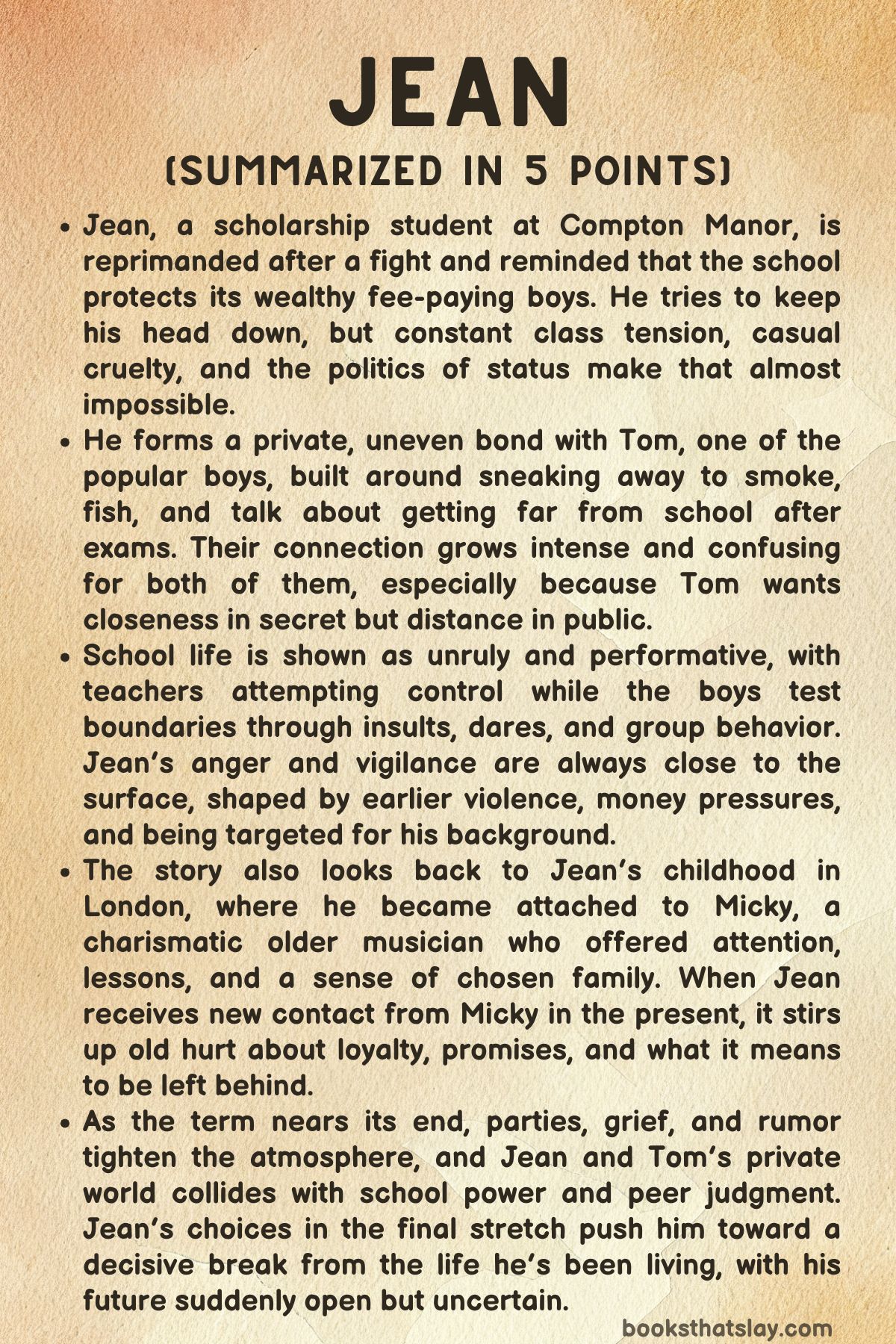
Summary
Jean, a scholarship student at Compton Manor, is called into Headmaster David Larkin’s office after punching Samuel during biology. Samuel sneezed on him, and Jean reacted without thinking, snapping under the pressure he constantly carries.
David scolds him with a polished kind of menace: Compton Manor is a “family,” Jean is “lucky” to be there, and boys like Samuel—who pay full fees—keep the school running. Jean hears what sits underneath the lecture: you’re poor, you’re different, you’re tolerated.
He swallows his anger and leaves.
Back in his dorm, the noise and disorder match the feeling inside him. He retrieves a tin of cannabis he keeps hidden in his trunk.
Outside, Hugo, one of the wealthy boys, mocks him with an antisemitic slur and tries to start a fight. Jean dodges and keeps moving, used to calculating when violence will cost him more than it satisfies.
Later, he meets Tom by the lake. Tom is popular, careful about appearances, and newly interested in Jean because Jean has weed and because Jean doesn’t flatter him.
Their friendship lives in gaps: fishing trips, smoke sessions, and intense conversations away from the eyes of the school. In public, Tom keeps his distance.
Jean tries not to want more than Tom can safely give, but he does anyway.
Jean thinks often about his past. He has been moved through schools because of fights and escalating incidents, including stabbing a boy with a compass.
At home, he lives with Rosa, his unpredictable, artistic mother, whose love can flip into cruelty in the space of a sentence. Jean also thinks about what comes after exams.
The idea of returning to Rosa feels like a trap. He dreams about going to China to study martial arts or Buddhism, imagining distance as a kind of cure.
By the lake, he tells Tom the plan. Tom jokes at first, then listens.
When Jean says Tom could come too, Tom eventually agrees. For Jean, it feels like being chosen.
In English, their teacher Charles Burrows runs a class that is half performance, half damage control. The boys are bored and vicious, doing whatever they like while Charles discusses poetry.
During a discussion of Hopkins, Hugo yells “faggot,” setting off a chant. Charles doesn’t explode or beg.
He calmly dismantles the insult by explaining its history and meaning, then controls the room with the quiet threat of the scissors in his hand. Jean watches, struck by how Charles can turn humiliation back on the boys without raising his voice.
Jean’s obsession with Tom intensifies. He sits at dinner with Samuel, who still shares food and homework with him even after being punched.
Across the hall Jean watches Tom, reading every glance and movement. He catches himself pinching the inside of his arm, an old habit from earlier years when his body tried to manage what his mind couldn’t.
Tom is inconsistent. Jean goes to the lake expecting him and waits until dark, then sees Tom laughing with others.
Jean returns to routines that keep him steady: meditation at dawn, farm work at the chicken coop, chores that give his hands something to do. When Tom finally approaches again, he leads Jean through the woods to a hidden clearing by the lake.
They fish, smoke, and talk seriously about routes to China, including the Trans-Siberian Railway. They laugh at place names and the idea of the trip becomes more detailed and real.
The closeness tips into something neither of them has named. In the clearing, Tom ends up pressing his erection against Jean’s hand.
They freeze, then pretend it was just the weed. But it happens again, and again: discreet touching in a meadow, thrusting in the dark at night.
Each time, Tom follows it with rules—hide the drugs, don’t come near me in public, don’t make it obvious. Jean accepts the terms because the alternative is nothing.
A football match draws the school out to watch. Jean goes because Tom asked him.
Sitting with Samuel, Jean watches Tom on the pitch with a focus that feels like control, as if Jean’s attention can steer Tom’s body. Tom scores and the crowd erupts.
After the match, a brawl breaks out, stopped by staff. Later, Jean ends up walking with Tom and Hugo and the rest.
Hugo needles Jean with antisemitic and sexual taunts. The boys mock Tom about sex and virginity.
When the others run off after a porn magazine, Tom and Jean are briefly alone, and Tom lashes out, calling Jean a pansy. Jean hits back, mentioning Tom’s epilepsy and doubting his sexual confidence.
Tom retaliates by insulting Jean’s mother and heritage. The insults land exactly where they’re meant to.
Jean slams into him, and the fight leaves Tom with a black eye and Jean with bite marks.
Soon after, a long green envelope arrives for Jean, written in purple ink and smelling of musk and cinnamon. It’s from Micky—Mick Caro—a famous musician Jean once adored, who hasn’t written in a long time.
The letter arrives while Jean is already in trouble, sentenced to break limestone for the hole being dug for a new swimming pool. As he swings the pick, time feels heavy: the ancient rock, the school’s routines, the way the past keeps showing up without warning.
The story turns back to Jean’s childhood in London. When he was ten, Micky moved nearby, bringing commotion and glamour that fascinated Jean and infuriated Rosa.
Micky was friendly, inviting, and unbothered by Rosa’s hostility. Jean, often alone after school while Rosa worked, began spending afternoons at Micky’s house, eating snacks, listening to music, and being treated with attention.
Micky talked openly about his estranged father, his Jewish background, and changing his name for his career. He told Jean that sometimes you choose your family, and Jean took that as a promise.
As Jean grew older, Micky taught him meditation and Bruce Lee, introduced him to hashish, and wrote a song called “Boy in Space” for him—a ballad about two boys building a spaceship and launching one of them into space. To Jean, the song meant permanence.
But the letter in the present says Micky is moving to Hollywood. Jean reads it as abandonment.
In anger, he cuts a worm in half after splitting a stone, acting out the feeling that things are ruined because people leave.
Jean’s anger spills everywhere. While working with pigs in the rain, he hoses them until they squeal, taking out his rage on anything that can’t fight back.
He remembers the real reason Micky disappeared: nearly a year earlier, Jean was drunk, lashed out, slapped Micky, and called him a “faggot” when Micky tried to comfort him. Jean never repaired it.
The letter offers no clear return, no invitation, no reassurance.
The school’s summer solstice party arrives, a strange pageant of masculinity and belonging. The boys are dunked in a pond, build a bonfire, wear costumes and headdresses, drink, and eat a roasted boar.
Runes are handed out; Jean receives Perthro, described as “destiny.” The oldest boys crawl blindfolded toward drums and leap the fire. Later, girls arrive and the band—The Larks, with Hugo and Tom among them—plays.
When they perform “Boy in Space,” Jean can’t stand it and leaves, as if the song has been stolen from his life and turned into entertainment.
He smokes with a girl named Sandra, returns, and kisses her on the dance floor while watching Tom with another girl, Millie. Overwhelmed, Jean runs to the lake.
Tom follows. Tom admits he hates being laughed at and is still raw from the talk about virginity.
In the dark, their closeness turns into sex. For Jean, it’s the first time pleasure feels shared rather than taken, the first time he feels wanted without being mocked for it.
The next day, news hits the school: Tom’s brother George has died in a car crash. The mood shifts into shock and sickness, with the usual routines suddenly looking fake.
In class, everyone is hungover and restless. During butchering duty, Jean’s focus slips and he ruins a cut on a cow carcass.
Death feels present in too many forms, including the memory of a boy who once jumped from the school roof.
Jean speaks to Rosa on the phone and ends up attacking her viciously, saying things meant to wound. He hangs up furious, then hates himself for it, caught in the pattern of needing her and wanting to destroy the hold she has on him.
The final-year boys begin a three-day solo wilderness hike. Jean starts early, aiming for the sea.
The hike feels like an escape hatch. He walks hard, eats stale food, cools off in streams, and gets briefly lost in hedges and brambles before reaching his marked spot.
He camps near a low river, carefully arranging food and tent, trying to prove he can survive without anyone.
At dawn, Tom appears, already frying bacon. Tom is irritated and points out Jean’s mistakes: the food parcel was left where the sun would warm it, and Jean didn’t ask the farmer’s permission to camp.
Tom has already spoken to the farmer and brought extra water, making it clear who is truly prepared. Jean tries to regain ground by showing Tom edible plants.
Tom is impressed, and warmth returns.
They go into town to restock, eat chips by the sea, swim, dry on the sand, and touch in small, private ways. Back at camp, Tom seems more interested in food and weed than sex at first, then suggests swimming naked in the river.
Their play turns into wrestling, teasing, kissing, and a moment where Tom holds Jean underwater as a “joke.” Jean panics, flashing to a memory of something frightening from France. Tom releases him, laughing, and then the mood swings back to desire.
They attempt penetrative sex; it is painful for Jean, and they use butter as lubricant. Jean endures it, wanting closeness even when his body says no.
They move camp to a deserted beach and fall into an easier rhythm: fishing, cooking, drinking, mutual sexual acts, and talking about a future that feels almost possible. One night, Tom insists on a “night vigil” and produces mushrooms.
They take them and roam, swim, and talk for hours. Tom speaks about George; Jean speaks about China and meditation.
Still high, Jean pretends to eat what he claims is hemlock. Tom panics, chases him, and in the struggle punches Jean, knocking loose a beehive.
Tom is stung and his face swells. Jean makes a poultice and apologizes.
Tom demands honesty, and Jean finally admits that in France there was a man who did something to him, without saying everything. Tom softens.
Tom confesses his own history with George, including cruelty that left him humiliated as a child.
Near dawn, Tom tells Jean his father expects him to join the family business immediately after exams. The trip to China begins to sound like fantasy.
When they separate to return to school, Tom calls Jean a “swan,” a strange, tender label that feels like both praise and goodbye.
Back at Compton Manor, gossip spreads that Charles Burrows has disappeared. The boys speculate nastily, and Tom snaps that everyone knows why.
Jean pieces together that Charles may have been involved with a student, possibly Hugo, and that David removed him quietly to protect the school.
As exams approach, Tom and Jean steal speed from Hugo’s stash to study. Jean’s focus improves, but the drugs make him twitchy and volatile.
One night after being with Tom by the lake, they run into Hugo, who is frantic because a girl says she’s pregnant and wants money for an abortion. Hugo taunts Jean, suggesting Tom is only using him.
Jean lunges, but Tom restrains him. Jean realizes Hugo knows about them because Tom told him.
The betrayal hits fast. Jean attacks Tom in sudden rage.
David intervenes and finds the open tin of drugs. He demands to know whose it is.
Tom, bleeding and furious, says it belongs to Jean. In one sentence, Tom protects himself and sacrifices Jean.
Soon Jean is on a train home, expelled, exhausted, and numbed by shock. At home, Rosa is baking and talking rapidly about plans and jobs for him, already aware of what happened.
A song plays on the radio, and Jean feels trapped inside a life that keeps repeating itself: violence, shame, need, and abandonment. Then he makes a decision that feels like the only clean line he can draw.
He leaves the house, walking out into the bright summer day, imagining an entirely different life ahead.
Characters
Jean
As the protagonist of Jean, Jean is the volatile center of gravity: a boy whose body reacts faster than his mind, and whose inner life is a constant negotiation between shame, hunger for belonging, and an almost spiritual desire to disappear into something cleaner than his circumstances. His violence is not random; it is defensive, reflexive, and often triggered by humiliation—being sneezed on, being called slurs, being laughed at, being handled socially like he is disposable.
At Compton Manor, he carries multiple kinds of otherness at once—poverty and Jewishness in a fee-paying world—and he experiences authority as a performance that protects the wealthy while demanding gratitude from the poor. Jean’s routines, from meditating at dawn to farm work and solitary swims, read as self-invented survival structures, as if he is building a person out of discipline to keep the chaos from leaking out.
He longs for escape routes—China, Buddhism, martial arts—not only as adventure but as a fantasy of becoming untouchable: purified, trained, beyond the reach of Rosa, bullies, and the school’s moral hypocrisy. Yet when intimacy arrives, it does not calm him; it intensifies everything.
With Tom, Jean becomes both exhilarated and terrified, because desire makes him visible, and visibility has always been dangerous for him. His pattern is painfully consistent: he bonds intensely, attaches meaning to gestures and promises, and then experiences inevitable withdrawal as betrayal, which he answers with rage or cruelty.
Even his tenderness is edged with fear; the moment he feels replaced, he spirals into self-harm habits, aggression, and catastrophic thinking. By the end, expulsion is not just punishment but confirmation of the story Jean has always half-believed—that he does not belong anywhere—so his final decision to leave home reads as both liberation and flight: a last act of agency from someone who has rarely felt he could choose his own life.
Headmaster David Larkin
David Larkin represents the institutional conscience that claims warmth while practicing control, and his language of “family” becomes a tool for silencing conflict rather than resolving it. He frames discipline as moral instruction, yet his priorities reveal a hierarchy: the fee-paying boys matter because they fund the school, and Jean is reminded—without tenderness—that his place is conditional.
David’s authority feels paternal on the surface but transactional underneath, which is why Jean hears not guidance but humiliation when David speaks. Importantly, David is not shown as naïve; he understands power, knows how reputations and money shape consequences, and he uses discretion when scandal threatens the school’s image.
His interventions in fights and rumors suggest a man managing risk as much as behavior. Even when he performs restraint—breaking up brawls, demanding answers about drugs—his presence communicates that the institution will protect itself first.
To Jean, David becomes the face of a world that judges him for impulses it has helped sharpen: a world that moralizes at the poor and quietly accommodates the privileged.
Samuel
Samuel functions as a quiet counterweight to the school’s cruelty, and his defining quality is a steadiness that makes him hard to categorize in the usual hierarchy. He is a fee-paying boy—part of the group the headmaster implicitly values—yet he responds to Jean’s violence with unexpected generosity, still sharing food and homework even after being punched.
That choice makes Samuel morally significant: he demonstrates that kindness can exist inside privilege without being merely patronizing. At the same time, his relationship with Jean highlights Jean’s confusion about care; Samuel offers a stable, socially safe form of connection, but Jean’s attention keeps tilting toward the riskier, more consuming bond with Tom.
Samuel also serves as a witness: he is present during the football match and the school’s public moments, watching Jean watch Tom, which underscores how visible Jean’s longing is even when Jean thinks he is hiding it. If Jean’s life is full of conditional belonging, Samuel is one of the few figures who offers something closer to uncomplicated companionship—yet the story’s emotional logic suggests Jean is not yet able to trust that kind of safety.
Hugo
Hugo is the story’s most overt agent of social violence, embodying the entitlement that turns prejudice into sport. He uses antisemitic slurs and sexual taunts not only to harm Jean but to establish dominance in front of the other boys, as if cruelty is a performance he expects applause for.
Hugo’s power is social: he belongs to the wealthy set, moves easily among the popular boys, and knows how to weaponize rumor and insinuation. He is also a pressure point where multiple hypocrisies converge—he can chant insults in class, needle people about sex, and yet remain protected by the same environment that polices Jean.
His role expands beyond bullying when drugs and secrets enter the story; he becomes a conduit for risk, through speed used for exams, and for blackmail-like knowledge, implying Tom’s motives and exposing the relationship indirectly. Even his crisis about a pregnancy demand shows how his recklessness creates consequences he expects others to help contain.
Hugo’s most unsettling function, though, is how he seems to thrive in ambiguity: he hints, provokes, and destabilizes, forcing others to react and thus reveal themselves. If Jean’s violence is defensive, Hugo’s is recreational—harm as a way of confirming that the world is arranged in his favor.
Tom
Tom is both invitation and threat in Jean, a boy whose charm and curiosity pull Jean into intimacy while his fear of exposure repeatedly turns that intimacy into cruelty. He approaches Jean from a position of popularity and social safety, but he crosses into Jean’s private world through drugs, secluded spaces, and the thrill of secrecy.
Tom’s attraction is real, yet it is braided tightly with performance: he wants Jean in the margins—at the lake, in the clearing, in the dark—while insisting Jean not approach him openly at school. That split creates a rhythm of closeness and disappearance that trains Jean to expect abandonment.
Tom’s sexuality is portrayed as exploratory and opportunistic at first—physical contact framed as something that “just happened,” blame shifted onto weed—yet it deepens into genuine emotional reliance after the solstice and the wilderness trip, when grief and confession crack open his defenses. Still, Tom’s tenderness is unstable.
His insecurity about masculinity and virginity, his sensitivity to ridicule, and his need to remain legible to the boys’ social order all make him lash out: he calls Jean names, uses Jean’s vulnerabilities as ammunition, and later sacrifices Jean by blaming him for the drugs when confronted by authority. That betrayal is not only cowardice; it reveals Tom’s core conflict—he wants the freedom Jean represents, but he fears the cost of being seen wanting it.
His epilepsy and his complicated history with his brother George add another layer: Tom has lived with bodily unpredictability and humiliation, and he tries to regain control by controlling narratives, including Jean’s. The wilderness section shows Tom at his best—practical, attentive, capable of warmth, open to wonder at Jean’s knowledge—yet it also shows his capacity for dangerous play, like the drowning “joke” that brushes against Jean’s trauma.
By calling Jean a “swan” at parting, Tom reaches for poetry and tenderness, but the gesture cannot erase the fact that, when forced to choose between Jean and himself, he chooses himself.
Charles Burrows
Charles Burrows is the most intellectually subversive adult at Compton Manor, and he appears as someone who understands the boys’ cruelty well enough to dismantle it without raising his voice. In the classroom, amid chaos, he uses language and etymology to deflate a shouted slur, turning an act meant to shame into an object lesson that returns power to him and, indirectly, dignity to the target.
His calm is not softness; it is control, signaled even by the unsettling detail of him trimming an Angora rabbit while teaching, as if he is always doing something delicate and slightly violent at once. Charles’s willingness to discuss erotic conflict in poetry suggests he refuses the school’s sanitized moral theater, and that refusal may be precisely why he becomes vulnerable.
When he disappears, the boys’ gossip turns him into a symbol of scandal, and the narrative implies the school removes him quietly to protect its reputation. Whether or not he crossed a line, his fate shows how the institution treats sexuality and transgression: not as a topic for truth, but as a threat to be managed.
For Jean, Charles represents a rare possibility—an adult who can name what others only insult—but the system proves that such naming has consequences.
Rosa
Rosa is the original storm system in Jean’s life, portrayed as both fiercely alive and catastrophically injurious. She is an artist mother with volatility that swings between tenderness and destruction, and Jean’s memories of camping with her capture the instability he learned to normalize: drinking, charm, risk, and the blurred boundaries of adult attention.
Rosa sends Jean away after violent incidents, not simply as punishment but as an act of desperate management—she cannot contain him, and he cannot contain himself in her orbit. Yet even at a distance, her presence dominates his imagination; much of his longing for China is also longing for a life not organized around Rosa’s moods and needs.
Their phone call reveals the ugliest intimacy between them: Jean knows exactly where to hurt her, and he uses that knowledge with precision, as if cruelty is the only language that reliably produces distance. Rosa’s rapid, plan-filled talk when Jean returns home shows a familiar pattern of control through narrative—she fills space with intentions so no one else can speak their own.
Jean’s final act of walking out is therefore not only rebellion against the school’s punishment but also separation from Rosa’s gravitational pull. Rosa is not just a parent in the background; she is a shaping force that has taught Jean that love can be loud, unstable, and conditional—training him, tragically, to accept versions of that pattern with other people.
Mick Caro
Mick Caro is Jean’s first experience of chosen belonging, functioning as both sanctuary and template for later attachment. To young Jean, Micky is dazzling—a celebrity presence who nevertheless offers ordinary kindness: snacks, music, attention, the feeling of being wanted in a room.
He introduces Jean to meditation and martial arts, giving him practices that later become Jean’s self-rescue rituals, and he frames kinship as something you can decide rather than inherit. That idea imprints on Jean like scripture.
Micky also complicates Jean’s relationship to identity: he speaks about Jewish background and changing names for survival in public life, which mirrors Jean’s own sense of being marked and judged. But Micky’s warmth carries an implicit power imbalance; he is the adult with resources, charisma, and the ability to define the relationship’s meaning, while Jean clings with a hunger that turns every gesture into a vow.
The song “Boy in Space” becomes Jean’s private evidence of permanence, a promise he believes will outlast everything. When the letter arrives announcing Hollywood, it detonates that belief, and Jean’s reaction—furious, abandoned, infantilized—shows how much of his emotional architecture was built around Micky not leaving.
The revelation that Jean once slapped Micky and used the same slur others use at school reveals the tragic loop: Jean repeats the violence he fears, striking first to avoid being the one left. Micky’s move is not merely a plot point; it is the origin of Jean’s later terror with Tom—the fear that intimacy always ends with someone choosing a larger life elsewhere.
George
George is largely absent in person but heavy in consequence, functioning as a shadow that shapes Tom’s emotional weather. His death in the car crash interrupts the school’s rituals and exposes how thin the boys’ performances of toughness are when confronted with actual loss.
Later, Tom’s confession that he hated George and that George once humiliated him by locking him in a suitcase reveals a family cruelty that parallels the school’s culture: dominance disguised as play, humiliation treated as entertainment, pain made private. George’s role, then, is not simply to die and create drama; he is evidence that Tom’s volatility did not start with Jean.
Tom has been trained in a world where affection can coexist with degradation, and where the powerful can terrorize you and still be called family. George’s death also intensifies Tom’s urgency and confusion about the future—duty to family business, expectations closing in—making the dream of China feel both more necessary and less possible.
Sandra
Sandra appears briefly, yet her role is emotionally strategic: she represents a socially legible intimacy that Jean can use as cover and as self-defense. When Jean smokes with her and later kisses her on the dance floor, he is not simply experimenting; he is trying to regulate jealousy, drown shame, and perform normality in a setting where his real desire feels dangerous.
Sandra is also a mirror for Jean’s loneliness. She is present at the moment he is most overwhelmed, which suggests Jean reaches for proximity wherever it is offered, even if it does not meet the deeper need driving him.
She is not portrayed as an object to be mocked; instead, she becomes part of the book’s portrait of adolescence as improvisation—using whoever is nearby to manage feelings too big to carry alone.
Colin
Colin is a minor figure, but he helps reveal the school’s machinery of masculinity through labor and ritual. During butchering duty, working beside Jean under David’s supervision, Colin’s presence emphasizes how the institution ties coming-of-age to sanctioned violence: cutting flesh, learning to handle blood, proving steadiness with a knife.
Jean’s mistake—driving the knife into bone—shows how distracted he is by grief, desire, and dread, but it also shows how little space the school allows for inner turbulence; the work must be done cleanly regardless of what is happening inside a boy’s head. Colin’s relative neutrality makes him useful as contrast: not every boy is a tormentor or a lover, but everyone is part of the system that trains them toward hardness.
Themes
Class, Power, and the Economics of Belonging
Compton Manor presents itself as a “family,” but that word is used as a method of control rather than comfort in Jean. When Headmaster David Larkin tells Jean he is “lucky” to be there and reminds him that fee-paying boys fund the school, the message is clear: Jean’s place is conditional.
The institution’s order is protected not by fairness but by money, reputation, and the ability to absorb scandal quietly. Jean learns that violence is not judged equally—Samuel’s sneeze and entitlement are treated as an inconvenience, while Jean’s reaction becomes a moral failure that threatens the school’s image.
The wealthy boys understand these rules instinctively. Hugo’s antisemitic slurs and sexual taunts are not random cruelty; they are social enforcement, a way to keep Jean marked as an outsider whose poverty and Jewishness can be used against him whenever the group wants entertainment or cohesion.
Even when teachers try to manage the classroom’s aggression, the power balance remains: the school can humiliate, punish, and ultimately remove Jean, while protecting itself from scrutiny. The rock-breaking punishment for attacking Tom is symbolic in a blunt way—Jean is made to literally break down ancient material while the school’s hierarchy remains intact, older than any one incident, and seemingly as immovable.
The disappearance of Charles Burrows later reinforces the same mechanism: when scandal threatens the institution, the solution is not truth but removal and silence, a quiet correction that preserves the school’s standing. Jean’s expulsion becomes the final proof that belonging is a transaction.
Those with money, family name, and social ease can survive mistakes; those without them become disposable, no matter how much they work, how disciplined they try to be, or how sincerely they want a future beyond the school’s gates.
Desire, Shame, and the Policing of Masculinity
Jean’s relationship with Tom develops in a climate where male desire is constantly monitored, joked about, and weaponized. That pressure turns intimacy into something unstable—alternating between tenderness, denial, and aggression.
Tom seeks Jean out privately to smoke and talk about escape, yet keeps distance during the day, not only to protect a reputation but to protect a version of himself that must remain acceptable to the boys who set the rules of masculinity. Their sexual contact begins in gestures that are easy to dismiss—touching in darkness, a body pressing into a hand—because ambiguity provides safety.
The moment the contact becomes harder to deny, language becomes a weapon. Hugo’s chanting in class, the casual slurs thrown around as entertainment, and Tom’s own use of “pansy” show how the group maintains a narrow definition of what men are allowed to be.
Tom’s cruelty toward Jean often follows public humiliation or fear of being seen as weak: being called a virgin, being laughed at, being targeted by Hugo’s comments. He lashes out to restore status, even if it means injuring the person he desires.
Jean mirrors this pattern in his own history—his earlier outburst toward Micky, the slur he uses when ashamed, the way he attacks when he feels exposed. The novel keeps returning to how masculinity is treated like performance, and how desire becomes dangerous when it threatens the performance.
Even moments of genuine closeness carry a shadow: their sex by the lake is tender and reciprocal, yet it happens alongside secrecy and the knowledge that the same environment that made the encounter possible will also punish it if named. The wilderness trip briefly loosens these pressures—naked swimming, shared food, physical play—yet even there, control and dominance surface in the drowning “joke” and in the painful sex Jean endures to keep closeness from collapsing.
Desire is not portrayed as simple liberation. It is something both boys want and fear, something that can offer refuge and also provoke violence when the world around them insists that certain forms of wanting must be laughed at, denied, or punished.
Betrayal, Abandonment, and the Search for Chosen Family
Jean’s deepest fear is not conflict but being left behind, and the story frames abandonment as a repeating wound that shapes how he attaches to people and how he destroys those attachments when he feels them slipping. The school’s constant reminders of conditional acceptance echo Jean’s earlier life with Rosa, where care exists but is unstable—loving one moment, volatile the next.
Into that instability, Micky enters as a dazzling alternative: attention, gifts, music, conversation, a house where Jean is welcomed rather than tolerated. Micky’s line about choosing your family becomes a promise Jean builds his inner life around, and the song “Boy in Space” functions as emotional proof that this bond is real and enduring.
Yet the adult world intrudes: careers move, loyalties shift, time passes, and a letter announces Hollywood without offering Jean a place in the new life. Jean experiences it not as ordinary change but as betrayal, because for him closeness has always been tied to survival.
What makes this theme especially painful is that Jean is not only a victim of abandonment; he participates in the cycle. He previously slapped Micky and used a slur during an ugly moment, then never repaired the rupture.
With Tom, the same pattern repeats: secrecy, sudden intimacy, then disappearance; closeness that feels like rescue, then a public insult that turns love into injury. The final betrayal—Tom blaming Jean for the drugs when David intervenes—lands with extra force because it mirrors the institutional logic of sacrifice: someone must be offered up to preserve the group, and Jean is the easiest choice.
Jean’s response to abandonment often becomes self-sabotage and rage, shown in the worm he cuts in half, the way he panics and sprays the pigs until they squeal, and the phone call where he attacks Rosa with words meant to harm. These acts are not random cruelty; they are attempts to manage helplessness by becoming the person who does the cutting first.
Even the fantasy of China is part of the same need: a place beyond the reach of people who can leave him. By the end, when he walks out of Rosa’s house imagining an entirely different life, the gesture is not just rebellion.
It is a desperate effort to stop being the one left behind by choosing departure on his own terms, even if it means stepping into uncertainty without anyone to catch him.
Escape, Self-Discipline, and the Body as a Battleground
Jean repeatedly turns to the body—training, drugs, meditation, sex, endurance—as his most reliable method of control, and the story treats physical experience as the site where freedom and damage coexist. When Jean imagines China, martial arts, and Buddhism, he is not chasing a tourist dream; he is searching for a structure strong enough to hold his mind together when relationships and institutions fail.
The book shows him practicing dawn meditation and working on the farm as routines that create a sense of earned stability. Yet the same body that can be trained is also where volatility lives.
Jean’s history of violence appears early and keeps resurfacing: the punch in biology, the older stabbing incident, the impulsive fights that erupt when he feels mocked or exposed. Drugs become another form of bodily management—cannabis as quieting and bonding, speed as productivity and panic, mushrooms as temporary widening of perception.
Each substance offers a different kind of escape, but none produces lasting safety; instead, they amplify what is already present, including Jean’s tendency toward paranoia, shame, and sudden anger. The wilderness hike is the clearest example of escape through discipline: he navigates alone, gathers food, treats his injuries, and builds a fire with flint and steel to reclaim competence after an earlier humiliation.
For a moment, survival skills feel like proof that he can live without the school’s approval. But even in that setting, the body remains contested territory.
Tom corrects Jean’s mistakes, establishing a subtle hierarchy; their intimacy shifts from playful wrestling into panic when Tom holds Jean underwater; sex becomes both closeness and pain, with butter used not as romance but as improvisation to make something possible that Jean’s body resists. The body records older harm too, hinted through Jean’s partial disclosure about France and his reaction to being restrained.
The theme culminates in Jean’s final act of leaving: walking out into the bright day is both physical and symbolic, a refusal to stay trapped in a life that feels like suffocation. Escape is never presented as pure liberation.
It is portrayed as an ongoing project—built through habits, endurance, and sometimes self-deception—because Jean’s body is where he carries fear, desire, memory, and the hunger for a life that does not require him to be hardened all the time.