Jealous Rage Summary, Characters and Themes
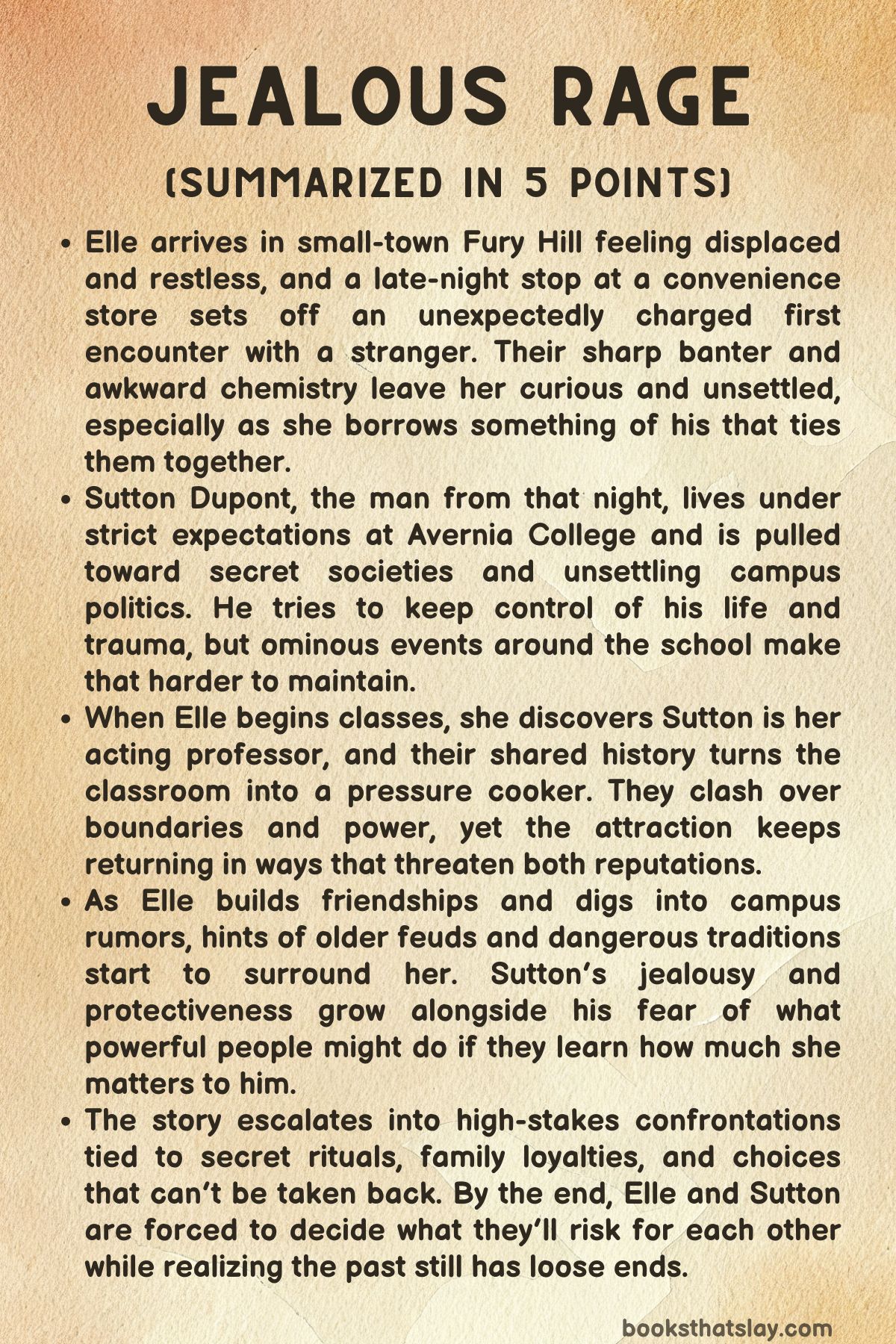
Jealous Rage by Sav R. Miller is a dark campus romance set in Fury Hill, New Hampshire, where Avernia College sits on top of old secrets, old money, and a student body that treats danger like background noise. Noelle “Elle” Anderson arrives from Los Angeles already angry at how her life derailed, only to collide—literally and verbally—with Sutton Dupont, a guarded professor with a polished public face and a private life shaped by fear, obligation, and a ruthless underground society.
Their attraction is immediate, messy, and risky, and it pulls Elle straight into the power games and violence that the town has been pretending not to see. It’s the 2nd book in the Monsters Within series.
Summary
Noelle “Elle” Anderson has barely landed in Fury Hill before she feels like she’s choking on it. The town is small, suspicious, and proud of being hard to impress.
Late at night, she drifts through a gas station convenience store, irritated by everything—especially the fact that she can find almost anything on the shelves except a lighter. The annoyance boils over until a stranger startles her, sending a display crashing and condoms flying.
He catches the rack before it falls, then ends up holding a boxed vibrator that got scooped up in the chaos. The moment turns awkward fast, then sharper as they trade snide remarks.
Elle talks too much when she’s uncomfortable, and she overshares—about casual sex, contraception, and even her endometriosis—because silence feels worse than embarrassment. The stranger, calm and observant, gives as good as he gets.
An employee addresses him in French, and he answers easily, making him even more of an outsider in a town that watches newcomers closely. When Elle finally admits she needs a lighter for a “meeting,” he produces a gold Zippo and explains that Fury Hill stopped selling lighters after a bar fire years ago.
He insists she borrow his. When she points out she can’t return it if she doesn’t know his name, he promises that if anything burns in Fury Hill, he’ll know where to find her.
That same night, the man—Sutton Dupont—heads to an invitation-only event hidden beneath Avernia College’s library. Behind a mask and strict doors is a ballroom where classical music plays while masked patrons participate in ritualized sex.
Sutton is treated as someone important, placed in a central chair, touched and serviced by masked attendants who call him “Elder.” He goes through the motions with no pleasure, fighting panic and flashbacks that hit hard enough to make him bolt. A masked woman known as the Director watches him leave and coolly remarks that there will be another chance.
Outside, Sutton sees firelight: the dean’s house is burning. There’s movement upstairs, trapped by flames.
Sutton doesn’t rush in. He believes the dean is corrupt and tied to the Curators, the group connected to deaths in the campus caves the previous semester.
Three hooded figures pass him, and he catches a scent—vanilla and honey—that yanks his thoughts back to the woman from the gas station. One of the figures hesitates, like they recognize him, then hurries away.
Sutton is left unsettled by how close everything feels.
Not long after, Elle is at Lethe’s bar with her siblings and friends. Their conversation makes it clear the fire wasn’t an accident: the group set it as a warning, confident the dean won’t go to police because the school’s board wants silence and clean headlines.
When the group starts to leave, Elle stays behind and spots Sutton alone at the bar, tense and on the phone. She recognizes him immediately.
Trying to be bold—and still mad about how the town is already shrinking her—Elle approaches to return the Zippo, adding a condom as a teasing “thank you.”
Sutton is in the middle of a heated call with his younger brother Beckett about Beckett’s expulsion and the scandal that led to it. He hangs up and turns his attention to Elle.
Their banter flips quickly into flirting, then into something more charged. Sutton seems unused to being pursued so directly; Elle pushes anyway, treating the interaction like a scene she can control.
They end up in Sutton’s cramped car, where Elle directs the pace, makes him respond, and insists on what she wants. Sutton’s restraint is obvious, and his touch is strangely cold, but he’s attentive to her comfort and makes sure she gets off before he tries to go further.
Then Sutton’s phone won’t stop buzzing. Something in him snaps back into duty.
He abruptly stops, pulls away, and leaves in a rush, cutting the encounter short and driving off without explanation. Elle is left furious and humiliated, forced to return to her dorm with her confidence shredded.
She tries to reset—showering, managing an endometriosis flare-up with medication and a heating pad—but she can’t shake the fact that she never learned his name, and that he left like she was disposable.
Sutton returns to Dupont Manor, a decaying estate above the college, where grief still hangs in the air after the death of his twin sister Bellamy and the departure of his younger sister. He’s been summoned for an “emergency” meeting.
Inside are his mother, Claire Dupont, Beckett, and Dean Justin Bauer—who looks far too pristine for a man whose house Sutton watched burn. They announce that Beckett’s expulsion has been reversed by an emergency board session, despite his involvement in the cave incident that led to kidnappings and student deaths that the school officially buried.
The reinstatement comes with rules meant to control the optics: Beckett must leave the Curator clubhouse and keep a low profile, possibly even living in Sutton’s staff apartment so the campus doesn’t connect them.
Claire admits privately that she bribed Bauer to get Beckett away from Sutton’s father, Jean-Louis, whose illness has sharpened into rage and obsession. Claire fears Beckett is easy to influence, and she believes Jean-Louis will push him into something worse.
As Sutton leaves, he senses eyes on him and spots Jean-Louis watching from a balcony, smoking and silent.
Meanwhile, Elle tries to orient herself on campus by hiding in her sister Quincy’s office, a cramped space full of plants, history texts, and occult research. Quincy warns her that Avernia is dangerous, that the town praises the Anderson name publicly while plotting in private, and that missing persons reports have surged.
She tells Elle to avoid the Primordial Forest and implies that some truths don’t depend on belief. When Elle leaves, she briefly glimpses a tall man carrying a briefcase near the Lyceum—then he’s gone when she blinks.
Sutton begins the semester teaching Acting for Beginners. He’s strict, controlled, and intent on discipline.
He shuts down rumors about bodies and cave deaths, blaming campus gossip and an anonymous poster called Pythia. He pushes his philanthropic organization, Visio Aternae, and demands attention when he calls roll.
When he reaches “Noelle Anderson,” no one answers—until Elle rushes in late. Sutton recognizes her voice.
The woman from his car is now his student. His composure cracks into anger, and he treats her with hostility, demanding work she hasn’t received and finally dismissing her from class after they clash.
Elle refuses to accept being punished for his mistakes. After class she confronts him, forcing a syllabus out of him and insisting he can’t kick her out because of what happened between them.
Their argument turns personal fast, tangled up in the Anderson name and what it represents in Fury Hill. Sutton accuses her of setting the dean’s house on fire and of using his lighter for it.
Elle denies it. She flirts, touches him, tries to regain control, but Sutton stops her cold, calls her a “temptress,” and throws the syllabus at her like it’s an eviction notice.
Away from Elle, Sutton is pressured by Jean-Louis to commit fully to Death’s Teeth, the secret society tied to ritual sex, sacrifice, and the town’s founding families. Jean-Louis demands Sutton complete initiation and choose a Maiden.
Sutton refuses, shaken by trauma and furious at being cornered. He reviews information about the Andersons and realizes multiple Anderson siblings are on campus at once, matching conditions tied to an old curse.
Campus gossip escalates when Pythia posts a photo of Elle labeling her trouble, with a shadowy figure watching her.
Elle starts building fragile friendships—Meg, Lexington, Percy—and learns the campus runs on rumors because official truth doesn’t exist here. She hears about Death’s Teeth, sigils, haunted dorms, and tunnels leading to the caves.
Sutton keeps avoiding her eyes in class but can’t stop tracking her, especially when he sees her with other students. Jealousy hits him hard enough that it scares him, because it feels like another way to lose control in a life built on control.
The tension between them keeps snapping into heat. Elle rehearses for auditions, and Sutton gets cornered into acknowledging the pull between them.
They kiss in a hallway, then separate before anyone sees. Quincy agrees to help Sutton as co-casting director, warning him not to damage Elle’s future.
Elle confides in friends about the danger on campus and the research surrounding Fury Hill’s legends, while Sutton worries that any attention on Elle could make her a target for Death’s Teeth the way his sister was.
At auditions for Jealous Rage’s central production, Othello, Elle’s performance shocks Sutton. He cuts her off early, claiming time is up, but the truth spills out when she confronts him: he can’t stand how much he wants her, how possessive the feeling is becoming, and how easily it could ruin them both.
Elle admits her Hollywood reputation was shaped by manipulation and rumor more than truth. Sutton reassures her she doesn’t have to trade sex for roles.
Then they cross the boundary again anyway, alone in his office, taking the risk and barely avoiding being caught.
The danger stops being theoretical when Beckett appears outside Elle’s dorm. Aurora attacks him for his role in last semester’s violence.
Beckett tries to apologize but instead hands Elle a note from Jean-Louis, warning that people are ready to expose her and that Jean-Louis believes a prophecy makes the Andersons a threat. The warning lands like a shadow over everything Elle has been trying to pretend is normal.
Soon after, the threat becomes real: Pythia and masked members of Death’s Teeth abduct Elle and hold her captive in Tartarus. Percy is brought out in front of her.
Pythia stabs him and marks him with a three-headed symbol, punishing him for knowing too much. Elle fights back and during the struggle kills one of the masked men when his head hits rock after his mask comes loose.
Sutton arrives wearing a gold skull mask and crimson cloak, holding authority as the Incarnate. He stops Pythia with violent certainty, declaring Elle is his Maiden and therefore untouchable.
He offers Elle the Maiden’s mask and asks if she accepts. With Percy bleeding and death all around, Elle agrees.
Sutton places the mask on her and attacks Pythia in retaliation for hurting Elle. Elle passes out.
Sutton brings her to his apartment, cleans her injuries, and listens as she explains how she was lured—she thought she was meeting Sutton, was grabbed at Lethe’s, drugged, and transported to Tartarus. She breaks down over Percy, over the man she killed, over the fact that agreeing didn’t save anyone the way she hoped.
Sutton holds her until she sleeps.
In the morning, Elle wakes to her father, Kallum Anderson, confronting Sutton with a gun, furious and terrified after being alerted. Kallum checks Elle’s bruises, demands answers, and Elle finally admits the secrets she’s been keeping.
Sutton admits he called Quincy, not her parents, trying to protect Elle without lighting a larger fuse.
Sutton storms off to deal with the fallout and confronts Quincy, believing she reported him and set events in motion. Soon after, Sutton meets Beckett at the quarry, where Beckett admits he helped orchestrate what happened to Elle to please Jean-Louis.
Jean-Louis appears and reveals his plan: offering Elle as Maiden was meant either to get her killed or force Sutton’s removal so Beckett could replace him. A fight erupts.
Beckett beats Jean-Louis savagely with a gun, but Jean-Louis stabs Beckett during the chaos. Sutton and Beckett tumble into Lake Lerna.
Elle learns Percy is alive in the ICU, but Sutton is missing. She follows clues to the quarry with friends and finds Beckett dead at the edge, stabbed.
She tries to dive into the lake after Sutton, but Lexington holds her back. Sutton finally emerges, drenched and numb, confirming Beckett is dead and Jean-Louis is missing.
At the hospital, Beckett is declared deceased. Jean-Louis is found alive but in a coma.
In Jean-Louis’s room, Claire reveals she has been poisoning Jean-Louis for years and drops a final truth: Sutton and Bellamy were not Jean-Louis’s biological children, and Jean-Louis worked with Death’s Teeth to eliminate Bellamy and target Sutton. Sutton realizes Claire is also the Director from the underground event—she’s injured from the stabbing Sutton dealt that night.
The betrayal reframes his entire life.
Othello’s opening night succeeds even without Sutton publicly at the helm. Sutton stays distant afterward, trying to protect Elle by stepping away.
But he returns with roses and makes it public: he resigns from Avernia and announces his love for Elle, choosing her openly instead of letting the town’s secret systems choose for him. Elle and Quincy begin a strained reconciliation as Quincy apologizes for meddling and fear-driven choices.
Yet even as the main crisis settles, a final detail lingers—a postcard with familiar handwriting tied to a secret journal—hinting that someone close still holds information and connections that could reopen everything.
Characters
Noelle “Elle” Anderson
Elle enters Jealous Rage feeling exiled from the identity she tried to build in Los Angeles, and that bitterness shapes how she performs confidence in Fury Hill. Her voice is fast, sharp, and deliberately provocative, not because she is shallow, but because she uses boldness as armor against being judged, pitied, or controlled.
Underneath the bravado sits a body that refuses to be ignored—her endometriosis, flare-ups, pain management, and the practicalities of sex and safety are not background details but part of how she navigates intimacy and autonomy. Elle’s central contradiction is that she insists she can keep things casual and contained, yet she is drawn to intensity: intense chemistry with Sutton, intense risk in a campus culture built on secrets, and intense emotional stakes when people she cares about are threatened.
As the story escalates, Elle’s growth is less about becoming “tougher” and more about allowing herself to be honest—about fear, desire, and love—without surrendering control of her choices. By the time she is forced into Death’s Teeth’s ritual theatre, she stops being only a survivor reacting to danger and becomes someone who actively claims her role and protects others, even while carrying the moral injury of having killed in self-defense.
Sutton Dupont
Sutton is presented as composed, cold-to-the-touch, and controlled, but the novel steadily reveals that his restraint is not serenity—it is containment. He moves through Avernia as a man split in two: professor and director on the surface, traumatized participant in an inherited underworld beneath it.
The “Elder” scene crystallizes his core wound: sex as ritualized performance has been weaponized against him, so what should be pleasure becomes panic, dissociation, and flashback. That history explains his contradictory behavior with Elle—his desire is immediate and consuming, but the moment intimacy feels like a loss of control or a trap, he retreats sharply, sometimes cruelly, to reassert distance.
Sutton’s jealousy is not merely romantic; it is bound to possession fears cultivated by Death’s Teeth, where “Maiden” is both partner and property, and where his compliance is demanded as proof of loyalty. Yet Sutton’s most meaningful trait is that he refuses to become the clean villain his lineage would make him: he tries to protect Elle even when protection risks his job, his status, and his life.
His arc is the struggle to sever intimacy from coercion, reclaim agency from ritual violence, and choose love publicly—resigning, declaring himself, and stepping away from a system that thrives on secrecy.
Quincy Anderson
Quincy operates like the story’s cautionary intellect: informed, strategic, and constantly scanning for hidden motives in Fury Hill. She embodies a protective love that often misfires into control—she believes she is safeguarding Elle by managing information, limiting risk, and keeping the family’s vulnerabilities from becoming leverage.
Her office full of occult and history texts is not aesthetic; it signals how Quincy understands their world through patterns, hauntings, old stories, and institutional rot, which makes her both credible and frustrating to those who want simple answers. Quincy’s guilt is a defining engine: she admits she once pushed Elle away out of fear, and that earlier rejection now haunts her as she recognizes how “changed” Elle seems.
With Sutton, Quincy functions as a boundary line—she will cooperate professionally but resists becoming complicit in derailing Elle’s future, which forces Sutton to confront the real consequences of his impulses. Quincy’s reconciliation with Elle is tense because it is not a neat apology; it is a confrontation with how love can become manipulation when it is rooted in fear, and how secrecy—her default tool—keeps reproducing the very danger she wants to prevent.
Beckett Dupont
Beckett is the novel’s most tragic portrait of indoctrination: a young man shaped by privilege, violence, and a father’s obsession, who oscillates between remorse and continued allegiance to the ideology that made him harmful. His expulsion and reinstatement underscore how institutions protect certain names while demanding “quiet” compliance, and Beckett becomes the human evidence of that bargain—punished symbolically, enabled materially.
He is emotionally volatile, self-pitying at times, but not merely a caricature; his despair outside Sutton’s apartment and his academic isolation show a boy discovering that even protected heirs can become disposable when they threaten the school’s image. Beckett’s confession that he believed it was his duty to eradicate the Andersons exposes how thoroughly Jean-Louis’s rhetoric colonized him, turning prophecy into justification.
The cruelest aspect of Beckett’s arc is that his final violent act against Jean-Louis is both rebellion and the last reflex of a life trained in brutality—he cannot escape the language he was taught, only redirect it. His death lands as a consequence of the world he helped sustain, while also a warning about how easily “family duty” becomes an engine for atrocities.
Jean-Louis Dupont
Jean-Louis is less a person than a force of inheritance in Jealous Rage—a patriarch who uses illness, delusion, and prophecy as excuses to tighten control and justify cruelty. He weaponizes family roles as assignments in a long game: Sutton must initiate, choose a Maiden, submit; Beckett must advance the bloodline agenda; the Andersons must be reduced to targets.
His power is not just physical intimidation; it is institutional reach, the ability to bend boards and deans, and the skill to make violence look like tradition. The revelation that Sutton and Bellamy were not his biological children reframes Jean-Louis’s brutality as something colder than twisted paternal care: it is ownership without love, possession without kinship, a man treating human beings as pieces to sacrifice for status and myth.
Even when his body is failing, Jean-Louis remains dangerous because he has already planted beliefs in others—he does not need to act directly if his ideology continues to move through Beckett, through campus structures, through Death’s Teeth.
Claire Dupont
Claire is written as the story’s most unsettling kind of protector: she appears to be the mother trying to keep her sons safe from an increasingly unstable patriarch, but her protection is entangled with complicity and, ultimately, predation. She is adept at navigating power—bribing, negotiating, staging “interventions,” and reshaping consequences so the family remains intact on the surface.
Her grief over the “child she lost” reads initially as genuine mourning, but later revelations complicate everything: she has been poisoning Jean-Louis for years and is also the Director, an authority within the masked ritual structure. This makes Claire a portrait of control masquerading as care—someone who will harm, conceal, and manipulate while insisting it is all necessary.
The fact that Sutton stabbed the Director without realizing it was his mother is thematically brutal: the violence of the secret society is not separate from family; it is family. Claire embodies how women in patriarchal systems can also become architects of harm, not merely victims of it, by learning the system’s tools and wielding them with precision.
Bellamy Dupont
Bellamy’s presence is largely absence, but it is an absence that governs Sutton’s life. Her death is the event that decayed the manor, fractured the siblings, and cemented Sutton’s relationship to guilt, grief, and protective rage.
Bellamy becomes the standard against which Sutton measures danger: what happened to her is what he fears will happen to Elle, and that fear shapes his possessiveness as much as his tenderness. The later implication that Jean-Louis conspired with Death’s Teeth to eliminate Bellamy reframes her death as sacrifice rather than tragedy, turning her into the story’s clearest proof that the society does not merely threaten outsiders—it consumes family members when convenient.
Bellamy functions as the moral line Sutton cannot uncross again; she is why he fights even when he wants to disappear.
Aurora Anderson
Aurora is the volatile, fire-lit energy of Elle’s inner circle—loud, reckless, and seemingly fearless, but also intensely loyal. Her casual complaint about not being included in torching the dean’s house reveals how normalized vigilantism is among their group, and how Aurora uses bravado and alcohol to blur the line between righteous anger and dangerous escalation.
She also serves as a mirror for Elle: where Elle masks pain with sexual confidence and sarcasm, Aurora masks fear with chaos, jokes, and spectacle. Yet Aurora’s protective instincts are real—her explosive confrontation with Beckett shows that she does not treat the Andersons’ danger as abstract campus lore; she treats it as personal.
Aurora’s role is to embody the cost of living at constant threat: the impulse to strike first, to laugh at risk, to burn something down just to feel power in a place designed to take power away.
Asher Anderson
Asher is a pragmatic guardian presence—less theatrical than the others, more focused on survival than symbolism. He consistently pulls conversations back from romantic obsession and toward practical danger, urging Elle to prioritize getting out and staying alive.
That groundedness matters because the story’s world is designed to make everything feel like performance—ritual sex, masked roles, public reputation management—and Asher refuses to romanticize it. He also helps frame the Anderson family not as a monolith but as a network of different coping styles: where Quincy strategizes and Aurora combusts, Asher plans.
His function in the narrative is to keep the reader anchored to the reality that the threat is not just scandal; it is death.
Kallum Anderson
Kallum arrives like a blunt instrument of parental terror: a father who shows up with a gun because the situation has crossed from rumor into bodily harm. He represents the outside world’s clear moral logic crashing into Avernia’s labyrinth—he doesn’t negotiate with symbolism; he checks bruises, demands answers, and prioritizes his daughter’s immediate safety.
His presence also exposes how isolated Elle has become: she has been lying to protect her independence, but the moment violence becomes undeniable, she collapses into childhood vulnerability, confessing what she has hidden. Kallum is not on-page long, but he is crucial as a boundary marker: there is still a world where love looks like direct action rather than secrecy, and his intervention briefly punctures the school’s culture of concealment.
Dean Justin Bauer
Bauer is institutional rot wearing a clean suit. He embodies how Avernia’s leadership manages catastrophe: bury deaths, reverse expulsions quietly, and treat truth as a public relations problem.
His most frightening quality is not personal menace but administrative fluency—he knows exactly how to apply rules selectively, isolate Beckett socially while restoring him legally, and pressure Sutton into complicity by tying family privilege to Sutton’s “reliable conduct.” Even his pristine appearance after the fire signals the story’s tone: consequences do not stick to certain people. Bauer’s warnings about inappropriate relationships are hypocritical not because such relationships are harmless, but because he uses policy as leverage rather than ethics; he wants control, not protection.
He is the face of the machine that enables Death’s Teeth by prioritizing secrecy over safety.
Pythia
Pythia is the novel’s embodiment of anonymous cruelty empowered by myth. As the poster behind The Delphic Pages and a ritual actor within Death’s Teeth, Pythia weaponizes information and spectacle—public shaming through gossip, then private terror through masks and knives.
Pythia’s violence is not impulsive; it is performative and ideological, staged on a literal platform with symbols painted in blood, turning murder into message. The killing of Percy in front of Elle is designed to break consent itself—Elle agrees to save him, and Pythia kills him anyway to prove that compliance offers no safety.
That is what makes Pythia uniquely horrifying: not the blade, but the intention to corrupt trust and agency. Pythia’s punishment at Sutton’s hands also exposes the society’s hierarchy—Pythia is vicious, but still disposable when a higher-ranked figure asserts authority.
Meg
Meg’s warmth and humor are a form of courage in a campus that runs on fear. She functions as the friend who translates chaos into conversation—introducing Elle to rumors, teasing her about Sutton, and helping socialize the reader into the school’s mythos without immediately drowning the story in dread.
Her wheelchair is not treated as inspiration; it’s simply part of her presence, while her sharpness and social awareness make her an anchor for Elle’s new life. Meg represents the possibility of community that is not built on bloodline or secret societies, which is why her friendship matters: Elle is not only fighting enemies, she is also trying to build a life worth staying alive for.
Lexington Abbott
Lexington is a friendly threshold character—someone who moves easily through social spaces and helps Elle navigate them. He points her toward Sutton’s office, partners with her in class exercises, and becomes a focal point for Sutton’s jealousy, which reveals how Sutton’s feelings are turning possessive and unsafe.
Lexington’s function is less about his own mystery and more about what he triggers: he highlights Elle’s ability to connect with peers, and he exposes how Sutton’s internal battle is not only about rules but about ownership. By physically restraining Elle from diving into the lake for Sutton, Lexington also becomes a momentary voice of survival, the person who stops grief from turning into another death.
Percy
Percy is the story’s most brutal lesson about what “knowing” costs in Avernia’s ecosystem. He exists at the edge of secrets—aware enough to be dangerous to Death’s Teeth, not powerful enough to be protected from them.
His stabbing is staged as punishment for perception itself, for having “seen too much,” which is the novel’s thesis about systems of concealment: knowledge is criminalized when it threatens power. The later reveal that Percy is alive in the ICU shifts him from martyr to living evidence, and that matters because it denies the society a clean erasure.
Percy becomes a surviving witness to ritual violence, proof that the underworld can be exposed, even if the cost is horrific.
Sabrina Taylor
Sabrina is ambition sharpened into surveillance. As Sutton’s former TA and Visio Aternae treasurer, she is close to him in a way that reads professional but feels proprietary, and she weaponizes that proximity to needle Elle and assert dominance in the social hierarchy.
Sabrina embodies the type of student who thrives under corrupt systems: she volunteers, earns letters, gains special tasks, and uses institutional access as social power. Her watchfulness unsettles Sutton because it suggests she may be less an admirer than an observer—someone reporting upward, someone positioned to notice his slips.
Sabrina’s role intensifies the claustrophobia of the professor-student line Sutton keeps crossing: even when the hallway is empty, someone like Sabrina can turn a private moment into leverage.
Gigi Dupont
Gigi’s absence is a different kind of commentary than Bellamy’s. She is alive, away at boarding school, and that distance reads like an escape route that Sutton and Beckett never got.
Gigi represents the possibility of leaving the family machinery before it consumes you, and her being “sent away” also signals how the Duponts manage risk: remove the piece that could be harmed, while keeping the pieces that serve the patriarchal game in play. She is not central in action, but her existence reinforces the theme that survival sometimes looks like distance, not confrontation.
Themes
Power, Consent, and the Politics of Choice
From Elle’s first night in Fury Hill, choices are constantly framed as “voluntary” while the surrounding system quietly narrows what is actually possible. The convenience store scene makes that tension visible in a small, almost comic way: Elle can talk big about autonomy and casual sex, but the town’s rules, its history, and its watchfulness already dictate what can be bought, what can be hidden, and what is considered dangerous.
That push and pull becomes sharper once Sutton’s private world is revealed. The masked event beneath the library looks like indulgence on the surface, yet Sutton’s physical shutdown and panic show a different reality: participation can be demanded, rehearsed, and enforced through status.
Titles like “Elder,” the surveillance of the Director, and the expectation that Sutton will “complete initiation” demonstrate a culture where consent is treated as a checkbox rather than an ongoing, human reality. In Jealous Rage, the story keeps returning to how coercion often arrives dressed as tradition, duty, or “the rules,” which is what makes it so difficult to name and resist.
Elle’s journey exposes another side of the same theme: not the pressure to dominate, but the pressure to submit. When she is cornered into becoming a “Maiden,” the offered “choice” is structured around terror and harm to someone else.
Her compliance is not agreement; it is survival under threat. The narrative also complicates the idea of agency by showing how even genuinely desired intimacy can exist alongside unequal power.
Sutton is her professor; he is also bound to forces that can punish him and her. Their sexual encounters include moments of care and attentiveness, but the setting around them—employment risk, social scrutiny, secret hierarchies—keeps turning private acts into political ones.
The book’s tension comes from the fact that both characters crave control over their own bodies and futures, yet every institution around them treats bodies as assets: something to recruit, trade, discipline, or sacrifice for loyalty. By the time Sutton claims authority as Incarnate to protect Elle, the reader has already seen how dangerous it is when protection requires ownership language.
The story forces an uncomfortable question: if safety is granted only through someone else’s power, how free are you really?
Jealousy as Identity Threat and Moral Stress
Jealousy in this story is not a cute romantic irritant; it functions like an alarm that rings whenever a character’s identity feels at risk. Sutton’s fixation on Elle, especially in class, is not only sexual want—it is a struggle to keep his inner life from being exposed and used against him.
He tracks her attention, her partnerships, her talent, and even her laughter because each of those things reminds him that he cannot fully control the narrative around him. The campus already treats him as an instrument—reliable adjunct, influential family member, possible successor in a secret order—so when Elle appears, unscripted and unimpressed by him, she becomes a threat to his fragile sense of control.
His jealousy flares most intensely when she is seen with others, not because she “belongs” to him, but because he cannot predict what she will reveal, what she will awaken, or how much he will need her. That kind of jealousy is rooted in fear: fear of losing authority, fear of being manipulated by the same structures that harmed his sister, fear of being forced back into a role that makes his body feel like a tool.
Elle’s jealousy looks different, but it is equally tied to self-worth and safety. Moving from Los Angeles to a town that feels hostile, she arrives already grieving a version of her life that didn’t happen.
Her sarcasm and bold talk about sex often read like armor—an insistence that she controls the terms, even when she feels exposed. Sutton’s abrupt departure during their first sexual encounter hits her as humiliation, but it also triggers a deeper injury: the fear that she is once again being treated as disposable or convenient.
When she sees Sabrina’s proximity to Sutton and the privileges Sabrina seems to hold, jealousy becomes tangled with resentment toward gatekeeping. Sabrina is positioned as someone who knows the rules and benefits from them; Elle is the outsider who keeps getting punished for not understanding what’s actually at stake.
That dynamic feeds insecurity and anger, and it pushes Elle to demand clarity: a syllabus, an explanation, a fair evaluation, a truthful account of what she is to Sutton.
What makes jealousy so central is that it keeps revealing each character’s moral stress. Sutton wants Elle and fears the consequences; he is repelled by the secret society’s sexual demands yet still carries authority inside it.
Elle wants desire without being owned, but she also wants to be chosen, publicly and privately, as someone worth staying for. Their jealousy spikes whenever the story forces them to face a painful possibility: that they might repeat old patterns of being used, silenced, or replaced.
In that sense, jealousy is not just possessiveness; it is the emotional signal that something important—dignity, safety, identity—feels close to being taken away.
Trauma, Secrecy, and the Body as Evidence
The book treats trauma less as a backstory detail and more as an active force that shapes decisions, perception, and even physiology. Sutton’s reactions at the underground event show trauma operating in real time: numbness, panic, detachment, and the sense of being watched and evaluated.
His body becomes a kind of testimony he cannot easily speak aloud. He can wear a mask and perform a role, but his lack of enthusiasm and sudden need to leave expose how the past still controls him.
The secrecy surrounding Death’s Teeth and the Curators magnifies this because secrecy is not neutral; it demands that people split themselves. Sutton must teach, direct, and appear stable while also carrying knowledge of killings, rituals, and family pressure.
That internal split is mirrored in his migraines and medication, suggesting that stress is not only emotional but embodied. The narrative keeps emphasizing that the body keeps records—through pain, shutdown, and involuntary responses—long after institutions have decided to bury the truth.
Elle’s trauma is layered: the displacement from Los Angeles, the implied harmful experience behind Hollywood rumors, the ongoing reality of endometriosis, and later, captivity and violence. Her endometriosis isn’t treated as a symbolic flourish; it affects her daily functioning, her vulnerability, and her need for control over her own comfort.
After Sutton leaves her mid-encounter, she returns to her dorm and manages a flare-up, and that sequence matters because it shows how quickly the body can become the site where emotional injury and physical pain meet. Later, when she is harmed by masked captors and forced into a role, her shock is immediate and messy: guilt, trembling disbelief, and the repetitive insistence that she “killed someone.” That repeated phrase is the mind trying to file an event too large to hold.
Her reaction also shows how trauma often attaches itself to the moment where you acted, even if you acted under threat, because the mind searches for a reason the world became unsafe.
Secrecy worsens everything. Lethe’s atmosphere, the anonymous surveillance of The Delphic Pages, and the town’s obsession with names and bloodlines create an environment where truth is constantly contested.
People know something is wrong, but they are trained to doubt themselves or to treat danger as gossip. Quincy’s warnings—about missing persons, about praise that hides plotting—frame secrecy as a survival technique that can also become a trap.
Elle learns to lie to her parents, to conceal what she has seen, and to keep her fear close to the chest because telling the truth might remove her autonomy or make her a bigger target. Even love becomes complicated by secrecy: Sutton’s attempt to protect Elle sometimes involves withholding information, deciding for her, or using institutional authority rather than transparent partnership.
Trauma does not disappear through romance; it demands acknowledgment, accountability, and a rebuilding of trust in a world designed to erase evidence and punish those who remember.
Reputation, Surveillance, and the Violence of Institutions
Fury Hill and Avernia operate like interconnected machines that manufacture reputation while hiding harm. The dean’s house fire illustrates how image management shapes justice: characters assume the dean won’t report the arson not because reporting is wrong, but because the board wants control of the story.
That single assumption exposes an institution that treats truth as optional and public perception as essential. The school’s motto about the dead teaching the living becomes bitterly ironic in this context—death exists in the background, but the “lessons” are curated, softened, or denied.
Rumors about cave deaths and bodies are dismissed as gossip, and an anonymous poster like Pythia becomes both symptom and weapon: a way to circulate information outside official channels, but also a tool for targeting individuals. Elle’s photo being posted as “trouble” shows how quickly reputation can be constructed and then used to justify mistreatment.
Once labeled, she becomes easier to punish, discredit, or threaten.
Surveillance is everywhere, and it wears many faces: gossip sites, secret societies, family networks, and even academic hierarchies. Sutton’s family influence gets Beckett reinstated despite serious wrongdoing, while the same influence is used to impose restrictions designed to protect the institution rather than the community.
Beckett’s experience—attending classes but being quietly removed from advanced courses—shows another institutional tactic: informal exclusion that avoids accountability. Sutton’s own role is shaped by this pressure.
His teaching, his philanthropic organization, his directing, and his family name make him part of the system even when he resents it. That is where the book’s institutional critique bites: complicity is not always enthusiastic; sometimes it is the cost of survival inside a powerful structure.
Sutton can shut down classroom talk about deaths, not necessarily because he believes the cover story, but because acknowledging reality could trigger consequences for him and for others.
The Andersons’ situation makes the same theme personal. Their last name attracts attention, suspicion, and obsession tied to “curse” rhetoric.
That rhetoric functions like propaganda: it turns people into symbols so harm against them can be framed as duty. Jean-Louis’s fixation on prophecy and bloodline is not only a family problem; it’s an ideology that can recruit others, including Beckett, into violence.
The school’s willingness to accommodate that ideology, or at least to make room for those who act on it, shows how institutions can enable extremity as long as it remains convenient. Even the supposedly corrective actions—interventions, warnings about inappropriate relationships—often serve to shield liability rather than protect students.
The end result is a setting where safety depends on who controls the narrative. Elle is endangered when she is visible; Sutton is endangered when he is vulnerable; and those in power treat both visibility and vulnerability as resources to manage.
By having Sutton resign publicly and claim love openly, the story frames disclosure as a form of resistance: refusing to let the institution keep deciding what is true, what is hidden, and whose suffering is allowed to count.