Just Breaking The Rules Summary, Characters and Themes
Just Breaking The Rules by Lauren Blakely is a contemporary romance centered on ambition, second chances, family expectations, and the frightening possibility of allowing love into a carefully planned future.
Mabel Llewelyn is fighting to prove that her unconventional approach to life does not make her irresponsible, while professional hockey player Corbin Knight has built his identity around discipline, reliability, and control. When an inherited firehouse brings them together as bakery partners, an attraction they first felt years earlier becomes impossible to ignore. Their romance develops alongside Mabel’s struggle for professional credibility and Corbin’s challenge to accept that a fulfilling life cannot always be perfectly managed.
Summary
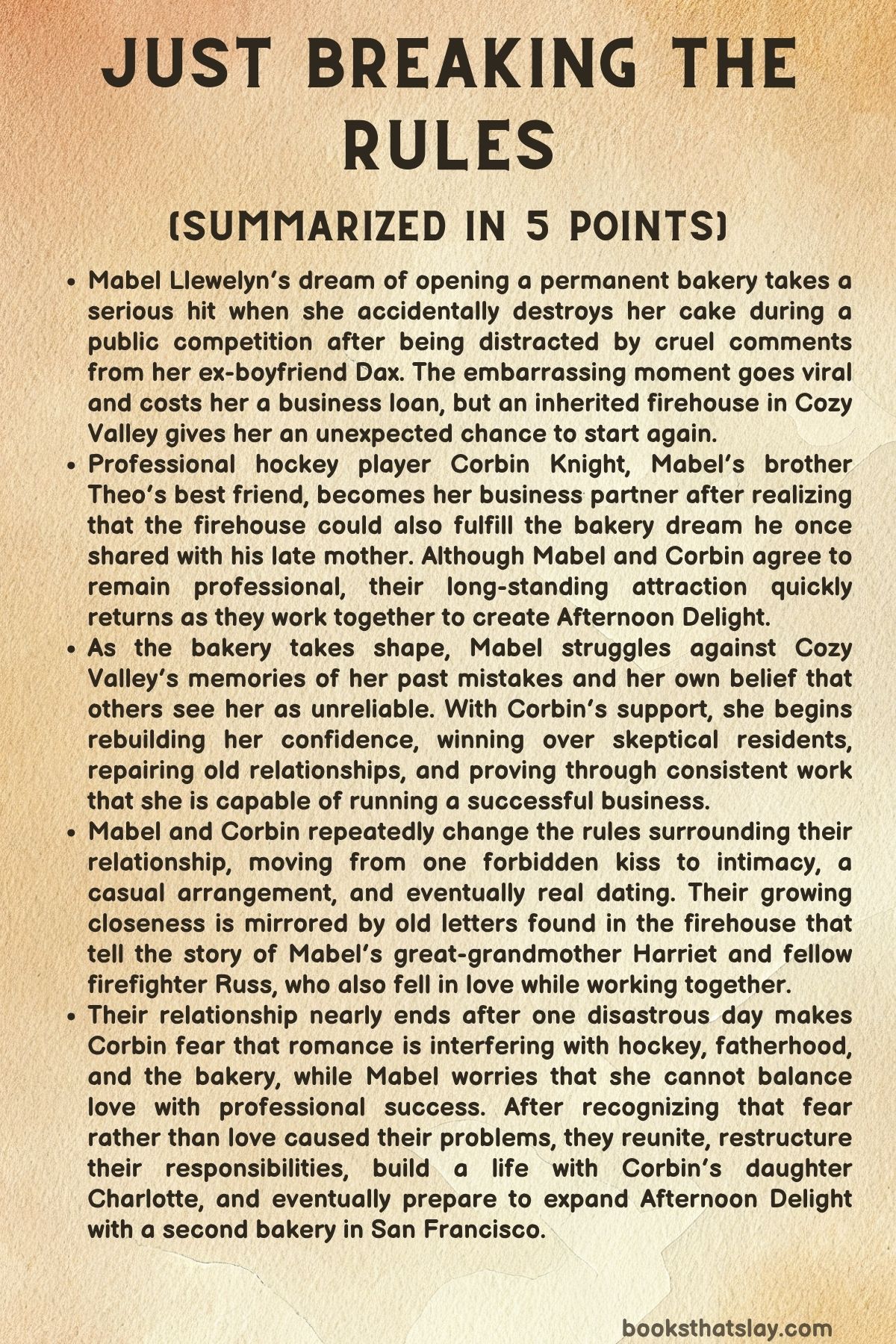
Mabel Llewelyn enters a public cake-decorating competition believing a victory could give her the money and attention she needs to open a permanent bakery. Her plans collapse when footage of her ex-boyfriend Dax Strong appears nearby, showing him calling her an unsuccessful “hot mess,” and the distraction causes Mabel to accidentally destroy the cake she has spent hours creating.
Rather than surrender, Mabel tries to turn the accident into an improvised smash cake, but celebrity judge Ronnie Legend is unimpressed. Corbin Knight, a professional hockey player and the best friend of Mabel’s brother Theo, finds her afterward and helps her clean herself up, reviving an attraction that first existed between them seven years earlier.
Their closeness quickly becomes romantic, and a playful frosting exchange ends in a passionate kiss. Both understand the complications immediately: Corbin is Theo’s closest friend, Mabel is trying to rebuild her career, and neither wants additional disorder in an already complicated life.
Mabel soon receives what appears to be good news when banker Jonas asks her to complete paperwork for a business loan. Instead, the viral footage of her ruined cake and Dax’s comments convince the bank that she is too risky, leaving her without financing just when she believed her bakery dream was becoming possible.
Her problems continue when the ghost kitchen she has been renting is sold, depriving her of the commercial space she needs to fulfill orders. Then her late grandmother Betty’s lawyer summons her to Cozy Valley and reveals that Betty purchased an abandoned firehouse and left it to Mabel, complete with a usable commercial kitchen.
The building carries uncomfortable memories because Mabel was involved in a disastrous fundraiser there years earlier, when escaped sanctuary animals contributed to an incident the town has never completely forgotten. Yet the property also gives her something she urgently needs: a physical place where she can finally build a permanent business.
Meanwhile, Theo realizes that Corbin may be exactly the partner Mabel needs. Corbin has money, strong baking skills, recipes inherited from his late mother Penny, and a long-standing dream of opening a bakery, so Theo proposes that Corbin invest in Mabel’s new venture.
Corbin agrees only if he can become a genuine creative and practical partner rather than a silent investor. He and Mabel test their compatibility through baking, discover that they work remarkably well together, and commit to opening a bakery in the firehouse despite knowing that their earlier kiss has made their partnership emotionally dangerous.
They name the bakery Afternoon Delight and begin shaping it around their shared personalities. Mabel contributes unconventional marketing ideas and creative energy, while Corbin supplies organization, recipes, financial stability, and practical planning without treating Mabel as incapable of managing herself.
Their partnership also becomes more personal. Mabel learns that Corbin has red-green color blindness and begins describing colors through foods, emotions, familiar objects, and other comparisons, while Corbin encourages her ideas and repeatedly reminds her that mistakes do not define her ability.
Charlotte, Corbin’s twelve-year-old daughter, becomes involved in the project as well. Mabel forms an easy friendship with her, and spending time with Corbin and Charlotte allows Mabel to see the warm family life behind Corbin’s disciplined public image.
During renovations, Mabel and Corbin discover an old strawberry-shaped cookie jar containing letters preserved by Betty. The correspondence tells the story of Mabel’s great-grandmother Harriet, one of the first women in the local fire department, and her growing relationship with fellow firefighter Russ.
Mabel and Corbin decide to read a new letter whenever the bakery reaches an important milestone. Harriet and Russ’s growing attraction while working together begins to reflect Mabel and Corbin’s own situation with uncomfortable accuracy, especially as their supposed promise to remain professional repeatedly fails.
Mabel also struggles with Cozy Valley’s memory of her past. She overhears local women betting on how quickly Afternoon Delight will fail, faces continued doubts from her parents, and worries that everyone still sees her as an unreliable girl who creates disasters rather than as a capable businesswoman.
Corbin consistently supports her without taking away her independence. He reminds her that the business belongs to both of them, helps her experience the town differently, and creates thoughtful gestures based on the things she loves, making it increasingly difficult for Mabel to treat him merely as a business partner.
Opening day succeeds, but Ronnie’s unexpected arrival creates another complication. When famous pickleball players Tiffany and Brittany recognize Mabel mainly as Dax’s ex and describe her bakery as part of her “redemption,” Corbin impulsively claims that he and Mabel are dating so her achievements will not continue to be framed through Dax.
The false relationship leads to a public pickleball event, but the lie soon matters less than the genuine relationship developing underneath it. Mabel and Corbin finally become intimate and admit that they had wanted each other from the first time they met seven years earlier.
They initially call the encounter a one-time event, then change the rule to business partners with benefits when neither can maintain that boundary. Their relationship becomes steadily more domestic and emotionally committed as Mabel spends time in Corbin’s home, grows closer to Charlotte, and discovers that Corbin’s ordinary acts of care affect her as strongly as their physical attraction.
Corbin also begins recognizing that Mabel is not harming the careful balance of his life. The Foxes continue performing well, the bakery gains customers, and his connection with Mabel often makes him calmer rather than distracted.
Mabel gradually repairs her relationship with Cozy Valley by approaching people directly instead of waiting for their opinions to change. She apologizes for past mistakes, brings food to local residents, helps Dottie find a difficult-to-locate yarn, supports animal rescue, and creates new experiences that slowly replace the town’s older image of her.
Corbin eventually stops pretending that his feelings are casual and privately decides to win Mabel’s heart. His Christmas gift to her includes a proper bed for the apartment above the firehouse and a message telling her that a dreamer deserves somewhere to keep dreaming, while Mabel begins openly admitting how much she misses him when they are apart.
Mabel also stands up to her parents, explaining that she understands budgeting, marketing, customers, and the practical realities of running a bakery. Her mother finally acknowledges that the business is legitimate and hires Afternoon Delight for a university event.
After Christmas, Corbin asks Mabel on a real date. Another family letter reveals Russ making almost the same decision with Harriet, convincing Corbin that he must tell Theo the truth before pursuing the relationship openly.
Theo is shocked but accepts Corbin’s intentions after warning him not to hurt Mabel. Soon afterward Mabel and Corbin appear at a Romance Beach reunion connected to Dax, where Dax accidentally lands in a cake and Mabel calmly produces a backup, turns the accident into publicity, and proves that she no longer needs to be controlled by the humiliating image he created of her.
The relationship appears secure until one difficult morning exposes the weakness in Corbin’s belief that he can successfully manage every responsibility. He accidentally turns off Mabel’s alarm, causing her to wake late for an important university cake order, while he himself arrives late for hockey practice for the first time in his professional career.
Mabel barely completes the order and arrives late to the event, while Corbin plays badly and receives penalties during a Foxes loss. Both interpret the disastrous day as evidence that they may have tried to handle too much at once.
Corbin reacts according to his deepest fear and tells Mabel they should create distance. He believes he has become a threat to her professional goals, while Mabel, already in love with him, protects herself from rejection by agreeing instead of telling him what she truly feels.
They attempt to continue as professional partners, but neither finds relief in the separation. Mabel’s friends point out that she sounds heartbroken rather than liberated, while Annabelle helps Corbin recognize that his obsession with control began when Penny became ill and he discovered that love could expose him to situations he could not fix.
Theo also confronts Corbin and tells him that serious relationships cannot be abandoned every time life becomes inconvenient. Corbin finally understands that his response to one bad day contradicted everything he claimed to feel about Mabel.
The final unread family letter strengthens that realization. Russ tells Harriet that he would rather risk professional consequences than continue hiding their relationship, showing the courage that both Mabel and Corbin have been struggling to find in their own circumstances.
Instead of attempting to solve the situation alone, Corbin finally does something difficult for him: he asks other people for help. His teammates, Theo, Remy, and Charlotte participate in arranging a moment at the Foxes arena where he can tell Mabel the truth.
Mabel arrives believing she is delivering bakery samples to important sponsors and is seated behind the players’ bench. Corbin passes her a lilac envelope containing a love letter in which he explains exactly what he loves about her and admits that he ended the relationship because he was afraid of failing and losing her.
Mabel accepts his apology and takes him back. After the game, she tells him that she loves him too, and they acknowledge that neither romance nor professional ambition has to be sacrificed simply because maintaining both requires adjustment.
Corbin accepts that he cannot work regular bakery shifts during hockey season and remains an owner while Mabel becomes the sole day-to-day manager. When they finally finish Harriet and Russ’s letters, they learn that the earlier couple also stopped hiding, told their captain the truth, and successfully remained together.
By summer, Mabel has left her San Francisco apartment and built a life with Corbin and Charlotte in Cozy Valley. Afternoon Delight is thriving, the community has accepted her, Corbin continues contributing during his off-season, and Mabel finally experiences the town as somewhere she belongs rather than somewhere defined by an old embarrassment.
Corbin then surprises her with an empty San Francisco storefront purchased in her name, giving her the opportunity to open the city bakery she once believed she had lost. Mabel immediately chooses to pursue the second location, ending the story with both her romantic and professional dreams expanding rather than competing with each other.
Characters
Mabel Llewelyn
Mabel is the emotional center of Just Breaking The Rules, and much of her development concerns the difference between actually being irresponsible and being repeatedly told that she is irresponsible. Her disastrous cake competition, Dax’s public criticism, the bank’s rejection, her parents’ doubts, and Cozy Valley’s memories all reinforce the same damaging message: that one mistake is evidence that she cannot be trusted with serious ambitions.
Yet Mabel repeatedly demonstrates the opposite. She improvises after destroying her competition cake, continues seeking ways to finance her bakery, turns Betty’s inherited firehouse into a business opportunity, understands marketing, develops products, repairs relationships with townspeople, and ultimately proves capable of managing Afternoon Delight herself.
Her creativity is one of her greatest strengths, although she initially interprets spontaneity as a flaw because other people frequently compare it with conventional ideas of responsibility. Corbin gradually helps her understand that flexibility, imagination, and enthusiasm are not defects that need to be eliminated.
Mabel’s romantic development is closely connected to this change in self-perception. She initially resists Corbin partly because she fears that love will become another area in which she loses control or fails to meet expectations, yet she eventually recognizes that rejecting something meaningful does not automatically make her more competent.
Her decision to return to Cozy Valley is equally significant. Instead of escaping the location associated with her past humiliation, she creates new relationships there, apologizes when appropriate, wins customers through persistence, and allows the community to know the adult she has become.
By the ending, Mabel is not transformed into a rigidly organized person who behaves like Corbin. Her success comes from accepting her own working style while learning when planning, communication, additional staff, and practical boundaries are genuinely useful.
Corbin Knight
Corbin functions as both romantic partner and thematic counterweight to Mabel in Just Breaking The Rules. Where Mabel is spontaneous and accustomed to being considered chaotic, Corbin is meticulous, dependable, professionally disciplined, and deeply invested in the belief that responsible adults should be able to manage every obligation.
His personality is shaped by fatherhood, professional hockey, and his experience caring for Penny during her Parkinson’s disease. Losing the ability to solve his mother’s illness appears to strengthen his reliance on routines, schedules, organization, and self-sufficiency because those are areas where effort can produce predictable results.
Corbin’s instinct to help others is genuine rather than controlling in most situations. He supports Mabel after the cake competition, encourages her business ambitions, shares Penny’s recipes, cares for Charlotte, helps his teammates, and contributes financially and practically to the bakery.
His weakness appears when he begins believing that helping successfully means never failing anyone. One missed alarm and one bad hockey game are enough to convince him that his relationship with Mabel has become irresponsible, even though the larger evidence of their lives suggests otherwise.
The breakup therefore reveals the central contradiction in Corbin. He is courageous when protecting others but becomes fearful when vulnerability requires him to admit that he cannot guarantee outcomes.
His reconciliation with Mabel represents genuine development because he does not simply make another grand decision alone. He asks friends and family for assistance, admits that his fear created the problem, and accepts a more realistic division of bakery responsibilities rather than pretending he can perfectly perform every role.
Charlotte Knight
Charlotte is an important emotional presence in Just Breaking The Rules because she reveals Corbin’s life outside professional hockey and allows Mabel to experience a relationship that is affectionate without being demanding. Intelligent, organized, humorous, and confident with her father, Charlotte is not written as a passive child waiting for adults to determine her world.
She takes an active interest in the bakery, contributes ideas, helps with scheduling, participates in community and animal-rescue activities, and comfortably teases Corbin about his habits. Her independence demonstrates that Corbin has succeeded as a father even though he often worries about whether he is doing enough.
Charlotte’s relationship with Mabel develops naturally. Mabel does not attempt to replace Penny or force herself into a formal maternal identity, and their eventual description of Mabel as a “cool aunt” reflects the freedom both are given to define their bond in a way that suits them.
Charlotte also becomes evidence of how deeply Mabel has entered Corbin’s life before either adult fully acknowledges it. She notices when he is sad, recognizes Mabel as important, chooses gifts for her, and participates in the plan to reunite them.
Theo
Theo begins as the protective older brother and Corbin’s best friend, but his role in Just Breaking The Rules becomes more interesting because he is actually responsible for bringing Corbin and Mabel together professionally. He sees that Mabel has property and baking ability while Corbin has capital, recipes, and a neglected bakery dream, so his proposal creates the partnership that changes both their lives.
His protectiveness can initially make Corbin nervous because Theo has strong opinions about anyone hurting his sister. Yet Theo is not simply an obstacle placed between the central couple.
When he believes the relationship is only fake, he sees its promotional value. Once Corbin admits his real feelings, Theo focuses less on possessiveness than on whether Corbin intends to treat Mabel seriously.
Theo becomes particularly important after the breakup. His anger at Corbin is based on the inconsistency between Corbin declaring serious intentions and then abandoning the relationship after one bad day, and his confrontation forces Corbin to see that commitment requires endurance rather than perfect circumstances.
Grandma Betty
Betty is deceased before the central events, yet her influence is present throughout Mabel’s journey. She is the relative who most consistently believed in Mabel, and her purchase of the firehouse provides the physical foundation for the bakery when conventional financing disappears.
Her motto asking “if not now, when?” represents the adventurous confidence Mabel is trying to recover. Betty understands that Mabel needs opportunity more than another lecture about becoming cautious.
The strawberry cookie jar and preserved family letters extend Betty’s influence beyond property and money. By arranging for Mabel to discover Harriet and Russ’s history, Betty effectively gives her granddaughter an emotional inheritance as important as the building itself.
Penny Knight
Penny shapes Corbin even though she is remembered rather than physically present during the central romance. Baking was something she shared with Corbin and Charlotte, and Corbin’s dream of owning a bakery originally belonged partly to his relationship with his mother.
Her Parkinson’s disease also explains much about Corbin’s emotional habits. Watching someone he loved lose abilities he could not restore taught him how frightening helplessness feels and contributed to his later need to control schedules, responsibilities, and potential sources of failure.
Afternoon Delight allows Penny’s influence to continue constructively. Her recipes become part of the menu, and Corbin finally pursues a dream he once assumed would have to remain postponed indefinitely.
Dax Strong
Dax is Mabel’s ex-boyfriend and the person whose public comments trigger the immediate crisis of the story. By describing her as an unsuccessful “hot mess,” he takes insecurities Mabel already carries and gives them a much larger public audience.
His importance is less about romantic competition than about reputation. Dax represents the danger of allowing another person’s version of you to become more influential than your own evidence about yourself.
The Romance Beach reunion demonstrates how far Mabel has moved beyond him. When Dax attempts to unsettle her again, she remains prepared, produces a backup cake after the accident, and turns the entire situation into marketing rather than personal humiliation.
Ronnie Legend
Ronnie is initially associated with Mabel’s humiliation because he judges the cake competition in which she fails publicly. His dismissal reinforces her sense that one mistake can erase hours of talent and effort.
His later return to Afternoon Delight forces Mabel to face that memory under completely different circumstances. Eventually Ronnie acknowledges that he underestimated her, allowing their relationship to show that early judgments do not have to remain permanent.
Ronnie also helps connect Mabel’s original failure with her later success. The smash-cake concept that seemed ridiculous during the competition becomes something other people recognize as commercially appealing.
Annabelle
Annabelle serves as one of the story’s clearest sources of emotional insight. Her intuitive observations often identify truths that Corbin prefers to translate into practical problems.
Her most important conversation with him occurs after the breakup. She connects his present panic with his experience during Penny’s illness and recognizes that Corbin’s constant desire to solve everything may actually be a defense against helplessness.
Annabelle does not tell Corbin that organization itself is wrong. Instead, she forces him to consider whether his supposed responsible decision is really an expression of fear.
Harriet Llewelyn
Harriet gives the historical dimension of Just Breaking The Rules much of its emotional meaning. As one of the earliest women in the local fire department, she faces professional hostility while trying to establish herself in a space where others question whether she belongs.
Her experience strongly parallels Mabel’s situation. Both women are judged according to expectations they did not create, both must develop confidence while working under observation, and both receive important encouragement from men who respect their abilities rather than treating them as fragile.
Harriet’s romance with Russ also provides a historical reflection of Mabel and Corbin’s relationship. Her letters repeatedly describe the difficulty of pretending a coworker is only a coworker when affection has already changed the relationship.
Her final choice is especially important because she and Russ decide that honesty is preferable to continued secrecy. Their successful outcome becomes indirect encouragement for Mabel and Corbin to stop treating love as automatically incompatible with professional partnership.
Russ
Russ is Harriet’s colleague and eventual partner. His letters show a man who respects Harriet’s professional ambition while also becoming increasingly unable to hide his personal feelings for her.
He encourages her when she faces resistance within the fire department rather than asking her to retreat from the challenge. This makes his support comparable to Corbin’s encouragement of Mabel when Cozy Valley doubts her bakery.
Russ ultimately decides that remaining with Harriet is worth professional risk. His willingness to accept consequences becomes particularly powerful when Mabel and Corbin are struggling with the opposite instinct of sacrificing their relationship for the sake of avoiding possible complications.
Aisha
Aisha becomes an important member of Afternoon Delight’s staff and represents the transition from Mabel and Corbin personally handling everything to the bakery becoming a functioning business with employees. Her presence allows Mabel’s dream to become less dependent on two people constantly extending themselves beyond reasonable limits.
She also participates naturally in the bakery’s informal culture. Her involvement in quickly hiring Audrey shows that the business increasingly develops its own team rather than remaining only an extension of the central romance.
Audrey
Audrey is introduced as a potential employee recommended through Charlotte and quickly joins Afternoon Delight. Her presence demonstrates that the bakery is growing quickly enough to require additional labor and that Mabel is learning to build a staff rather than proving competence by doing everything alone.
Her illness during the faculty luncheon crisis also illustrates an important business reality. Even good planning cannot eliminate every unexpected problem, which is one reason Mabel eventually learns that resilience matters as much as perfect preparation.
Clementine, Remy, Skylar, and Trevyn
Mabel’s friends provide a social environment where she can be challenged without being diminished. They tease her about Corbin, help during business emergencies, listen to her after the breakup, and refuse to accept the explanations she uses to protect herself from vulnerability.
Remy becomes particularly involved in Corbin’s reconciliation plan, while Skylar challenges Mabel’s assumption that love and professional success must compete. Their friendship shows Mabel what supportive criticism looks like in contrast with the judgment she receives from Dax or skeptical townspeople.
Riggs
Riggs is one of Corbin’s hockey teammates and participates in the teasing that repeatedly exposes how obvious Corbin’s feelings for Mabel have become. His observations matter because Corbin spends much of the story insisting that he can separate attraction, work, hockey, and emotion into tidy categories.
Riggs also forms part of the support network Corbin eventually turns to when he decides to repair the relationship. His presence helps show that asking other men for emotional assistance is not presented as weakness.
Miller
Miller is another member of Corbin’s close hockey circle. Like Riggs, he notices that Corbin’s connection with Mabel is far more serious than Corbin initially admits.
He later helps Corbin plan the arena reconciliation. This moves him from comic teammate to practical friend and reinforces the story’s argument that even highly capable people sometimes need others to help them act courageously.
Lake
Lake completes the core group of teammates surrounding Corbin. Much of his function is social, giving Corbin a group in which personal changes become visible long before Corbin is prepared to discuss them honestly.
The teammates’ joking is significant because it never becomes cruel. Their humor exists alongside loyalty, creating another example of a community that can challenge someone without reducing that person to a mistake.
Mabel’s Mother and Father
Mabel’s parents initially represent conventional ideas of security. Their repeated suggestions that baking is merely a hobby and that Mabel should pursue a more traditional career deepen her fear that the people closest to her do not consider her ambitions legitimate.
Her mother becomes especially important because her attitude changes. After Mabel finally explains the practical work behind her business, her mother acknowledges her talent and hires Afternoon Delight for a university event.
Following the breakup, Mabel expects her mother to support the decision to focus exclusively on work. Instead, her mother asks whether ending the relationship is actually what Mabel wants, revealing that her concern for stability was never meant to require emotional self-denial.
Dottie
Dottie represents Cozy Valley’s skepticism in a form Mabel can confront directly. As part of the group betting that the bakery will fail, she initially confirms Mabel’s fear that the town still sees only her old reputation.
Mabel does not defeat Dottie through argument. She listens to her needs, finds the difficult magenta yarn she has been seeking, continues offering excellent baked goods, and gradually creates a new relationship through consistent behavior.
Dottie eventually admits that her prediction about the bakery is failing. Her change becomes one of the clearest signs that Mabel has successfully rewritten her place within the community.
Mrs. Henderson
Mrs. Henderson is connected to one of Mabel’s old mistakes because Mabel damaged her mailbox years earlier. Mabel’s decision to apologize personally represents a change in how she handles the past.
Rather than assuming everyone will always condemn her or pretending the incident never happened, Mabel accepts responsibility and allows Mrs. Henderson to decide how to respond. The acceptance she receives helps demonstrate that some of Mabel’s shame has survived far longer inside her than in the minds of other people.
Jonas
Jonas, the banker who rejects Mabel’s loan application, represents institutional judgment based on public perception. He initially praises her business concept and online growth but changes direction after seeing the viral footage and Dax’s comments.
His decision is painful because it converts embarrassment into a practical economic consequence. Mabel is not simply hurt by strangers laughing at her; she loses access to financing that could materially change her future.
Tiffany and Brittany
Tiffany and Brittany are accomplished pickleball players whose interest in Mabel’s smash cakes helps validate an idea that originally appeared to be evidence of failure. Their enthusiasm contributes to the growing public interest surrounding Afternoon Delight.
At the same time, their first reaction to Mabel as Dax’s ex frustrates her because it shows how difficult it is to separate her identity from the story created around her former relationship. Their later enthusiasm about Mabel and Corbin as a couple adds comic pressure to the fake-dating arrangement.
Coach Ahmed
Coach Ahmed represents the professional standards Corbin takes extremely seriously. When Corbin arrives late to morning skate, Ahmed checks that his family is safe before imposing a fine and reminding him that veteran players must set an example.
His reaction is firm but not catastrophic, which is important. Corbin interprets the mistake as evidence that his entire life has become unmanageable, while the coach treats it as a correctable professional failure rather than proof that Corbin is fundamentally unreliable.
Arnie
Arnie appears late in the story as another sign of Afternoon Delight’s increasing integration into Cozy Valley. After finding retirement unsatisfying, he begins working at the bakery part-time.
His presence reinforces the transformation of the bakery from Mabel’s uncertain experiment into a community institution capable of offering employment, regular gathering space, and genuine local connection.
Themes
Identity, Reputation, and Self-Worth
Public judgment repeatedly threatens to become private truth in Just Breaking The Rules. Mabel begins the story surrounded by other people’s definitions of her: Dax calls her a hot mess, the bank interprets viral embarrassment as evidence of financial irresponsibility, her parents question whether baking qualifies as a serious career, and Cozy Valley remembers an old disaster long after she has changed.
The central problem is therefore not simply that people underestimate Mabel. It is that she has heard these judgments often enough to begin using them against herself whenever something goes wrong.
Her growth depends on separating mistakes from identity. Destroying a cake does not make her incapable of baking, losing financing does not mean the business is foolish, arriving late to one order does not erase months of successful management, and being remembered for an embarrassing incident does not prevent her from becoming someone new.
The story repeatedly shows Mabel replacing reputation with evidence. She opens the bakery, gains customers, repairs old relationships, develops commercial partnerships, manages employees, wins over skeptics, and eventually expands toward a second location.
Her greatest victory is not making everyone approve of her. It is reaching a point where approval is no longer required before she permits herself to trust her own competence.
Control, Failure, and the Limits of Perfection
Corbin’s disciplined personality initially appears to be the obvious opposite of Mabel’s spontaneity, but his need for control creates its own form of vulnerability. He depends on organization because organization has helped him manage fatherhood, professional sports, grief, financial responsibility, and years of caring for people who rely on him.
The weakness appears when Corbin begins treating reliability as an absolute rather than a value. He assumes that if he is a good father, athlete, partner, friend, and business owner, he should be able to perform every role without allowing one to interfere with another.
The missed alarm destroys this illusion. Instead of viewing one late practice and one terrible game as ordinary failures within a long successful career, Corbin treats them as proof that his life has become structurally unsafe.
His reaction reveals how perfectionism can disguise fear. Ending the romance gives him the temporary feeling that he is reducing variables, but it does nothing to solve the emotional problem beneath his behavior.
Growth arrives when Corbin accepts limits openly. He asks friends for help, allows Mabel to manage daily bakery operations, acknowledges that hockey season restricts his available time, and discovers that depending on other people does not make him unreliable.
Belonging, Community, and Rewriting the Past
Cozy Valley initially feels to Mabel like a place where her identity was permanently decided years ago. Returning to the firehouse forces her to confront people, locations, and memories she would rather leave behind.
Her first instinct is to assume that belonging depends on persuading everyone that their old opinion was wrong. Gradually, she learns that community is built through repeated acts rather than one dramatic act of vindication.
She visits people directly, delivers baked goods, apologizes for old damage, listens to Dottie’s complaint about yarn, participates in animal rescue, creates employment, serves local clubs, and makes the bakery useful to the town. These gestures do not erase the past; they place newer experiences beside it until the older story loses its power to define her completely.
The firehouse itself reflects this process. It begins as the location of one of Mabel’s most embarrassing memories and becomes the home of Afternoon Delight, the place where she discovers family history, builds a career, falls in love, and establishes a new relationship with Cozy Valley.
Belonging therefore becomes something active. Mabel does not wait for the town to pronounce her redeemed; she participates in the community until she recognizes that she has already become part of it.
Love, Partnership, and Breaking Unnecessary Rules
Much of Just Breaking The Rules is driven by rules Mabel and Corbin create because they believe boundaries will protect everything that matters to them. First the kiss must never happen again, then intimacy can happen once, then they become partners with benefits, then they can date as long as professional life remains unaffected.
Every new rule attempts to preserve the illusion that emotion can be separated neatly from business, family, ambition, and responsibility. Harriet and Russ’s letters repeatedly challenge that belief by showing an earlier couple confronting almost the same conflict within the same building.
The story does not argue that responsibilities should simply be ignored for love. Corbin genuinely cannot work full bakery shifts during hockey season, Mabel genuinely needs sufficient staff, and both genuinely require communication when professional commitments become demanding.
What changes is their assumption that love itself is the problem. Their disastrous morning results partly from poor planning and overextension, but they mistakenly respond as though ending the relationship will automatically make everything manageable.
Their eventual solution is more mature because it involves adjustment rather than sacrifice. They redistribute work, communicate honestly, ask others for help, and allow ambition and intimacy to exist together.
The final expansion toward a second bakery confirms this idea. Mabel does not receive love instead of professional independence, and Corbin does not abandon responsibility in order to remain with her; both learn that meaningful partnership can enlarge a life when the rules protecting that life no longer make sense.