Just One More Day Summary, Characters and Themes
Just One More Day by Shari Low is a contemporary novel about love, betrayal, secrecy, forgiveness, family and the cost of waiting too long to say what matters.
The story connects several women whose lives were shaped in different ways by celebrated surgeon Kenneth Manson and by the secrets surrounding his relationships. Five years after his death, one ordinary February day forces old wounds back into the open while creating unexpected chances for reconciliation. Moving between Kenneth’s funeral and the present, the novel shows how people survive infidelity, grief and regret by choosing honesty, compassion and the relationships they still have time to repair.
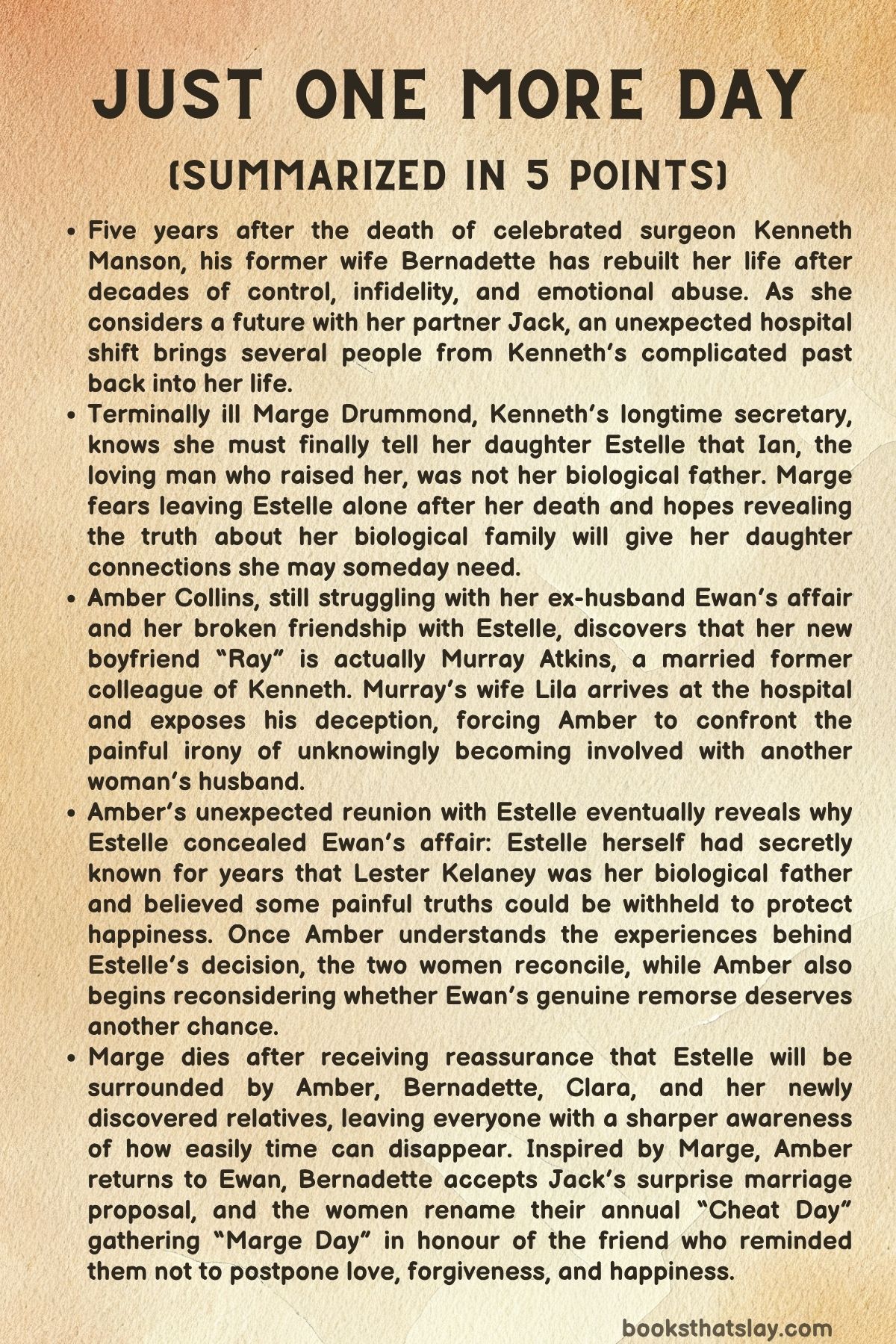
Summary
Just One More Day begins with the public image of Dr Kenneth Manson, a respected Scottish cardiac surgeon remembered for his skill, dedication and the lives he saved. His obituary presents an admirable professional figure, but behind that reputation was a controlling husband, an unfaithful partner and a father whose behaviour left lasting wounds within his family.
Five years after Kenneth’s death, his former wife Bernadette O’Brien lives independently in Glasgow after finally escaping their thirty-year marriage. She is looking forward to what she believes will be the vow renewal of her daughter Nina and Nina’s husband Gerry, yet her thoughts keep returning to her own long-distance relationship with Jack Donovan and whether she is ready to build a permanent future with him.
Bernadette has spent years rebuilding the confidence Kenneth damaged. She loves Jack but fears that moving to Ireland or changing her life for him might resemble the sacrifices she once made for Kenneth, so she considers taking control of the situation by proposing to Jack herself.
Her personal plans are interrupted when an understaffed Emergency Department asks her to work on her day off. Bernadette reluctantly agrees, unaware that the hospital will become the place where several unresolved relationships from her past collide during the same extraordinary day.
Elsewhere in the hospital, Marge Drummond is dying from advanced lung cancer. For three decades she worked as Kenneth’s highly capable secretary, managing both his professional demands and many of the consequences created by his private behaviour, but her immediate concern is now her daughter Estelle.
Marge has hidden a major truth from Estelle throughout her life. Although Estelle was raised lovingly by Marge’s husband Ian, Ian was not her biological father, and Marge knows that Estelle has blood relatives she has never met.
The approach of death makes that secret unbearable to Marge. A visit from her former wardmate Wilma, whose life was saved when one of her children donated a kidney, reminds Marge that biological connections may one day matter to Estelle medically as well as emotionally.
Marge therefore decides that Estelle must finally know the truth. She tries to contact Bernadette because Bernadette is one of the few people who knows who Estelle’s biological father really is and understands the history behind Marge’s silence.
At the same time, Amber Collins is attempting to restart her romantic life after her marriage to Ewan collapsed because of his affair. Although she and Ewan have gradually formed a workable friendship while raising their sons Alfie and Sid, Amber still carries intense anger toward Estelle, once her closest friend, because Estelle knew about Ewan’s betrayal and did not tell her.
Amber has begun dating an older man named Ray and decides to take their relationship seriously. Their first intimate encounter quickly becomes disastrous when Ray slips in her bathroom, hits his head and requires emergency treatment.
While paramedics attend to him, Amber hears Ray murmuring about contacting his wife. Her confusion increases at the hospital when she learns that his real name is Murray Atkins and discovers that he has concealed basic details about his life from her.
Murray is no stranger to Bernadette. He was one of Kenneth’s surgical colleagues and had delivered a eulogy at his funeral, and Bernadette quickly suspects that the much younger Amber is involved with him despite knowing that Murray remarried after his divorce.
The connection between Murray and Kenneth reaches much further into the past. Murray’s first marriage to Diana ended after Diana admitted sleeping with Kenneth, yet Murray maintained a public friendship with Kenneth because their professional relationship remained useful to him.
Kenneth’s funeral had also brought Murray into contact with Lila Anderson, Kenneth’s long-term mistress. Lila had spent years believing Kenneth would eventually leave Bernadette for her, only to discover after Bernadette finally left that Kenneth had never intended to make Lila his wife.
Murray and Lila were attracted to each other at the wake, eventually married, and have now repeated the same pattern of dishonesty that had defined their earlier relationships. When Lila tracks Murray to the hospital using an AirTag and discovers Amber beside him, Murray’s deception is exposed in humiliating fashion.
Amber is horrified to realise that after being devastated by her husband’s affair, she has unknowingly become involved with another woman’s husband. Bernadette comforts her and explains that people who lie habitually can make deception extremely difficult to recognise, drawing on her own experience with Kenneth.
Their conversation reveals another remarkable connection: Amber knew Marge and Estelle and attended Kenneth’s funeral with Marge. Moments later Estelle arrives at the hospital looking for Bernadette, bringing Amber face-to-face with the former best friend she has avoided for two years.
The meeting is initially painful rather than healing. Estelle explains that Marge has terminal cancer, leaving Amber devastated by the knowledge that her anger toward Estelle also cost her precious time with a woman she loved almost like family.
Amber and Estelle then revisit the argument that destroyed their friendship. Ewan had been unfaithful once after weeks of flirtation with another woman, and when Amber discovered the affair she also discovered that Estelle had known and intentionally kept quiet because she believed revealing an ended affair might unnecessarily destroy a family.
Estelle apologises, but she cannot honestly say that she would make a different decision if faced with the same circumstances again. Amber leaves convinced that their fundamental disagreement about trust remains unresolved, although Marge’s condition has begun changing the way she views the anger she has carried.
Marge’s secret explains much of Estelle’s philosophy. Decades earlier, shortly before meeting Ian, Marge became pregnant after a single encounter with a married man, and she was honest with Ian that the child was not biologically his.
Ian chose Marge and the unborn child without reservation. Marge later informed Estelle’s biological father of the pregnancy and gave him complete freedom to choose whether he wanted a relationship with his daughter, but he never replied and never acknowledged the child.
Marge and Ian repeatedly planned to tell Estelle the truth as she grew older. On Estelle’s twenty-first birthday, Ian finally insisted they could delay no longer, but before they could have the conversation, he was killed by a car while walking home with Marge.
His death destroyed Marge’s courage, and she continued keeping the secret. In the present, however, she recognises that her own lifelong habit of avoiding painful revelations may even have influenced Estelle’s decision to remain silent about Ewan’s affair.
The significance of Kenneth’s funeral gradually becomes clearer through memories of the day. After spending hours listening to public praise of Kenneth, Bernadette finally spoke honestly with Marge about the man he had been in private, while Marge admitted that she had spent years overlooking behaviour she knew was wrong.
Later that evening, Marge finally confessed Estelle’s parentage to Bernadette. Bernadette then joined several other women connected to Kenneth, including Diana, Danielle, Annabel and Clara, and what might have become an ugly confrontation instead became an unusually honest evening of confessions, laughter and shared understanding.
The women decided to meet every year on the anniversary of Kenneth’s funeral. Their gathering became known as Cheat Day, an occasion where people shaped by betrayal could speak openly without pretending to be morally perfect.
Five years later, Bernadette arrives at the annual dinner carrying the news that Marge is seriously ill. When Marge decides to reveal Estelle’s biological father, Bernadette asks Clara to accompany her because Clara has known the truth for years.
Marge’s secret is that Estelle’s biological father is Lester Kelaney, Clara’s husband. Long ago, Clara found the letter Marge had written informing Lester about the pregnancy and learned that he had ignored it, but Clara eventually promised Marge that if Estelle ever discovered the truth, she would accept her as the half-sister of Clara and Lester’s daughters.
When Marge finally tells Estelle that Ian was not her biological father, she expects anger. Instead, Estelle shocks everyone by revealing that she already knows.
After Ian died, Estelle found a copy of Marge’s letter to Lester among Ian’s possessions. She believes Ian intentionally preserved it so that she could discover the truth if he died before Marge could explain it herself.
Estelle never confronted her mother because learning the truth did not change what mattered to her. Ian had loved and raised her completely, while Lester had deliberately rejected the chance to know her before she was even born.
This revelation finally helps Amber understand Estelle’s controversial choice concerning Ewan’s affair. Estelle’s own childhood taught her that some withheld truths can preserve happiness, so her silence came from a misguided attempt to protect Amber rather than disloyalty or indifference.
Amber cannot fully agree with Estelle’s reasoning, but she can finally understand it. Their years of anger collapse into forgiveness, humour and tears, and Amber returns with Estelle to see Marge.
Amber’s thinking about Ewan also changes. Marge’s approaching death forces her to consider what she would regret if her own time were suddenly limited, and she realises that she still longs for her husband, her family and the friendship she lost.
She visits Ewan and finally asks whether he genuinely regrets what he did. Ewan says that he would undo the affair if he could and that the life he still wants is the one he had with Amber and their sons, leaving her willing for the first time to consider reconciliation.
Marge’s final hours are spent surrounded by people who prove that Estelle will not face the future alone. Amber promises to care for her, Clara offers a connection to Estelle’s biological relatives, and Bernadette remains beside the family that formed through years of complicated history.
As Marge weakens, she imagines Ian waiting for her. Once she understands that Estelle has Amber, Bernadette, Clara and others to support her, she allows herself to let go and dies with the knowledge that her daughter will still be loved.
Afterward, Estelle wears Marge’s simple wedding ring and takes comfort in believing her mother is reunited with Ian. Amber remains beside her, fulfilling the promise she made to Marge and recognising that maintaining resentment has already cost her enough time.
Instead of returning to an empty home, Amber goes back to Ewan and asks whether there is still room beside him on the couch. The gesture does not erase what happened, but it shows that she is ready to stop defining their future entirely by his worst mistake.
Bernadette reaches a similar decision about her own life. Marge’s death convinces her that love cannot always be postponed until circumstances become perfect, so she resolves to tell Jack that she is ready to create a shared future with him.
The next morning Bernadette discovers that Nina’s supposed vow renewal was actually a carefully planned surprise for her. Jack has gathered Bernadette’s family and friends, announces that he intends to restructure his life so they can finally live together, and proposes marriage.
Bernadette accepts, and the celebration becomes an immediate commitment ceremony surrounded by the people who matter most to her. Meanwhile, the women decide that their future annual meetings will no longer be called Cheat Day but Marge Day, turning a gathering born from Kenneth’s betrayals into a tribute to friendship, truth and the woman whose final day reminded everyone not to postpone happiness.
Characters
Bernadette O’Brien
Bernadette is the emotional centre of Just One More Day, a woman whose present independence has been earned through decades of emotional pressure, betrayal and gradual recovery. Kenneth’s controlling behaviour taught her to distrust not only men but her own judgement, making her hesitation about committing fully to Jack an understandable consequence of her previous marriage rather than simple indecision.
Her strength lies in the fact that she does not become permanently hardened by what happened to her. Bernadette works in a profession built around caring for vulnerable people, supports Amber without condemning her, stays beside Marge during her final hours and even offers sympathy to Lila despite their painful history.
Bernadette’s central conflict concerns whether independence requires remaining emotionally self-contained. By the end, she understands that choosing Jack freely is entirely different from surrendering control to Kenneth, allowing her to accept love without sacrificing the self she fought to recover.
Marge Drummond
Marge is one of the most morally complex figures in Just One More Day because she understands both the damage caused by secrets and the reasons frightened people continue keeping them. As Kenneth’s secretary, she spent decades separating his professional excellence from his private misconduct, convincing herself that his affairs were outside her responsibility even while helping maintain the structures that allowed his double life to continue.
Her secrecy concerning Estelle has a more sympathetic origin. She wants to protect the daughter she adores from the pain of knowing that her biological father consciously rejected her, while Ian’s complete devotion makes the biological truth seem emotionally unnecessary.
Marge eventually recognises, however, that protection can become avoidance. Her final decision to tell Estelle represents an attempt to leave her daughter with truth, family connections and emotional security rather than unanswered questions, and her death becomes the event that encourages several other characters to stop postponing reconciliation.
Amber Collins
Just One More Day uses Amber to examine the difference between justified anger and an identity built around remaining angry. Ewan’s affair shattered her marriage, while Estelle’s silence destroyed her confidence in the friendship she had trusted most, leaving Amber convinced that forgiveness would somehow minimise what was done to her.
Her experience with Murray becomes an ironic but important turning point. After unknowingly becoming involved with a married man herself, Amber is forced to recognise how easily people can be deceived and how complicated moral situations can appear from the inside.
Marge’s illness gives Amber a sharper perspective on time. She does not decide that betrayal is acceptable, but she begins separating forgiveness from approval, allowing her to reconnect with Estelle and cautiously reopen the possibility of a life with Ewan.
Estelle Drummond
Estelle initially appears stubborn because she refuses to tell Amber that remaining silent about Ewan’s affair was unquestionably wrong. Her later history transforms that position into something more understandable, since her own experience taught her that knowing every painful fact does not always improve a person’s life.
Learning that Lester was her biological father did not weaken her bond with Ian. Instead, it confirmed her belief that fatherhood is defined by sustained love and responsibility, because Ian knowingly chose her while Lester knowingly declined the opportunity.
Her silence toward Marge also mirrors Marge’s silence toward her, creating an important generational parallel. Both women conceal truths because they believe disclosure could cause unnecessary pain, and their eventual honesty allows Estelle to understand both her mother’s fear and the complicated assumptions that shaped her own behaviour toward Amber.
Kenneth Manson
Although Kenneth dies before most of the present-day action, Just One More Day makes his influence almost constant. His professional brilliance creates the polished public identity presented in his obituary, while the private memories of those closest to him reveal repeated infidelity, control, arrogance and emotional cruelty.
Kenneth’s treatment of Bernadette shows his need for control, particularly when he threatened to use his status against her if she left. His rejection of Stuart’s sexuality and attempts to dictate his son’s choices similarly reveal how affection from Kenneth often depended on obedience to his expectations.
His greatest narrative importance comes from the strange community created after his death. The women he lied to, betrayed or indirectly hurt eventually become sources of support for one another, meaning Kenneth’s legacy is transformed into something he never intended and could never have controlled.
Jack Donovan
Jack represents a form of love very different from the one Bernadette experienced with Kenneth. He is patient enough to maintain a long-distance relationship rather than forcing Bernadette into decisions before she is ready, giving her the space necessary to choose commitment freely.
His decision to sell his haulage business is especially significant because it challenges Bernadette’s assumption that she alone would have to surrender something in order for them to live together. Jack approaches partnership as mutual adjustment rather than one person controlling the other.
His proposal therefore marks more than a romantic ending. It proves to Bernadette that a relationship can expand her life rather than reduce it, allowing her to embrace commitment without repeating the conditions of her first marriage.
Nina
Nina is the child who retained the strongest positive connection with Kenneth despite recognising some of his faults. Her willingness to deliver his eulogy shows that the novel allows different family members to hold conflicting memories of the same difficult person without insisting that one perspective cancels the others.
Her marriage to Gerry also gives Bernadette an example of the kind of loving partnership Kenneth never provided. Nina ultimately participates in arranging the surprise celebration for her mother, helping Bernadette move away from a past dominated by Kenneth toward a future shaped by people who genuinely value her.
Stuart
Stuart carries some of the clearest emotional scars left by Kenneth’s parenting. His father criticised his sexuality, relationships and career, causing Stuart to refuse the polite pretence that Kenneth had been a loving father simply because death made open criticism socially uncomfortable.
His refusal to rewrite the past gives him an important role in the story’s treatment of truth. Stuart demonstrates that forgiveness, grief and family loyalty do not require pretending harmful behaviour never occurred.
His relationship with Connor further contrasts with the environment Kenneth created. Through Stuart, the novel shows Bernadette recognising that her children have managed to build healthier partnerships than the one they witnessed growing up.
Gerry
Gerry is Nina’s supportive husband and one of the partners Bernadette views with gratitude because he provides her daughter with the affection and respect absent from Bernadette’s own marriage. His presence helps establish that unhealthy family patterns do not have to repeat automatically across generations.
He also contributes to the final surprise arranged for Bernadette. Though he remains a secondary character, his stability helps create the secure family environment in which Bernadette can finally imagine a future defined by trust rather than control.
Connor
Connor is Stuart’s partner and represents another quiet contrast with Kenneth. Where Kenneth responded to Stuart’s sexuality with rejection and criticism, Connor offers companionship that allows Stuart to live openly and without seeking paternal approval.
His importance is therefore primarily relational. Through Connor, the story shows that Stuart has created the acceptance for himself that his father failed to provide.
Murray Atkins
Murray resembles Kenneth in several uncomfortable ways. He is professionally accomplished, entitled, unfaithful and highly skilled at treating his own choices as problems caused by everyone around him.
His history with Kenneth exposes another weakness in his character. Although Kenneth slept with Diana and damaged Murray’s marriage, Murray eventually restored their public friendship because maintaining valuable professional connections mattered more to him than personal integrity.
His treatment of Amber and Lila shows that he has learned almost nothing from being betrayed himself. Rather than becoming more empathetic after experiencing infidelity, he repeats the same behaviour, turning him into an example of how suffering does not automatically produce wisdom.
Lila Atkins
Lila is deliberately difficult to reduce to either victim or villain. She knowingly carried on an affair with Kenneth for years and expected him eventually to leave Bernadette, yet Kenneth also deceived her by encouraging expectations he never intended to fulfil.
Her eventual marriage to Murray creates another relationship shaped by status, ego and questionable loyalty. When Murray betrays her, Lila refuses Bernadette’s sympathy and insists that her comfortable lifestyle matters more than marital fidelity.
That response separates her values sharply from Bernadette’s. Lila is not portrayed as unaware of her circumstances; instead, she consciously accepts a transactional version of marriage because material security is more important to her than the emotional standards other characters prioritise.
Diana
Diana is both a participant in Kenneth’s history of infidelity and someone who suffered from its consequences. Her affair with Kenneth contributed to the collapse of her marriage to Murray, placing her within the morally mixed group of people who have both hurt others and been hurt themselves.
Her behaviour in the present reveals lingering attachment to Murray despite everything that happened between them. When he calls after his hospital accident, Diana immediately leaves the annual gathering to collect him, demonstrating how emotional bonds can survive even after relationships formally end.
Her involvement in the yearly gathering also reinforces its refusal to divide people neatly into innocent and guilty categories. Diana finds value in a space where complicated choices can be admitted without permanently defining the person who made them.
Clara Kelaney
Clara displays an unusual combination of realism, restraint and generosity. She discovered decades earlier that Marge had become pregnant by her husband Lester, yet she understood that the encounter was part of a much larger pattern of Lester’s repeated infidelity rather than treating Marge as the sole cause of her marital problems.
Her promise to recognise Estelle as the half-sister of her daughters shows emotional maturity. Clara cannot change Lester’s rejection of Estelle, but she refuses to allow his behaviour to prevent Estelle from having access to the relatives connected to her.
She also helps transform Kenneth’s post-funeral gathering into an enduring tradition. Her desire for a place where women can speak honestly without maintaining public appearances becomes one of the foundations of the group’s lasting friendship.
Lester Kelaney
Lester is important largely because of the choice he refuses to make. After Marge personally gives him a letter explaining that she is carrying his child, he chooses silence and continues his professional life as though the pregnancy does not exist.
His rejection becomes especially significant when contrasted with Ian’s immediate willingness to become Estelle’s father. Biology connects Lester and Estelle, but the novel denies him the moral status of fatherhood because he never accepts any responsibility for the relationship.
Clara’s revelation that Lester was repeatedly unfaithful also prevents his encounter with Marge from appearing as an isolated mistake. His pattern of behaviour places him among the men whose dishonesty forces other characters to decide how much truth they can live with.
Ian Drummond
Ian is one of the story’s clearest examples of love expressed through action. After learning that Marge is pregnant by another man, he takes time to process the situation and then chooses both Marge and the unborn child without making Estelle feel like an obligation.
His understanding of fatherhood is based on commitment rather than genetics. Even when he insists that Estelle deserves to know about her biological relatives, he does so because he respects her right to information rather than because he doubts his place in her life.
His sudden death explains much of Marge’s later fear and also shapes Estelle’s values. Estelle’s certainty that Ian remains her only true father confirms that the love he gave her continues to define her long after his death.
Ewan
Ewan commits the betrayal that destroys Amber’s marriage, but the story refuses to freeze him permanently at that moment. His affair is presented as a serious failure, yet his later behaviour shows sustained remorse and continued devotion to his sons.
Over two years, he works toward a cooperative friendship with Amber rather than demanding instant forgiveness. When she finally asks whether he regrets what he did, his answer reflects someone who understands that a short period of selfishness cost him the family life he valued most.
The possibility of reconciliation does not excuse his affair. Instead, Ewan represents the idea that a person can be responsible for a terrible decision while still being capable of change, remorse and meaningful love afterward.
Keli
Keli provides compassionate care to Marge during the final stage of her illness. Her kindness never becomes sentimental or unrealistic; she is honest about palliative care while still preserving Marge’s dignity and sense of control.
She also comforts Bernadette after Marge’s condition worsens, reminding her that regret over missed opportunities should not erase the value of being present now. That advice becomes closely connected to Bernadette’s later decision to stop postponing her future with Jack.
Yvie and Jeanie
Yvie and Jeanie, alongside Keli, contribute warmth and humour to Marge’s hospital experience. Their presence shows how professional care can become deeply human without ignoring the reality of terminal illness.
They are minor figures structurally, but they help create an environment in which Marge remains a person rather than merely a patient. Their ordinary kindness supports the book’s wider emphasis on small acts of care having lasting emotional value.
Caleb
Caleb is Bernadette’s colleague in the Emergency Department and contributes both practical support and humour during an exceptionally complicated shift. His request for Bernadette to work brings her into the hospital on the exact day when Murray, Amber, Estelle and Marge’s stories begin colliding.
He also helps Bernadette delay Lila when she arrives demanding to see Murray. Though secondary, Caleb is part of the dependable professional community surrounding Bernadette and contrasts with the controlling personalities that dominated much of her earlier life.
Stevie
Stevie is another member of Bernadette’s hospital circle and offers companionship during the chaotic day. Bernadette trusts Stevie enough to share her suspicions about Murray’s circumstances, showing the easy professional friendship she has developed after leaving Kenneth.
Stevie’s appearance at Bernadette’s final celebration, where Stevie sings one of Bernadette and Jack’s meaningful songs, also connects Bernadette’s work life with her personal future. It reinforces how broad and supportive her community has become.
Val
Val is Bernadette’s lively friend who arrives hoping to take her for a pampering session. Bernadette notices that Val seems more disappointed than expected when she declines, which illustrates Bernadette’s instinctive awareness of other people even when she is preoccupied with her own concerns.
Although Val has a relatively small role in the central action, she contributes to the picture of the fuller social life Bernadette has created after Kenneth. Bernadette is no longer isolated inside one controlling relationship but surrounded by people who actively seek her company.
Danielle Strang
Danielle is one of the women connected to Kenneth and initially carries shame over discovering that he had misrepresented his marital situation to her. Meeting Bernadette and the other women helps her recognise that Kenneth’s dishonesty, rather than her ignorance, was central to what happened.
Her presence strengthens the annual gathering’s purpose as a space without simple moral categories. Danielle can acknowledge mistakes without remaining permanently trapped in humiliation, showing how confession within a compassionate community can reduce shame.
Annabel Stevenson
Annabel is another woman associated with Kenneth whose circumstances are complicated by her public life and political career. Her concern about discretion reveals how private sexual histories can carry very different consequences depending on reputation and social position.
She participates in the unusual fellowship created after Kenneth’s funeral despite needing privacy. Her involvement demonstrates how the women gradually become valuable to one another precisely because they understand the risks attached to honesty.
Craig
Craig is Estelle’s partner and appears most importantly through his role in the original crisis between Estelle and Amber. He tells Estelle about Ewan’s affair, placing Estelle in the difficult position of deciding whether she should reveal information that could destroy her closest friend’s marriage.
His return from Edinburgh after Marge’s death also shows that Estelle has dependable support beyond Amber and her newly discovered biological relatives. Craig therefore contributes quietly to the novel’s emphasis on the network of people who will remain around Estelle after her mother is gone.
Sarah
Sarah is the friend who helped Bernadette leave Kenneth after decades of manipulation. Her assistance matters because escaping a controlling relationship often requires practical as well as emotional support, and Bernadette was carrying the fear that Kenneth could use his status to punish her for leaving.
Though Sarah appears mainly through memory, her role is decisive. She represents the kind of friendship that makes personal freedom possible when someone has been conditioned to doubt whether escape is achievable.
Wilma Cunningham
Wilma appears briefly but triggers one of Marge’s most important decisions. Her recovery after receiving a kidney from one of her children reminds Marge that biological relatives can matter in practical medical circumstances, not simply as abstract information about ancestry.
Her large and supportive family also intensifies Marge’s fear that Estelle will be isolated after her death. Through Wilma, Marge recognises that continuing to hide Estelle’s biological family could deny her daughter relationships or assistance she may someday need.
Themes
Truth, Secrecy and the Consequences of Silence
In Just One More Day, secrecy is rarely presented as simple dishonesty. Marge hides Estelle’s biological father because she wants to protect her daughter from rejection, Estelle hides Ewan’s affair because she wants to protect Amber’s family, and Bernadette spends years tolerating Kenneth’s behaviour partly because fear and manipulation make direct confrontation difficult.
These choices show how silence can begin with understandable motives while still producing consequences. Marge’s decision postpones an essential conversation for decades, while Estelle’s attempt to preserve Amber’s marriage destroys their friendship instead.
The novel also distinguishes between truth and cruelty. Revealing information is not automatically virtuous simply because it is factual, yet concealing painful information removes another person’s right to decide what that knowledge means to them.
Estelle’s reaction to learning about Lester complicates the issue even further because she had secretly known for years and genuinely preferred the life created by Marge and Ian’s silence. Her experience proves that honesty does not guarantee happiness, but the eventual conversations still matter because they replace assumptions with understanding.
By the end, truth functions less as punishment than as release. Bernadette, Marge, Amber and Estelle become freer when they stop protecting old arrangements and finally allow difficult facts to be spoken.
Forgiveness Without Erasing Responsibility
Forgiveness in the novel does not require pretending betrayal was insignificant. Amber remains correct that Ewan broke their marriage vows and that Estelle knowingly withheld important information, yet her growing willingness to forgive them comes from deciding that she no longer wants those actions to control every future choice.
Ewan’s remorse is important because forgiveness is not presented as something automatically owed to him. He spends two years remaining a dependable father and maintaining a respectful relationship with Amber before she becomes willing even to discuss reconciliation.
Estelle’s situation works differently. She is sorry for hurting Amber but remains honest that she still understands why she made the decision, forcing Amber to accept that reconciliation does not always require complete agreement about the past.
Bernadette embodies another form of emotional release. She does not excuse Kenneth, nor does she revise her judgement of his behaviour after his death, but she stops allowing his cruelty to determine whether she can trust Jack or build another committed relationship.
The novel therefore treats forgiveness as a forward-looking decision rather than retroactive approval. Characters heal when they recognise wrongdoing accurately, accept that the past cannot be changed and then decide whether the person responsible deserves space in the life that remains.
Family Defined by Choice and Care
The relationship between Ian and Estelle challenges the assumption that biological connection automatically creates the strongest family bond. Ian knows before marrying Marge that Estelle is another man’s child, yet he chooses parenthood fully and never treats her as anything less than his daughter.
Lester provides the opposite example. He has the biological connection but refuses every opportunity to participate, making his genetic relationship far less meaningful to Estelle than Ian’s daily love and responsibility.
The same idea appears in the friendships surrounding Marge. Amber is not related to Estelle, yet Marge sees her as someone capable of protecting and supporting her daughter after her death, and Amber’s promise gives Marge enough reassurance to let go.
Clara also expands the definition of family when she offers Estelle access to her half-sisters despite the painful history behind Estelle’s conception. Rather than allowing Lester’s behaviour to dictate the relationships among the women he affected, Clara chooses generosity.
Even the annual gathering created after Kenneth’s funeral becomes a form of chosen family. Women who might logically have regarded one another as rivals instead become confidantes, proving that shared honesty and sustained care can create bonds stronger than the circumstances that first brought people together.
Time, Regret and Choosing the Present
Just One More Day repeatedly asks what people would do differently if they truly understood how little time could remain. Marge and Bernadette spent years talking about trips and future visits because they assumed another opportunity would always exist, only for Marge’s illness to make those postponed plans impossible.
Marge’s approaching death changes Amber’s perspective just as powerfully. Amber begins measuring her anger against the possibility of permanent loss and realises that protecting herself from further hurt has also kept her separated from people she still deeply loves.
Bernadette reaches the same conclusion concerning Jack. Her caution developed for legitimate reasons, but continuing to let Kenneth’s behaviour shape her future would give him influence long after his death.
The final proposal therefore carries a broader meaning than romantic fulfilment. Bernadette chooses to participate fully in the present rather than waiting for certainty, perfect circumstances or absolute guarantees that pain will never return.
Marge’s death gives the surviving characters an urgent awareness that time itself is one of life’s most valuable possessions. Renaming Cheat Day as Marge Day captures that lesson: what began as an annual remembrance of betrayal becomes a reminder to love, reconcile, speak honestly and act while another day is still available.