Kids Wait Till You Hear This Summary and Analysis
Kids Wait Till You Hear This is Liza Minnelli’s account of a life lived under extraordinary public attention, from a Hollywood childhood shaped by Judy Garland and Vincente Minnelli to her own rise as an award-winning performer.
Rather than presenting fame as a simple success story, Minnelli looks closely at the work, relationships, addictions, illnesses, losses, and recoveries that defined her experience. The memoir also serves as her attempt to reclaim events that have often been interpreted by journalists and outsiders, allowing her to describe both her achievements and her failures without reducing either her mother or herself to public stereotypes.
Summary
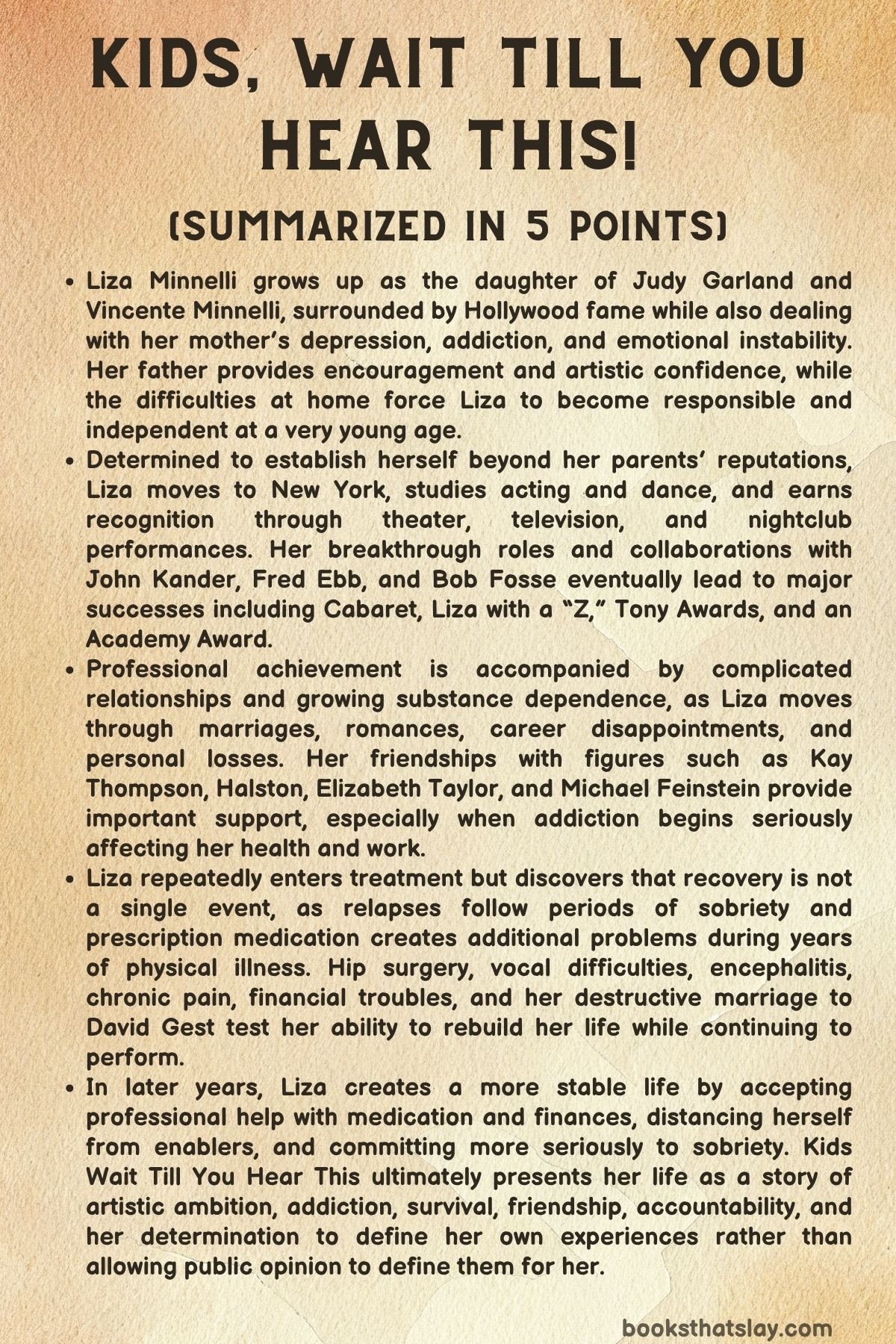
Liza Minnelli grows up in circumstances that make celebrity seem almost ordinary. As the daughter of Judy Garland and film director Vincente Minnelli, she spends her early years surrounded by performers, musicians, writers, directors, and other Hollywood figures, while MGM and the entertainment industry feel almost like extensions of family life.
Her father provides much of the emotional steadiness of her childhood. Vincente encourages creativity, introduces her to dance and filmmaking, and treats imagination as something worth following, giving Liza an early conviction that artistic ambition is not only possible but natural.
Life with Judy Garland is far less predictable. Liza remembers her mother as funny, affectionate, tremendously talented, and capable of turning even disaster into comedy, but Judy’s depression, dependence on pills and alcohol, hospitalizations, and emotional volatility force her daughter to become unusually cautious and responsible at a young age.
After her parents separate, Judy marries Sid Luft, and the family moves into an enormous mansion that outwardly suggests prosperity. Inside the home, however, Judy’s mental health deteriorates, and Liza gradually becomes involved in monitoring medication, contacting doctors, and attempting to protect her mother while also caring deeply for her younger siblings, Lorna and Joey.
Despite the instability around her, Liza begins discovering where she belongs. Television appearances, dancing, summer stock, acting classes, theater, and friendships with other young artists help her develop a professional identity, and live performance increasingly feels more compelling than the protected world of Hollywood.
At sixteen, after attending numerous schools and enduring years of family upheaval, she decides to leave formal education and move to New York. Vincente supports the decision, while Judy makes it clear that choosing independence means earning her own living, a challenge Liza willingly accepts.
New York immediately tests her determination. Although people connected to her family are willing to help financially, she wants to prove that she can succeed without depending on famous parents, so she studies, auditions, struggles with money, and gradually earns professional opportunities.
Her breakthrough in Best Foot Forward brings strong reviews and confirms that audiences can respond to her as Liza Minnelli rather than simply Judy Garland’s daughter. Recording opportunities and television work follow, but the question of whether she can separate her career from her mother’s reputation remains central to her early professional life.
Her relationship with Judy becomes more complicated once they begin sharing professional spaces. Their love remains strong, but Judy sometimes becomes competitive, particularly when Liza’s success proves that her daughter is no longer merely a child following her into show business.
That tension becomes especially visible during their London Palladium performances. Liza insists on being introduced under her own name, audiences respond enthusiastically, and Judy briefly reacts as a threatened star rather than only as a proud mother, yet the experience ultimately proves that Liza can perform beside one of the world’s most famous entertainers without disappearing behind her.
Her career advances rapidly when she forms a creative partnership with John Kander and Fred Ebb. She fights for the leading role in Flora the Red Menace, and although the production itself is short-lived, she wins a Tony Award at nineteen, giving her major recognition based on her own performance.
She also develops as a nightclub performer and learns from Charles Aznavour to treat songs as dramatic stories rather than simply musical pieces. That principle becomes central to the style for which she will eventually become famous: singing through character, intention, gesture, and emotional precision.
Her personal life becomes more difficult. She marries Peter Allen and discovers that his romantic life and sexuality make their marriage very different from what she expected, yet affection between them survives even as the relationship itself becomes unsustainable.
At the same time, film opens another path. The Sterile Cuckoo earns her an Academy Award nomination, but professional success is followed by devastating personal loss when Judy Garland dies in 1969 from an accidental overdose, leaving Liza to manage grief while also resisting the public tendency to reduce her mother to a tragic figure.
The period after Judy’s death becomes one of the greatest artistic phases of Liza’s career. She aggressively pursues the role of Sally Bowles in Cabaret, and director Bob Fosse challenges her to control her instincts, use restraint, and allow her physical appearance and unconventional qualities to become strengths rather than something to disguise.
The film becomes a landmark success, and Liza wins the Academy Award for Best Actress in 1973. She sees the victory not as an individual achievement alone but as the result of years of influence from Vincente, Fosse, Kander, Ebb, Halston, and the many artists who helped shape her understanding of performance.
Her television concert Liza with a “Z” further establishes her as an entertainer capable of combining stage intensity with television production. Fosse’s direction, Halston’s costumes, and Kander and Ebb’s music contribute to a program that wins major awards, yet even after an exceptional performance, Liza remains capable of leaving the stage uncertain whether she has done enough.
That insecurity becomes increasingly important as fame expands. The Oscar brings international superstardom, lucrative concerts, media attention, and professional freedom, but it also intensifies her anxiety, and she begins depending more heavily on prescription drugs, alcohol, and eventually cocaine while convincing herself that continued work proves she is still functioning.
Romantic relationships become similarly unstable. She becomes engaged to Desi Arnaz Jr., abruptly leaves that relationship for Peter Sellers, and later regrets the public manner in which the engagement ended, while her involvement with Sellers soon becomes disturbing and unpredictable.
Two relationships offer more reliable support: her godmother Kay Thompson becomes a fierce mentor, and designer Halston helps construct the elegant visual identity associated with Liza’s public image. Her participation in the famous Versailles fashion event further connects her with the changing cultural energy of the 1970s.
Film opportunities after Cabaret bring inconsistent results. Lucky Lady disappoints, while A Matter of Time, directed by Vincente, is altered by the studio and fails commercially, although live performance repeatedly restores Liza’s confidence.
Her marriage to Jack Haley Jr. offers companionship but does not stop her substance use. She later begins a relationship with Martin Scorsese while working on New York, New York, and although the film initially disappoints commercially, its songs become permanently associated with her career.
Broadway provides another major victory with The Act, earning Liza another Tony, but her private life continues to deteriorate. After her marriage to Jack ends, she marries Mark Gero, and their attempts to have children end in painful pregnancy losses.
Addiction eventually begins damaging the one place where she has always felt most dependable: the stage. During The Rink, lateness, missed performances, and conflict make the extent of the problem impossible to dismiss, and Lorna eventually intervenes after Liza is hospitalized.
With encouragement from Elizabeth Taylor and others, Liza enters the Betty Ford Center. Treatment forces her to confront not only substances but also denial, unresolved family responsibilities, and the childhood belief that she was responsible for keeping Judy alive and emotionally stable.
Recovery is not immediate. After treatment she convinces herself that controlled drinking or occasional substance use might be possible, relapses, and later enters Hazelden, gradually accepting that recovery requires continued assistance rather than a single act of determination.
During this period she forms one of the most important relationships of her adult life with Michael Feinstein. Their shared love of classic American music creates immediate closeness, but Feinstein’s importance grows because he refuses to excuse her destructive behavior and continues confronting her when others remain silent.
Professional accomplishments continue through Carnegie Hall, Radio City, European tours, recordings, work with Frank Sinatra and Sammy Davis Jr., and experimentation with the Pet Shop Boys. Yet these years are also marked by repeated deaths, including Vincente, Sammy, Halston, Peter Allen, and many others during the AIDS crisis.
Those losses strengthen her involvement with AIDS activism and LGBTQ+ causes. She performs at benefits, speaks publicly, and uses her fame in support of communities that have long formed an important part of her professional and personal world.
By the 1990s, decades of dancing, touring, injuries, addiction, and physical strain begin affecting her body. Arthritis, scoliosis, joint problems, chronic pain, hip surgery, and later vocal-cord surgery make performance more difficult, but she repeatedly returns to work despite serious health limitations.
Pain medication creates new dangers. During recovery from physical problems, she becomes dependent on OxyContin and other drugs, and in 2000 she develops encephalitis so severe that doctors warn she may never walk, speak, or sing normally again.
Through intensive rehabilitation, she recovers enough to perform again. Appearances after the September 11 attacks and at Michael Jackson’s anniversary concert demonstrate how strongly she continues to define herself through performing, even after illness has made every return more difficult.
Her relationship with David Gest begins during a period of financial and physical vulnerability. He promises to manage her career, protect her interests, and provide security, but according to Liza, the marriage becomes controlling, financially damaging, isolating, and eventually physically hostile.
After leaving Gest, she experiences another severe relapse. In one especially humiliating episode in 2003, she collapses on a Manhattan street while secretly drinking, an experience that forces her to confront how far addiction can strip away the protections normally associated with celebrity.
Her career nevertheless continues finding new forms. Arrested Development introduces her comic abilities to younger viewers, while collaborations with My Chemical Romance, another Broadway success, recordings, and film appearances show her capacity to reappear in unexpected cultural settings.
Medical crises and addiction continue, however, and by 2015 she is exhausted financially, physically, and emotionally. Returning to Los Angeles, she eventually enters treatment again after interventions from Feinstein, Terrence Flannery, and others.
This treatment differs because she accepts forms of control she previously resisted. She allows trusted professionals to supervise medication, removes enablers, begins managing money more responsibly, reduces the scale of her lifestyle, and sells memorabilia, creating a more stable environment and what she describes as her longest period of sobriety.
In later life, Liza becomes increasingly concerned with ownership of her own story. Her uncomfortable experience at the 2022 Academy Awards, where a last-minute wheelchair decision leaves her feeling humiliated, strengthens her determination to describe events on her own terms rather than allow public images to replace her perspective.
By the end of Kids Wait Till You Hear This, she does not present survival as perfection. She accepts responsibility for addiction, failed relationships, financial mistakes, and harm while also insisting on the value of her work, friendships, resilience, and continuing interest in performance, ending her life story not with retirement from the world but with curiosity about what may still come next.
Key People
Liza Minnelli
Liza is the central figure of Kids Wait Till You Hear This, and the book presents her identity as the product of both extraordinary privilege and unusual emotional responsibility. She grows up with access to Hollywood’s greatest performers, yet the instability surrounding Judy Garland forces her to become watchful, protective, and mature far earlier than most children.
Her greatest strength is persistence. Whether facing professional rejection, addiction, failed marriages, physical collapse, financial difficulty, or aging, she repeatedly returns to work because performing gives her a sense of identity that exists independently of family history and personal crisis.
Liza is also capable of severe self-deception. For years she treats continued professional productivity as evidence that substance use is under control, and her movement toward recovery requires accepting that talent, discipline, and determination cannot by themselves defeat addiction.
Her later reflections show increasing self-awareness rather than an attempt to make herself innocent. She admits mistakes in relationships, finances, addiction, and judgment while also resisting simplified public versions of her life, making personal accountability and control over her own narrative central to her final self-portrait.
Judy Garland
Judy Garland is one of the most complicated figures in Kids Wait Till You Hear This because Liza refuses to present her only as either a legendary entertainer or a tragic addict. Judy is loving, witty, musically extraordinary, impulsive, insecure, vulnerable, and frequently unpredictable, and all of these qualities exist simultaneously in her daughter’s memory.
Her illness changes the structure of Liza’s childhood. Rather than being protected by her mother, Liza often becomes the protector, monitoring medication, contacting doctors, worrying about emotional reactions, and learning to anticipate emergencies.
Professional jealousy adds another layer to their relationship. Judy clearly loves her daughter and recognizes her talent, yet moments such as their London engagement show how difficult it becomes for her to separate maternal pride from the competitive instincts of a performer whose identity depends heavily on audience attention.
Liza’s refusal to reduce Judy to tragedy is crucial. Even after Judy’s death, she emphasizes humor, affection, intelligence, and creative energy, suggesting that addiction was a devastating part of her mother’s life without being the total definition of who she was.
Vincente Minnelli
Vincente Minnelli functions as the emotional counterweight to instability in Kids Wait Till You Hear This. Where Judy’s unpredictable condition teaches Liza vigilance, Vincente teaches imagination, artistic confidence, discipline, and the belief that creative ambitions are worth pursuing.
His influence extends beyond fatherhood into Liza’s artistic instincts. His filmmaking background helps her understand visual composition and performance, while his willingness to support her decision to pursue a career gives her independence without forcing her to reject her family.
Their later collaboration on A Matter of Time becomes professionally disappointing because studio changes damage the film, but the experience does not erase the deeper importance of their bond. His death in 1986 represents the loss of the parent Liza most strongly associates with stability and encouragement.
Sid Luft
Sid Luft enters Liza’s life after Judy’s marriage to him, and his presence contributes to the increasingly unstable atmosphere surrounding her adolescence. Liza sees him as volatile, and his personality makes her uncomfortable at a time when Judy’s condition already requires constant emotional attention.
His significance lies partly in what his arrival represents. The marriage marks a shift away from the relative stability Liza associates with Vincente and toward a household in which adult conflict, financial uncertainty, illness, and parental unpredictability become normal parts of daily life.
Lorna Luft
Lorna is both Liza’s younger sister and an important witness to the family pattern created by Judy’s illness. Liza’s early instinct to care for Lorna reflects the responsibility she assumes within the household, where she often behaves more like a protective adult than a child herself.
As an adult, Lorna becomes capable of reversing those roles. When Liza’s addiction begins seriously affecting her work and health, Lorna participates in the intervention that pushes her toward treatment, demonstrating that their relationship develops from childhood dependency into mutual accountability.
Peter Allen
Peter Allen occupies an important place in Liza’s early adult life because their relationship begins during the period when she is becoming professionally independent. Their marriage contains genuine affection, but Liza gradually realizes that Peter’s sexuality and relationships with men make the marriage impossible to understand according to the expectations she carried into it.
What distinguishes Peter from several later partners is the durability of emotional affection even after romantic compatibility disappears. His eventual death becomes part of the enormous wave of losses that Liza experiences during the AIDS era, linking personal grief with the broader crisis that later strengthens her activism.
John Kander
John Kander becomes one of the creative forces most responsible for helping Liza discover a musical language that fits her personality. Their connection begins when she is still establishing herself, and his compositions give her material through which dramatic acting and singing can become a unified style.
His importance continues through major achievements including Cabaret and Liza with a “Z.” Liza understands his contribution not merely as that of a songwriter supplying songs but as that of a collaborator whose work helps define the performer audiences eventually recognize as uniquely hers.
Fred Ebb
Fred Ebb’s creative relationship with Liza is closely tied to Kander’s, but his influence has its own importance because lyrics and theatrical structure become essential to how she communicates a song. Their material gives her space to create characters, dramatic situations, and emotional shifts rather than relying only on vocal power.
The longevity of this partnership shows the value of artistic relationships built on mutual understanding. Through repeated collaborations, Ebb becomes part of the creative foundation that allows Liza to construct an identity distinct from Judy Garland while still working within the traditions of American musical theater.
Bob Fosse
Bob Fosse plays a decisive role in transforming Liza’s screen presence. During Cabaret, he challenges her to reduce rather than exaggerate, teaching her that stillness, control, and physical specificity can create greater cinematic power than performing with stage-sized intensity.
He also recognizes qualities that others might have viewed as limitations and incorporates them into Sally Bowles’s appearance and behavior. Their later work on Liza with a “Z” demonstrates how fully their artistic instincts could complement each other when theatrical risk, choreography, camera placement, costume, and performance were treated as parts of one unified event.
Charles Aznavour
Charles Aznavour contributes a principle that becomes fundamental to Liza’s musical identity: every song should be approached as an acting performance. His influence encourages her to think less about displaying vocal ability and more about communicating what a character wants, fears, remembers, or hides.
That lesson helps explain why Liza’s strongest performances depend so heavily on gesture, phrasing, facial expression, and dramatic timing. Aznavour therefore appears less as a long-term personal figure than as a teacher whose artistic advice affects decades of her career.
Kay Thompson
Kay Thompson is both mentor and protector. As Liza’s godmother, she provides a strong adult presence capable of offering encouragement without the instability that characterized much of Liza’s family life.
Kay’s influence is demanding rather than sentimental. She represents the kind of loyalty Liza values most: support combined with high expectations, artistic judgment, and the willingness to strengthen rather than simply comfort her.
Her death becomes especially painful because Kay belongs to the small group of figures connected to Liza’s formative years who survive into her adulthood. Losing her contributes to the growing sense that aging for Liza means not only physical change but the disappearance of people who once gave her history continuity.
Halston
Halston becomes essential to Liza’s visual identity. His clothing is not merely decorative; it helps construct the recognizable public image associated with her during the height of her fame, turning costume into an extension of performance.
Their friendship also connects Liza with the cultural energy of 1970s New York, fashion, nightlife, and a changing understanding of celebrity. His death during the years when AIDS is taking many people from her community turns an artistic friendship into part of a larger personal and cultural grief.
Desi Arnaz Jr.
Desi Arnaz Jr. represents one of Liza’s impulsive romantic decisions during the period when fame is accelerating. Their engagement appears to offer familiarity and companionship because they have known each other since childhood.
Liza’s sudden decision to leave him for Peter Sellers becomes something she later regards with regret, particularly because of how publicly the relationship ends. His role in the story therefore reveals her capacity to recognize that emotional excitement sometimes caused her to treat other people carelessly.
Peter Sellers
Peter Sellers initially attracts Liza with the intensity and excitement that repeatedly shape her romantic choices. She leaves her engagement to Desi Arnaz Jr. because of her feelings for Sellers, only to discover that the relationship is unstable and frightening.
His presence illustrates a recurring difficulty in her personal life: the difference between dramatic attraction and emotional security. Liza often responds intensely to charismatic personalities even when those relationships provide little of the steadiness she actually needs.
Jack Haley Jr.
Jack Haley Jr. offers Liza affection and companionship during an increasingly complicated stage of her life. Their marriage appears less volatile than some of her other romantic relationships, but emotional warmth cannot solve the addiction that is becoming more deeply established.
The marriage also demonstrates how professional and personal instability begin overlapping. Even while she remains highly successful, Liza’s substance use and attraction to others contribute to choices that gradually damage the relationship.
Martin Scorsese
Martin Scorsese has both professional and personal importance in Liza’s life. As director of New York, New York, he introduces her to a more improvisational kind of filmmaking, asking her to respond to Robert De Niro and to less controlled dramatic situations than those she had previously encountered.
Their romantic relationship begins while she is still married to Jack Haley Jr., showing how closely artistic excitement and emotional attraction can become connected for her. Her later desire to have Scorsese direct The Act also demonstrates the strength of her belief in him, even though his filmmaking methods ultimately prove unsuited to the demands of Broadway.
Mark Gero
Mark Gero enters Liza’s life through the theater world and becomes her third husband. Their relationship carries hopes for a more settled domestic future, particularly through their attempts to become parents.
The pregnancy losses they experience become among the most painful private events described in the book. For Liza, whose childhood had been defined by an unstable family structure, the inability to create the family she wanted adds a deeply personal form of grief to an already turbulent adult life.
Chita Rivera
Chita Rivera becomes particularly important during The Rink, when Liza’s addiction begins interfering directly with professional responsibilities. Conflict between them exposes how far Liza’s unreliability has progressed, especially because stage discipline had traditionally been one of the strongest parts of her identity.
Rivera’s presence therefore helps mark a turning point. When addiction damages relationships with fellow performers and threatens the quality of live theater itself, Liza can no longer convincingly maintain that professional success proves she is functioning normally.
Elizabeth Taylor
Elizabeth Taylor appears as an example of celebrity friendship used for practical intervention rather than social glamour. When Liza’s addiction becomes too serious to ignore, Taylor helps encourage her toward treatment.
Her role is brief but meaningful because Liza’s life contains many people willing to celebrate her and fewer willing to challenge her destructive behavior. Taylor belongs to the smaller group whose loyalty includes supporting difficult decisions rather than merely offering sympathy.
Betty Ford
Betty Ford becomes an important figure in Liza’s developing understanding of recovery. Treatment at the center associated with Ford gives Liza her first sustained opportunity to examine addiction not simply as bad behavior but as an illness connected to denial, family patterns, emotional wounds, and the need for continued support.
Ford’s later letter emphasizes humility and acceptance rather than personal control. That message directly challenges Liza’s instinct to believe that sufficient discipline should allow her to manage substances on her own.
Michael Feinstein
Michael Feinstein becomes one of the most enduring relationships in Kids Wait Till You Hear This because his friendship survives success, relapse, illness, aging, and repeated crises. Their connection begins through their shared knowledge of classic American music, giving them a bond rooted in genuine artistic curiosity rather than celebrity status.
His deeper importance comes from his refusal to enable Liza. Feinstein confronts her substance use, participates in interventions, helps maintain contact during medical emergencies, and remains present even when friendship requires uncomfortable honesty.
He also becomes part of her later support structure as she attempts to stabilize her health and finances. His loyalty demonstrates the distinction the memoir repeatedly makes between people who enjoy proximity to fame and people willing to protect the person behind it.
David Gest
David Gest represents one of the darkest personal relationships in Liza’s adult life. He enters when she is recovering from serious illness and facing financial insecurity, promising professional revival, protection, and stability at precisely the moment when those promises are especially attractive.
According to Liza’s account, the reality of the marriage becomes radically different. She describes financial exploitation, interference with friendships, control over access to her, attempts to gain valuable possessions, emotional hostility, and eventually physical conflict.
The relationship is important because it shows how vulnerability can survive even after decades of fame and professional success. Liza may be globally recognizable, but illness, addiction, financial confusion, and a desire to feel protected leave her susceptible to manipulation.
Lady Gaga
Lady Gaga appears late in Liza’s story through their joint appearance at the 2022 Academy Awards. Although the event is publicly presented as an affectionate celebration between generations of performers, Liza remembers the circumstances surrounding her wheelchair use as embarrassing and disempowering.
Her presence also creates a symbolic contrast between public affection and private experience. The event helps strengthen Liza’s determination to record her own version of events rather than allow televised images, online commentary, or assumptions about aging to become the final authority on what happened.
Themes
The Cost of Growing Up Around Fame
Fame in Kids Wait Till You Hear This is never presented as a simple privilege because Liza experiences its benefits and emotional costs almost from birth. Hollywood gives her access to brilliant artists, extraordinary opportunities, and an environment where creative ambition feels natural, yet it also exposes her to adult crises before she has the maturity to understand them.
Being Judy Garland’s daughter means that Liza cannot experience her mother’s illness as a private family matter. Judy’s professional difficulties, addiction, hospitalizations, public image, and emotional changes become part of a larger world in which the boundary between family and celebrity rarely feels secure.
This environment helps explain why Liza becomes both unusually capable and emotionally vulnerable. She learns how to function among powerful adults, cope with unpredictable circumstances, and adapt rapidly, but she also develops the belief that she must manage other people’s emotions and prevent disaster.
Later fame repeats the same contradiction in her own life. Awards, major performances, international recognition, and financial opportunities increase her freedom, yet celebrity also amplifies anxiety and surrounds her with people who do not always challenge her destructive choices.
The story therefore treats fame less as a cause of every problem than as an environment that magnifies existing strengths and weaknesses. It gives Liza extraordinary opportunities to become herself while simultaneously making it harder to know where the performer ends and the private person begins.
Identity Beyond a Famous Parent
Liza’s early career is shaped by the question of whether audiences will ever view her independently of Judy Garland. She understands that her mother’s name can open doors, but she also recognizes that inherited fame can prevent other people from seeing her achievement as legitimate.
Her decision to work in New York without relying heavily on family money becomes an early declaration of independence. Returning financial assistance, studying seriously, auditioning, and accepting professional uncertainty allow her to build confidence from work rather than inheritance.
The London Palladium engagement becomes especially important because mother and daughter briefly occupy the same professional space as competitors. Liza’s insistence on being introduced by her own name expresses more than youthful pride; it shows that she needs public recognition as an individual artist.
Later partnerships with Kander, Ebb, Fosse, Halston, and Aznavour help her develop qualities that are clearly distinct from Judy’s style. Cabaret, television concerts, Broadway performances, nightclub work, comedy, and dramatic acting gradually establish a career with its own artistic language.
Even after achieving independence, however, Judy remains part of Liza’s emotional and creative identity. The memoir suggests that becoming oneself does not require rejecting one’s parents; it requires learning which parts of their influence to carry forward and which responsibilities must finally be put down.
Addiction, Denial, and Recovery
Addiction appears as a family pattern that changes form across generations. As a child, Liza watches Judy struggle with pills and alcohol and learns to manage medication, emergencies, and emotional crises, yet those experiences do not prevent her from developing serious substance problems of her own.
One of the most significant aspects of Liza’s addiction is her ability to remain professionally productive for long periods. Because she can still perform, earn money, travel, and receive praise, she repeatedly interprets achievement as evidence that she remains in control.
Treatment gradually destroys that assumption. Betty Ford, Hazelden, interventions from family and friends, relapse, hospitalization, and later medical crises teach her that recovery cannot depend entirely on willpower.
The theme becomes more complex because medical treatment itself sometimes contributes to addiction. Prescription drugs given after grief, surgery, chronic pain, and serious illness blur the boundary between legitimate medical care and dangerous dependence, demonstrating how vulnerability can continue even when illegal substances are no longer the central problem.
Her later sobriety depends on accepting limits. Allowing others to supervise medication, removing enablers, reducing spending, and rebuilding daily structure represent a fundamental change from her earlier belief that independence means controlling everything herself.
Recovery therefore becomes less about achieving a perfect life than about creating systems that make survival possible. The memoir treats relapse as serious without allowing it to erase every previous attempt at recovery.
Performance, Survival, and Ownership of One’s Story
Performance is the place where Liza repeatedly regains a sense of order. Even when films fail, marriages collapse, addiction worsens, or health problems threaten her mobility and voice, live performance gives her a structure in which discipline, preparation, music, movement, and audience connection temporarily create clarity.
This helps explain why she continues returning to the stage despite extraordinary physical costs. Performing is not simply employment or a pursuit of applause; it is one of the central ways she understands herself.
As she ages, survival itself becomes another form of performance discipline. Rehabilitation after encephalitis, recovery after surgery, repeated treatment for addiction, and adaptation to physical limitations require the same persistence that once carried her through difficult rehearsals and demanding concerts.
The closing movement of Kids Wait Till You Hear This expands this idea from performing to storytelling. Liza becomes increasingly concerned that public appearances, tabloid accounts, biographies, and other people’s interpretations can create versions of her that eventually replace her own experience.
Her reaction to the 2022 Academy Awards becomes particularly important because she feels that decisions made around her body and appearance publicly communicate something she did not choose. Writing the memoir therefore becomes an act of authorship in the broadest sense.
By acknowledging addiction, failed relationships, financial mistakes, grief, ambition, and survival together, she refuses both heroic and tragic simplifications. Controlling the story does not mean erasing failure; it means insisting that a complicated life can be understood only when the person who lived it is allowed to speak.