Katabasis by R.F.Kuang Summary, Characters and Themes
Katabasis by R.F. Kuang is a dark academic fantasy about ambition, guilt, intellectual obsession, abusive mentorship, and the frightening cost of building an identity around achievement. Set partly at Cambridge and largely in a strange scholarly version of Hell, the novel follows two postgraduate magicians who sacrifice years of their lives to retrieve their dead professor.
Beneath its magical journey is a deeply human story about competition, trauma, friendship, love, and the ways brilliant people can learn to mistake suffering for proof of worth. The novel also asks whether knowledge remains beautiful when the institutions surrounding it become cruel.
Summary
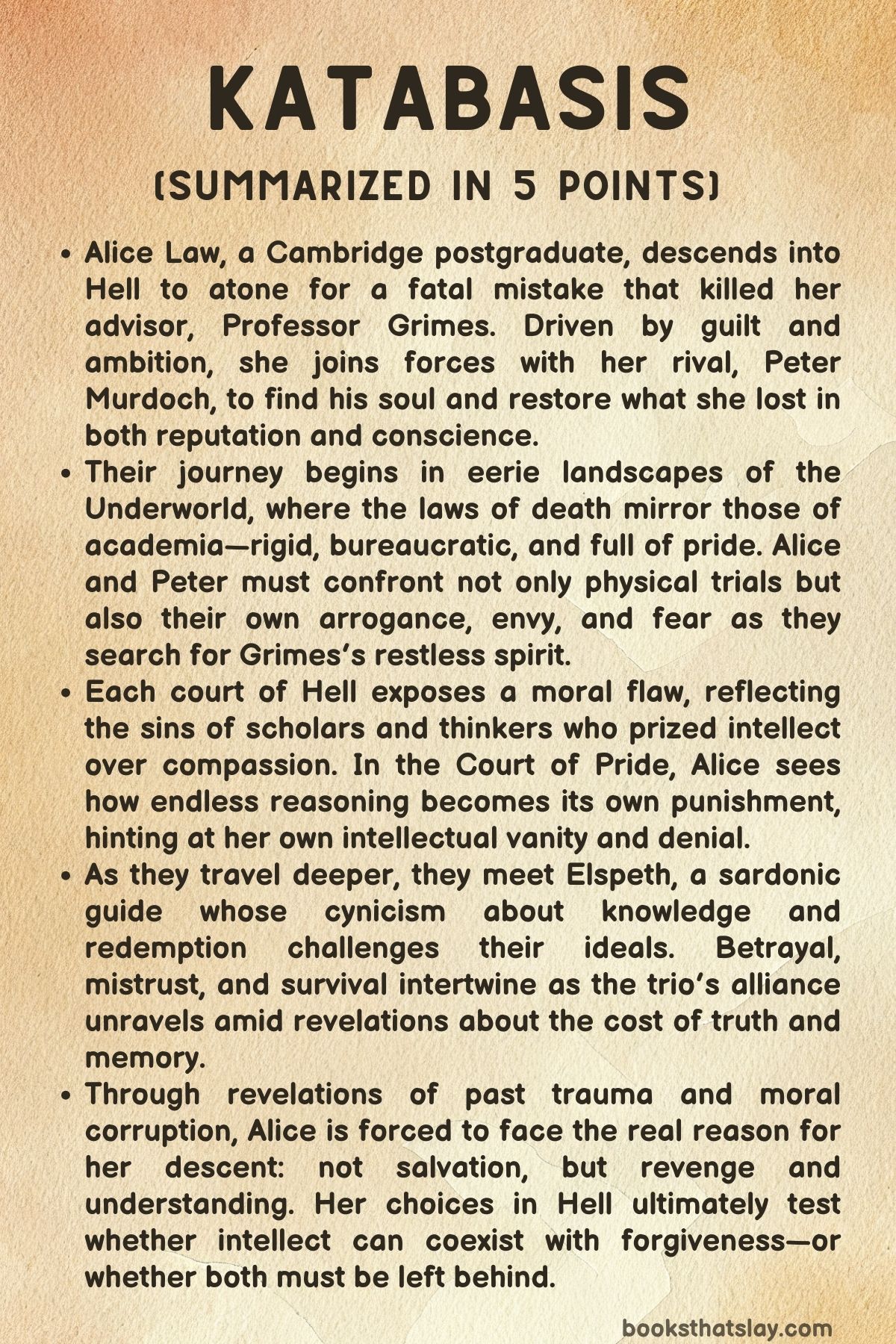
Alice Law is a postgraduate researcher in Cambridge’s Department of Analytic Magick, where she has spent years working under the celebrated Professor Jacob Grimes. When Grimes dies during a laboratory accident, Alice prepares an extraordinary magical expedition into Hell to recover his soul.
Her reasons are far more complicated than professional loyalty. Alice believes Grimes is essential to completing her dissertation and securing an academic future, but she also knows that his death was connected to a pentagram she failed to check while exhausted and emotionally unstable.
Peter Murdoch, Alice’s brilliant rival and former close friend, discovers what she is planning and insists on joining her. Their relationship is burdened by competition, jealousy, unexplained distance, and years of resentment, yet Peter knows enough about the underworld to make his presence indispensable.
Entering Hell requires both of them to surrender half of their remaining lifespans. They accept the price and arrive in a bleak realm where geography refuses to obey ordinary physical laws and where magick itself functions differently from anything they studied at Cambridge.
Searching for Grimes quickly forces them to confront uncomfortable facts about their advisor. They encounter the Shades of students who died during an experiment he supervised decades earlier, deaths that Cambridge concealed without seriously damaging his career.
As Alice and Peter move deeper, Hell increasingly takes the form of Cambridge itself. Libraries, laboratories, colleges, academic offices, debates, examinations, professional rivalries, and institutional rituals become part of the landscape because Grimes understood almost his entire existence through academia.
The different regions of Hell exaggerate human weaknesses into systems of punishment. Pride becomes an endless intellectual examination in which scholars defend their ideas forever, while Desire traps souls in repetitive attempts to recover sensations that once gave them pleasure.
Alice repeatedly insists that Grimes does not truly belong among such sinners. Despite everything she knows about his cruelty, she continues finding explanations for his behavior because admitting what he was would force her to question years of sacrifice made in his name.
Peter gradually becomes the person who keeps Alice psychologically anchored. When she is drawn toward the Lethe, whose waters erase memory and identity, he pulls her back and reminds her who she is.
This is especially important because Alice carries an unusual magical burden. Grimes once permanently inscribed a pentagram into her body that gave her near-perfect memory, allowing her to retain enormous quantities of knowledge but also preventing her from forgetting humiliation, fear, pain, and trauma.
Alice agreed to the procedure because she believed becoming a greater magician justified the risk. Grimes treated its success as an intellectual achievement even though the experiment was dangerous, painful, secret, and ethically indefensible.
Meanwhile, hostile skeletal creatures begin pursuing Alice and Peter. They eventually learn that the hunters serve Nicomachus and Magnolia Kripke, notorious magicians who deliberately entered Hell and transformed themselves into predators capable of using blood to make magick function there.
Tension between Alice and Peter worsens after Alice discovers notes describing an exchange spell involving Grimes and herself. She interprets them as proof that Peter intends to sacrifice her in order to recover their professor.
Her suspicion becomes decisive when she and Peter face a test of loyalty. Peter trusts Alice, but Alice chooses self-preservation because she expects him to betray her first.
They are rescued from the consequences by Elspeth Bayes, a former doctoral student of Grimes who died years earlier. Cambridge reduced Elspeth to a vague institutional memory, but Alice learns that she died by suicide after being damaged by the academic system surrounding Grimes.
Elspeth has survived in Hell for years and has become an expert navigator of its strange rules. She explains that fresh blood allows magick to function there and tells Alice and Peter about the Dialetheia, a genuine contradiction powerful enough to threaten the logical structure of Hell.
Through Elspeth, Alice is forced to confront the possibility that Grimes was not simply a demanding genius. He was part of a system that rewarded cruelty, arbitrary judgment, prestige, hierarchy, and the exploitation of students who had been trained to treat endurance as virtue.
Yet Alice remains unwilling to abandon her mission. She even convinces Peter to help her betray Elspeth in an attempt to steal information, reasoning that they have already sacrificed too much to fail.
Their plan is exposed, and Elspeth discovers that the person they intend to rescue is Grimes. Furious that they would give up so much for the man associated with her own destruction, she abandons them.
Peter finally confronts Alice about her obsession with continuing. Their supplies are disappearing, the dangers are worsening, and Alice increasingly argues that because they have already paid such an enormous price, the journey must somehow be completed.
During this confrontation, Alice reveals the truth she has avoided saying aloud: she hated Grimes, and she believes she killed him.
Her confession exposes the history behind that hatred. Grimes initially made Alice feel intellectually recognized and protected, but his attention eventually became sexual, culminating in an encounter in which he ignored her refusal and violated her boundaries.
Afterward, his professional treatment of her changed. Support disappeared, rumors spread, and Alice found herself trapped between the desire to preserve her career and the unbearable knowledge of what had happened.
Because her perfect memory made forgetting impossible, the experience remained present with extraordinary intensity. Alice stopped sleeping and eating properly, worked obsessively, and began psychologically collapsing.
When Grimes died, her first response was not grief but relief.
Alice also admits that retrieving him was never truly about restoring his life. She had researched a spell capable of forcing his soul into his corpse, intending to keep him as an imprisoned source of academic knowledge while also punishing him.
Peter responds with a confession of his own. The exchange equation Alice found was genuine, but Peter never intended to sacrifice her.
He intended to sacrifice himself.
Peter believed he was responsible for Grimes’s death because Grimes had stolen Peter’s important research and published it under his own name. In anger, Peter deliberately performed a careless safety check on the work, unknowingly contributing to the fatal experiment.
Peter also explains why he disappeared from Alice’s life years earlier. He suffers from severe Crohn’s disease and had built his identity around hiding physical weakness because he could not tolerate being treated with pity.
When his illness worsened, he withdrew rather than allow Alice to see him vulnerable. Alice interpreted that disappearance as rejection, while Peter believed he was protecting himself from becoming someone she merely felt sorry for.
The two finally understand that Grimes manipulated them through comparison. Alice believed Peter was the effortless favorite, while Peter believed Alice possessed the dedication and brilliance Grimes valued most.
Both had been privately suffering while assuming the other was succeeding.
Their reconciliation comes too late to prevent another disaster. Trapped by the Kripkes inside a spatial paradox, Peter creates a way for Alice to escape, but the solution can only save her.
Alice refuses to leave him, but Peter activates the spell himself and forces her out.
The Kripkes then kill Peter.
His death destroys Alice emotionally. She wanders deeper through Hell, consumed by grief and guilt, but eventually realizes that killing herself would reject the life Peter deliberately sacrificed himself to preserve.
Her journey now becomes less about achievement and more about finding a reason to continue existing. She encounters John Gradus, an ancient Shade fascinated by ordinary details from the living world because centuries in Hell have taught him how valuable physical existence truly is.
Alice reaches the city of Dis, where sinners endlessly produce dissertation-like confessions while searching for the correct argument that will earn release. Instead of accepting responsibility, many transform repentance into another intellectual problem.
She is later taken to the Rebel Citadel, where Gertrude and other Shades reject both reincarnation and conventional judgment. Their proposed paradise initially appeals to Alice because it seems to offer certainty and independence.
Yet their existence has become almost completely static. Some have transformed themselves into trees or withdrawn into near-motionless states simply to survive endless consciousness.
Alice finally recognizes that she does not want such an existence and, more importantly, does not want to die. She cannot produce a grand philosophical justification for living, but she accepts that being Alice Law, however imperfectly, is enough reason to continue.
Her renewed attachment to life becomes physical as well as intellectual. After escaping another Kripke trap, she experiences hunger, pain, warmth, food, blood, and bodily sensation with an appreciation she had never allowed herself before.
She then decides to hunt the Kripkes.
Using blood-powered spells, logical paradoxes, weapons, and everything she has learned in Hell, Alice constructs traps for them. Her assault reveals a dangerous capacity for violence, but it also shows that she is no longer helpless before the people who have been hunting her.
Alice ultimately defeats Nicomachus by forcing him into the Lethe, where his memories and identity are erased. Magnolia and their son Theophrastus subsequently enter the river voluntarily and disappear as well.
Gradus, who helped Alice at the decisive moment, finally receives his own opportunity to leave Hell through reincarnation. He abandons the fixed identity he has carried for centuries and accepts the possibility of becoming someone new.
Alice herself is damaged by the Lethe. Grimes’s perfect-memory spell begins dissolving, taking enormous amounts of knowledge with it.
Instead of viewing the loss entirely as catastrophe, Alice begins accepting ordinary human memory. Forgetting, reconstruction, uncertainty, and imperfection become parts of life rather than defects she must eliminate.
Elspeth eventually finds Alice and reveals that she possesses the Dialetheia. Rather than keeping it, she gives it to Alice so she can bargain with the Lord of Death.
Alice reaches King Yama and offers the contradiction in exchange for a boon. Before she makes her request, however, Yama summons Grimes.
Alice learns that Grimes deliberately encouraged her journey from the afterlife. He wants her to remain with him in Hell, free from bodily distractions, so that they can pursue knowledge forever.
For a moment, his approval still affects her. Then he treats Peter’s death as intellectually useful rather than tragic, and Alice finally sees how limited the man she worshipped truly was.
She no longer needs him to validate her intelligence.
Using Peter’s research, Alice performs the exchange spell she once misunderstood. Rather than recovering Grimes, she trades his soul for Peter’s.
Peter returns.
Alice and Peter are reunited and finally acknowledge the love, guilt, jealousy, resentment, and misunderstandings that shaped their relationship. They cannot erase what happened, but they now have the possibility of continuing the conversation instead of remaining trapped inside assumptions about one another.
King Yama returns part of the lifespan they sacrificed and allows them to leave Hell. Their academic futures remain completely uncertain.
For the first time, that uncertainty does not terrify Alice.
Alice and Peter emerge into Cambridge at night, where ordinary things such as rain, grass, food, touch, water, and the open sky suddenly possess extraordinary value. Alice ends her journey understanding that life does not need to be justified by greatness, achievement, suffering, or intellectual accomplishment.
It simply needs to be lived.
Characters
Alice Law
Alice Law is the emotional and intellectual center of Katabasis, and nearly every major conflict in the book is filtered through her distorted understanding of achievement, loyalty, suffering, and personal worth. She is exceptionally intelligent, ambitious, stubborn, competitive, and capable of extraordinary endurance, but those qualities have been shaped by an environment that repeatedly teaches her to distrust her own needs.
Her deepest weakness is not ambition by itself but her belief that pain validates ambition. Because Cambridge treats scarcity, exhaustion, rivalry, and humiliation as normal conditions of serious scholarship, Alice begins interpreting her ability to survive these things as evidence that she deserves success.
Grimes exploits precisely this tendency. His early recognition gives Alice something she desperately wants: confirmation from a powerful scholar that her mind belongs in Cambridge, and that initial gift becomes the foundation of a psychological debt she spends years attempting to repay.
Even after his behavior becomes abusive, Alice struggles to separate the man who once affirmed her brilliance from the man who later harmed her. Her repeated defense of him shows how abuse can survive through interpretation, because she continually turns evidence against Grimes into evidence that she herself needs to become stronger.
Her perfect memory intensifies this conflict. What initially appears to be an academic advantage becomes a psychological prison because Alice cannot naturally soften, reconstruct, or lose painful memories over time.
Her relationship with Peter reveals another side of her insecurity. She experiences his intelligence as both exhilarating and threatening, loving the fact that he understands her while simultaneously fearing that his effortless brilliance proves she is inferior.
This fear makes Alice vulnerable to manipulation. Once Grimes establishes competition between the two students, Alice begins interpreting Peter’s successes as judgments upon her own worth rather than as the achievements of someone she loves.
Her moral decline during the journey is therefore important. Alice betrays Peter, attempts to betray Elspeth, rationalizes revenge, and begins thinking according to the same ruthless principles she condemns in Grimes.
Yet the book does not reduce her to either victim or villain. Alice is capable of causing genuine harm while also being someone whose moral instincts have been damaged by years of fear, exploitation, and obsessive competition.
Peter’s death becomes the event that finally destroys her belief that every sacrifice must lead to achievement. Once success can no longer justify what has happened, Alice must decide whether life has value without an impressive result attached to it.
Her eventual transformation is therefore quieter than becoming more powerful. Alice learns to accept incomplete memory, uncertain plans, bodily needs, imperfect choices, and a future whose value does not depend upon academic greatness.
Peter Murdoch
Within Katabasis, Peter initially appears to represent everything Alice fears she can never become: naturally brilliant, socially comfortable, intellectually quick, and apparently untouched by the strain that consumes everyone around him. That image gradually collapses as the book reveals how carefully Peter has constructed it.
His severe Crohn’s disease has shaped his understanding of vulnerability from childhood. After learning that some forms of kindness toward him were motivated by pity, he becomes determined to hide illness, pain, and dependence behind the personality of an eccentric prodigy who succeeds without visible effort.
Peter’s disappearances are therefore not evidence that he does not care about Alice. They come from terror that revealing his physical suffering will alter the way she sees him and replace intellectual equality with compassion he experiences as humiliation.
This secrecy has devastating consequences. Because Peter never explains himself, Alice fills the silence with interpretations based on abandonment, competition, and betrayal.
Peter is also deeply vulnerable to Grimes’s manipulation. Although Alice imagines him as the favored student, Grimes steals Peter’s work, dismisses his illness, and treats his body as an inconvenience that intellectual discipline should overcome.
His careless proofcheck becomes an act of rebellion against that exploitation, but the resulting guilt consumes him once he believes it contributed to Grimes’s death. His proposed self-sacrifice shows how completely he too has accepted the idea that mistakes must be paid for through suffering.
Peter’s love for Alice is expressed more consistently through action than language. He rescues her from the Lethe, trusts her during the loyalty test, continues traveling after she betrays him, listens when she reveals what Grimes did, and ultimately gives his own life to save hers.
Yet Peter is not simply an idealized romantic figure. His refusal to communicate causes real pain, and his carefully maintained distance helps create the misunderstandings that separate them.
His importance lies in the contrast between brilliance and vulnerability. Peter demonstrates that extraordinary intelligence does not eliminate illness, fear, jealousy, shame, or the need to be understood.
His eventual return gives both characters an opportunity denied to them throughout most of the story: time. Rather than solving their relationship through one confession, the ending allows them to begin living beyond the rigid roles that Grimes imposed upon them.
Professor Jacob Grimes
In Katabasis, Jacob Grimes is both an individual antagonist and the human expression of a damaging academic culture. His power comes not merely from cruelty but from the fact that he is genuinely intelligent, influential, charismatic, and capable of recognizing talent.
His first interaction with Alice explains much of her later loyalty. At a moment when she feels like an outsider surrounded by Cambridge privilege, Grimes tells her that she belongs there and that her intellectual ability is real.
That affirmation gives him enormous psychological authority. Alice does not simply want professional advancement from him; she wants the man who first validated her mind to continue confirming that his faith in her was justified.
Grimes later turns mentorship into control. He manipulates Alice and Peter through comparison, treats suffering as an acceptable cost of intellectual accomplishment, takes ownership of Peter’s work, subjects Alice to unethical magical experimentation, and crosses sexual boundaries while maintaining institutional power over her future.
His attitude toward the body is particularly revealing. Hunger, illness, exhaustion, sexuality, physical pain, and even mortality are treated as irritating obstacles to the life of the mind.
This philosophy allows Grimes to turn neglect into intellectual discipline. Peter’s illness becomes weakness, Alice’s exhaustion becomes insufficient commitment, and ethical concerns become restrictions placed upon genius by lesser people.
The most unsettling aspect of Grimes is that he does not need to be secretly benevolent for Alice’s loyalty to make sense. He once helped her, once inspired her, and sometimes spoke beautifully about knowledge, but these truths do not cancel the harm he later caused.
His final appearance completes Alice’s separation from him. When he dismisses Peter’s death and imagines eternal scholarship as an ideal existence, Alice recognizes that the grandeur she projected onto him was far greater than the man himself.
Grimes’s claim that he created Alice is therefore defeated by Alice’s independent intellectual achievement. She finally understands that mentorship may influence a mind without owning it.
Elspeth Bayes
Katabasis uses Elspeth Bayes as both a warning about Alice’s possible future and proof that the people erased by institutions remain more complicated than the stories institutions tell about them. Cambridge remembers Elspeth mainly as a former student who died, reducing the conditions surrounding that death to an almost administrative fact.
Elspeth rejects the implication that she simply lacked the strength for academic life. She was talented and capable, but sustained exposure to hierarchy, arbitrary evaluation, prestige competition, and Grimes’s behavior gradually destroyed her capacity to continue.
Her discussion of gradual self-torture is central to understanding both Alice and the academic culture surrounding them. Catastrophic damage does not always arrive through one dramatic demand; it can accumulate through hundreds of individually tolerable sacrifices.
Elspeth also demonstrates what survival after destruction might look like. In Hell she becomes physically disciplined, knowledgeable, independent, and formidable, mastering conditions that initially overwhelm Alice and Peter.
Yet her competence does not mean she has completely escaped the past. Discovering that Alice and Peter sacrificed years of their lives to retrieve Grimes reopens the anger associated with her own experience, and their attempted betrayal understandably destroys her willingness to protect them.
Her later return is significant because reconciliation does not require either woman to pretend nothing happened. Alice acknowledges her betrayal, while Elspeth allows the relationship to move beyond that betrayal.
Giving Alice the Dialetheia marks Elspeth’s final rejection of endless obsession. She no longer needs to spend eternity solving Hell, defeating every enemy, or proving that all her suffering led toward some grand intellectual victory.
Her decision to seek passage onward makes her a parallel to Alice. Both eventually learn that refusing to release the past can become another form of imprisonment.
John Gradus
John Gradus initially appears as a mysterious guide whose greatest desire is surprisingly ordinary. Rather than demanding profound knowledge from the living world, he wants descriptions of music, clothes, meals, buildings, and everyday physical experiences.
His curiosity reveals one of the story’s central changes in perspective. Things Alice once considered distractions from intellectual work become treasures when viewed by someone who has spent centuries without embodied life.
Gradus is also a philosophical counterweight to Alice. He has spent an immense period asking why consciousness continues to resist extinction even when existence seems exhausting and death becomes less frightening.
His history with the Rebel Citadel shows that he has seriously considered withdrawal from existence. He knows the temptation of reducing consciousness until almost nothing remains, yet some unexplained desire continues drawing him toward experience.
Alice eventually gives Gradus something he has struggled to find through argument: not a perfect philosophical proof for living but an example of someone deciding to live without one. Her choice suggests that life may precede justification rather than depend upon it.
Gradus’s decisive intervention against Nicomachus becomes his act of grace. He stops remaining merely an observer and risks involvement in another person’s struggle.
His eventual departure into reincarnation is therefore appropriate. The character who spent centuries searching for an intellectual explanation of existence finally accepts uncertainty and becomes willing to enter a new life without preserving the identity he worked so long to understand.
Nicomachus Kripke
Nicomachus Kripke represents intellectual curiosity stripped of ordinary moral restraint. He entered Hell voluntarily with Magnolia and Theophrastus because the underworld offered problems powerful enough to attract scholars who believed ordinary limits no longer applied to them.
Over time, curiosity becomes predation. Nick treats living visitors as sources of blood, magical materials, information, and entertainment rather than as people whose lives possess independent value.
His behavior provides a frightening extension of the mentality Alice sees in Grimes. When knowledge becomes the highest possible good, other human beings can easily be reclassified as instruments, experiments, rivals, or obstacles.
Yet Nick’s final weakness is also intellectual. Alice knows that scholarly curiosity can overpower caution because she understands the temptation herself.
She uses that weakness to draw him into her trap. His defeat therefore does not come from Alice abandoning intelligence but from learning to recognize when intellectual appetite has become destructive.
His destruction in the Lethe is especially appropriate because a man who spent decades accumulating power is reduced through the gradual loss of memory. The identity he treated as something powerful and permanent disappears piece by piece.
Magnolia Kripke
Magnolia Kripke carries particular symbolic importance for Alice because she once represented an apparently complete version of female academic success. Alice viewed her as evidence that a woman might possess intellectual prestige, professional authority, beauty, marriage, motherhood, and public respect without having to sacrifice one part of herself for another.
The reality Alice encounters is horrifyingly different. Magnolia has become part of a predatory family whose pursuit of knowledge and survival has consumed the values that once made conventional achievement meaningful.
This makes her more than a secondary antagonist. Magnolia represents the collapse of one of Alice’s fantasies about what academic success could eventually provide.
Her final action complicates her characterization. After Nick disappears into the Lethe, Magnolia gathers Theophrastus and enters the river with him instead of attacking Alice.
The moment reveals that some form of attachment remains within her despite decades of brutality. It does not erase what she has done, but it prevents her from becoming a completely mechanical embodiment of evil.
As Magnolia disappears, Alice also loses an idealized future. The perfect academic woman she once imagined was never protection against obsession, corruption, or suffering.
Theophrastus Kripke
Theophrastus is the most disturbing member of the Kripke family because his presence raises questions about choice, inheritance, and identity. He entered Hell as the child of two adults whose ambitions determined his circumstances.
Unlike Nick and Magnolia, Theophrastus did not begin from an equal position of informed intellectual obsession. His development occurs inside the isolated moral universe created by his parents.
This makes his participation in their violence difficult to evaluate using the same framework applied to the adults. He has become dangerous, but the person he becomes has been shaped by parents who made predation normal.
Alice’s inability to kill Magnolia and Theophrastus when they are helpless is therefore morally important. Even during her revenge campaign, she discovers a boundary she does not want to cross.
Theophrastus ultimately disappears with Magnolia into the Lethe. His ending emphasizes one of the novel’s recurring questions: how much of a self has been chosen, and how much has been inherited from the systems and people who created the conditions of that self?
Archimedes
Archimedes provides comic relief, mystery, companionship, and surprising practical importance throughout the book. As the Cambridge department cat, he seems at first like an absurd presence within a journey concerned with death, metaphysics, logical paradoxes, and academic trauma.
His ability to move between worlds gradually makes him much more important. He repeatedly appears at moments when Alice and Peter need guidance, companionship, warning, or assistance.
Archimedes also differs from nearly every intellectual character because he does not need an elaborate philosophy for existing. He survives, seeks safety, forms attachments, experiences pain, and returns to people he recognizes.
That simplicity becomes particularly meaningful for Alice. At moments when she cannot produce an argument for continuing, the injured cat beside her offers an uncomplicated model of persistence.
His presence also helps keep the story connected to Cambridge as something larger than academic ambition. The institution that caused so much pain is still associated with familiar rooms, animals, friendships, memories, and ordinary forms of attachment.
Archimedes therefore represents continuity without intellectual justification. He remains important simply because Alice cares whether he lives.
Gertrude
Gertrude offers Alice one of the story’s most intellectually seductive alternatives. Rather than accepting Hell’s systems of judgment, punishment, memory loss, and reincarnation, she proposes rejecting the entire structure.
Her Rebel Citadel seems to promise autonomy. Its inhabitants intend to survive indefinitely, create their own social order, and refuse to surrender themselves to cosmic authorities.
The problem is that endless preservation gradually destroys the qualities that make preservation meaningful. Without genuine development, mortality, bodily change, or future uncertainty, the rebels become static.
Some reduce themselves almost to vegetation because remaining fully conscious across endless time becomes unbearable. Their supposed victory over death begins resembling another form of disappearance.
Gertrude cannot accept Alice’s challenge because Alice’s questions threaten the assumptions holding the citadel together. Her decision to prevent Alice from leaving reveals how easily a philosophy of liberation can become coercive when dissent places its certainty at risk.
Through Gertrude, the story distinguishes continued existence from living. Duration by itself does not produce meaning.
The Weaver Girl
The Weaver Girl appears briefly but plays a crucial role because her test exposes the central weakness in Alice and Peter’s relationship. She offers them a situation in which cooperation would protect both of them, but each person must choose without knowing what the other has selected.
Peter chooses trust. Alice chooses self-protection.
The outcome proves that Alice’s fear of betrayal has become powerful enough to make her betray someone first. She does not hurt Peter because she feels nothing for him; she hurts him precisely because losing his trust matters so much that she attempts to protect herself before he can cause the same wound.
The Weaver Girl interprets the result cynically, treating it as proof that trust between people is fundamentally unreliable. The larger story eventually rejects that certainty.
Trust can fail, but failure does not make trust meaningless. Alice and Peter’s relationship survives only when they finally replace speculation about each other with communication.
King Yama
King Yama functions less like a conventional ruler and more like an authority whose perspective makes the obsessions of mortal magicians appear strangely small. By the time Alice reaches him, she has spent enormous effort trying to understand and manipulate the laws governing Hell.
Yama reveals that magicians have misunderstood even the basic philosophy of their own craft. They imagine themselves deceiving reality, when reality is fully aware of the contradiction and occasionally permits their tricks.
This revelation gently undermines the intellectual arrogance running throughout the story. Human cleverness matters, but it does not necessarily grant mastery over the universe.
Yama also allows Alice to define herself through choice. He does not tell her what she must value when she receives the opportunity to demand a boon.
Her decision to recover Peter rather than fulfill her original mission proves how completely her priorities have changed. The person who entered Hell believing academic survival justified almost anything now chooses a human relationship over the professor around whom she had built her career.
Helen Murray
Helen Murray represents the inadequate forms of practical help available inside institutions that recognize abuse without necessarily possessing the will or structure to repair its consequences. When Alice approaches her after Grimes’s misconduct, Helen can identify possible procedures, including changing advisors, making complaints, or contacting authorities.
None of these possibilities gives Alice what she actually wants. Alice wants the relationship with Grimes restored to the version she once believed existed, with her intellectual respect intact and her academic future undamaged.
Helen understands that such restoration is impossible. Her response reflects the brutal pragmatism of environments where victims may be forced to calculate the professional consequences of acknowledging what happened to them.
She is therefore neither a direct villain nor an effective rescuer. Her role shows the distance between formally available remedies and solutions that feel psychologically or professionally survivable to the person who has been harmed.
Charlotte
Charlotte appears primarily through Alice’s developing understanding of Grimes’s sexuality and professional boundaries. Seeing Grimes involved with his secretary destabilizes Alice’s belief that she can control the meaning of his attention through intelligence and self-discipline.
Her presence helps expose the uncertainty surrounding Grimes’s relationships with women working beneath him. Alice has tried to imagine herself as exceptional enough to remain outside the ordinary dangers of gendered power, but Charlotte’s presence makes that confidence harder to maintain.
Charlotte consequently functions less as a fully developed independent figure and more as part of the evidence that challenges Alice’s interpretation of Grimes. She helps force Alice to recognize that professional admiration, sexual attention, hierarchy, and exploitation cannot always be cleanly separated simply because Alice wants those categories to remain distinct.
G. E. Moore
G. E. Moore serves as a comic and satirical representation of academic pride. In Hell, he effectively turns damnation into administration by organizing intellectual activity rather than confronting the judgment he is supposed to face.
His behavior captures an important habit criticized throughout the story: converting self-examination into work. As long as Moore can organize, define, debate, supervise, or establish another procedure, he can avoid asking what his endless activity is designed to accomplish.
Alice defeats him through logic itself, trapping him inside an argument whose structure prevents him from stopping. The scene shows how intellectual tools can become prisons when the desire to complete an argument becomes stronger than the ability to recognize its absurdity.
Moore consequently provides a humorous miniature of a much larger problem. Intelligence does not automatically produce self-awareness.
Themes
Achievement, Suffering, and the Myth of Earned Greatness
Alice has learned to understand suffering as evidence that she is becoming worthy of intellectual greatness. Exhaustion, humiliation, isolation, hunger, competition, and emotional pain are not initially interpreted as signs that something is wrong; she treats them as entrance fees demanded by serious academic life.
Katabasis repeatedly challenges this assumption by showing how institutions benefit when ambitious people learn to romanticize their own mistreatment. A student who believes every hardship builds character is less likely to ask whether that hardship is necessary, fair, or deliberately imposed.
Grimes reinforces the connection between pain and achievement because it protects his authority. If Alice succeeds, her success supposedly proves his methods worked; if she collapses, the failure can be attributed to her inability to meet the standard.
Elspeth’s account of gradual self-torture exposes the logic behind this system. No single sacrifice appears large enough to justify abandoning a dream, but the accumulated sacrifices can eventually consume the person making them.
The same mentality explains Alice’s refusal to abandon the journey. Because she and Peter have already surrendered years of life, endangered themselves, and betrayed others, turning back begins to feel as though it would make those costs meaningless.
Her eventual growth requires rejecting the idea that suffering automatically acquires value merely because it has already happened. Pain does not become noble through endurance, and a person does not have to continue a destructive course simply to justify previous sacrifices.
By the end, Alice can imagine a meaningful life without knowing whether she will obtain the career that once defined her entire future. That uncertainty represents freedom because achievement is no longer the condition she must satisfy before allowing herself to live.
Memory, Identity, and the Right to Change
Alice’s perfect memory initially appears to represent the ultimate scholarly advantage. She can preserve languages, texts, conversations, diagrams, and experiences with extraordinary accuracy, seemingly overcoming one of the mind’s ordinary limitations.
The same ability soon reveals its cruelty. Human beings normally survive partly because memory changes: details fade, emotional intensity weakens, interpretations shift, and the past becomes something reconstructed from fragments rather than endlessly replayed in full.
Alice has been denied that natural distance. Humiliation, assault, fear, pain, and regret remain available with almost the same intensity as when they first occurred.
The Lethe gives this conflict physical form. Total forgetting terrifies the characters because memory appears central to personal identity, yet for Alice the possibility of forgetting can also look like relief.
Other characters demonstrate different responses to the same problem. The Kripkes deliberately reduce their humanity by surrendering memories, while inhabitants of the Rebel Citadel attempt to preserve themselves so completely that they nearly eliminate change.
Gradus ultimately chooses another possibility. He relinquishes a fixed identity through reincarnation, accepting that becoming someone new may be more valuable than preserving one version of himself forever.
Alice’s damaged memory spell eventually moves her toward the same insight without completely erasing her. Losing knowledge frightens her, especially when Peter’s memory seems endangered, but she discovers that identity does not require perfect archival accuracy.
A human self can survive forgetting. In fact, the ability to change may be one of the conditions that makes a continuing self bearable.
Mentorship, Authority, and Institutional Abuse
Grimes’s power over Alice would be easier to reject if he had never helped her. Instead, he becomes influential because he recognizes her ability at exactly the moment she feels least certain that she belongs.
That early kindness creates a debt in Alice’s imagination. Years later, she continues searching for explanations that will allow the generous mentor and the abusive professor to remain versions of the same admirable man.
Katabasis refuses the comforting idea that harmful authority figures must be fraudulent in every part of their lives. Grimes can be brilliant, inspiring, perceptive, and intellectually important while also exploiting students, stealing work, violating boundaries, encouraging destructive competition, and treating people as tools for scholarship.
This contradiction explains why institutional abuse can persist around respected individuals. Achievements become defenses, professional influence discourages confrontation, former acts of generosity create loyalty, and those who suffer may fear losing the opportunities connected to the person who harmed them.
Cambridge intensifies the problem because Grimes does not operate alone. The university can absorb student deaths, rumors, exploitation, burnout, professional favoritism, and sexual misconduct without fundamentally changing the system that gave him authority.
Alice and Peter are also prevented from recognizing their shared experience because Grimes sets them against each other. Each student looks at the other and sees evidence that the system works perfectly for someone else.
Their eventual reconciliation breaks that structure. Once they compare experiences honestly, they discover that the rivalry benefited the mentor far more than either student.
Alice’s final rejection of Grimes therefore involves more than defeating one man. She rejects his authority to define what her intelligence means, what her suffering was worth, and what kind of future she deserves.
Life, Embodiment, and the Value of Ordinary Experience
Alice begins the story treating the body largely as an obstacle. Hunger, exhaustion, sleep, illness, sexuality, pain, and other physical demands compete with the intellectual productivity on which she has built her identity.
Grimes encourages this division between mind and body, while Peter attempts to hide chronic illness because he fears that physical vulnerability will change the meaning of his intellectual identity. Both characters have learned that serious scholars should somehow transcend bodily limitation.
Hell gradually reverses that hierarchy. The dead crave cigarettes, food, touch, pain, warmth, music, changing fashions, ordinary meals, and other experiences that living academics might dismiss as trivial.
Gradus’s fascination with everyday details makes this especially clear. Centuries without embodied existence transform ordinary sensations into evidence of an extraordinary privilege: the ability to participate in a changing physical world.
Alice’s hunger after escaping the Kripke trap becomes an important stage of her transformation. Eating no longer feels like an interruption of thought but proof that her body is functioning and that she remains alive.
The Rebel Citadel shows the opposite condition. Its inhabitants possess endless duration, but without meaningful physical and psychological change their immortality becomes a motionless form of existence.
Peter’s sacrifice finally forces Alice to confront the value of her own life without converting that value into an academic argument. She continues living partly because another person believed her continued existence was worth his own.
The ending completes this movement when ordinary Cambridge sensations suddenly matter to her: weather, grass, water, food, stars, physical touch, and the simple presence of another person. Life has not become valuable because Alice has proved a theory about it.
It is valuable because it can be experienced, changed, shared, and eventually lost.