The Compound by Aisling Rawle Summary, Characters and Themes
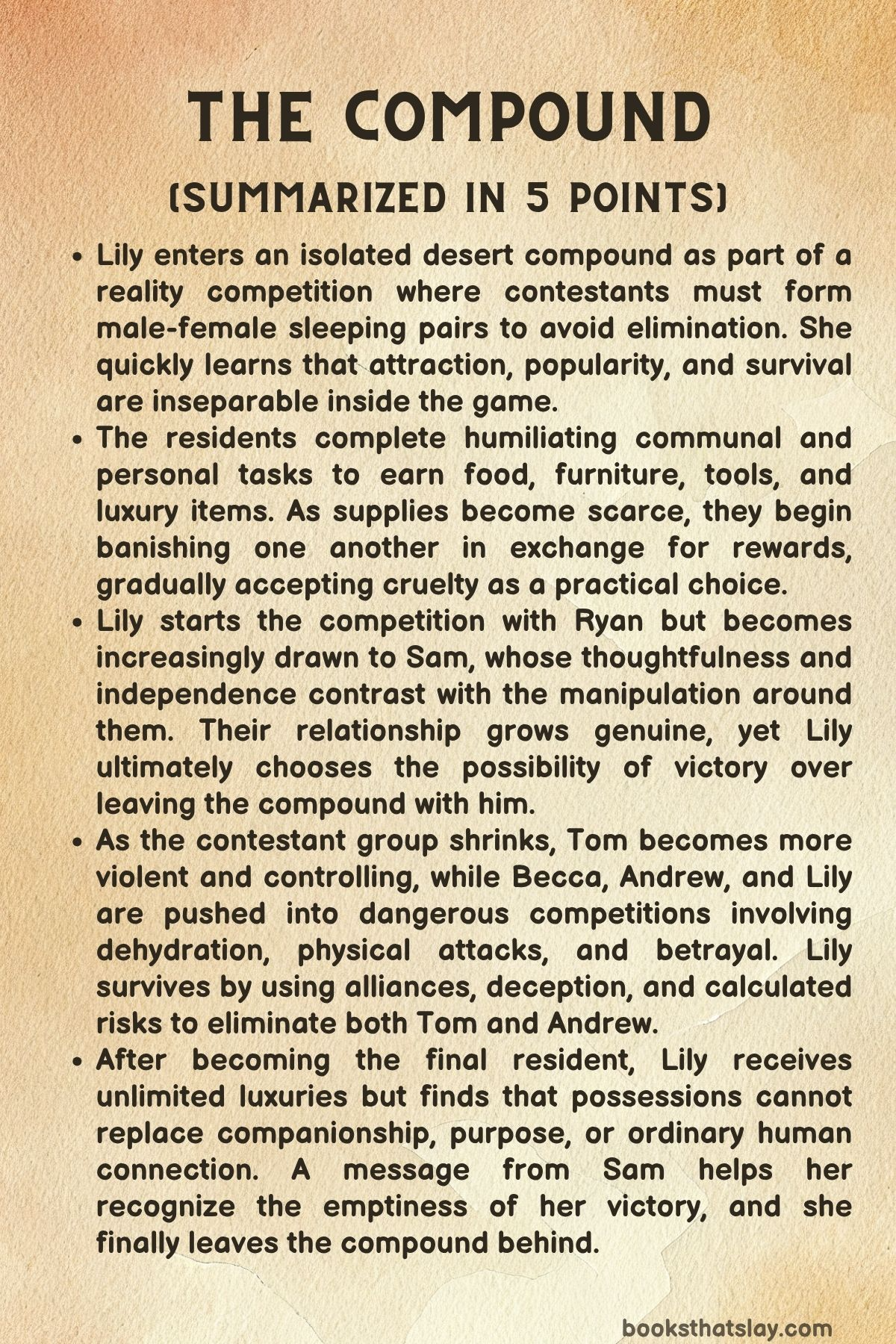
The Compound by Aisling Rawle is a dystopian novel about reality television, consumer desire, social competition, and the dangerous human need to feel chosen. Lily enters an isolated desert property believing that survival, popularity, and victory might offer her the meaningful life she has never found outside.
The contestants must form romantic partnerships, complete humiliating tasks, earn basic supplies, and decide who should be removed. As comfort increases and the group becomes smaller, cooperation gives way to manipulation, violence, obsession, and fear. Lily’s changing relationships reveal how easily people can mistake possession for happiness and attention for love.
Summary
Lily wakes in a dark bedroom inside an unfamiliar desert compound, where she meets Jacintha, another young woman who appears equally confused. Together they explore the property, discovering an impressive swimming pool, luxurious bathrooms, untended gardens, damaged furniture, abandoned clothing, a dirty kitchen, a maze, and a boundary separating the grounds from the surrounding desert.
Although the women behave as though they do not understand why they are there, they all know that they have entered a famous reality programme. They are forbidden from naming the show, discussing their previous lives without permission, or deliberately harming another contestant.
Eight more women gradually emerge, including the confident Candice, who immediately commands attention because of her beauty and natural authority. While they clean the neglected property and wait for the male contestants, the women quietly judge one another’s appearances, personalities, and chances of attracting a partner.
Nine exhausted men eventually arrive after crossing the desert, though a tenth man has become separated from the group. The contestants learn that everyone must sleep beside someone of the opposite sex each night, and anyone left without a partner will be removed by sunrise.
The screen controlling the property explains that Communal Tasks can earn shared necessities, while Personal Tasks provide rewards to individuals. The value of the prizes will increase as contestants leave, creating a system in which everyone benefits materially whenever another person disappears.
The residents are soon required to rank one another by physical attractiveness. Ryan is judged the most attractive man, Candice the most attractive woman, Lily places second among the women, and Melissa finishes last.
Lily is interested in Ryan, Sam, and Andrew, but Ryan joins her bed on the first night. Melissa fails to secure a partner and is gone the next morning, demonstrating how quickly rejection becomes a form of elimination.
The contestants begin earning furniture, food, tools, and household equipment through increasingly uncomfortable tasks. One challenge requires each resident to be held underwater for a full minute, but Becca repeatedly panics and surfaces before the time has passed.
Tom forces Becca beneath the water despite her resistance, while Lily tries unsuccessfully to stop him. Lily eventually holds Becca’s hand until the task is completed, and the others accept the new couch without seriously confronting the violence used to obtain it.
Lily continues sharing a bed with Ryan, yet she becomes increasingly interested in Sam. Their quiet conversations create a connection that feels more meaningful than her physical attraction to Ryan, though the rules of the compound make every romantic decision partly dependent on survival.
The group soon accepts its first permanent banishment in exchange for a freezer. Gav is selected because he has broken a rule and contributed little, while Eloise disappears soon afterward when she cannot persuade any man to abandon his current partner.
Food supplies begin to disappear, and hunger changes the residents’ behaviour. Andrew and Tom organise the household into departments, but the tasks continue offering useless or humiliating rewards instead of the nourishment everyone needs.
Lily, Sam, Ryan, and Jacintha decide to act without the producers’ permission by catching and killing ducks from the pond. The successful meal briefly gives the contestants pride because they have provided for themselves rather than submitting to the screen.
Their independence does not last. Seb is discovered hoarding food from Personal Tasks while the others have been starving, and the group banishes him in exchange for meat.
Sarah is then sacrificed for bread, showing that the residents have begun treating human removal as an ordinary household decision. Once food is available again, the moral objections that previously troubled them are replaced by relief and celebration.
Tom becomes increasingly controlling, presenting himself as the only person capable of protecting the compound. Lily and Sam suspect that he deliberately stages an animal disturbance in the kitchen to frighten the others into following a stricter routine.
The group temporarily sends Susie into the desert in exchange for construction materials. She returns badly sunburned, frightened, injured, and emotionally changed after becoming lost and encountering a snake.
Susie withdraws from everyone and becomes terrified by sudden sounds. When the screen later offers a decorative vase for a permanent banishment, the residents select her almost automatically, treating the damage caused by the earlier task as a reason to remove her.
The group continues sacrificing people for increasingly luxurious objects. Mia and Marcus are sent away for a Persian rug, leaving Jacintha devastated because she genuinely cared for Marcus and resented the assumption that Carlos should replace him merely because they shared the same race.
Lily’s relationship with Ryan collapses when she catches him having sex with Vanessa. During a task requiring everyone to kiss each other, Lily publicly reveals her anger and gives Sam a deliberately passionate kiss.
Ryan admits that he also slept with Mia and attempts to repair his position, but Lily secretly organises enough votes to banish him. When his removal leaves one woman without a male bedmate, Sam leaves Becca’s bed and joins Lily, finally making their relationship official.
Vanessa is left unpaired and is sent into the desert after Tom humiliates her and destroys her teddy bear. Becca is forced to remain beside Tom, whose attempts to gain her affection through gifts, food, and protection fail because she refuses to treat his control as love.
As the number of contestants decreases, rewards become more valuable and easier to obtain. The compound fills with food, alcohol, clothing, furniture, beauty products, and recreational equipment, convincing Lily that the property could become a permanent paradise.
Jacintha and Carlos eventually volunteer to leave so that the others can receive a hot tub. Lily is deeply upset by Jacintha’s departure, but she stays and accepts the reward, showing how strongly comfort has begun to outweigh her relationships.
After Tom is punished for revealing details about a task, the hot tub becomes dangerously hot and burns him. His injuries temporarily stop the household from completing tasks, while Lily, Sam, Candice, and Andrew begin imagining themselves as a peaceful final group.
That possibility ends when Tom discovers that Lily damaged his record player during a Personal Task. He slaps her and tears out part of her hair, causing Sam to attack him.
Because several contestants have participated in violence, the producers punish everyone by setting the storage shed on fire. The flames destroy the gardens, crops, orchard, possessions, rewards, and much of the outdoor property, reducing the contestants’ carefully constructed paradise to a blackened ruin.
The remaining residents abandon most household responsibilities and become emotionally exhausted. During a task requiring them to reveal every sexual relationship formed inside the compound, Andrew admits that he has betrayed Candice with both Eloise and Carlos.
Candice recognises that she spent months attempting to secure Andrew’s loyalty while gradually surrendering her own power. She kisses Lily goodbye and leaves before sunrise, reducing the group to Lily, Sam, Tom, Becca, and Andrew.
With the earlier rules removed, contestants are no longer required to share beds, and open violence becomes possible. Sam finally tells Lily about his brothers’ deaths in war, his estrangement from his father, and his decision to enter the programme because he felt directionless and alone.
Lily explains that she entered because low-paid work and limited opportunities made ordinary life seem hopeless. Sam wants them to leave together, but Lily believes that winning is her only chance to gain wealth, recognition, and a sense of personal value.
After an argument, Sam prepares to depart. He warns Lily about Tom’s violence during the men’s desert journey, gives her one final opportunity to leave, and accepts a duck feather from her before crossing the boundary alone.
Lily chooses the compound over the man she loves. Soon afterward, the producers turn off the water, drain the pool and pond, and announce that future eliminations will be decided through competitions rather than votes.
The first competition is a hundred-metre race. Becca reveals that she has hidden water in the maze and proposes starving Tom and Andrew of it until dehydration makes them weak enough for the women to win.
Lily agrees, secretly carrying food to Becca and pretending to suffer alongside the men. Tom eventually follows Lily into the maze, attacks both women, drinks the remaining water, and forces the four contestants to begin the race while exhausted and injured.
Lily wins after Tom briefly looks back when Becca cries out. Tom finishes second, Andrew abandons the injured Becca to claim third place, and Becca finishes last.
Before leaving, Becca attempts to strangle Tom while he sleeps, but the belt she uses breaks. Tom retaliates and nearly kills her until Lily persuades him to stop, after which Becca is forced across the boundary.
Andrew becomes dangerously ill from dehydration and is temporarily removed for medical treatment. Lily is left alone with Tom, who carries a knife, watches her movements, controls where she sleeps, and admits that he wants to remain inside forever.
Recognising that a mathematical competition will favour Tom, Lily creates a plan involving meat, coyotes, the damaged fence, and a staged animal attack. She locks Tom outside, blinds him with cleaning fluid when he breaks into the house, and gives a closer answer to the numerical challenge.
Tom is banished, though Lily helps clean his eyes and guides him to the boundary. Andrew returns the following morning, convinced that the producers saved him because they genuinely care about him.
Andrew begins building a monument from rubbish and insists that Lily act as his romantic partner because he believes this will please the audience. His behaviour becomes increasingly unstable as he sleeps less, talks to himself, and develops an obsessive faith in the unseen production team.
The final task requires one contestant to kiss the other in exchange for a key, with the kiss causing an elimination. After the producers lock them outside during freezing weather, Andrew handcuffs Lily to a pipe and injures himself in the hope that the producers will rescue them.
When no one comes, Andrew finally understands that they do not care about him personally. He releases Lily but demands a kiss before leaving, and she complies.
Lily is now alone, yet the promised key never arrives, forcing her to pick the lock herself. Once inside, she is invited to request anything she wants and begins ordering clothes, food, alcohol, appliances, beauty products, furniture, and other luxuries.
Unlimited consumption does not satisfy her. She becomes anxious, drinks heavily, neglects the property, and realises that everything she wanted has become meaningless without other people.
A telephone conversation with her mother makes Lily question whether she has truly won anything. Soon afterward, she receives a message from Sam, who says that he still loves her and hopes they can meet again.
Lily loads a sled with her possessions and keepsakes belonging to the former contestants. She finally leaves the compound, dragging the heavy rewards across the freezing desert until she hears someone calling her name and sees a raised hand near the collection point.
Characters
Lily
Lily is the narrator and central character of The Compound, and the story follows her movement from insecurity and romantic dependence toward manipulation, violence, self-knowledge, and eventual rejection of the game. She enters believing that beauty, popularity, money, and material comfort might provide the identity she lacks in ordinary life.
Her strongest weakness is her need to be chosen. At first, she measures her safety through Ryan’s presence in her bed, her attractiveness ranking, and the attention she receives from men, but she gradually recognises that possession and affection are not the same.
Lily is capable of compassion, as shown when she protects Becca, cares for Andrew during his illness, helps the injured Tom, and preserves objects connected to former contestants. At the same time, she becomes calculating enough to hoard water, deceive Andrew and Tom, manipulate competitions, expose others’ secrets, and use the structure of the game against her enemies.
Her decision to remain when Sam leaves reveals the depth of her emotional dependence on the compound. She loves him, yet she cannot surrender the possibility of winning because she has connected victory with personal worth.
Lily’s final departure is therefore more significant than simply leaving a location. She accepts that endless rewards cannot replace companionship, dignity, purpose, or an ordinary future in which her choices are not controlled by an audience.
Sam
Sam is thoughtful, practical, observant, and more openly critical of the programme than most of the other contestants. His skills as an architect and builder allow him to contribute to the physical development of the property, while his calmness during the duck hunt shows that he can act decisively when survival requires it.
His relationship with Lily develops slowly because he recognises how thoroughly the rules manipulate attraction. He understands that romance formed under surveillance and the threat of banishment cannot be separated from strategy, even when the emotions involved are genuine.
Sam’s personal history explains his discomfort with violence and false heroism. The deaths of his brothers, his refusal to enlist, and his separation from his father have left him grieving, isolated, and uncertain about the direction of his life.
Unlike Lily, he eventually concludes that remaining inside will only deepen that emptiness. His request that she leave with him is not simply romantic; it is an attempt to choose an imperfect reality over a controlled fantasy.
Sam also functions as Tom’s moral opposite. Both men possess practical ability and physical courage, but Sam uses strength to build, feed, defend, and repair, whereas Tom uses it to intimidate and dominate.
Tom
Tom is the most openly dangerous figure in The Compound, although his violence is initially concealed beneath claims of discipline, order, and protection. He presents himself as someone who can keep the group safe, but he repeatedly creates fear so that others will accept his authority.
His treatment of Becca exposes his belief that force can be justified when it produces a desired result. Holding her underwater, attempting to purchase her affection, monitoring her behaviour, and later attacking her all reveal that he regards consent as an obstacle rather than a boundary.
Tom is not entirely without complexity. He objects when Seb insults the women, occasionally protects the group, looks back when Becca cries during the race, and admits humiliating truths about his former life.
These moments suggest that he still possesses fragments of empathy, but they never become strong enough to restrain his anger or entitlement. His desire to live permanently inside the compound reflects his inability to function within ordinary social limits, where his behaviour has already cost him a career and a relationship.
Tom’s resemblance to Lily becomes especially important near the end. Both want isolation, control, comfort, and escape, but Tom represents what Lily might become if her desire to remain completely overcomes her concern for other people.
Becca
Becca initially appears quiet, vulnerable, and socially withdrawn, leading the others to underestimate her. Her knowledge of poetry, resistance to Tom, concealed water supply, and long-term strategy later reveal considerable intelligence and determination.
Her experience during the underwater task establishes the group’s willingness to sacrifice individual safety for collective comfort. The others accept her suffering because completing the task gives them a couch, and their silence helps Tom understand that violence will often be tolerated when it produces a reward.
In the plot of The Compound, Becca’s resistance to Tom becomes the organising purpose of her time inside. She rejects his gifts and protection because she recognises that they are attempts to create obligation rather than genuine acts of care.
Her revelation that she is under eighteen and not attracted to men further exposes the cruelty of a system built around forced heterosexual pairing. She entered intending to expose the programme’s shallowness but becomes focused on defeating Tom after experiencing his abuse.
Her attempt to kill him is morally alarming but psychologically understandable. By that stage, she no longer believes that the producers, rules, or other contestants will protect her, so she treats private violence as the only remaining form of justice.
Jacintha
Jacintha is Lily’s first friend and one of the few relationships that offers her emotional comfort without depending entirely on romantic competition. Intelligent, observant, and capable, she studies engineering and contributes practical ideas to the development of the compound.
She also exposes the racial assumptions built into the programme. The producers repeatedly give her wigs, clothing, and makeup that seem designed to present her as a Black version of Lily rather than allowing her an independent identity.
Her relationship with Marcus is one of the more sincere attachments in the book. His removal hurts her deeply, and she rejects the suggestion that Carlos should automatically replace him simply because both men are Black.
Jacintha’s eventual decision to leave with Carlos shows that she values human connection more than the increasingly luxurious rewards. Her departure devastates Lily because it removes one of the last people who remembers her before competition and suspicion changed the household.
Candice
Candice enters as the most beautiful and socially commanding woman, quickly assuming authority without needing to request it. Her confidence makes Lily feel threatened, yet Candice is not merely a shallow rival.
She understands the importance of presentation, negotiation, and strategic partnership. Her relationship with Andrew appears stable because she has carefully managed her image and behaviour to ensure that he continues choosing her.
Candice occasionally reveals generosity and tenderness, particularly when she styles Lily’s hair and makeup. That private moment suggests that her expertise in beauty can create intimacy rather than only competition.
Andrew’s confession destroys the belief that her discipline has given her control. She realises that her efforts to secure his loyalty have instead made her dependent on his approval while he has continued pursuing other people.
Her quiet departure is an act of regained agency. Rather than remain and compete after discovering the truth, she chooses to remove herself from the system that taught her to treat romantic selection as power.
Andrew
Andrew initially appears sociable, reasonable, and well suited to leadership. He helps organise departments, maintains a successful public relationship with Candice, and often seems less threatening than Tom.
His charm conceals a strong need for approval. Andrew adjusts himself to the expectations of the group, the programme, and the imagined audience, making it difficult to determine where performance ends and his genuine personality begins.
His sexual relationships with Eloise and Carlos reveal that his commitment to Candice was partly constructed for survival and status. When she leaves, he loses the identity that their partnership provided.
The race shows his capacity for selfishness when he abandons the injured Becca to avoid elimination. Lily still cares for him during his illness, creating a contrast between her remaining humanity and his failure to help someone weaker.
After medical treatment, Andrew becomes fanatically devoted to the producers because he interprets their intervention as personal love. His monument, forced romantic performance, self-injury, and decision to handcuff Lily show the collapse of a man who can no longer distinguish attention from care.
Ryan
Ryan represents physical attraction without emotional security. His appearance immediately gives him status, and Lily chooses him partly because being selected by the most attractive man confirms her own value.
He can be charming and affectionate, but he treats intimacy as an opportunity rather than a commitment. His relationships with Vanessa and Mia show that he expects Lily’s loyalty while preserving his own freedom.
Ryan’s betrayal forces Lily to recognise how little their partnership contains beyond desire and survival. Organising his banishment becomes one of her first major acts of strategic independence.
His shock at being removed also shows his confidence that beauty and popularity will protect him. He underestimates the women’s ability to organise against him because he assumes that personal attraction will outweigh collective anger.
Susie
Susie is one of the clearest victims of the contestants’ growing moral indifference. She initially participates in the shared life of the property but is selected for temporary banishment because the others value construction materials more than her safety.
Her return from the desert shows severe physical and emotional distress. Rather than accepting responsibility for sending her outside, the group begins viewing her trauma as a disruption to household stability.
When Susie is permanently removed for an ornamental vase, the reward exposes the emptiness of the decision. Her suffering is exchanged for an object that is already cracked, making the contestants’ justification appear especially cruel.
Susie’s inability to cross the boundary willingly also complicates the claim that she wants to leave. Her panic suggests that she is no longer making decisions freely and needs help that neither the programme nor the contestants provide.
Vanessa
Vanessa is initially defined by her role in the romantic competition, but her relationships with Ryan and Tom expose the unequal standards applied to male and female sexuality. Ryan’s affairs weaken Lily’s trust in him, while Vanessa receives much of the direct humiliation.
Tom’s destruction of her teddy bear is an attempt to strip her of dignity before sending her away. His behaviour turns her banishment into a public punishment designed to demonstrate his power.
Vanessa’s removal also reveals how easily women can be treated as replaceable once a man withdraws protection. Although Ryan participated equally in their affair, she faces a harsher and more personal form of condemnation.
Mia
Mia in The Compound is confident enough to challenge the routine of endless Communal Tasks and question whether obedience is still worthwhile. Her resistance suggests that not every contestant accepts the programme’s authority without frustration.
Her relationships with Ryan and Tom place her inside the secret sexual network that operates beneath the official couples. These encounters demonstrate how romantic partnerships are constantly undermined by Personal Tasks, desire, boredom, and strategy.
Mia’s banishment with Marcus for a Persian rug represents the group’s increasing willingness to remove multiple people for decorative luxuries. Her departure is treated less as a human loss than as part of the compound’s improvement.
Marcus
Marcus is important primarily through his relationship with Jacintha. Their connection appears emotionally genuine, making his banishment more damaging than the removal of contestants whose relationships are based mainly on convenience.
The decision to remove him for a rug demonstrates how the group has normalised sacrificing people for objects. Jacintha’s grief proves that the emotional cost of these decisions does not disappear merely because the majority accepts them.
Marcus also becomes part of the book’s criticism of racial simplification. The expectation that Carlos can replace him in Jacintha’s life ignores his individuality and treats romantic compatibility as a matter of racial matching.
Carlos
Carlos initially remains less central than several other men, but his presence gains importance through Jacintha and Andrew. The assumption that he should become Jacintha’s partner after Marcus leaves reduces both of them to racial categories.
His later decision to leave with Jacintha gives their partnership a degree of dignity because they volunteer rather than waiting for the group to sacrifice them. They choose departure together at a moment when material rewards have become increasingly difficult for the others to resist.
Andrew’s confession that he also slept with Carlos complicates the official romantic structure. It reveals desires and relationships that the programme’s male-female sleeping rule does not openly acknowledge.
Melissa
Melissa in The Compund is the first contestant removed after failing to secure a male bedmate. Her early departure establishes the brutal consequences of being ranked least attractive within a system that treats romantic selection as a condition of continued existence.
Her elimination teaches the remaining women that friendship cannot protect them if they are not desired. The fear created by her disappearance shapes every later romantic decision.
Melissa also shows how quickly a person can vanish from collective memory. Once she leaves, the others continue competing, adapting to her absence almost immediately.
Eloise
Eloise struggles to convince a man to abandon an existing partner after Gav’s banishment changes the numerical balance. Her disappearance demonstrates that contestants are required to disrupt other relationships simply to remain.
Andrew’s later admission that he slept with her reveals that Eloise’s social position was more complicated than the others understood. Although she lacked an official partner, she was still involved in hidden interactions that may have shaped her decisions.
Her removal exposes the difference between being privately desired and publicly chosen. Within the rules of the property, only the visible sleeping arrangement offers protection.
Gav
Gav is selected for the first deliberate permanent banishment because he breaks a rule and is seen as contributing little to the community. His removal allows the contestants to frame elimination as a rational response to poor behaviour.
By choosing someone they already dislike, the residents avoid confronting the full moral weight of their decision. They can tell themselves that he deserves removal while still accepting the freezer gained through his loss.
Gav therefore becomes the point at which banishment changes from an automatic consequence into a collective tool. Once the group has voted someone out successfully, later sacrifices become easier.
Seb
Seb displays contempt toward the women and secretly hoards valuable food while the group is starving. His behaviour in The Compund destroys trust because it proves that Personal Tasks can reward selfishness even during a collective crisis.
Tom’s brutal treatment of him during the race is excessive, yet the others tolerate it because they are angry about the hidden food. Seb’s unpopularity makes violence against him easier to excuse.
His banishment for meat appears morally simpler than several later eliminations because he has genuinely harmed the group. However, the decision still helps transform human removal into a practical method of obtaining supplies.
Sarah
Sarah is removed in exchange for bread after Seb’s departure creates another imbalance. Her quiet acceptance makes the decision appear less violent, but it also shows how completely the contestants have accepted the programme’s logic.
Tom’s later confession that he slept with her reveals that her relationships inside were more complicated than the public arrangements suggested. Like Eloise, she is remembered mainly through information disclosed after she is gone.
Her elimination marks the point at which hunger defeats the group’s earlier refusal to exchange a person for food. Once the bread arrives, the contestants celebrate rather than mourn.
Evan
In The Compound, Evan voluntarily prepares to leave after Susie’s removal changes the balance between men and women. His decision contrasts with contestants who manipulate others to preserve their own positions.
Although he receives limited attention, his willingness to accept removal suggests a degree of responsibility. He does not force a woman to lose her partner or begin a campaign against another resident.
His quiet departure also reflects the speed with which less dominant personalities disappear from the social narrative. The game rewards people who demand attention, form powerful alliances, or create conflict.
Alexandre
Alexandre never reaches the compound because he becomes separated from the men during their desert crossing. His unexplained disappearance creates an unsettling reminder that danger exists beyond the boundaries as well as inside them.
The producers provide no visible concern or closure regarding his fate. This silence suggests that contestants matter primarily when they remain useful to the programme.
Alexandre also represents the person excluded before the formal competition begins. Unlike those who are voted out or defeated, he disappears without recognition, reward, or explanation.
Brittany and Donna
Brittany and Donna in The Compound are former contestants whose experience influences Lily after she becomes the final resident. They once remained inside together for several weeks and appeared happy, yet they eventually chose to leave when comfort could no longer give their lives meaning.
Their example offers Lily a model of voluntary departure. They prove that leaving does not necessarily represent failure, even after someone has gained access to everything the property can provide.
Although they do not participate directly in Lily’s season, their decision becomes an important counterargument to the programme’s definition of victory. They recognised the emotional emptiness of permanent isolation before Lily was able to do the same.
Themes
Consumerism and the Failure of Material Satisfaction
Every reward promises that the contestants’ lives will become easier, safer, or more enjoyable, yet each new possession creates a stronger appetite for the next one. Furniture, food, beauty products, alcohol, tools, jewellery, and decorative objects gradually become measures of progress, even when obtaining them requires humiliation or banishment.
In The Compound, consumer desire is not presented as simple greed. Lily’s longing for possessions grows from economic insecurity, low-paid work, limited opportunities, and the belief that ordinary life will never provide her with comfort or recognition.
The producers exploit this vulnerability by making every object appear scarce and meaningful. A freezer seems essential when food is limited, while a vase or rug becomes desirable once basic needs have been met.
The rewards also encourage moral separation between actions and consequences. Contestants focus on the object arriving rather than the person leaving, allowing material improvement to conceal human loss.
Lily’s victory exposes the final failure of consumption. Once she can request almost anything, choice becomes exhausting rather than liberating, and each delivery loses its value almost immediately.
Her possessions cannot speak to her, challenge her, remember shared experiences, or offer affection. The moment of apparent abundance becomes the point at which she finally understands her emotional poverty.
Leaving with only a selection of rewards and personal keepsakes shows a change in how she values objects. They matter most when they connect her to people, memory, work, and the possibility of a future outside.
Surveillance, Performance, and Manufactured Identity
The contestants are constantly aware that they are being watched, even though they cannot see the audience or production team. This awareness turns ordinary behaviour into performance and makes authentic identity difficult to separate from strategy.
Clothing, makeup, romantic attraction, emotional confession, sexual behaviour, courage, vulnerability, and even grief become possible forms of entertainment. The contestants must consider not only what they feel but also how their actions might appear to the people observing them.
Lily’s concern with beauty illustrates how surveillance enters a person’s self-image. Her attractiveness ranking, Ryan’s interest, Candice’s appearance, and Jacintha’s styling all affect how she understands her value.
Andrew’s collapse offers the most extreme example of identity shaped by an imagined audience. He becomes convinced that the producers care about him personally and that he must build a monument, perform a romance, and injure himself to earn their attention.
The production team rarely needs to give direct instructions because the contestants begin predicting what viewers might want. They monitor themselves, adjust their personalities, create dramatic relationships, and punish behaviour that threatens the programme’s structure.
Even after Lily is alone, the voice reminding her that she is being watched affects how she drinks, cries, dresses, and moves through the property. Surveillance continues controlling her long after the competition appears to have ended.
Her departure is therefore an attempt to recover a private self. Outside the compound, her choices may once again belong to her rather than to an invisible audience demanding continuous performance.
Desire, Love, and the Need to Be Chosen
Romantic relationships inside the property cannot be separated from survival because sharing a bed initially determines who remains. Attraction becomes both an emotion and a resource, while rejection carries the threat of disappearance.
Lily’s relationship with Ryan begins because she desires him, but his selection also confirms her social value. She repeatedly checks that he has not left her bed because losing him would mean both emotional humiliation and physical removal.
Her connection with Sam feels more genuine, yet it is still shaped by tasks, surveillance, jealousy, and strategic sleeping arrangements. Sam recognises this problem and questions whether love can be fully authentic when the surrounding conditions are designed to produce it.
Candice and Andrew show how the desire to be chosen can encourage self-erasure. Candice believes that careful beauty, patience, and emotional control will secure Andrew, but she later realises that she has organised her identity around his approval.
Tom represents the most violent form of this desire. He offers Becca gifts, food, protection, and comfort, then becomes furious when these gestures fail to produce affection.
The story repeatedly distinguishes between wanting a person and possessing one. Ryan wants access to several women, Tom wants control over Becca, and Lily wants Sam while refusing the future he offers.
Lily’s final decision to leave suggests that love cannot survive as a reward for victory. She must accept uncertainty, vulnerability, and the possibility of rejection before she can seek a relationship based on freedom.
Power, Complicity, and Moral Decline
The contestants in The Compound do not become cruel in a single moment. Their moral standards weaken through repeated decisions that appear practical, temporary, democratic, or necessary.
The first banishments can be justified by rule-breaking, poor contribution, or numerical imbalance. Later, people are removed for food, construction materials, furniture, decorative objects, and the convenience of those who remain.
This decline depends on collective complicity. Tom’s violence becomes possible because others accept the couch earned through Becca’s suffering, while Susie’s trauma becomes a reason to remove her rather than evidence that the group has harmed her.
Voting allows individuals to hide behind majority decisions. No single contestant needs to feel fully responsible when everyone contributes a name, accepts the reward, and returns to daily life.
Scarcity intensifies this process but does not entirely explain it. Hunger makes the removal of Seb and Sarah easier to defend, yet the group continues sacrificing people after food and comfort have returned.
Power also changes form as the rules disappear. Social influence initially belongs to attractive or charismatic figures such as Candice, Ryan, and Andrew, while physical force later gives Tom greater control.
Lily survives by learning to use secrecy, alliances, deception, emotional pressure, and environmental danger. Her success proves that the system rewards moral flexibility, even when she continues seeing herself as less dangerous than Tom.
The ending does not erase her complicity. Instead, leaving requires her to acknowledge that remaining would mean accepting the person the competition has taught her to become.