Magic and Mischief at the Wayside Hotel Summary, Characters and Themes
Magic and Mischief at the Wayside Hotel by Elizabeth Everett is a warm fantasy romance about a strange hotel that is much more than a building. Number Five Wayside Hotel once helped magical travelers move safely between worlds, but now it is stuck on Earth and losing power.
Into this failing magical hub comes Josie LaChusia, a widowed mother looking for a safe home for herself and her young son, Amos. What begins as an ordinary apartment search becomes a story of found family, healing, trust, and love, as Josie discovers that the hotel needs more than magic to survive.
Summary
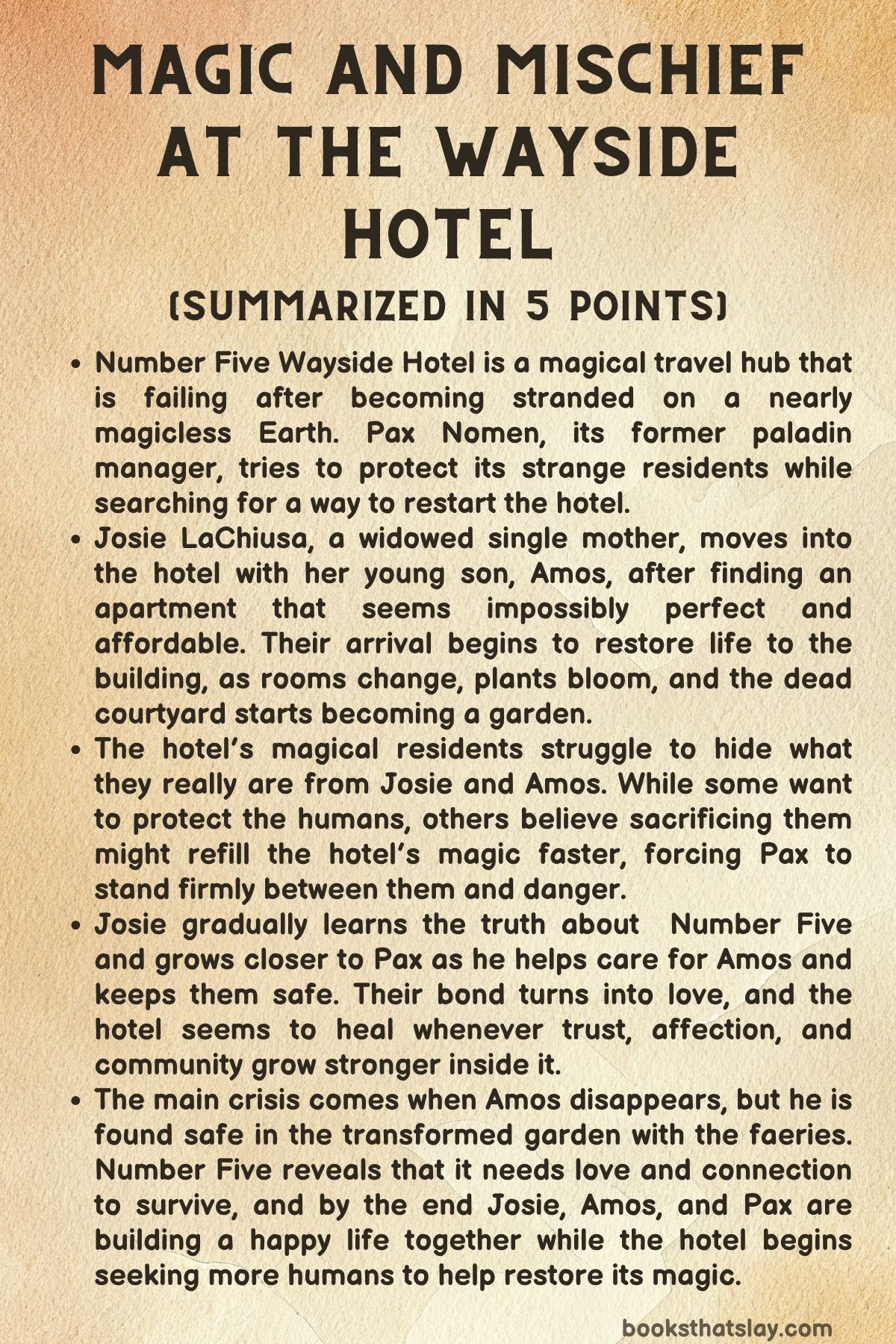
Number Five Wayside Hotel was once part of a magical system that carried travelers between different worlds. It served as a World Travel Hub, a place where beings from many realms could pass through safely.
Now that system is breaking down. One Wayside has vanished, another cannot stay fully present, and Number Five is stranded on Earth, a world with almost no magic left to feed it.
Its magical fuel gauge, called the hypsidoodle, is empty, and the hotel is slowly dying.
Pax Nomen, the manager of Number Five, does everything he can to keep the building and its residents from falling apart. He was once a paladin, but now his duty is to protect the hotel and the unusual beings trapped inside it.
The residents include gnomes, vampires, faeries, ghosts, gargoyles, zombies, medusas, Fates, and other magical creatures who are far from home. They are restless, worried, and often badly behaved.
Pax studies the hotel’s operating manual and learns that in an emergency, the building must be “rebooted.” He believes this means Number Five needs a human tenant.
Josephine “Josie” LaChusia is a widowed single mother who badly needs an affordable apartment. She is raising her four-year-old son, Amos, on her own, and money is tight.
While walking near work, she receives a notification about an available apartment at Number Five Wayside Hotel. The opportunity seems almost too good to be true, but Josie has few choices.
Pax shows her apartment 3C, and it seems perfect for her and Amos. It is affordable, comfortable, and strangely suited to their needs.
When Josie and Amos move in, Number Five starts to change. Amos’s room decorates itself with Spider-Man details, making him instantly happy.
The stove adjusts, vines turn green, flowers bloom, and the dead courtyard begins to show signs of new life. The building seems to respond to Josie and Amos, especially to their emotions and needs.
Josie notices the strange changes, but at first she tries to explain them away. She wants stability for her son, and Number Five offers a home when she needs one most.
The magical residents attempt to act like ordinary tenants, but they are not very convincing. Josie meets Maddy, a powerful medusa who leads the tenants’ association and quickly becomes an important presence in the building.
She also meets Raphe, a vampire prince who wants to return to his own world and reclaim his throne after his father’s murder. There are also faery cheerleaders named Naliti and her group, a rude gnome named Denis, gargoyles Bert and Ernie, zombies, Fates, and many others.
Some of them welcome Josie and Amos. Others see them mainly as a possible solution to the hotel’s failing magic.
Not everyone agrees on how the hotel should be saved. Denis and, at first, Raphe suggest that sacrificing a human might refill Number Five faster.
Pax refuses to allow any harm to come to Josie or Amos. He is firm that they are residents under his protection, not tools to be used.
His role as manager becomes more than a job; he becomes their shield against fear, desperation, and old magical thinking.
Josie gradually realizes that the hotel is alive and magical. Her apartment changes color, roses appear, and the courtyard becomes a garden.
The more she settles in, the more Number Five responds to her presence. Pax finally tells her the truth: the building is alive, stranded, and in danger.
Josie is frightened by what she learns, but she does not leave. Amos loves the hotel, and Josie has begun to care for the community around her.
She is also increasingly drawn to Pax, whose seriousness, kindness, and devotion to her son make him hard to resist.
Pax grows close to both Josie and Amos. He helps Amos during difficult moments, protects him from danger, and treats him with patience and respect.
Josie sees that Pax is not simply a magical manager trying to save a building. He is a man with a strong sense of duty and a deep capacity for love.
Their relationship begins with caution, because Josie has already suffered loss and does not want to risk more pain. Pax also carries his own history, but being with Josie and Amos changes him.
As their trust grows, the hotel becomes stronger.
The bond between Josie and Pax develops into romance. Their connection is not separate from the survival of Number Five; it becomes part of what helps the hotel heal.
The building improves when love, care, and community grow inside it. This reveals that Number Five does not need a simple magical fix.
It needs the kind of living energy that comes from people choosing one another, building trust, and making a home.
Outside the hotel’s magical problems, Josie also faces pressure from Gloria, the mother of her late partner, Dan. Gloria questions Josie’s parenting and suggests that Amos might be better cared for by his grandparents.
Her interference adds emotional strain to Josie’s life. Josie is already doing everything she can to provide for Amos, and Gloria’s criticism makes her feel judged and threatened.
After a chaotic museum incident involving Naliti, Gloria becomes even more difficult. Instead of leaving Josie to handle it alone, Pax, Maddy, and the other residents stand beside her.
They defend her as Amos’s mother and help her see that she is not alone.
The danger reaches its highest point when Amos disappears from the apartment. Josie is terrified, and Pax fears that one of the dangerous sleeping beings on the sixth floor may have taken him.
The possibility sends Pax into a state of fury and fear. Josie demands the full truth, and Pax prepares to fight anything that might have hurt the child he has come to love.
They eventually find Amos safe in the transformed garden with the faeries. The fear passes, but the moment forces everyone to face what Number Five truly needs.
The hotel appears to Josie in the form of her dead mother, allowing Josie to understand its nature more clearly. Number Five explains that it is not fed by violence or sacrifice.
It needs love, community, and real connection. These are the forces that refill its tank and give it life again.
Pax then tells Josie that he wants a future with her and Amos. He is willing to stay on Earth if that is what it takes to be with them.
Josie admits that she loves him too. Their confession marks a turning point not only for them but also for Number Five.
The hotel has found the beginning of what it needs: not a victim, but a family and a community willing to care for one another.
In the epilogue, Josie, Amos, and Pax are living together happily in apartment 3C. Their home is full of warmth, and Number Five is stronger than before, though its tank is not yet completely full.
The problem has not been entirely solved, but the path forward is clearer. Denis suggests speed dating as a way to create more love in the building, and Number Five begins recruiting more humans.
A later section introduces Sophie Cooper, a divorced attorney and new tenant. Maddy pushes Raphe to charm Sophie, hoping another romance might help refill Number Five completely.
This sets up the possibility of more stories within the same magical hotel, where love, chaos, and community continue to shape the future of the Wayside.
Characters
Magic and Mischief at the Wayside Hotel presents its characters as part of a warm, magical, and emotionally driven story about belonging, trust, love, and community. The characters are not only important because of their individual roles, but also because each of them contributes to the life of Number Five Wayside Hotel and to the emotional growth of Josie, Amos, and Pax.
Through these characters, the book shows how healing can come from unexpected relationships and how a broken community can begin to repair itself through care and connection.
Pax Nomen
Pax Nomen is one of the central figures in the book, and his character combines responsibility, loneliness, protectiveness, and emotional restraint. As a former paladin and the manager of Number Five Wayside Hotel, Pax carries the burden of keeping order in a place that is slowly dying.
He is surrounded by magical beings who are frightened, trapped, impatient, or desperate, yet he must remain calm and responsible even when he does not have clear answers. His past as a paladin suggests discipline, duty, and courage, but his role as hotel manager shows a softer and more patient side of him.
He is not simply a warrior; he is also a caretaker.
Pax’s greatest strength is his moral firmness. Even when some residents suggest that Josie and Amos might be sacrificed to refuel the hotel, Pax refuses to let fear turn into cruelty.
His protection of them shows that he values innocent life over easy solutions. This makes him a deeply honorable character, but it also places him under great emotional pressure because he must defend Josie and Amos while also trying to save everyone else.
His inner conflict comes from wanting to rescue the hotel without becoming the kind of person who harms others for survival.
His relationship with Josie reveals his emotional growth. At first, Pax is cautious and burdened by his responsibilities, but as he grows closer to Josie and Amos, he becomes more open, tender, and hopeful.
His affection for Amos shows that he is capable of fatherly gentleness, while his love for Josie gives him a reason to imagine a future beyond duty and crisis. By the end of the story, Pax becomes more than a protector of the hotel.
He becomes part of a family, and his willingness to stay on Earth for Josie and Amos shows that love changes his understanding of home.
Josephine “Josie” LaChusia
Josie LaChusia is one of the emotional anchors of the book. She is a widowed single mother who enters the story in a vulnerable position, searching for a safe and affordable home for herself and her young son, Amos.
Her need for stability makes her situation immediately sympathetic, but she is not portrayed as helpless. Josie is resilient, practical, loving, and determined to protect her child.
Her strength comes not from having an easy life, but from continuing to move forward despite grief, financial pressure, and judgment from others.
Josie’s role in the story is especially important because she brings human warmth into a magical place that has become disconnected and depleted. Number Five begins to respond to her presence, and the changes in the apartment, the courtyard, and the garden reflect the emotional energy she brings with her.
She does not simply live in the hotel; she helps awaken it. Her love for Amos, her growing trust in Pax, and her ability to form bonds with the residents all become part of the hotel’s healing process.
Josie is also a character shaped by conflict between fear and trust. When she realizes that the building is magical and that she and Amos may be connected to its survival, she is understandably frightened.
However, she does not run away immediately because she sees that the place has also given her son joy, safety, and belonging. Her relationship with Pax develops slowly because she must decide whether she can trust him with the truth and with her heart.
Her eventual confession of love shows that she has moved from guarded survival toward emotional openness.
Her conflict with Gloria further highlights Josie’s strength as a mother. Gloria’s criticism and interference challenge Josie’s confidence, but Josie’s love for Amos remains clear and powerful.
The support she receives from Pax, Maddy, and the residents helps affirm that she is not alone. Through Josie, the book explores motherhood, grief, self-doubt, and the courage it takes to build a new life after loss.
Amos LaChusia
Amos LaChusia is a young child, but his presence has a major effect on the book. As Josie’s four-year-old son, Amos represents innocence, wonder, emotional honesty, and the possibility of renewal.
He responds to Number Five with a natural openness that many adults lack. While Josie has to question and fear the magical changes around her, Amos accepts them more easily, and this makes him especially important to the hotel’s revival.
Amos’s room transforming with Spider-Man decorations shows how deeply the building responds to his needs and desires. This detail reveals his childlike imagination and also shows that Number Five is not only reacting to magic in a general sense; it is responding personally and lovingly to the people inside it.
Amos becomes a symbol of the kind of pure emotional connection the hotel needs. His happiness helps bring life back into a place that has been fading.
His relationship with Pax is also meaningful. Pax helps him through tantrums, protects him, and gradually becomes a steady presence in his life.
This bond allows Pax to show tenderness and allows Amos to experience care from someone who is not replacing his father, but still becoming part of his family’s future. Amos’s disappearance near the climax reveals how central he has become to everyone’s emotional world.
The fear that he may be in danger forces hidden truths into the open and pushes the characters toward honesty.
Amos may be young, but he is not unimportant. He brings emotional clarity to the story.
Through him, the book shows that love, safety, play, and belonging can be powerful forms of magic.
Maddy
Maddy, the medusa who runs the tenants’ association, is one of the strongest supporting characters in the book. She is formidable, organized, protective, and commanding.
Her role as leader of the tenants’ association gives her authority within the strange community of Number Five, and her presence helps create structure in a place filled with chaos. She is the kind of character who can intimidate others, but her toughness is tied to responsibility rather than cruelty.
Maddy’s importance lies in the way she balances practicality with loyalty. She understands the danger facing the hotel, but she also becomes one of the residents who supports Josie and Amos.
Her defense of Josie as Amos’s mother shows that she recognizes emotional truth and family bonds. She does not treat Josie as merely a human tool for the hotel’s survival; she sees her as a person who deserves respect.
Maddy also plays a role in moving the wider community toward connection. Her later pressure on Raphe to charm Sophie shows that she is invested in finding new ways to refill the hotel’s tank.
While this can seem forceful, it also reveals her commitment to saving Number Five and keeping the residents together. Maddy’s character adds humor, strength, and leadership to the book.
She represents the protective force of community when it is guided by loyalty instead of fear.
Raphe
Raphe is a vampire prince whose character is shaped by pride, grief, duty, and political urgency. He wants to return home to claim his throne after his father’s murder, which gives him a serious personal stake in the hotel’s survival.
For Raphe, Number Five is not only a place of shelter; it is the route back to his responsibilities and his future. This makes him impatient and, at first, morally troubling because he is willing to consider human sacrifice as a possible solution.
Raphe’s early attitude toward Josie and Amos reveals his desperation. His willingness to think in terms of sacrifice shows how fear and ambition can distort judgment.
However, this does not make him a flat villain. His background as a prince dealing with the murder of his father suggests that he is under intense emotional and political pressure.
He is a character caught between personal loss, royal duty, and survival.
As the story develops, Raphe becomes part of the hotel’s larger community rather than simply a self-interested noble. His later involvement in Maddy’s plan with Sophie shows that he remains important to the continuing effort to restore Number Five.
Raphe’s charm, status, and complexity make him a character with potential for growth. He represents the kind of person who must learn that power and duty are not enough without compassion and connection.
Naliti
Naliti is connected with the faery cheerleaders and brings energy, mischief, and magical chaos into the book. Her character adds liveliness to the story, especially because the faeries do not blend easily into ordinary human life.
Naliti’s presence helps show how difficult it is for the magical residents to pretend to be normal tenants. She represents the playful and unpredictable side of the hotel’s community.
At the same time, Naliti’s role is not only comic. The museum incident involving her contributes to the conflict between Josie and Gloria, which means Naliti’s actions affect the emotional pressure surrounding Josie’s parenting.
Through Naliti, the book shows that magical beings may be charming and entertaining, but their carelessness can create real problems in the human world.
The faery energy around Naliti also becomes important when Amos is found safe in the transformed garden with the faeries. This moment softens the fear surrounding them and suggests that their mischief is not the same as malice.
Naliti represents magical disorder, but also wonder, beauty, and the possibility that joy can exist even during crisis.
Denis
Denis, the rude gnome, is one of the more openly difficult residents of Number Five. He is blunt, unpleasant, and initially associated with the harsher idea that human sacrifice might refuel the hotel more quickly.
This makes him a source of tension in the book because he reflects the fear and selfishness that can emerge when a community feels trapped.
Denis’s character is important because he shows the darker side of desperation. While Pax insists on protecting Josie and Amos, Denis seems more willing to reduce them to a solution for the hotel’s problem.
His rudeness is not just a personality flaw; it reflects a survival mindset that lacks empathy. Through Denis, the book explores how panic can make people morally careless.
However, Denis is also used for humor and later practical absurdity. In the epilogue, his suggestion of speed dating to create more love in the building shows that he has accepted, at least in his own strange way, that connection is the answer rather than sacrifice.
This does not suddenly make him gentle, but it does show a shift from harmful thinking toward a more comic and community-based solution. Denis remains rough-edged, but his role helps show how even difficult residents can be pulled into the hotel’s healing process.
Bert and Ernie
Bert and Ernie, the gargoyles, are part of the magical population that gives Number Five its strange and lively atmosphere. Their presence helps establish the hotel as a place where many kinds of beings coexist under one roof.
As gargoyles, they suggest watchfulness, old magic, and a slightly comic sense of stone-faced strangeness.
Although they are not described as central decision-makers, Bert and Ernie contribute to the texture of the book’s community. They help make the hotel feel crowded, unusual, and alive.
Characters like them are important because the hotel’s survival depends not only on the main romance, but also on the idea of a whole magical household learning to function together.
Their names also add humor, making them memorable even in a large cast. They represent the book’s playful approach to magical beings: strange creatures are not treated only as frightening or grand, but also as neighbors with personalities and quirks.
Gloria
Gloria, the mother of Josie’s late partner Dan, is one of the main sources of emotional conflict outside the hotel’s magical crisis. She questions Josie’s parenting and implies that Amos might be better off with his grandparents.
This makes her a painful figure in Josie’s life because her criticism touches Josie’s deepest fears as a widowed single mother.
Gloria’s character represents judgment, control, and the difficulty of family relationships after loss. She is not a magical threat, but her interference is emotionally dangerous because it undermines Josie’s confidence and challenges her role as Amos’s mother.
Her behavior suggests that grief can sometimes turn into possessiveness. Rather than fully supporting Josie, Gloria seems to compete for authority over Amos’s life.
The conflict with Gloria allows the book to show Josie’s strength more clearly. Josie must defend not only her choices, but also her identity as a good mother.
When Pax, Maddy, and the residents support her, the contrast becomes clear: family is not only about blood or legal connection, but about who protects, respects, and stands beside someone. Gloria’s role helps strengthen the book’s theme that chosen community can become a powerful form of family.
Dan
Dan, Josie’s late partner and Amos’s father, is not physically present in the main events, but his absence shapes Josie and Amos’s lives. He represents the grief that Josie carries and the family life that was interrupted before the story begins.
His death helps explain Josie’s vulnerability, her guardedness, and her need to create a stable home for Amos.
Dan’s importance lies in how his memory affects the emotional stakes of the book. Josie is not simply beginning a romance with Pax; she is learning how to open her heart again after loss.
This makes her relationship with Pax more meaningful because it does not erase Dan. Instead, it shows that love after grief is possible.
Amos’s need for care and stability is also connected to Dan’s absence, which makes Pax’s growing bond with him especially tender.
Dan also connects to Gloria’s role in the story. Because Gloria is Dan’s mother, her interference carries the weight of shared grief and family history.
Through Dan’s absence, the book explores how the people left behind can struggle over memory, responsibility, and love.
Josie’s Mother
Josie’s mother appears through Number Five, which takes her form in a deeply emotional moment. Although she is not an active everyday character in the story, her image carries great symbolic importance.
For Josie, the appearance of her mother creates a moment of comfort, recognition, and emotional truth. It allows the hotel to speak to Josie in a form connected to love, memory, and trust.
The use of Josie’s mother’s form shows how deeply Number Five understands emotional connection. It does not approach Josie as a distant magical force.
Instead, it reaches her through someone associated with care and loss. This makes the scene powerful because it connects the hotel’s need for love with Josie’s own history of love and grief.
Josie’s mother also represents the continuing influence of family even after death. Her form helps Josie understand what the hotel truly needs, and it encourages the movement from fear to acceptance.
Through this figure, the book suggests that memory can guide healing rather than only cause pain.
Sophie Cooper
Sophie Cooper is introduced later as a divorced attorney and a new human tenant. Even though her role comes after the main emotional resolution involving Josie, Amos, and Pax, she is important because she points toward the continuing life of the hotel.
Her arrival suggests that Number Five’s story is not finished and that new human connections may help the hotel continue to recover.
Sophie represents a new possibility. As a divorced attorney, she likely brings her own history of disappointment, independence, and emotional guardedness.
Her introduction hints that the hotel may become a place where more people find healing, not only Josie and Amos. Maddy’s pressure on Raphe to charm Sophie also suggests that Sophie may become part of another romance or emotional bond that could help refill the hotel’s tank.
Her character expands the book’s ending beyond one family. Sophie shows that the solution to Number Five’s problem is not a single romantic miracle, but an ongoing process of building relationships.
She represents the future of the hotel and the possibility that new residents will bring new forms of love.
Themes
Love as a Source of Renewal
In Magic and Mischief at the Wayside Hotel, love is not treated only as romance; it becomes a force that restores life, safety, and purpose. Number Five begins in a state of decline, with its magic almost gone and its residents trapped in fear.
Josie and Amos bring warmth into a place that has become anxious and divided, and the building responds to their presence through flowers, garden growth, changing rooms, and renewed energy. Pax’s growing attachment to Josie and Amos also changes him.
He is no longer only a manager trying to control a crisis; he becomes someone willing to build a family and choose emotional risk over duty alone. The hotel’s recovery shows that survival cannot come from sacrifice, fear, or technical rules.
It comes from care, affection, and genuine bonds. Love becomes practical as well as emotional because it gives the building the strength it needs to continue.
Found Family and Community
The residents begin as a strange and chaotic group of magical beings, many of whom are suspicious, selfish, frightened, or desperate. Their shared crisis could easily make them turn against one another, especially when some believe Josie and Amos might be useful as a sacrifice.
Yet the story gradually shows community forming through protection, loyalty, and shared responsibility. Maddy, Pax, and others help defend Josie when she is overwhelmed by Gloria’s criticism and when she struggles to understand the truth about the building.
Even the hotel itself seems to reward connection, becoming healthier when the people inside it act less like isolated tenants and more like a family. This theme suggests that home is not created by walls or magic alone.
It is created when people choose to care for one another, even across differences. The many unusual residents show that belonging can exist among people who appear mismatched, difficult, or even frightening at first.
Trust After Loss and Fear
Josie enters the story carrying grief, financial pressure, and the burden of single motherhood. Her need for an affordable home makes her vulnerable, but it also places her in a situation where trust is difficult.
Pax hides the truth about the hotel, and the magical residents are clearly not what they pretend to be. Josie has good reasons to be frightened when the building changes around her and when Amos’s safety seems uncertain.
Still, trust grows through repeated acts of care rather than easy promises. Pax protects Amos, supports Josie, and proves through action that he values them as people, not as tools to save the hotel.
Josie’s trust is also tested by Gloria, whose interference makes Josie question whether others see her as a capable mother. The theme develops through Josie’s decision to stay, understand, and love again.
Trust is shown as something fragile, earned slowly, and strengthened through honesty and protection.
Home as a Living Relationship
The hotel is more than a setting; it behaves like a living presence that reacts to emotion, need, and connection. Josie’s apartment becomes suited to her and Amos, the courtyard begins to recover, and the building’s magic improves as love and community grow inside it.
This makes home feel active rather than fixed. It is not simply the place Josie rents because she needs shelter; it becomes a space that listens, responds, and heals.
For Pax, the hotel is also tied to duty and failure because he is responsible for keeping it alive while its systems collapse. For the trapped residents, it is both refuge and prison.
By the end, home becomes something different for all of them: not a perfect escape, but a shared place where people choose commitment. The theme suggests that a true home is built through emotional investment, safety, and mutual care, not merely through ownership, rent, or location.