Metal Slinger Summary, Characters and Themes
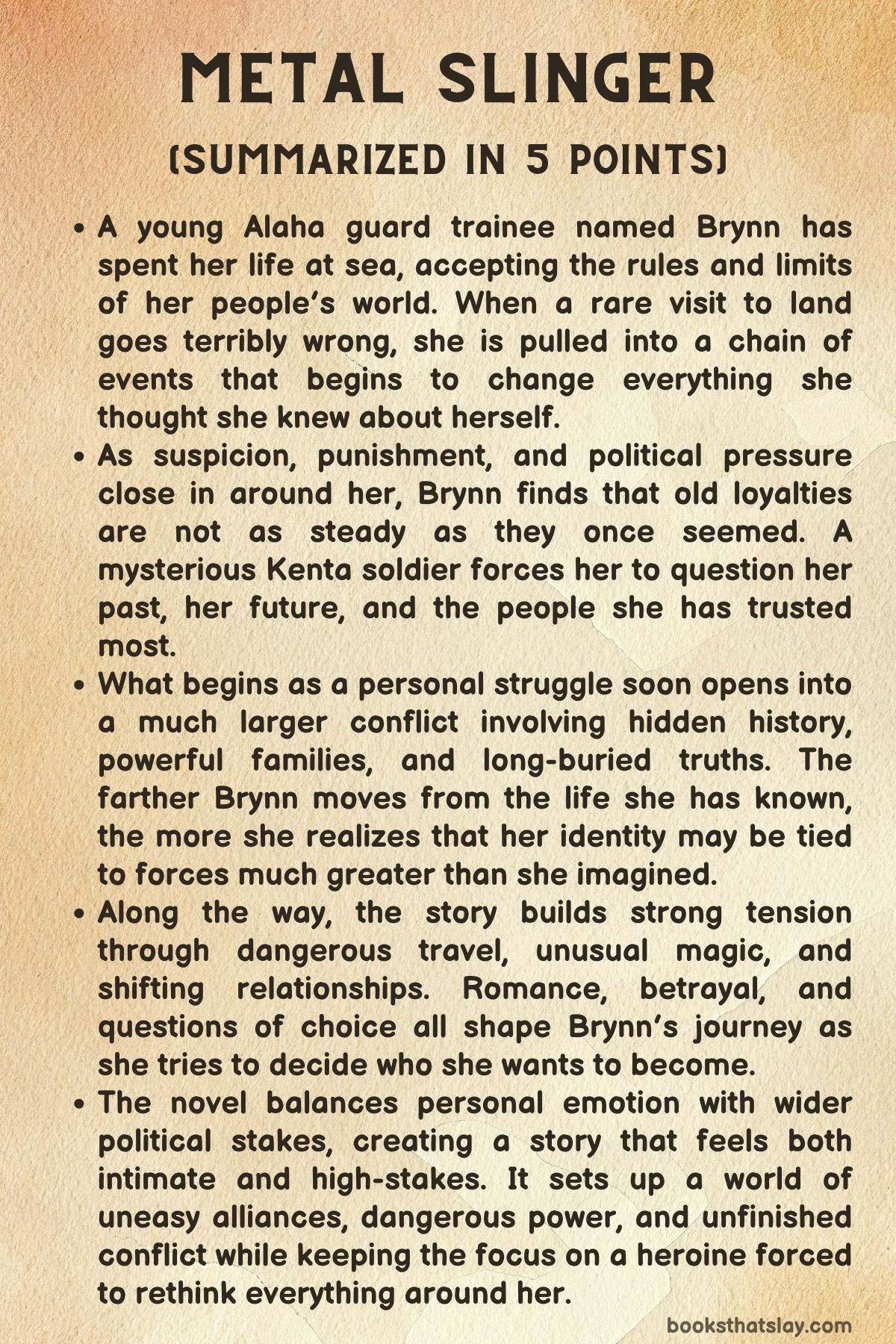
Metal Slinger by Rachel Schneider is a fantasy novel built around stolen identity, political control, hidden magic, and divided loyalties. It begins with Brynn, a young woman raised among the seafaring Alaha, who has spent her life accepting rules that keep her world small.
A violent encounter during a rare visit to land sets off a chain of revelations that tears apart everything she thought she knew about her family, her past, and the people she trusted most. As the story grows, it combines court politics, romance, betrayal, and power struggles, following a heroine who must decide who she really is and what kind of future she is willing to fight for.
Summary
Brynn is a guard trainee among the Alaha, a people forced to live at sea after a long conflict with the land-dwelling Kenta. When she and other trainees are allowed to visit the annual Market on land, the outing feels extraordinary, since it may be their only chance to experience life beyond the ships for many years.
At the Market, Brynn is struck by the beauty and abundance of the land, but the visit quickly turns dangerous. A Kenta soldier accuses her of theft after planting evidence on her, drags her into an alley, and threatens brutal punishment.
During the struggle, Brynn feels a strange pain when her hand touches stone. Kai, her friend and fellow trainee, intervenes, and Brynn, Kai, and Messer escape as fighting breaks out between Alaha and Kenta.
Their return home is ugly. Brynn is blamed for ruining the Market, mocked by her peers, and targeted by bullies.
She keeps the black-bladed knife she took from the Kenta soldier and feels oddly unable to get rid of it. At the same time, her bond with Kai deepens.
He asks about marriage, and although Brynn is unsettled by how quickly her future seems to be narrowing, she is also drawn to him. Their leaders, especially Captain Wren, treat the possible match as politically useful.
Brynn feels trapped between exile and a life chosen for her by others.
The tension with Kenta grows when the same soldier from the Market arrives near Alaha territory and asks to speak only with Brynn. He is imprisoned, but Brynn becomes curious enough to visit him in secret.
He introduces himself as Acker and hints that Wren has lied to her about her origins. Bound by magical blood oaths, he cannot reveal everything directly, but he suggests that Brynn’s parents may still be alive and that she does not truly belong to Alaha.
He also challenges her belief in Kai, claiming Kai has been using magic to push her feelings in his favor.
A storm creates the chance for Brynn to act. Fearing Acker will be left to drown in the flooding brig, she tries to free him.
Guided by his instructions, she somehow summons the black blade back into her hand and uses it to break the seals holding him. Before escaping, Acker tells her that her real name is Jovie.
He also demonstrates impossible strength by breaking his chains. Brynn hides him after the storm, though doing so forces her to lie to Kai and everyone else around her.
As Acker recovers, he tells Brynn a very different history of the world. He says the ruling families of various territories carry magical gifts tied to the land and that Wren is not a benevolent protector but a dangerously powerful figure whose actions shaped the suffering of many nations.
He insists Brynn was kidnapped as a child and is actually Princess Jovie of Maile. Her mother is alive and has been searching for her for years.
The black blade belonged to Jovie herself, forged long ago with her father’s help. Acker says he knew her as a child and came for her because he never stopped believing she could be found.
Brynn appears devastated by Kai’s supposed manipulation and by the lies surrounding her life, but later it becomes clear that some of this reaction is performance. At this stage, though, she asks Faline for money, planning an escape.
When she and Acker attempt to steal a boat, they are stopped by Dupre and then by Kai. Kai reveals that he did use his influence on Brynn, but claims he did so to protect her from something even worse.
The confrontation turns violent. Acker kills Dupre, defeats the guards, and spares Kai after Brynn asks him to.
Brynn and Acker flee by sea, leaving Alaha behind.
The escape is harsh and nearly fatal. Their small boat carries them through hunger, thirst, infection, and storms.
As they struggle to survive, Brynn and Acker begin to trust one another. He explains that forcing her hand onto the stone wall at the Market was his way of awakening her dormant magic and confirming her identity.
The awakening will come with extreme pain because she has been cut off from land and magic for so long. During their journey they also grow closer in quieter ways, sharing stories, teasing each other, and learning how much of themselves they are willing to reveal.
A violent sea storm nearly destroys them, but enormous tentacles guide their boat through it. Brynn later realizes that Messer, their friend from Alaha, has secretly followed them in the form of a giant sea creature.
Before that truth comes out, Brynn and Acker reach land in Roison territory, where her long-delayed magical awakening finally crashes over her. The pain is overwhelming and lasts far longer than expected.
While trying to escape rebels, they are confronted by Vad, an oracle who can read minds. An arrow strikes Brynn, and Acker races to get her to a healer.
During this ordeal, Brynn repeatedly slips into Acker’s memories, seeing his past from within his mind.
She survives and begins to understand her powers. Her magic appears to involve light, fire-like force, and a strange ability to move her consciousness into another person’s perspective, especially Acker’s.
As they continue toward Kenta, more truths emerge. Brynn starts choosing the name Jovie for herself.
She and Acker learn that they share a rare magical bond, one that ties their emotions and minds together. Acker has known for some time that she is his match, but he kept it from her, fearing she would see it as another form of control.
Jovie is angry at the secrecy, especially after Kai’s betrayal, but she cannot deny her growing feelings for him.
Their road to Kenta is filled with danger. Messer returns openly and reveals he is a shapeshifter.
Jovie enters the Dark Forest to save him, unleashing a burst of power so strong that she clears what others have feared for ages. This act makes soldiers and nobles alike view her with awe and fear.
When they finally reach Kenta, Jovie encounters a royal court shaped by suspicion, propaganda, and cruelty. Acker’s father, King Edmond, rules through fear.
The city walls display prisoners in cages. The court also includes Princess Irina of Strou, to whom Acker has long been engaged for political reasons.
Jovie sees how little freedom exists even inside a palace.
At court, Jovie studies forbidden texts, learns more about bonds, and discovers that Acker’s oath of love and nonviolence toward her had to be genuine or it would have killed them both. Their connection grows more intense, carrying them into astral meetings, shared dreams, and eventually a physical relationship.
Jovie falls fully in love with him, even as warnings gather around them. Greta suggests power changed Edmond and may also corrupt Acker.
Jovie learns of ancient rulers, forbidden magic, and the substance that can sever someone from their gift. She also sees evidence that Kenta’s king is pushing the realm toward war for his own purposes.
Then the story turns sharply. A late revelation returns to the period after Acker escaped Alaha and shows that Brynn and Kai had been working together as part of a rebellion.
Their plan was to manipulate Acker into bringing Brynn, still pretending to be ignorant of her identity, back to Kenta so she could get close enough to destroy Edmond’s power. Brynn had not been merely deceived the whole time.
She had also been deceiving Acker.
At a grand ball, after dancing with Acker and promising that she will love him forever, Jovie carries out the rebellion’s move. Poison drops nobles around them, though she keeps Acker from drinking it.
She places a suppressing collar on him, Beau restrains him, and Messer joins the attack. Jovie declares herself the leader of the Alaha rebellion and offers Acker a chance to take Edmond’s throne peacefully and end the wars with Maile, Roison, and Alaha.
When he refuses, she strikes at Edmond not by killing him but by severing his connection to magic with her hearthstone blade. Chaos erupts as Maile soldiers enter and battle fills the palace.
Jovie frees Acker so he can chase her, knowing his oath prevents him from harming her. When he finally catches her, he kisses her, and the moment feels like both love and goodbye.
Instead of stopping her, he orders her to leave. She does, carrying with her the cost of what she has done, the truth of who she is, and the knowledge that love, power, and loyalty have left every side of the conflict changed.
Characters
Jovie / Brynn
Jovie is the center of the story’s emotional and political conflict, and her character works because she is never just one thing at a time. She begins as Brynn, a guard trainee shaped by discipline, hardship, and a life of limits among the Alaha.
At first, she appears restless but loyal, someone who accepts that her future may be decided by custom, duty, and survival. What makes her compelling is that even in these early stages, she is observant, proud, and quietly dissatisfied.
She notices beauty, questions unfairness, and feels the weight of living inside a system that constantly narrows her choices. Her early embarrassment, anger, and confusion all build a portrait of a young woman who has been taught to endure rather than to expect freedom.
As the truth about her identity begins to surface, her character becomes more layered instead of simply transforming from one self into another. Jovie is not a girl who discovers she is special and then easily grows into that truth.
She is torn between the life that formed her and the life that was stolen from her. She misses Alaha even after learning its foundations are built on lies.
She loves people there even after realizing they were part of a structure that controlled her. That contradiction gives her emotional realism.
She does not throw away her former self. Brynn remains part of Jovie’s instincts, loyalties, and pain, which makes her identity struggle feel earned rather than decorative.
One of her strongest traits is adaptability. She survives bullying, political manipulation, magical awakening, physical suffering, court hostility, and emotional betrayal, yet she keeps moving.
That resilience is not presented as ease. She is frightened, angry, physically broken at times, and often uncertain of her own judgment.
Her strength comes from continuing to act while unsure. She learns quickly, absorbs new truths, and adjusts to changing power structures without losing her inner force.
Even when others try to define her as victim, princess, weapon, or symbol, she continues trying to decide for herself what role she will play.
Her relationship with power is one of the most interesting aspects of her characterization. At first, she is someone acted upon.
Kai influences her, Wren positions her, Alaha judges her, and Acker brings knowledge she did not ask for. Yet as the story develops, she becomes a planner, negotiator, and force in her own right.
The late revelation that she has been playing a strategic game complicates the reader’s perception of her. She is not only betrayed; she is also capable of deception.
That twist deepens her character because it prevents her from becoming too morally simple. She can love sincerely and manipulate effectively at the same time, which places her in the uncomfortable territory occupied by many powerful figures in epic fantasy.
Her emotional life is equally complex. Her connection with Kai is rooted in history, familiarity, and a long dependence that becomes deeply contaminated by coercion and strategy.
Her connection with Acker grows through danger, recognition, trust, attraction, and eventually love, but even that bond is marked by secrecy and political consequence. Jovie’s struggle is not simply choosing between two men.
It is about learning whether any form of closeness can exist without control. Because of that, romance becomes part of her larger search for agency.
She wants love, but not at the cost of selfhood.
By the end, Jovie stands as a character defined by contradiction in the best way. She is compassionate and ruthless, loyal and deceptive, wounded and formidable.
She wants peace, yet she helps set violence in motion. She wants truth, yet withholds it.
She longs to belong, yet can no longer fit cleanly into any one world. In Metal Slinger, she is written not as a symbolic chosen heroine but as a young woman whose choices grow heavier as her world grows larger.
Acker
Acker enters the story first as a threat and then becomes one of its most emotionally charged figures. His introduction frames him as dangerous, watchful, and unsettling.
He follows Brynn, plants the stolen object that puts her in danger, and later appears again in a way that makes him seem both invasive and deliberate. This is important because the narrative never lets him become too soft too quickly.
Even after he becomes an ally, there remains something sharp about him. He is protective, but he is also forceful.
He is honest in some ways and secretive in others. That tension sustains his presence throughout the story.
At his core, Acker is driven by loyalty that has lasted for years. He never stopped searching for Jovie, and that endurance gives him depth beyond the role of romantic interest.
His loyalty is not abstract. It has cost him, shaped his choices, and tied him to guilt.
He carries a sense of unfinished duty toward the child who was taken, and that duty evolves into adult love. Because of this history, his feelings are intense from the beginning, but the novel does not present them as uncomplicated virtue.
Hallis rightly questions whether Acker’s emotions are tangled with guilt, memory, responsibility, and the magical bond. That uncertainty makes him more believable.
His magic also reflects his personality. His ability to control metal suits his hardness, precision, and disciplined violence.
He is not a chaotic fighter. He is efficient, exact, and frighteningly competent.
When he kills, the action feels swift and purposeful. This competence gives him authority, but it also makes him morally unsettling.
Acker can be tender with Jovie and horrifying to others within the same stretch of narrative. The story does not ignore that.
In fact, it repeatedly asks whether a man trained in violence can remain trustworthy when given even more power.
Acker’s greatest strength is that he takes Jovie seriously. He may hide things from her, but he never treats her as intellectually weak.
He pushes her, teaches her, and expects her to survive. He does not protect her by lowering his view of her capabilities.
Even when this becomes frustrating or harsh, it distinguishes his care from more paternalistic forms of protection. At the same time, he does sometimes assume he knows what is best, and that flaw matters.
His secrecy about their match, his silence about Irina, and his instinct to control information all show that he is capable of repeating, in smaller ways, the very patterns of power that hurt Jovie elsewhere.
His romance with Jovie works because it is built on recognition and friction. He knows who she is before she fully does.
He sees her with the force of memory, destiny, and longing, while she must slowly decide whether to trust that vision. Their bond is emotionally intense, magical, and often invasive, which mirrors the broader theme that intimacy and autonomy do not always sit easily together.
Acker wants to be chosen, not merely fated, and that desire gives him vulnerability. For all his power, he cannot force the one thing that matters most to him without destroying its meaning.
Politically, he occupies a difficult role. He is both son of the king and a potential alternative to him.
He is loved by many in Kenta yet constrained by dynastic expectations, alliances, and the machinery of rule. His conflict with Edmond reveals that he is not naturally aligned with his father’s cruelty, but he is still a product of that world.
He benefits from rank, commands soldiers, and moves with the confidence of someone raised near the center of power. That makes his love for Jovie and his resistance to Edmond significant, but not enough to make him innocent.
He is torn between inherited duty and chosen loyalty, and the story wisely keeps that tension unresolved.
By the end, Acker is tragic not because he is defeated, but because he is divided. He loves Jovie, opposes his father in key ways, and yet cannot fully step into the role she offers him.
His final actions suggest love, grief, and surrender all at once. He remains one of the strongest characters because he is never reduced to hero, prince, or lover alone.
He is a man of devotion and damage, trying to be worthy of someone he cannot fully hold.
Kai
Kai is one of the most complicated and unsettling figures because he begins in the position of trusted intimacy. He is Brynn’s closest companion, childhood anchor, co-conspirator, and expected future.
His early charm, protectiveness, and tenderness are not false in a simple sense. That is what makes his later revelations effective.
He is not merely pretending to care. He does care, but he is also willing to bend Brynn’s emotions and choices in order to keep her near him and to serve a larger plan.
That mixture of affection and control defines him.
His social position matters a great deal. As Wren’s son and heir, Kai moves through Alaha with protection and privilege Brynn does not have.
Even when both are involved in transgression, she bears the public shame while he remains more insulated. He understands power because he was raised inside it, and unlike Brynn, he has always had some room to negotiate with authority.
This makes his use of magical influence even more disturbing. He is not a desperate outsider with no options.
He is someone who chooses to interfere with another person’s inner life while claiming it is for her good.
Kai’s characterization avoids becoming flat villainy because he genuinely believes his actions are justified. He sees himself as protector, strategist, and partner in rebellion.
He thinks the world has left him with bad options, and in response he chooses the one that preserves both his goals and his access to Brynn. That self-justifying logic is frightening precisely because it is emotionally plausible.
He convinces himself that he is magnifying feelings rather than creating them, guarding Brynn rather than violating her, and working toward a future that will help many people rather than simply himself. The story lets the reader see how dangerous a person can be when love, entitlement, and political purpose blur together.
He is also defined by frustration. Kai wants a future with Brynn that would place her beside him, yet nearly everything in the story begins slipping beyond his control.
Acker arrives. Brynn learns too much.
The rebellion evolves. Messer becomes unstable from Kai’s perspective.
His responses to these losses reveal a man who does not handle uncertainty well. He can be controlled, polished, and persuasive when events follow his expectations, but once his place in Brynn’s life is threatened, his desperation becomes more visible.
An important aspect of Kai is that he is not only an emotional antagonist. He is also a political one.
The late reveal that he and Brynn planned to use Acker changes the shape of the narrative around him. It shows that Kai is capable of long-range strategy, concealment, and revolutionary intent.
He is not just the controlling former lover figure. He is part of a broader effort to break old power systems.
That makes him more interesting because his goals are not wholly selfish. He wants change, but he is willing to pursue it through deeply compromised means.
Kai’s emotional effect on Brynn lingers even after she leaves him behind. Her confusion around desire, consent, trust, and memory is inseparable from what he did.
His role in the story is therefore larger than his page presence alone. He becomes one of the central reasons Jovie struggles to believe in herself, in love, and in her own perceptions.
That psychological aftereffect gives him a long shadow over the entire narrative.
In the end, Kai stands as a portrait of corrupted closeness. He is not evil because he lacks feeling.
He is dangerous because he mixes feeling with entitlement and strategy until he can no longer distinguish love from possession. That makes him one of the most effective characters in Metal Slinger.
Messer
Messer brings warmth, humor, and unpredictability to the story, but he is much more than comic relief or loyal friend. At the beginning, he appears as part of Brynn’s close circle, someone skilled, observant, and slightly more relaxed than the others.
He is socially easier than Brynn, less burdened by self-consciousness, and often able to cut tension with irreverence. Yet from early on, there are hints that he carries pain beneath that lighter surface.
His father’s abuse marks him physically and emotionally, and the story uses that detail to explain both his toughness and his instinctive sympathy for other people trapped by systems stronger than themselves.
Messer’s loyalty is one of his defining traits. He defends Brynn when others bully her, stands beside her when public opinion turns against her, and later follows her at great personal risk.
That loyalty is not blind. He is suspicious of Acker, uneasy about the shifting politics around Jovie, and uncomfortable with the truths coming to light.
He questions, hesitates, and worries, which makes his faith in her more meaningful. He stays not because he understands everything, but because he has decided she matters.
His hidden shapeshifting ability adds another dimension to his character. It turns him from supporting friend into someone with his own mystery, secrecy, and inherited burden.
Like Jovie, he has been cut off from land and from a fuller understanding of himself. His changing eyes symbolize that return.
Once on land, parts of him that had been dormant become visible, suggesting that he too has been living a reduced version of his life. This parallel with Jovie deepens their friendship.
Both have been constrained by Alaha and by truths kept from them.
Messer also functions as a moral counterweight in the story. He is not morally pure, but he is emotionally direct in ways other characters are not.
He does not cloak everything in strategy. He gets angry, jokes, forgives, and reacts from the heart.
Even when he knows of Kai’s coercion, his attempts to defend Kai feel less like endorsement than confusion and loyalty colliding. He is someone trying to make sense of terrible choices made by people he loves.
That makes him human rather than idealized.
His relationship with Jovie is important because it is one of the few bonds in the story that remains fundamentally non-romantic and deeply affectionate. Their friendship contains awkwardness, gratitude, humor, and mutual care.
In a narrative crowded with political matchmaking, magical bonds, and coercive desire, Messer offers another model of devotion. He follows her without expecting ownership.
He protects her without demanding emotional return. That quiet contrast matters.
The scar Acker carves into him becomes a powerful symbol. It is brutal, possessive, and politically useful all at once.
Yet Messer accepts it with striking grace, almost as though he has already made peace with the fact that love and loyalty often leave marks. That response captures much of who he is: resilient, wounded, and still willing to stay.
He is one of the most emotionally generous figures in the novel, and his presence keeps the story from collapsing into suspicion alone.
Beau
Beau enters as a formidable secondary figure and quickly proves essential. She is not soft, decorative, or merely supportive of her brother.
She has authority, intelligence, and an edge sharpened by survival within the palace. Her aura-reading gift reinforces her role as someone who sees more than others want seen.
This makes her both useful and dangerous, and she carries that power with an air of competence that often outmatches the men around her.
One of Beau’s strengths as a character is her balance between severity and care. She can be blunt, intimidating, and politically ruthless, yet she repeatedly acts to protect Jovie.
She warns her about palace danger, escorts her through unfamiliar spaces, explains social dynamics, and gives practical advice rather than sentimental comfort. Beau’s care is not gentle, but it is reliable.
She does not sugarcoat the truth. In a world full of hidden motives, that makes her refreshing.
Her exhaustion and pain also add depth. The moments involving her drinking and Hallis’s concern reveal that her power is not simple to bear.
She is strong, but strength in this world has costs, and Beau clearly pays them. That prevents her from becoming an invulnerable archetype.
She is someone carrying heavy knowledge while functioning in a court that punishes weakness and rewards calculation. Her sharpness is therefore not just personality but adaptation.
Beau’s view of bonds and love is also important. She does not romanticize fate.
She tells Jovie that feelings can shift and that actions matter more. This perspective offers one of the clearest thematic counters to the story’s magical matchmaking.
Beau understands that destiny may exist, but she refuses to treat it as an excuse for thoughtless behavior. Through her, the narrative acknowledges that even sacred bonds require choice, responsibility, and restraint.
She also occupies an interesting moral position in relation to violence. Beau is not squeamish.
She is fully capable of harsh action, and the story implies that her methods can be chilling. Yet her violence feels less impulsive than protective or political.
She belongs to the machinery of power but sees its ugliness clearly. In the final confrontation, her role in restraining Acker shows that her loyalties are not simplistic.
She is willing to act decisively when she believes change is necessary, even against those she loves.
As a character, Beau gives the story steel. She embodies what a woman shaped by hierarchy and magic might become if she learns to read danger early and trust softness late.
Her bond with Jovie grows into one of the more satisfying female relationships in the novel because it is based on observation, challenge, and earned respect rather than instant intimacy.
Hallis
Hallis serves as one of the clearest voices of perspective in the story. He is deeply loyal to Acker, but unlike flatter companion characters, he does not simply affirm everything Acker feels or does.
He teases him, questions him, and identifies uncomfortable truths that Acker would rather avoid. Because of this, Hallis becomes crucial in helping the reader see Acker from the outside.
He names the possibility that guilt, duty, and love may be entangled. He recognizes danger where others might call it devotion.
His history matters too. Vad’s betrayal cost him his hand and nearly his life, placing him among the few survivors of a formative disaster.
That backstory gives his loyalty real weight. Hallis is not loyal because he is naive.
He has already lived through betrayal, pain, and war. If he still trusts Acker, that trust means something.
At the same time, his losses likely make him more cautious, which explains why he is so alert to the emotional risks surrounding Jovie and the bond.
Hallis also adds a grounded social presence to the narrative. He jokes, complains, and banters, especially with Beau, giving the story a rhythm that cuts through heavier scenes.
Yet beneath that humor is strong discipline and perception. He understands military realities, court expectations, and personal weakness.
He can be playful and incisive in the same conversation. That combination makes him feel alive rather than purely functional.
His feelings for Beau add a quiet emotional layer. He does not perform grand declarations, but his protectiveness and attentiveness reveal depth.
This subtle thread helps mirror the larger romantic plot without overwhelming it. It also reinforces Hallis’s general character pattern: he feels deeply but rarely dramatizes himself.
He watches, weighs, and then acts.
As a supporting character, Hallis succeeds because he stabilizes the story’s emotional intensity. He offers skepticism without cynicism and loyalty without blindness.
He keeps Acker human, helps Jovie understand the world she is entering, and reminds the reader that history leaves marks on everyone, not only on the central pair.
Captain Wren
Wren is one of the most important hidden forces in the narrative. At first, he appears as stern leader, political realist, and father figure within Alaha’s order.
He speaks in the language of necessity, peace, and communal survival. Because Brynn has grown up under his authority, his control initially feels almost natural.
Yet the deeper the story goes, the more Wren is revealed as a central architect of suffering. His power rests not simply on governance, but on deception, coercive structure, and the theft of identity.
What makes Wren effective as an antagonist is that his cruelty is strategic rather than theatrical. He does not behave like an obvious tyrant at every moment.
He reasons, calculates, and presents his choices as regrettable but practical. That is exactly what allows him to maintain control.
He can justify sacrificing Aurora, arranging Brynn’s future, rationing freedom, and manipulating political tensions because he frames everything as protection of the whole. In this, he resembles many authoritarian figures who survive by making control look like stewardship.
His kidnapping of Jovie is the defining act that reorders the entire story. It is not merely a personal crime but a geopolitical move, one that reshapes multiple kingdoms and launches years of conflict.
That scale makes him more than a local villain. He is a manipulator of nations.
Yet his power also reaches into intimate spaces. He controls marriages, suppresses truth, and creates a society where young people police themselves through fear of exile and shame.
His tyranny is broad and domestic at once.
Wren’s relationship with Kai also adds complexity. He is not only political leader but father, which means his methods shape the next generation.
Kai’s controlling tendencies do not emerge in a vacuum. They are the inheritance of a world where love, rule, and possession have long been tangled together.
In that sense, Wren’s influence extends beyond his visible acts.
He stands as a powerful example of how authority can become self-justifying over time. He may once have told himself stories about protection and necessity, but the result is a life built on stolen agency.
His presence lingers over the story even when Jovie is physically far from him because much of her pain begins in choices he made for her long before she could resist them.
Edmond
Edmond represents rule at its most coldly ceremonial and punitive. Where Wren’s power initially hides behind communal survival, Edmond’s is more openly tied to hierarchy, fear, and public display.
The cages on the palace walls are perhaps the clearest image of his reign. He does not simply punish.
He stages punishment. He wants authority to be visible, unforgettable, and internalized by the people who witness it.
That makes him a different kind of tyrant than Wren, but no less dangerous.
As Acker’s father, Edmond adds pressure to the story’s central emotional arc. He is not just a king standing in the way of love.
He is the embodiment of the political order Acker may inherit if he cannot break from it. Greta’s warning that power changed Edmond is significant because it places him within a pattern rather than outside humanity altogether.
He may once have been better, but power enlarged the part of him that desired obedience more than justice. That possibility gives his character a cautionary role in the story.
Edmond’s insistence on political marriage, magical restriction, and submission reveals a man who treats people as assets first. Jovie is useful as treaty symbol, Acker is useful as dynastic son, Irina is useful as alliance, and even magic is useful only when contained within his system of rule.
He has little patience for emotional truth unless it can be weaponized. That makes his household emotionally barren even when outwardly magnificent.
There is also a strong thematic link between Edmond and the idea of corrupted lineage. He is proof that inherited power does not automatically produce wisdom or stewardship.
In a story where magical gifts are tied to ruling families, Edmond becomes evidence that sacred legitimacy can still rot into domination. His conflict with Acker therefore carries generational meaning.
It is not simply son against father but one model of rule against another.
His downfall is handled in a striking way because Jovie does not kill him. She severs his connection to power instead.
That matters. Edmond has defined himself through magical and royal dominance, so stripping that away is both political and symbolic.
It suggests that the deeper crime is not merely his existence, but the system of force he embodies. He is a strong antagonist precisely because he turns governance into punishment and inheritance into captivity.
Aurora
Aurora plays a smaller on-page role than some of the others, but she is important as an early sign that resistance exists beyond Brynn’s immediate awareness. From the beginning, she is marked as aggressive, capable, and associated with rebellion.
The explosion at the Market and the suspicions around her position her as someone willing to provoke conflict rather than quietly endure oppression. In this sense, she broadens the novel’s political landscape.
Brynn is not the only restless young person in Alaha. Others are already acting.
Her social position also matters. She and Brynn are the only female trainees and have been pushed into rivalry.
That detail reveals how restrictive communities create competition among women instead of solidarity. Aurora’s presence therefore indirectly highlights one of Brynn’s losses: the chance at uncomplicated female friendship in her earlier life.
The later political revelations make Aurora even more significant because they show that rebellion has roots in many corners, not only in Brynn and Kai’s secret plans.
Aurora is also a character defined by perception. Others treat her as dangerous, volatile, and possibly expendable.
Wren is ready to use her as a bargaining piece. This reflects how power often reads defiance in women as disorder rather than conviction.
Even without extensive interior focus, she contributes to the story’s critique of structures that contain and punish dissent.
She remains somewhat less developed than the central cast, but her role is meaningful. She is one of the first visible cracks in Alaha’s controlled surface, and her presence helps establish that revolt was always building beneath the rituals of obedience.
Faline
Faline occupies a morally complicated space because she is associated with care, memory, and maternal warmth, yet she is also tied to the structures that trapped Brynn. She helped raise Brynn after the disappearance of her supposed parents, which gives her a personal closeness that cannot be dismissed as purely political.
Brynn’s trust in her seems genuine. That makes Faline’s character quietly painful.
She represents affection compromised by participation in a lie.
Her emotional function in the story is to show that systems of harm are often maintained not only by obvious tyrants but also by people who nurture within them. Faline may love Brynn in a real sense, yet she still supports a world in which Brynn’s marriage can be arranged for political convenience.
She can be tender while accepting the theft of choice as normal. That contradiction makes her believable and sad.
She also serves as part of the emotional bridge between Brynn’s old life and the truths that undo it. Because Faline is not presented as openly cruel, her involvement in the larger deception becomes more difficult to process.
If even the kind figures are implicated, then Jovie’s past cannot be separated into simple categories of good caregivers and bad rulers. Faline helps the narrative explore how love can exist inside unjust systems without erasing the injustice.
Greta
Greta is one of the quieter but intellectually important characters. She functions as keeper of memory, forbidden knowledge, and historical perspective.
Through her, Jovie gains access to information that the ruling powers would rather keep hidden. Greta is therefore linked to truth not as emotional confession, but as preserved record.
In a story full of lies, blood oaths, and strategic silences, that role is crucial.
Her past with Edmond adds poignancy and warning. Greta once loved him and now sees what power has made of him.
This history allows her to serve as a subtle prophetic voice regarding Acker. She is not simply feeding Jovie facts.
She is also offering a long view of how love can be deformed by ambition and rule. Her calm intelligence and lack of melodrama make her especially persuasive.
She does not shout warnings. She places them where Jovie can find them.
Greta enriches the palace sections because she introduces another kind of resistance: archival resistance. She preserves what official power tries to bury.
In doing so, she reminds the reader that memory itself can be political.
Vad
Vad is one of the more unsettling secondary figures because his gift allows direct intrusion into thought. His presence externalizes one of the book’s major fears: the violation of inner space.
If Kai represents emotional influence and the bond represents involuntary closeness, Vad represents outright mental access. He is unnerving not only because he can read minds, but because he seems comfortable using that intimacy as leverage.
His history with Acker gives him additional weight. Their hostility is not abstract but rooted in betrayal, injury, and opposing loyalties.
Vad carries the atmosphere of someone who has crossed moral lines and accepted what that means. He is transactional, dangerous, and difficult to trust, yet he is not merely random menace.
He belongs to the world’s fractured politics and helps reveal the scars left by past conflict.
Vad’s scenes are effective because they force characters into exposure. Around him, secrets become less secure and mental defenses matter as much as physical ones.
He sharpens the novel’s ongoing concern with privacy, agency, and the risks of magic that enters the mind.
Irina
Irina is important not because the reader spends large stretches with her, but because she embodies the political cost of dynastic expectation. She is the princess to whom Acker has long been engaged, and her presence turns private romance into diplomatic crisis.
It would be easy for such a character to be reduced to obstacle alone, but her anger makes sense. She is not just the rival woman in a love triangle.
She is someone whose future, dignity, and political standing are threatened by shifts she did not create.
Irina’s role also reminds the reader that royal arrangements affect more than the central couple. Every claim of true love or fated bond lands inside systems built on alliance and obligation.
Her fury is therefore not petty. It reflects the instability caused when personal feeling collides with statecraft.
Even with limited page space, she adds political realism to the court plot.
Blue
Blue begins almost as an odd, amusing presence and slowly becomes something far more interesting. Initially treated as a bird Brynn cares for despite practical objections, Blue introduces a note of strange affection into the harsher early chapters.
Later, his appetite, intelligence, and mythic qualities mark him as more than an ordinary animal. He represents mystery before that mystery is fully explained.
Once it is revealed that Blue is connected to Messer’s shapeshifting, earlier scenes acquire new meaning. What first seemed like eccentric companionship becomes part of the hidden magical life surrounding Brynn long before she understands it.
Blue also functions symbolically as a fragment of freedom, instinct, and watchfulness. He is often near at moments when surveillance, protection, and transformation matter most.
Though not a character in the same human sense as the others, Blue contributes strongly to the story’s atmosphere and to the unfolding recognition that the world is fuller, stranger, and more alive than Brynn had been taught to believe.
Themes
Identity and the Pain of Stolen Truth
Brynn’s journey is shaped by the slow collapse of the identity she has been taught to accept. She begins as an Alaha trainee guard who believes her orphan status explains her insecurity, her lack of family power, and her uncertain place among others.
Yet the truth beneath that life is far more painful: she is Jovie, a kidnapped princess whose memories, name, homeland, and family were taken from her. This theme becomes powerful because identity is not restored in one simple revelation.
Jovie has to question her friendships, her loyalty to Alaha, her memories of childhood, and even her feelings for Kai. The return of her name does not immediately give her peace; instead, it forces her to face how much of her life was controlled by lies.
In Metal Slinger, identity is shown as something tied to memory, love, magic, family, and choice. Jovie’s struggle is not only to learn who she was, but to decide who she will become after the truth breaks everything familiar.
Power, Control, and Manipulation
Power in the story is rarely simple strength; it is often hidden inside rules, blood oaths, political arrangements, and emotional control. Wren’s influence over Alaha reveals how authority can be built on fear and false history, while Kai’s magic makes personal affection deeply uncertain because Jovie must ask whether her emotions were ever fully her own.
The Alaha rules about matching, boundaries, obedience, and loyalty also show how a society can control people by making restriction feel like duty. Kenta is not free from this cruelty either, since Edmond’s rule depends on punishment, cages, forced alliances, and the treatment of gifted people as threats.
Acker’s own position as prince places him inside a system he hates but cannot easily escape. The theme gains force because power affects both nations and relationships.
Jovie learns that control can look like protection, love, law, or tradition. Her growth depends on recognizing manipulation even when it comes from people she once trusted.
Love, Trust, and Betrayal
The emotional center of the story rests on the painful difference between love that frees and love that controls. Jovie’s bond with Kai begins in familiarity, comfort, and shared history, but it becomes damaged once she learns that his influence magic shaped her feelings.
His claim that he only strengthened emotions she already had does not erase the betrayal, because trust depends on consent and honesty. Acker, by contrast, also hides truths, and his secrecy repeatedly wounds Jovie, especially when she learns about Irina and his political betrothal.
Yet his love is tested through sacrifice, danger, and the willingness to let Jovie make choices even when those choices hurt him. The matching bond complicates love further because attraction becomes magical, physical, and emotional all at once.
The story refuses to present love as simple destiny. It asks whether love can survive fear, secrecy, divided loyalties, and political pressure.
Trust becomes something Jovie and Acker must earn, damage, repair, and choose again.
Freedom, Loyalty, and Rebellion
Jovie’s story constantly places loyalty against freedom. At first, she feels bound to Alaha, to her training, to Kai, and to the rules that have shaped her life.
Escaping with Acker forces her to betray the only home she remembers, yet staying would mean accepting a life built on lies. This conflict continues in Kenta, where Acker’s loyalty to his people clashes with his duty to resist Edmond’s cruelty.
Messer’s secret role as Blue also deepens the theme, because his loyalty to Jovie leads him beyond Alaha’s control and into danger. Rebellion is not treated as clean or easy.
Aurora’s attack causes destruction, Jovie’s hidden plan with Kai complicates her motives, and the political struggle against Edmond risks war. In Metal Slinger, freedom requires more than escape; it demands moral choice.
Jovie must decide which loyalties deserve to survive once truth is revealed, and which ones were only chains disguised as duty.