Not a Strong Enough Word Summary, Characters and Themes
Not a Strong Enough Word by Allie Samberts is a contemporary romance about creativity, mental health, professional burnout, and the difficult work of rebuilding a relationship after years of silence.
Scarlett Frye was once a celebrated novelist, but the demands of publishing pushed her into a breakdown that cost her career, friendships, and relationship with editor Ryan Whitlock. When a new manuscript secretly brings them together again, their professional reunion revives unresolved love as well as old fears. The book presents recovery as an ongoing process that requires boundaries, honesty, personal responsibility, and support that respects rather than controls the person receiving it.
Summary
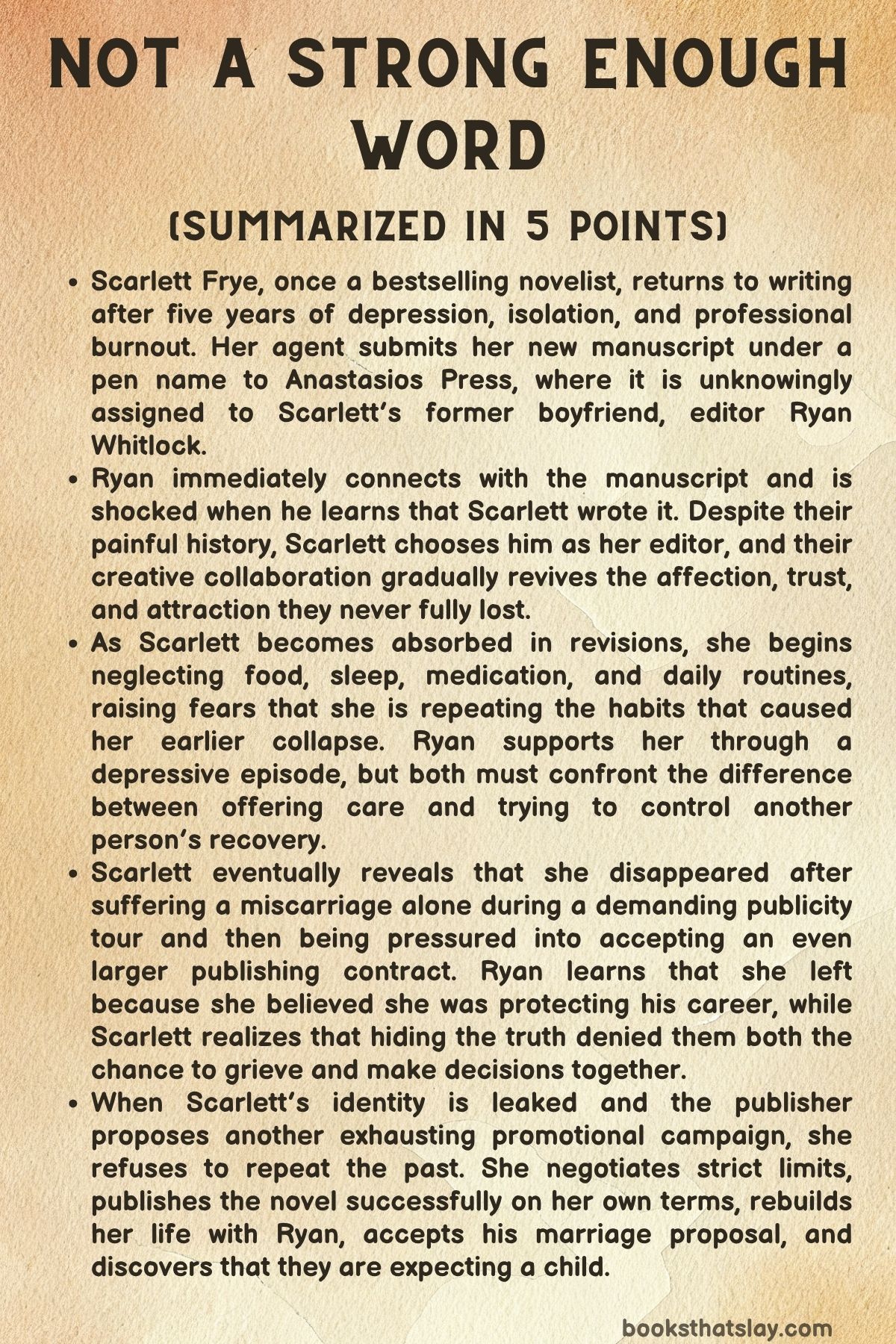
Scarlett Frye has spent five years separated from the publishing world after a severe breakdown ended her successful writing career. During those years, depression, isolation, medication, therapy, and creative paralysis have shaped her daily life, but she has finally completed a new novel that gives her a reason to hope again.
Her agent and closest friend, Trina McBryde, believes the manuscript is Scarlett’s best work. Unfortunately, the strongest publishing opportunity comes from Anastasios Press, an imprint connected to John Monroe Press, the company Scarlett left after its exhausting schedules, publicity demands, and expanding contracts destroyed her health.
Scarlett refuses to return under her own name, so Trina submits the manuscript as the work of a supposed debut author named S.J. Falmouth. Their plan is to reveal Scarlett’s identity only after the publisher becomes emotionally and financially invested in the novel.
At Anastasios Press, senior editor Ryan Whitlock has lost his excitement for literature. He still performs his job well, but the manuscripts he edits no longer affect him deeply, and his emotional numbness is connected to Scarlett’s unexplained disappearance five years earlier.
Ryan receives S.J. Falmouth’s manuscript, Becoming, from his colleague Casey. The novel affects him immediately because of its emotional honesty, its exploration of loss and hope, and the distinctive sensitivity behind its language.
Ryan reads the entire manuscript in one night and becomes determined to acquire it. He senses qualities that remind him of Scarlett’s writing, although the voice is different enough that he never suspects she is the hidden author.
Trina arranges an in-person meeting before any agreement is signed. Scarlett enters the meeting terrified of being recognized, but the situation becomes impossible to control when Ryan walks into the conference room and discovers that S.J. Falmouth is the woman he once loved.
Casey and Trina argue over the deception, while the publicity team considers the commercial potential of Scarlett’s return. Scarlett becomes increasingly distressed as everyone discusses her career without asking what she wants.
Ryan stops the argument and directs the decision back to Scarlett. When she asks whether he truly loved the manuscript, he tells her that loved is not a strong enough word, repeating language that once defined their romantic relationship.
Scarlett chooses Ryan as her editor because he admired the novel before knowing her identity. She believes that his response proves he understands the work itself rather than merely responding to the value of her famous name.
Their editorial collaboration quickly revives their former connection. They debate symbols, challenge each other’s interpretations, exchange teasing messages, and rediscover the intellectual intimacy that once made them such effective creative partners.
The work also encourages Scarlett to return to unhealthy habits. She begins writing through the night, neglecting food, medication, sleep, hygiene, and ordinary routines while insisting that the situation is different because she is now working by choice.
Ryan recognizes the warning signs and becomes deeply concerned. Trina and Casey remind him that Scarlett has professional support and that he cannot assume responsibility for managing her mental health, but his feelings make professional distance increasingly difficult.
Frightened by her worsening condition and by the emotional effect of Ryan’s return, Scarlett asks Trina to arrange another editor. She believes that separating herself from Ryan may be necessary to protect both her health and her manuscript.
Ryan visits her apartment with food and finds her in a severe depressive episode. Instead of demanding explanations or offering grand solutions, he gives her two manageable tasks: eat something and take a bath.
He cleans her apartment, washes her hair, starts her laundry, and remains beside her while she cries. His care is practical and patient, but their closeness also makes it clear that neither of them has stopped loving the other.
Their present-day reunion is accompanied by memories of their earlier relationship. They first met in a bar after Scarlett signed her original publishing contract, where an argument over language quickly became flirtation.
Ryan admired her mind before he became involved in her career, and their relationship grew through shared books, quiet picnics, tacos, editing conversations, private jokes, and an understanding that their feelings exceeded the ordinary meaning of love. They imagined marriage, children, a home, and a peaceful life centered on stories.
However, Scarlett’s success gradually consumed her time and energy. Interviews, tours, deadlines, and contractual obligations left her physically weak, emotionally exhausted, and unable to enjoy the life her success was supposed to create.
In the present, Scarlett and Ryan resume their romantic relationship after Ryan interrupts her disastrous dinner with bestselling author Charles Hall. Charles treats Scarlett, whom he believes to be an inexperienced debut writer, with arrogance and condescension.
Scarlett admits that the second chance she wants is not limited to her career. Ryan kisses her and confesses that he has never been happier without her, making it clear that their years apart did not erase his devotion.
Their physical reunion is marked by honesty about Scarlett’s medication and its effects. Ryan responds without judgment, and Scarlett discovers that the tattoo on his arm contains words from one of her novels, permanently preserving the connection he believed he had lost.
Although their renewed relationship brings happiness, they continue avoiding the deepest cause of Scarlett’s disappearance. Ryan believes her breakdown resulted mainly from professional pressure, but Scarlett has concealed the pregnancy and miscarriage that occurred immediately before she left.
During her final press tour five years earlier, Scarlett discovered that she was pregnant. Her fear gradually became hope as she imagined raising a child with Ryan, but she miscarried alone in a hotel room before she could tell him.
Still bleeding and in pain, Scarlett returned to Chicago and was taken directly into a contract meeting. Ryan, Trina, and the publishing executives proudly offered her an even larger deal containing more books, tours, and obligations, while no one noticed her physical or emotional condition.
Scarlett rejected the contract and called her friend Mandy for support. Mandy responded with jealousy, accused Scarlett of ingratitude, and warned that Ryan would destroy his career trying to protect her.
Believing she had failed professionally, lost their child, and become a threat to Ryan’s future, Scarlett disappeared without telling him the truth. She blocked his number, left Chicago, and convinced herself that everyone would be better without her.
When Scarlett finally reveals the miscarriage, Ryan is devastated. His temporary need for space frightens her, and she begins leaving his condo because she assumes that he is rejecting her.
Ryan follows and confronts her for repeating the pattern of disappearing when situations become painful. Scarlett explains that she left years earlier because she believed removing herself from his life was the only way to save his career.
Ryan admits that he would have left publishing for her, but he also insists that the decision should have belonged to him. He tells Scarlett that she mattered more than any job and that she never needed to protect him by erasing herself.
They mourn the pregnancy, the misunderstanding, and the five years they lost. Ryan assures her that sadness can exist beside love and that decisions about children can be made together when they are ready.
Their reconciliation is threatened when Scarlett’s identity is leaked to the public. An old photograph of Scarlett and Ryan appears online, and Anastasios Press suspects that Ryan may have exposed the information because of his personal connection to her.
Ryan is removed from the manuscript, and the company prepares a rushed publication plan filled with television appearances, travel, signings, and months of publicity. The new plan closely resembles the conditions that caused Scarlett’s original breakdown.
During the emergency meeting, Scarlett begins emotionally shutting down as professionals once again discuss her as a commercial product. This time, however, she uses techniques learned in therapy to remain aware of her body, emotions, and surroundings.
In the lobby, Scarlett encounters Charles, whose use of her real name reveals that he leaked her identity. Charles admits that he traded the information to John Monroe Press to secure his own publishing agreement and released the photograph because Scarlett left their dinner with Ryan.
Scarlett confronts him without Ryan’s assistance. She refuses to accept his attempt to shame her for leaving difficult situations and recognizes that walking away can be an act of control when it is done deliberately rather than from panic.
Ryan witnesses the confrontation and understands that supporting Scarlett does not always require rescuing her. Instead of intervening, he allows her to defend herself and then reports Charles’s manipulation to Anastasios and Casey.
Charles loses his publishing opportunities after both companies learn that he attempted to exploit them. Nevertheless, Scarlett decides that the new publicity expectations are too dangerous and tells Trina that she intends to withdraw Becoming.
Ryan initially argues against her decision. He believes the world needs Scarlett’s work and assumes that determination, planning, and his support can protect her from another collapse.
Scarlett accuses him of once again valuing her books and audience above her stated needs. She asks whether he can love her if she never becomes a bestselling author again, forcing him to face the difference between loving her and loving the future he imagines for her.
Casey helps Ryan recognize that he is repeating his old mistake. He still believes that he can identify what Scarlett needs, prevent every crisis, and guide her toward the correct choice, even when she has clearly expressed her own limits.
Ryan finally understands that love does not give him authority over Scarlett’s recovery. Supporting her means respecting her decisions, including decisions that disappoint or frighten him.
Scarlett also reconsiders complete withdrawal. Writing remains central to her identity, and abandoning publication would allow Charles’s betrayal and the industry’s pressure to determine her future.
Rather than surrender the manuscript or accept damaging conditions, Scarlett creates her own terms. She decides that the book will be published on a normal schedule under her real name, with only sixteen carefully selected appearances over two months.
She also requires Ryan to finish editing the novel because their collaboration remains important to the work. Anastasios agrees after Scarlett makes it clear that another publisher would accept the manuscript under healthier conditions.
One year later, Becoming has been successfully published with a more appropriate cover. Scarlett completed a limited promotional tour, while Trina defended her boundaries and protected her writing time.
Scarlett now lives with Ryan, who is no longer her official editor but continues to read and discuss everything she writes. Their creative relationship remains important without replacing Scarlett’s independence.
Ryan creates an illustrated book about their relationship and hides his mother’s engagement ring inside it. He proposes, and Scarlett accepts before revealing that she is pregnant again.
The pregnancy brings uncertainty, but Scarlett is able to speak openly about her feelings rather than carrying them alone. Ryan responds with joy, and their engagement, shared home, creative partnership, and growing family represent a future built on communication, limits, and mutual choice.
Characters
Scarlett Frye
Scarlett Frye is the emotional center of Not a Strong Enough Word, and her journey examines what happens when professional success demands more than a person can safely give. She begins as a once-famous writer who has spent five years living with depression, shame, isolation, and the belief that her disappearance permanently destroyed her future.
Her withdrawal from publishing is not caused by a loss of talent or commitment to writing. She continues to view storytelling as an essential part of herself, but the business surrounding her creativity transformed something meaningful into a source of physical and emotional harm.
Scarlett’s greatest struggle involves distinguishing writing from the publishing system that once controlled her life. She initially assumes that returning to one will inevitably return her to the other, and her fear becomes stronger when she again neglects food, medication, sleep, and personal care.
Her depression is presented as a continuing reality rather than a weakness that disappears through romance. Therapy, medication, routines, grounding methods, and dependable relationships all contribute to her progress, but she continues to experience episodes in which basic tasks become extremely difficult.
Scarlett often responds to fear by leaving before another person can reject, control, or sacrifice themselves for her. Five years earlier, she disappeared because she believed she was protecting Ryan, yet that decision denied both of them the chance to grieve, communicate, and choose their futures together.
Her secrecy about the miscarriage reveals the depth of her guilt. She interprets the loss as another personal failure and believes her uncertainty about motherhood somehow contributed to it, even though that belief has no rational basis.
Scarlett’s growth becomes visible when she confronts Charles without waiting for Ryan to defend her. She recognizes that leaving a harmful encounter is different from disappearing out of shame, because one action protects her boundaries while the other prevents honest communication.
Her final decision regarding publication demonstrates mature control rather than either submission or complete withdrawal. She refuses the false choice between sacrificing her health and abandoning her creative identity, then negotiates a professional life that reflects her actual needs.
Ryan Whitlock
Ryan Whitlock is both Scarlett’s romantic partner and the editor whose understanding of her work first reconnects them in Not a Strong Enough Word. His love is sincere and enduring, but his character arc requires him to understand that devotion can become harmful when it assumes authority over another person’s choices.
Ryan recognizes Scarlett through her writing before he recognizes her name. His response to Becoming confirms that his admiration is rooted in her emotional intelligence, language, and artistic vision rather than in her reputation.
As an editor, Ryan challenges Scarlett without trying to erase her intentions. Their disagreement over the bicycle motif shows his ability to identify weaknesses while remaining open to her reasoning, and their solution demonstrates the strength of their creative partnership.
His emotional attachment, however, makes professional boundaries nearly impossible. He monitors Scarlett’s work habits, arrives at her apartment, cleans her home, helps her eat, manages practical problems, and repeatedly tries to prevent another collapse.
Many of these actions are compassionate and necessary in immediate moments of crisis. The problem emerges when Ryan begins to believe that Scarlett’s health can be measured by his ability to redirect her behavior.
Ryan carries guilt for encouraging the larger contract that preceded Scarlett’s disappearance. He assumed that more money represented greater security, failing to understand that the contract would also bring more travel, deadlines, attention, and pressure.
His tendency to imagine himself as Scarlett’s protector is connected to genuine love as well as fear. After losing her without explanation, he becomes determined never to overlook another warning sign, but that determination leads him to treat support as a form of prevention and control.
Casey forces Ryan to examine his behavior from an outside perspective. When Ryan insists that Scarlett must publish because the world needs her books, he finally sees that he is placing his desires above the boundary she has clearly stated.
Ryan’s growth lies in accepting that he cannot guarantee Scarlett’s recovery, prevent every depressive episode, or decide which risks she should take. By the conclusion, he learns to stand beside her while allowing her to determine the direction of her own life.
Trina McBryde
Trina McBryde serves as Scarlett’s agent, closest friend, practical caretaker, and strongest professional advocate. She is one of the few people who remained present during Scarlett’s years away from publishing, and her loyalty is expressed through action rather than sentimental reassurance.
Trina brings food, checks Scarlett’s apartment, schedules therapy appointments, organizes salon visits, and prepares her for professional meetings. These gestures show that she understands recovery often depends on ordinary forms of support that help a person reenter daily life.
As an agent, Trina is strategic and willing to take significant risks. Submitting Becoming under a false name is ethically questionable, but she believes Scarlett would not receive a fair reading if the company knew her identity from the beginning.
Trina also understands the commercial value of Scarlett’s return and occasionally speaks about publicity before fully considering Scarlett’s emotional response. However, she repeatedly corrects herself and becomes increasingly forceful about protecting Scarlett’s boundaries.
Her suspicion of Ryan comes from concern rather than hostility. Trina recognizes that he never stopped loving Scarlett, but she fears that their renewed relationship may revive the same emotional patterns that existed before the breakdown.
Trina’s regret after learning about the miscarriage is especially important. She realizes that she participated in a meeting about contracts and money while Scarlett was physically suffering, and she must face the limits of how well she understood the person she claimed to protect.
By the conclusion, Trina becomes the professional ally Scarlett originally needed. She does not decide whether Scarlett should publish; instead, she helps negotiate the conditions Scarlett chooses for herself.
Casey
Casey is Ryan’s colleague, friend, and most reliable source of honest criticism. He understands Ryan’s emotional history with Scarlett and recognizes that Ryan’s personal feelings influence his judgment even when Ryan believes he is acting professionally.
Casey gives Ryan the manuscript because he hopes it will restore his enthusiasm for editing. This decision unknowingly reunites Ryan and Scarlett, but it also demonstrates Casey’s understanding of Ryan’s creative needs.
He is initially angered by Trina’s deception because Scarlett’s history with John Monroe Press creates genuine professional risks. Unlike those who view her return only as an exciting publicity opportunity, Casey considers the legal, ethical, and corporate consequences.
His most important role appears when Ryan attempts to pressure Scarlett into publishing. Casey refuses to support Ryan’s heroic view of himself and asks him to consider how his behavior would appear if the situation were part of a manuscript.
That comparison allows Ryan to recognize that he is repeating the past. Casey understands that good intentions do not excuse ignoring another person’s boundaries, and his honesty prevents Ryan from turning love into another source of pressure.
Casey represents friendship that challenges rather than merely agrees. He supports Ryan’s happiness but refuses to protect him from uncomfortable truths about his behavior.
Dianne
Dianne is Scarlett’s therapist and one of the foundations of her recovery. Her presence establishes that Scarlett’s improvement began long before her reunion with Ryan and depends on continued professional care rather than romantic love alone.
She questions Scarlett’s claim that working with Ryan will be purely professional. Instead of forbidding the relationship, she encourages Scarlett to examine whether she is using the collaboration to heal, avoid the past, or recreate an emotionally dangerous situation.
Dianne also helps Scarlett understand that progress is not linear. A depressive episode does not erase years of work, and accepting help does not mean that Scarlett has failed to become independent.
Her guidance encourages Scarlett to use grounding exercises when the emergency publishing meeting begins recreating her earlier trauma. By naming physical sensations and emotions, Scarlett remains present and avoids completely shutting down.
Dianne consistently returns responsibility to Scarlett. She does not tell her whether to publish, reconcile with Ryan, or reveal the miscarriage, but she encourages choices based on honesty rather than fear.
Anastasios Martis
Anastasios Martis is the publisher whose imprint offers Scarlett a possible route back into the literary world. He is cautious because Scarlett’s departure created conflict with the parent company, yet he is also willing to hear her explanation rather than relying entirely on industry gossip.
During their first meeting, Anastasios gives Scarlett the space to describe the conditions that caused her breakdown. He acknowledges that the old publishing structure treated commercial success as more important than her health and apologizes for the way she was handled.
His imprint initially appears healthier than John Monroe Press, but the leak exposes how quickly even a supportive company can return to profit-centered decisions. Under pressure, his team proposes a rushed release and extensive publicity schedule that closely resembles Scarlett’s earlier experience.
Anastasios therefore represents both the possibility and limitations of institutional change. He may be more compassionate than the previous executives, but business concerns still shape his decisions until Scarlett firmly defines her conditions.
His eventual acceptance of her terms shows that publishing systems can adjust when an author possesses enough leverage and refuses to surrender it. The outcome does not make the industry harmless, but it proves that negotiation and accountability can create safer conditions.
Charles Hall
Charles Hall functions as a contrast to Ryan and as an example of professional entitlement. He is attractive, successful, socially confident, and apparently interested in Scarlett, but his dinner conversation reveals that he sees relationships mainly as opportunities to display his importance.
Believing Scarlett to be a debut author, Charles orders for her, dismisses her ideas, criticizes her subject matter, and assumes she needs his instruction. He never treats her as an equal because he considers professional status a measure of personal value.
His decision to expose Scarlett’s identity demonstrates resentment, selfishness, and a willingness to exploit private information for career advancement. He sells the information to John Monroe Press and releases the photograph because Scarlett wounded his pride by leaving with Ryan.
Charles repeatedly describes Scarlett’s departure as evidence of weakness, but his accusation exposes his own inability to accept rejection. He assumes that her decisions must center on him and punishes her for exercising a choice he dislikes.
Scarlett’s confrontation with Charles marks a major stage in her growth. She refuses to let his interpretation define her, while Ryan’s decision not to intervene confirms that she no longer needs another person to fight every battle for her.
Mandy
Mandy is one of Scarlett’s former closest friends and a major influence on the decision that separated Scarlett from Ryan. During Scarlett’s early success, Mandy appears supportive, but jealousy gradually changes the way she interprets Scarlett’s career.
When Scarlett calls after rejecting the large contract, Mandy responds with resentment instead of concern. She sees financial success and public attention as privileges Scarlett has no right to reject, failing to understand the physical and psychological cost behind them.
Her warning that Ryan will damage his career by protecting Scarlett has a lasting effect. Scarlett is already grieving, exhausted, and convinced that she has failed everyone, so Mandy’s words confirm her belief that disappearing is an act of sacrifice.
Mandy’s later apology does not erase the harm she caused. However, she accepts responsibility, admits the role of jealousy and industry pressure, and does not demand immediate forgiveness.
Scarlett’s refusal to restore the friendship instantly demonstrates healthier boundaries. She leaves open the possibility of future contact while protecting herself from being pressured into reconciliation before trust has been rebuilt.
Esmerelda “Meri” Chavez
Meri Chavez is the publicist who immediately recognizes the marketing potential of Scarlett’s return. Her enthusiasm reflects the publishing industry’s tendency to transform personal history into a promotional story.
Unlike the more aggressive executives connected with Scarlett’s earlier career, Meri is warm and welcoming. However, her first instinct is still to consider how Scarlett’s comeback can be presented to readers and the media.
Meri is not portrayed as cruel or manipulative. Instead, she represents a professional whose job naturally prioritizes visibility, audience interest, and narrative control.
Her presence helps explain why Scarlett must establish firm limits even when working with kind people. Harm does not always result from malicious individuals; it can also result from ordinary employees performing roles within a demanding system.
Margie
Margie is Ryan’s intern and has a small but meaningful role in the story. Her discussion of Scarlett’s earlier novel reminds Ryan of the emotional connection to literature that he has lost.
Ryan advises Margie to search for manuscripts that make her feel something rather than simply looking for technically competent writing. The advice reveals his own dissatisfaction and prepares him to recognize the importance of Becoming.
Margie also represents a new generation entering publishing with enthusiasm. Through her, Ryan is reminded that editing should involve discovery, emotional response, and belief in a writer’s work rather than routine professional achievement.
Ava
Ava is one of Scarlett’s friends during the earlier years of her career. She participates in celebrations and social gatherings that allow Scarlett to experience affection outside the professional attention surrounding her books.
Her relationship with Marcie also forms part of the ordinary domestic world Scarlett values. Time spent with Ava offers Scarlett relief from being treated primarily as an author or commercial success.
Although Ava is not central to the later action, her absence from Scarlett’s life reflects the social cost of the disappearance. Scarlett does not lose only Ryan and her career; she also loses the community that once connected her to a more balanced life.
Katherine
Katherine belongs to Scarlett’s early friendship group and helps establish the life Scarlett had before burnout and isolation. She celebrates Scarlett’s first publishing deal and participates in the social world surrounding Scarlett’s early success.
Like Ava, Katherine is associated with a period when Scarlett still possessed friendships, romantic hope, and professional excitement at the same time. Her limited later presence emphasizes how completely Scarlett’s breakdown separated her from her former identity.
Katherine is less individually developed than the central characters, but her role contributes to the contrast between Scarlett’s earlier community and the loneliness of the following five years.
Marcie
Marcie is Ava’s partner and joins the double date that shows Scarlett and Ryan during a period of domestic security. Her presence helps create an environment in which Scarlett can relax among people who value her personally.
The gathering represents the kind of quiet social life Scarlett genuinely desires. She enjoys conversation, familiarity, and emotional safety more than high-profile events or promotional celebrations.
Marcie’s role is minor, but she contributes to the story’s picture of an ordinary future that Scarlett once believed she could postpone until her career became less demanding.
Ryan’s Father
Ryan’s father shapes Ryan’s understanding of love even though he is no longer alive during the main events. He taught Ryan that true love is recognized with certainty rather than established through evidence or argument.
Ryan remembers this lesson during his picnic with Scarlett and understands that he wants a permanent life with her. The memory gives emotional depth to his belief that their relationship is singular and irreplaceable.
The anniversary of his father’s death also shows that Scarlett once cared for Ryan during his grief. Ryan later uses that memory to justify remaining beside her during her depressive episode, viewing care as a natural exchange between people who love each other.
Ryan’s Mother
Ryan’s mother is primarily represented through the engagement ring she gives him. The ring was purchased when Ryan’s parents had little money, yet its emotional meaning made it more valuable to her than a more expensive replacement.
By passing the ring to Ryan, she connects his future relationship to the endurance of her own marriage. Ryan decides years earlier that Scarlett is the person who should receive it.
The ring also represents patience. Ryan keeps it through Scarlett’s disappearance and does not immediately propose after their reunion, recognizing that rebuilding trust must come before creating a public symbol of permanence.
Scarlett’s Parents
Scarlett’s parents are not extensively present, but their disapproval contributes to her isolation. After she abandons her career, they appear unable to understand why she rejected the success so many people would have welcomed.
Their reaction reflects a broader cultural assumption that wealth, fame, and professional recognition should automatically produce happiness. Because Scarlett cannot explain her experience in terms they accept, she becomes even more convinced that she has failed.
The emotional distance from her parents makes Trina, Dianne, and eventually Ryan especially important. Scarlett must build a chosen support system because her family does not provide the understanding she needs.
The John Monroe Press Executives
The executives at John Monroe Press operate as a collective force rather than as individually developed characters. They represent a professional structure that sees Scarlett primarily through sales, contracts, publicity value, and future productivity.
Their large contract appears generous, but it ignores the reality that greater payment will create greater expectations. They treat financial reward as a complete response to exhaustion without asking whether Scarlett wants the life attached to the offer.
The meeting held while Scarlett is actively miscarrying becomes the clearest example of institutional blindness. No one notices her pain because attention remains fixed on revenue, expansion, and celebration.
Their role shows that exploitation can be presented as opportunity. Scarlett’s refusal to accept their definition of success becomes necessary for her survival.
Themes
Mental Health, Burnout, and Sustainable Recovery
Depression and burnout shape nearly every major decision in Not a Strong Enough Word, but the book refuses to present either condition as a temporary obstacle solved by romance. Scarlett’s improvement depends on therapy, medication, routines, practical assistance, self-awareness, and the difficult acceptance that recovery does not follow a straight line.
Her return to writing initially appears to confirm that she has recovered, yet creative excitement quickly produces neglected meals, missed medication, poor hygiene, sleeplessness, and isolation. These warning signs demonstrate that meaningful work can still become harmful when it consumes the structures that make daily life sustainable.
The story also distinguishes burnout from a lack of gratitude or ambition. Scarlett does not reject publishing because she dislikes writing or because success means nothing to her; she rejects a professional system that demands constant access to her time, body, emotions, and public identity.
Her final negotiation represents a more realistic form of recovery than either total retreat or fearless return. She accepts that certain pressures remain dangerous, establishes limits before signing, and treats those limits as conditions of participation rather than personal weaknesses.
Recovery therefore becomes the ability to recognize needs, communicate them clearly, and respond to setbacks without turning them into evidence of failure. Scarlett remains vulnerable, but she is no longer powerless within that vulnerability.
Love, Care, and the Desire to Rescue
Ryan’s devotion repeatedly moves between compassionate support and an unhealthy belief that love gives him the power to prevent Scarlett’s suffering. His practical care during her depressive episode is valuable because he responds to immediate needs without judgment, reducing overwhelming problems to small actions such as eating, bathing, and resting.
The danger appears when he begins treating those moments as proof that he can manage her recovery. He watches her habits, interprets her choices through his fear of losing her, and assumes that his presence can stop the past from repeating itself.
Scarlett also contributes to this pattern by believing that love requires self-erasure. She disappears because she wants to protect Ryan’s career, but the decision removes his ability to choose whether the relationship matters more than professional advancement.
Both characters must learn that sacrifice made without communication can become another form of control. Ryan cannot decide what Scarlett needs simply because he loves her, while Scarlett cannot decide that Ryan is better without her simply because she fears becoming a burden.
Their healthier relationship begins when care no longer means rescue. Ryan learns to support Scarlett’s decisions even when he disagrees, and Scarlett learns to ask for help without believing that dependence in one moment destroys her independence as a person.
Second Chances, Accountability, and Honest Communication
The reunion between Scarlett and Ryan is not treated as a simple restoration of the past. Their love survived the separation, but affection alone cannot repair the harm created by secrecy, guilt, mistaken assumptions, and years of unanswered questions.
Scarlett must accept responsibility for disappearing without explanation. Although her decision was shaped by depression, miscarriage, exhaustion, and Mandy’s cruel warning, those circumstances do not erase the pain Ryan experienced or the fact that he was denied the truth.
Ryan must also confront his role in the conditions that preceded her departure. He encouraged a more profitable contract because he believed money would provide security, failing to recognize that Scarlett needed fewer demands rather than greater compensation.
Their second chance becomes possible only when both stop presenting themselves as the sole guilty or innocent person. Scarlett tells the truth about the pregnancy, Ryan admits that his protective instincts can become controlling, and both acknowledge that love cannot replace communication.
Other relationships follow the same principle. Mandy’s apology opens a possibility of reconciliation but does not entitle her to forgiveness, while Anastasios’s apology matters only when it leads to changed contractual conditions.
The book therefore presents second chances as earned processes rather than automatic rewards. They require accountability, patience, changed behavior, and respect for the injured person’s right to decide whether trust can be restored.
Creative Identity, Professional Autonomy, and the Meaning of Success
Writing is not simply Scarlett’s occupation; it is one of the main ways she understands herself and transforms private experience into meaning. Losing publication protects her from industry pressure, but losing writing entirely would remove a source of purpose, pleasure, and personal expression.
The conflict arises because the publishing world repeatedly treats creativity as a commercial resource. Scarlett’s stories generate contracts, tours, interviews, public appearances, and marketing opportunities, while her health becomes secondary to maintaining momentum.
Her pen name initially offers protection by allowing the manuscript to be judged without the burden of her public history. However, it also divides Scarlett from her own achievement, suggesting that her work can return only if her real identity remains hidden.
By choosing to publish under her own name, Scarlett reclaims both the manuscript and the story surrounding her return. She refuses to let the company present her as a passive comeback figure whose pain can be converted into publicity without her consent.
Her final definition of success is therefore based on creative freedom rather than maximum sales or constant visibility. She wants enough publicity to support the book, enough privacy to protect her health, and enough time to continue writing.
The negotiated contract does not remove every danger, but it changes Scarlett’s position within the process. She is no longer a product accepting whatever success requires; she becomes an author who defines the conditions under which success remains worth having.