Not Good Neighbors Summary, Characters and Themes
Not Good Neighbors by Violet Lumani is a contemporary romantic comedy about Penelope “Penny” Huff and Jack Craig, two New York neighbors whose thin dividing wall turns everyday irritation into open warfare.
Their struggle over noise, privacy, property, and control gradually exposes the emotional defenses both have built around themselves. Penny fears abandonment and has learned to avoid difficult relationships, while Jack hides his vulnerability beneath competence, sarcasm, and an instinct to rescue others. Through outrageous pranks, forced cooperation, career pressures, family conflicts, and growing attraction, the novel examines how love requires honesty, boundaries, courage, and the willingness to remain present when life becomes uncomfortable.
Summary
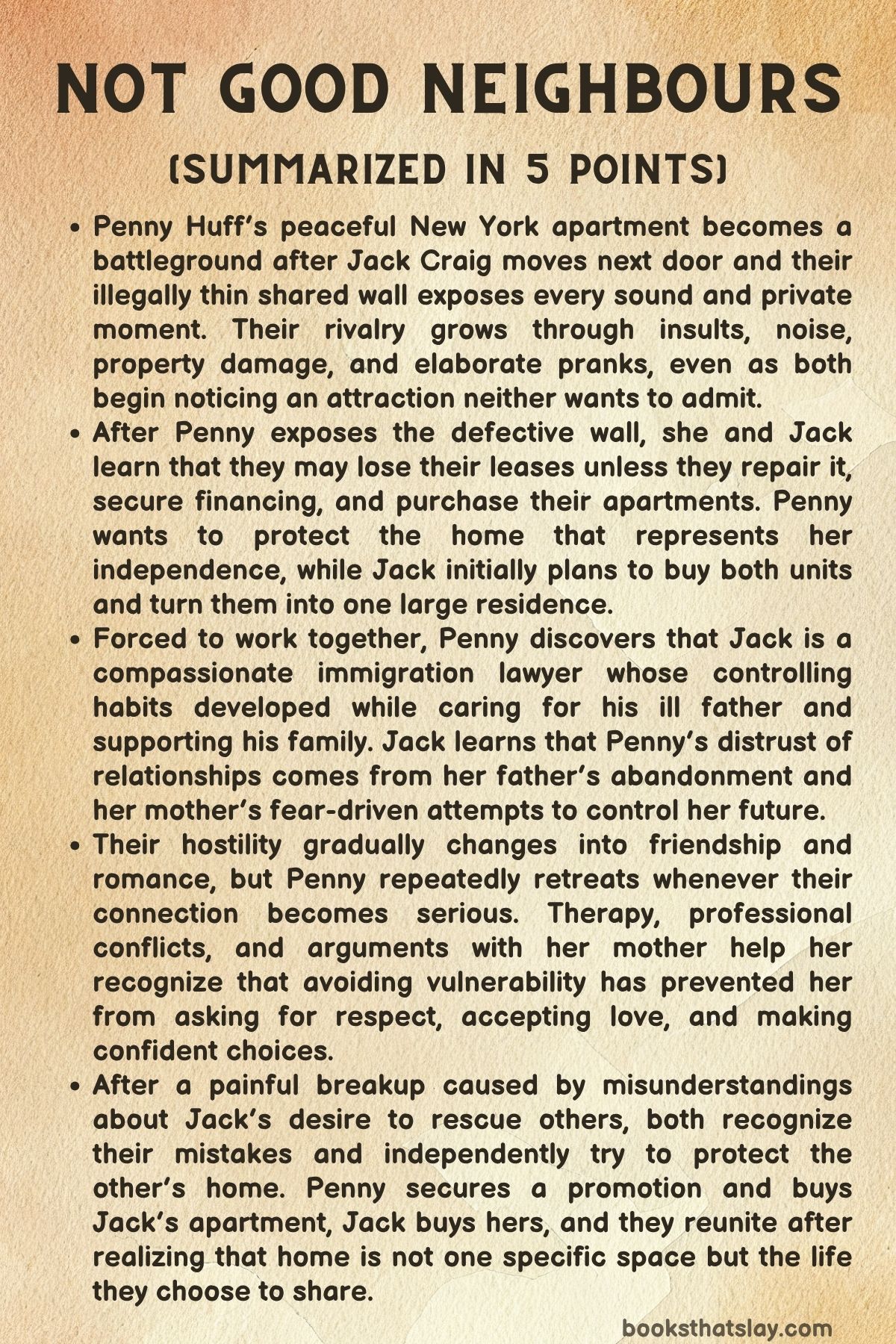
Penelope “Penny” Huff has spent six years building an independent life in New York City, far from her controlling mother in Stone Harbor. Her apartment represents freedom, security, and proof that she can create a future on her own terms.
That peace has been disrupted by Jack Craig, the irritatingly handsome man who moved into the adjoining apartment ten months earlier. The wall between them is so thin that each can hear the other’s conversations, television, movements, and private moments.
Their frustration has developed into a constant battle involving loud movies, aggressive vacuuming, banging, insults, and deliberate disturbances. Although Penny claims to despise Jack, she is disturbed by how often she notices his appearance and reacts to his suggestive teasing.
Penny’s closest friends are Margie, an actress, Avery, a dependable and cautious man, and La, the owner of their favorite bar. When Margie receives a promotion to series regular on the legal drama Glass and Carter, the group celebrates with a long night of drinking.
During the celebration, Penny complains about Jack and refuses Margie’s offer to move into her spare room. Penny insists that she will not surrender the apartment she has worked so hard to make her sanctuary.
A scene in Margie’s television script gives Penny an idea. After meeting Genevieve Duro, the program’s legal consultant, she learns that exposing a structural defect could force the building owner to bring the wall up to modern standards.
Penny attacks the wall with a hammer and pretends the damage was accidental. A city inspector confirms that the dividing wall was installed illegally, meaning the landlord must either rebuild it properly or restore the two apartments to one large unit.
Penny initially believes she has won, but the situation becomes much worse when superintendent Gence Delpi enlarges the opening. Penny and Jack are left with a direct passage between their homes and almost no privacy.
While Jack is away, Margie convinces Penny to inspect his apartment. They find photographs, safety supplies, medicine, and a picture of Jack with a woman Penny recognizes from an earlier incident.
Penny explains that she began hating Jack after seeing the woman run from his apartment while accusing a man of cheating. Believing Jack was responsible, Penny rejected him when he later attempted to ask her out.
The building owner, Mr. MacManus, becomes furious that the illegal wall has been exposed. He threatens not to renew either lease unless Penny and Jack repair the wall, secure permits, divide the costs, and submit approved offers to purchase their apartments.
Penny becomes determined to buy her home, despite the intimidating price. Jack also intends to purchase property, but he wants both apartments so he can remove the wall permanently and create one large residence.
Their competition intensifies when Penny mistakes Yelena, Jack’s property appraiser, for a romantic visitor. Penny warns Yelena that Jack mistreats women, causing the appraiser to flee and placing Jack’s mortgage application in danger.
Jack confronts Penny, who is already upset because her own mortgage application has been denied due to her low salary. During their argument, Jack reveals that the supposedly betrayed woman was his sister, Anna, and that the cheating man was Anna’s fiancé, Seth.
Penny realizes that her hatred of Jack began with a false assumption. Jack then cruelly repeats personal information he overheard through the wall, including Penny’s fear that her father’s betrayal has made her unable to trust men.
Jack’s words expose a painful pattern in Penny’s life. She repeatedly finds reasons to end relationships before another person has the opportunity to leave or disappoint her.
The hostility continues through increasingly childish pranks. Penny spreads cat fur through Jack’s apartment because she believes he is allergic, while Jack covers her illegal garden with birdseed and attracts destructive birds.
Penny hides tuna behind his radiator, and Jack tampers with household fixtures. She later fills his shampoo and other products with glitter, leaving him sparkling despite repeated attempts to wash it away.
Forced to work together on the damaged wall, Penny begins seeing sides of Jack that do not match the selfish man she imagined. He is an immigration lawyer who performs extensive pro bono work and cares deeply about clients whose lives are threatened by unfair systems.
Jack explains that his obsessive cleaning began during his father’s illness. Creating order in the home helped him cope with fear, uncertainty, and the pressure of becoming responsible at a young age.
Their insults gradually become playful rather than hostile. They share pizza, watch baseball, exchange personal stories, and discover that they enjoy each other’s company when they are not actively trying to win.
Penny also faces mounting pressure at work. Her manager, Rochelle, gives her responsibility for a major international marketing project but refuses to guarantee the raise Penny needs to qualify for a mortgage.
A condescending colleague named Anthony repeatedly interrupts meetings and delays decisions. Penny struggles to confront him because she has spent much of her life believing that keeping other people comfortable is safer than asserting herself.
Meanwhile, the television production begins filming scenes in Penny’s office. Actor Lucas Webb openly flirts with her, offering the glamorous and apparently uncomplicated romantic possibility that Margie encourages her to consider.
Penny enjoys Lucas’s attention, but Jack’s presence affects her far more deeply. At Avery’s parents’ anniversary celebration, Jack interrupts Penny’s dance with Lucas, and their attraction becomes increasingly difficult to deny.
Avery’s speech about his parents’ marriage also challenges Penny’s beliefs about love. She learns that the seemingly ideal couple once nearly divorced but chose to repair their relationship instead of treating conflict as proof that they had failed.
At a bar after the celebration, Jack apologizes for using Penny’s private fears against her. Penny admits that she unfairly judged him, and they agree to cooperate on rebuilding the wall.
Their honesty leads to a passionate kiss in a coat closet. Penny responds eagerly but quickly becomes frightened by the seriousness of her feelings and declares that the encounter was a mistake.
She then injures her ankle while trying to leave. Jack carries her home, prepares food and tea, applies first aid, and takes care of her despite being hurt by her rejection.
Their attraction again overwhelms them while Penny is recovering, but her injured ankle interrupts the moment. Jack leaves, and Penny escapes to Stone Harbor rather than confront what she wants.
Penny’s mother interprets the visit as proof that Penny is finally ready to abandon New York. She arranges for Penny to view a house and encourages her to date Brian, a financially secure acquaintance from school.
For a moment, Penny imagines accepting the safe and predictable future her mother wants. She soon recognizes that returning permanently would mean surrendering the identity and independence she spent years creating.
Penny returns to New York intending to speak honestly with Jack, but another misunderstanding involving Yelena causes her to retreat. Jack, tired of being rejected, becomes emotionally distant and limits their interactions to construction.
Penny begins therapy with Wendy, who helps her understand how her father’s abandonment and her mother’s fear have shaped her relationships. Penny recognizes that she treats emotional difficulty as a reason to leave because she believes departure is inevitable.
When Penny invents a boyfriend to silence her mother’s matchmaking, she accidentally describes Jack. She calls the imaginary man kind, honorable, intelligent, generous, and capable of making her feel alive, forcing her to admit that she has genuine feelings for him.
Lucas later visits Penny to rehearse a script. Hearing aggressive lines through the wall, Jack mistakenly believes Lucas is attacking her and bursts through the opening.
Lucas falls into construction materials and suffers injuries to his jaw and wrist. The accident temporarily suspends production of Glass and Carter, leaving Penny ashamed and frightened that Margie’s career may be damaged.
Jack and Penny discuss the incident at a diner, where his jealousy becomes apparent. They share food, stories, and a milkshake, briefly returning to the comfortable companionship they have developed.
Jack quietly repairs Penny’s damaged furniture, cleans her apartment, and leaves her coffee. He also tells her about Sophie, a client whose legal case may be difficult to win but whose story deserves to be heard.
Penny realizes that Jack’s impulse to protect others is rooted in compassion, although it can also become a way for him to avoid his own emotions. Jack has spent so long being dependable that he struggles to admit when he is frightened, exhausted, or in need of support.
During therapy, Penny connects her reluctance to demand respect with her mother’s past. After confronting Penny’s unfaithful father, her mother repeatedly described the confrontation as the decision that destroyed the family, teaching Penny that speaking up creates disaster.
Jack encourages Penny to stop accepting less than she deserves. Using a mistaken restaurant order as an example, he tells her that she is entitled to receive what she clearly requested rather than quietly tolerating whatever she is given.
Penny finally confronts Anthony during a conference call and refuses to let him delay the project. She also reminds Rochelle directly that she expects the raise she was promised.
Jack admits that he likes Penny, and she confesses that she wants him too. However, she asks to move slowly while she continues therapy, and Jack agrees without pressuring her.
When Anna ends her engagement to Seth, Jack gives her his bedroom. Penny offers to share her bed with him, creating an emotionally intimate situation in which both respect the boundaries they have established.
Their physical relationship continues to develop, but Penny remains frightened. Margie, who has fallen in love with La, encourages Penny not to use personal growth as another excuse to postpone happiness indefinitely.
A tabloid story about Penny, Lucas, and Jack creates new trouble by portraying Jack as violent. The article identifies his legal-aid office, raising concerns that vulnerable clients may be frightened away.
After successfully presenting the global campaign, Penny returns home to find the replacement wall nearly complete. Panicked by the possibility of permanent separation, she tells Jack that they should abandon their romantic connection.
Jack challenges her, arguing that she is using therapy to justify avoidance. He insists that they already know each other’s worst qualities and can build a relationship gradually rather than demanding certainty from the beginning.
Wendy later confirms that healing does not require Penny to remain single. Penny begins to accept that fear may continue to exist even when a relationship is healthy.
When Penny’s mother appears to suffer a medical emergency, Jack drives Penny to Stone Harbor. The situation turns out to be less serious than Penny was led to believe, and Penny feels manipulated into returning home.
At a hotel, Jack listens as Penny describes the exhaustion of constantly managing her mother’s emotions. He offers comfort without trying to take control, and Penny finally chooses to trust him completely.
They spend the night together, combining desire with emotional openness, humor, and affection. For Penny, the experience represents a conscious decision to remain present rather than allowing fear to dictate her actions.
The following day, Penny confronts her mother for inviting Brian to a gathering despite Jack’s presence and for telling others that Penny will eventually move home. She clearly states that her career, apartment, relationships, and future belong to her.
Her mother finally admits that betrayal made her fearful and controlling. She promises to work on respecting Penny’s boundaries and considers beginning therapy herself.
The fragile peace is disrupted when Avery and Anna announce plans to marry. Jack becomes determined to stop them, arguing that Anna is rebounding from Seth and will hurt Avery.
Penny believes Jack is behaving like her mother by refusing to trust another adult’s choices. Their disagreement becomes personal when Penny fears that Jack views her as another damaged woman who needs to be managed.
Jack dismisses her concerns as baggage from her mother, while Penny accuses him of needing to fix people. Hurt and angry, she ends their relationship and reveals that she may lose her apartment if her raise is not approved.
Avery and Anna marry, but Anna abandons the marriage after only one day. Jack later explains that Anna repeatedly uses new relationships to escape Seth without addressing the emotional cycle that keeps drawing her back.
Penny overhears Jack acknowledge that rescuing Anna has helped the pattern continue. She realizes that his concerns were more thoughtful than she assumed and that her own fears caused her to interpret his anger as proof that he saw her as incapable.
At work, Penny discovers that Rochelle never seriously secured the promised raise. Penny quits, refusing to continue accepting additional responsibilities without recognition or fair compensation.
Rochelle later offers her a director-level promotion and a twenty-five-percent raise. Penny negotiates the increase to thirty percent and finally obtains the documents required for a mortgage.
When Penny returns home to reconcile, she discovers that Jack has moved out. She learns that he did not purchase his own apartment, so she submits an offer for it.
Jack soon returns and explains that his packed phone prevented him from receiving her messages. He apologizes for attempting to control Anna’s decisions and assures Penny that he never viewed her as helpless or broken.
Jack reveals that he purchased Penny’s apartment so she would never lose the home she loved. He intends to live there with her and presents her with a sunflower representing loyalty, perseverance, and adoration.
Penny reveals that she purchased Jack’s apartment and had planned to give up her own space to be with him. Each has independently surrendered the territory they once fought to protect.
Penny tells Jack that home is no longer limited to a particular apartment. Home has become the life they can create together, and they finally declare their love.
Margie later announces that Lucas has left the television series for a film role, allowing production to continue with her character promoted to the leading role. She also points out that Penny and Jack now own both apartments, meaning the carefully rebuilt wall must be removed once again.
Six months later, Penny and Jack are living happily together. Their relationship remains noisy, playful, physical, and argumentative, but their disagreements no longer threaten the emotional security they have created.
Penny’s mother has begun therapy and is making progress with boundaries. Penny and Jack continue choosing each other while accepting that love does not require perfect behavior or the absence of conflict.
Gence eventually reveals to his wife, Zoya, that he secretly contributed to the original feud by delaying repairs, tampering with appliances, and attempting to make one tenant leave. His efforts failed because neither Penny nor Jack was willing to surrender the home that ultimately brought them together.
Characters
Penelope “Penny” Huff
Penny is the emotional center of Not Good Neighbors, and her development is shaped by the conflict between independence and vulnerability. She has worked hard to create a life separate from her mother, so her apartment represents more than property; it is evidence that she can survive without surrendering control to anyone.
Her hostility toward Jack begins with a mistaken belief, but she maintains it because anger feels safer than attraction. By deciding that Jack is dishonest and selfish, she avoids considering the possibility that she might care about him and later be abandoned.
Penny’s fear comes primarily from her father’s betrayal and departure. She learned that people can promise security and still leave, so she habitually discovers flaws in relationships before emotional attachment becomes dangerous.
She also struggles to assert herself professionally. Penny accepts unpaid responsibilities, tolerates Anthony’s disrespect, and trusts Rochelle’s vague promises because she associates confrontation with loss and instability.
Therapy allows her to understand that self-protection has become self-sabotage. She gradually learns that boundaries are different from avoidance, that conflict does not always lead to abandonment, and that asking for respect is not an act of cruelty.
Her eventual confrontation with her employer and mother shows genuine growth. Penny does not become fearless, but she stops allowing fear to make every important decision for her.
Her love for Jack becomes possible when she accepts uncertainty rather than demanding proof that she will never be hurt. By the conclusion, she understands that independence does not require emotional isolation and that home can be shared without losing her identity.
Jack Craig
Jack is Penny’s romantic counterpart and the second central figure in Not Good Neighbors. His confidence, sarcasm, physical attractiveness, and relentless teasing initially make him appear arrogant, but his behavior is closely connected to a childhood defined by illness, fear, and excessive responsibility.
When Jack’s father became seriously ill, Jack responded by trying to create order. Cleaning, vacuuming, preparing for emergencies, and solving practical problems became ways of controlling a world that otherwise felt frighteningly unpredictable.
As an immigration lawyer, Jack directs this instinct toward people who are vulnerable or treated unfairly. His pro bono work and his commitment to clients such as Sophie demonstrate that his desire to help is sincere rather than merely self-serving.
However, Jack’s helpfulness has an unhealthy side. He often assumes that competence gives him the right to decide what is best for other people, particularly Anna, and he can mistake protection for control.
His relationship with Penny allows him to behave imperfectly. She challenges him, irritates him, exposes his jealousy, and refuses to treat him as an endlessly capable rescuer.
Jack’s willingness to wait when Penny requests a slower relationship reveals his respect for her boundaries. He wants her, but he does not believe affection gives him automatic access to her body or emotional life.
His harsh remarks during arguments show that he can use insight as a weapon when hurt. His growth therefore requires him to apologize, examine his motives, and stop assuming that good intentions excuse controlling behavior.
By purchasing Penny’s apartment, Jack initially appears to perform another rescue. Yet his willingness to admit his errors and accept Penny as an equal transforms the act into a genuine sacrifice made for someone whose freedom matters to him.
Margie
Margie is Penny’s outspoken best friend and one of the strongest sources of emotional support in the book. Her career as an actress gives her a dramatic personality, but her observations about Penny are often accurate beneath the humor.
She recognizes the attraction between Penny and Jack long before Penny accepts it. Although her encouragement can be intrusive, she challenges Penny’s habit of disguising desire as hostility.
Margie is fiercely loyal and sometimes carries that loyalty too far. Her decision to retaliate against Jack with unwanted subscriptions and messages demonstrates how easily support can become interference when anger replaces judgment.
Her own relationship with La gives her development additional importance. Margie begins as someone comfortable discussing Penny’s romantic problems while avoiding serious emotional commitment in her own life.
Falling in love with La forces her to practice the vulnerability she recommends to Penny. Her happiness shows Penny that people can change their relationship patterns when they stop treating fear as proof that love should be avoided.
Margie’s career crisis after Lucas’s injury also reveals her generosity. Rather than blaming Penny, she reassures her and refuses to allow professional uncertainty to destroy their friendship.
Avery
Avery is a cautious, dependable, and emotionally intelligent member of Penny’s closest social group. He often acts as the responsible person who escorts friends home, helps with construction, and provides calm support during chaotic situations.
His relationship with Anna challenges his usual approach to life. Although he normally values careful planning, he becomes certain about her quickly and decides that emotional conviction can sometimes matter more than conventional caution.
Avery’s speech about his parents’ marriage introduces an important lesson for Penny. By explaining that his parents survived a period of near-divorce, he presents lasting love as a repeated choice rather than a state of effortless harmony.
His rapid marriage to Anna may appear reckless, but Avery does not behave without awareness. He knows the risks and chooses to trust his feelings, making Anna’s departure especially painful.
Even after being abandoned, Avery does not become cruel. His heartbreak shows the genuine cost of vulnerability, but it does not prove that choosing love was inherently foolish.
Anna Craig
Anna is Jack’s sister and a major source of both misunderstanding and conflict. Penny initially mistakes Anna’s anger at Seth for evidence that Jack is an unfaithful partner, creating the false belief that fuels the neighbors’ hostility.
Anna has spent much of her life comparing herself with Jack. His competence and willingness to rescue the family made him admirable, but they also created an impossible standard that left her feeling irresponsible and inadequate.
Her engagement to Seth is defined by betrayal and emotional instability. Even after his cheating, Anna remains attached to the turbulence of their relationship and repeatedly struggles to separate intensity from genuine security.
Her attraction to Avery offers the possibility of a healthier connection. Avery chooses her openly and provides the attention she has long wanted, but Anna has not yet confronted the habits that bind her to Seth.
Leaving Avery one day after their marriage confirms Jack’s fears, though it does not make his attempts to control her acceptable. Anna’s behavior demonstrates that love cannot repair patterns a person is unwilling or unprepared to examine.
She also forces Jack to confront his role in the cycle. By repeatedly providing rescue without requiring accountability, he has protected Anna from consequences while unintentionally helping her avoid change.
La
La is the owner of the bar where Penny and her friends regularly gather. She provides a welcoming social space that functions as a second home for the group during celebrations, arguments, romantic developments, and personal crises.
Her calm presence contrasts with Margie’s dramatic energy. Although she is often positioned slightly outside the central chaos, she remains observant, loyal, and ready to offer practical support.
La’s relationship with Margie expands her role beyond that of a supportive friend. Their romance shows that affection can develop quietly through familiarity, trust, and repeated acts of care.
Her willingness to assist with the wall construction also reflects the strength of the group’s friendship. La does not merely listen to Penny’s problems; she becomes physically involved in helping her protect the home she values.
Penny’s Mother
Penny’s mother is driven by fear rather than simple cruelty. Her husband’s betrayal left her convinced that emotional and financial security can disappear without warning, so she attempts to protect Penny by controlling her decisions.
She criticizes Penny’s job, income, apartment, location, and romantic life because she believes safety can be created through a secure husband, an affordable home, and a return to Stone Harbor. Her advice ignores Penny’s individuality and treats independence as a temporary mistake.
Her manipulation becomes especially clear when a minor health problem is presented as an emergency. She also invites Brian into Penny’s life despite Jack’s presence and tells others that Penny will eventually move home.
These actions show how concern can become coercion when one person assumes that fear gives them authority over another adult. Penny’s mother repeatedly demands closeness while behaving in ways that make genuine closeness difficult.
Her eventual admission is important because she accepts that betrayal changed her and that her efforts to protect Penny have caused harm. Her decision to consider therapy suggests that she is capable of change, even though repairing their relationship will require continued effort.
Gence Delpi
Gence is the building superintendent and an important source of comic disorder. He appears to be a practical authority figure responsible for quiet hours, repairs, permits, and the physical problems created by the illegal wall.
His many side businesses and unusual confidence give him an unpredictable personality. He can enforce building rules one moment and offer wedding services the next.
The epilogue reveals that Gence secretly contributed to Penny and Jack’s conflict. He delayed repairs, tampered with appliances, removed laundry, and attempted to make one or both tenants leave.
This revelation changes him from a passive observer into a hidden instigator. However, his schemes are presented humorously rather than as serious malice, and they fail because Penny and Jack are equally stubborn.
His long marriage to Zoya allows him to recognize something familiar in the couple’s noisy devotion. Gence understands that affection can coexist with annoyance, argument, embarrassment, and foolish behavior.
Zoya Delpi
Zoya is Gence’s wife and appears briefly near the conclusion, but her presence adds depth to his character. Their forty-year marriage provides a mature parallel to Penny and Jack’s new relationship.
She is comfortable enough with Gence to tease him and share the explicit romance novel that has circulated through the story. Their exchange suggests a relationship sustained by humor, curiosity, and continued physical affection.
Zoya also helps reveal that enduring love is not always dignified or quiet. Her marriage includes playfulness and private absurdity, supporting the book’s argument that lasting relationships can remain lively rather than becoming emotionally dull.
Rochelle
Rochelle is Penny’s manager and represents a professional system that rewards compliance while exploiting it. She praises Penny as a superstar and assigns her major responsibilities, but she avoids providing fair compensation.
Her compliments allow her to appear supportive without making meaningful commitments. Penny’s willingness to work nights and weekends makes it easy for Rochelle to continue benefiting from her labor.
Rochelle’s behavior changes only after Penny resigns. The sudden offer of a director-level promotion and a major raise demonstrates that the company always had more flexibility than Rochelle admitted.
She is not presented as purely malicious, but she benefits from Penny’s reluctance to advocate for herself. Her panic after Penny quits reveals that Penny’s value was recognized long before it was rewarded.
Lucas Webb
Lucas is a handsome television actor who initially represents a glamorous romantic alternative to Jack. He is charming, confident, and clearly interested in Penny, giving her the flattering attention of someone who appears uncomplicated.
His presence helps Penny recognize that attraction is not based only on appearance or status. Although Lucas is desirable, he does not affect her with the same emotional force as Jack.
The accident in Penny’s apartment turns Lucas into an unintended victim of the neighbors’ misunderstandings. His injuries suspend production and create serious consequences for people beyond Penny and Jack.
Lucas later accepts Jack’s apology and admits that he deliberately provoked Jack’s jealousy. This honesty gives him more depth than the role of a shallow celebrity rival.
His departure for a film project ultimately allows Margie’s career to advance. Lucas therefore influences both the romantic conflict and the professional conclusion without becoming a true antagonist.
Wendy
Wendy is Penny’s therapist and an important guide in her emotional development. She does not tell Penny whom to love or provide an immediate solution to her fears.
Instead, Wendy helps Penny identify patterns connecting anger, sadness, abandonment, avoidance, and control. She encourages Penny to examine the beliefs beneath her behavior rather than simply judging individual decisions.
Wendy also challenges Penny when therapy begins to function as another hiding place. She makes it clear that healing does not require complete emotional perfection before entering a relationship.
Her guidance supports personal responsibility. Penny’s history explains her reactions, but Wendy does not allow explanation to become permanent justification for hurting others or refusing vulnerability.
Anthony
Anthony is Penny’s condescending international colleague and a professional obstacle. He repeatedly interrupts discussions, reopens settled decisions, and creates unnecessary delays.
His behavior tests Penny’s ability to assert herself. Because she has learned to avoid confrontation, she initially accommodates him even when his conduct harms the project.
When Penny finally refuses to let him control the meeting, she proves that firmness does not automatically create disaster. Anthony therefore functions less as a fully developed personal antagonist and more as a practical test of Penny’s changing self-respect.
Genevieve Duro
Genevieve is the legal consultant who gives Penny the idea of exposing the illegal wall. Her advice begins the physical conflict that drives much of the plot.
She explains how building law could force the landlord to correct structural defects, but Penny turns the information into a risky plan. Genevieve’s suggestion therefore becomes the catalyst for both the property crisis and the forced intimacy between Penny and Jack.
Her role also contributes to the story’s comic cause-and-effect structure. A professional legal explanation leads to property damage, mortgage competition, romantic tension, and the eventual destruction of the same wall.
Mr. MacManus
Mr. MacManus is the building owner whose decisions place Penny and Jack under intense pressure. After the illegal wall is exposed, he threatens to stop renewing their leases and restore the floor to one large apartment.
His willingness to sell the apartments provides both characters with an opportunity, but the strict deadline and financial requirements turn their homes into competing objectives. He represents the economic insecurity beneath Penny’s emotional attachment to her apartment.
Although he remains mostly absent, his authority shapes the entire conflict. His decisions force Penny to confront her salary, Jack to pursue financing, and both neighbors to decide what they are willing to sacrifice for a home.
Yelena
Yelena is the professional appraiser whom Penny mistakes for one of Jack’s romantic partners. Penny’s warning causes her to flee, damaging Jack’s mortgage efforts.
Her brief appearance demonstrates the consequences of Penny’s habit of acting on assumptions. Penny believes she is protecting another woman, but her certainty is based entirely on an inaccurate interpretation of Jack’s character.
Yelena later becomes part of another misunderstanding when Penny sees her with Jack and loses the courage to confess her feelings. Her presence repeatedly exposes how quickly Penny allows fear to create conclusions without evidence.
Calvin
Calvin is the city inspector who confirms that the wall between the apartments was installed illegally. His professional judgment turns Penny’s personal feud into a legal and financial crisis.
He has limited emotional involvement, but his decision is essential to the plot. Once he identifies the violation, Penny and Jack can no longer treat the wall as a minor inconvenience and must address ownership, permits, construction, and possible eviction.
Seth
Seth is Anna’s unfaithful fiancé and the unseen force behind several major misunderstandings. His cheating causes the confrontation Penny witnesses and incorrectly attributes to Jack.
He also represents Anna’s attachment to unstable emotional intensity. Despite his betrayal, she remains drawn back to him and struggles to accept the steadier affection Avery offers.
Seth’s influence demonstrates how a harmful relationship can continue shaping decisions even when the person is not physically present. Anna’s failure to separate from that pattern causes pain for Avery, Jack, and herself.
Brian
Brian is the financially secure acquaintance whom Penny’s mother considers an appropriate partner. He represents the safe, conventional future being designed for Penny without her consent.
There is little evidence that Brian himself is cruel or manipulative. The problem lies in the way Penny’s mother uses him as a symbol of stability and ignores Penny’s actual desires.
His presence at the baby shower becomes especially disrespectful because Jack is already there. Brian therefore functions as a reminder of the life Penny might accept if she allowed fear and family pressure to replace personal choice.
Sophie
Sophie is one of Jack’s clients and represents the human purpose behind his legal work. Her emotional-distress case appears difficult to win, but Jack believes she deserves the opportunity to tell her story.
His commitment to Sophie shows that justice is not defined only by guaranteed victory. Being heard and taken seriously can possess value even when the legal outcome remains uncertain.
Through Sophie, Penny sees that Jack’s protective instinct is grounded in compassion. The case helps distinguish his genuine dedication to vulnerable people from his less healthy tendency to control those closest to him.
Donna
Donna is Penny’s colleague whose successful request for a raise exposes the unfairness of Penny’s situation. Donna receives better compensation because she directly asks for it.
Her example forces Penny to recognize that patience and extra effort do not automatically lead to reward. Donna’s experience becomes evidence that Penny must communicate her expectations rather than wait for others to notice her sacrifices.
Monica
Monica is connected to the alarming message that Penny’s mother is being taken to the hospital. The exaggerated communication ensures that Penny immediately returns to Stone Harbor.
Her role is small, but the message contributes to Penny’s realization that family concern can be used manipulatively. The incident creates the circumstances for Penny to establish clearer boundaries with her mother.
Cashmere
Cashmere is Margie’s cat and an unwilling participant in Penny’s revenge campaign. Penny uses the cat’s fur throughout Jack’s apartment because she believes he is allergic.
The prank reflects the childish stage of the neighbors’ conflict, when both are more interested in provoking each other than understanding the source of their anger. Cashmere also adds to the exaggerated physical comedy surrounding the feud.
Themes
Emotional Walls and the Fear of Vulnerability
The physical wall in Not Good Neighbors reflects the emotional barriers Penny and Jack have created. It separates their homes while allowing unwanted sounds to pass through, just as their defensive behavior creates distance without preventing them from becoming deeply aware of each other.
When the wall is damaged, Penny and Jack lose privacy and are forced into uncomfortable closeness. They can see each other’s routines, belongings, visitors, strengths, and weaknesses, making it increasingly difficult to maintain the false identities they have assigned one another.
Penny’s emotional wall is built from abandonment. She protects herself by judging quickly, withdrawing early, and treating conflict as evidence that a relationship should end.
Jack’s wall is built from competence. He hides fear beneath sarcasm, preparation, cleaning, legal work, and the belief that he must always be capable of solving problems.
Rebuilding the wall appears to promise safety, but its completion leaves Penny feeling isolated rather than protected. The barrier that once represented privacy begins to symbolize everything she could lose by refusing emotional risk.
Their eventual decision to remove it again does not mean boundaries are unnecessary. Instead, it shows that healthy closeness depends on chosen openness rather than forced exposure, and that people can share a life without surrendering individuality.
Independence, Ownership, and the Meaning of Home
Penny’s apartment represents the life she created after leaving Stone Harbor. Every architectural detail carries emotional value because the space proves that she can support herself and make decisions without her mother’s approval.
The possibility of losing the apartment therefore feels like a threat to her identity. Her mortgage struggle is not merely financial; it forces her to ask whether independence depends on possessing one particular space.
Jack also connects property with security. His desire to purchase both apartments reflects his preference for order, control, and sufficient room to build a stable future.
Their competition initially treats ownership as a victory one person must achieve at the other’s expense. Each views the other as an obstacle standing between them and the home they believe they need.
By the conclusion, both independently choose to purchase the other person’s apartment. Penny is prepared to surrender her sanctuary for Jack, while Jack is prepared to give Penny the residence he believes she cannot bear to lose.
These decisions redefine home as an emotional commitment rather than a fixed location. Penny does not abandon independence by choosing Jack because she enters the relationship after securing her career, establishing family boundaries, and learning to advocate for herself.
A shared home becomes healthy only when it is chosen by two people who recognize each other as equals. Their union succeeds because neither person ultimately wins the territorial war; both voluntarily give up the need to possess the correct side.
Assumptions, Miscommunication, and Conflict
Nearly every major crisis begins with incomplete information. Penny assumes Jack cheated on a woman, mistakes an appraiser for a date, misreads his interactions with Yelena, and interprets his concern for Anna as proof that he sees all emotionally troubled women as helpless.
Jack also makes damaging assumptions. He interprets Penny’s interference as jealousy, hears fragments of Lucas’s rehearsal and assumes violence, and often believes his understanding of a situation gives him the right to act immediately.
The thin wall provides information without context. Penny and Jack hear conversations, movements, and private remarks, but partial knowledge repeatedly produces conclusions that are more dangerous than complete ignorance.
Their pranks allow them to communicate anger without expressing the emotions beneath it. Noise, glitter, cat fur, birdseed, tuna, and damaged fixtures become substitutes for admitting attraction, jealousy, hurt, or fear.
Honest conversation gradually changes the nature of their conflict. Apologies, personal histories, therapy discussions, shared meals, and direct confessions allow each person to replace imagined motives with actual understanding.
The book does not present disagreement as a relationship failure. Penny and Jack continue arguing even after they fall in love, but their later disagreements are different because they are increasingly willing to return, explain, apologize, and take responsibility.
Healthy communication is shown not as perfect calm but as the ability to remain engaged after anger. Conflict becomes constructive when neither person uses it as an excuse for control, punishment, or immediate escape.
Inherited Fear, Boundaries, and Breaking Patterns
Penny’s emotional habits were shaped long before she met Jack. Her mother’s response to betrayal taught her that confrontation destroys families, dependence creates danger, and a woman’s safest future lies in financial protection provided by the correct husband.
Penny absorbs these lessons even while openly rejecting them. She avoids demanding raises, minimizes her needs, leaves relationships early, and becomes frightened whenever emotional attachment threatens her sense of control.
Jack inherits a different pattern. His father’s illness teaches him that safety depends on constant preparation, personal strength, and the ability to rescue others before disaster occurs.
Both characters initially mistake inherited coping strategies for permanent personality traits. Penny believes she is simply bad at relationships, while Jack believes he is naturally responsible for solving everyone’s problems.
Therapy helps Penny separate explanation from destiny. She can understand why she developed certain defenses without allowing those defenses to determine the rest of her life.
Jack reaches a similar realization through conflict with Anna and Penny. He learns that helping someone does not require controlling choices, preventing every mistake, or treating vulnerability as evidence of incompetence.
Boundaries become the practical method through which both characters change. Penny establishes limits with her mother and employer, while Jack learns to respect Penny’s pace and allow Anna to face the consequences of her decisions.
Breaking a family pattern does not require rejecting every person connected to it. Penny maintains a relationship with her mother, and Jack continues loving Anna, but neither accepts responsibility for managing another adult’s entire emotional life.