Ply by Hernan Diaz Summary, Characters and Themes
Ply by Hernan Diaz is a speculative fiction novel set in a future city where electricity has become a valuable commodity controlled by a powerful corporation.
The story follows an unnamed young woman whose extraordinary mechanical abilities allow her to survive by stealing and storing electrical power. Her life changes when an ambitious scientist recruits her for an experiment that could challenge humanity’s understanding of physical reality. Combining scientific speculation with personal loss, political oppression, friendship, and the search for belonging, the novel explores the relationship between technological progress and human experience. Its unconventional narrative gradually connects the protagonist’s difficult past with an uncertain and potentially transformative future.
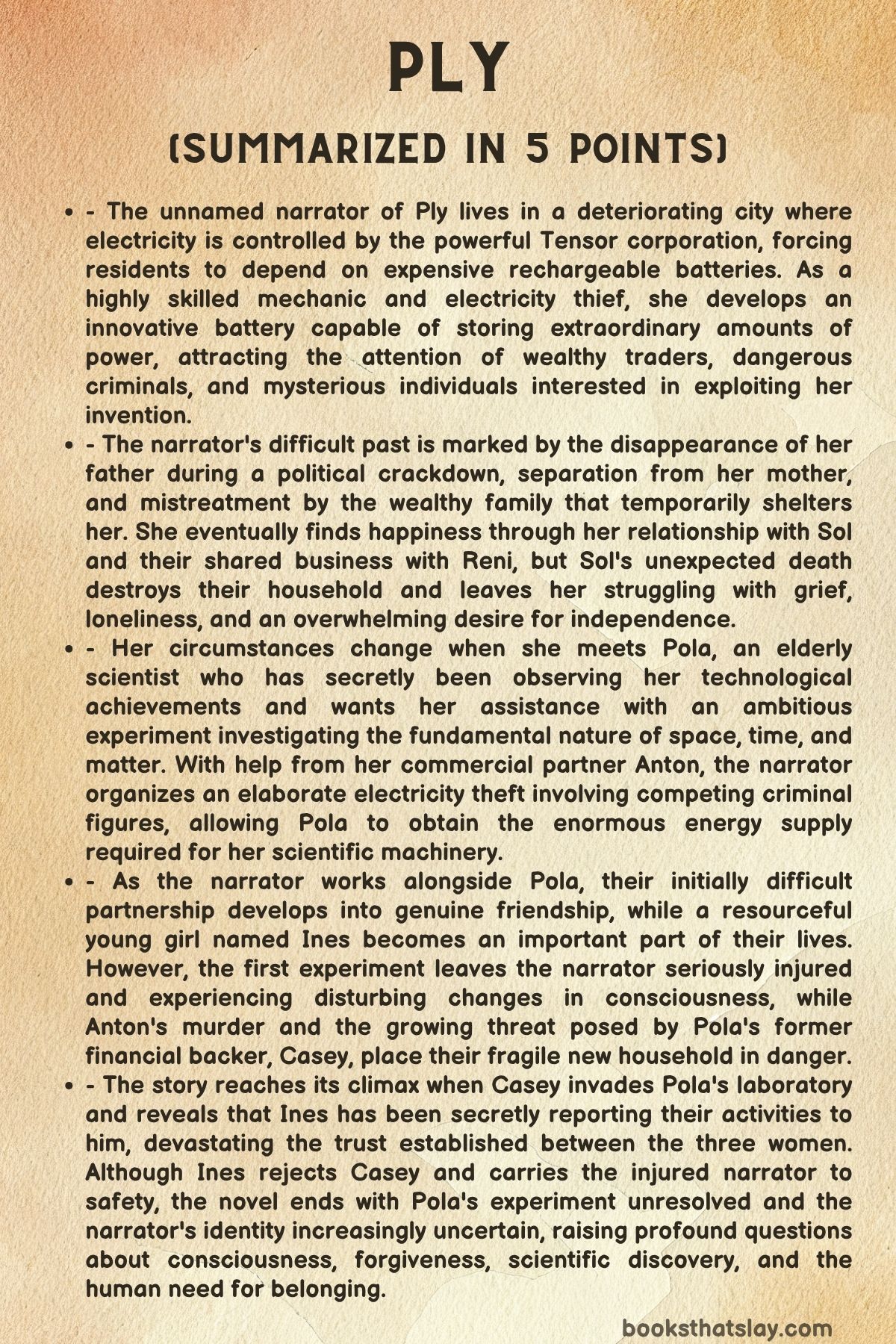
Summary
In a deteriorating city where electricity is scarce and tightly controlled, an unnamed young woman survives through an illegal activity known as pinching. This involves extracting power from the electrical infrastructure operated by Tensor, a corporation that maintains an effective monopoly over the city’s energy supply.
Electricity is so valuable that rechargeable batteries, commonly called bricks, function as an important medium of exchange, while those who steal power risk violent punishment from CTS, the private security organization protecting corporate interests.
The narrator is an exceptionally skilled mechanic who has developed a revolutionary battery capable of storing approximately forty times the electricity held by conventional bricks. Her invention allows her to extract power slowly enough to escape Tensor’s monitoring systems, giving her a considerable advantage over other pinchers.
Although her technological achievement could make her extraordinarily wealthy, she remains primarily interested in preserving her independence and supporting the underground musical community.
At the beginning of the story, she is preparing a powerful battery for a concert by Politburo, a band she personally dislikes. She accepts the assignment because Alexis, the band’s manager, has promised to introduce her to the Children, a musical group she greatly admires.
While checking her concealed battery beside the river, she repeatedly experiences the disturbing sensation that someone is observing her. Her suspicions become more serious when she discovers that an unknown person has inspected her equipment and left two exceptionally rare Faraday components alongside a handwritten message inviting communication.
The valuable gift suggests that her invention has attracted someone with considerable resources. Fearing an attempt to steal her technology, she abandons the location and begins searching for alternative arrangements.
The story frequently returns to the narrator’s childhood, revealing how her technical abilities and distrust of powerful institutions developed. She grew up in a bookstore operated by her parents, surrounded by literature, mechanical objects, and conversations about the city’s political history.
Her father valued intellectual freedom and sympathized with movements seeking to restore public control over essential services, while her mother possessed remarkable mechanical talents and taught her daughter to repair and construct machines.
Their family life was destroyed during the Suppression, a coordinated campaign in which CTS arrested or disappeared individuals associated with political opposition. The narrator’s father vanished during the raids, leaving his wife and daughter to face a world increasingly governed by suspicion and fear.
Her mother eventually abandoned the bookstore and established a workshop elsewhere in the city. There, she continued teaching her daughter practical engineering through repairs and imaginative mechanical constructions, providing both education and emotional security.
When her mother’s health deteriorated, however, the narrator was sent to live with Nelson, a young man from an extraordinarily wealthy family.
Nelson offered companionship and a degree of stability, gradually becoming someone the narrator trusted. Their relationship provided relief from the losses that had already shaped her childhood, but the family’s wealth also exposed her to forms of authority she had never fully understood.
Nelson’s sister, Mina, viewed the narrator as an unwelcome dependent and eventually used her position to remove her. During a particularly brutal encounter, Mina ordered an assistant to break the narrator’s little finger, leaving a permanent physical reminder of how easily the powerful could injure those beneath them.
The injured narrator eventually found refuge in the workshop of Acevedo, an idealistic inventor who operated a cooperative community inside a former health club.
Acevedo believed that knowledge and resources should serve collective well-being rather than private enrichment. His workshop offered an alternative to the competitive economic arrangements dominating the city, and he recognized the narrator’s unusual technical abilities.
Among his apprentices was Sol, an intelligent and adventurous young woman who became the narrator’s closest companion and romantic partner. Their relationship developed through shared work, intellectual curiosity, and the desire to establish an independent existence.
Sol eventually became involved in stealing electricity, creating a philosophical conflict with Acevedo, who argued that theft could reinforce the very assumptions about property that made corporate domination possible.
Despite Acevedo’s objections, the narrator chose to leave with Sol. The two developed their abilities as pinchers and eventually joined forces with Reni, a powerful young distiller whose talents complemented their technical work.
Together, they established a profitable enterprise called Bricks and Brix, supplying electricity and alcoholic drinks to underground concerts. Their interconnected waterfront buildings became a home where friendship, romance, work, and personal freedom seemed capable of existing together.
This happiness ended when Sol died following an accident involving a contaminated nail. Her death devastated the narrator, and Reni eventually departed because the shared household had become unbearable without her.
Left alone, the narrator concentrated on improving her battery technology, using mechanical work to escape the emptiness created by grief.
In the present, her invention attracts increasing attention from influential figures within the city’s criminal and commercial networks. Leslie, also known as Kiteface, approaches her with a proposition involving commercial control of the battery, while his rival Kenneth independently attempts to secure access to the technology.
The narrator turns to Anton, a sophisticated trader operating from an abandoned bank, for assistance in understanding the situation. Although Anton has long been her business partner, she gradually suspects that his inquiries into the rare components may have exposed her invention to dangerous competitors.
Meanwhile, another anonymous message promises that her mysterious observer will approach peacefully and explain a proposal. The narrator becomes convinced that several powerful individuals may be cooperating or competing to exploit her abilities.
Her artistic interests also begin changing as she encounters the experimental music of a group called the Suppression. Their performances challenge her assumptions about sound, creativity, and the possibility of expressing experiences beyond ordinary understanding.
While attempting to escape surveillance, she eventually discovers an enormous abandoned cruise ship near the former hospital district. There, she encounters an elderly scientist named Pola, who admits that she has been observing the narrator and was responsible for leaving the Faraday components.
Pola proposes an undertaking far beyond ordinary electricity theft. She wants the narrator’s assistance in obtaining enough energy to conduct an experiment that could expose fundamental structures underlying space, time, and matter.
At Pola’s laboratory, the narrator discovers an extraordinary scientific installation containing a powerful accelerator, sophisticated electrical machinery, and a mysterious circular apparatus.
Pola explains that familiar physical reality may conceal structures operating at scales where conventional ideas about distance, continuity, and time no longer apply. She believes that sufficiently powerful equipment could reveal or influence those structures, although the outcome remains uncertain.
The narrator recognizes that her battery invention could provide the electricity necessary for this project. However, the quantity required is enormous, and acquiring it would involve stealing power from Tensor’s main generating station.
She approaches Anton again, setting aside her earlier suspicions because his knowledge of the city’s commercial networks makes him indispensable. Anton designs an elaborate operation using the rivalry between Leslie and Kenneth to conceal the actual purpose of the theft.
The competing figures are encouraged to believe they are participating in a profitable criminal arrangement. Their involvement creates a diversion that allows the narrator to pursue the genuine objective without exposing Pola’s scientific ambitions.
As preparations continue, the narrator and Pola develop a complicated relationship. Pola is fiercely committed to scientific discovery and questions the narrator’s attachment to wealth and possessions, while the narrator argues that material security is essential in a society governed by scarcity and violence.
Their disagreements gradually reveal the emotional meaning of the narrator’s accumulated property. Many of her possessions have become substitutes for relationships she has lost, and her desire for independence frequently conceals a fear of abandonment.
Despite these tensions, their shared technical work produces growing admiration and affection. The narrator also introduces Pola to experimental music, helping her recognize similarities between scientific discovery and artistic attempts to move beyond established forms of understanding.
Pola eventually reveals that she previously worked in a scientific community supported by a wealthy investor named Casey. Their relationship deteriorated because Casey’s commercial expectations conflicted with Pola’s commitment to independent research.
Her decision to investigate the narrator secretly arose partly from concern that Casey might have placed someone in her path to obtain information about the experiment.
As the electricity operation advances, Anton successfully manipulates the competing criminal interests and organizes the necessary diversion. The narrator and Pola construct specialized batteries and prepare their experimental machinery, although substantial technical difficulties remain.
During this period, the narrator encounters Ines, a young girl who claims to have been expelled from a former community. Ines displays unusual confidence, commercial intelligence, and curiosity, but also appears vulnerable and in need of protection.
The narrator gradually becomes attached to her, helping her obtain eyeglasses and encouraging her interest in mechanical invention. Ines brings youthful energy into the laboratory and begins forming a close relationship with both women.
Eventually, the first major experiment begins. As the machinery operates, the circular apparatus produces disturbing physical effects, and the narrator experiences sensations that become increasingly difficult to interpret.
Overwhelmed by heat, light, and physical instability, she appears to fall toward the experimental device before losing consciousness.
When she awakens, she has suffered serious burns and other injuries. Pola and Ines care for her, but neither can explain precisely what happened during the experiment or whether its effects extend beyond her visible wounds.
Pola’s explanations raise unsettling questions about consciousness and individuality. She suggests that human beings are not separate from physical reality but emerge from complicated interactions among matter and forces, making the idea of an independent, permanent self increasingly uncertain.
The injured narrator initially decides to abandon the dangerous project and return to a quieter existence. She visits Anton to settle their business arrangements but discovers that Kenneth and his associates have taken control of the abandoned bank.
Anton has been murdered, and Kenneth attempts to intimidate her into surrendering access to the valuable battery technology.
The death of her longtime business partner creates another painful loss. Although their relationship had been complicated by suspicion and commercial disagreements, the narrator realizes that Anton had become an important part of her life.
She returns to Pola and reveals that Casey may be approaching the city and that their experiment is no longer sufficiently concealed. Pola refuses to abandon her work but recognizes that they must protect their equipment and prepare for further interference.
The narrator considers leaving, yet Pola offers her something more valuable than payment: a place within their emerging household. The possibility of belonging persuades her to remain with Pola and Ines.
As they continue working, Ines becomes increasingly important to the narrator’s emotional recovery. Their conversations about personal injuries and earlier experiences of violence create intimacy, while the girl’s mechanical experiments remind the narrator of her own childhood.
At the same time, the narrator begins experiencing alarming changes in consciousness. She sometimes observes herself from an unfamiliar perspective and occasionally seems to perceive events through Pola or Ines, as though the boundaries separating their identities have become unstable.
These experiences suggest that the experiment may have altered something fundamental about her relationship with reality. Her physical condition continues deteriorating, and she cannot determine whether the changes represent injury, transformation, or an entirely new form of perception.
As Pola prepares another trial, Casey arrives at the laboratory with armed operatives and demands control of the project. He possesses sufficient force to overwhelm the women and reveals that their apparent security has been compromised from within.
Ines, he explains, has been reporting their activities to him. Her vulnerability and personal history were deliberately used to gain their trust, and she willingly participated in the deception.
The revelation devastates Pola and the narrator, who had come to regard Ines as a member of their household. Yet the girl unexpectedly rejects Casey’s authority, insisting that she wants to remain with Pola, become a scientist, and be forgiven for her betrayal.
Facing overwhelming pressure, Pola agrees to conduct the experiment but insists that Ines take the gravely weakened narrator to safety.
Casey permits their departure, and Ines carries the narrator away on a bicycle, traveling through the city toward the river.
During the journey, the narrator reflects on her losses, the relationships that have shaped her, and the possibility that Ines represents a future she herself may not survive to experience. Her perception of individual identity remains uncertain, and the boundary between herself, Pola, and Ines seems increasingly difficult to establish.
The novel ends without revealing the final outcome of Pola’s experiment or resolving the narrator’s physical and psychological transformation. Instead, it leaves open the possibility that the experiment has challenged not only humanity’s understanding of physical reality but also the very meaning of individual existence, continuity, and connection.
Characters
The Unnamed Narrator
The unnamed narrator is the central character of Ply, a mechanically gifted young woman whose extraordinary intelligence allows her to challenge the economic and technological restrictions governing her society. Her ability to design advanced batteries and steal electricity without detection establishes her as an innovative thinker who refuses to accept the limitations imposed by powerful institutions.
Her independence, however, conceals considerable emotional suffering. The disappearance of her father, separation from her mother, mistreatment by Mina, and death of Sol have taught her that love and security can disappear without warning.
Consequently, she develops a strong attachment to material possessions and financial independence, treating these things as protection against further abandonment. Her prosperous pinching business demonstrates both her resourcefulness and her tendency to substitute technical achievement for emotional recovery.
The narrator’s development becomes especially significant through her relationships with Pola and Ines. Initially, she approaches Pola’s experiment as another commercial arrangement, but gradually recognizes that scientific curiosity, companionship, and shared creative work can offer forms of satisfaction unavailable through wealth.
Her response to Anton’s death demonstrates how deeply she values relationships, even when she struggles to acknowledge their importance. The possibility of belonging to a new household eventually persuades her to accept risks that her earlier self might have rejected.
Her physical and psychological transformation following the experiment introduces another dimension to her character. As her sense of individual identity becomes unstable, she must confront the possibility that the self she has worked so hard to protect may not be as separate or permanent as she once believed.
Pola
Pola gives Ply its central scientific challenge through her ambitious investigation into the fundamental structure of physical reality. An elderly scientist of exceptional intelligence, she is determined to explore the physical conditions underlying familiar understandings of space, time, and matter.
Her devotion to knowledge distinguishes her from the merchants and criminal figures who regard technical innovation primarily as an opportunity for financial enrichment. She considers scientific discovery valuable in itself and becomes frustrated when others fail to appreciate intellectual achievement beyond its commercial applications.
Nevertheless, Pola’s uncompromising dedication sometimes makes her insensitive to the practical and emotional needs of people around her. Her criticism of the narrator’s attachment to possessions initially overlooks the insecurity and deprivation that have shaped the younger woman’s life.
Pola gradually develops greater emotional awareness through their collaboration. Her admiration for the narrator’s craftsmanship becomes genuine affection, and their technical partnership evolves into a relationship built upon intellectual respect and personal concern.
Her earlier association with Casey also reveals the difficulties she faces in protecting independent scientific research. She recognizes that wealthy patrons may support technological development while simultaneously attempting to control its direction and benefits.
Pola’s greatest conflict emerges when her scientific ambitions threaten the people she has come to love. Her response to the narrator’s injuries, her growing attachment to Ines, and her willingness to negotiate with Casey demonstrate that she is more than an isolated intellectual pursuing an experiment.
Ines
Ines occupies one of the most emotionally complicated positions in Ply, initially appearing as a vulnerable young girl whose difficult past invites the narrator’s sympathy. Her apparent expulsion from a former community suggests that she has already experienced exclusion and instability despite her young age.
She possesses remarkable intelligence, confidence, and resourcefulness, displaying practical business instincts and a natural interest in mechanical experimentation. Her enthusiasm for constructing and operating small devices reminds the narrator of her own childhood and creates an increasingly affectionate relationship between them.
Ines gradually becomes part of the household established around Pola’s laboratory. Her curiosity brings moments of happiness into an environment otherwise dominated by demanding scientific work, physical danger, and unresolved grief.
The narrator’s decision to obtain eyeglasses for her represents an important development in their relationship. Helping Ines see clearly becomes an expression of protection and care, while their conversations about past injuries establish a more intimate form of trust.
The revelation that Ines has been reporting their activities to Casey fundamentally changes the reader’s understanding of her behavior. Her apparent vulnerability has also served a calculated purpose, demonstrating how innocence and deception can coexist within a single character.
Yet her decision to reject Casey and seek forgiveness prevents her from becoming a straightforward antagonist. Her desire to remain with Pola and pursue science suggests that the relationships she developed during her assignment have changed what she wants from life.
By carrying the injured narrator away from the laboratory, Ines assumes a protective role previously occupied by the adults around her. Her final actions introduce the possibility that genuine affection and moral growth can emerge even from relationships founded upon deception.
Sol
Sol’s presence in Ply is essential to understanding the narrator’s emotional history and the development of her independent identity. An intelligent, adventurous, and confident young woman, Sol enters the narrator’s life during their apprenticeship under Acevedo.
Their relationship grows from shared technical interests into romantic intimacy, giving the narrator companionship after years marked by family separation and insecurity. Sol encourages her to explore possibilities beyond the protected environment of the workshop and to imagine a future constructed through their own abilities.
Sol’s willingness to challenge established authority becomes particularly visible through her involvement in electricity theft. She regards pinching as an opportunity to escape corporate control, even though Acevedo argues that such activities remain dependent upon the economic assumptions they appear to oppose.
Her influence persuades the narrator to leave the workshop and establish an independent business. Together with Reni, they create a household that briefly provides the emotional and financial security the narrator has spent much of her life seeking.
Sol’s sudden death after an accident involving a contaminated nail exposes the fragility of this happiness. The narrator’s subsequent isolation demonstrates how profoundly Sol had shaped her understanding of love, freedom, and belonging.
Although Sol disappears from the active timeline before many of the novel’s decisive events, her memory continues influencing the narrator’s decisions. The desire to recover something resembling their shared life becomes an underlying motivation for her eventual attachment to Pola and Ines.
Anton
Anton is one of Ply’s most significant supporting characters, combining commercial intelligence, theatrical behavior, and considerable influence within the city’s trading networks. Operating from an abandoned bank, he maintains authority through negotiation, personal connections, calculated intimidation, and an understanding of other people’s ambitions.
His partnership with the narrator demonstrates his ability to recognize valuable technological innovations and transform them into commercial opportunities. He appreciates her exceptional mechanical talents but frequently evaluates their importance through the financial advantages they provide.
Anton is morally ambiguous because his assistance cannot always be separated from his personal interests. His inquiries into the rare Faraday components contribute to the narrator’s exposure, while his apparent secrecy encourages her to suspect that he may be manipulating the competition surrounding her invention.
Despite these tensions, he proves indispensable when she requires electricity for Pola’s experiment. His elaborate deception involving Kenneth and Leslie demonstrates remarkable organizational ability and psychological insight.
Anton understands that powerful individuals can often be controlled through their greed, vanity, and rivalry. Rather than confronting them directly, he creates circumstances in which they unknowingly contribute to a project whose real purpose remains concealed.
His murder transforms the narrator’s understanding of their relationship. She recognizes that beneath their frequent disagreements and commercial negotiations, Anton had become a dependable presence in her otherwise unstable life.
His death also emphasizes the dangers of operating within a society where economic influence and violence are closely connected.
Acevedo
Acevedo represents an alternative understanding of technology, property, and collective responsibility. A gifted inventor and educator, he operates a workshop in a former health club where apprentices acquire technical skills while participating in a cooperative community.
His philosophy challenges the assumption that intellectual achievement must lead to personal enrichment. Instead, he believes technological knowledge should support shared well-being and reduce dependence upon institutions that concentrate essential resources.
For the narrator, Acevedo becomes an important mentor after her painful experiences with Nelson’s wealthy family. His workshop offers shelter, education, and an environment where her mechanical abilities are respected rather than exploited.
His relationship with Sol reveals the limitations of his idealism when confronted with younger people who seek immediate freedom through activities he considers philosophically inconsistent. He disapproves of electricity theft because he believes that appropriating privately controlled resources can leave the underlying logic of ownership unquestioned.
The narrator’s decision to leave the workshop with Sol deeply hurts him, demonstrating that even generous and principled individuals can experience disappointment when others reject their guidance.
Acevedo’s lasting importance lies in the intellectual and ethical questions he introduces. His teachings remain relevant long after the narrator abandons his community, particularly when she begins reconsidering wealth, ownership, and the broader purposes of technological invention.
Reni
Reni is a physically powerful, unusually expressive young distiller whose friendship with the narrator and Sol helps establish one of the happiest periods of their lives. His practical abilities complement their electrical expertise, allowing the three companions to develop a profitable business serving the underground music scene.
His presence gives their partnership a sense of shared purpose extending beyond financial cooperation. When the group establishes a household in abandoned waterfront buildings, Reni participates in transforming the neglected spaces into a place of safety and belonging.
His dramatic destruction of the wall separating their living areas symbolizes the removal of barriers between their individual lives. The incident reflects his unconventional personality while establishing the emotional significance of their chosen household.
Reni’s departure after Sol’s death reveals how grief can fracture relationships that previously appeared secure. Although he does not remain to share the narrator’s isolation, his absence should not be interpreted simply as indifference.
His inability to continue living within the home they created together suggests that the loss has become unbearable in a different way for him. Through Reni, the novel demonstrates that people connected by shared affection may respond to tragedy through separation rather than continued companionship.
The Narrator’s Mother
The narrator’s mother is a remarkable mechanic whose practical intelligence forms the foundation of her daughter’s abilities. She possesses the creativity to transform discarded materials into functional inventions and approaches mechanical construction as both useful work and an expression of imagination.
Her marriage brings together two different forms of knowledge, with her technical expertise complementing her husband’s devotion to literature and intellectual conversation. Their household exposes the narrator to a world where scientific curiosity and cultural understanding naturally coexist.
Following her husband’s disappearance during the Suppression, she assumes responsibility for protecting and supporting her daughter. Her decision to abandon the bookstore reflects the emotional consequences of political violence, while the establishment of a new workshop demonstrates determination and resilience.
She continues educating her daughter through repairs, experiments, and elaborate mechanical constructions. These activities provide a degree of stability while also teaching the narrator to understand the physical relationships underlying complicated machines.
Her deteriorating health eventually forces her to make the painful decision to send her daughter to Nelson. This separation becomes another formative loss, reinforcing the narrator’s fear that security and affection cannot be permanently maintained.
The mother’s influence nevertheless survives through the narrator’s craftsmanship. Her lessons continue shaping the younger woman’s approach to invention, collaboration, and the possibilities contained within apparently ordinary objects.
The Narrator’s Father
The narrator’s father is a bookseller whose intellectual interests preserve a connection to cultural and political traditions largely forgotten by the surrounding society. He values reading, conversation, and the exchange of ideas, creating a childhood environment that encourages curiosity beyond immediate practical concerns.
Although he sympathizes with political movements seeking to challenge corporate control over essential services, his involvement appears primarily connected to discussion and intellectual support. His bookstore provides a setting where people can debate alternatives to the existing economic order.
His disappearance during the Suppression demonstrates the danger of political association in a society where private security organizations exercise enormous coercive power. The uncertainty surrounding his fate is particularly disturbing because it denies his family any clear understanding of what happened.
For the narrator, his loss becomes an early lesson in the vulnerability of ordinary people before powerful institutions. His intellectual influence also helps explain her enduring interest in books, history, and forms of knowledge that cannot be reduced to economic usefulness.
Nelson
Nelson is a wealthy young man who provides the narrator with companionship after her separation from her mother. His quiet temperament and willingness to respect her grief allow their friendship to develop without the pressure of immediate emotional intimacy.
Although he belongs to a family possessing extraordinary resources, his personal behavior differs from the arrogance and cruelty later displayed by his sister. He offers the narrator a sense of emotional security that appears independent of the social advantages surrounding him.
Nevertheless, Nelson cannot fully protect her from the unequal power structures within his household. His family’s authority ultimately determines her position, revealing the limitations of kindness when it exists within institutions governed by wealth and hierarchy.
Nelson’s importance lies partly in this contradiction between individual affection and inherited privilege. He demonstrates that personal goodness does not necessarily grant someone the ability to challenge the social arrangements from which they benefit.
Mina
Mina is Nelson’s sister and one of the clearest examples of cruelty supported by inherited wealth. Her appearance and behavior communicate confidence, authority, and an expectation that others will obey her decisions without resistance.
She regards the narrator as an unwelcome dependent whose relationship with Nelson threatens an order based upon status and control. Rather than treating the young woman as a person with legitimate emotional needs, Mina approaches her presence as a problem to be eliminated.
Her decision to order the breaking of the narrator’s finger reveals an especially disturbing form of violence. She does not need to commit the physical act herself because her position allows her to command someone else to inflict punishment.
The resulting injury becomes a permanent symbol of the narrator’s vulnerability within unequal social relationships. Mina’s actions demonstrate that economic privilege can become a form of personal sovereignty when effective legal protections are absent.
Kenneth
Kenneth is a powerful commercial and criminal figure who becomes interested in controlling the narrator’s advanced battery technology. His ambition is driven by the enormous profits and strategic advantages that could result from gaining access to unusually efficient electricity storage.
His rivalry with Leslie makes him vulnerable to Anton’s elaborate deception. Kenneth believes he is negotiating from a position of strength, but his desire to outmaneuver a competitor encourages him to participate in arrangements he does not fully understand.
His character becomes more threatening when he seizes control of Anton’s bank and murders the trader. This act demonstrates that his commercial ambitions are backed by a willingness to use direct violence whenever negotiation proves insufficient.
Kenneth treats the narrator’s technical abilities as resources to be controlled rather than achievements deserving independent recognition. His intimidation of her while she is physically weakened reveals the contempt underlying his pursuit of profit.
Through Kenneth, the novel illustrates how technological innovation can attract individuals who seek power without accepting responsibility for the people whose work creates it.
Leslie, or Kiteface
Leslie, known as Kiteface, is another influential figure seeking to exploit the narrator’s battery invention. His threatening appearance and association with organized criminal networks establish him as a dangerous presence in the city’s commercial underground.
He approaches the narrator with a proposition framed around business cooperation, but the implied consequences of refusal reveal the coercive character of the arrangement. He is interested in securing control over the technology rather than developing an equitable partnership with its inventor.
His rivalry with Kenneth creates opportunities for Anton to manipulate both men. Their competition demonstrates how the pursuit of economic advantage can interfere with rational decision-making, particularly when personal prestige becomes inseparable from financial ambition.
Leslie also represents the environment in which legitimate commerce and criminal intimidation are difficult to distinguish. His behavior suggests that control over a valuable resource provides both wealth and the ability to threaten others.
Casey
Casey is a wealthy investor whose financial support previously enabled Pola to undertake sophisticated scientific research. His resources provide access to advanced equipment and technical infrastructure, making him an influential figure in a world where electricity and technological knowledge are exceptionally valuable.
His relationship with Pola deteriorates because their objectives are fundamentally different. Pola seeks scientific understanding, while Casey expects research supported by his money to produce results compatible with his commercial interests.
His influence continues after their professional separation. Pola’s concern that he might attempt to recover or control her experiment helps explain her secrecy and her initial suspicion of the narrator.
Casey’s arrival at the laboratory reveals the full extent of his determination. Accompanied by armed operatives, he uses force to demand control over the apparatus and exposes Ines as a source of information.
His manipulation of a child to infiltrate the laboratory demonstrates his willingness to exploit personal relationships for strategic advantage. He represents the danger that scientific discovery may become subject to the interests of those possessing the resources to finance and seize it.
Alexis
Alexis is the manager associated with Politburo, the musical group whose concert requires the narrator’s specialized battery. His promise to introduce her to the Children persuades her to accept an assignment she would otherwise find artistically unappealing.
Although his role is limited, Alexis connects the narrator’s technological work with her personal interest in experimental music. His ability to arrange valuable introductions demonstrates the importance of reputation and relationships within the city’s underground artistic communities.
He also becomes indirectly relevant to the narrator’s suspicions about Anton. Her recollection of their interactions contributes to her belief that her commercial partner may possess information he has chosen not to disclose.
The Champion
The Champion is an influential figure connected with obscure trading and commercial networks. His resources and contacts make him useful to Anton and the narrator as they investigate rare electrical components and later organize the operation required for Pola’s experiment.
His inability to locate comparable Faraday components emphasizes the exceptional nature of the mysterious gift left for the narrator. Even individuals with considerable access to valuable materials cannot easily explain its origin.
During the preparations for the electricity theft, the Champion contributes logistical knowledge and information concerning the power station. His participation demonstrates how sophisticated operations depend upon relationships connecting different parts of the city’s unofficial economy.
Harlow
Harlow is an influential presence within the overlapping worlds of music, social gatherings, and criminal commerce. A gathering associated with Harlow provides the setting for the narrator’s encounter with Kenneth, bringing several competing interests into closer contact.
Although Harlow’s personal history receives limited attention in the supplied account, the character’s social position reveals how entertainment venues can serve purposes beyond artistic expression. Such spaces become places where introductions are arranged, information circulates, and powerful individuals negotiate influence.
Harlow’s role reinforces the importance of informal networks within a city that lacks familiar civic and legal institutions.
Eunice
Eunice is an acquaintance from the narrator’s earlier downtown community whom she encounters at a water station. Their conversation reveals how much the narrator has withdrawn from ordinary social contact after experiencing successive personal losses.
Eunice represents the relationships that continue existing beyond the narrator’s immediate circle, even when grief has made her reluctant to participate in communal life. The encounter also shows that everyday activities, including obtaining water, remain important points of social interaction.
Although her appearance is brief, Eunice helps establish the contrast between the narrator’s increasing isolation and the broader community that continues functioning around her.
Themes
Power, Scarcity, and the Ownership of Essential Resources
The struggle to control electricity establishes the central economic and political conflict in Ply. In the narrator’s city, electrical power is not simply a public utility but a scarce commodity whose distribution determines wealth, opportunity, personal freedom, and social influence.
Tensor’s monopoly demonstrates how control over an essential resource can become a mechanism of widespread domination. Because nearly everyone depends upon electricity, the corporation possesses extraordinary authority over ordinary economic activity, while CTS uses violence to protect its commercial interests.
The narrator’s work as a pincher represents an attempt to challenge this arrangement through technological ingenuity. By developing batteries that can store unusually large amounts of electricity, she creates an alternative means of accessing a resource that powerful institutions have made deliberately difficult to obtain.
However, her invention also exposes the limitations of individual resistance. Although she can steal electricity and avoid surveillance, her technology quickly attracts the attention of wealthy traders and criminal figures who hope to convert her achievement into another source of concentrated power.
Acevedo’s objections to pinching introduce a deeper philosophical question about the meaning of resistance. He argues that stealing privately controlled resources may challenge particular owners without necessarily rejecting the broader assumption that essential goods should be treated as exclusive property.
This disagreement complicates the narrator’s understanding of independence. Her ability to accumulate wealth and valuable equipment protects her from certain forms of exploitation, but it also leaves her participating in the economic arrangements she resents.
Pola’s scientific experiment creates a different possibility by directing technological achievement toward knowledge rather than immediate financial gain. Yet Casey’s determination to control the research demonstrates that even apparently independent intellectual pursuits remain vulnerable to financial influence.
The novel ultimately presents power as something extending beyond electricity or money. It also operates through institutional authority, violence, access to knowledge, and the ability to decide how technological discoveries will be used.
Grief, Attachment, and the Search for Belonging
Loss shapes nearly every important stage of the narrator’s life, influencing her relationships, professional ambitions, and understanding of personal security. Her father’s disappearance during the Suppression introduces her to the possibility that loved ones can be taken away through circumstances completely beyond her control.
Her separation from her mother creates another emotional disruption, forcing her to depend upon people whose intentions and authority she cannot fully understand. Although Nelson provides companionship, Mina’s cruelty demonstrates that apparent security can disappear when powerful individuals decide to withdraw it.
The narrator eventually finds greater happiness through her relationship with Sol and their shared household with Reni. Their home represents more than a place to live because it allows them to establish relationships based upon affection, cooperation, and freely chosen commitments.
Sol’s unexpected death destroys this fragile stability. Reni’s subsequent departure intensifies the narrator’s isolation, leaving her surrounded by material possessions that preserve reminders of the life she has lost without restoring its emotional meaning.
Her concentration on battery development becomes a method of avoiding painful memories. Mechanical work offers clear problems, measurable achievements, and controllable outcomes, unlike the unpredictable circumstances governing human relationships.
The narrator’s attachment to wealth can therefore be understood as an attempt to create lasting security through objects. Valuable equipment cannot abandon her in the same way people can, even though possessions cannot provide the affection she continues to need.
Pola challenges this dependence upon material accumulation, gradually encouraging the narrator to reconsider what makes life meaningful. Their developing friendship, followed by the arrival of Ines, offers the possibility of forming a new household without recreating the past.
Anton’s death tests this emerging emotional openness by confronting the narrator with another devastating absence. Nevertheless, Pola’s assurance that she belongs with them gives her a reason to remain connected to others rather than withdraw into isolation.
The novel suggests that belonging cannot be guaranteed through wealth, physical protection, or permanent possession. It emerges through shared responsibility and the willingness to form meaningful relationships despite the possibility of future suffering.
Science, Music, and the Limits of Human Understanding
Scientific investigation and experimental music appear to occupy separate areas of the narrator’s life, but both involve attempts to encounter realities that cannot be adequately represented through familiar systems of understanding. Her fascination with mechanical construction begins in childhood, when her mother teaches her to recognize complicated relationships between physical objects and their movements.
This education encourages the narrator to approach the world as something that can be understood through observation, experimentation, and practical invention. Her revolutionary battery demonstrates the extraordinary achievements possible when technical knowledge is combined with imagination.
Music provides a different kind of intellectual and emotional experience. The narrator initially judges performances according to her established preferences, admiring the Children while dismissing Politburo as artificial and uninteresting.
Her encounter with the Suppression challenges these assumptions by introducing forms of sound that cannot be evaluated through conventional expectations of musical beauty. Their performances encourage her to consider whether art can communicate experiences that ordinary language and familiar structures cannot capture.
Pola’s scientific research pursues a comparable objective through physical experimentation. She believes that everyday perceptions of matter, space, and time may conceal structures that remain inaccessible to ordinary observation.
The narrator initially struggles to understand these theoretical arguments because her expertise is grounded primarily in practical mechanics. Nevertheless, she recognizes a similarity between the scientist’s ambitions and the artistic experiments that have transformed her understanding of music.
Both activities require a willingness to question accepted boundaries and tolerate uncertainty. Scientific progress and artistic innovation become possible when individuals refuse to assume that existing explanations exhaust the possibilities of experience.
The first experiment demonstrates the dangers of pursuing knowledge beyond established limits. Although Pola develops sophisticated equipment and theoretical explanations, she cannot predict every consequence of manipulating physical conditions that remain poorly understood.
The narrator’s injuries and altered perceptions reveal that discovery may transform the observer as well as the subject being investigated. Knowledge is therefore presented not merely as the accumulation of facts but as an activity capable of changing the conditions under which human beings understand themselves.
Identity, Consciousness, and the Fragility of Trust
The boundaries separating individual consciousnesses become increasingly uncertain as Pola’s experiment produces consequences that neither she nor the narrator can fully explain. In Ply, questions about personal identity emerge gradually from the narrator’s experiences of memory, attachment, physical injury, and scientific transformation.
Throughout much of her life, the narrator understands herself as an independent individual whose survival depends upon controlling her resources and avoiding dependence upon others. This outlook develops from repeated experiences in which external forces disrupt her relationships and determine circumstances she cannot prevent.
Pola’s scientific explanations challenge the assumption that individuality represents a permanent essence existing separately from physical processes. If living beings emerge from complicated interactions among matter and forces, the boundaries defining a particular person may be less absolute than ordinary experience suggests.
Following the experiment, the narrator begins experiencing events from perspectives that seem to extend beyond her own body. She sometimes perceives herself, Pola, and Ines as distinct individuals, while at other moments their consciousnesses appear to overlap.
These experiences complicate the meaning of personal identity because the narrator can no longer rely entirely upon familiar distinctions between herself and others. Her transformation also raises questions about whether consciousness is confined to individual bodies or can exist through relationships that conventional perception cannot recognize.
Trust becomes especially significant within this uncertainty. The narrator gradually develops affection for Pola and Ines, allowing herself to depend emotionally upon people despite the painful experiences that previously encouraged isolation.
Ines’s betrayal challenges this developing confidence by revealing that apparent vulnerability and affection can conceal deliberate manipulation. Yet her subsequent rejection of Casey suggests that deception does not necessarily determine a person’s future choices or eliminate the possibility of genuine attachment.
The novel’s ending leaves both scientific and emotional questions unresolved. The reader cannot know whether the narrator’s altered perceptions represent a new form of existence, the consequences of physical injury, or a transformation whose full meaning remains beyond human understanding.
What becomes increasingly clear is that identity cannot be separated easily from memory, embodiment, and relationships. The narrator’s uncertain future, alongside Ines’s attempt to seek forgiveness and protect her, suggests that human connection may remain meaningful even when the boundaries defining individual existence begin to change.