The Adventures of Amina al-Sirafi Summary, Characters and Themes
The Adventures of Amina Al-Sirafi by S. A. Chakraborty is a fantasy adventure about a retired pirate captain pulled back into danger by money, old loyalties, and unfinished guilt. The book follows Amina, a legendary sailor, mother, Muslim woman, and former rogue of the Indian Ocean, as she tries to rescue a missing young scholar and protect her own daughter from the magical world she once tried to escape.
It blends seafaring danger, family secrets, monsters, faith, humor, and the burden of becoming a legend on one’s own terms.
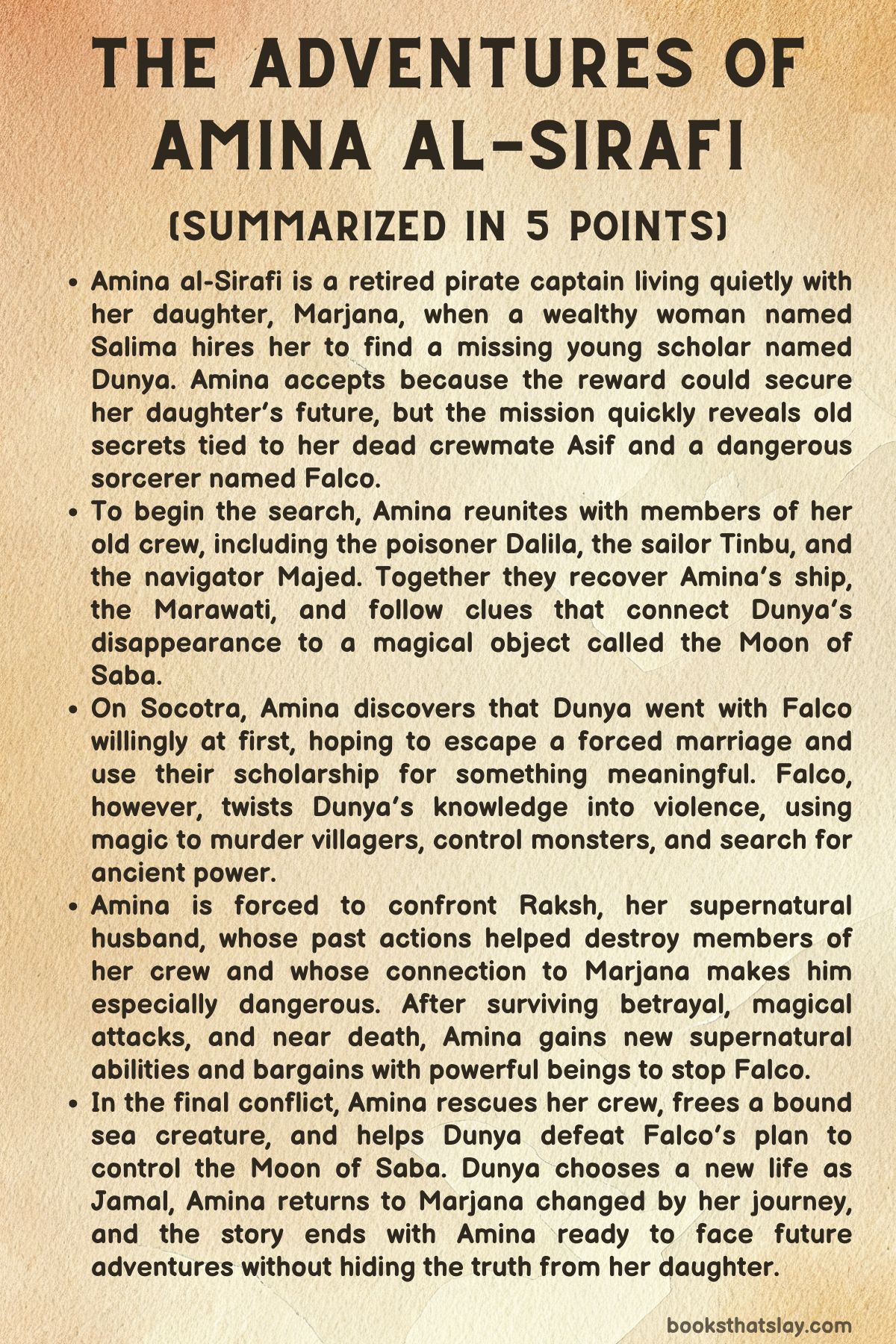
Summary
Amina al-Sirafi has spent years trying to live quietly. Once, she was a feared nakhudha, a pirate captain whose name traveled across the Indian Ocean with stories of theft, violence, and impossible escapes.
Now she hides in the mountains with her young daughter, Marjana, and her mother. She repairs her roof, worries about money, and tries to keep Marjana safe from the enemies and supernatural dangers tied to Amina’s past.
Yet the sea still calls to her, and even in retirement, she cannot fully escape the skills and instincts that made her famous.
Amina’s new life is disturbed when Salima, a rich and powerful woman from Aden, arrives at her hidden home. Salima wants Amina to find her missing grandchild, Dunya.
She claims Dunya has been kidnapped by a Frankish adventurer and sorcerer named Falco Palamenestra, a man obsessed with ancient magical objects. Amina resists the job at first.
She has a child to protect and no desire to return to the life that once broke her. But Salima offers a million dinars, enough to secure Marjana’s future forever.
The matter becomes personal when Amina learns that Dunya is the child of Asif, a former member of her crew and someone whose death still haunts her. Amina accepts the mission, promising herself that she will only search for a limited time.
Before beginning the hunt, Amina gathers trusted members of her old crew. First she finds Dalila, a brilliant and dangerous poisoner with a sharp tongue and a mysterious past.
Dalila once joined Amina’s crew by blackmailing them, but she became one of Amina’s most trusted companions. Then Amina goes to Aden, where she discovers that her old ship, the Marawati, is in trouble.
Tinbu, the ship’s current captain and another beloved former crewmate, has been arrested and falsely accused of piracy and murder. Amina cannot leave him to die, so she and Dalila stage a clever escape involving disguise, stolen goods, and a powerful sleeping drug.
They free Tinbu, recover the Marawati, and flee the harbor in a noisy, fiery escape that ruins Amina’s hope of remaining discreet.
The crew learns that Falco has been searching not only for Dunya but also for Amina and her old companions. His agent, Layth, reveals that Dunya may not have been kidnapped at all.
Instead, she approached Falco willingly because she wanted to help him locate a legendary magical relic called the Moon of Saba. Before Layth can explain more, he dies in a gruesome magical manner, coins choking him from within.
Amina realizes Salima has lied and that the mission is far more dangerous than a simple rescue.
Amina returns to Salima and confronts her. Salima admits more than she first revealed, but she also threatens Marjana if Amina abandons the search.
Trapped by both money and fear for her child, Amina continues. She steals a clue from Dunya’s library, a cryptic passage pointing toward Socotra.
To understand it, she seeks out Majed, her old navigator, now living respectably in Mogadishu with his wife Nasteho and their children. Majed has left adventure behind, but when he hears that Asif’s child is involved and that Amina’s family is threatened, he chooses to help.
Nasteho understands the part of him that still longs for the sea and encourages him to join the mission.
The Marawati sails to Socotra, where Amina, Tinbu, and Dalila investigate a strange area of the island. They find a wrecked ship, signs of violence, a burned settlement, and murdered elders.
Then Amina encounters someone she hoped never to see again: Raksh, her supernatural husband. Years earlier, in the Maldives, Amina had drunkenly married Raksh, believing him to be a beautiful stranger.
She later discovered that he was a powerful nonhuman being who fed on human desire. His presence on her ship had ended in horror, especially for Asif, and Amina eventually trapped him and abandoned him.
Now Raksh has returned, angry and desperate to break the strange magical bond created by their marriage.
Raksh reveals that he gave Falco information about Amina and her crew in order to find her. He also explains that Falco survived the wreck and has been using Dunya’s knowledge to command magical forces, including a sea monster.
Falco has slaughtered local people and used their blood for spells. Amina and her companions enter the caves where Falco has been operating and find imprisoned survivors.
Amina helps free them but stays behind to confront Falco’s men.
Falco presents himself as a visionary who wants to end war and remake the world through ancient power, but Amina quickly sees that his noble language hides hunger for control. His men have become partly monstrous through magic, and Falco himself has gained unnatural strength.
He poisons Amina and nearly kills her by feeding her to sea scorpions, but Dalila’s black powder attack saves her. Amina escapes with her companions and the rescued villagers.
Soon after, they locate Dunya adrift in a small boat, sunburned and unconscious.
When Dunya wakes, they explain that they went with Falco willingly. They admired Amina from childhood and wanted to escape a forced marriage to the governor of Aden.
Dunya believed Falco valued their scholarship and that he sought treasure, not slaughter. By the time they understood the horror of what he intended, their research had already helped him kill.
Dunya also explains that the Moon of Saba exists, though it is not a pearl or crown jewel, but a magical washbasin linked to the moon-being al-Dabaran. Dunya wants to destroy it, but Amina initially decides to return them to Salima, believing that going home is the safest path.
Amina’s crew challenges this decision. Tinbu and Majed remind her that she herself ran toward danger at Dunya’s age.
Amina also learns that Raksh manipulated several members of the old crew, not just Asif. Before she can act on this knowledge, Falco’s marid attacks the Marawati.
The sea monster lifts and damages the ship, and Falco arrives demanding Dunya and the vessel. Amina fights him but is defeated.
Dunya bargains for the crew’s safety, promising to help him find the Moon of Saba. Falco then stabs Amina with her grandfather’s knife and throws her into the ocean.
Amina survives by clinging to wreckage, fighting off danger, and reaching a magical island. There she drinks strange water that changes her vision, allowing her to see supernatural beings.
Raksh is also on the island, and despite her anger, she needs his knowledge. He explains that if Falco controls the Moon of Saba, creatures like him and possibly Marjana could be used as fuel for its power.
Amina petitions the island’s rulers, the peris, for help. At first they dismiss human suffering as too small to matter, but Khayzur, a more sympathetic peri, helps her argue her case.
Because drinking the island’s water has made Amina a minor magical bridge between worlds, she bargains with the peris: in exchange for aid, she will find and destroy several dangerous magical objects, beginning with the Moon of Saba.
Amina returns to Socotra and seeks help from the pirates there. Most hesitate, but a formidable captain named Magnun agrees to support her.
With Magnun’s pirates, Amina attacks Falco’s forces and rescues her crew. Using a sacred iron knife, she cuts the magical bonds tying Falco’s transformed men to his power.
She also frees the marid from Falco’s control, forming a brief mental connection with the creature before it escapes.
Amina then enters the cave alone to stop Falco. She faces illusions, monsters, and painful memories of Asif before reaching Dunya.
Falco has forced Dunya to summon the Moon of Saba during an eclipse. Dunya, however, has secretly reversed the spell so that the Moon controls Falco rather than the other way around.
Chaos breaks out as al-Dabaran, the being trapped in the basin, tries to escape. Amina calls on the freed marid to break open the cave wall so moonlight can enter.
She throws the basin toward the light, releasing al-Dabaran and destroying the Moon’s threat. Falco survives the collapse long enough to offer Amina knowledge and power, but she rejects him and kills him.
Afterward, Amina returns Dunya’s letter to Salima rather than Dunya. Dunya has chosen a new life and a new name, Jamal, and will not go back to forced marriage or confinement.
Salima is furious but keeps her promise not to harm Amina’s family. Amina returns home to Marjana and her mother, changed by magic and by what she has learned.
She realizes that hiding the world from Marjana may not protect her. Instead of ending her adventures, Amina begins to imagine sharing the sea, danger, and truth with her daughter.
Jamal becomes the scribe who records Amina’s story, making sure that the legendary captain is remembered in her own words.
Characters
Amina al-Sirafi
Amina al-Sirafi is the central force of The Adventures of Amina Al-Sirafi, a retired pirate captain whose life is shaped by ambition, guilt, faith, motherhood, and an unbreakable attraction to the sea. She is physically imposing, quick-thinking, violent when necessary, and far more intelligent than the exaggerated rumors about her suggest.
Her reputation as a terrifying captain is not false, but the book shows that her ruthlessness often comes from responsibility rather than cruelty. She knows how to inspire loyalty, frighten enemies, command sailors, and survive impossible conditions.
At the same time, she is not presented as invincible. Her knee aches, her body carries scars, she fears heights, and she worries constantly about whether she has become too old for the life she secretly misses.
Amina’s deepest conflict is between the safety of motherhood and the hunger for adventure. She loves Marjana fiercely and has built her retirement around protecting her, yet she also feels incomplete away from the ocean.
The mission to find Dunya forces her to admit that she did not simply leave piracy because she wanted peace; she left because trauma, guilt, and fear drove her into hiding. Her relationship with God is also important.
She has sinned, killed, stolen, and lapsed in her practice, but she continues to pray and seek divine help. This makes her morally complex without making her faith decorative.
By the end of the story, Amina accepts that being a mother does not require erasing her own desires. She chooses truth over concealment and becomes a legend not because she is fearless, but because she keeps acting despite fear, shame, and uncertainty.
Marjana
Marjana is Amina’s young daughter and the emotional anchor of the book. Though she is not present during most of the voyage, her influence shapes nearly every major decision Amina makes.
Marjana represents the life Amina has tried to build after leaving the sea: hidden, domestic, and protected from enemies. She is curious, observant, and eager to go to school, which shows that her world has become too small for her growing mind.
Amina’s refusal to let her attend school is not born from cruelty but from fear, since Marjana’s safety depends on secrecy.
Marjana also carries the mystery of inheritance. Her father is Raksh, though she does not know it, and Amina fears that supernatural abilities may appear in her.
Marjana’s “bad feeling” before Amina leaves suggests that she may have inherited more than ordinary intuition. This possibility transforms Amina’s understanding of parenting.
Keeping Marjana ignorant may leave her more vulnerable, not less. By the end, Marjana becomes the reason Amina chooses a different kind of motherhood: one based on preparation, honesty, and shared knowledge rather than silence.
Amina’s Mother
Amina’s mother is a practical, loving, sharp-eyed woman who understands the cost of Amina’s past better than most. She is not impressed by glory, treasure, or stories of legend.
To her, the sea returned Amina wounded and changed, and she fears that another voyage may take her daughter away permanently. Her opposition to Amina’s mission comes from experience, not narrowness.
She knows Amina well enough to see when money is only part of the reason she is leaving.
She also provides a grounded domestic counterweight to the magical and nautical chaos of the story. Her prepared food, warnings, and emotional honesty show the quiet labor of family care.
She is one of the few people before whom Amina cannot fully maintain the mask of captainly confidence. Through her, the book shows that love can be protective, angry, fearful, and generous at the same time.
Salima
Salima is a wealthy, commanding, and morally severe woman whose desperation for Dunya drives the plot into motion. She approaches Amina with calculation, bringing both payment and threats.
Her offer of a million dinars shows that she understands Amina’s practical needs, but her backup plan of exposing Amina to enemies reveals a ruthless willingness to control others. Later, when she threatens Marjana, she crosses a line that permanently alters Amina’s view of her.
Salima is not a simple villain, however. She wants Dunya returned because she believes she is protecting family honor, lineage, and safety.
Yet her idea of protection is built on control. She cannot understand Dunya’s need for freedom, identity, and self-definition.
Her power is social rather than magical, but it is frightening because it is tied to wealth, reputation, and family authority. By the end, she loses Dunya not because Amina fails, but because Salima refuses to see Dunya clearly.
Dunya / Jamal
Dunya, who later takes the name Jamal, is one of the most important characters in the book because their choices shift the story from rescue mission to moral reckoning. At first, Dunya appears to be a missing girl, possibly kidnapped by Falco.
The truth is more complicated. They are a brilliant young scholar who willingly sought Falco out, hoping to escape a forced marriage and prove the value of their knowledge.
Their admiration for Amina also matters; Amina’s legend gave them an image of female freedom and daring that seemed unavailable in their own life.
Dunya’s mistake is not stupidity but misplaced trust. They believe Falco values learning and magical history, only to realize that he is willing to turn scholarship into murder.
Their guilt over Socotra is intense because their research helped Falco commit atrocities. Yet Dunya does not remain passive.
Their reversal of the spell at the climax is one of the story’s most important acts of resistance. The adoption of the name Jamal marks a movement toward selfhood.
Jamal becomes not only a survivor but also the scribe who helps preserve Amina’s voice, making them essential to how the legend is shaped.
Asif al-Hilli
Asif is dead before the main events unfold, but his presence haunts the entire book. He was a member of Amina’s crew, Dunya’s father, and a man whose tragic end is tied to Raksh’s bargains.
Amina remembers him with guilt because she believes she brought the danger that destroyed him. Asif’s desire for wealth, admiration, and respect made him vulnerable to Raksh’s contract, and his fall shows how supernatural temptation often works through ordinary human longing.
Asif also connects Amina and Dunya before they ever meet. The revelation that he had a child shocks Amina and adds emotional weight to her mission.
He was part of her chosen family, and his hidden parenthood forces Amina to confront what she did not know about the people closest to her. His fate is a warning about desire without caution, but it is also a reminder that shame and ambition can make people easy prey.
Dalila
Dalila is a poisoner, strategist, survivor, and one of Amina’s most loyal companions. She is sharp, secretive, and often hilarious in her irritation with others, especially when forced into danger she claims not to want.
Her knowledge of poisons, sleeping drugs, explosives, and practical deception repeatedly saves the crew. She is dangerous in a precise way, preferring planning and chemistry to brute force, though she is perfectly willing to kill when necessary.
Dalila’s loyalty is hidden under sarcasm. She demands payment, complains about risk, and guards her true name, but her actions prove deep attachment.
She helps rescue Tinbu, saves Amina from Falco’s scorpion trap, and stands by the crew even when the mission becomes far more magical than expected. Her secrecy suggests a past filled with danger, but the book wisely lets some of that mystery remain.
Dalila’s bond with Amina is one of trust earned through shared survival rather than sentimentality.
Tinbu
Tinbu is the captain who has cared for the Marawati during Amina’s absence, and he represents loyalty, tenderness, and competence. Originally from the Malabar coast, he was captured as a teenager and later escaped into a life at sea.
His past gives him a personal understanding of freedom, which explains both his loyalty to Amina and his care for the ship. He is capable, affectionate, and more emotionally open than some of the others.
Tinbu’s relationship with the Marawati is especially important. He has kept the ship alive, disguised, repaired, and active even without Amina.
He does not enjoy command in the same way she does, but he has carried the responsibility well. His love life, his cat, and his humor soften him without reducing his courage.
Even with a broken leg, he helps save Amina during battle, proving that his bravery is steady rather than showy.
Majed
Majed is Amina’s former navigator, a gifted mapmaker and explorer who has tried to build a respectable life in Mogadishu. He is devout, intelligent, and deeply knowledgeable about geography and old stories.
Unlike Amina, he has successfully stepped away from the sea for a time, marrying Nasteho, raising children, and gaining social stability. Yet his curiosity has not died.
His son’s interest in exploration mirrors the part of Majed that still longs for movement.
Majed’s return to the crew is not just nostalgia. He joins because Asif and Amina are family to him, and because Dunya’s danger carries moral weight.
He is often anxious and argumentative, especially around Dalila, but his skills are indispensable. He reads clues, navigates dangerous waters, and rescues Amina from drowning after she frees the marid.
Majed shows that a person can love domestic life and still feel called by adventure.
Nasteho
Nasteho, Majed’s wife, is a small but important character because she sees her husband clearly. She welcomes Amina with warmth rather than suspicion, even though Amina represents Majed’s dangerous past.
Her hospitality during Friday celebrations shows confidence, intelligence, and emotional steadiness. She is not fooled by the idea that respectability has erased Majed’s longing for the sea.
Nasteho’s conversation with Amina about motherhood and work is one of the book’s clearest reflections on women’s lives. She understands that loving children does not mean abandoning every other part of the self.
By encouraging Majed to help Amina, she acts not as a passive wife but as someone who makes a difficult and generous choice. She expands the book’s view of family by showing that love can include letting someone answer a calling.
Raksh
Raksh is Amina’s supernatural husband, a being of desire, appetite, charm, and danger. He is seductive, funny, vain, cowardly, and frightening.
When Amina first meets him, he appears as an impossibly beautiful man who promises luck and greatness. His true form and his feeding on human desire reveal the threat beneath his charm.
He does not operate like a human villain; he thinks in contracts, cravings, and self-preservation.
Raksh’s relationship with Amina is one of the book’s most unstable bonds. He has harmed her life, manipulated her crew, and contributed to Asif’s destruction, yet he is also tied to her through marriage, magic, and Marjana.
He sometimes helps her, sometimes abandons her, and often acts from selfish motives. His fear of the Moon of Saba reveals that even powerful beings can be prey to greater powers.
Raksh is not redeemed, but he is not flatly evil either. He remains dangerous because he understands Amina’s ambition and feeds on the very force that makes her extraordinary.
Falco Palamenestra
Falco is the main human antagonist, a Frankish warrior and sorcerer whose language of reform conceals a desire for domination. He presents himself as a man disillusioned by war who wants to end human suffering by recovering ancient power.
Yet his methods reveal his true nature. He murders villagers, enslaves magical beings, corrupts his followers, manipulates Dunya, and treats people as tools.
Falco is frightening because he believes his own grand claims. He is not merely greedy for treasure; he wants authority over the structure of the world.
His interest in God, war, and older powers gives him the shape of a fanatic who has confused spiritual hunger with entitlement. Amina sees through him because she understands ambition in herself.
The difference is that she has limits, loyalties, and accountability. Falco has only appetite dressed as vision.
Layth
Layth is Falco’s agent, a sickly and frightened man who helps connect Falco to Amina’s old crew. His brief appearance carries major importance because he reveals that Dunya went to Falco willingly and that Falco has been actively searching for Amina.
Layth’s fear of Amina, whom he calls a seawitch, shows how her reputation has grown beyond her control.
His death by magical coins demonstrates the seriousness of Falco’s power and the danger of speaking too freely. Layth is a minor figure, but he acts as a warning sign.
Through him, the book shifts from a human chase to a supernatural threat where information itself can be trapped, punished, and controlled.
Yusuf
Yusuf is connected to Tinbu and appears during the Aden crisis. His concern for Tinbu suggests affection, loyalty, and possibly romantic attachment.
Amina quickly reads his emotions and uses him in the rescue plan, asking whether he can act well enough to help deceive the authorities. Yusuf’s role is brief, but it shows Tinbu’s life continued during Amina’s absence and that he has formed meaningful bonds beyond the old crew.
Yusuf also helps reveal Amina’s ability to assess people quickly. She sees his worry and turns it into a practical advantage.
Though he is not central to the wider magical conflict, he helps move the story from danger to escape and makes Tinbu’s arrest feel personal rather than merely procedural.
Fiorz
Fiorz is one of the younger sailors on the Marawati and becomes memorable during the marid’s attack. When the ship is lifted, he clings to Amina in terror, showing the vulnerability of the ordinary crew members caught in supernatural violence.
His fear is not weakness; it gives scale to the danger. Amina is a legend, but many of the people under her command are young, frightened, and mortal.
Through Fiorz, the book reminds readers that command carries responsibility for lives less experienced than Amina’s. The crew is not an anonymous mass.
Even minor sailors have bodies, fears, families, and futures at risk. Fiorz helps humanize the cost of Amina’s return to adventure.
Yazid
Yazid is one of Falco’s men and serves as a direct physical threat during the fight on Socotra. He receives Amina’s favorite scimitar after Falco disarms her, which makes him part of Falco’s attempt to humiliate and erase her authority.
Later, he nearly kills her before Tinbu and Dalila intervene. His transformation under Falco’s magic shows how Falco’s followers become both empowered and deformed by their master’s ambition.
Yazid is not deeply explored psychologically, but his role matters because he embodies the kind of loyalty Falco produces: violent, enhanced, and stripped of moral independence. His defeat through Tinbu’s courage and Dalila’s poisons shows the old crew’s collective strength.
Amina survives not because she stands alone, but because her people protect her.
Magnun
Magnun is a powerful pirate captain from Socotra who chooses to help Amina when others hesitate. He is physically impressive, bold, and direct, with a well-run ship and a disciplined crew that includes many women.
His willingness to act contrasts with the caution of the pirate council. He responds to courage and opportunity, but he also understands the importance of reputation and decisive action.
Magnun’s support gives Amina the force she needs to challenge Falco on land and sea. He also provides her with armor and a sacred iron knife, one of the tools that allows her to cut magical bonds.
His respect for Amina is immediate but not submissive. He treats her as another formidable captain, and his promise to retrieve the knife later suggests that his story may continue beyond this book.
Khayzur
Khayzur is a peri who becomes Amina’s advocate among the magical rulers of the island. Unlike the rest of the council, he is willing to listen, explain, and help.
His tea, courtesy, and patience make him feel more humane than many of the supposedly higher beings around him. He teaches Amina about Transgressions, magical objects that bridge worlds, and reveals that she has become one herself after drinking the island’s water.
Khayzur is important because he gives Amina a path forward when raw courage is not enough. He does not save her without cost; instead, he helps her bargain.
Through him, the book introduces a wider magical order governed by balance, rules, and cold calculations. Khayzur’s sympathy matters because it exists inside a system that does not naturally value human lives.
The Peri Council
The peri council represents supernatural authority that is powerful but morally distant. These beings are ancient, orderly, and concerned with balance rather than human suffering.
When Amina asks for help, they calculate the possible damage Falco may cause and initially decide it is not significant enough to justify intervention. Their reaction is chilling because it shows that magical wisdom does not automatically mean compassion.
The council forces Amina into a bargain that changes the direction of her life. By requiring her to destroy magical objects, they turn her into an agent between human and supernatural worlds.
They are not villains in the ordinary sense, but their indifference makes them dangerous. Their presence expands the story’s scale beyond pirates and sorcerers into a larger conflict over who controls access to magic.
The Marid
The marid is a vast sea being controlled by Falco through magical bonds and human sacrifice. At first, it appears as a monster attacking ships and serving Falco’s will.
Later, Amina recognizes that it is enslaved, not loyal. This realization changes the moral meaning of the battle.
The creature is terrifying, but it is also suffering.
When Amina frees the marid, she briefly connects with its mind and senses its desire for freedom. This moment strengthens the book’s argument that living beings should not be reduced to instruments of power.
The marid’s liberation also helps defeat Falco, showing that mercy and strategy can be the same act. Amina’s ability to see the marid as captive rather than merely monstrous marks her growth as a supernatural actor.
Al-Dabaran
Al-Dabaran is the moon-being trapped in the object known as the Moon of Saba. The legends surrounding him change across the story.
At first, he appears as a romantic figure who loved Bilqis, but the truer account reveals him as a voyeuristic and dangerous being who bewitched her washbasin to spy on her. Bilqis trapped and used him, and later owners of the basin were damaged by its power.
Al-Dabaran is less a person than a force of corrupted access. He represents the danger of seeing too much, possessing too much, and treating knowledge as entitlement.
Once Falco reaches him, the situation becomes uncontrollable even for the sorcerer. His release destroys the immediate threat, but his history shows why magical objects in the book are never neutral.
They carry old violations, old power, and old consequences.
Amina’s Father
Amina’s father appears mainly through memory and family history, but his influence is significant. He told Amina stories and helped shape her attraction to the sea and the marvelous.
His connection to smuggling and to Majed’s early departure from respectable apprenticeship shows that Amina’s adventurous life did not emerge from nowhere. She inherited a world of risk, movement, and rule-breaking.
He also represents the storytelling tradition that formed Amina before Jamal ever began recording her words. Through him, the sea becomes not just a place of work but a place of possibility.
His legacy helps explain why ordinary domestic safety could never fully satisfy Amina, even when she genuinely loves her family.
Amina’s Grandfather, the Sea Leopard
Amina’s grandfather, known as the Sea Leopard, is a legendary pirate whose memory inspires Amina’s own sense of daring. His dagger is one of her treasured weapons, and when Falco takes it and uses it against her, the act becomes symbolic.
He is not only injuring Amina but also trying to claim power over her lineage and legend.
The Sea Leopard’s presence in the story is mostly ancestral, but it matters because Amina measures herself against inherited stories of greatness. She comes from a line of sea-rovers and dangerous figures, yet she must define what kind of legend she wants to become.
Her grandfather’s knife links family memory, violence, survival, and identity.
The Socotra Villagers and Elders
The villagers of Socotra are victims of Falco’s ambition, but they are not portrayed only as helpless sufferers. Their elders are murdered for spellwork, and their community is burned, making clear the human cost of Falco’s search for power.
The bodies of the elders, especially the women and priest, show that Falco’s magic depends on violating local life and sacred authority.
The surviving villagers help Amina and her companions reach safety. They also have ties to the island’s pirates, reminding the reader that Socotra has its own political and social order.
Their suffering gives urgency to Amina’s mission beyond Dunya and Marjana. Falco’s crimes are not abstract; they destroy communities with names, customs, and obligations.
The Socotra Pirate Council
The pirate council is orderly, wealthy, political, and more civilized than outsiders might expect. Their court has scribes, procedures, and public hearings, which challenges simple ideas of piracy as chaos.
They have agreements with local villagers and responsibilities they are expected to honor. Their hesitation to help Amina reflects caution, self-interest, and political calculation.
The council also shows that outlaw societies can have laws of their own. Some members are hostile because of old grudges tied to Amina’s family, while others are curious or concerned.
Their debate creates a contrast between institutional caution and Magnun’s boldness. They expand the maritime world of The Adventures of Amina Al-Sirafi by showing that pirates are not a single type of person but a society with factions, memory, and duty.
Salima’s Family Djinn
The family djinn appears briefly near the end, giving Amina a bag for Dunya. Its presence confirms that Salima’s family has long-standing magical ties and that Dunya’s knowledge comes from a real heritage, not mere fantasy.
The djinn is bound to serve the family, which quietly echoes the larger theme of magical enslavement seen with the marid and the Moon of Saba.
Although minor, the djinn changes how Amina sees the world after her transformation. She can now perceive beings that were previously hidden, which means her life can never return fully to ordinary boundaries.
The djinn also hints that Salima’s household contains more secrets and obligations than Amina ever knew.
The Two Youths from Salalah
The two youths from Salalah appear at the beginning and help reveal that Amina’s retirement has not made her ordinary. Their careless magical experiment brings a dangerous sea creature upon them, and Amina saves them through courage, religious recitation, iron, and experience.
They are foolish rather than malicious, but their actions show how young people can be drawn toward magic without understanding its cost.
Their encounter also restarts the movement of rumor. Because they survive and speak of the mysterious woman who saved them, word eventually reaches Salima.
In that sense, their recklessness becomes the first push that brings Amina out of hiding. They show the gap between romantic curiosity about magic and the hard knowledge of someone who has paid for it.
The Ship’s Cat
Tinbu’s cat is a small comic presence, but it adds warmth to life aboard the Marawati. Tinbu insists that she is lucky despite evidence that she is clumsy and not especially useful as a mouser.
His affection for her reveals his gentle side and gives the ship a lived-in feeling. The cat also becomes part of the crew’s emotional world, a reminder that sailors attach meaning to signs, habits, and companions during dangerous voyages.
Her presence helps balance the darker material with ordinary fondness. In a book full of monsters, contracts, poison, and betrayal, the cat represents the small comforts people carry with them into uncertainty.
Tinbu’s belief in her luck is humorous, but it also fits a world where luck, magic, and love often overlap.
Jamal the Scribe
Jamal, formerly Dunya, is also the scribe who records Amina’s story. As scribe, Jamal matters because the book is deeply concerned with who gets remembered and who gets misrepresented.
Amina does not want to become a polished legend stripped of her anger, profanity, mistakes, faith, appetite, or motherhood. Jamal’s promise to preserve Amina’s words gives the story its frame and purpose.
This role completes Jamal’s transformation from hidden scholar to active shaper of history. They are no longer merely studying old magical texts; they are creating a record of a woman whom history would otherwise distort.
Through Jamal, the book argues that storytelling is an act of power, especially for people whose lives are often rewritten by others.
Themes
Motherhood Without Self-Erasure
Amina’s motherhood is not treated as the end of her story, but as one of the forces that makes the story possible. She leaves home because she wants to secure Marjana’s future, yet every stage of the journey makes her question what protection truly means.
At first, Amina believes safety requires secrecy. Marjana must stay hidden, avoid school, and remain separated from Amina’s past.
This seems practical because Amina has enemies and because Marjana may have inherited supernatural traits from Raksh. Over time, however, Amina realizes that silence can also endanger a child.
If Marjana carries magic, ignorance will leave her unprepared. If Amina denies her own longing for the sea, she teaches her daughter that motherhood demands self-burial.
The book rejects that idea. Amina’s love for Marjana is fierce and sincere, but it does not erase her ambition, skill, or hunger for adventure.
By the end, she begins to imagine a life where Marjana can know the truth, join the world more fully, and inherit not only danger but knowledge, courage, and choice.
The Cost of Ambition
Ambition drives nearly every major figure in The Adventures of Amina Al-Sirafi, but the book carefully separates ambition from entitlement. Amina wants greatness, travel, money, freedom, and recognition.
These desires make her vulnerable to Raksh, but they also make her brave, capable, and alive. Dunya’s ambition leads them to scholarship, escape, and the hope of controlling their own future, yet it also leads them to trust Falco too easily.
Asif wants admiration and prosperity, and Raksh turns that longing into a deadly contract. Falco is the darkest version of ambition because he believes his desire for power is justified by a vision of remaking the world.
He cannot accept limits, so he turns people, monsters, texts, and relics into tools. The book does not condemn wanting more from life.
Instead, it asks what happens when desire loses humility, accountability, and love. Amina survives her ambition because she can still feel guilt, admit mistakes, and protect others.
Falco is destroyed by his because he sees every boundary as an insult.
Storytelling, Reputation, and Who Controls History
Amina’s life is surrounded by rumor. People call her seawitch, murderer, sorceress, pirate, monster, and legend, often with little concern for truth.
The opening frame makes clear that women’s stories are especially vulnerable to distortion. They are turned into villains, temptresses, witches, mothers of heroes, or warnings, while their own voices are lost.
Amina resists this by telling her story herself. Her version includes pride, shame, jokes, violence, prayer, lust, fear, and maternal love.
She refuses to become a clean moral symbol. Jamal’s role as scribe matters because recording Amina accurately becomes an act of justice.
The book also shows that stories shape action. Dunya admires Amina’s legend and uses it as a model for escape.
Sailors surrender or fight based on what they have heard of Amina. Falco builds his quest around old tales of magical objects, many of which are incomplete or false.
History is never neutral here. It can liberate, mislead, preserve, or endanger, depending on who tells it and why.
Freedom, Power, and the Refusal to Be Used
The struggle against being used runs through human and supernatural relationships alike. Dunya is used by Falco for scholarship and spellwork.
The marid is bound and forced to destroy. Falco’s men are empowered but also tethered to him through hidden magical cords.
The family djinn is bound to serve Salima’s bloodline. Raksh feeds on desire and treats human longing as a resource.
Even Amina is nearly turned into a tool by the peri council, who want her to destroy dangerous objects for them. Against this pattern, the book repeatedly values chosen bonds over forced ones.
Amina’s crew follows her not because she controls them magically, but because loyalty has been earned through danger, memory, and care. When Amina frees the marid, she recognizes that a terrifying creature can still be a captive deserving release.
When she refuses to return Jamal to Salima, she chooses self-determination over social order. Power in the book becomes most corrupt when it turns living beings into instruments.
Freedom begins when someone cuts the cord, breaks the contract, or refuses the role chosen for them.