The Atlantis Gene Summary, Characters and Themes
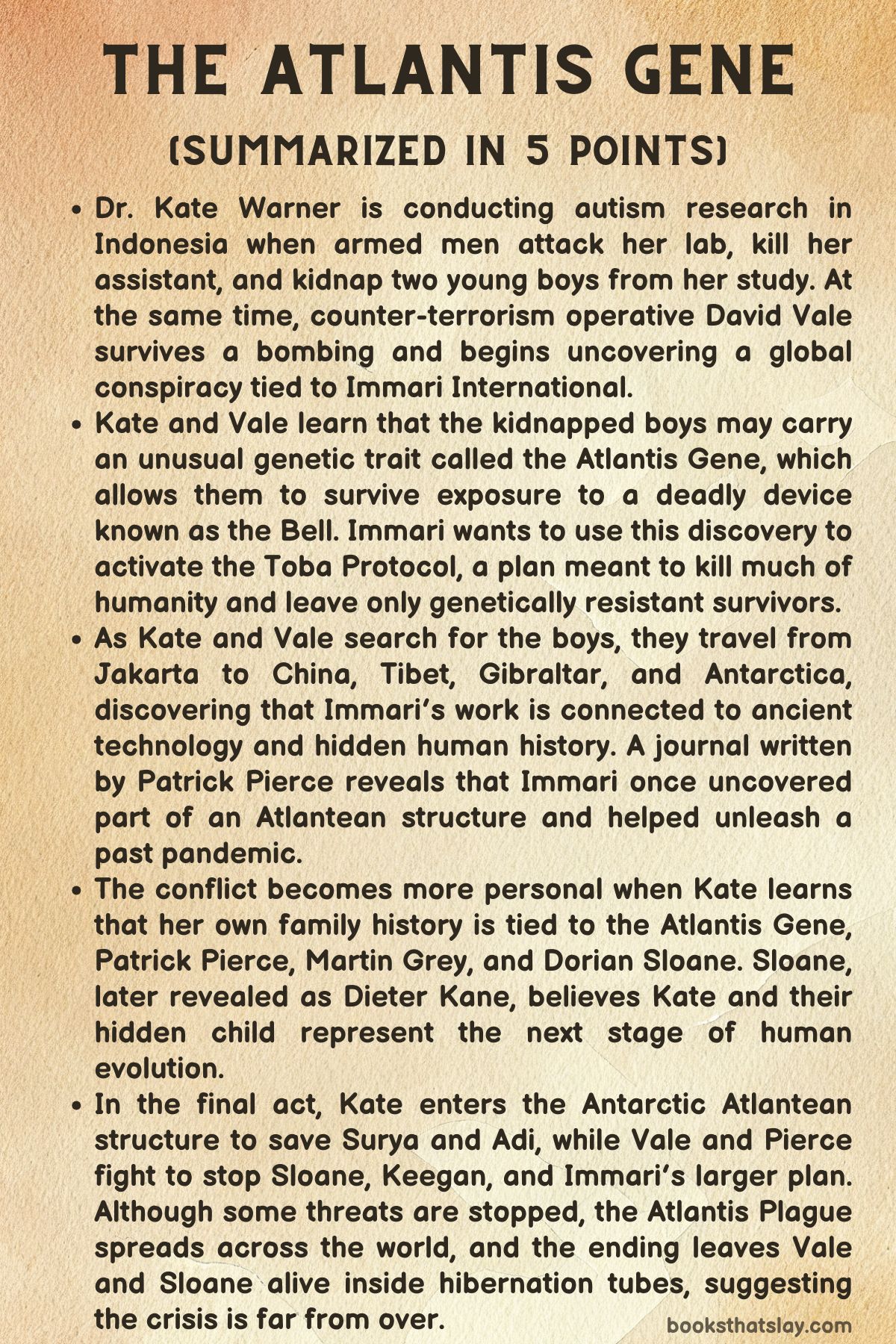
The Atlantis Gene by A.G. Riddle is a science-fiction thriller built around ancient mysteries, genetic research, secret organizations, and a possible turning point in human evolution. It follows Dr. Kate Warner, whose autism research unexpectedly connects her to a global conspiracy, and David Vale, a counter-terrorism operative trying to expose the Immari, a powerful organization willing to sacrifice millions for its vision of survival.
The story mixes archaeological speculation, pandemic fear, alien technology, and personal loss, creating a fast-moving narrative about what humanity is, where it came from, and who gets to decide its future. It’s the 1st book of The Origin Mystery series.
Summary
Dr. Kate Warner is a medical researcher in Indonesia, where she studies autism and runs a clinical program involving two boys, Surya and Adi. Her work is unusual because she is not only treating the children but also observing changes that might connect autism to deeper genetic possibilities.
Her lab is attacked by armed intruders, her assistant Ben Adelson is killed, and the two boys are taken. The Indonesian police treat Kate with suspicion rather than compassion, accusing her of exploiting children and using her research as a cover for illegal activity.
At the same time, David Vale, an operative for the counter-terrorism organization Clocktower, survives a train station bombing in Jakarta and learns that recent terror attacks may not be random acts by separate groups. He begins to see evidence that the violence is being coordinated by Immari International, a powerful organization with hidden archaeological and genetic goals.
Vale discovers that Clocktower itself has been compromised. Many of its analysts and field officers are exposed as infiltrators or collaborators, and Josh Cohen, one of the remaining loyal analysts, manages to decode a set of strange clues before being killed during the fall of the Jakarta station.
Those clues point toward Antarctica, Gibraltar, and Roswell, suggesting that Immari’s activities are tied to long-buried discoveries about human origins and advanced technology. Vale rescues Kate from police custody, but the escape throws them both into the center of a conflict involving the kidnapped boys, an ancient genetic marker called the Atlantis Gene, and a catastrophic plan known as the Toba Protocol.
Kate learns that her adoptive father, Martin Grey, is deeply involved with Immari. Grey claims that her research could help prevent a disaster.
He believes the autism treatment she gave Surya and Adi may have activated something in their biology that allows them to survive exposure to a deadly device called the Bell. The Bell produces radiation that kills most people, but the boys survive, making them valuable to Immari scientists.
Dr. Shen Chang, who runs tests at an Immari facility, is ordered to process human subjects in search of people who can survive the Bell. The tests are cruel and fatal, but the results strengthen Immari’s belief that a hidden genetic advantage exists in a few humans.
Dorian Sloane, Immari’s ruthless security leader, wants to activate the Toba Protocol immediately. The plan is to release a deadly pandemic created through the Bell, killing much of the world’s population while allowing only those with the right genetic resistance to survive.
To Sloane, mass death is not a tragedy but a forced evolutionary filter. Grey, though also morally compromised, tries to delay him.
Grey hopes Kate’s research can provide another path, one that does not require global destruction. Sloane has no patience for hesitation, and his interest in the Atlantis Gene is tied to his own strange past and his obsession with an old Nazi figure named Konrad Kane.
Vale and Kate escape Immari forces in Jakarta and travel to western China, where encrypted clues lead them to the Immari research facility that holds the children. Kate infiltrates the facility using a false identity, while Vale enters separately to sabotage its power systems.
Inside, Kate meets Naomi, who appears to work with Sloane but secretly helps her reach Surya and Adi. Their rescue attempt fails when Sloane discovers the breach.
Kate and Naomi are thrown into the Bell chamber with other test subjects. Naomi dies, but Kate survives, proving that she too has unusual resistance to the Bell.
Vale is badly injured during the assault, and the facility is heavily damaged, but Kate manages to get him onto a departing train.
The train is intercepted by Tibetan monks connected to the Immaru, an older spiritual branch of the same ancient movement that later produced Immari. Kate and Vale are taken to a monastery, where Vale receives medical care and Kate meets Qian, an old guardian of secret knowledge.
Qian gives her a journal written by Patrick Pierce, a soldier from the First World War. The journal becomes the key to understanding Immari’s history.
Pierce had been hired to work on a hidden archaeological excavation beneath Gibraltar, where Immari discovered part of a vast metallic structure believed to be connected to Atlantis. The excavation exposed the Bell and released a deadly illness that became associated with the 1918 flu pandemic.
Pierce blamed himself for helping unleash the disaster, especially after the illness killed Helena Barton, the woman he loved.
Through the journal, Kate learns that Immari’s long search has always centered on the Atlantis Gene. The organization believes an advanced ancient race once influenced human development, helping Homo sapiens survive a prehistoric catastrophe while other human subspecies disappeared.
Immari fears that the beings connected to Atlantis may one day return or awaken, and its leaders want to create a new form of humanity capable of fighting them. The Toba Protocol is designed to reproduce the conditions of an evolutionary bottleneck: kill billions, identify the resistant survivors, and build a stronger human species from them.
While Kate and Vale recover at the monastery, Sloane spreads infected bodies around the world to start the pandemic. News reports begin calling the disease a new flu, though Kate realizes it is not a normal illness.
Sloane also uses drones to destroy monasteries in the mountains, searching for Kate and Vale. They escape by hot air balloon with the help of the monks, but the danger grows as the pandemic spreads across countries.
Kate and Vale decide they must go to Gibraltar to find the secret chamber mentioned in Pierce’s journal, hoping it contains a way to stop Immari.
In Gibraltar, Vale contacts Clocktower director Howard Keegan, believing him to be an ally. Keegan claims he has been secretly fighting Immari and offers help.
In reality, Keegan is Mallory Craig, an old Immari figure who has survived into the present through Atlantean hibernation technology. He has manipulated Clocktower from within and wants control of Immari for himself.
Kate is taken to Antarctica, where Sloane is preparing to send Surya and Adi into another section of the Atlantean structure with nuclear warheads strapped to their backs. Sloane wants to destroy the beings inside before they can awaken.
He also reveals himself to be Dieter Kane, son of Konrad Kane, preserved from the past just like Craig.
Kate confronts Sloane and realizes their history is even darker than she believed. Years earlier, she had become pregnant by him and later thought she lost the child.
Her stem-cell research came from the umbilical cord of that unborn child. Sloane reveals that the child survived and has been kept in stasis.
He believes their daughter has full Atlantis Gene activation, making her the beginning of a new human line. Grey helps Kate enter the Antarctic structure to stop the boys, but Sloane’s men cut the cable lowering her down, leaving her nearly frozen in the ice cavern.
Inside the Atlantean structure, Kate finds Surya and Adi alive. She also encounters Konrad Kane, who has survived inside the structure because time moves differently there.
Meanwhile, Vale enters the Gibraltar structure and finds Patrick Pierce, now living under the name Tom Warner and revealed to be Kate’s true father. Pierce had been preserved and later returned to raise Kate for a time before disappearing into the Atlantean system.
He and Vale pass into the Antarctic section of the structure and discover vast chambers filled with preserved human forms and possible Atlanteans. They reunite with Kate and the boys as Sloane, Konrad Kane, and armed soldiers move through the same corridors.
The final conflict takes place inside the Atlantean chambers. Vale battles Sloane’s soldiers and eventually kills Sloane, though he is badly wounded.
Kate and Pierce remove the nuclear backpacks from Surya and Adi. Pierce sends Kate and the boys back through the portal to Gibraltar, explaining that her Atlantean blood allows her to pass where others cannot.
Pierce follows with the warheads, intending to use them to stop Keegan. Kate and the boys are captured after emerging, but Grey helps them escape in a small submarine.
Pierce confronts Keegan in Gibraltar with the warheads, and the resulting explosion destroys much of the Rock of Gibraltar.
The ending leaves the world in crisis. The Atlantis Plague has spread widely, Gibraltar and Northern Africa are under quarantine, and Immari scientists have finally isolated the Atlantis Gene using genetic data from Helena Barton and Konrad Kane.
Kate, Grey, and the boys escape into uncertain waters, knowing the disaster has not ended. Vale awakens inside a hibernation tube, healed and scarless, only to see that his former body and Sloane’s body remain outside the tube.
Then he sees another tube nearby containing Dorian Sloane, awake and alert. The ending suggests that survival, identity, and human evolution are far more unstable than anyone has understood.
Characters
Kate Warner
Kate Warner is the emotional and scientific center of The Atlantis Gene. She begins as a doctor trying to help children with autism, but her research gradually becomes tied to a global fight over human evolution.
Kate is intelligent, compassionate, and stubborn in ways that keep her alive even when powerful people try to control her. Her refusal to abandon Surya and Adi shows that her medical work is not detached or purely academic; she sees the children as people, not test subjects.
Her past also shapes her deeply. The loss of her mother, her strained upbringing under Martin Grey, her miscarriage, and her history with Dorian Sloane all leave marks on her sense of trust.
Yet Kate does not become passive because of trauma. She keeps asking questions, keeps resisting manipulation, and keeps choosing life over abstract theories of survival.
Her survival of the Bell marks her as biologically important, but her moral importance comes from her insistence that science must protect human beings rather than treat them as raw material.
David Vale
David Vale is the book’s main action hero, but he is also a man driven by grief and duty. As a Clocktower operative, he has been trained to read danger quickly, make ruthless decisions, and keep moving even when wounded.
His survival in Jakarta shows both skill and instinct, and his rescue of Kate shows that his loyalty is not limited to institutions. Vale’s past is shaped by the 9/11 attacks and the loss of his fiancée, which explains his intense hatred of hidden forces that engineer public tragedies for private goals.
He is practical, suspicious, and often emotionally guarded, but he is not cold. His care for Kate develops through shared danger and honest vulnerability.
He also carries guilt over the collapse of Clocktower and Cohen’s death, making his mission against Immari personal as well as political. Vale’s courage is physical, but his growth comes from learning whom to trust when every organization around him has been compromised.
Dorian Sloane
Dorian Sloane is one of the most dangerous figures in The Atlantis Gene because he combines personal rage, ideological certainty, and institutional power. As Immari’s security leader, he believes that mass death can be justified if it produces a stronger human future.
His support for the Toba Protocol shows a worldview in which ordinary human lives are expendable. Sloane’s identity as Dieter Kane adds another layer to him: he is not merely a modern villain but a survivor of older Immari ambitions, carrying forward his father’s fear of the Atlanteans and obsession with genetic superiority.
His relationship with Kate reveals his possessive and cruel side, especially when he speaks about their child as proof of a new breed rather than as a human being. Sloane’s tragedy, if it can be called that, lies in how completely he has turned pain into domination.
He sees himself as humanity’s defender, but his methods make him one of its greatest threats.
Martin Grey
Martin Grey is a morally conflicted figure whose intelligence and ambition lead him into terrible compromises. As Kate’s adoptive father and a high-ranking Immari leader, he lives between personal affection and institutional loyalty.
He does not share Sloane’s appetite for mass destruction, but he still participates in systems that kidnap children, experiment on vulnerable people, and hide the truth from the world. Grey believes he can manage events from within Immari, delaying the Toba Protocol and guiding the organization toward contact with the Atlanteans rather than war.
His failure is that he overestimates his control. By the time he tries to help Kate directly, much of the damage has already been done.
Still, Grey is not without conscience. His decision to help Kate enter the Antarctic structure and later rescue her in Gibraltar shows that he finally acts against Immari when neutrality is no longer possible.
He represents the danger of believing that good intentions can excuse participation in evil structures.
Howard Keegan / Mallory Craig
Howard Keegan appears at first to be Vale’s mentor and the head of Clocktower’s resistance, but his true identity as Mallory Craig reveals him as one of the book’s most deceptive power players. His greatest weapon is not brute force but patience.
He builds trust, hides behind a counter-terrorism organization, and uses the language of security to mask his own hunger for control. As Craig, he belongs to the older Immari world connected to the Gibraltar excavation, and his survival through hibernation technology makes him a bridge between past crimes and present conspiracies.
Unlike Sloane, who is openly violent, Keegan works through layered betrayal. He manipulates Vale, bargains with Kate, and seeks to replace Sloane rather than stop Immari’s ambitions.
His character shows how institutions can be corrupted from their foundations. He understands truth better than many others, but he uses that truth as a tool for personal advantage.
Patrick Pierce / Tom Warner
Patrick Pierce, later known as Tom Warner, is one of the key tragic figures in The Atlantis Gene. His early choices come from love, fear, and desperation rather than grand ideology.
He accepts Immari’s work because he wants to marry Helena, but that decision places him at the center of a disaster that helps unleash a deadly pandemic. Pierce’s journal is filled with remorse, and that remorse gives the later story much of its moral weight.
Unlike Immari leaders who turn catastrophe into doctrine, Pierce recognizes his own guilt and tries to leave warnings for the future. His later identity as Kate’s father adds emotional force to the story, especially because time, secrecy, and hibernation technology rob him of the chance to raise her fully.
Pierce is brave, flawed, and haunted. He is not innocent, but he spends the rest of his life trying to repair the consequences of one terrible bargain.
Konrad Kane
Konrad Kane represents the older, militarized side of Immari’s fear. His thinking is rooted in racial superiority, conquest, and the belief that any unknown intelligent life must be destroyed before it can threaten humanity.
His connection to Nazi ambition makes him more than a private villain; he carries the logic of extermination into the scientific search for human origins. Kane treats the Atlanteans not as possible teachers or ancestors but as enemies to be eliminated.
His survival inside the Antarctic structure makes him a living remnant of the past, but the book does not present his survival as wisdom. Instead, it shows how old hatreds can remain dangerous when preserved by technology and inherited by the next generation.
His relationship with Dieter is cold and strategic, suggesting that even family bonds mean little when filtered through ideology. Kane’s final abandonment by Keegan is fitting because his life has been built on betrayal and utility.
Josh Cohen
Josh Cohen is a supporting character, but his role is crucial because he helps expose the scope of the conspiracy inside Clocktower. As an intelligence analyst, Cohen is not a field warrior like Vale, yet his courage appears in the way he keeps working while the Jakarta station collapses around him.
He decodes the clues that connect Gibraltar, Antarctica, and advanced technology, and he manages to pass key information to Vale before being killed. Cohen’s death gives the story a sense of cost.
He is not simply a technical helper; he is a loyal man caught in an organization that has been hollowed out by betrayal. His final actions show professional discipline and moral bravery.
He knows he is likely doomed, but he still protects the information, destroys what he can, and makes sure Vale has a chance to continue the fight.
Surya and Adi
Surya and Adi are central to the conflict because their bodies hold answers that powerful adults are willing to kill for. They begin as children in Kate’s autism study, but Immari views them as biological evidence of Atlantis Gene activation.
Their survival of the Bell makes them valuable to Chang, Grey, Sloane, and the wider Immari leadership. Yet the story repeatedly reminds the reader that they are children first.
Kate’s determination to rescue them keeps the narrative grounded in human stakes rather than abstract scientific theory. Sloane’s attempt to send them into the Atlantean structure with nuclear warheads is one of the clearest examples of Immari’s moral collapse.
The boys also reveal the book’s concern with neurological difference. Their abilities are not treated as simple weakness or simple superpower.
Instead, their difference becomes part of a larger question about whether humanity’s future may come from minds that society often misunderstands.
Naomi
Naomi first appears in connection with the Antarctic discovery and later becomes a key figure inside the Immari facility. Her loyalties are not immediately clear, especially because she is associated with Sloane, but her actions eventually show that she wants to save the children.
She helps Kate reach Surya and Adi, risking her own life to oppose the organization from within. Naomi’s death in the Bell chamber is significant because it shows the price of resistance in a world controlled by Immari.
She does not receive the same extended emotional treatment as Kate or Vale, but her choices matter. She is one of several characters who prove that proximity to evil does not always mean full consent to it.
Her courage is quiet and practical, expressed through action at the moment when action is most dangerous.
Dr. Shen Chang
Dr. Shen Chang is the scientist who gives Immari’s cruelty a clinical face. He oversees experiments on human subjects, including the kidnapped boys and other victims processed through the Bell.
Chang is not portrayed as a wild fanatic in the same way Sloane is; his danger lies in his professional detachment. He explains genetics, epigenetics, and the search for the Atlantis Gene with technical calm, even as people die under his supervision.
This makes him a disturbing character because he shows how scientific language can be used to soften moral horror. Chang doubts parts of Immari’s theory, but his doubts do not stop him from obeying orders.
His work helps transform human beings into data points. Through him, the book criticizes research that separates knowledge from responsibility.
Robert Hunt
Robert Hunt begins as a worker who believes he is drilling for oil in Antarctica, but his suspicion grows as the details around him stop making sense. His role is important because he offers an outsider’s view of Immari’s Antarctic operation.
Unlike the scientists and security leaders, Hunt does not know the full conspiracy, which makes his observations feel practical and grounded. He notices the strange equipment, the dead monkeys, and the presence of the two boys.
His decision to share what he has seen with other workers turns him from a hired hand into a reluctant witness. Hunt’s perspective shows how enormous secret operations still depend on ordinary people, and how those people can become dangerous to the powerful when they begin asking simple, reasonable questions.
Qian
Qian is the guardian of memory in the book. As a survivor of a Nazi attack on a Tibetan monastery, he carries the pain of historical violence and the responsibility of preserving knowledge that others tried to destroy.
His role is not physical combat but transmission. By giving Kate Patrick Pierce’s journal and explaining the ancient record kept by the Immaru, he gives her the context needed to understand Immari’s plans.
Qian represents the spiritual and moral branch of the ancient search for human origins. Unlike Immari, which turns discovery into control, Qian’s tradition treats knowledge as something that must be protected until it can be used wisely.
His calm presence contrasts with the urgency and brutality surrounding Kate and Vale.
Milo
Milo is a young Tibetan monk who helps care for Kate and Vale after they are taken from the train. He provides medical assistance, guidance through the monastery, and access to Qian.
His character is gentle but not passive. He belongs to a community that has prepared for danger and knows how to hide, communicate, and protect those targeted by Immari.
Milo’s practical help keeps Vale alive and gives Kate enough time to read the journal. He also represents continuity between generations within the Immaru tradition.
Where Qian holds memory, Milo helps carry that memory into action. His presence shows that resistance does not only come from spies and soldiers; it can also come from quiet people who choose care, secrecy, and courage.
Ben Adelson
Ben Adelson is Kate’s lab assistant and one of the first casualties in the story’s central conflict. His death establishes how quickly Kate’s medical world is invaded by violence.
Ben’s attempt to protect the children and confront the gunman shows loyalty and courage, even though he is not trained for combat. He matters because his death strips away any illusion that the attack on the lab is a simple kidnapping or misunderstanding.
It is the first clear sign that Kate’s work has attracted forces willing to kill without hesitation. Ben’s role is brief, but it helps define Kate’s later urgency.
She is not only trying to rescue Surya and Adi; she is also carrying the loss of a colleague who died because her research became valuable to dangerous people.
Vincent Tarea
Vincent Tarea is a traitor within Clocktower’s Jakarta operations and a direct link between the organization’s collapse and Immari’s influence. He kidnaps the boys and tries to turn Clocktower personnel against Vale by presenting him as the threat.
Tarea is important because he shows how thoroughly Immari has infiltrated the institutions meant to oppose terrorism. His willingness to torture Kate also reveals his lack of moral restraint.
Tarea is not an ideological mastermind like Sloane or Keegan, but he is dangerous because he is useful to them. He represents the middle layer of corruption: the operative who enables larger crimes by following orders, spreading lies, and using institutional trust as a weapon.
Harto
Harto is a fisherman who rescues Vale from the river after the attack in Jakarta. His role is small but meaningful because he offers a moment of ordinary decency in a story filled with deception and brutality.
Harto does not know the full situation, but he recognizes a wounded man in need and chooses to help him. Vale later rewards him with a boat, which gives Harto the possibility of a better livelihood.
This exchange briefly shifts the story away from global conspiracy and back to everyday human generosity. Harto shows that the survival of the main characters sometimes depends not on technology or strategy but on a stranger’s basic moral instinct.
Cole
Cole is an Immari security agent whom Vale captures and coerces into helping him infiltrate the Jakarta campus. At first, Cole functions as an enemy soldier, but his scenes with Vale also add tension and dark humor because Vale tricks him with a fake explosive.
Cole’s fear makes him compliant, and his limited knowledge helps Vale reach Kate. He is not developed as deeply as the major players, but he serves an important purpose by showing how Immari’s security machine is made up of individuals who can be frightened, manipulated, and outmatched.
Cole’s survival also marks a difference between Vale and Immari: Vale can be ruthless, but he does not kill when deception and restraint will achieve the goal.
Barnaby Prendergast
Barnaby Prendergast is a doctor at the Immari research facility whose interaction with Kate briefly exposes cracks in the organization’s secrecy. He is curious, bureaucratic, and initially unsuspecting, which allows Kate to get closer to the children.
When she tells him the truth, his response suggests that not everyone inside Immari fully understands the larger horror of the work being done around them. Prendergast represents the insulated professional who operates within a system without seeing its full moral shape.
His confusion and suspicion create immediate danger for Kate, but his presence also helps show the facility as a functioning institution rather than a simple villain’s lair. Evil in the book often hides behind offices, badges, and specialized departments.
Helena Barton
Helena Barton is central to Patrick Pierce’s emotional life and to the hidden genetic history that later surrounds Kate. As a nurse, she first appears as a source of care during Pierce’s recovery from war.
Their love gives Pierce hope, but it also becomes the pressure point through which Immari and Lord Barton pull him into the Gibraltar project. Helena’s death during the pandemic is one of the great losses that shapes Pierce’s guilt.
She is also biologically significant because her preserved body later helps Immari isolate the Atlantis Gene, and her unborn child survives to become Kate. Helena’s role is therefore both intimate and historical.
She is a beloved woman, a victim of Immari’s ambition, and an essential link in the chain of inheritance that drives the later conflict.
Lord Barton
Lord Barton is a powerful Immari figure who uses class authority, money, and family control to force Pierce into service. His refusal to bless Pierce’s marriage to Helena unless Pierce accepts the excavation job shows how personal desire can be exploited by institutional power.
Barton is not as visibly violent as Kane, but his manipulation has devastating consequences. He treats his daughter’s future and Pierce’s conscience as bargaining tools.
His position as controller of the Immari treasury also shows that the organization’s crimes are supported not only by soldiers and scientists but by financiers and aristocrats. Barton’s death in the pandemic he helped set in motion becomes an example of ambition turning back on those who thought they could manage it safely.
Rutger Kane
Rutger Kane is a jealous and cruel figure whose personal resentment intensifies Immari’s violence against Pierce. His bitterness over Helena and his betrothal to her make the conflict around the Gibraltar excavation more personal.
He helps arrange Pierce’s entrapment and possible death, showing that Immari’s grand mission is often mixed with petty revenge. Rutger’s actions are cowardly because he relies on plots, power, and family connections rather than direct confrontation.
His death during the pandemic links him to the consequences of the very system he serves. Though he is not as historically significant as Konrad or Dieter Kane, he adds another layer to the Kane family’s pattern of entitlement, brutality, and obsession.
Eddi Kusnadi
Eddi Kusnadi, the Indonesian police chief, represents local corruption and institutional cynicism. When he finds Kate injured and Ben dead, his first concern is not justice but money.
His attempt to extract a large payment from Kate in exchange for help finding the missing children shows how vulnerable she is when official systems fail her. Kusnadi’s behavior also complicates Kate’s situation by turning her from victim into suspect.
He is not connected to the deepest Immari secrets, but his corruption makes Immari’s work easier by creating confusion and delay. Through him, the story shows that global conspiracies thrive when ordinary institutions are already compromised by greed and prejudice.
Karl Selig and Steve Cooper
Karl Selig and Steve Cooper are graduate students whose Antarctic discovery opens the door to the novel’s central mystery. Their discovery of a Nazi submarine trapped in ice, along with another strange object below it, signals that the past is not buried as securely as people believe.
They are not major emotional figures, but their scene is important because it connects the modern plot to World War II, Antarctica, and the hidden Atlantean structure. Their curiosity sets off a chain of attention from powerful observers who have been waiting for proof that the object has been found.
They function as witnesses to a secret too large for them to understand.
Themes
Evolution, Survival, and the Cost of Forced Progress
In The Atlantis Gene, evolution is treated not as a distant scientific process but as a battlefield where powerful groups try to control who deserves to survive. The Toba Protocol is built on the belief that humanity can be improved by recreating catastrophe and allowing only genetically resistant people to live.
This idea turns natural selection into planned mass murder. The book repeatedly questions whether survival alone can be called progress if it requires the destruction of empathy, consent, and moral responsibility.
Kate’s research offers a different view of human advancement. Her work with autism is based on care, observation, and the possibility that neurological difference may hold value that society has failed to understand.
Immari’s leaders look at the same difference and see a tool for war. The contrast is essential.
One approach treats human variation as something to protect and learn from; the other treats it as a resource to weaponize. The story suggests that the future of humanity cannot be measured only by strength, intelligence, or immunity.
A species that survives by sacrificing its conscience may remain alive, but it may also lose the qualities that make survival worth having.
Science Without Conscience
Scientific discovery in the story often appears beside secrecy, coercion, and human suffering. Immari’s laboratories, archaeological digs, and genetic programs are impressive in scale, but they are built on kidnapped children, disposable test subjects, and buried truth.
Dr. Shen Chang’s experiments show how research becomes monstrous when the subject is reduced to a specimen. He can explain epigenetics and Bell radiation in rational terms, yet the clean language of science cannot erase the bodies left behind.
Martin Grey’s character makes this theme more complex because he is not simply anti-science or cruel for its own sake. He believes knowledge can save humanity, but his willingness to hide, manipulate, and delay moral action helps the crisis grow.
Kate stands as the strongest counterpoint. Her medical work is rooted in responsibility to individual lives, especially Surya and Adi.
She does not reject discovery; she rejects discovery detached from care. The book warns that intelligence and technical ability are not the same as wisdom.
When science becomes loyal to fear, power, or ideology, it can explain the world while destroying the people who live in it.
The Burden of the Past
The present crisis is shaped by choices made decades and even thousands of years earlier. The Gibraltar excavation, the 1918 pandemic, Nazi expeditions, hidden hibernation chambers, and ancient Atlantean technology all return to influence Kate and Vale’s world.
The book treats history as an active force rather than a closed record. Patrick Pierce’s guilt does not remain private; it becomes a warning passed forward through his journal.
Konrad Kane’s ideology does not die with his era; it survives through his son, through Immari, and through the belief that fear justifies extermination. Keegan’s identity as Mallory Craig shows how old ambitions can hide behind modern institutions and respectable titles.
This theme also appears in Kate’s personal life. Her unknown parentage, her miscarriage, and her connection to Helena and Pierce all reshape her understanding of herself.
The past is painful because it contains betrayal and loss, but it is also necessary because it provides the information needed to resist Immari. The story suggests that buried history becomes dangerous when powerful people control it.
Healing begins when hidden records are recovered and the truth is allowed to challenge inherited lies.
Identity, Humanity, and the Fear of the Other
Much of the conflict comes from uncertainty about what counts as human and how humanity should respond to beings that are different. Immari fears the Atlanteans because they may be older, stronger, or more advanced.
That fear becomes the excuse for genocide before contact has even been understood. The same pattern appears in the discussion of Neanderthals, other human subspecies, and children with autism.
Difference is repeatedly interpreted as threat by those who want control. Kate’s role challenges that fear.
Her relationship with Surya and Adi is based on recognition rather than suspicion. She sees them as children whose minds work differently, not as symbols of replacement or danger.
Sloane, by contrast, sees difference as hierarchy: some lives are higher, some are lower, and the lower can be sacrificed. The Atlantean mystery expands this question to the whole species.
If human beings were changed or helped by another civilization, then human identity is not as pure or self-contained as Immari claims. The story argues that fear of the other often reveals fear within the self.
Humanity’s future depends less on defeating difference than on learning how to face it without turning to violence.