The Atlas Paradox Summary, Characters and Themes
The Atlas Paradox by Olivie Blake is a dark academic fantasy about power, ambition, morality, and the dangerous belief that brilliant people are entitled to reshape the world. Being the 2nd book of the Atlas series, it follows the remaining initiates of the Alexandrian Society after Libby’s disappearance, while hidden agendas inside and outside the Society begin to surface.
Its world is filled with medeians, telepaths, naturalists, empaths, physicists, dream-walkers, and time travelers, but its real tension comes from choice: who deserves power, who controls knowledge, and what people justify when they think the future depends on them.
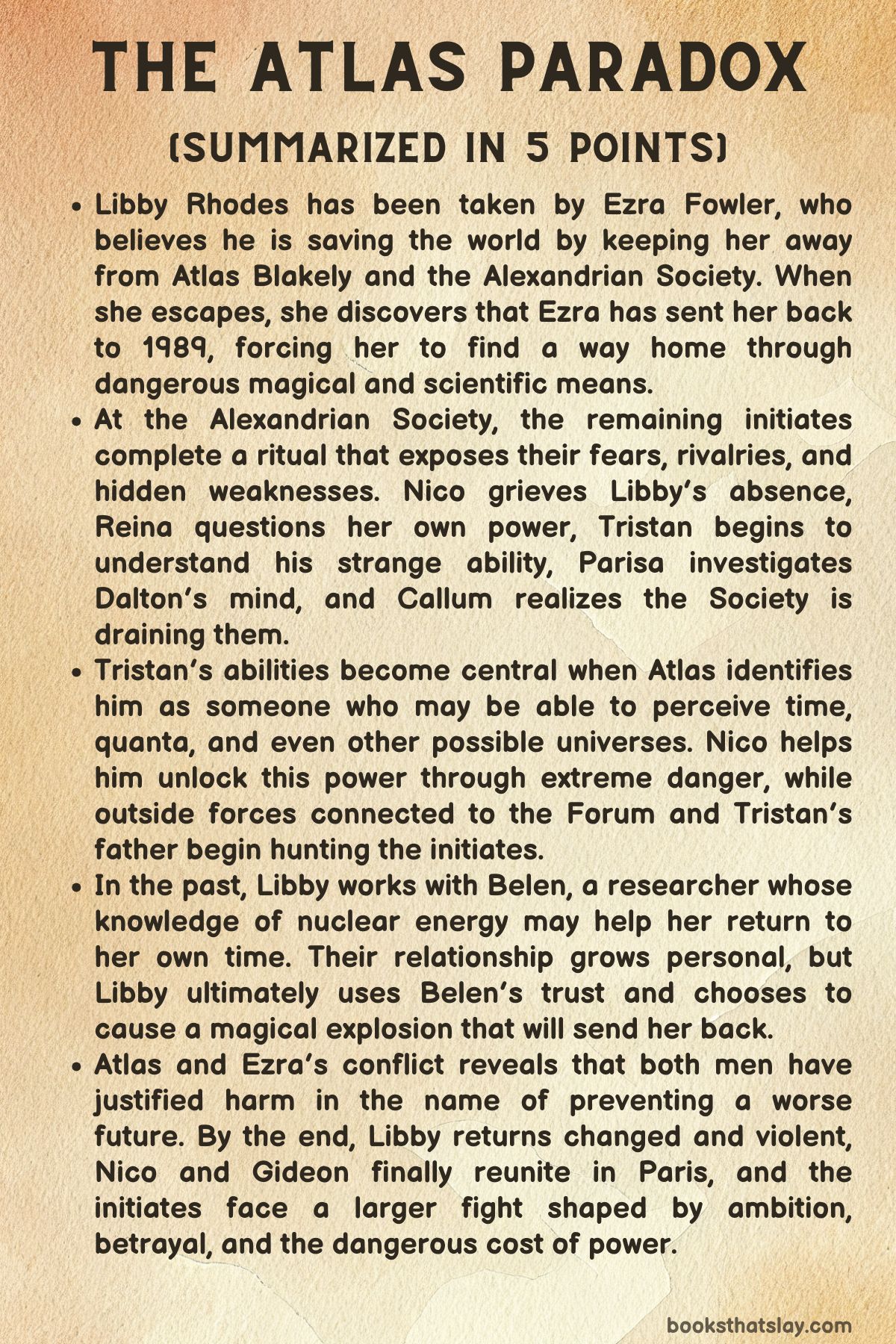
Summary
Gideon Drake moves through dreams with an ease that sets him apart from other magical beings. With his roommate Max beside him in the form of a black Labrador, he searches for Nico de Varona, whose absence has become a steady ache in his life.
Gideon’s talent lets him cross boundaries between subconscious and conscious states, but even he struggles to slip through the protections surrounding the Alexandrian Society. When he finally reaches Nico in a dream, he brings important news: he is close to finding Libby Rhodes, who has been missing for a year.
Libby is not dead, as many of the Society’s initiates feared. She has been taken by her former boyfriend, Ezra Fowler, who believes he is protecting the world by keeping her away from Atlas Blakely and the Alexandrian Society.
Ezra thinks Atlas’s plans will end in disaster, and he sees Libby as a central danger. Libby, trapped in a room prepared for a long stay, slowly realizes that Ezra does not want to kill her.
He wants to control where she is, when she is, and what she can become.
At the Society, the remaining initiates continue without her, though her absence distorts everything. Nico, Reina, Tristan, Parisa, and Callum undergo a ceremonial trial on the astral plane.
Each must face a projection shaped by their own understanding of another person. The ritual exposes their weaknesses more than their strengths.
Nico’s projection of Reina reveals that he does not truly see her as a threat, wounding her pride and reopening her fear that emotional closeness makes her vulnerable. Reina has spent much of her life protecting her power by withdrawing from others, and Nico’s view of her feels like a betrayal.
Tristan’s trial is harsher. He faces a projection of Libby, who attacks him with fire.
The experience forces him into a strange shift of perception, allowing him to move through time or reality in a way he does not yet understand. Parisa, watching closely, realizes the trial is doing more than testing them; it is revealing their weaknesses to someone or something.
Atlas sees Tristan differently after this, as if Tristan may be the answer to a question Atlas has been pursuing for years. Callum’s trial, meanwhile, forces everyone to see the cost of his empathy.
He can change and absorb emotional states, but the pain he softens in others often becomes his own.
Nico remains consumed by Libby’s disappearance and by Gideon’s visits in dreams. Gideon tells him that Libby has been located but is difficult to reach, partly because she is skeptical even inside her own dreams.
Nico also learns that Gideon has agreed to perform a dangerous task for his mother, Eilif: freeing someone from a prison inside the mind. Nico worries for him but is distracted when Tristan asks for help understanding his own power.
Tristan believes that he can only activate it under the threat of death, so he asks Nico to try to kill him.
Reina begins searching the archives for information about longevity, gods, and old magical figures who seem to have died too young despite powerful abilities. She suspects the archives are sentient and withholding books from her because her questions are dangerous.
She recruits Callum, hoping his empathic influence combined with her naturalist power can manipulate the archive into giving her forbidden texts. Callum hesitates, but he also begins to see how the library may be using them all, draining their powers because the initiation has not been completed in the violent way the Society expects.
Parisa investigates Dalton Ellery, the Society’s caretaker, and discovers something hidden inside him: a younger, trapped version of himself, later identified as the Prince. This part of Dalton appears to hold his ambition, which Atlas separated and imprisoned.
The Prince may have created the false body that made the initiates believe Libby was dead. Parisa’s visits make the Prince stronger, and she eventually helps bring about his escape without understanding the full consequences.
Dalton becomes less stable afterward, more complete in one sense but more dangerous in another.
Libby escapes Ezra’s prison by using her power, setting fire to the motel where he held her. She finds herself in Los Angeles, but something is wrong.
A newspaper reveals that she is in 1989. Ezra has not merely hidden her in another place; he has displaced her in time.
Alone, exhausted, and angry, Libby searches for a way back. She enters a magical academic environment in Los Angeles and begins working with doctoral students whose knowledge is behind her own.
To return, she must generate enough energy to open a path through time, and she begins to think about nuclear power as a source.
Ezra, meanwhile, meets with a coalition opposed to the Alexandrian Society. These people include representatives from political, corporate, magical, and intelligence circles.
Their stated goal is to expose the Society and make its knowledge public, but their motives are not pure. Ezra believes that capturing the initiates will prevent the future he has seen, yet his plan grows increasingly unstable.
Atlas confronts him and reveals that he knows Ezra took Libby. Ezra still believes Atlas is the greater threat, but he is forced to recognize that many of his allies may be willing to kill rather than simply expose.
At the Society, Nico and Tristan train brutally. Nico repeatedly threatens Tristan’s life, trying to force his ability into action.
At first, Tristan cannot respond because he trusts that Nico does not truly mean to kill him. Eventually, Nico attacks him while he sleeps, creating real fear.
Tristan’s power answers. He begins to perceive reality in terms of quanta, matter, time, possibility, and alternative structures.
Atlas later explains that Tristan may be able to locate other universes, making him crucial to Atlas’s larger plan.
Libby’s path in 1989 brings her close to Belen, a young researcher studying fission. Belen helps Libby think about ley lines and energy sources, and their connection becomes personal.
Libby is drawn to her but also knows she is using her. When Tristan, projecting from the future, reaches Libby at Callanish Circle, he explains that she needs nuclear energy and that records indicate she will eventually cause a magical explosion at a Wessex testing site in Nevada in 1990.
No one dies, but the event has lasting consequences. Libby realizes that her future may already be fixed because she has already done what she is now deciding whether to do.
Belen feels betrayed when she learns the truth. Libby has not been honest about who she is, where she comes from, or what their research is for.
Belen understands that her own hopes for academic recognition were part of Libby’s plan, whether Libby meant to be cruel or not. Libby chooses herself and her return over Belen’s judgment.
She goes to Nevada and prepares to create the explosion that will send her back. This choice marks a major change in her character.
The old Libby wanted to be good, responsible, and morally certain. The new Libby accepts that survival may require becoming someone harder.
In the present, the initiates prepare to leave the Society’s protection after their first period of study ends. Parisa suggests they confuse their enemies by going to one another’s homes instead of their own.
The plan works only partly, as they are still attacked. Nico goes to Paris to meet Gideon in person, but the reunion is interrupted by attackers.
Reina and Callum confront the forces linked to Tristan’s father, Adrian Caine. Parisa meets Dalton in Osaka and begins considering a future in which they use the Forum or remake the world by opening a door to another one.
Atlas allows Ezra into the Society, and their confrontation reveals the broken origin of Atlas’s mission. Atlas once tried to make a new world, and the attempt led to the deaths of the other initiates in his class.
He has continued because abandoning the project would make those deaths meaningless. Ezra, who has spent years trying to stop him, begins to see that his own choices have also led to bloodshed.
He came seeking forgiveness more than victory. Then Libby arrives, furious and changed by everything he did to her.
She attacks him with fire. Later, she appears in Paris, covered in blood, and collapses into Nico’s arms, while Nico and Gideon’s relationship finally crosses from longing into open affection.
Characters
Libby Rhodes
Libby Rhodes is one of the central forces of The Atlas Paradox, and her journey is defined by displacement, anger, intelligence, and moral transformation. At the beginning of the book, she is physically absent from the Alexandrian Society but emotionally present in everyone’s fear, guilt, longing, and strategy.
Ezra’s decision to abduct her is rooted in his belief that she is dangerous, and the book gradually shows why that belief is not entirely baseless. Libby is brilliant, powerful, and capable of extraordinary magical work, but she has also spent much of her life trying to be good in a controlled, acceptable way.
Being trapped in the past breaks that structure. In 1989, she is forced to rely on herself without the approval of her peers or the rules of the Society.
Her relationship with Belen exposes the conflict between her desire for connection and her willingness to use people when survival is at stake. By the end, Libby is not simply returning home; she is returning as someone who has accepted the frightening scale of her own agency.
Nico de Varona
Nico de Varona is driven by loyalty, restlessness, and a need to matter to the people he loves. His grief over Libby’s disappearance keeps him emotionally fixed on rescue, even while the Society pulls him toward new forms of ambition.
He begins as someone whose deepest reason for joining the Society was Gideon, since he hoped the archives could help him understand and protect his friend’s dangerous dream-walking power. Yet Nico’s own abilities become more important as the book progresses.
His experiments with Tristan reveal both his brilliance and his capacity for recklessness. He is willing to hurt Tristan because he believes the result will unlock something necessary, but his morality still limits him until he convinces himself to create real danger.
Nico’s relationship with Reina deteriorates because she realizes that his love and loyalty have boundaries he does not always admit. With Gideon, however, he is emotionally open in a way he rarely allows elsewhere.
His reunion with Gideon in Paris makes visible a tenderness that has shaped him all along.
Gideon Drake
Gideon Drake exists at the edge of the main action, yet his role is crucial because he connects the physical plot to the dream realm. He is rare even among magical beings because he can consciously move through dreams and enter minds in ways others cannot.
That gift makes him powerful, but it also makes him vulnerable to being used. His mother, Eilif, draws him into a task that places him against forces far beyond ordinary dream-walking, including the prison inside Dalton’s mind where the Prince is held.
Gideon is gentle in many ways, especially in his bond with Nico, but the book never treats gentleness as weakness. His power is dangerous precisely because it bypasses ordinary defenses.
He can reach people who should be unreachable, including Libby in the past and Nico behind the Society’s wards. His longing for Nico gives his chapters emotional weight, while his encounters with Parisa show that he is not merely a messenger or romantic figure.
He is a serious magical force with consequences attached to every choice.
Ezra Fowler
Ezra Fowler is a character built around justification. He believes he is choosing the lesser evil, but his choices steadily reveal how easily fear can become control.
His abduction of Libby is framed, in his mind, as an act of prevention. He has seen enough of Atlas’s plans to believe that the world is at risk, and he convinces himself that removing Libby from the equation is necessary.
Yet the cruelty of what he does cannot be erased by his stated purpose. He imprisons her, manipulates time, lies to collaborators, and places others in danger while telling himself that he is protecting the future.
Ezra’s opposition to the Society is also compromised by the people he works with. The Forum claims transparency, but its members are just as willing to exploit power as the Society is.
By the time Ezra confronts Atlas near the end of the book, he is no longer simply an enemy of Atlas. He is a man facing the fact that his moral compromise has produced its own destruction.
Reina Mori
Reina Mori’s power is tied to nature, but her emotional life is marked by isolation and distrust. Her childhood taught her that people would value her for what her power could do, not for who she was.
The “Businessman” represents that early exploitation, and Reina’s response has been to withdraw, refusing to give others access to her abilities or vulnerabilities. Her anger at Nico after the initiation ceremony comes from the realization that he has seen her too closely while still underestimating her.
Reina’s arc in the book is not about becoming powerful; she already is. It is about deciding whether refusing power is truly safety or simply fear in another form.
Her research into gods, natural order, and the Anthropocene shows a growing belief that her abilities may carry responsibility. Her alliance with Callum is surprising because their powers differ so sharply: hers belongs to the natural world, his to human emotion.
Together, they represent a possible balance, but Reina’s ambition also becomes more severe as she begins to imagine herself as an agent of correction.
Tristan Caine
Tristan Caine is one of the most unstable and important figures in The Atlas Paradox because his power changes the scale of the entire story. At first, he is trapped by guilt over Libby and Callum.
He has already participated in betrayal, and the initiation ceremony forces him to confront the emotional wreckage of his choices. His ability to see through illusions and perceive the structure beneath reality separates him from the other initiates, but he does not understand what he is until danger pushes him into new perception.
The training with Nico is brutal, and it reveals Tristan’s desperation to understand himself even at the cost of bodily harm. Atlas recognizes that Tristan may be able to perceive quanta, alternate realities, and the hidden architecture of the multiverse.
That makes Tristan valuable to everyone: Atlas, the Forum, his father, and the initiates. Yet Tristan is also emotionally exhausted.
His decision to work with Atlas is not simple loyalty; it comes from being hunted, cornered, and tired of having no safe place to stand.
Parisa Kamali
Parisa Kamali is a telepath who understands that intimacy, information, and power are rarely separate. She reads people with precision, often seeing the desires and fears they try hardest to conceal.
Because of this, she is both one of the most dangerous and one of the most perceptive characters in the book. Her relationship with Dalton becomes central because she finds the imprisoned Prince within him and continues to visit that hidden part of his mind.
Parisa often believes she is in control because she knows more than others, but the Dalton storyline challenges that confidence. By strengthening the Prince, she helps release something that Atlas had deliberately contained.
Her connection with Atlas is also tense because they recognize each other’s capacity for manipulation. Parisa refuses to be merely useful to him, yet she is tempted by the scale of what he knows.
Her final movement toward Dalton suggests that she may prefer creation over preservation, even if that creation requires moral abandonment.
Callum Nova
Callum Nova is often cruel, detached, and performative, but the book complicates him by revealing the cost of his empathic ability. He can alter emotional states and influence people, yet what he removes from others does not vanish.
He absorbs it, and that burden has shaped his cynicism. His relationship with Tristan is one of the book’s most strained emotional lines.
Tristan’s earlier willingness to kill him leaves Callum wounded in a way he tries to hide through sarcasm and control. Callum’s alliance with Reina gives him a new direction because it allows him to use his power toward a project larger than personal survival.
He recognizes Atlas’s depression and understands that the Society is feeding on them because the expected sacrifice has not been completed. Callum is dangerous because he sees human weakness clearly and can manipulate it, but he is not empty.
His planning, resentment, and occasional honesty show a man who has been hurt enough to distrust sincerity, even when he wants it.
Atlas Blakely
Atlas Blakely is the central architect of danger in The Atlas Paradox, though the book resists making him a simple villain. He is secretive, manipulative, and responsible for terrible choices, including the deaths connected to his own initiation class.
His great project appears to be an attempt to reach or create another world, and he has continued because stopping would mean admitting that the dead were lost for nothing. That logic makes him frightening.
Atlas is not reckless in the ordinary sense; he is disciplined, patient, and willing to let people become tools in a plan whose full shape only he understands. His relationship with Dalton reveals how far he will go to make someone useful, including separating ambition from a person’s mind.
His conversations with Ezra expose a weary self-awareness beneath his authority. Atlas knows he has made grave mistakes, but he also believes he may still be able to correct the path.
His tragedy is that he can recognize damage without surrendering the system that caused it.
Dalton Ellery
Dalton Ellery begins as the Society’s caretaker, but his identity becomes one of the book’s major mysteries. He appears controlled, polite, and bound to the Society’s rules, yet Parisa discovers that his mind contains a hidden, younger self known as the Prince.
This buried part of Dalton holds ambition, desire, and creative force, all of which Atlas separated to make Dalton safer or more useful. The result is a man who has been altered so deeply that even his self-knowledge cannot be trusted.
Dalton’s research into creation, chaos, and cosmic origin becomes more alarming once the Prince is released. He is not simply studying the beginning of worlds; he may want to open a path into another one.
His relationship with Parisa grows from seduction into partnership, but it remains ethically unstable because both of them are drawn to power and secrecy. Dalton’s transformation shows the danger of dividing a person for a purpose.
What was removed from him does not disappear; it returns changed and hungry.
Belen
Belen is one of the most important characters introduced through Libby’s time in the past. She is intelligent, ambitious, and eager to be taken seriously in a scientific environment that does not fully value her.
Her bond with Libby begins through shared research, but it becomes emotionally charged as Belen recognizes both Libby’s brilliance and her hidden pain. The betrayal cuts deeply because Libby does not merely keep secrets; she uses Belen’s knowledge, time, and hope for a purpose that Belen cannot truly consent to because she does not know the full truth.
Years later, Belen’s anger becomes political. She connects with the Forum, sees its hypocrisy, and eventually concludes that public knowledge alone does not create justice.
Her later life, including her funding of revolutions, shows how personal betrayal can harden into global disillusionment. Belen is not just a person Libby hurt.
She is proof that the consequences of Libby’s return ripple outward for decades, shaping institutions, resistance movements, and the future Libby came from.
Max
Max is Gideon’s roommate and appears in the dream realm as a black Labrador, a form that gives him an unusual presence in the book. Though he is not central to the political conflicts surrounding the Alexandrian Society, he helps define Gideon’s world and the strangeness of dream travel.
His companionship makes Gideon’s early scenes feel less isolated, and his form suggests comfort, loyalty, and grounding in a space where ordinary rules do not apply. Max also helps show that Gideon’s life exists beyond Nico, even though Nico remains Gideon’s deepest emotional focus.
In a story filled with people who manipulate, recruit, and test one another, Max’s role is quieter. He represents steadiness in an unstable realm, a presence beside Gideon as he crosses psychic landscapes that would otherwise feel empty and dangerous.
His importance lies less in action than in atmosphere and relationship, giving Gideon’s gift a lived-in quality rather than making it seem purely abstract.
Eilif
Eilif, Gideon’s mother, is significant because she pulls Gideon into a dangerous task that links the dream realm to the larger struggle around the Society. As a mermaid, she belongs to a magical world that exists alongside medeian institutions but follows its own rules and pressures.
Her request that Gideon break someone out of a consciousness places him in direct contact with the Prince inside Dalton, even if Gideon does not understand the full meaning of what he is doing. Eilif’s influence shows that Gideon is not independent of family obligations, and his power makes him useful to forces outside the Alexandrian Society.
She also complicates the idea that the main conflict is only between Atlas and the Forum. Other magical communities have their own interests, and Gideon can be pulled into them because of blood, loyalty, or fear.
Eilif’s presence reminds the reader that every powerful person in the story is connected to someone else’s agenda.
The Prince
The Prince is the separated part of Dalton that contains ambition, hunger, and creative force. He is not a separate person in the ordinary sense, but he behaves with enough awareness and desire to become one of the book’s most unsettling figures.
His imprisonment inside Dalton’s subconscious raises difficult questions about identity. If Atlas removed this part of Dalton to make him safer, then Dalton’s calmness was built on violation.
If the Prince created the false Libby body, then the hidden part of Dalton had agency even while buried. Parisa’s contact with him strengthens him, and his escape briefly threatens to animate the house itself.
The Prince matters because he exposes the violence beneath the Society’s polished control. Ambition cannot be cut out of a person without consequences.
Once restored, it does not return as a harmless missing piece; it returns with the force of everything denied, contained, and watched for too long.
Themes
Power as a Form of Dependence
Power in The Atlas Paradox does not make the characters free. It makes them more visible, more useful, and more vulnerable to being claimed by systems larger than themselves.
The Alexandrian Society promises knowledge, prestige, and access, but the initiates slowly learn that membership also means being studied, drained, directed, and possibly sacrificed. The more exceptional their abilities are, the less private their lives become.
Tristan’s power makes him a target for Atlas, the Forum, and his father. Libby’s power makes Ezra believe he has the right to imprison her for the sake of the future.
Reina’s naturalist ability makes others want to use her long before she understands what she wants to do with herself. Even Callum, who can control emotional atmospheres, pays physically and mentally for what he changes in others.
The book repeatedly challenges the fantasy that power is simple mastery. Power creates appetite around the powerful person.
It invites institutions to categorize them, enemies to hunt them, and allies to rationalize harm in the name of potential.
The Corruption of Moral Certainty
Many characters do terrible things because they believe they are preventing something worse. Ezra kidnaps Libby because he thinks Atlas will destroy the world.
Atlas manipulates and sacrifices because he believes his research may correct an old catastrophe. The Forum claims openness and public good, yet its members are willing to capture or kill people who stand in the way.
Libby lies to Belen and uses her research because returning home feels necessary. The danger is not that these characters have no morals; it is that they have morals strong enough to excuse cruelty.
Once someone believes they understand the future better than everyone else, consent becomes easy to ignore. The book treats certainty as one of the most dangerous forms of power because it allows characters to stop seeing others as full people.
Ezra sees Libby as a threat before he sees her as a person he has betrayed. Atlas sees the initiates as possible answers.
Even Libby, who begins as one of the more ethically anxious characters, learns to choose herself in a way that leaves damage behind.
Knowledge, Secrecy, and Institutional Control
The Alexandrian Society is built on the control of knowledge. Its archives contain extraordinary resources, but access is selective, guarded, and shaped by a sentience that appears to judge what seekers should be allowed to know.
This raises one of the book’s central tensions: whether dangerous knowledge should be hidden, shared, or destroyed. Reina’s denied requests show that the archive is not a neutral library.
It has preferences, fears, and perhaps survival instincts. The Forum positions itself as the answer to this secrecy, arguing that knowledge should be made public, but the book refuses to present that as a clean solution.
Public exposure does not automatically create justice, and Belen’s later disillusionment makes that clear. People can know the truth and still do nothing.
Institutions can speak the language of transparency while reproducing the same hunger for control. The Society hides knowledge to preserve power; the Forum wants to reveal knowledge in order to redirect power toward itself.
Between them, the characters struggle to imagine a form of knowledge that does not immediately become ownership.
Identity, Division, and the Cost of Becoming
The book repeatedly shows characters split between who they were, who others need them to be, and who they are becoming under pressure. Dalton is the clearest example, because Atlas has literally separated his ambition into the Prince, leaving him incomplete and unaware of his own inner fracture.
Yet the same pattern appears emotionally in other characters. Libby separates herself from the old version who needed to be good, choosing a harder self capable of causing a magical nuclear event to return home.
Tristan must abandon his old understanding of reality once he realizes that he can perceive time, quanta, and possibility differently from everyone around him. Reina has to decide whether her detachment is wisdom or fear.
Nico is divided between loyalty to others and fascination with his own expanding power. Becoming, in this story, is not gentle self-discovery.
It is often violent, embarrassing, and morally costly. To become more fully oneself may mean recovering a buried desire, accepting a frightening capacity, or admitting that the person one tried to be was built to survive a smaller world.