The Atlas Six Summary, Characters and Themes
The Atlas Six by Olivie Blake is a dark academia fantasy novel about power, knowledge, ambition, and moral compromise. The story follows six extraordinary medeians invited to compete for initiation into the secret Alexandrian Society, an elite magical organization that guards the hidden Library of Alexandria.
Access to the Society means access to impossible knowledge, political influence, and near-limitless power, but only five of the six candidates will be accepted. As alliances form and break, the candidates discover that the cost of entry is far more violent and personal than they expected. It is the first book of the Atlas series by the author.
Summary
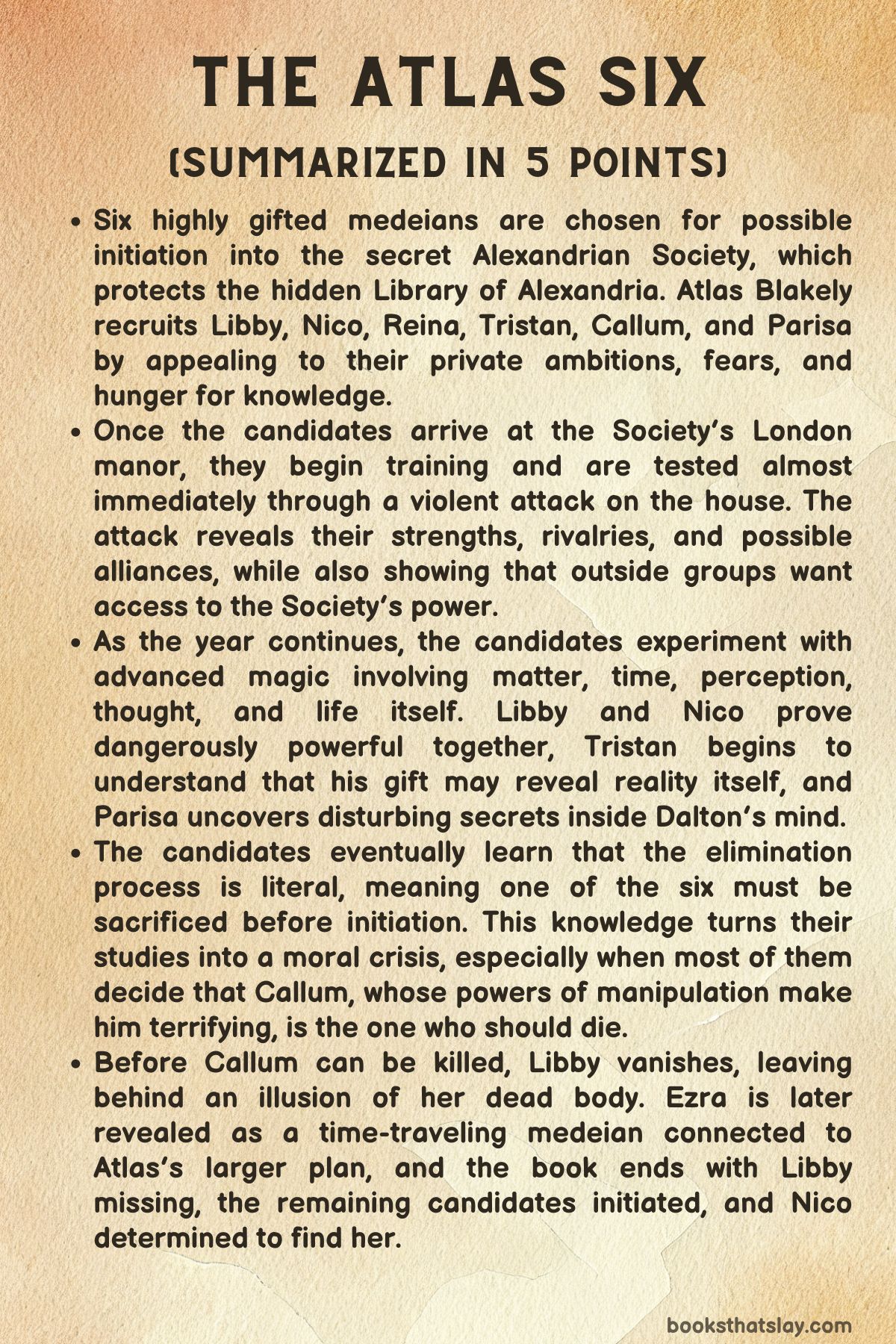
The Atlas Six begins with the hidden history of the Library of Alexandria. The world believes the Library was destroyed, but its burning was actually a magical deception designed to protect its knowledge from human greed.
Since then, the Library has existed under the protection of the Alexandrian Society, a powerful secret order made up of the most gifted magical scholars, known as medeians. Every ten years, six candidates are chosen for possible initiation.
They are given a year to study, compete, and prove themselves. At the end, only five are accepted, though the true meaning of that selection is not immediately made clear.
The newest six candidates are selected by Atlas Blakely, the Society’s Caretaker. Libby Rhodes and Nicolás Ferrer de Varona are chosen first.
They are graduating together from the New York University of Magical Arts as rivals and co-valedictorians. Both are physicists of magic, capable of manipulating matter with extraordinary skill.
Their rivalry is intense, bitter, and almost inseparable from their identities. Libby is anxious, hardworking, and desperate to prove that she is not inferior to Nico, while Nico enjoys provoking her and seems to thrive on their conflict.
After graduation, Atlas offers them a place among the six most gifted medeians in the world.
Reina Mori is selected next. She has the rare ability to command and accelerate plant life, though she has spent much of her life resenting her power because nature constantly demands energy from her.
Rather than embracing her talent, she has tried to distance herself from it by studying mythology. Atlas approaches her with the promise of ancient books and rare knowledge, and despite her caution, she accepts.
Tristan Caine is also recruited. He works for the wealthy James Wessex and is engaged to Wessex’s daughter, Eden.
Tristan is the son of a criminal figure and has worked hard to reshape himself into someone respectable. His power allows him to see through illusions and magical deceptions, though even he does not fully understand the extent of what he can do.
Callum Nova, who works in his family’s media empire, is chosen for his dangerous ability to influence emotion and thought. He is intelligent, cruel, bored, and very aware of how easily people can be moved.
Parisa Kamali, a telepath who uses beauty, desire, and perception as tools, completes the group.
The six candidates are brought together and introduced to the Society by Dalton Ellery, who explains the structure and prestige of the organization. They are given a short time to decide whether to accept.
Each candidate has private reasons for wanting the Society’s knowledge. Nico wants access to the archives partly to protect his best friend Gideon, a dream-walker whose criminal mother has used him for her own purposes.
Libby wants validation and independence, especially from the expectations of her boyfriend, Ezra Fowler. Tristan wants to understand why he has been chosen, since he thinks his gift is less impressive than the others’.
Parisa wants to uncover secrets. Reina wants access to knowledge.
Callum wants a challenge worthy of his abilities.
Once the candidates arrive at the Society’s London manor, they are asked to design a security protocol for the Library. Their first days reveal immediate tensions.
Nico, Libby, and Reina belong more clearly to physical magic, while Parisa, Callum, and Tristan are tied to more abstract forms of power. Before they can settle into academic life, the manor is attacked by outside operatives.
The candidates are forced into combat, where their abilities and instincts are tested. Nico and Reina fight together, and Nico uses Reina’s power as an energy source.
Libby and Tristan discover that Tristan’s ability to see through illusion can guide Libby’s attacks. Parisa and Callum handle their own attackers in a disturbing way that later proves important.
After the violence ends, Atlas reveals that the attack was expected. It was an unofficial test, made possible because enemies of the Society always try to breach its defenses when new candidates arrive.
He names the Forum as one of those enemies, a group that believes knowledge should be freely available rather than hoarded by the Society.
As their studies continue, the candidates gain partial access to the archives and begin experimenting with more advanced magic. Libby and Nico manage to create a wormhole, showing how powerful they can become when they work together.
Libby also discusses time and space with Tristan and begins to wonder whether time travel is possible. Tristan starts to realize that he may not simply see through illusions.
His power may allow him to perceive the true nature of reality itself. With Libby’s help, he learns that he can sense time, and she briefly stops time by using his perception as a guide.
Personal relationships grow more complicated. Parisa becomes interested in Dalton and suspects that he is hiding something.
By manipulating his attraction to her, she learns that the elimination process is literal: the five who remain are not merely selected over the sixth; the sixth is expected to die. This knowledge spreads unevenly among the candidates.
Some learn it earlier than others, and each reacts according to their nature. Reina accepts the reality with cold practicality.
Nico is disturbed but tries to understand what must be done. Tristan becomes trapped between morality, fear, and his growing attachment to Callum.
Libby is the last to learn the truth and feels betrayed by the others’ evasions.
The Forum attempts to recruit several of the candidates during a Christmas break. Reina rejects them because she refuses to be used by anyone.
Libby rejects them angrily when they exploit the death of her sister, Katherine, as an argument for open knowledge. Parisa and Tristan also encounter Forum members but do not accept their offers.
These approaches show that the Society is not the only powerful force at work and that the candidates are being watched from outside as well as inside.
The psychological pressure among the six intensifies. Parisa and Callum stage a contest of power in front of the others.
Callum exposes Parisa’s painful past, including the way her brother’s possessiveness shaped her use of desire as a weapon. He pushes the illusion so far that it appears Parisa jumps to her death, only for her to reveal that the scene happened inside Nico’s mind and that she controlled the frame of the encounter.
Although Callum is declared the technical winner, the others see the ugliness of what he did. His victory leaves him more isolated.
As the deadline for initiation approaches, the candidates begin considering who should die. Atlas gives several of them an opportunity to speak without Callum present, and Parisa urges them toward the obvious conclusion: Callum is the most dangerous choice to keep alive.
Libby argues that Tristan should be the one to kill him, because Tristan’s emotional connection to Callum would create the necessary balance. Tristan confronts Callum, but Callum already understands what is happening.
He manipulates Tristan’s guilt and history, and when Tristan cannot complete the act, Callum takes the knife and threatens him instead.
Before anything can happen, Libby screams. The others break into her room and find what appears to be her dead body.
Tristan, however, uses his power and realizes that the body is an illusion. Libby is not dead; she has been taken.
The group searches for weeks without success. Nico is devastated and refuses to accept that she is gone.
Gideon suggests that Libby may have been removed from ordinary reality, possibly hidden in another dimension of time. Nico realizes that this would require immense power, but he promises to find her.
The truth shifts toward Ezra Fowler. Ezra is not merely Libby’s boyfriend.
He is a medeian with the ability to move through time. Earlier in life, he tried to save his mother from death and learned that some events are fixed.
Because of his time-jumping, he ages more slowly. Years before, he was recruited into the Society, where he met Atlas.
Together, they developed a plan to use the Library’s power to break the Society’s old structure and reshape the world. Atlas remained inside the organization and rose to become Caretaker, while Ezra stayed hidden and helped identify the perfect candidates.
Over time, however, Ezra began to doubt Atlas’s motives. To stop Atlas from using Libby, Ezra abducted her and hid her in an unknown dimension of time.
With Libby gone, the Society treats her absence as the required elimination, and the initiation proceeds. Nico forces the others to promise that they will help him find her.
Dalton watches the ritual and reflects that the initiates are binding themselves to powers and obligations they do not yet understand. The book ends with the surviving candidates inside the Society, Libby missing, Ezra revealed as a far more important player than he seemed, and Atlas’s true plans still uncertain.
Characters
Libby Rhodes
Libby Rhodes is one of the emotional and intellectual centers of The Atlas Six, and her character is built around insecurity, discipline, anger, and enormous power. She is introduced as Nico’s academic equal, but she does not experience that equality as comfort.
Instead, she constantly measures herself against him, interpreting their rivalry as proof that she must keep proving her worth. Her skill in physical magic is exceptional, especially in relation to matter, space, and later time, but her confidence lags behind her ability.
Libby often behaves as though achievement can quiet her self-doubt, yet every success only creates another standard she feels forced to meet. Her relationship with Ezra shows her struggle for independence.
She wants love and support, but she resents being managed or protected. Her grief over her sister Katherine also explains the emotional force behind her rejection of the Forum; they try to use her private pain as an argument, and she sees it as exploitation.
Libby’s moral instincts are strong, but the Society tests them by forcing her to consider sacrifice in intellectual terms. Her abduction removes her from the final initiation, but it also confirms her importance.
She is not disposable; she is valuable enough for Ezra to hide, and powerful enough for both Atlas and others to fear what she might become.
Nicolás Ferrer de Varona
Nicolás Ferrer de Varona, usually called Nico, is charming, brilliant, reckless, and more emotionally loyal than he first appears. In the book, he often uses humor and arrogance as armor, especially around Libby.
Their rivalry is not simple hatred; it is a form of dependence neither of them wants to admit. Nico defines himself through opposition to Libby, yet he trusts her abilities and repeatedly works best when paired with her.
His deepest loyalty belongs to Gideon, whom he has protected from Eilif without fully explaining the danger. This hidden protectiveness reveals Nico’s core conflict: he wants to appear effortless and untouchable, but he is driven by attachment and fear of losing the people he loves.
His magic is versatile and powerful, especially when combined with Reina’s energy or Libby’s precision, but he sometimes overreaches and places himself at risk. Nico’s reaction to Libby’s disappearance shows the sincerity beneath his performance.
He refuses to accept her loss as convenient or final, even when the Society moves forward without her. His insistence that the others help find her turns him from rival and provocateur into someone capable of leadership through loyalty.
Reina Mori
Reina Mori is quiet, detached, and deeply self-possessed. Her ability to influence plant life makes her one of the most naturally powerful candidates, but she experiences her gift almost as a burden because nature constantly pulls from her energy.
This creates an unusual tension in her character: she has immense power, yet her first instinct has been refusal rather than ambition. Her choice to study mythology instead of fully embracing her magic suggests a desire to define herself outside the demands placed on her by nature, family, and magical society.
Once inside the Society, however, Reina begins to see a life that suits her. She values access to rare texts, intellectual freedom, and the chance to exist without apology.
Her morality is not sentimental. When asked whether she would kill for this life, she answers plainly, not because she is cruel in the same way Callum is, but because she has already decided that survival and self-interest matter.
She also notices patterns others miss, including oddities around Dalton and Atlas. Reina’s calmness makes her easy to underestimate, but she is one of the clearest thinkers in the story because she is not desperate to be liked or understood.
Tristan Caine
Tristan Caine is one of the most conflicted figures in The Atlas Six because his central struggle is not a lack of power but a lack of self-knowledge. At first, he believes his gift is limited to seeing through illusions and charms.
Compared to the more dramatic abilities of the others, this makes him feel like a mistake in the selection. Atlas’s attention forces him to reconsider that assumption.
Tristan may be able to see reality more clearly than anyone else, including the structure of time and the true nature of magical phenomena. This makes him valuable, but it also makes him vulnerable, because perception does not automatically create certainty.
His background as the son of a crime lord shapes his hunger for legitimacy, and his engagement to Eden connects him to a world of wealth and status that he has worked hard to enter. His bond with Callum is especially dangerous.
Callum reads his weaknesses and manipulates his emotions, yet Tristan is still drawn to him. His connection with Libby is different; through her experiments, he feels useful and intellectually alive.
Tristan’s inability to kill Callum when asked shows both his moral hesitation and his emotional entrapment. He can see truth, but acting on it is much harder.
Callum Nova
Callum Nova is the book’s most openly unsettling candidate. His power lies in influence, persuasion, and emotional control, and he uses it with very little guilt.
He understands people as systems of desire, fear, vanity, and pain, and he treats those systems as instruments. His cruelty is not impulsive; it is analytic.
He pushes people because he wants to see what they are made of and because ordinary success bores him. His role in convincing an enemy medeian to kill herself reveals the terrifying practical force of his magic.
His contest with Parisa exposes even more of his character. He attacks her past not simply to win but to possess the narrative of her pain, turning her own memories into weapons.
Yet his victory leaves him empty because the others respond with disgust rather than admiration. Callum’s relationship with Tristan adds another layer.
He seems capable of attachment, but even that attachment is infected by manipulation. When he realizes Tristan may have discovered his influence, he tries to regain control through guilt and fear.
Callum is dangerous because he does not merely harm bodies; he alters the inner conditions that allow people to choose freely.
Parisa Kamali
Parisa Kamali is a telepath whose beauty, intelligence, and emotional control make her one of the most formidable candidates. She has learned to read desire as both information and currency, and she often uses attraction to gain access to what people would otherwise hide.
Yet Parisa is not a shallow seductress; her behavior grows from a history of violation, control, and self-protection. Her past with her brother taught her that desire could become a cage, so she turned it into a weapon she could command.
This makes her morally complex. She manipulates Libby, Tristan, Dalton, and others, but she also sees more clearly than most how power operates beneath polite surfaces.
Her pursuit of Dalton begins as strategic curiosity but becomes tied to a genuine desire to understand and free the trapped younger version of him inside his mind. Parisa’s contest with Callum shows both her vulnerability and her strength.
He reaches painful truths about her, yet she controls the larger frame and refuses to be reduced to his interpretation. In The Atlas Six, Parisa stands out because she knows that intimacy is never separate from power, and she uses that knowledge with precision.
Atlas Blakely
Atlas Blakely is the architect of the candidates’ experience and one of the story’s most controlled mysteries. As Caretaker of the Alexandrian Society, he presents himself as composed, authoritative, and intellectually superior.
He knows how to give people just enough information to make them curious while withholding enough to keep them dependent. His recruitment style is revealing: he approaches each candidate through their private hunger, whether that is knowledge, ambition, recognition, safety, or purpose.
Atlas appears to believe in large designs rather than ordinary morality. The candidates are not simply students to him; they are pieces in a plan shaped over many years.
His past connection with Ezra shows that his loyalty to the Society is not straightforward. At one point, he and Ezra shared a desire to challenge or transform the institution, but Atlas’s current motives are uncertain.
He allows danger, secrecy, and possible death to define the initiation process, justifying it through balance and sacrifice. Atlas is frightening because he rarely seems surprised.
Even when others discover secrets, he appears to have anticipated more than he admits. His calmness makes him powerful, but it also makes him difficult to trust.
Dalton Ellery
Dalton Ellery serves as the candidates’ guide inside the Society, but his role is far more tragic and unstable than it first appears. He explains rules, history, and expectations with the authority of someone who has survived the same path, yet his own initiation has left deep damage.
Dalton’s specialty is animation, and this becomes central to the mystery around him. Parisa discovers that part of his mind contains a younger version of himself who remembers or represents the act of killing another initiate.
The real Dalton does not fully understand what is hidden inside him, which suggests that the Society has not simply trained him but altered or divided him in some way. His attraction to Parisa weakens his defenses, but it also creates one of the few spaces where his buried self can be seen.
Dalton is both participant and victim. He upholds the system that harmed him, yet part of him wants release from it.
His presence warns the candidates that initiation does not end danger; it may only bind them more tightly to forces they cannot control.
Ezra Fowler
Ezra Fowler begins as Libby’s protective boyfriend, but he is eventually revealed as one of the most important hidden forces in the story. His early behavior toward Libby can appear merely anxious or possessive, especially when he worries about Nico and the Society, but those concerns come from knowledge he has concealed.
Ezra is a time traveler who has already lived through a long and complicated relationship with the Alexandrian Society. His ability has shaped his entire life, especially after his failed attempt to save his mother taught him that some moments cannot be changed.
Time travel has also separated him from ordinary aging and ordinary attachment. His connection with Atlas began as a shared rebellion against the Society’s limits, but Ezra comes to suspect that Atlas’s ambitions have become dangerous.
His decision to abduct Libby is morally troubling because it violates her autonomy, even if he believes he is protecting her. Ezra is therefore not simply a rescuer or villain.
He acts from love, fear, strategy, and distrust, and his choices create one of the story’s largest betrayals.
Gideon
Gideon is Nico’s best friend and one of the most important characters outside the Society’s chosen six. He is a dream-walker, able to move through dreams and perceive realities that others cannot access.
His narcolepsy and magical nature make his life unstable, and his mother Eilif’s exploitation of his gift has left him vulnerable. Nico’s protection of Gideon reveals a great deal about both of them: Gideon is someone others have tried to use, while Nico becomes most sincere when defending him.
Gideon’s role grows more important after Libby disappears. Because he understands dreams, dimensions, and the strange edges of reality, he is able to suggest possibilities that the Society-trained medeians might overlook.
He identifies the chance that Libby was taken outside ordinary space or time, which gives Nico a path forward. Gideon’s importance lies not in institutional power but in his access to liminal spaces.
He belongs to the margins of the magical world, yet those margins may contain answers the Library itself cannot easily provide.
Eilif
Eilif, Gideon’s mother, represents one of the story’s clearest forms of predatory family power. She is a mermaid and a criminal figure who has used Gideon’s dream-walking ability for theft and manipulation.
Her sudden appearance in Nico’s bathroom shows both her magical reach and her disregard for boundaries. She wants access to Gideon not because she respects him as a person but because his ability is useful.
This makes her an important contrast to Nico. Where Nico protects Gideon, even imperfectly and secretly, Eilif treats him as an asset.
Her presence also widens the magical world beyond the Society, showing that exploitation is not limited to elite institutions. Family, too, can become a site of coercion.
Eilif’s danger is intimate rather than academic. She knows Gideon’s weaknesses, history, and fears, which makes her hold over him especially threatening.
Even when she is not physically present, the possibility of her return shapes Nico’s choices and strengthens his need for the Society’s knowledge.
Aiya Sata
Aiya Sata is a Society member whose conversation with Reina quietly unsettles the official version of events. She does not dominate the story, but her reactions matter because they suggest that Dalton, Atlas, and the initiation process carry histories that the candidates have not been told.
Her surprise that Dalton stayed as a researcher hints that his current role may not match who he once was or what others expected of him. She also shows surprise at Atlas’s involvement, which implies that his current degree of control over the candidates may be unusual.
Aiya’s function is subtle but important: she gives Reina enough information to sense that something is wrong without fully explaining it. In a story built on secrecy, characters like Aiya reveal how much can be communicated through hesitation, surprise, and partial knowledge.
She represents the older layer of the Society, the people who survived initiation and now live with its consequences.
James Wessex
James Wessex is a billionaire venture capitalist, Tristan’s employer, and Eden’s father. He is not one of the central candidates, but his influence reaches into the Society’s world through money, power, and opposition.
The attack on the manor is linked to him, showing that powerful non-Society figures are willing to use violence to challenge or access the Library’s protected knowledge. Wessex represents worldly power outside magical scholarship: wealth, corporate ambition, and strategic aggression.
His connection to Tristan also complicates Tristan’s social position. Tristan works for him and is engaged to his daughter, which places Tristan in a world he has tried hard to earn.
Yet Wessex’s involvement in the attack suggests that this world is not morally cleaner than the criminal background Tristan wants to escape. Through Wessex, the book shows that the desire to control knowledge is not limited to scholars or medeians.
It is also a concern of billionaires, political actors, and anyone who understands that information can become dominance.
Eden Wessex
Eden Wessex appears mainly through her connection to Tristan as his fiancée and James Wessex’s daughter. Her role is limited in the book, but she still matters because she represents the respectable life Tristan has tried to build.
Being engaged to Eden ties him to wealth, legitimacy, and a future that distances him from his father’s criminal reputation. Yet her absence from much of Tristan’s inner conflict is revealing.
Once Tristan enters the Society, his emotional and intellectual life shifts toward Callum, Libby, and the dangerous possibilities of his own power. Eden becomes less a fully active participant in the events and more a symbol of the social identity Tristan thought he wanted.
Her position highlights the distance between ordinary ambition and the deeper hunger awakened by the Society. Tristan’s engagement suggests stability, but the story around him moves steadily toward instability, secrecy, and transformation.
Katherine Rhodes
Katherine Rhodes, Libby’s sister, is dead before the main events, but her absence shapes Libby’s emotional life. She died from a degenerative disease when Libby was young, and that loss remains one of Libby’s deepest wounds.
The Forum’s attempt to recruit Libby by suggesting that greater access to knowledge might have saved Katherine is cruel because it turns grief into leverage. Katherine represents the kind of pain that cannot be solved through achievement alone.
Libby’s drive, anxiety, and anger are tied in part to the helplessness of having lost someone she loved. In a story concerned with knowledge and power, Katherine’s death raises a painful question: what is the value of forbidden knowledge if it cannot undo the losses that define a person?
For Libby, Katherine is not merely a memory but a measure of what power failed to fix. Her death makes Libby’s pursuit of control more understandable and more fragile.
Themes
Knowledge as Power and Possession
Knowledge in The Atlas Six is never neutral. The hidden Library of Alexandria contains extraordinary information, but access to it is guarded by a Society that treats knowledge as property, currency, and political force.
The candidates are not invited merely to study; they are invited into a structure that uses learning to create hierarchy. The Society’s members can become researchers, politicians, CEOs, and global influencers, which makes clear that scholarship is tied to authority.
The Forum challenges this structure by arguing that knowledge should be freely available, yet even its recruitment methods are manipulative. This creates a moral problem without an easy answer.
Restricted knowledge can protect the world from chaos, but restriction also allows a small elite to decide who deserves power. The candidates each respond differently to this system.
Reina wants books and intellectual freedom. Libby wants proof of worth.
Nico wants protection for Gideon. Atlas treats knowledge as a tool for reshaping reality.
The theme asks whether knowledge becomes corrupt because people hoard it, or whether dangerous knowledge must always demand barriers. The novel does not present learning as pure enlightenment.
It presents it as something people fight over because it can change the balance of the world.
Ambition and Moral Compromise
Ambition drives nearly every major decision in the story, but it rarely appears in a simple form. The candidates want the Society’s power for different reasons, and some of those reasons are sympathetic.
Libby wants recognition and independence. Nico wants resources to protect someone he loves.
Reina wants access to a life of the mind. Tristan wants to understand his own worth.
Parisa wants control in a world that has tried to control her. Even Callum’s cruelty is tied to boredom and the need for a challenge that can match his ability.
The problem is that the Society turns ambition into a moral test. To gain entry, the candidates must accept that one of them will be eliminated through death or disappearance.
This forces them to ask how much they are willing to sacrifice and whether survival can be separated from guilt. The initiation process exposes the stories people tell themselves to justify harm.
Some call it balance. Some call it necessity.
Some avoid naming it at all. Ambition becomes dangerous not because wanting power is automatically wrong, but because the desire for power can teach people to make cruelty sound reasonable.
Identity, Perception, and Hidden Truth
Many characters are defined by the gap between what they appear to be and what they truly are. Tristan believes he can only see through illusions, but his gift may reach the structure of reality itself.
Ezra appears to be Libby’s worried boyfriend, yet he is a time traveler with a long history inside the Society’s plans. Dalton appears to be a composed guide, but his mind contains a hidden younger self and a buried history of violence.
Parisa appears to use beauty and seduction casually, but those tools come from pain and survival. This theme is reinforced through the kinds of magic the characters possess.
Illusion, telepathy, emotional influence, dream travel, and time displacement all challenge ordinary trust in appearances. The story repeatedly shows that perception is powerful but incomplete.
Seeing more than others does not guarantee understanding, as Tristan proves. Reading thoughts does not guarantee emotional safety, as Parisa proves.
Knowing the future or moving through time does not guarantee control, as Ezra proves. Identity in the book is layered, guarded, and often shaped by trauma.
To know someone fully would require more than facts. It would require understanding what they hide, what they fear, and what they choose when pressured.
Sacrifice, Balance, and the Cost of Magic
The Society frames sacrifice as a law of magical balance, suggesting that power cannot exist without a cost. This idea appears in lectures, in the elimination process, and in the candidates’ growing understanding of what initiation requires.
The rule that only five of six may enter gives sacrifice an institutional form. It is not an accident or emergency but a ritualized demand.
This makes the Society’s morality deeply troubling because it turns death into procedure. The candidates are encouraged to think of killing as balance rather than murder, which shows how language can soften violence.
Reina accepts this logic most readily, while Libby resists it with anger and confusion. Tristan struggles because the person chosen for death is Callum, someone he mistrusts but also desires and understands.
Nico’s reaction to Libby’s disappearance rejects the Society’s attempt to treat her absence as a completed requirement. For him, sacrifice does not erase attachment.
The theme becomes most powerful because the story never lets cost remain abstract. Every magical gain is attached to a body, a memory, a relationship, or a wound.
Power may demand balance, but the people asked to provide that balance are never merely symbols.