The Better Mother Summary, Characters and Themes
The Better Mother by Jennifer van der Kleut is a domestic psychological thriller about pregnancy, control, and the terrifying ways obsession can hide behind concern. The story follows Savannah Mitchell, a woman already hurt by abandonment, who discovers she is pregnant after a brief relationship with Max Hunter.
What should become a difficult but manageable new chapter turns dangerous when Max’s wife, Madison, begins inserting herself into Savannah’s life. At first, Madison seems overly eager to help, but her attention soon turns invasive, manipulative, and threatening. The novel builds around Savannah’s fight to protect herself, her future, and her unborn child.
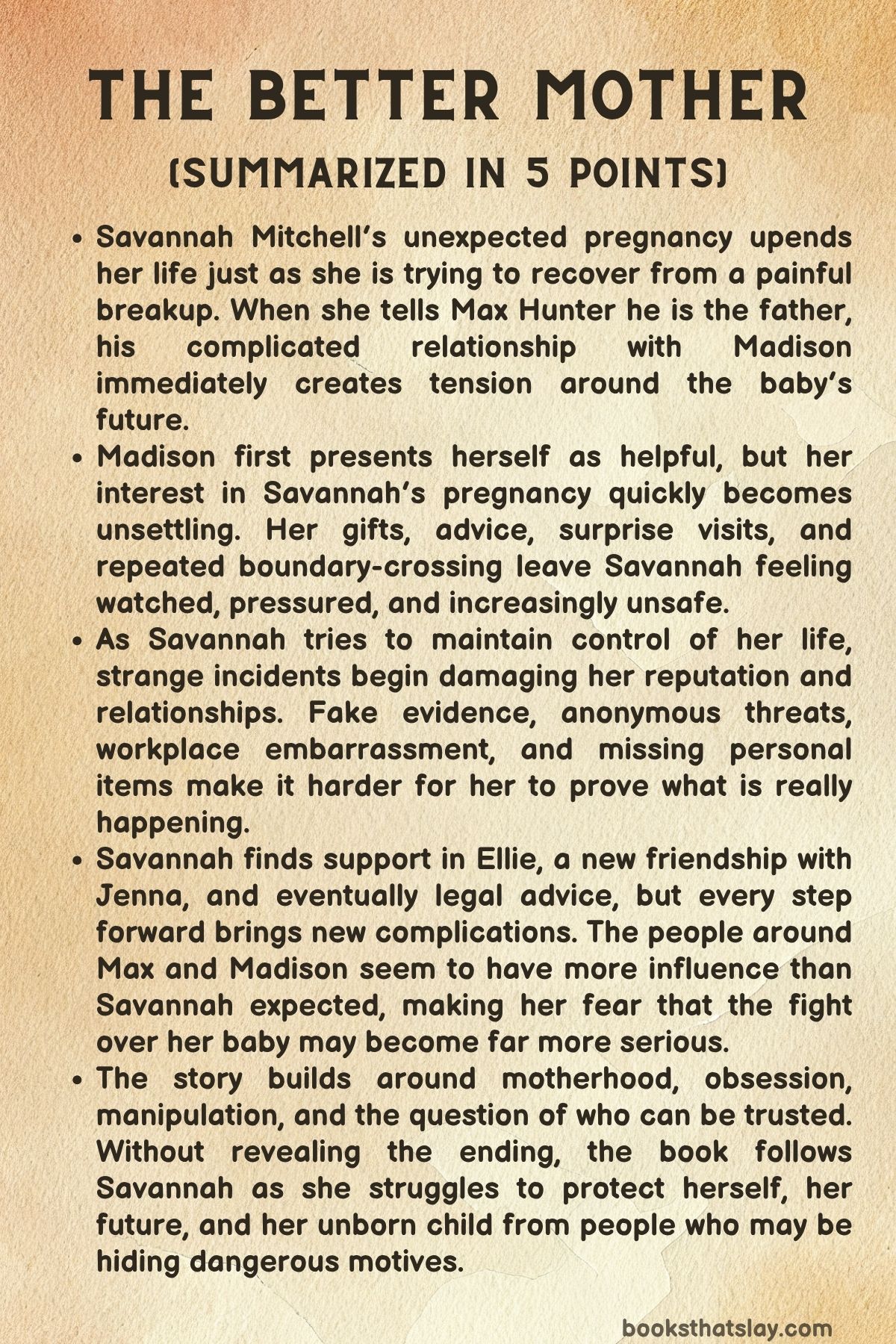
Summary
Savannah Mitchell’s life changes when four pregnancy tests confirm that she is expecting a baby. The discovery leaves her stunned rather than joyful.
She is still trying to recover from the collapse of her long relationship with Jason, who left after she told him she was ready to begin a family. With her best friend Ellie beside her, Savannah works through the shock and realizes the father is Max Hunter, a man she casually dated after meeting him at Ellie’s bistro.
Savannah decides Max deserves to know. She meets him at a coffee shop and tells him she is pregnant.
Max is shocked, especially because he has recently reunited with Madison, his former partner. Still, he tells Savannah he wants to be involved and says he intends to be a father.
Savannah is unsure what that will mean, but she hopes they can find a respectful arrangement.
Max later tells Savannah that Madison knows about the pregnancy and wants to meet her. Savannah is uneasy but agrees.
Madison presents herself as polished, warm, and helpful, yet something about her manner feels too intense. She asks detailed questions about Savannah’s doctor, due date, and appointments.
She speaks as though she expects to be deeply involved in the pregnancy and repeatedly suggests that she will help with the baby.
Madison soon begins crossing clear boundaries. She arrives at Savannah’s apartment without being invited, bringing expensive teas, vitamins, snacks, flowers, and a pregnancy book filled with highlighted advice.
While Savannah showers, Madison cleans the apartment. She keeps referring to “our” appointments, making Savannah feel as though Madison is trying to claim a place in her pregnancy that does not belong to her.
The interference grows more disturbing. Madison sends repeated texts while Savannah is at work, offering nutrition advice and links Savannah never asked for.
She appears outside Savannah’s building with groceries and claims they had plans. Savannah becomes alarmed when Madison seems to know private details, including what Savannah has been eating and when she has used Ubers.
Then Savannah’s ultrasound photo disappears from her refrigerator. Around the same time, she notices a woman in dark clothing watching her near her apartment.
Savannah also meets Jenna, another woman who says she is pregnant and uncertain about her baby’s father. The two women connect after Savannah helps Jenna at a farmer’s market.
Savannah finds comfort in knowing someone else is facing a complicated pregnancy, though she does not yet realize how closely Jenna is connected to the danger around her.
Soon, Savannah’s life begins falling apart in ways that look designed to ruin her reputation. Fraudulent charges appear on her credit card from places that make her seem reckless and irresponsible, including a liquor store, a strip club, an adult store, and a marijuana dispensary.
One image appears to show a pregnant woman who looks like Savannah making one of the purchases. At a bachelorette party, a man named Rob approaches her, believing she arranged a paid sexual encounter through an app profile using her photograph.
Madison appears at the club as well, accusing Savannah of partying and risking the baby’s health. Anonymous threatening texts follow, but evidence keeps disappearing from Savannah’s phone.
Madison posts online that she and Max are “going to be parents,” making it sound as though Savannah’s baby belongs to them. When Savannah confronts Max, he minimizes Madison’s behavior and questions Savannah’s version of events.
Savannah’s career is also damaged. Madison sends balloons and a baby gift to her office, exposing Savannah’s pregnancy before she is considered for an account-manager role.
Savannah loses the promotion. Later, a fake text causes her to arrive late to an important client meeting.
Her car is vandalized, with slashed tires and a cruel insult painted on it.
At the twenty-week ultrasound, Savannah asks that the baby’s gender remain private. Before Savannah even learns it herself, Madison posts publicly that the baby is a boy.
Dr. Quinlan confirms that Savannah never requested the gender, which suggests someone accessed her medical records. Savannah then confronts Jamie, an employee at the clinic and the woman who has been following her.
Jamie admits Madison has been blackmailing her after catching her stealing pills. Madison forced Jamie to spy on Savannah, photograph her, and access her records.
Jamie also warns that Madison’s mother, Nora, has a history of protecting Madison from consequences.
Savannah takes Jamie’s phone and copies evidence of Madison’s involvement. When she returns the phone, Jamie reveals there may be another person following Savannah.
She shows Savannah a photo of a tall, thin woman in purple leggings and a hoodie. The woman’s face is hidden, but Savannah notices a heart-shaped ankle tattoo with initials inside it.
Then Jenna sends Savannah a photo showing Melanie Daniels, the supposed child services investigator, working as a Starbucks barista. Savannah realizes the investigation may have been fake.
Dr. Quinlan urges her to go to the police. The police say they may be able to use the photo’s metadata to locate Melanie.
Savannah meets Robert, Ellie’s cousin and a lawyer, and explains everything: Madison’s harassment, the fake investigation, the spying, the vandalism, and her fear that Madison and Max will try to take her baby. Robert says Madison may have committed crimes.
He suggests sending a certified warning letter and later seeking a restraining order or custody agreement. For the first time in a while, Savannah feels she has a plan.
The next day, police trace Melanie’s photo to Sausalito, where Madison’s parents live. At work, Savannah gets encouraging news: the Blackwell Agency has won the Pedro Torres restaurant account, giving her another chance to prove herself professionally.
But Max comes to see her that evening. He already knows she met a lawyer, though she never told him.
He asks her not to take legal action, admits he and Madison are married, and says he has treated Savannah unfairly. He nearly kisses her, leaving her confused, but she later realizes he never explained how he knew about Robert.
The danger then reaches Ellie. A masked man attacks her and warns her and her friends to stay out of the situation.
Savannah suspects Madison. She calls Robert, but he can no longer represent her because Nora Clark’s real estate firm has hired his law firm, creating a conflict.
Soon after, Ellie accidentally breaks a vase Madison once gave Savannah. Inside it, they find a hidden nanny camera.
Savannah understands that Madison has been watching her apartment for a long time and using what she sees to stay ahead of every move.
Ellie brings Savannah to stay with her. Savannah tries to focus on work and is named deputy account manager on the Torres campaign.
But while at Ellie’s place, she sees social media photos from a baby shower Madison is hosting at Max’s apartment for “Baby Charlie.” Madison is pretending the child is hers and has already named him. Furious, Savannah goes to the shower.
Madison provokes her in private, then slams her own face into a table and screams that Savannah attacked her. Nora threatens to destroy Savannah in court.
Max later calls from the hospital and refuses to believe Savannah, saying Nora wants to press charges.
Melanie disappears before police can find her. Savannah pushes herself through the Torres presentation, which goes well until police arrive and arrest her for assaulting Madison and for questioning in Jenna Martin’s disappearance.
At the station, detectives reveal that Jenna was not pregnant when Savannah knew her; she had miscarried months earlier. They also found a lock of Jenna’s bloody hair in Savannah’s car trunk.
Savannah realizes the ankle tattoo in Jamie’s photo belonged to Jenna, meaning Jenna was the other person watching her.
Jenna’s side of the story reveals a deeper scheme. She had once been pregnant with Max’s baby, but she miscarried after Max withdrew from her emotionally.
She followed him and discovered he was married to Madison while also seeing other women. Jenna learned Madison could not have children and that the Clark family opposed adoption.
When Jenna found out Savannah was carrying Max’s child, she first resented her but later befriended her. As Madison’s attacks grew worse, Jenna began to pity Savannah and hate Madison.
Jenna later found Melanie at Starbucks and forced her to confess that Nora had paid and blackmailed her to impersonate a child services investigator, plant fake evidence, and make Savannah appear unfit so Madison and Max could take the baby. Jenna arranged for Melanie to meet Nora while secretly recording them, but Melanie betrayed her.
Madison arrived with a gun, forced Jenna into Nora’s car, and drugged her. Jenna woke to hear Madison and Max planning to kill her, frame Savannah, force Savannah to give birth, and take the baby for themselves.
Characters
Savannah Mitchell
Savannah Mitchell is the emotional center of The Better Mother, and her character is shaped by fear, resilience, confusion, and a growing determination to protect her unborn child. At the beginning of the book, she is already vulnerable because Jason’s abandonment has left her emotionally bruised and uncertain about her own judgment.
Her unexpected pregnancy forces her into a situation she is not prepared for, especially because the father is Max, a man with whom she does not share a stable relationship. Savannah’s first major conflict is internal: she wants to do the right thing, but she is also frightened of being alone, judged, or manipulated.
This makes her believable as a character because she does not immediately become fearless. Instead, she gradually learns how dangerous the people around her can be.
Savannah’s strength develops through pressure. Madison’s constant interference, Max’s emotional unreliability, the attacks on her reputation, the professional sabotage, and the fake evidence all push Savannah into a defensive position.
What makes her compelling is that she is not simply fighting one obvious villain; she is fighting a carefully constructed campaign designed to make her look unstable, immoral, and unfit. Her fear is intensified because the attacks are personal and intimate.
Madison seems to know what she eats, where she goes, what medical appointments she attends, and even what is inside her home. This invasion of privacy turns Savannah’s pregnancy, which should be a private and hopeful experience, into something filled with suspicion and danger.
Savannah is also important because she represents the difficulty of being believed when someone powerful is manipulating the story. Max doubts her.
Madison performs innocence. Nora uses influence.
Even official-looking figures such as Melanie are used against her. Savannah’s frustration comes from knowing the truth but not having enough proof.
Her arc becomes a movement from emotional shock to active resistance. By seeking help from Jamie, Dr. Quinlan, the police, and Robert, she begins to build a case instead of simply reacting.
Savannah is not perfect; she becomes confused by Max, makes emotionally charged decisions, and crashes Madison’s baby shower in anger. However, these flaws make her more human.
She is a woman under extreme pressure, trying to protect her child while everyone around her seems to be rewriting reality.
Max Hunter
Max Hunter is one of the most morally slippery characters in the book because he presents himself as conflicted and reasonable while repeatedly failing to protect Savannah. When Savannah tells him about the pregnancy, his first reaction is shock, but he also says he wants to be involved.
This makes him appear responsible at first. However, his actions soon reveal a pattern of weakness, secrecy, and self-interest.
He has reconciled with Madison, later admits he is married to her, and continues to let Savannah believe only part of the truth. His dishonesty creates the foundation for much of the chaos that follows.
Max’s greatest flaw is his refusal to confront Madison’s behavior honestly. When Savannah tells him about Madison’s disturbing intrusions, he minimizes her concerns.
When Madison posts online as if Savannah’s baby belongs to her and Max, he does not respond with the urgency or outrage the situation deserves. His passivity enables Madison’s obsession.
Even when he seems apologetic or emotionally drawn to Savannah, his behavior remains suspect because he withholds crucial information. His near-kiss with Savannah complicates him further, suggesting either genuine confusion or calculated manipulation.
The fact that he already knows about Savannah’s lawyer without explaining how shows that he is not as innocent or detached as he wants to appear.
As the plot darkens, Max becomes more than just a weak man caught between two women. Jenna’s perspective reveals that he has a history of abandoning women emotionally and becoming involved with others while still tied to Madison.
His connection to Jenna shows that Savannah is not an isolated case; Max has left damage behind before. By the time Jenna overhears Madison and Max plotting to kill her, frame Savannah, and take the baby, Max’s character becomes far more sinister.
He is not simply indecisive. He is willing to participate in a plan that treats women as disposable and the unborn child as something to be possessed.
His charm and moments of apparent guilt make him dangerous because they keep Savannah emotionally uncertain longer than she should be.
Madison Clark Hunter
Madison Clark Hunter is the central antagonist of the story and one of its most disturbing figures because her cruelty is wrapped in politeness, elegance, and false concern. When she first meets Savannah, she appears friendly and composed, but her behavior quickly becomes invasive.
Her repeated use of language suggesting shared ownership of the baby reveals her obsession. She does not see Savannah as the mother of the child; she sees her as an obstacle between herself and the baby she wants.
Madison’s interest in Savannah’s doctor, due date, diet, appointments, and daily habits is not care. It is surveillance disguised as helpfulness.
Madison’s character is built around control. She sends vitamins, tea, snacks, pregnancy books, and flowers, but each gift carries a hidden demand: Savannah must allow Madison into her life.
When Savannah resists, Madison escalates. She uses spying, fake messages, social media manipulation, medical-record access, and planted evidence to isolate Savannah and destroy her credibility.
Madison understands that if Savannah looks irresponsible, unstable, promiscuous, or dangerous, then Madison can position herself as the “better” mother figure. This makes Madison especially chilling because she weaponizes social expectations about motherhood.
She knows exactly how to make Savannah appear unfit in the eyes of employers, doctors, police, and even Max.
Madison’s violence is also theatrical. At the baby shower, she injures herself and frames Savannah for assault, showing how skilled she is at turning herself into the victim.
She does not merely lie; she performs lies convincingly. Her baby shower for “Baby Charlie” reveals the depth of her delusion and entitlement.
She has already named and claimed a child who is not hers. Her obsession is not loving or maternal in a healthy sense.
It is possessive, narcissistic, and predatory. By the time she appears with a gun and helps abduct Jenna, Madison’s polished mask has fully fallen away.
She is willing to ruin, imprison, or kill anyone who threatens her fantasy of motherhood.
Ellie
Ellie is Savannah’s best friend and one of the few consistently loyal figures in the book. From the beginning, she provides emotional support when Savannah discovers she is pregnant and realizes Max is the father.
Ellie’s role is important because Savannah is surrounded by people who doubt, manipulate, or betray her, while Ellie offers a steady source of belief. She does not treat Savannah’s fear as exaggeration.
Instead, she listens, helps, and becomes increasingly involved as Madison’s behavior grows more dangerous.
Ellie also represents practical friendship. She is not only emotionally comforting; she actively protects Savannah.
After the hidden nanny cam is discovered inside the vase Madison gave Savannah, Ellie immediately helps Savannah leave the apartment and stay somewhere safer. This moment is significant because it confirms how deeply Madison has invaded Savannah’s life, but it also shows Ellie’s instinct to act.
Ellie gives Savannah a place where she can breathe, think, and regroup. Her presence helps counter the isolation Madison tries to create.
Ellie’s attack by the masked man shows the cost of loyalty. The threat against her is meant to frighten Savannah’s support system into silence.
Through Ellie, the story shows that Madison and her allies do not only target Savannah directly; they target anyone who might help her. Ellie’s courage stands out because even after danger reaches her personally, she remains connected to Savannah.
She is not a decorative best friend character. She functions as Savannah’s emotional anchor and as evidence that genuine care exists in sharp contrast to Madison’s controlling imitation of care.
Jenna Martin
Jenna Martin is one of the most tragic and complex figures in the story. At first, she appears to be another pregnant woman who understands Savannah’s uncertainty.
Their friendship seems to offer Savannah comfort because Jenna appears to share a similar situation involving an uncertain father. However, the later revelation that Jenna was never pregnant during her friendship with Savannah changes the meaning of her character completely.
She enters Savannah’s life through deception, but her motives are not as simple as Madison’s. Jenna begins from pain, jealousy, and obsession, yet she gradually develops real sympathy for Savannah.
Jenna’s backstory explains much of her behavior. She had been pregnant with Max’s baby and miscarried, leaving her emotionally devastated.
Max’s abandonment deepens that wound. When she follows him and learns that he is married to Madison while also being involved with other women, Jenna begins to understand the larger pattern of harm around him.
Her discovery that Madison cannot have children and that the Clarks oppose adoption helps her see why Savannah’s pregnancy becomes so valuable to Madison. Jenna initially resents Savannah because Savannah has what Jenna lost: Max’s child.
But as she witnesses the campaign against Savannah, her resentment shifts into anger at Madison and Max.
Jenna is morally complicated because she stalks Savannah and withholds the truth, yet she also becomes one of the few people trying to expose the larger conspiracy. Her decision to force Melanie into confessing and secretly record the truth shows bravery, but also desperation.
She is not a polished investigator; she is a wounded woman trying to correct a wrong while carrying her own grief. Her abduction by Madison and Max turns her from a suspicious side character into a victim of the same predatory system targeting Savannah.
Jenna’s tragedy lies in how her longing for justice comes too late to keep her safe. She is both flawed and sympathetic, deceptive and courageous.
Nora Clark
Nora Clark is a powerful antagonist whose danger comes from influence rather than open emotional instability. While Madison is impulsive, obsessive, and theatrical, Nora is strategic and socially protected.
She has the resources, connections, and confidence to cover up wrongdoing. Jamie’s warning that Nora has a history of concealing Madison’s schemes reveals that Madison’s behavior has likely been enabled for a long time.
Nora is not shocked by Madison’s actions; she manages them. This makes her one of the most frightening characters because she understands systems of power and knows how to bend them.
Nora’s role in the fake DCS investigation shows the extent of her corruption. By blackmailing and paying Melanie to impersonate an investigator, plant suspicion, and help make Savannah look unfit, Nora turns institutions meant to protect children into weapons against an innocent mother.
Her goal is not justice or concern for the baby’s welfare. Her goal is possession and control.
She wants Madison and Max to have the child, and she is willing to destroy Savannah’s life to make that happen.
Nora also uses professional and legal pressure to isolate Savannah. Robert’s law firm becomes unavailable because Nora’s real estate firm hires it, creating a conflict.
This detail shows Nora’s ability to close doors before Savannah can walk through them. At the baby shower, Nora immediately threatens to destroy Savannah in court after Madison frames her.
She knows how to exploit appearances, wealth, and reputation. Nora is the kind of character who makes evil look respectable.
She does not need to scream or stalk because she can make institutions, lawyers, and false authority figures serve her family’s interests.
Jamie
Jamie is a morally compromised but ultimately important supporting character. As an employee at Dr. Quinlan’s office, she has access to private medical information, which makes her a valuable tool for Madison.
Jamie’s mistake of stealing pills gives Madison the leverage she needs to blackmail her. This places Jamie in a difficult position: she becomes part of the harm done to Savannah, but she is also being coerced.
Her role adds another layer to the story’s exploration of manipulation because Madison does not only attack Savannah directly; she exploits the weaknesses of others.
Jamie’s confession is a turning point because it gives Savannah proof that her instincts are correct. Until then, Savannah has been repeatedly doubted and gaslit.
Jamie confirms that Madison has been using her to spy, access records, and send photos. This validation matters almost as much as the evidence itself because Savannah has been made to feel paranoid.
Jamie’s admission shows that the danger is real and organized. Her revelation that Madison may have had more than one person following Savannah expands the threat and leads to the discovery of Jenna’s involvement.
Jamie is not portrayed as purely heroic. She did violate Savannah’s privacy and contribute to the harassment.
However, she also becomes frightened enough and guilty enough to tell the truth. Her character shows how people with secrets can be controlled by someone more ruthless.
Jamie’s weakness makes her useful to Madison, but her eventual confession makes her useful to Savannah. She stands in the morally gray space between victim and accomplice.
Melanie Daniels
Melanie Daniels is a deceptive figure whose role demonstrates how easily false authority can frighten and manipulate someone already under pressure. She appears as a supposed DCS investigator, which immediately gives her power over Savannah because any threat involving child welfare strikes at Savannah’s deepest fear: losing her baby.
Melanie’s impersonation is especially cruel because it uses the language and appearance of official concern to support a lie. Her presence makes Savannah seem more unstable and more endangered at the same time.
The later revelation that Melanie is actually a Starbucks barista exposes the fake investigation as part of a larger scheme. She is not acting from personal obsession like Madison, but from pressure and payment connected to Nora.
This makes Melanie another example of how the Clarks use vulnerable or ordinary people to carry out their plans. She becomes a tool in a staged reality designed to make Savannah look unfit.
Melanie’s betrayal of Jenna is especially important because it shows that she is not simply a frightened participant trying to escape. When Jenna tries to use her to expose Nora, Melanie turns against her, leading directly to Jenna’s abduction.
This makes Melanie more culpable. Even if she was pressured, she repeatedly chooses self-preservation over truth.
Her disappearance after the police trace her location reinforces her role as a shadowy accomplice whose false identity has caused real damage.
Dr. Quinlan
Dr. Quinlan serves as one of the few professional figures who responds to Savannah with seriousness rather than dismissal. As Savannah’s doctor, she represents the medical space that Madison tries to invade.
When Savannah asks that the baby’s gender remain private and Madison somehow posts that it is a boy, Dr. Quinlan’s confirmation that Savannah did not request the gender becomes crucial. It suggests that someone accessed private records, helping Savannah understand that the violations against her are not imagined.
Dr. Quinlan’s importance lies in her credibility. In a story where Savannah is repeatedly made to look unreliable, Dr. Quinlan provides a grounded professional perspective.
She does not solve everything for Savannah, but she recognizes that something is wrong and urges her to go to the police. This support matters because Savannah needs people in authority to take her seriously.
Dr. Quinlan also indirectly becomes connected to Jamie’s confession because the breach comes from within the clinic.
As a character, Dr. Quinlan is not emotionally central in the way Ellie or Jenna is, but she plays an important structural role. She helps move Savannah from suspicion to evidence.
Her presence also emphasizes how deeply Madison’s scheme has penetrated Savannah’s life. Even the doctor’s office, which should be safe and confidential, has been compromised.
Robert
Robert, Ellie’s cousin and a lawyer, briefly represents hope, strategy, and legal protection for Savannah. When Savannah meets him, she finally receives practical guidance from someone who understands the seriousness of Madison’s actions.
He recognizes that the harassment, fake investigation, stalking, vandalism, and intimidation may involve crimes. His suggestions about a certified warning letter, a restraining order, and a custody agreement give Savannah a sense of direction after so much chaos.
Robert’s role is significant because he helps Savannah feel that she can fight back through legitimate channels. Until then, Madison and Nora have controlled the narrative by making Savannah appear unstable.
Robert offers a path based on documentation, law, and boundaries. His presence gives Savannah a brief feeling of security and a belief that she is not powerless.
However, Robert’s inability to continue representing Savannah after Nora’s firm hires his law firm shows how far Nora’s influence reaches. This development is devastating because it removes one of Savannah’s few sources of professional support.
Robert’s withdrawal is not a personal betrayal, but it demonstrates that Nora can manipulate systems around Savannah. Through Robert, the book shows how justice can become difficult to access when the opposing side has money, connections, and timing.
Jason
Jason is important even though he is not present in the main conflict in the same way as Madison, Max, or Savannah. He is Savannah’s former long-term boyfriend, and his abandonment shapes her emotional state at the beginning of the story.
Savannah had told him she was ready to start a family, and instead of moving toward that future with her, he left. This rejection makes Savannah’s pregnancy with Max’s child even more complicated because it comes after the loss of the future she thought she wanted.
Jason’s role is largely emotional and symbolic. He represents the wound Savannah carries before the central danger begins.
Because of Jason, Savannah enters the pregnancy already feeling rejected and uncertain. This makes Max’s initial promise to be involved more powerful and more confusing.
Savannah wants stability, and Jason’s departure has left her vulnerable to hoping Max might provide some version of it.
Although Jason is not the main villain, his abandonment helps explain Savannah’s loneliness. He is part of the emotional background that makes her situation so painful.
Savannah is not only dealing with pregnancy; she is dealing with pregnancy after being left by someone she trusted. Jason’s absence therefore helps deepen the reader’s understanding of Savannah’s fear of facing motherhood alone.
Rob
Rob is a minor but disturbing character because his appearance reveals one of the ways Savannah’s image is being weaponized against her. When he approaches Savannah at the bachelorette party believing she arranged a paid sexual encounter through an app profile using her photo, he becomes part of the campaign to make her look reckless and immoral.
Rob himself may not understand the larger scheme, but his interaction with Savannah humiliates and frightens her.
His role in the story is brief, yet it is important because it shows how Madison’s attack extends beyond private harassment. Savannah is being publicly misrepresented.
A fake sexual profile using her photo is meant to damage her reputation and create evidence that she is irresponsible during pregnancy. Rob’s confusion also shows how easily fabricated digital material can affect real life.
He is not central as a person, but his scene is central as proof of the kind of character assassination Savannah is facing.
Rob’s presence also intensifies Savannah’s isolation. The more public these incidents become, the harder it is for Savannah to defend herself without sounding paranoid.
Through Rob, the story shows how Madison’s scheme depends on embarrassment as much as fear. Savannah is not only being threatened; she is being degraded.
Baby Charlie
The unborn baby, whom Madison tries to name Charlie, is not an active character in the usual sense, but he is the emotional and symbolic center of the conflict. To Savannah, the baby represents motherhood, responsibility, fear, and love.
Her pregnancy begins as a shock, but as the story develops, her bond with the child becomes the reason she fights harder. The baby gives Savannah’s struggle its urgency because the danger is not only to her reputation or safety; it is to her right to mother her own child.
To Madison, however, the baby represents possession. Her use of the name Charlie before Savannah has agreed to anything shows how completely Madison has erased Savannah from the role of mother in her own mind.
The baby shower at Max’s apartment is one of the clearest examples of this. Madison behaves as if the child is already hers, turning Savannah’s pregnancy into a performance centered on herself.
This makes the baby a symbol of the difference between real motherhood and ownership disguised as motherhood.
The unborn child also exposes the motives of several characters. Savannah wants to protect him.
Madison wants to claim him. Max wants control without accountability.
Nora wants to secure Madison’s desired family image. Jenna sees in him both the child she lost and the injustice being done to Savannah.
Because of this, the baby is the point around which every major conflict turns.
Themes
Maternal Desire and Possessive Control
Madison’s longing for motherhood becomes dangerous because it is not rooted in care for Savannah or the unborn child as a person, but in ownership. Her language exposes this early when she talks about “our” appointments and behaves as if Savannah’s pregnancy is a shared project she has the right to manage.
What begins as polished concern soon becomes surveillance, manipulation, and identity theft. Madison does not simply want to help; she wants to replace Savannah.
Her gifts, advice, medical interference, and public posts all show a woman trying to write herself into the role of mother before the child is even born. In The Better Mother, motherhood is presented not as a title someone can claim through money, marriage, or social power, but as a responsibility built on respect, protection, and truth.
Madison’s obsession turns the idea of being a “better mother” into something frightening because she measures motherhood through control rather than love.
Gaslighting and the Destruction of Credibility
Savannah’s fear becomes worse because Madison’s attacks are designed to make her look unstable, irresponsible, and dishonest. The fake purchases, missing evidence, anonymous threats, altered messages, workplace sabotage, and staged public incidents create a pattern where Savannah knows the truth but struggles to prove it.
This makes the conflict especially cruel: Madison does not only hurt Savannah directly; she damages the way others see her. Max’s refusal to believe Savannah deepens this harm because his doubt gives Madison more power.
Savannah is forced to defend her reality again and again while the people around her are handed false evidence that seems easier to accept. The theme shows how gaslighting works best when the victim’s reputation is slowly weakened.
By attacking Savannah’s job, friendships, medical privacy, and public image, Madison creates a trap where every attempt Savannah makes to protect herself risks making her appear more desperate or dangerous.
Power, Privilege, and Corruption
Nora Clark’s influence shows how wealth and status can protect wrongdoing when people use power to control systems meant to provide justice. Madison’s actions are serious on their own, but Nora makes them more dangerous by helping cover them up, hiring people, arranging fake authority figures, and blocking Savannah’s legal support.
The fake DCS visit is especially important because it turns an institution associated with child protection into a weapon against an innocent mother. Robert’s sudden conflict of interest also shows how easily Savannah’s support network can be weakened when Nora’s reach enters professional spaces.
In The Better Mother, privilege does not appear only as luxury or social polish; it appears as access, silence, and protection from consequences. Savannah must fight not just one woman’s obsession, but an entire structure of money, connections, and reputation management that keeps shifting blame onto her.
Female Friendship, Isolation, and Betrayal
Savannah’s relationships with Ellie and Jenna show two different sides of trust during crisis. Ellie represents steady loyalty: she supports Savannah emotionally, believes her fears, gives her shelter, and becomes a target because she refuses to abandon her.
This friendship gives Savannah strength when Max dismisses her and Madison isolates her. Jenna’s role is more complicated because she enters Savannah’s life through deception, pretending to share the experience of pregnancy while secretly carrying her own grief and resentment.
Yet Jenna’s false friendship changes as she begins to see Savannah not as a rival, but as another woman being harmed by Madison and Max. Her shift from watcher to sympathizer adds moral complexity to the story.
The theme suggests that isolation makes people easier to control, while genuine support can help them resist manipulation. At the same time, betrayal can come from people who seem harmless, wounded, or familiar, making trust both necessary and risky.