The Blood Countess Summary and Analysis
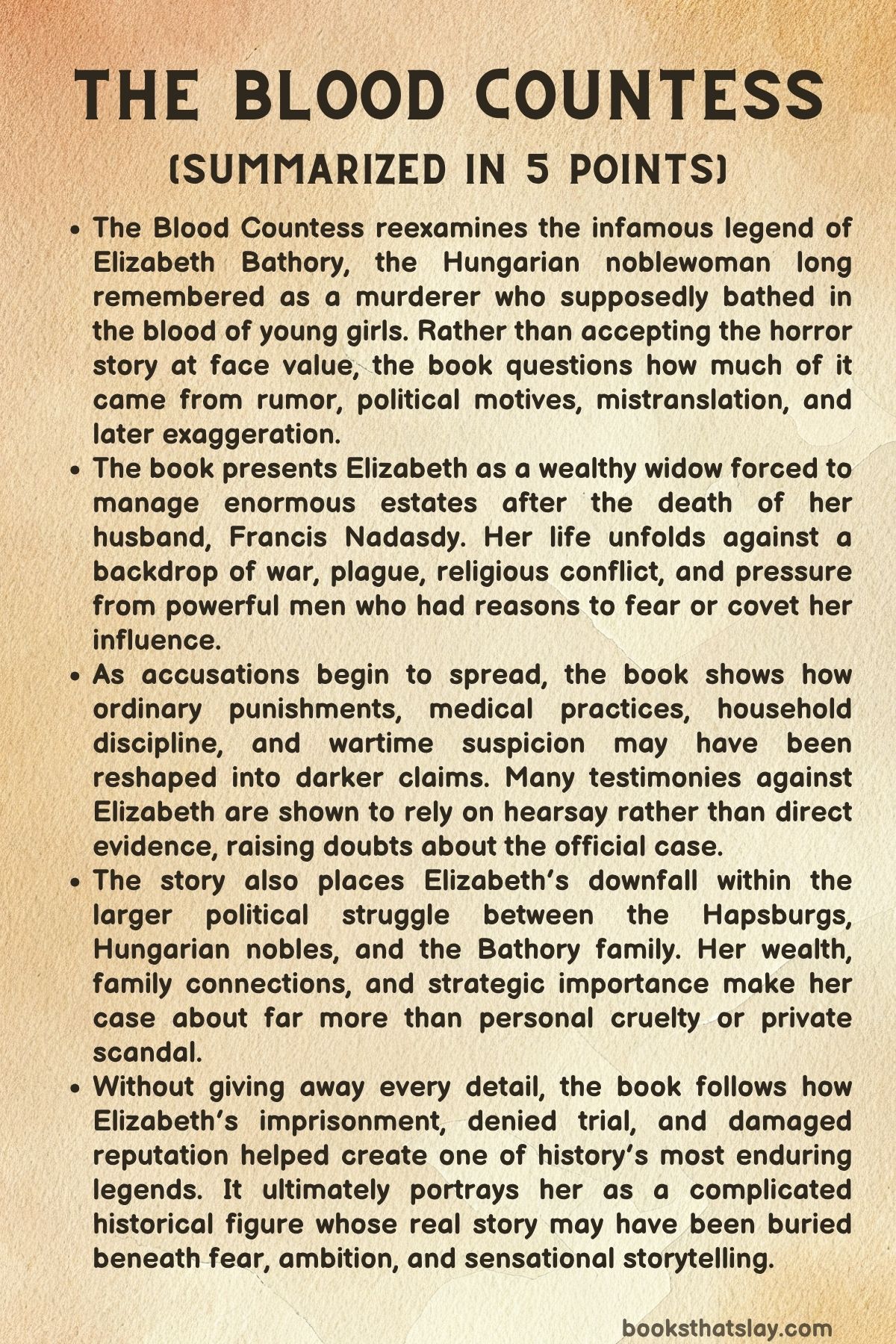
The Blood Countess: A Tale of Deception, Disinformation, and History’s Deadliest Woman by Shelley Puhak is a historical re-examination of Elizabeth Bathory, the Hungarian noblewoman remembered as one of history’s most notorious female killers. Rather than accepting the familiar horror story of a countess bathing in blood and murdering hundreds of girls, the book questions how that image was created.
It presents Bathory as a rich widow, landholder, mother, and political figure caught in a dangerous world of war, religious conflict, family rivalry, and Hapsburg ambition. The book is less a simple crime story than an investigation into power, rumor, property, and the making of a monster.
Summary
The Blood Countess begins with the legend that has followed Elizabeth Bathory for centuries. According to popular memory, she was a sadistic Hungarian countess who tortured and killed hundreds of young women, used their blood in grotesque beauty rituals, and was finally discovered by royal authorities in her castle at Čachtice.
The story has become one of the most famous tales of aristocratic cruelty in European history. Yet the book immediately questions this version.
It points out that the largest claims, including the idea of more than six hundred victims, were not based on firm proof. They grew from rumor, mistranslation, political storytelling, and later writers who turned a murky legal case into a horror legend.
The narrative then returns to Elizabeth’s life before the accusations. She was born into the powerful Bathory family, one of the great noble families of Hungary.
Her marriage to Francis Nadasdy joined her to another influential house. Francis was a respected military commander known as the Black Lord, famous for fighting the Ottoman Turks.
Together, they controlled large estates and lived at the center of Hungarian political and religious life. Elizabeth was not a helpless woman in the background.
She managed property, handled legal matters, oversaw servants, and understood the importance of alliances.
The year 1603 changes her life. Her son Andras dies, Turkish raids continue to threaten the region, and Francis becomes seriously ill.
When Francis dies, Elizabeth is left a widow with three surviving children: Anna, Kate, and Paul. Her grief is joined by heavy responsibility.
She must protect her children’s inheritance, keep control over vast lands, deal with tenants and clergy, and defend her position in a kingdom weakened by war, plague, religious dispute, and unstable politics.
After Francis’s death, Elizabeth organizes an elaborate funeral and pushes for her young son Paul to inherit his father’s offices and status. This becomes part of her larger effort to preserve the Nadasdy and Bathory wealth.
At the same time, she faces pressure from Lutheran leaders on her estates. Pastor Stephen Magyari uses Francis’s funeral as a chance to claim authority and strengthen Lutheran influence.
Religious tensions between Lutherans and Calvinists are already intense. Pastors accuse one another of corruption, false teaching, and abuse of power.
In this atmosphere, even ordinary household actions can be turned into suspicious signs.
One early detail later used against Elizabeth concerns a servant described with the Latin word carnifex, meaning “butcher” or executioner. Later readers might see this as a sign of violence.
The book suggests a more uncertain meaning. It may have referred to improper eating of meat during Lent, or to someone involved in medical procedures, rather than to murder.
This kind of ambiguity becomes central to the book’s argument. Much of the case against Elizabeth depends on words, memories, and stories that can be read in more than one way.
The political situation grows more dangerous when Emperor Rudolf II moves against Hungarian nobles. His government seizes lands, strengthens Catholic influence, and treats powerful Protestant families with suspicion.
Elizabeth’s daughter Anna marries Nicolas Zrinyi, creating another noble alliance. Soon after, Stephen Bocskai leads a rebellion against Hapsburg rule.
Elizabeth is trapped between competing loyalties. She has ties to the Hapsburg emperor, but she is also connected by blood to the Bathory family, including her brother Stephen, who supports rebellion.
Hapsburg troops damage her Keresztúr estate, and General Basta demands that she house imperial soldiers at Sárvár. Elizabeth resists these demands, trying to protect her household and property.
Her position becomes even more exposed when her brother Stephen dies suddenly in 1605. His death brings her more property, but that wealth also makes her a more attractive target.
In a period when land was power, Elizabeth’s holdings were enough to draw the attention of ambitious men.
During Elizabeth’s journey east for her brother’s funeral, the first damaging rumors appear. One of the most repeated stories concerns Miss Modl, a German servant said to have refused to serve at a meal and then been punished.
The versions differ widely. In some, she is humiliated with a “log baby.” In others, she is beaten, murdered, or mutilated.
Other stories claim that girls had injured hands, that servants were forced into cold water, or that bodies were buried suspiciously. The book does not treat these accounts as simple proof.
Instead, it places them in the world of plague fears, harsh discipline, folk medicine, and suspicion of women who practiced healing.
A major figure in these suspicions is Anna Darvulia, Elizabeth’s female healer. In a society already uneasy about women with medical knowledge, Darvulia becomes a convenient focus for fear.
Treatments that involved cutting, bleeding, cold water, or painful procedures could later be described as torture. This does not prove that no violence occurred, but it shows how uncertain the evidence remains.
The same action might be remembered as punishment, medical treatment, cruelty, or superstition depending on who told the story and why.
By 1609 and 1610, Elizabeth is drawn into a wider political struggle involving her nephew Gabriel Bathory, Prince of Transylvania. The Hapsburgs see Gabriel as a threat, and Elizabeth’s family connection to him makes her vulnerable.
George Thurzo, the palatine of Hungary, begins investigating her. Witness statements are collected, but many witnesses do not claim direct knowledge.
They repeat what they heard from others. Elizabeth answers through legal means.
She has Lady Helen Hernath testify that her daughter Susanna was not killed by Elizabeth, contradicting one of the accusations. She also prepares a will to protect her property from seizure.
Elizabeth then moves to Čachtice, where another hostile clergyman, Pastor Ponikenus, helps advance the charges against her. In December 1610, Thurzo’s men arrest Elizabeth and several servants.
Her servants are taken to Bytča, questioned under torture, tried, and executed. Their forced statements become a key part of the case.
Elizabeth, however, is never given the public trial she repeatedly seeks. Instead, she is confined at Čachtice while her lands are divided among her children.
Her imprisonment begins before any legal conviction.
King Matthias repeatedly urges Thurzo to follow proper procedure, but Thurzo delays and withholds documents. He argues that Elizabeth can remain imprisoned without trial.
While she waits, Hapsburg forces move against Gabriel Bathory. Gabriel seeks Turkish aid in case of invasion, and a suspicious letter appears claiming he plans to surrender Transylvania to the Turks.
His supporters call it a forgery, but the Hapsburgs use it as a reason to attack. Gabriel defeats the invading Royal Hungarian army, embarrassing Matthias, but he remains politically unsafe.
Elizabeth’s son-in-law George Drugeth also becomes a threat. He joins the invading army and hopes to gain power in Transylvania.
He tries to claim more of Elizabeth’s land and wealth, including her jewels. Elizabeth acts to protect them, arranging for her daughter Anna to remove valuables from the treasury.
Drugeth and his allies threaten legal action, but the jewels remain beyond their reach.
In 1612, Elizabeth’s situation appears to improve briefly. Transylvania and Royal Hungary form a secret alliance against the Turks, making her less useful as a suspected traitor.
Officials consider whether she should finally be prosecuted or simply ignored. Matthias and Thurzo begin preparing for trial, and the king even considers bail because she has been imprisoned without lawful summons or conviction.
More depositions are gathered, but the evidence remains inconsistent. Many witnesses know nothing directly.
Others repeat rumor. Some describe punishments that may also resemble medical practices.
Little effort is made to interview supposed survivors or the noble families whose daughters were said to have died.
A public trial is expected, but it never happens. Gabriel Bethlen, one of Gabriel Bathory’s advisers, betrays him and gains Ottoman support.
In October 1613, Bethlen enters Transylvania with a large Ottoman army and is declared prince under pressure. Gabriel Bathory retreats to Várad and waits for aid from Royal Hungary, but Thurzo sends only weak support.
Gabriel is later lured from the castle and murdered near his carriage by men he knows. His death ends Elizabeth’s value as a political hostage and destroys her hope of release.
The Bathory family also loses its last direct male heir. Power and property now rest largely with Bathory women, and they become targets.
Bethlen accuses Gabriel’s sister Anna, his aunt Kate Iffiu, and his cousin Kate Torok of incest and witchcraft. These trials help him seize lands and weaken remaining Bathory influence.
In July 1614, Elizabeth senses that death is near. She summons priests to witness her final declaration.
She insists that Drugeth receive nothing beyond his wife Kate’s rightful inheritance and confirms the division of her property among her heirs. On August 18, 1614, she tells her guard that her hands are cold.
She goes to bed praying and singing hymns and is found dead the next morning.
Elizabeth receives an aristocratic funeral and is buried in Čachtice church. Her death is met with public silence, despite the shocking accusations attached to her name.
Later writers revive and embellish the story. Father Laszlo Turoczi helps create the famous blood-bathing myth, and that version spreads through folklore, guidebooks, horror stories, tourism, and popular culture.
The Blood Countess presents a different picture: not a proven monster from legend, but a powerful widow caught in a violent political struggle, condemned through rumor, weak evidence, family greed, and a legal process that denied her the trial she demanded.
Key Figures
Elizabeth Bathory
Elizabeth Bathory is the central figure of The Blood Countess, and the book presents her not simply as a monster from legend but as a powerful noblewoman caught in a dangerous world of war, inheritance struggles, religious tension, political rivalry, and gendered suspicion. At the beginning of the story, she is surrounded by the terrifying myth that later made her infamous: the image of a countess who tortured and murdered girls and bathed in their blood.
However, the book complicates that image by showing how much of the legend was built from rumor, hearsay, mistranslation, exaggeration, and later storytelling. Elizabeth appears as a wealthy Hungarian aristocrat whose power makes her both influential and vulnerable.
After the death of her husband Francis Nadasdy, she becomes responsible for vast estates, surviving children, servants, political alliances, and property claims at a time when noble families were under pressure from the Hapsburg crown. Her widowhood does not weaken her immediately; instead, she acts decisively, arranging Francis’s funeral, protecting her son Paul’s inheritance, managing lands, resisting military demands, and defending her household’s interests.
Elizabeth’s character is defined by a combination of authority, intelligence, pride, and isolation. She understands the legal and political systems around her and repeatedly tries to use them to protect herself and her family.
When accusations begin to grow, she does not behave like someone passively accepting disgrace. She gathers testimony, makes a will, protects property, and appears to expect formal legal treatment.
Her insistence on a public trial is especially important because it shows her desire to confront the accusations within recognized legal structures. Yet the more she becomes politically useful to others, the less control she has over her own fate.
The book portrays her as a woman whose wealth and lineage make her valuable, but also make her a target. Her imprisonment without trial turns her from a powerful estate-holder into a trapped political prisoner whose reputation can be shaped by others.
Elizabeth is also tragic because the story leaves her surrounded by uncertainty. The accusations against her are horrifying, but the evidence described in the book is often indirect, inconsistent, or shaped by torture and hostile witnesses.
Some alleged punishments may have been exaggerated, misunderstood, or connected to medical practices, plague treatments, household discipline, or wartime fear. This does not make Elizabeth simple or innocent in a sentimental way; rather, it makes her morally and historically complicated.
She is a character whose actual life is buried beneath accusation, politics, fear, and legend. By the time she dies in captivity, praying and singing hymns, the book presents her as someone whose legal rights were denied and whose name was left vulnerable to later invention.
Her final concern with inheritance shows that even near death, she remains focused on protecting her family’s property from those she distrusts.
Francis Nadasdy
Francis Nadasdy is Elizabeth’s husband and a major presence in the first part of the book, even though he dies relatively early in the narrative. Known as the Black Lord, he is a celebrated military hero whose reputation gives the Nadasdy household prestige, protection, and political importance.
His identity is tied to martial strength, noble masculinity, and service in a violent borderland world shaped by conflict with the Turks. While he lives, Elizabeth’s position is powerful, but it is also partly stabilized by his fame and offices.
His death changes the balance of the story because it leaves Elizabeth exposed to pressures that had previously been absorbed by the authority of a male noble warrior.
Francis is significant not only as a husband but as a symbol of the older order Elizabeth must suddenly manage without him. His funeral becomes a stage for religious and political conflict, especially when Lutheran clergy use the ceremony to assert authority.
The fact that Elizabeth has to arrange his funeral, petition for Paul’s inheritance, and manage the estates afterward shows how much responsibility falls on her immediately after his death. Francis’s absence creates a vacuum that other men try to fill: pastors, imperial officials, generals, relatives, and eventually investigators.
In this sense, Francis’s death is one of the turning points of the book because it marks Elizabeth’s transition from powerful wife to politically vulnerable widow.
Anna Nadasdy
Anna Nadasdy, Elizabeth’s daughter, represents the importance of marriage, inheritance, and family alliance in the world of the book. Her marriage to Nicolas Zrinyi is not merely a personal event; it is part of the network of noble relationships that shape Elizabeth’s political position.
Through Anna, Elizabeth maintains connections to other powerful families, and Anna becomes important later when Elizabeth worries about her wealth and jewels falling into the hands of George Drugeth. Elizabeth trusts Anna enough to involve her in removing valuables from the treasury, which suggests that Anna is not only a daughter but also a practical ally in protecting the family’s property.
Anna’s role shows how noblewomen in the story often operate through inheritance, marriage, and household management rather than public military or political office. She is not presented as a rebel or investigator, but her actions matter because property is one of the central forces driving the plot.
Her loyalty to Elizabeth becomes visible when she helps keep the jewels away from Drugeth and his allies. In this way, Anna reflects one of the book’s larger concerns: women in aristocratic families could hold and transfer immense wealth, but that wealth also made them vulnerable to pressure from husbands, in-laws, rulers, and courts.
Kate Nadasdy
Kate Nadasdy is one of Elizabeth’s surviving children and becomes especially important in connection with George Drugeth. Her marriage links Elizabeth’s family to a man who later appears ambitious, opportunistic, and eager to benefit from Elizabeth’s downfall.
Kate herself is not shown as forcefully as Elizabeth or Anna, but her position matters because Drugeth’s claims to property come through her. Elizabeth’s final declaration specifically insists that Drugeth should receive nothing beyond Kate’s proper inheritance, which reveals Elizabeth’s distrust of him and her determination to protect the estate from being swallowed by an aggressive son-in-law.
Kate’s character is therefore shaped by the politics of marriage. She stands at the center of a property dispute even when she is not the one driving it.
The book uses her situation to show how daughters could become channels through which ambitious men tried to gain access to family lands, jewels, and influence. Kate’s importance lies less in direct action and more in what her marriage exposes about Elizabeth’s vulnerability.
Through Kate, the struggle over Elizabeth’s fortune becomes intimate, entering the family itself.
Paul Nadasdy
Paul Nadasdy is Elizabeth’s young son and the male heir whose future becomes one of her chief concerns after Francis’s death. Elizabeth petitions for Paul to inherit his father’s offices, showing her determination to preserve the family’s status and political standing.
Paul’s youth makes him vulnerable, but his gender makes him crucial. In a world where male inheritance carried enormous legal and symbolic weight, Paul represents continuity for the Nadasdy line and a possible protection for Elizabeth’s household.
Paul’s character functions mainly as a figure of inheritance and dynastic survival. He does not dominate the action personally, but Elizabeth’s efforts on his behalf reveal her priorities as a mother and estate manager.
Protecting Paul means protecting the family’s future. His presence also helps explain why Elizabeth’s enemies might prefer to weaken her legally and politically rather than confront her in a straightforward trial.
If Elizabeth’s control over property could be broken, then the future of her children’s inheritance could be reshaped by others.
Andras Nadasdy
Andras Nadasdy, Elizabeth and Francis’s son who dies before Francis, is a brief but emotionally important figure in the book. His death contributes to the terrible year that precedes Francis’s own death and deepens the sense of grief surrounding Elizabeth’s household.
Though Andras does not appear as an active character, his loss helps establish the emotional and familial strain under which Elizabeth enters widowhood. The family is not merely managing politics and estates; it is also recovering from private devastation.
Andras’s death matters because it reduces the number of surviving heirs and intensifies the pressure on Paul as the remaining son. In aristocratic families, the death of a child was both a personal tragedy and a dynastic event.
Through Andras, the book shows that Elizabeth’s later struggles unfold after a period of mourning, instability, and fear. His absence becomes part of the background that makes Elizabeth’s situation after Francis’s death even more precarious.
Stephen Bathory
Stephen Bathory, Elizabeth’s brother, is important because he connects her to the broader Bathory family and to the political rebellion under Stephen Bocskai. His support for the rebellion places Elizabeth in a difficult position between loyalty to the Hapsburg emperor and loyalty to her own kin.
This tension is central to her vulnerability because the Hapsburg authorities are already targeting Hungarian nobles, seizing property, and trying to strengthen Catholic and imperial control. Stephen’s political choices therefore affect Elizabeth even when she is not openly leading rebellion herself.
Stephen’s sudden death in 1605 makes Elizabeth more powerful and more exposed at the same time. By inheriting more property, she becomes wealthier and more desirable as a target.
His death removes a male Bathory relative who might have strengthened her position, leaving her with more land but less protection. Stephen’s role shows how family connections in the book are double-edged.
They provide identity, alliance, and inheritance, but they also pull Elizabeth into dangerous political conflicts.
Gabriel Bathory
Gabriel Bathory, Elizabeth’s nephew and Prince of Transylvania, is one of the most politically significant characters in the book. His position places him at the center of Hapsburg fears, Ottoman diplomacy, and Transylvanian instability.
To Elizabeth, he is family and a source of political value; to the Hapsburgs, he is a potential threat. As long as Gabriel remains alive and powerful, Elizabeth can be useful as a hostage or bargaining piece because of her connection to him.
This gives her imprisonment a broader political meaning beyond the accusations against her.
Gabriel is portrayed as a dangerous and endangered prince. He resists Hapsburg pressure, seeks Turkish support as protection against invasion, and defeats a Royal Hungarian army, humiliating King Matthias.
Yet his victory does not secure him. His enemies continue to gather around him, and betrayal eventually destroys him.
His murder is brutal and symbolic: he is lured from safety, ambushed by men he knows, stripped, and discarded. His death devastates Elizabeth because it removes one of the last reasons powerful men might keep her alive as a politically useful captive.
Gabriel’s fall also marks the collapse of direct male Bathory power, leaving Bathory women exposed to new attacks on their reputation and property.
George Thurzo
George Thurzo, the palatine, is one of the most consequential figures in Elizabeth’s downfall. He begins investigating her, gathers testimonies, arrests her and her servants, and then keeps her imprisoned without giving her the public trial she repeatedly wants.
His character is marked by legal authority mixed with political calculation. As palatine, he should represent lawful procedure, yet the book presents him as delaying, withholding documents, and resisting King Matthias’s pressure to handle the case properly.
This makes him appear less like a neutral seeker of justice and more like a political operator managing a dangerous situation for advantage.
Thurzo’s treatment of Elizabeth reveals the central injustice of the case. Her servants are interrogated under torture, tried, and executed, while Elizabeth herself is never properly tried.
This allows the accusations to damage her permanently without being tested in open court. Thurzo’s actions also intersect with the larger struggle over Transylvania and Gabriel Bathory.
His weak response when Gabriel needs military support suggests either caution, incompetence, or political self-interest. In the book, Thurzo stands as a figure of controlled power: he does not need to prove everything publicly because he can shape events through delay, confinement, and selective legal action.
King Matthias
King Matthias is an important royal figure because he repeatedly urges Thurzo to follow legal procedure in Elizabeth’s case. His role complicates the idea that all authorities simply wanted Elizabeth silently destroyed.
Matthias appears concerned, at least at times, with the legal irregularity of her imprisonment. He considers the possibility that she should be prosecuted properly or even released on bail because she has not been legally summoned or convicted.
This makes him a figure associated with royal authority, but not necessarily effective justice.
At the same time, Matthias is deeply involved in the political world that makes Elizabeth vulnerable. The Hapsburg campaign against Gabriel Bathory and Transylvania shapes the context of Elizabeth’s imprisonment.
Matthias’s humiliation after Gabriel defeats the Royal Hungarian army adds to the instability surrounding the case. His concern for legal process does not ultimately save Elizabeth.
The book therefore presents him as a ruler whose authority is real but limited by politics, war, and the actions of powerful nobles like Thurzo.
Emperor Rudolf II
Emperor Rudolf II represents imperial pressure and Hapsburg ambition. His targeting of Hungarian nobles, seizure of lands, and promotion of Catholic power create the dangerous environment in which Elizabeth’s fortunes begin to shift.
He is not central as a personal presence in the later accusations, but his policies help explain why wealthy Protestant or politically complicated Hungarian nobles were vulnerable. Under Rudolf’s rule, property, religion, and loyalty become inseparable.
Rudolf’s importance lies in the atmosphere he creates. The book shows that Elizabeth’s case does not emerge in a calm legal world but in a period when imperial authority is expanding, noble rights are under threat, and religious identity can become politically dangerous.
Rudolf is therefore a background force whose policies help make Elizabeth’s wealth and family connections suspicious. His role helps transform private rumor into something politically useful.
General Basta
General Basta appears as a representative of military pressure and imperial force. His demand that Elizabeth house imperial soldiers in Sárvár shows how war intrudes directly into noble estates.
Elizabeth’s resistance to him demonstrates her assertiveness and unwillingness to surrender control of her household easily. Basta’s presence also reveals the vulnerability of even powerful aristocrats when armed forces enter their lands.
As a character, Basta is less psychologically developed than Elizabeth or Thurzo, but he is important as a symbol of coercive power. He belongs to the world of raids, occupation, damaged estates, and forced obligations.
Through him, the book shows that Elizabeth’s authority was constantly being tested not only by courts and clergy but also by armies. His pressure contributes to the sense that Elizabeth’s estates are valuable spaces contested by larger powers.
Pastor Stephen Magyari
Pastor Stephen Magyari is a significant religious figure in the book because he uses Francis Nadasdy’s funeral to assert Lutheran authority and pressure Elizabeth. His presence shows that religious conflict is not a background detail but an active force in the story.
The Nadasdy estates are already marked by tension between Lutheran and Calvinist clergy, and Magyari’s actions reveal how pastors could influence noble households, public reputation, and communal suspicion.
Magyari’s character reflects the aggressive religious atmosphere surrounding Elizabeth after Francis’s death. He is not merely a spiritual leader; he is also part of a struggle for authority.
His conduct at the funeral suggests that Elizabeth’s widowhood becomes an opportunity for others to impose influence. Through Magyari, the book shows how religious men could challenge aristocratic women and frame conflicts in moral or doctrinal terms that later made accusations easier to believe.
Pastor Ponikenus
Pastor Ponikenus is one of the hostile religious figures who helps push the accusations against Elizabeth after she moves to Čachtice. His role is important because he appears at the point where rumor, local hostility, and formal investigation begin to converge.
Like Magyari, he represents the power of clergy to shape public suspicion. In Elizabeth’s case, religious hostility becomes part of the machinery that turns private stories into legal danger.
Ponikenus’s character matters because he stands near the transformation of Elizabeth from controversial noblewoman to accused criminal. His hostility gives moral force to the charges against her, even when much of the evidence remains weak or indirect.
The book uses him to show that Elizabeth’s downfall was not caused by a single enemy but by overlapping pressures from clerics, nobles, rulers, servants, and political rivals.
Anna Darvulia
Anna Darvulia, Elizabeth’s female healer, is one of the most intriguing and suspiciously viewed figures in the story. She is associated with medical practices, treatments, and the care of bodies, but because she is a woman working in a world shaped by fear of disease, witchcraft, and female power, her role becomes vulnerable to sinister interpretation.
The rumors surrounding injured girls, cold-water treatment, and strange punishments are partly connected to suspicion of her work.
Darvulia’s character shows how easily healing and harm could be confused in a fearful society. Practices that might have been understood as medical treatment by some could be retold as cruelty or torture by others.
Her presence also intensifies the gendered suspicion around Elizabeth’s household. A powerful widow surrounded by female servants and healers could be imagined as unnatural or dangerous.
Darvulia therefore becomes part of the atmosphere in which Elizabeth’s household is turned into a place of horror by hostile storytelling.
Miss Modl
Miss Modl is a German servant whose alleged punishment becomes one of the earliest and most persistent damaging rumors against Elizabeth. Her story changes depending on who tells it: in some versions she is humiliated with a “log baby,” in others she is flogged, murdered, or mutilated.
This instability makes Miss Modl less a fully knowable person than a revealing example of how rumor operates in the book. Her alleged experience becomes a seed from which larger accusations grow.
Miss Modl’s character is important because her story shows the gap between event and legend. Something may have happened to her, but the changing versions make certainty difficult.
The book uses her case to demonstrate how servant testimony, ethnic difference, household discipline, and fear could combine into increasingly violent narratives. Miss Modl represents the vulnerable lower-status women at the center of the accusations, but she also represents the difficulty of recovering truth once stories have been repeated, reshaped, and politicized.
George Drugeth
George Drugeth, Elizabeth’s son-in-law, is one of the more openly opportunistic figures in the later part of the book. Married to Kate, he tries to seize more of Elizabeth’s land and wealth while she is imprisoned.
His desire for her jewels makes Elizabeth deeply suspicious of him, and she acts to keep valuables out of his reach by involving Anna. Drugeth’s behavior shows how Elizabeth’s captivity creates opportunities for relatives by marriage to enrich themselves.
Drugeth’s character is driven by ambition, property hunger, and political calculation. He joins the invading army against Gabriel Bathory and hopes to replace him as prince, which shows that his ambitions extend beyond family inheritance.
He is not simply a greedy relative; he is part of the larger political struggle over Transylvania and noble power. Elizabeth’s final declaration cutting him off from anything beyond Kate’s proper inheritance reveals how seriously she views him as a threat.
In the book, Drugeth embodies the danger that family alliances can become predatory when a powerful woman is imprisoned and unable to defend her estate directly.
Gabriel Bethlen
Gabriel Bethlen is a calculating and transformative political figure. Initially one of Prince Gabriel Bathory’s advisers, he betrays him, flees to Ottoman territory, gives shifting explanations, and persuades the Turks to support him.
His entry into Transylvania with a massive Ottoman army and his declaration as prince show his ability to use foreign power and political pressure to achieve his goals. Bethlen is presented as a man whose rise depends on betrayal, opportunism, and the collapse of Bathory authority.
Bethlen’s importance extends beyond Gabriel Bathory’s death. Although he denies responsibility for the murder, he benefits from it, and the aftermath allows him to target Bathory women, including Anna, Kate Iffiu, and Kate Torok.
By accusing them of incest and witchcraft, he weakens resistance and seizes lands. Bethlen therefore becomes one of the clearest examples of how accusations against women could serve political and economic ends.
His character is not built around superstition but strategy. He understands that reputation, gendered scandal, and legal accusation can be weapons as powerful as armies.
Nicolas Zrinyi
Nicolas Zrinyi is Anna Nadasdy’s husband and part of the noble alliance network surrounding Elizabeth. His role is not as prominent as those of Thurzo, Drugeth, or Gabriel Bathory, but he matters because marriage in the book is political.
Anna’s marriage to him connects Elizabeth’s family to another aristocratic house and helps define the social world in which property, loyalty, and family standing are constantly negotiated.
Nicolas functions as a reminder that Elizabeth’s children are not isolated private individuals; they are pieces in a broader dynastic structure. His marriage to Anna reflects Elizabeth’s effort to secure her family’s position after Francis’s death.
Even when Nicolas does not drive the central conflict, his presence helps show how noble families maintained power through carefully arranged relationships.
Lady Helen Hernath
Lady Helen Hernath appears as a witness who helps Elizabeth defend herself against accusation. She testifies that her daughter Susanna was not killed by Elizabeth, directly challenging one of the claims being used against her.
Helen’s role is important because she represents the possibility of counter-testimony in a case otherwise dominated by rumor, torture, and hostile voices. Her statement suggests that not every noble family accepted the accusations or allowed their dead daughters to be used unquestioned against Elizabeth.
Helen is significant because she briefly restores specificity to a case filled with vague claims. Instead of anonymous rumor, she gives a direct correction about her own daughter.
In doing so, she highlights one of the weaknesses of the investigation: the authorities did not seriously pursue all possible survivors, families, or contrary evidence. Her character shows that Elizabeth’s defense was not entirely silent, even though it was ultimately overwhelmed.
Susanna Hernath
Susanna Hernath is important because she is one of the supposed victims whose fate is challenged by direct testimony. Her mother, Lady Helen Hernath, states that Susanna was not killed by Elizabeth.
Susanna therefore becomes a symbol of how names and deaths could be absorbed into accusation without careful verification. Her role is small but meaningful because it exposes the instability of the evidence.
As a character in the book’s broader structure, Susanna represents the danger of rumor becoming accepted truth. The fact that her mother has to testify about her fate suggests that the accusation process could claim victims without adequately proving what had happened to them.
Through Susanna, the book emphasizes the need to distinguish between genuine suffering, political storytelling, and evidentiary failure.
Kate Iffiu
Kate Iffiu, Gabriel Bathory’s aunt, becomes one of the Bathory women targeted after Gabriel’s death. Bethlen accuses her, along with other female relatives, of incest and witchcraft.
Her character is important because she shows what happens to Bathory women once the direct male line has been broken. Without Gabriel’s protection, women connected to the family become vulnerable to scandalous charges that help justify the seizure of lands and the weakening of resistance.
Kate Iffiu’s role parallels Elizabeth’s in important ways. Both women belong to a powerful family, both are associated with property, and both become vulnerable to accusations that mix sexuality, supernatural fear, and political convenience.
Her treatment shows that Elizabeth’s case is not an isolated episode of suspicion but part of a broader pattern in which powerful women could be attacked through reputation and law.
Kate Torok
Kate Torok, Gabriel Bathory’s cousin, is another Bathory woman targeted by Bethlen after Gabriel’s murder. Like Kate Iffiu, she is accused of incest and witchcraft, charges that reveal how female reputation could be weaponized.
Her character is less individually developed than Elizabeth’s, but her role matters because she helps show the systematic nature of the attack on Bathory women and Bathory property.
Kate Torok represents the vulnerability of noblewomen in a political order that feared their inheritance rights and family influence. Once the male heir is gone, women become the remaining holders or transmitters of Bathory power.
Accusing them of moral and supernatural corruption becomes a way to delegitimize them. Her presence reinforces one of the book’s central ideas: gendered accusations often served material and political purposes.
Father Laszlo Turoczi
Father Laszlo Turoczi is crucial to the afterlife of Elizabeth’s reputation. Long after her death, he revives and embellishes her story, helping create the famous blood-bathing legend.
His version spreads through guidebooks, folklore, horror, tourism, and popular culture, overshadowing the more complicated reality of politics, imprisonment, missing evidence, and denied due process. Turoczi is therefore not important because he shapes Elizabeth’s life, but because he shapes how later generations imagine her.
Turoczi’s character represents the power of storytelling after history has already become fragile. By inventing or amplifying sensational details, he helps transform Elizabeth from a politically trapped noblewoman into a monstrous legend.
In The Blood Countess, his role shows that reputation can be murdered after the body is gone. The silence surrounding Elizabeth’s actual death allows later writers like him to fill the gap with horror, spectacle, and myth.
Themes
Legend, Rumor, and the Making of a Monster
Public memory turns Elizabeth Bathory into a monster before the facts are even tested. The story begins with shocking claims of torture, mass murder, blood bathing, and hundreds of victims, but the narrative steadily shows how fragile many of these claims are.
Numbers rise through hearsay, translations distort meanings, and later writers add details that were not supported by reliable evidence. This theme is important because The Blood Countess is not only about what may have happened; it is also about how stories become accepted as truth when fear, politics, religion, and popular imagination support them.
Elizabeth’s reputation is built through repetition rather than proof. Once people begin to believe she is capable of unnatural cruelty, every uncertain detail becomes another sign of guilt.
The legend becomes more powerful than the legal record, and the woman disappears behind the title forced onto her. The text shows how history can be shaped by those who tell the story afterward.
Power, Property, and Political Vulnerability
Elizabeth’s wealth makes her powerful, but it also makes her vulnerable. After Francis Nadasdy’s death, she becomes responsible for estates, children, inheritance, servants, and political obligations during a dangerous period.
Her position as a widowed noblewoman is unusual because she controls valuable lands at a time when rulers, relatives, and rivals are eager to expand their influence. The accusations against her cannot be separated from this property struggle.
Her imprisonment allows others to divide her lands, pressure her heirs, and limit her ability to defend herself. Even her jewels become part of the conflict, showing that the fight is not only about justice but also about possession.
The Hapsburg court, George Thurzo, George Drugeth, and other political actors all benefit in different ways from her weakened position. The theme reveals how easily a powerful woman can be turned into a target when her wealth becomes more useful to others than her freedom.
Religion, Fear, and Social Suspicion
Religious conflict creates an atmosphere in which suspicion becomes dangerous. Lutheran and Calvinist tensions on the Nadasdy estates shape how people view authority, morality, and punishment.
Clergymen such as Stephen Magyari and Pastor Ponikenus are not neutral figures; they act within a world where religious loyalty affects political trust and personal reputation. At the same time, war, plague, Turkish raids, illness, and medical uncertainty make ordinary events seem threatening.
A healer’s work can look like witchcraft, a servant’s injury can become evidence of cruelty, and burial practices can become signs of murder. This theme shows how fear changes interpretation.
People living through disease and violence are more likely to believe extreme stories, especially when those stories concern women with unusual authority or knowledge. The accusations against Elizabeth grow in a society already trained to see enemies everywhere: in rival churches, foreign armies, rebellious nobles, and women who do not fit expected roles.
Denied Justice and the Failure of Legal Process
Elizabeth’s case becomes a study in how justice can be avoided while still pretending to exist. King Matthias urges legal procedure, but George Thurzo delays, withholds documents, and keeps her imprisoned without the public trial she repeatedly seeks.
Her servants are tortured, tried, and executed, while she herself is held in captivity without being properly convicted. This contrast exposes a system more interested in control than truth.
Depositions are gathered, but many witnesses rely on rumor, indirect knowledge, or stories they cannot prove. Supposed survivors and noble families who could clarify key claims are not seriously examined.
The absence of a fair trial allows uncertainty to remain, which helps the legend grow. The Blood Countess presents Elizabeth not simply as an accused noblewoman but as someone trapped between law and politics, where procedure can be used selectively and silence can become a weapon stronger than evidence.