The Girl Who Was Taken Summary, Characters and Themes
The Girl Who Was Taken by Charlie Donlea is a psychological crime novel centered on two young women who disappear from the same community on the same night, but whose fates take dramatically different paths.
Megan McDonald returns alive and becomes a public symbol of survival, while Nicole Cutty remains missing and is gradually pushed out of the public consciousness. More than a year later, Nicole’s sister Livia, now training as a forensic pathologist, discovers evidence that links Nicole to a murdered man and to several other abducted women. The book combines forensic investigation, buried memory, family guilt, and a predator hiding behind an appearance of authority.
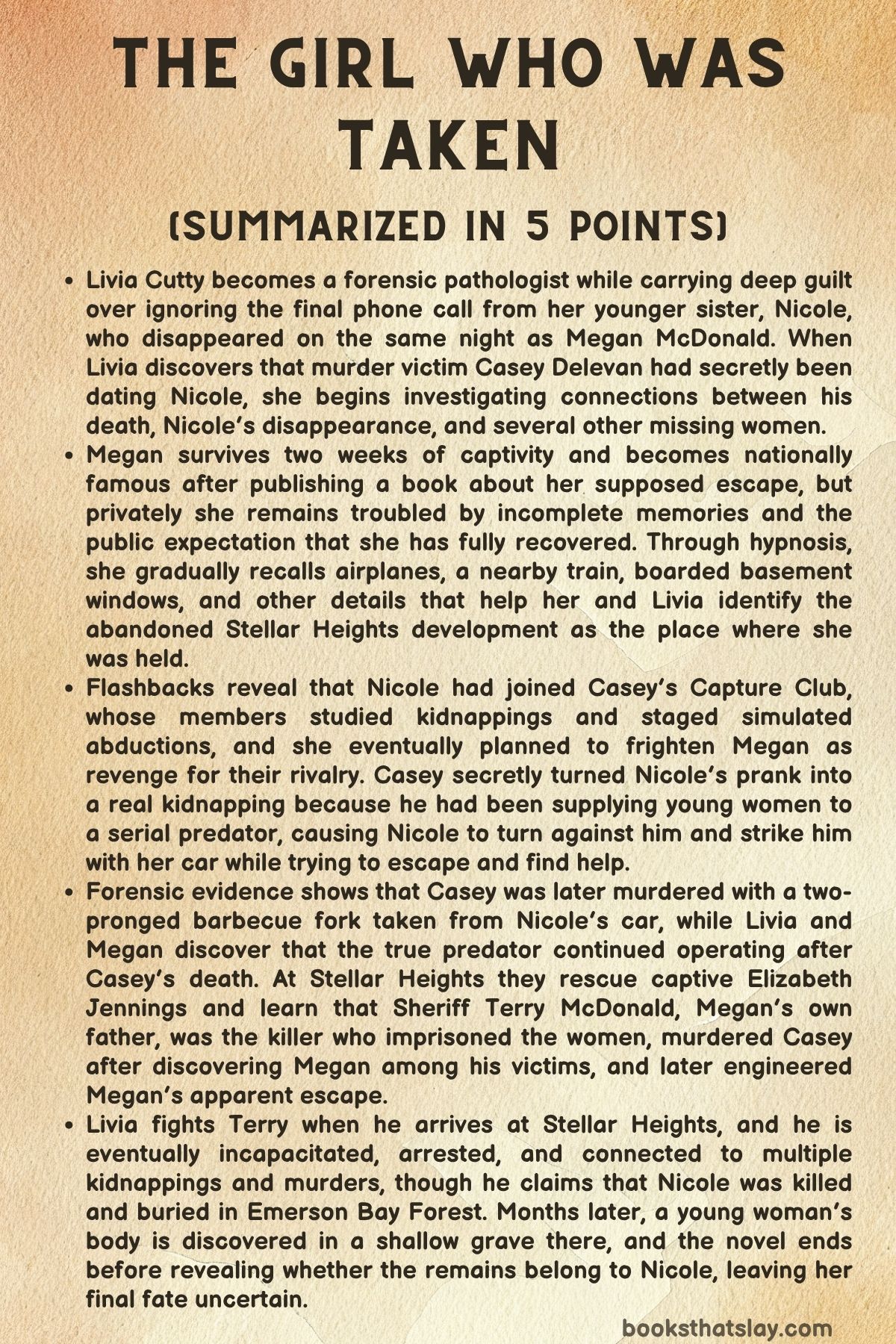
Summary
Nicole Cutty’s disappearance begins with a desperate attempt to escape something far more dangerous than the reckless games she has been playing. After fleeing from a threatening situation, she reaches her car, strikes a pursuing man, and drives away injured and terrified. Unsure whom she can trust, she calls her older sister Livia, but Livia does not answer.
At almost the same time, Megan McDonald disappears. Two weeks later, Megan awakens in a forest bunker and discovers that the door is partly open and that she is no longer chained. Believing she may never receive another opportunity, she runs through the woods despite injuries and lingering drugs in her body until a passing motorist recognizes her and brings her to safety.
Nicole never returns.
A year later, Megan has become famous. Her abduction has been transformed into a bestselling book called Missing, television interviews, and a carefully shaped story about courage and recovery. Publicly, she appears to have survived and moved forward, but privately she feels disconnected from the identity everyone expects her to resume.
Nicole’s sister Livia has taken a very different path. She begins a forensic pathology fellowship under Dr. Gerald Colt, driven partly by her fascination with medicine and partly by guilt over Nicole. Livia believes that one day a medical examiner may have to identify Nicole’s body, and she wants to become the kind of doctor who can give grieving families truthful answers.
Her guilt is personal because Nicole called her on the night she vanished. Livia deliberately ignored the call, assuming Nicole was creating another crisis. That decision has remained with her ever since.
During her fellowship, Livia receives the decomposed body of a young man initially believed to have jumped from a bridge. The evidence quickly contradicts that explanation. His injuries are inconsistent with a fatal fall, his lungs do not support drowning, and his skull contains twelve unusual puncture wounds.
The victim is eventually identified as Casey Delevan. The case becomes intensely personal when Nicole’s friend Jessica reveals that Casey had secretly been dating Nicole during the summer before she disappeared. Livia suddenly realizes that a homicide victim lying on her autopsy table may be directly connected to her missing sister.
Through flashbacks, Nicole’s life before the disappearance comes into focus. She was restless, provocative, increasingly hostile toward Megan, and fascinated by stories of kidnappings and missing people. Some of that fascination came from the childhood disappearance of her cousin Julie, an event Nicole never emotionally resolved.
Online, Nicole met Casey, whose own childhood had been destroyed by a disappearance. Casey’s older brother Joshua vanished from a fair when Casey was seven, and Casey had watched a stranger lead him away without intervening. The guilt followed him into adulthood.
Casey introduced Nicole to the Capture Club, a secret group obsessed with missing-person cases, predators, and simulated kidnappings. Nicole’s initiation involved being grabbed, hooded, restrained, transported, and locked inside a dark shed without being told it was staged. Rather than rejecting the experience afterward, she found the terror exciting.
Nicole soon became one of the group’s more extreme participants. During a staged kidnapping involving Diana Wells, she helped push the event beyond what Diana expected, leaving the young woman traumatized.
Meanwhile, Nicole’s resentment toward Megan intensified. Megan represented achievement, admiration, stability, and the carefully polished future Nicole felt disconnected from. Nicole was also attracted to Matt Wellington, who was close to Megan, but Matt rejected Nicole’s advances.
As Livia investigates Casey, she discovers files on several women, including Nancy Dee, Paula D’Amato, and Diana Wells. Nancy had been abducted and later found murdered. Paula was missing. Diana confirms Casey’s involvement with the Capture Club and Nicole’s participation in its increasingly dangerous activities.
Livia then discovers a crucial medical connection. Nancy Dee had ketamine in her body, and Megan had also been heavily sedated with ketamine during captivity. Paula’s case later reveals similar evidence, suggesting that the women may have been targeted by the same offender.
Megan is conducting her own investigation. Through hypnosis with Dr. Mattingly, she reconstructs sounds and details from the basement where she was held: boarded windows, stairs, airplanes overhead, and a distant train whistle. Rather than simply recovering emotionally, Megan is trying to locate the place and identify the person responsible.
Livia and Megan eventually begin working together. Their investigations show that Casey was involved in real abductions, but they also discover that victims continued appearing in circumstances that suggest another person was ultimately controlling them. Casey seems less like the central predator than an accomplice who located and delivered women.
Forensic evidence also reveals what happened to Casey. A barbecue-tool set recovered from Nicole’s abandoned car is missing a long two-pronged fork. Imaging confirms that the missing fork matches the wounds in Casey’s skull.
Another clue is equally important. Casey had a femur fracture at the exact height of Nicole’s car bumper, indicating that Nicole struck him with her vehicle shortly before he was killed. The evidence suggests that Nicole had confronted Casey on the night of her disappearance.
The past timeline gradually explains why. Nicole planned to use the Capture Club’s methods to frighten Megan as revenge for their rivalry and Nicole’s humiliation over Matt. She believed Casey would abduct Megan temporarily and take her to the abandoned brewery used by the club.
Casey had entirely different intentions. He kidnapped Megan for real, drugged her, and drove her toward Stellar Heights, an abandoned housing development in West Bay. Nicole followed him because she initially believed the plan remained a cruel but temporary prank.
At Stellar Heights, Nicole discovered that Casey had been involved in genuine kidnappings. He had delivered Nancy and Paula to someone using the deserted houses as hidden prisons, and Megan was intended to become another captive.
Nicole turned against him. She escaped in her car and struck Casey as she fled, breaking his leg.
She then encountered what appeared to be salvation: a police cruiser.
Nicole willingly stopped and trusted the officer, explaining what had happened and believing he would rescue Megan. The officer inspected Nicole’s car and removed the barbecue fork from the trunk.
Instead of taking Nicole to safety, he drove her back toward Stellar Heights and addressed her using the phrase the serial captor used for his prisoners: “my Love.” Nicole had escaped Casey only to fall directly into the hands of the man Casey served.
In the present, Megan’s memories lead her and Livia to Stellar Heights. Megan becomes certain that her supposed escape had never been an accident. Unlike other victims, she had not endured the same prolonged sexual abuse, and the circumstances of her release now appear carefully arranged.
When Megan finds the boarded basement windows she remembers, she knows she has located the house where she spent most of her captivity. Inside, she also recalls another sound: the creaking leather of a police officer’s equipment belt.
Megan and Livia enter the cellar and make an astonishing discovery. Elizabeth Jennings, another kidnapped young woman, is still alive and chained inside.
The existence of a living captive proves that the offender never stopped operating. Even more shocking, Elizabeth tells Livia that she has communicated through the ventilation system with another prisoner named Nicole.
The truth about the captor finally emerges. Sheriff Terry McDonald, Megan’s own father, has secretly used Stellar Heights to imprison women, while Casey helped provide victims.
On the night of Megan’s kidnapping, Terry arrived after Nicole struck Casey. He discovered Megan chained inside one of his own hidden rooms and realized Casey had unknowingly abducted his daughter.
Terry killed Casey with the barbecue fork, buried the body, and took Nicole prisoner because she knew too much. He later moved Megan to the forest bunker and deliberately allowed her to escape because keeping or killing his own daughter would have created impossible risks.
More than a year later, Terry has continued maintaining his secret prisons while attempting to destroy evidence. When Megan and Livia locate Elizabeth, his entire hidden life is threatened.
Livia desperately searches for Nicole but finds only signs that she had recently been held in another room. Terry then arrives at Stellar Heights under the appearance of responding officially to the emergency.
His disguise collapses when he attacks Megan and Livia. Livia uses the kickboxing skills she has developed during her fellowship to fight him and eventually uses an accelerant and lighter during the struggle, severely burning and incapacitating him.
Police and emergency workers arrive, Elizabeth is rescued, and Terry eventually begins confessing. He admits responsibility for the women held at Stellar Heights and claims he killed Nicole before investigators reached the development.
According to Terry, Nicole was buried somewhere in Emerson Bay Forest. Police search extensively but fail to recover her body, leaving Livia with answers but not the physical certainty she had spent so long expecting to receive.
Megan withdraws from public attention and enters treatment. She refuses to participate in the media frenzy surrounding the discovery that her father was the kidnapper, resisting the public’s attempt to turn her suffering into another inspirational story.
Livia continues her fellowship and begins accepting herself as a capable medical examiner rather than someone defined by guilt over Nicole. Her understanding of death has changed: she now sees her work less as an intellectual challenge and more as a responsibility toward people whose families need answers.
Six months later, however, a new case unsettles that fragile sense of closure. A young woman’s body is discovered in a shallow grave in Emerson Bay Forest, within the age range that could match Nicole.
Livia travels to the scene with Kent and Sanj. Standing before the covered body, she prepares herself professionally and emotionally for what might be beneath the sheet.
The novel ends before the body is identified, leaving open the possibility that Terry told the truth, that he lied about Nicole’s death, or that the final discovery may produce an entirely different answer. Nicole’s fate therefore remains the last unresolved question in The Girl Who Was Taken, just as it has haunted Livia from the beginning.
Characters
Livia Cutty
Livia is the emotional and investigative center of The Girl Who Was Taken, carrying enormous guilt because she ignored Nicole’s final phone call and had previously refused her sister’s request to stay with her. Her decision to become a forensic pathologist is closely connected to that guilt, since she imagines that someone in her profession may eventually have to identify Nicole’s remains.
Her development is defined by the movement from self-punishment toward purposeful action. Initially, she treats professional achievement partly as a way to control grief, but Casey Delevan’s autopsy forces her to confront Nicole’s disappearance actively rather than simply preparing for its worst possible conclusion.
Livia’s strongest qualities are persistence, intellectual discipline, and compassion for families seeking answers. Her investigation is not always professionally appropriate, since she removes material from Casey’s belongings, conducts interviews on her own, and becomes deeply involved in cases outside her official responsibilities, but these decisions show how personal urgency repeatedly challenges her medical objectivity.
Her changing understanding of Nicole is equally important. Livia begins with an idealized image of her missing younger sister, then learns that Nicole participated in dangerous Capture Club activities, mistreated Diana, pursued Matt, and helped arrange Megan’s supposed kidnapping.
Instead of abandoning Nicole emotionally after these discoveries, Livia learns to accept that loving someone does not require imagining that person as innocent or uncomplicated. By the end, her confrontation with Terry demonstrates how far she has moved from passivity, as the physical discipline she developed through kickboxing becomes essential to her survival.
Nicole Cutty
Nicole is the absent presence controlling much of The Girl Who Was Taken. Although missing during the principal investigation, the book gradually reconstructs her personality through flashbacks, memories, forensic discoveries, and testimony from the people who knew her.
She is intelligent, rebellious, sexually provocative, cruel at times, emotionally restless, and fascinated by danger. Her interest in disappearances grows partly from the unresolved loss of her cousin Julie, suggesting that her attraction to frightening situations is connected to an attempt to approach and control something that once made her feel powerless.
Nicole’s relationship with Casey becomes especially dangerous because he appears to understand this part of her. The Capture Club gives her both excitement and belonging, but it also encourages her to treat terror as entertainment and ignore the emotional boundaries of others.
Her hostility toward Megan exposes Nicole’s insecurity beneath her confident behavior. Megan’s accomplishments, popularity, and relationship with Matt become symbols of everything Nicole feels she lacks, leading Nicole to organize a fake kidnapping designed to humiliate her.
Yet Nicole changes decisively once she understands that Casey has turned the prank into a real abduction. She rejects him, attempts to save Megan, strikes Casey with her car, and tries to reach help, showing that there remains a clear moral boundary she refuses to cross.
Nicole’s tragedy is that her attempt to correct her mistake leads directly to Terry. Her flaws contribute to the circumstances surrounding the crime, but the novel never treats those flaws as justification for what happens to her.
Megan McDonald
Megan begins The Girl Who Was Taken as the apparent opposite of Nicole. She is successful, disciplined, popular, academically ambitious, admired by adults, and expected to continue toward Duke University and medical school.
After her abduction, that polished identity becomes a burden. Her family, publishers, interviewers, and the public want Megan to embody the reassuring story of a victim who suffered, escaped, and returned stronger, but Megan knows that survival has altered her too deeply for that simple narrative.
Her determination to reconstruct her captivity is one of the book’s strongest expressions of personal agency. Dr. Mattingly sees memory recovery primarily as a therapeutic process, while Megan increasingly regards it as an investigation that may reveal her captor.
She carefully studies airplane routes, train sounds, geography, hypnosis memories, and details of the basement until she eventually identifies Stellar Heights. Her greatest realization is that her famous “escape” was deliberately engineered rather than achieved through the circumstances everyone has celebrated.
The discovery that Terry is the offender destroys the remaining foundation of Megan’s former life. Her father was supposedly her protector, and his authority as sheriff made him seem especially trustworthy, yet he was responsible for the crimes she had spent more than a year trying to understand.
Megan’s final refusal to return immediately to television is therefore significant. Instead of allowing the public to shape another version of her trauma, she chooses privacy, treatment, and greater control over her own identity.
Casey Delevan
Casey is one of the most morally disturbing characters in The Girl Who Was Taken because he occupies the space between victim, accomplice, manipulator, and criminal. His childhood was permanently damaged when he watched his older brother Joshua disappear with a stranger and failed to intervene.
That experience gives Casey an authentic connection with Nicole, whose cousin also disappeared. Their shared trauma initially makes their relationship understandable, but Casey converts his obsession with missing people into increasingly destructive behavior.
The Capture Club gives him a socially acceptable disguise for his fixation. Staged kidnappings allow him to recreate the experience that defined his childhood, only now he controls who disappears, how it happens, and when the ordeal ends.
Eventually, those simulations become a cover for genuine crimes. Casey selects or delivers women to Terry, including Nancy and Paula, while maintaining enough distance from the final captivity to avoid seeing himself as the primary predator.
His betrayal of Nicole completes his moral collapse. He exploits her resentment toward Megan to carry out a real kidnapping, believing Nicole’s planned prank will provide the perfect cover.
Casey is nevertheless not the final source of the crimes, and his death demonstrates his subordinate position in the criminal partnership. Once he accidentally delivers Terry’s daughter, he becomes a liability Terry immediately eliminates.
Terry McDonald
Terry is the central antagonist and the revelation that transforms The Girl Who Was Taken from a search for an unknown predator into a story about corrupted trust. As sheriff, husband, and father, he occupies roles associated with protection, stability, and lawful authority.
His secret life is the complete opposite. He imprisons women in abandoned houses, uses ketamine to control them, sexually abuses some captives, kills those who resist or become inconvenient, and disposes of their bodies while imagining these relationships as distorted forms of romance.
The phrase “my Love” captures the central feature of Terry’s psychology. He does not merely want physical control; he invents emotional relationships with women who are terrified of him and interprets resistance as personal betrayal.
His relationship with Megan makes his character especially disturbing. He genuinely behaves like a concerned father while simultaneously being the man responsible for the system of abduction that eventually captures her.
When Casey delivers Megan to Stellar Heights, Terry is forced to confront the collision between his public identity and secret compulsions. He cannot treat Megan like his other victims, so he kills Casey, imprisons Nicole, and engineers Megan’s release in an attempt to preserve both his daughter and his hidden life.
Terry’s position also explains why he remains difficult to detect. His access to police equipment, official materials, information, and public trust allows criminal behavior to exist behind the very institution expected to investigate disappearances.
Dr. Gerald Colt
Dr. Colt is Livia’s forensic pathology mentor and represents disciplined professional reasoning. He repeatedly reminds her that medical examiners should distinguish what evidence proves from what they suspect, a lesson that becomes especially important once Nicole’s disappearance begins influencing Livia’s judgment.
His handling of Casey’s autopsy shows this philosophy clearly. Even when the injuries strongly suggest homicide, Colt refuses to classify the death beyond what the physical findings can establish at that stage.
For Livia, he functions as a counterweight to emotional urgency. Her private investigation often encourages her to connect clues rapidly, while Colt’s training teaches her to slow down, document findings, and avoid turning possibility into certainty.
He also helps show Livia’s professional growth. By the end, she approaches bodies less as technical puzzles and more as people whose deaths must be explained accurately for those left behind.
Kent Chapple
Kent is a medicolegal investigator whose friendship with Livia gradually becomes more personal. He is dealing with an unhappy marriage, drinks excessively at times, and frequently retreats to Tinder Valley to escape his domestic problems.
Because the narrative reveals that the killer also uses Tinder Valley as an alibi, Kent temporarily appears suspicious. His access to death investigations and professional materials further allows the story to keep him within the group of plausible suspects.
His real importance, however, lies in his relationship with Livia. He becomes someone she trusts enough to discuss her discoveries with, while his own inability to confront his failing marriage parallels the book’s broader interest in people clinging to lives that no longer exist.
Kent also indirectly contributes to Livia’s survival when the lighter he previously gave her becomes useful during the confrontation with Terry. His later separation and admission of romantic feelings leave their future relationship unresolved.
Randy
Randy is Livia’s kickboxing partner and a practical source of emotional guidance. He understands that Livia cannot erase guilt through endless self-criticism and encourages her to act rather than remain trapped in the past.
His lesson about waking up and continuing to move becomes an important principle for Livia. She gradually stops treating Nicole’s disappearance as a fixed tragedy she must endure and begins treating unanswered questions as something she can investigate.
Randy’s physical training also has a direct narrative purpose. The striking skills and instincts Livia develops through kickboxing allow her to resist Terry when he attacks her at Stellar Heights.
Dr. Mattingly
Dr. Mattingly is Megan’s psychiatrist and one of the few characters consistently concerned with the psychological danger of recovering traumatic memories too quickly. He uses hypnosis carefully, attempting to balance Megan’s desire for answers against the possibility that forcing suppressed memories into consciousness may destabilize her.
This creates conflict because Megan increasingly sees him as an obstacle. She wants information about the cellar, while Mattingly is responsible for protecting her from overwhelming emotional reactions.
His caution proves justified when Megan’s recovered memories begin invading her dreams and daily life. Yet Megan’s persistence also shows that clinical safety and personal agency do not always point in the same direction.
Mr. Steinman
Mr. Steinman is the motorist who finds Megan after she reaches the highway and later becomes one of her most genuine friends. Unlike interviewers, publishers, and even Megan’s parents, he does not need her to perform recovery for his reassurance.
Their cribbage games provide Megan with moments when she can exist without being treated as a symbol. Steinman repeatedly encourages her to decide what she wants rather than organize her life around other people’s expectations.
His later appearance at Nicole’s funeral carrying Megan’s message connects the two families after the investigation. He remains a quiet source of stability at a time when Megan is rebuilding her life privately.
Jessica Tanner and Rachel Ryan
Jessica and Rachel represent Nicole’s old social world and become important witnesses to the changes in her personality before the disappearance. They remember her growing secrecy, her relationship with Casey, her hostility toward Megan, and her increasingly extreme behavior.
Jessica plays the larger investigative role because she recognizes Casey from the news and tells Livia that Nicole had been dating him. Her information gives Livia the first direct connection between Casey’s death and Nicole’s disappearance.
Both women also demonstrate how successfully Nicole hid parts of herself even from close friends. They knew she was becoming reckless and secretive but did not understand the scale of the world she had entered.
Nate Theros
Nate is a former Capture Club member whose fascination with missing-person cases makes him both unsettling and useful. His knowledge helps Livia understand Casey’s role in the club and reveals that Casey often seemed aware of disappearances unusually early.
Later, Nate helps construct a behavioral portrait of the predator. He notices the offender’s emotional attachment to victims, the careful use of black body bags, and the significance of materials that suggest professional access.
His character demonstrates that disturbing interests do not automatically make someone responsible for violent crimes. Nate possesses knowledge similar to Casey’s, but what matters is the choice between observing darkness and participating in harm.
Elizabeth Jennings
Elizabeth is the living captive discovered at Stellar Heights and provides undeniable proof that the crimes are continuing. Her physical condition shows the long-term brutality of Terry’s imprisonment system.
Despite her weakness, Elizabeth provides the revelation that gives Livia renewed hope: another woman named Nicole has been communicating with her through the building. Her testimony transforms Livia’s understanding of Nicole’s fate only moments before the final confrontation.
Elizabeth also changes the stakes of the investigation from solving old murders to saving someone in immediate danger. Finding her validates Megan’s memories and prevents Terry from quietly eliminating another victim.
Themes
Guilt, Responsibility, and the Need to Act
Guilt drives several of the central characters in The Girl Who Was Taken, but the novel repeatedly distinguishes between feeling responsible and responding constructively to responsibility. Livia carries guilt because she ignored Nicole’s call and refused an earlier request for help, while Casey’s entire adult life is shaped by the memory of watching his brother disappear without intervening.
Their responses move in opposite directions. Livia initially allows guilt to become self-punishment, imagining that becoming a forensic pathologist may prepare her to confront Nicole’s corpse someday, but eventually she turns that emotion toward finding answers and helping other families.
Casey instead converts guilt into obsession and control. Rather than processing his childhood helplessness, he recreates disappearances through the Capture Club and later helps make real abductions possible, becoming part of the kind of violence that once destroyed his own family.
Nicole experiences her own reckoning when the prank she planned for Megan becomes an actual kidnapping. Her earlier cruelty matters, but the story also emphasizes what she does once she understands the truth: she opposes Casey, strikes him with her car, escapes, and tries to seek help.
The contrast among these characters suggests that guilt alone has no moral value. It can trap a person, motivate repair, or become justification for further harm depending on what the individual chooses to do with it.
The Difference Between Survival and Recovery
Megan’s story challenges the assumption that surviving a traumatic event automatically produces emotional resolution. From the public perspective, her escape gives the story a satisfying ending: she is alive, celebrated, planning for the future, and supposedly transformed into an inspirational figure.
Privately, Megan knows that the person she was before the kidnapping no longer exists in the form everyone wants restored. Television appearances, the bestselling book, and carefully practiced answers force her to perform a version of recovery designed largely for other people’s comfort.
Her investigation becomes an attempt to reclaim authority over her own experience. She wants to understand where she was held, what happened to her, who was responsible, and why she survived when other women did not.
This need brings her into conflict with her parents and Dr. Mattingly because they interpret safety as avoiding memories that cause distress. Megan increasingly believes that avoiding those memories prevents her from regaining control.
The novel does not treat either position as simple. Mattingly’s concern is justified when Megan becomes emotionally destabilized, yet Megan’s persistence ultimately leads to Stellar Heights and Elizabeth’s rescue.
Recovery therefore appears not as a return to a previous identity but as the difficult creation of a different one. Megan’s final rejection of renewed publicity reinforces that idea because she begins deciding for herself when, how, and whether her story will be told.
Appearance, Authority, and Hidden Evil
Much of the suspense in The Girl Who Was Taken depends on the difference between how people appear publicly and what they conceal privately. Megan looks like a recovered survivor while privately struggling with memory and identity, Casey appears to be a strange enthusiast before being exposed as an accomplice, and Terry embodies respectable authority while secretly committing the crimes he should be investigating.
Terry represents the theme in its most dangerous form because people do not merely fail to suspect him; his position actively encourages trust. Nicole accepts his assistance after escaping Casey because a police officer seems like the safest person she could encounter.
His profession also provides practical advantages. Law-enforcement knowledge, equipment, professional materials, investigative awareness, and social credibility all make it easier for him to conceal his crimes and manage evidence.
The abandoned Stellar Heights development strengthens this contrast between visible appearance and hidden reality. From outside, it is simply a failed housing project waiting for demolition, yet inside its forgotten buildings Terry has created private prisons.
Even the public narrative surrounding Megan operates according to appearance. Her publishers and interviewers prefer a clean story about escape and victory because unresolved trauma is less comforting.
The novel repeatedly warns that social roles and polished narratives should not be mistaken for truth. Reliable understanding comes instead through physical evidence, remembered details, contradictions, and the willingness to question explanations that appear convenient.
Memory, Truth, and the Stories People Create
Memory is unstable throughout the novel, but it remains essential to discovering the truth. Megan’s captivity memories have been damaged by trauma and ketamine, leaving her with fragments of sound, geography, physical sensation, and fear rather than a complete chronological account.
Her hypnosis sessions gradually recover airplanes, trains, boarded windows, stairs, and the sound of police equipment. Individually, these details seem insignificant, but together they eventually identify Stellar Heights and Terry’s connection to law enforcement.
The book also shows how repeated stories can alter understanding. Megan’s public narrative says she escaped because the bunker door was accidentally left open, and that version becomes so established that Megan herself initially accepts it.
Only after comparing her experience with those of Nancy and Paula does she recognize that her release was deliberately staged. Truth therefore requires more than remembering events; it requires reexamining the interpretation attached to them.
Livia undergoes a similar process with Nicole. Her memory of her sister is shaped by guilt and loss, encouraging her to imagine Nicole mainly as the missing girl she failed to protect.
The investigation reveals a more difficult person: jealous, cruel at times, reckless, secretive, and capable of helping terrorize Diana. Yet it also reveals Nicole’s decision to resist Casey and try to save Megan.
By allowing contradictory truths to coexist, the story argues that real understanding cannot depend on simple narratives of innocence, heroism, guilt, or recovery. People and events become clearer only when comforting versions are replaced by the full complexity of what actually happened.