The Good Girl Summary, Characters and Themes
The Good Girl by Mary Kubica is a psychological suspense novel centered on Mia Dennett, a young teacher whose disappearance exposes long-hidden fractures within her wealthy family and gradually challenges every assumption about victimhood, guilt, loyalty, and love.
Told through shifting perspectives and alternating periods before and after Mia’s return, the book follows her mother Eve, detective Gabe Hoffman, and her abductor Colin Thatcher as each tries to understand what really happened. What first appears to be a conventional kidnapping becomes increasingly difficult to classify, especially after Mia returns traumatized, pregnant, unable to remember three months of her life, and insisting that her name is Chloe.
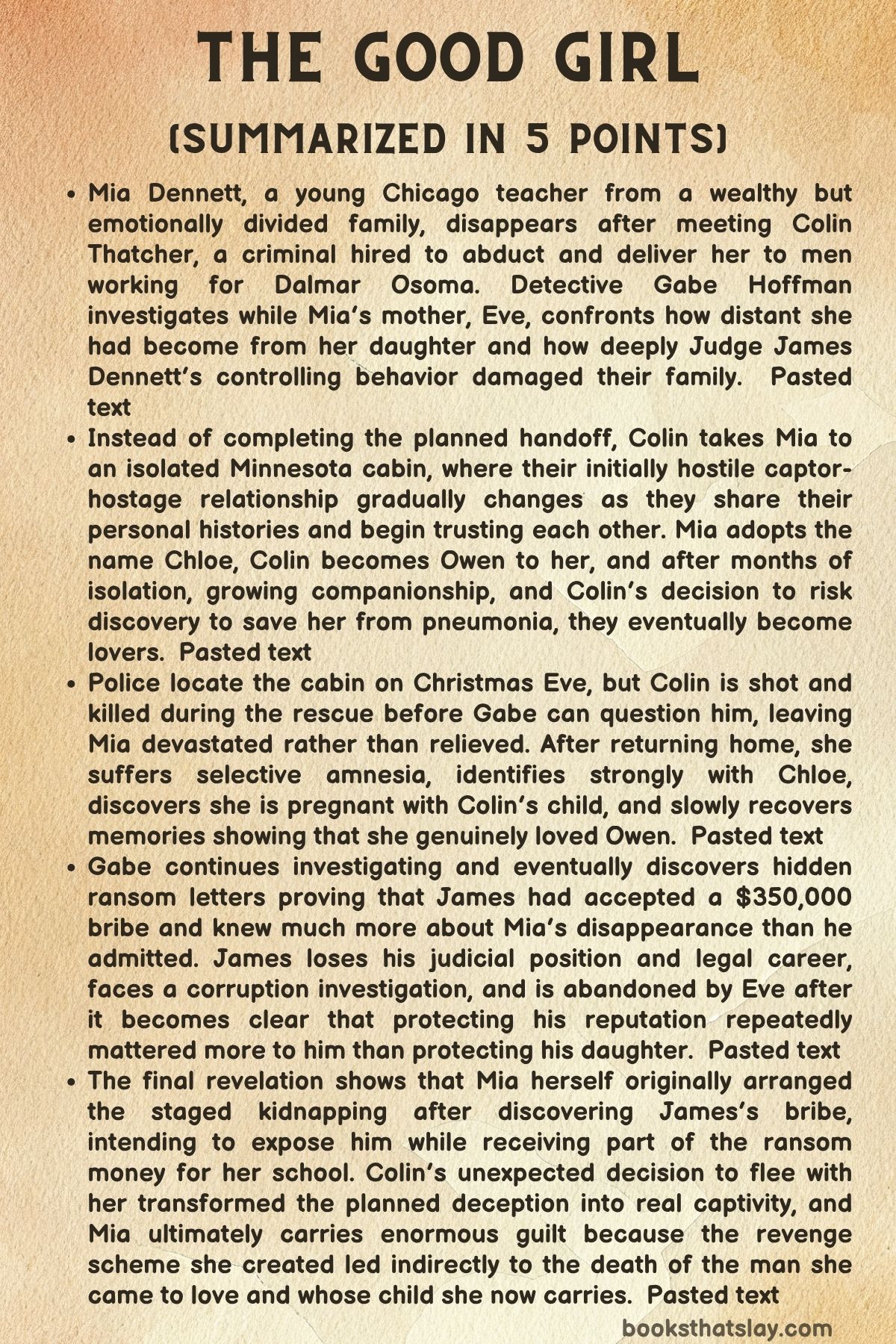
Summary
Mia Dennett disappears after failing to arrive at the alternative high school where she teaches. Her colleague Ayanna Jackson alerts Eve Dennett, Mia’s mother, after Mia fails to answer calls and messages, and Eve slowly realizes how little she actually knows about her adult daughter’s daily life.
Detective Gabe Hoffman begins investigating the disappearance and quickly encounters tension inside the Dennett family. Eve is frightened, but her husband, Judge James Dennett, initially treats Mia’s absence as another example of the rebellious behavior she displayed during adolescence.
Mia’s older sister Grace, a successful attorney who has always fit James’s expectations, also reveals that Mia had disappeared overnight in the past. Gabe nevertheless learns that the adult Mia is dependable, committed to her students, and unlikely to abandon her job without explanation.
Attention initially turns toward Jason Becker, an architect Mia had been casually dating. He was supposed to meet her on the night she vanished but cancelled because of work, and his indifference makes him suspicious until records support his alibi.
The investigation eventually leads to the bar where Mia had been waiting for Jason. There she met Colin Thatcher, a man who had secretly followed her for days because he had been hired to abduct her.
Colin approaches Mia as though they are strangers meeting by chance. Their conversation becomes unexpectedly natural, and Mia eventually accompanies him to his apartment, unaware that he intends to deliver her to criminals working with Dalmar Osoma.
When Colin finally reveals the gun and forces her into his truck, Mia believes she has been deceived by a dangerous stranger. Colin drives toward the planned handoff beneath Lower Wacker Drive, but at the crucial moment he refuses to surrender her and instead drives away from Chicago.
His decision turns both of them into targets. Colin believes Dalmar’s men may abuse or kill Mia, but by refusing the handoff he also places himself in danger and transforms what should have been a short criminal job into an unpredictable flight.
They travel north until reaching an isolated family cabin near Grand Marais, Minnesota. Colin cuts the telephone line, restores basic utilities, establishes false identities, and tells Mia that she must call herself Chloe whenever they encounter anyone.
The name has an old emotional importance to Mia that Colin does not yet understand. At first, however, their life at the cabin is defined by fear, captivity, and Mia’s attempts to escape.
Mia runs into the woods after trying to take Colin’s truck, but he catches her. She later tries another survival strategy by offering herself sexually, believing that giving her captor what she assumes he wants might protect her from something worse.
Colin refuses to take advantage of her fear. His refusal does not erase the kidnapping, but it begins disrupting Mia’s understanding of him because his behavior repeatedly conflicts with the cruelty she expects.
Meanwhile, Gabe reconstructs Mia’s movements in Chicago. Surveillance evidence eventually connects her to Colin’s apartment, public photographs help identify him, and information about his history leads Gabe to Colin’s sick mother, Kathryn Thatcher.
Kathryn suffers from a degenerative illness and depends heavily on her son. Gabe discovers that much of Colin’s money and many of his criminal choices were connected to his desperate attempts to support her.
At the cabin, Mia and Colin slowly begin talking rather than merely confronting each other. Mia tells him about growing up under James’s constant judgment, his contempt for her artistic ambitions, and her painful belief that Grace was the daughter her father truly valued.
Colin initially dismisses Mia’s problems because she grew up wealthy, but he gradually recognizes that financial privilege did not protect her from emotional rejection. Mia, in turn, learns about his abusive father, his impoverished childhood, Kathryn’s illness, and the financial desperation that brought him into Dalmar’s criminal world.
Their understanding grows through ordinary acts. Colin buys Mia a sketchbook for her birthday, allows her increasing freedom outside, listens as she talks about art, and eventually trusts her enough to place his own gun in her hands.
Mia has an opportunity to shoot him but cannot do it. Later, when an unexpected visitor named Beth approaches the cabin, Mia has another clear opportunity to expose Colin but instead supports their cover story and allows Beth to leave without realizing that she has met a missing woman.
A stray cat, eventually named Canoe, becomes another part of their secluded existence. Mia feeds and cares for the animal despite Colin’s objections, and the cat later becomes an important connection between her lost memories and the cabin.
Winter intensifies their isolation. Colin worries about supplies, Dalmar, his mother, and the police, while Mia becomes increasingly aware that Colin’s refusal to deliver her may have saved her from people more dangerous than he is.
When Mia develops severe pneumonia, Colin faces a choice between protecting himself and protecting her. He takes her to a medical clinic in Grand Marais under a false name and obtains antibiotics, knowingly creating evidence that could eventually lead investigators to them.
After she recovers, their emotional dependence becomes openly romantic. They choose a Christmas tree together, imagine escaping to Canada and starting over, and eventually become lovers after Mia initiates physical intimacy.
Mia tells Colin that she wants to remain Chloe if they escape. She also explains why she chose the name: as a lonely child, she became fascinated by a deceased girl named Chloe Frost whose grieving family publicly expressed the kind of unconditional love Mia desperately wanted from her own family.
To Mia, Colin becomes Owen, the false identity under which she has come to know him. She does not want his real name because Owen represents the person he became with her rather than the criminal history attached to Colin Thatcher.
Back in Chicago, Eve deteriorates emotionally while searching for her daughter. Mia’s disappearance forces her to reconsider years of passivity within her marriage and to recognize how often she allowed James to criticize, control, and emotionally isolate their daughter.
Eve and Gabe also become emotionally close. His patience and willingness to listen contrast sharply with James’s coldness, and their relationship eventually crosses into romantic territory.
The investigation gains momentum through small clues connected to Kathryn, including mail sent from Wisconsin, Colin’s childhood connection to Grand Marais, and the clinic visit made when Mia had pneumonia. Police eventually locate the family cabin shortly before Christmas.
Colin and Mia are preparing to leave together when officers surround the property. Mia does not welcome the police as rescuers; instead, she wants to remain with Owen and believes they should escape together.
During the confrontation Mia briefly holds Colin’s gun before he takes it from her. When Colin appears near a window with the weapon, officers outside interpret him as an immediate threat.
Gabe has repeatedly ordered the local police not to fire unless absolutely necessary, but he reaches the scene too late. A sniper shoots Colin, killing him before Gabe can question him or understand what happened inside the cabin.
Mia is found covered in Colin’s blood and emotionally devastated. Rather than identifying herself as Mia, she insists that she is Chloe, revealing how completely her identity has changed during the months away.
After returning home, she develops selective amnesia and acute trauma symptoms. She remembers much of her earlier life but cannot consciously recover her time with Colin, although drawings, dreams, physical sensations, the name Owen, and familiar objects repeatedly suggest that the memories remain buried.
Eve initially assumes that Colin was simply an abusive captor. Her certainty becomes even stronger when doctors discover that Mia is pregnant, because Eve assumes the pregnancy must have resulted from rape.
James immediately pressures Mia to terminate the pregnancy. His behavior repeats his lifelong tendency to decide what is appropriate for his daughter rather than allowing her to determine her own future.
At the clinic, however, Mia encounters a little boy named Owen. The name produces such a powerful emotional response that she cannot go through with the abortion, even though she still cannot consciously explain what Owen means to her.
Gabe continues investigating rather than treating Mia’s rescue as the end of the case. When Canoe is located near the cabin, seeing the cat unlocks additional memories, and Mia eventually returns to Minnesota with Eve, Gabe, and Dr. Rhodes.
Inside the cabin, sensory details bring the lost months back. Mia finally remembers Owen being shot, his blood spreading across the floor, and her desperate attempts to revive him.
Her reaction convinces Eve that Mia’s attachment cannot be dismissed simply as fear or dependency. Dr. Rhodes raises Stockholm syndrome as one possible psychological framework, but Eve concludes more simply that her daughter loved Colin.
The returning memories leave Mia grieving intensely and even experiencing suicidal thoughts. She also begins revealing that Colin had originally been hired to deliver her to someone else and that the kidnapping somehow involved James.
Gabe obtains a warrant and discovers hidden ransom letters in James’s chambers. The letters reveal an extortion scheme built around evidence that James had accepted a $350,000 bribe in a racketeering case.
James admits that he knew about the ransom demands throughout Mia’s disappearance. He originally considered paying to save Mia and conceal his corruption, but once he decided she was probably dead, he refused because paying would expose the bribe without bringing his daughter back.
His concealment destroys his career and family. He is removed from office, disbarred, investigated for corruption, and abandoned by Eve, who files for divorce.
Yet the final explanation overturns even this version of events. Mia herself had discovered evidence of James’s bribe and secretly contacted Dalmar, intending to punish the father whose reputation had always mattered more to him than his relationship with her.
She arranged a staged kidnapping in which Dalmar would demand ransom while threatening to reveal the corruption. Mia would receive forty percent of the payment and intended to donate her share anonymously to her school.
To make her reactions convincing, she deliberately avoided learning exactly when or how she would be taken. When Dalmar asked which member of the family should become the hostage, Mia chose herself.
Colin was supposed to be only the operative who delivered her to the next stage of the scheme. His unexpected decision to abandon the handoff turned Mia’s carefully planned deception into actual captivity and placed both of them beyond Dalmar’s control.
Mia initially remained silent because she was frightened by what had happened. Later, after understanding that Colin had protected her from Dalmar and after falling in love with him, she concealed the truth because revealing her role would destroy what existed between them.
Her repeated statements that everything had gone wrong and that events were her fault therefore carried a meaning no one around her understood. Mia’s guilt over Owen’s death comes partly from believing that her own revenge scheme set in motion every decision that ultimately placed him in front of the police sniper.
Pregnant with his child, she chooses to preserve the baby as the living connection she still has to Owen. The Good Girl therefore ends by revealing that Mia was neither simply a helpless hostage nor fully in control of what happened; she began the scheme herself, lost control of it, found love in circumstances created by deception and crime, and must live with consequences that cannot be reduced to a single moral explanation.
Characters
Mia Dennett / Chloe
Mia is the central figure of The Good Girl, and almost every major mystery in the book depends on the distance between who other people believe she is and what she actually knows. To her family she is the difficult daughter, to her students she is a devoted teacher, to the police she is a missing victim, and to Colin she gradually becomes Chloe, a woman trying to separate herself from the identity shaped by James Dennett.
Her childhood explains much of her adult resistance. She grows up financially privileged but emotionally insecure, constantly comparing herself with Grace and feeling that James regards her artistic interests, career choices, and personality as evidence of failure.
Her decision to teach disadvantaged students shows that Mia has deliberately rejected the status system her father respects. She values work based on human connection rather than prestige, which also explains why she plans to donate her share of the ransom scheme to her school rather than use the money simply for personal luxury.
The staged kidnapping reveals a darker side of her independence. Mia is intelligent enough to discover James’s corruption and bold enough to construct an elaborate revenge plan, but she seriously underestimates what happens when a plan involving professional criminals moves beyond her control.
Her relationship with Colin is morally and psychologically difficult because he genuinely abducts and controls her after his deviation from Dalmar’s instructions. At the same time, he refuses to hand her over, repeatedly protects her, obtains medical care when she becomes ill, and gradually becomes the person with whom she shares her most private fears and desires.
Mia’s adoption of Chloe is therefore more than a false name. It represents an identity in which she can temporarily escape James’s definition of her and imagine herself as someone who is loved without having to become the obedient “good girl” demanded by her family.
Her post-rescue amnesia functions as psychological protection from unbearable contradictions. Remembering Colin means remembering love, captivity, responsibility for the original plot, and the fact that the scheme she created indirectly brought about his death.
By the end, Mia is neither morally innocent nor equivalent to the criminals around her. Her complexity comes from being simultaneously the architect of the original deception, a genuine victim once the plan changes, a woman who falls in love with her captor, and a grieving mother-to-be who knows that Owen’s child will permanently connect her to the life she lost.
Colin Thatcher / Owen
Colin is the most morally conflicted character in The Good Girl because the book never erases his responsibility for abducting Mia while also showing how radically his choices change afterward. He accepts money to participate in a kidnapping and uses deception, restraints, threats, and a gun, making his responsibility for Mia’s terror undeniable.
His background nevertheless gives important context to the path that brought him there. Poverty, an abusive father, limited opportunities, and the increasing cost of caring for his ill mother Kathryn push him toward illegal work until criminal activity becomes both a source of income and a world he fears he cannot safely leave.
The decisive moment in his development occurs when he refuses to deliver Mia to Dalmar’s associates. That action does not make him innocent, but it shows that his conscience is stronger than his original commitment to the job.
At the cabin his behavior remains contradictory. He controls Mia and prevents her escape, yet he also refuses sex offered out of fear, gives her the means to shoot him, buys her art supplies, allows greater freedom, risks public exposure to obtain treatment for her pneumonia, and begins trusting her with his own history.
“Owen” becomes the identity associated with this changing version of Colin. Mia separates Owen from Colin Thatcher because the man she knows at the cabin seems increasingly distant from the criminal who originally followed and abducted her.
His love for Kathryn is also central to understanding him. Much of his criminal activity begins with his belief that he must provide for his mother, and abandoning the original kidnapping means sacrificing both money and his ability to return safely to her.
Colin’s death is tragic partly because it comes at the moment when he and Mia believe escape into a different life may be possible. The police see an armed kidnapper, Mia sees the man she loves, and Colin stands between those two realities without an opportunity to explain himself.
Eve Dennett
Eve undergoes one of the strongest transformations in The Good Girl because Mia’s disappearance forces her to confront not only the possibility of losing her daughter but also the failures of her marriage and motherhood. At first she recognizes with shame that she knows remarkably little about Mia’s present life.
Her greatest regret concerns her passivity around James. Eve remembers watching him dismiss Mia’s art, criticize her academic performance, and pressure her toward a socially impressive future, yet she rarely challenged him strongly enough to protect her daughter.
The disappearance turns that regret into action. Eve becomes Mia’s most determined defender, refuses James’s attempts to portray her as irresponsible, participates actively in the investigation, and later protects Mia as she struggles with trauma and memory loss.
Her response to the pregnancy initially shows the limitations of her understanding. She assumes Colin must have assaulted Mia because she cannot imagine that Mia could have loved him, but the return to the cabin forces her to reconsider what happened.
Eve’s relationship with Gabe is also significant because his attention exposes how emotionally empty her marriage has become. He listens to her fears and memories without treating them as inconveniences, creating an intimacy that eventually crosses professional boundaries.
By the conclusion, Eve is finally prepared to reject James’s authority. Filing for divorce is not merely a marital decision; it represents her refusal to continue organizing her life around a man whose concern for reputation repeatedly outweighed the emotional needs of his family.
Detective Gabe Hoffman
Gabe provides much of the investigative structure of The Good Girl, but his importance goes beyond solving the disappearance. He begins as an outsider observing the Dennett family and gradually becomes one of the people most emotionally connected to its crisis.
His investigative strength comes from persistence rather than a single brilliant deduction. He follows Mia’s movements from the bar to Colin’s apartment, investigates Kathryn, notices the significance of Grand Marais, traces the medical visit, and later continues working even after Mia has technically been recovered.
Gabe also refuses to reduce Colin to a simple stereotype once evidence complicates the case. His encounters with Kathryn and his understanding of Colin’s role as her caregiver make him increasingly aware that the criminal he is pursuing has personal responsibilities and motivations that do not fit neatly into the public image of a kidnapper.
His relationship with Eve creates an ethical complication. He becomes personally invested in comforting her, eventually kissing her and admitting through his continued visits that his interest is no longer entirely professional.
The Christmas Eve rescue becomes a lasting source of frustration because Gabe explicitly wants Colin taken alive. He understands that killing the suspect will destroy the possibility of learning why the original plan changed, but local officers act before he can control the situation.
Afterward Gabe remains committed to Mia rather than treating her recovery as the completion of his duty. His discovery of James’s ransom letters ultimately exposes the corruption beneath the respectable public image that shaped the Dennett family.
James Dennett
James represents institutional authority and domestic control throughout The Good Girl. As a judge, wealthy husband, ambitious public figure, and demanding father, he has spent years constructing an identity based on achievement, respectability, and the assumption that his judgment should override the wishes of others.
His relationship with Mia exposes the emotional consequences of those values. Because she rejects the path he wants for her, he treats her interests and choices as disappointments rather than attempts to build an independent life.
Even Mia’s disappearance does not immediately break this habit. James initially minimizes the danger, worries about public embarrassment, and repeatedly treats Eve’s fear as excessive.
His response to Mia’s pregnancy is another form of the same control. Rather than allowing his traumatized daughter time to decide what she wants, he pressures her toward an abortion and attempts to manage the situation as though it were another threat to the family’s public image.
The discovery of his corruption completes the exposure of his hypocrisy. The judge who demands discipline and achievement from his family has secretly accepted a large bribe and then concealed ransom letters because paying the kidnappers might expose his own crime.
His most damaging decision is not simply accepting the bribe but deciding that Mia is probably dead and therefore no longer worth the risk of paying the ransom. That calculation reveals exactly why Mia has spent so much of her life questioning whether her father truly values her.
Grace Dennett
Grace is Mia’s older sister and the daughter who successfully follows the path James respects. Her legal career, conventional achievement, and closeness to her father make her an unavoidable point of comparison throughout Mia’s childhood and adulthood.
This does not make Grace directly responsible for Mia’s insecurity, but her success becomes part of the family system that labels one daughter dependable and the other difficult. Mia consequently experiences Grace not merely as a sister but as evidence of the standard she has failed to meet.
Grace often responds to Mia’s post-rescue behavior with impatience, particularly when confronted with selective amnesia and the drawings of Colin. Her reaction shows how difficult it is for people outside a traumatic experience to understand behavior that contradicts what a victim is expected to feel.
At the same time, Grace is also affected by the disappearance. The public case changes how others see her, forcing even the favored daughter to live inside the consequences of the family’s hidden conflicts.
Kathryn Thatcher
Kathryn is physically absent from most of Colin and Mia’s cabin life, yet she is one of the strongest forces behind Colin’s choices. Her degenerative illness leaves her increasingly dependent on her son, and Colin measures much of his worth by whether he can continue caring for her.
His desperation over medical expenses helps push him toward criminal work. The five thousand dollars offered for Mia’s kidnapping matters because Colin imagines it as money that can preserve Kathryn’s care and stability.
Gabe’s encounters with Kathryn also complicate his perception of Colin. Seeing an ill mother waiting for the son who normally provides food, medication, and daily assistance makes it impossible to regard Colin solely as an anonymous criminal suspect.
Mia eventually becomes concerned about Kathryn as well. After Colin’s death, learning that Gabe has arranged proper care for his mother provides one of the few sources of comfort available to her.
Dr. Rhodes
Dr. Rhodes functions as the professional guide through Mia’s damaged memory. Rather than forcing a simple narrative onto her, the psychiatrist recognizes that trauma can produce fragmented recollection, selective amnesia, self-blame, and emotional responses whose meaning is not immediately available to conscious thought.
Hypnosis helps uncover sensory fragments of the journey and cabin, but Rhodes remains cautious about treating recovered images as a perfectly ordered account. This caution contrasts with James’s demand for immediate answers.
Rhodes later introduces Stockholm syndrome as one possible explanation for Mia’s attachment to Colin. The book does not present that framework as sufficient, however, because Eve believes the bond she witnesses cannot be explained away solely through a clinical label.
Dalmar Osoma
Dalmar represents the criminal system from which Colin cannot easily escape and which Mia dangerously believes she can manipulate. He operates through intermediaries, allowing people to participate in serious crimes without always knowing who controls the entire operation.
Mia contacts Dalmar because she wants a staged kidnapping that will expose James’s corruption. Her decision demonstrates how badly she misjudges the danger of using organized criminals as instruments of private revenge.
For Colin, Dalmar represents coercion as much as employment. He understands that refusing orders can bring severe consequences, which makes his decision to abandon the handoff particularly dangerous.
Dalmar therefore remains a threatening presence even when he is not physically at the cabin. Both Mia and Colin eventually understand that discovery by his associates may be as dangerous as discovery by the police.
Ayanna Jackson
Ayanna is one of the first people to recognize that Mia’s disappearance is abnormal. Her concern contrasts sharply with the emotional distance of Mia’s family and immediately shows that Mia has built meaningful relationships outside the Dennett household.
Her description of Mia as an unusually dedicated teacher also corrects James’s image of his daughter as irresponsible. Through Ayanna, the book establishes that Mia’s adult life has purpose, discipline, and compassion even if those qualities have never earned her father’s approval.
Ayanna also provides Gabe with useful information about Jason and Mia’s routines. Her knowledge exposes an uncomfortable truth for Eve: Mia’s colleagues sometimes understand her everyday life better than her own family does.
Jason Becker
Jason initially appears important because he was supposed to meet Mia on the night she disappeared. His arrogance, emotional detachment, and failure to react strongly when she stops answering him make Gabe understandably suspicious.
The investigation eventually verifies his alibi, reducing him from suspect to evidence of Mia’s emotionally unsatisfying life before Colin. Their relationship is casual enough that neither appears deeply committed to the other.
Jason also unintentionally creates the opportunity Colin needs. By cancelling their meeting, he leaves Mia alone at the bar where Colin has been waiting for the right moment to approach her.
Detective Hammill
Hammill represents the difference between Gabe’s increasingly nuanced understanding of the case and the more conventional law-enforcement view of Colin as an armed kidnapper. Once the cabin is located, Hammill and the local officers focus primarily on containment and tactical threat.
Gabe repeatedly insists that Colin must be taken alive unless firing becomes absolutely necessary. Hammill’s confidence in his sniper team contributes to an atmosphere in which officers are prepared to interpret Colin’s appearance with a weapon as an immediate danger.
The resulting shooting prevents investigators from questioning the one man who could have explained why the kidnapping departed from its original plan. It also turns Mia’s rescue into the most traumatic moment of her captivity.
Beth
Beth appears only briefly, but her arrival at the cabin provides an important test of Mia’s changing relationship with Colin. She is an unexpected outsider who could potentially provide Mia with an immediate path toward rescue.
Instead of revealing her identity, Mia protects the false story that she and Colin are living together as a couple. Her choice demonstrates that the emotional structure of the captivity has already changed significantly.
Colin himself is startled by her decision because he understands that she has protected him voluntarily. Beth therefore becomes a measuring point showing how far Mia has moved from seeing exposure of Colin as an uncomplicated route to freedom.
Canoe
Canoe, the stray cat Mia adopts near the cabin, becomes a quiet but important presence in the story. Caring for him allows Mia to direct affection and responsibility toward another vulnerable creature at a time when much of her own freedom has been taken away.
The cat also creates conflict with Colin, who sees another mouth to feed and another threat to their secrecy. Mia’s refusal to abandon Canoe demonstrates the persistence of her compassion and independence.
After Mia’s return, Canoe becomes one of the strongest bridges to her blocked memories. Recognition of the cat helps restore Owen’s name and emotional fragments from the cabin, making the animal an unexpected connection between Mia’s lost identity as Chloe and her recovering identity as Mia.
Themes
Identity, Names, and the Search for an Authentic Self
Names in The Good Girl carry emotional histories rather than functioning as simple disguises. Mia becomes Chloe because the name already represents an imagined version of existence in which a person is unquestionably loved, while Colin becomes Owen because Mia wants to separate the man she knows in Minnesota from the criminal identity attached to Colin Thatcher.
Mia’s attachment to Chloe begins in childhood after she hears about Chloe Frost, a dead girl whose family publicly mourns her. What fascinates young Mia is not death itself but the certainty of being cherished, something she doubts within her own family despite its wealth and outward stability.
The cabin therefore becomes a place where identities are both imposed and chosen. Colin initially forces Mia to use a false name for security, but she eventually claims Chloe as her own and imagines keeping it permanently.
Owen develops in a similar way. Colin begins using the name as part of concealment, yet Mia comes to associate Owen with tenderness, confession, protection, and the possibility of a future disconnected from his criminal past.
The return to Chicago creates an identity crisis because everyone insists on restoring Mia Dennett while she emotionally remains connected to Chloe. Her amnesia strengthens that separation, making recovery partly a process of reconciling identities that contain truths she cannot comfortably combine.
The final revelation complicates the issue further. Mia was never only the person others believed her to be, and the divide between Mia and Chloe reflects a lifelong struggle over whether identity is inherited from family expectations or constructed through personal choice.
Control, Autonomy, and the Consequences of Manipulation
Nearly every major conflict concerns one person attempting to control another person’s choices. James controls his family through expectations, money, status, and emotional pressure, while Mia eventually responds by designing a plan intended to destroy the public identity he values.
Her revenge, however, reproduces the same dangerous assumption that she can control other people. By hiring criminals to stage her own abduction while deliberately avoiding details, she gives away authority over a situation whose consequences become impossible to predict.
Colin also repeatedly controls Mia after departing from the original plan. He threatens her, prevents escape, determines where they live, and initially holds nearly all practical power, even when his purpose changes from delivering her to protecting her.
Yet control steadily becomes less stable. Mia refuses to shoot Colin when given the opportunity, protects him when Beth arrives, chooses intimacy with him, and later refuses the abortion James wants her to undergo.
Her decision to continue the pregnancy is especially important because it occurs while her conscious memory remains incomplete. Even before she understands why the name Owen affects her, she refuses to allow James to decide another major part of her life.
The novel repeatedly shows that attempts to dominate people create consequences that cannot be managed. James cannot shape Mia into his preferred daughter, Mia cannot control Dalmar’s criminal operation, Colin cannot maintain a simple captor-hostage relationship, and the police cannot produce a clean rescue once human motives become more complicated than their tactical assumptions.
Love, Dependency, and Moral Ambiguity
The Good Girl refuses to present love as automatically pure or morally exonerating. Mia’s relationship with Colin emerges from circumstances involving kidnapping, fear, physical control, deception, and genuine danger, so recognizing that she loves him does not erase how the relationship began.
Colin’s actions create the central contradiction. He kidnaps Mia and prevents her escape, yet he also refuses to surrender her to Dalmar, rejects sex offered from fear, entrusts her with his gun, buys her art supplies, seeks medical care when she becomes dangerously ill, and ultimately imagines a future with her.
Mia’s feelings develop as she gains greater freedom and learns more about him. Their conversations about parental rejection, loneliness, poverty, responsibility, and failure allow each to recognize parts of the other that their original social identities concealed.
The book also questions whether psychological dependence and romantic love can coexist. Dr. Rhodes offers Stockholm syndrome as a possible framework, but Eve resists reducing her daughter’s grief to a diagnostic explanation after witnessing Mia relive Colin’s death.
That tension is never fully resolved, and this uncertainty is central to the story. Mia may have formed her bond under abnormal conditions, yet her memories show conscious choices, attraction, trust, sexual desire, and plans for a shared future alongside dependency and captivity.
The pregnancy gives that relationship a permanent consequence. For Mia, the unborn child is not merely evidence of what happened in Minnesota but a surviving connection to Owen, making love, grief, trauma, and responsibility impossible to separate cleanly.
Family, Reputation, and Emotional Neglect
The Dennett family demonstrates how material security and public respectability can conceal profound emotional deprivation. James provides wealth, status, education, and opportunity, yet Mia spends much of her childhood wondering whether she is valued because affection seems conditional upon achievement and obedience.
Grace succeeds within this structure because her choices match James’s expectations. Mia’s artistic interests, teaching career, teenage rebellion, and refusal to follow his professional ambitions turn her into the family disappointment.
Eve loves Mia but initially contributes to the problem through passivity. Her later guilt comes from recognizing that silence allowed James’s criticism to become one of the defining voices in Mia’s childhood.
The kidnapping forces Eve to reconsider motherhood not as private affection but as active protection. Her eventual willingness to challenge James, defend Mia’s reproductive autonomy, and leave the marriage represents a delayed rejection of the family structure she once accepted.
James’s corruption reveals the contradiction between reputation and character most clearly. He has demanded excellence from Mia while secretly accepting a bribe, and his decision to conceal the ransom letters shows how strongly self-preservation shapes his behavior.
Mia’s original kidnapping scheme is consequently an extreme attempt to attack the value system that injured her. She wants to expose James publicly because public standing is the language she believes he understands.
The tragedy is that revenge cannot repair years of emotional neglect. By involving Dalmar, Mia creates consequences far beyond her intentions, and Colin’s death leaves her carrying guilt alongside the anger that motivated the plan.
The story ultimately treats family damage as cumulative rather than sudden. James’s corruption may trigger the kidnapping scheme, but the emotional conditions behind Mia’s decision were created over years of comparison, control, silence, and uncertainty about whether being loved depended on being the daughter her father wanted.