The House of Boleyn Summary, Characters and Themes
The House of Boleyn by Tracy Borman is a historical novel centered on the rise and destruction of the Boleyn family, told through the private conflicts, ambitions, secrets, and betrayals surrounding Hever Castle.
Rather than treating Anne Boleyn’s queenship as an isolated royal drama, the book places her story within several generations of family struggle. Thomas Boleyn’s ambitions, Anne’s political education, George’s advancement, Jane Parker’s private desires, and the schemes of relatives and servants all contribute to a household increasingly dependent on royal favor. The novel ultimately presents power as both an opportunity and a profound danger.
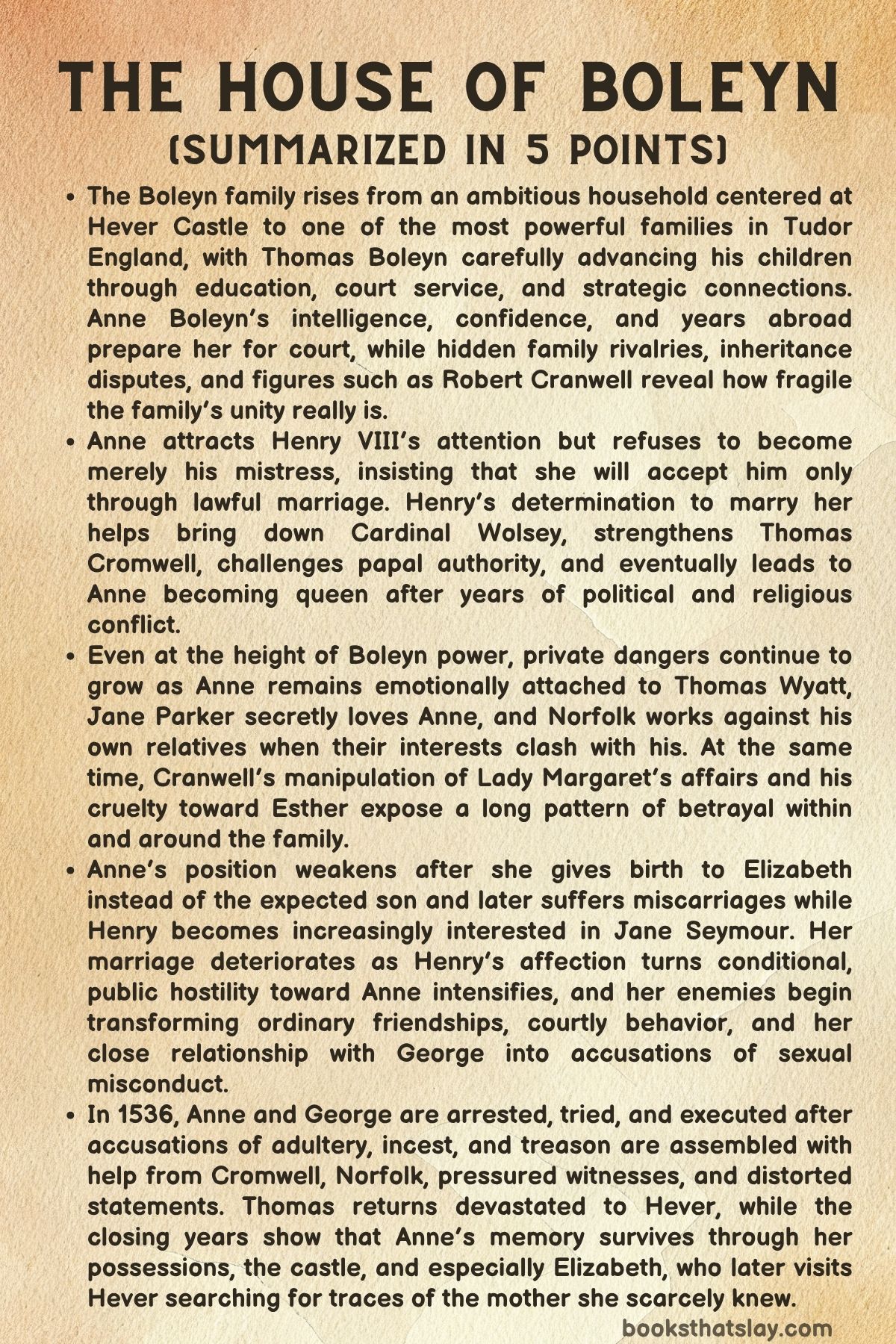
Summary
The House of Boleyn begins in the aftermath of catastrophe. Thomas Boleyn returns to Hever Castle in 1536 after the executions of his daughter Anne and his son George, carrying memories of a family that had once risen astonishingly high before being almost completely destroyed.
The story then moves backward to Anne’s childhood at Hever. Young Anne is clever, inquisitive, and already fascinated by a world larger than the household around her, although she often feels overshadowed by her beautiful elder sister Mary.
Anne’s early life exposes her to the dangerous secrets hidden inside respectable families. She discovers Mary in a sexual relationship with the steward Neville and later realizes that Mary has become pregnant, forcing the women of the household to arrange a secret termination before scandal can damage the family.
These experiences teach Anne that reputation can determine a woman’s future. They also expose deep tensions between her mother, Elizabeth, and her grandmother, Lady Margaret, whose strong personality and control over her property repeatedly create conflict within the family.
Thomas recognizes Anne’s intelligence and arranges for her to enter the household of Margaret of Austria. Anne leaves England while still young and receives an education far beyond what many English noblewomen experience.
Her years abroad transform her. She becomes fluent in courtly behavior, develops sophisticated political and religious ideas, and gains confidence that later makes it difficult for her relatives to treat her as an obedient daughter whose marriage can simply be arranged for convenience.
Meanwhile, events at Hever reveal another source of danger. Robert Cranwell, a calculating steward with connections to the Howard family, enters Boleyn service and begins studying the household’s weaknesses.
Cranwell quickly understands that information is a form of power. He notices Thomas’s affair with Aphra Hayes, exploits Lady Elizabeth’s resentment toward Lady Margaret, and begins collecting details that can be used to advance himself.
Lady Margaret’s occasional forgetfulness becomes particularly useful to him. With support from Elizabeth, James Boleyn, and other interested relatives, her ordinary lapses are exaggerated into evidence that she is mentally incapable of controlling her estates.
The scheme succeeds. Margaret loses control of her property through legal proceedings completed before Thomas can effectively intervene, leaving him furious that members of his own family have participated in humiliating his mother.
Thomas’s growing royal career provides advancement but cannot protect him from every private loss. He also learns the truth about the death of his eldest son Tom, who had died while serving the Duke of Buckingham.
Buckingham eventually admits that Tom died following a confrontation involving Buckingham’s son and that the circumstances were concealed. The revelation strengthens Thomas’s awareness that noble power frequently protects the powerful rather than producing justice.
Anne eventually returns to England as an accomplished young woman. She renews her connection with Thomas Wyatt, whose marriage prevents them from openly pursuing their mutual attraction, although their feelings remain strong.
Anne also returns to a household increasingly shaped by ambition. Her attendant Esther becomes pregnant by Cranwell, who has secretly encouraged her affection without intending to accept responsibility for her or their child.
When Esther confronts him, Cranwell allows her to fall down a dangerous slope rather than helping her. Believing that both Esther and her unborn child have died, he continues his rise without apparent remorse.
The Boleyn family’s fortunes change dramatically when Henry VIII becomes fascinated with Anne. Rather than accept the position of royal mistress, Anne refuses to surrender herself to the king unless he can make her his lawful wife.
Her resistance intensifies Henry’s pursuit. Thomas initially hopes distance will weaken the king’s interest, but Henry eventually informs him that he intends to end his marriage to Catherine of Aragon and make Anne queen.
The possibility transforms the Boleyn family’s future. Anne’s personal relationship with Henry becomes inseparable from questions of succession, religion, international diplomacy, and the authority of the papacy.
Anne and George become increasingly sympathetic to religious reform. Reformist books, vernacular scripture, and arguments against papal control give Anne political ideas that eventually connect her with Thomas Cromwell, who sees a way to solve Henry’s marital problem through English royal supremacy.
At the same time, Jane Parker enters the family through her marriage to George. Jane feels little attraction toward her husband and instead develops an intense private love for Anne.
Her concealed desire leaves her emotionally vulnerable. Anne treats Jane with affection, but Jane interprets many ordinary gestures through the intensity of her own feelings and becomes jealous when she suspects Anne’s continuing attachment to Wyatt.
Henry’s pursuit grows increasingly possessive. Anne understands that marriage may offer protection and status, but she does not share the depth of feeling that the king claims to feel for her.
Her emotional connection to Wyatt therefore remains dangerous. When Anne secretly meets Wyatt after experiencing frightening sexual aggression from Henry, she finally acts on the desire she has suppressed for years.
Unknown to them, Norfolk has arranged surveillance. He obtains evidence that Anne and Wyatt met privately, creating information that could later become politically destructive.
Norfolk increasingly emerges as an enemy inside Anne’s own extended family. Although her queenship could elevate the Howards, he distrusts the religious and political transformation connected with Henry’s determination to marry her.
Anne meanwhile attempts to correct an older injustice by seeking restoration of Lady Margaret’s property. Her efforts threaten those who benefited from Margaret’s dispossession and strengthen the hostility of relatives who have their own interests to protect.
The sweating sickness brings another major revelation. Anne nearly dies, while Aphra discovers Lady Margaret’s missing account books hidden beneath Cranwell’s floorboards, proving that evidence of Margaret’s supposed incompetence had been deliberately manufactured.
Aphra dies during the epidemic, but Esther unexpectedly returns. She survived Cranwell’s attempt to abandon her, lost her child, and eventually learned herbal medicine while building a new life away from Hever.
Esther confirms Cranwell’s cruelty and brings information linking him to the conspiracy against Margaret. Anne now understands how extensively enemies within the extended family have manipulated events.
As Henry’s campaign against his first marriage continues, Wolsey loses power. Cromwell proposes a far more radical path: Henry can separate English religious authority from Rome and obtain control over the decision himself.
Anne recognizes the political possibilities. Her relationship with Henry therefore contributes not only to the Boleyns’ rise but also to enormous institutional change.
Thomas becomes Earl of Wiltshire, George becomes Lord Rochford, and Anne assumes an increasingly queenlike position before she is officially crowned. Yet Thomas remains conscious that every reward depends upon Henry’s favor.
Anne is finally married to Henry and crowned Queen of England. Her triumph is nevertheless shadowed by public hostility, devotion to Catherine, religious division, and the urgent expectation that Anne must produce a male heir.
Her first child is Elizabeth. Anne loves her daughter, but Henry’s disappointment is unmistakable because he has reorganized his marriage and kingdom partly in pursuit of a legitimate son.
Their relationship begins deteriorating. Henry resumes relationships with other women, Anne becomes increasingly anxious and confrontational, and every pregnancy becomes a political test rather than a purely private family event.
Anne suffers a miscarriage and becomes increasingly conscious of Jane Seymour as a rival. Her queenship, once imagined as the ultimate form of security, becomes a position dependent upon her fertility and Henry’s changing desires.
Elsewhere, Jane Parker gives birth to a son and discovers genuine maternal love. Her new devotion to the child changes her priorities and eventually gives Anne’s enemies a powerful way to pressure her.
By early 1536, Catherine of Aragon is dead, apparently removing one obstacle to Anne’s position. Instead, Catherine’s death leaves Henry even freer to reconsider his current marriage.
Anne becomes pregnant again, but Henry’s tournament accident terrifies her. She later miscarries, losing the male child that might have restored her security.
Her despair damages her relationship with Jane Parker. Anne lashes out cruelly, mocks Jane’s marriage, and makes reckless comments about George that can be misunderstood when removed from context.
Norfolk recognizes the opportunity. He pressures Jane to describe Anne and George’s exceptionally close relationship and then threatens Jane through the future of her infant son.
Jane refuses to claim that the siblings have a sexual relationship, but her words are distorted. At the same time, Cromwell begins building a broader case against Anne, while Mark Smeaton is taken for questioning.
Anne’s enemies convert ordinary relationships, courtly flirtation, private conversations, and family affection into accusations of adultery, incest, and treason. Several men associated with Anne are arrested, while George is accused of sleeping with his own sister.
Jane is horrified to discover that remarks she made under pressure have helped create the incest charge. She attempts to retract the implication, but the machinery of Anne’s destruction is already in motion.
Anne and George are tried and condemned. Jane, terrified that her son will suffer as the child of a traitor, secretly arranges for Esther to take him away and raise him under another identity.
George is executed, followed by Anne. Thomas returns to Hever knowing that royal favor, which elevated his family beyond anything he could once have imagined, has now taken two of his surviving children from him.
Cranwell then returns and openly reveals his years of treachery. He admits his involvement in the theft of Lady Margaret’s ledgers and his long service to Norfolk.
Thomas nearly kills him in rage, but Norfolk intervenes. Cranwell expects loyalty from the patron he served, only to discover that Norfolk has no further use for him and discards him once his usefulness has ended.
The novel closes several years later under very different circumstances. Hever has passed to Anne of Cleves, Henry’s fourth wife, who survived her marriage by accepting an annulment and securing property and independence rather than resisting the king.
Princess Elizabeth visits Hever and searches for traces of her mother. Among Anne’s surviving belongings, the child gains access to a family history that the royal court has largely attempted to erase, leaving the memory of Anne Boleyn alive through the daughter who will eventually inherit her legacy.
Characters
Anne Boleyn
Anne is the central force within The House of Boleyn, developing from an observant and occasionally insecure child into an educated courtier, royal favorite, queen, religious patron, mother, and finally political victim. Even in childhood she possesses a strong curiosity about religion, politics, and the world beyond Hever, while her early exposure to Mary’s pregnancy teaches her how severely women can be punished for sexual scandal.
Her years abroad strengthen the independence already present in her personality. When she returns, she resists the assumption that her relatives can simply determine her marriage and later refuses Henry’s demand that she become another royal mistress.
Anne’s ambition is genuine, but the book never reduces her to ambition alone. She wants status and influence, yet she also longs for emotional freedom, particularly in her relationship with Thomas Wyatt, the man she appears to love but cannot openly choose.
Her relationship with Henry contains a central contradiction. Becoming his wife offers the greatest imaginable elevation for a woman of her background, but the marriage eventually leaves her more vulnerable because her survival depends upon satisfying a king who controls law, status, wealth, and punishment.
Motherhood reveals a gentler aspect of Anne. Her affection for Elizabeth is sincere, and her growing fear is partly rooted in her awareness that her daughter’s status depends upon the security of the marriage.
Anne can also be proud, volatile, and cruel when frightened. Her attack on Jane Parker after the miscarriage shows how desperation can distort her behavior, yet the scene also demonstrates how isolated she has become.
Her downfall ultimately depends less on proven wrongdoing than on the ability of powerful men to reinterpret relationships around her. The affection she shares with George, the flirtations expected at court, her friendship with male courtiers, and the hostility generated by her queenship are converted into material for a prosecution designed to remove her.
Thomas Boleyn
Thomas is one of the most complex figures in The House of Boleyn because his ambition is inseparable from his devotion to his family. He recognizes Anne’s unusual abilities long before she becomes politically important and gives her the international education that allows those abilities to mature.
His rise at court demonstrates impressive political skill. Yet Thomas repeatedly discovers that advancement cannot give him complete control over the lives of the people he loves.
The deaths of his sons, the attack on his mother’s property, Anne’s dangerous relationship with Henry, and the eventual executions of Anne and George all confront him with the limits of paternal authority. He can advise, negotiate, and use influence, but he cannot protect his family once the king decides to act.
Thomas is also morally imperfect. His affair with Aphra reveals the distance between private behavior and public respectability, while his willingness to participate in Tudor politics means that he benefits from the same unstable system that later destroys his children.
His warnings about Wolsey are particularly important. Thomas understands that someone elevated by royal favor can be ruined by that same favor, and his fear becomes an exact description of his own family’s experience.
George Boleyn
George is intelligent, witty, ambitious, and deeply loyal to Anne. Their closeness begins in childhood and continues into adulthood, providing Anne with one of the most reliable emotional relationships in her increasingly dangerous life.
He supports reformist religious ideas and recognizes that Anne’s influence over Henry may help transform English religious policy. His enthusiasm for advancement, however, sometimes makes him less cautious than Thomas.
George’s marriage to Jane Parker is emotionally unsatisfactory. He treats the marriage largely as a dynastic obligation and initially fails to understand the extent of Jane’s loneliness.
The birth of their son produces one of the few moments of genuine tenderness between them. George is visibly affected by becoming a father, suggesting that a more stable family life might have developed if political catastrophe had not intervened.
His ultimate tragedy comes from the corruption of sibling affection into an accusation of incest. The charge is especially cruel because the book consistently establishes his relationship with Anne as one of loyalty, humor, trust, and shared political interests.
Jane Parker
Jane is among the most psychologically conflicted characters in The House of Boleyn. Her marriage to George gives her access to the Boleyn family, but her strongest emotional attachment is to Anne, toward whom she develops an intense and largely unreturned romantic desire.
Her feelings create jealousy, hope, shame, and vulnerability. She interprets Anne’s kindness through the expectations of someone who desperately wants greater intimacy, while suspicions about Thomas Wyatt intensify her insecurity.
Jane is not presented simply as the malicious wife traditionally blamed for helping destroy Anne and George. Her eventual involvement in the case against them occurs under pressure from Norfolk, who threatens the future of her child.
Motherhood profoundly alters her. After the birth of little George, protecting him becomes more important than personal resentment, romantic longing, or courtly ambition.
Her tragedy is that words spoken under pressure are transformed into something far more damaging than she intended. Once she realizes that her remarks about Anne and George have been used to support incest accusations, she attempts to correct them but cannot stop the prosecution.
Jane therefore becomes both participant and victim. Her fear contributes to disaster, yet the novel emphasizes how powerful men exploit that fear and how deeply she suffers once she understands what her cooperation has helped accomplish.
Robert Cranwell
Robert Cranwell functions as the internal betrayer of The House of Boleyn, someone who understands that service provides access to information and that information can be converted into influence. From the beginning, he watches the household rather than belonging emotionally to it.
His manipulation of Lady Margaret is especially calculated. By stealing account books and emphasizing ordinary lapses of memory, he helps create the false impression that she is incapable of controlling her own estates.
His treatment of Esther reveals the cruelty beneath his ambition. After fathering her child, he rejects responsibility and deliberately refuses to save her when she falls, believing her death will conveniently remove a threat.
Cranwell also experiences desires that he must conceal, particularly his attraction to George. Yet the secrecy forced upon him does not make him more sympathetic toward the vulnerabilities of others; instead, he repeatedly exploits private weaknesses for advancement.
His final humiliation is fitting. After years of believing that Norfolk’s patronage will reward his loyalty, he learns that he was merely useful and can be discarded immediately once the Boleyn family has fallen.
Esther
Esther represents endurance, loyalty, and survival in The House of Boleyn. She begins as Anne’s devoted attendant and knows her from childhood, giving her a relationship with Anne that predates queenship and royal politics.
Her pregnancy by Cranwell places her in the same dangerous position that the young Anne earlier saw Mary occupy. Unlike Mary, however, Esther refuses to end the pregnancy, even though the father will not protect her.
After Cranwell leaves her to die, Esther survives but loses her child. Her recovery and later training in herbal medicine allow her to return as a stronger and more independent woman.
Her loyalty to the Boleyn household remains remarkable because she has personally experienced betrayal within it. She brings Anne crucial information, cares for Lady Margaret, and eventually agrees to protect Jane’s son when the family collapses.
Esther frequently sees political events from outside the royal court. Through markets, servants, local gossip, and household networks, she understands how public hostility toward Anne spreads and how dangerous the Boleyn name has become.
Lady Margaret
Lady Margaret is the formidable older matriarch whose control over her property makes her both respected and threatening. She provides young Anne with affection, family history, and an example of female authority rooted in age, property, and experience.
Her declining memory gradually makes her vulnerable. The crucial distinction is that occasional forgetfulness does not initially mean she lacks judgment, yet relatives seeking financial advantage treat her lapses as proof of total incapacity.
The removal of her estates is therefore both a family betrayal and an attack on female independence. Margaret understands much of what is being done to her even when others insist that she cannot understand.
Her later mental decline is genuine and painful. By the final years, she increasingly inhabits memories of Ireland and childhood, creating a contrast between the woman who once commanded the estate and the elderly figure dependent upon others for guidance.
Lady Elizabeth Boleyn
Elizabeth is proud, socially conscious, and highly sensitive to her position within the family. Her Howard background shapes her sense of rank, and she frequently resents Lady Margaret’s authority within Hever.
Her involvement in the attempt to remove Margaret from control of her estates exposes a selfish side of her character. She can justify the action as responsible management, but personal resentment and financial interest clearly influence her decisions.
Elizabeth also embraces Anne’s royal prospects more eagerly than Thomas initially does. The possibility that her daughter might attract the king appears to her as extraordinary family advancement.
Her character helps show how ambition is not limited to men at court. Women within noble households also compete for status, security, property, and influence, although their available methods are often more indirect.
Mary Boleyn
Mary first appears as the beautiful elder sister against whom Anne measures herself. Her secret relationship with Neville and resulting pregnancy introduce Anne to the sexual double standards governing women’s lives.
Mary later becomes connected with Henry VIII and eventually establishes a life less dependent on courtly ambition. She serves as an important contrast to Anne because she experiences scandal and royal attention without building her entire future around political elevation.
In the final crisis, Mary shows sympathy toward Anne rather than rivalry. Her conversation with Jane reveals that she understands how isolated and frightened her sister has become.
Henry VIII
Henry is charming, passionate, possessive, generous, insecure, and increasingly frightening. His pursuit of Anne initially appears romantic because he is willing to challenge enormous religious and political obstacles to marry her.
Yet his love always contains an expectation of control. Anne’s resistance attracts him partly because it makes possession more difficult, and once their relationship changes, his fascination becomes increasingly conditional.
The need for a male heir dominates his decisions. Elizabeth’s birth, Anne’s miscarriages, and Jane Seymour’s availability gradually change the way he evaluates his second marriage.
Henry’s most dangerous quality is the scale of his authority. Personal frustration can become state policy, accusations can become treason charges, and the end of affection can become a death sentence.
His treatment of Anne demonstrates the instability at the center of Tudor court life. Anyone who depends upon his favor must also live with the possibility that he will withdraw it.
Thomas Wyatt
Thomas Wyatt represents the life Anne cannot choose. Their familiarity, affection, attraction, and shared history create a relationship that feels more emotionally equal than her relationship with Henry.
Wyatt’s existing marriage prevents Anne from openly building a future with him. Her repeated refusal to cross certain boundaries shows that she understands the consequences of becoming involved with a married man.
Eventually, however, Anne chooses intimacy with him during a period of fear and emotional distress. That decision becomes dangerous because Norfolk has arranged surveillance and because Henry is already intensely jealous of Wyatt.
Wyatt therefore functions as both Anne’s private refuge and a potential political vulnerability. He represents genuine desire in a world where marriages are primarily governed by property, rank, succession, and power.
Duke of Norfolk
Norfolk embodies aristocratic self-interest and ruthless family politics. Although Anne is his niece, he is willing to work against her once her religious policies, personal influence, and political position conflict with his objectives.
His relationship with Cranwell demonstrates how he uses subordinates. He encourages secret surveillance and manipulation but refuses to reward Cranwell once his services are no longer required.
His treatment of Jane is equally severe. By threatening her son’s future, he obtains statements that can be redirected against Anne and George.
Norfolk shows that biological kinship provides no guarantee of loyalty. Family members can become political rivals when property, religious authority, royal favor, and succession are at stake.
Thomas Cromwell
Cromwell initially appears as a potentially valuable ally to Anne. He shares reformist interests and offers a political solution to Henry’s marriage problem by challenging papal authority.
His intelligence lies in recognizing institutional possibilities that others hesitate to imagine. He understands that Henry can transform the English church rather than continue waiting for Rome.
The relationship between Cromwell and Anne later deteriorates as political interests change. By 1536, the administrative ability that once helped Anne becomes instrumental in constructing the case against her.
Cromwell therefore demonstrates that alliances at court are temporary. Shared objectives can create cooperation, but once those objectives diverge, former allies can become exceptionally dangerous enemies.
Aphra Hayes
Aphra is a discreet and capable member of Lady Margaret’s household. Her relationship with Thomas reveals another concealed layer of the family’s private life, while Margaret’s awareness of the affair demonstrates the complicated accommodations made inside aristocratic households.
Aphra is also suspicious of Cranwell before many others fully recognize his nature. She searches for evidence against him and eventually discovers the missing account books hidden beneath his floorboards.
Her death during the sweating sickness prevents her from exposing the conspiracy herself. Nevertheless, her discovery confirms that Lady Margaret was deliberately framed and allows the truth to survive beyond her.
Lady Jane Seymour
Jane Seymour remains largely at the edge of direct action but becomes increasingly important as Anne’s marriage deteriorates. Henry’s tenderness toward her immediately alarms Anne because she recognizes patterns that resemble the king’s earlier pursuit of herself.
Jane’s strategy of withholding herself from Henry reportedly imitates Anne’s own earlier resistance. That parallel makes her rise especially threatening because Anne sees another woman using the same method that once elevated her.
Her presence demonstrates how replaceable royal favorites can become. Anne’s former advantage becomes the strategy of the woman who may succeed her.
Catherine of Aragon
Catherine is not a dominant active character, but her position shapes nearly every stage of Anne’s rise. Popular loyalty to Catherine contributes significantly to public hatred of Anne.
Her refusal to disappear quietly turns Henry’s marital ambitions into an international religious crisis. Even after she is displaced, many English people continue to regard her as the rightful queen.
Her death removes one potential obstacle to Henry’s freedom, but it does not protect Anne. Instead, Anne quickly discovers that the same king who replaced Catherine can also replace her.
James Boleyn
James represents internal family opportunism. He participates in the action against Lady Margaret and appears repeatedly around attempts to control property.
His suspicious searches at Hever suggest that loyalty to Thomas is secondary to his own ambitions. The later arrangement allowing Hever to pass toward his branch after Thomas’s death confirms how much he might benefit from Thomas’s destruction.
James reinforces one of the novel’s darkest observations about family politics: relatives can become competitors when inheritance and royal patronage are involved.
Bess Boleyn
Bess works alongside James and gradually gains greater access to Anne’s household. Her increased presence at court troubles those who already distrust her husband’s intentions.
During Anne’s downfall, she becomes one of the women associated with accusations against the queen. Her behavior illustrates how private observations by household women can be transformed into evidence when powerful men are searching for material to support a predetermined political goal.
John Denny
Denny represents steady household loyalty. He serves Thomas faithfully, carries messages, observes the consequences of public hostility, and remains connected to Hever through both prosperity and ruin.
Unlike Cranwell, Denny does not treat service primarily as a ladder toward political advancement. His reliability makes him valuable precisely because secrecy and betrayal have become so common around the Boleyn family.
Mark Smeaton
Smeaton becomes significant primarily during Anne’s destruction. His disappearance into Cromwell’s custody signals that the political attack has moved from rumor into coordinated prosecution.
Among the accused men, Smeaton is the one reported to have confessed. Whatever circumstances produced that confession, it becomes useful to the authorities because it provides apparent confirmation for claims that otherwise rely heavily on reinterpretation and accusation.
Anne of Cleves
Anne of Cleves provides the final perspective on Henry’s marriages and the legacy of Anne Boleyn. Unlike Anne, she survives rejection by accepting the annulment and negotiating wealth, property, and personal independence.
Her possession of Hever symbolically transforms a place associated with tragedy into one of survival. She also treats Elizabeth kindly and understands the importance of allowing the child to encounter possessions connected to her mother.
Her appearance at the end broadens the novel beyond Anne Boleyn’s death. It shows another woman learning how to survive Henry by yielding where resistance would be dangerous.
Princess Elizabeth
Elizabeth begins life as the daughter Henry did not want because he expected a son, but she becomes one of the story’s most powerful symbols of continuation. Anne’s genuine love for her gives emotional meaning to a child whose birth was treated politically as a disappointment.
The closing image of Elizabeth exploring Hever links her directly with the mother she scarcely knew. The family that appeared destroyed in 1536 therefore survives through the daughter whose existence preserves Anne’s blood, memory, and historical significance.
Themes
The Instability of Power and Royal Favor
Power in The House of Boleyn never provides permanent security. Thomas, Anne, George, Wolsey, Cromwell, Norfolk, and Cranwell all operate within systems where influence depends on satisfying someone stronger, and even extraordinary advancement can disappear almost instantly.
Thomas understands this danger earlier than most. When George celebrates Wolsey’s destruction, Thomas warns that the same king who elevated the cardinal can destroy anyone else who becomes inconvenient, and the warning later becomes a direct description of the Boleyn family’s fate.
Anne’s journey demonstrates the same pattern at the highest level. Refusing to become Henry’s mistress gives her unusual leverage, and marriage eventually makes her queen, but the crown cannot protect her once Henry begins viewing the marriage as a failure.
Her authority is therefore conditional from the beginning. The birth of Elizabeth, miscarriages, Henry’s changing desire, public resentment, and the appearance of Jane Seymour progressively reduce Anne’s security until accusations can be assembled against her with remarkable speed.
Cranwell experiences the theme at a lower social level. He spends years betraying others because he believes service to Norfolk will produce advancement, only to discover that a patron values a secret agent only while the agent remains useful.
The novel repeatedly separates possession of power from genuine safety. The closer characters move toward the center of Tudor authority, the more catastrophic the consequences become when that authority turns against them.
Family Loyalty, Rivalry, and Betrayal
Family relationships provide comfort throughout the story, but they are also repeatedly corrupted by inheritance, ambition, jealousy, and politics. Anne and George possess one of the strongest sibling relationships in the novel, while Anne’s bond with Thomas remains important even after she becomes queen.
Yet the extended family is filled with competition. Lady Elizabeth resents Margaret’s authority, James participates in attempts to take control of family property, and Norfolk ultimately helps destroy his own niece and nephew.
The dispute over Lady Margaret’s estates provides an early model for the later destruction of Anne. Relatives construct a legal argument around Margaret’s supposed incapacity because controlling her property offers practical benefits.
Years later, Anne’s enemies use similar methods against her. Ordinary affection, flirtation, private conversations, and social relationships are stripped of context and reorganized into a case involving adultery, treason, and incest.
Jane Parker occupies the most painful position within this theme. Her love for Anne, unhappy marriage to George, fear for her son, and vulnerability to Norfolk’s threats make her simultaneously loyal and compromised.
Thomas also experiences betrayal as a father, brother, and son. He discovers that advancement cannot protect his mother, his children, or his home from relatives who benefit by weakening his branch of the family.
The story therefore presents kinship as emotionally meaningful but politically unreliable. Blood can inspire extraordinary devotion, yet it can also intensify rivalry when inheritance and royal favor are involved.
Women, Sexuality, and the Politics of Reputation
Women throughout the novel live under standards that make sexual reputation a matter of survival. Mary’s secret pregnancy teaches the young Anne that a woman can face disgrace for conduct that men often escape with limited consequences.
Anne later attempts to avoid this fate by refusing Henry’s offer to become his mistress. Her insistence on marriage is not simply romantic resistance; it reflects an understanding that sexual access without recognized status could leave her dependent upon a king who might abandon her whenever his interest fades.
Jane Parker experiences a different form of restriction. Her attraction to women cannot be openly acknowledged, forcing her emotional life into secrecy even while marriage requires her to perform heterosexual duties and produce an heir.
Esther is similarly exposed when Cranwell impregnates her. His ability to reject her and their unborn child demonstrates how easily a man can distance himself from consequences that might permanently destroy a woman’s position.
Anne’s downfall brings these patterns to their most extreme conclusion. The government attacks her through accusations of sexual disorder because adultery, multiple lovers, and especially incest can transform an unwanted queen into a figure whose execution appears legally and morally defensible.
Her body has already been treated politically through the demand for a son. Once her pregnancies fail to secure the succession, her sexuality becomes evidence against her rather than a source of royal hope.
The story repeatedly shows that control over women’s reputations becomes a method of controlling their futures.
Memory, Legacy, and Survival
The desire to preserve memory becomes increasingly important as political power attempts to erase inconvenient people. Portraits of Anne disappear after her fall, her name becomes dangerous, and the family that once dominated royal attention is treated as though its destruction should be complete.
Hever Castle becomes the physical center of this struggle over remembrance. In The House of Boleyn, rooms, chairs, books, letters, household objects, and familiar landscapes preserve personal history even when official institutions turn against the people who once inhabited them.
Lady Margaret represents another form of memory. Her decline gradually removes her ability to remain anchored in the present, yet her recollections of Ireland preserve an earlier family identity that exists before the Boleyns’ dramatic Tudor ambitions.
Thomas carries painful memory differently. He remembers Tom, Anne, George, and the decisions he could not reverse, making survival itself a burden after the destruction of his children.
Esther survives an attempted killing and returns with knowledge that others assumed had vanished with her. Her continued existence allows hidden crimes to be exposed and later enables Jane’s son to escape the consequences of his father’s condemnation.
The final scenes give memory its strongest symbolic victory. Anne of Cleves occupies Hever without attempting to erase Anne Boleyn’s presence, while Elizabeth searches through the castle for traces of the mother she barely knew.
Anne’s political position has vanished, but her legacy survives through objects, places, stories, and most importantly her daughter. The effort to erase her therefore remains incomplete, and survival becomes a form of historical resistance.