The House That Eats the Dead Summary, Characters and Themes
The House That Eats the Dead by Max Doty is a supernatural horror novel about memory, grief, family, and the dangerous appeal of living without consequences.
At its center is Claire Morgan, a mother and former artist who moves with her family into an old Queen Anne house that possesses an impossible appetite: it can consume dead matter and erase what it has eaten from almost everyone’s memory. What begins as a frightening discovery slowly becomes a source of temptation, artistic renewal, moral compromise, and violence. The novel asks what happens when human beings gain the power to erase pain, guilt, evidence, and even entire lives.
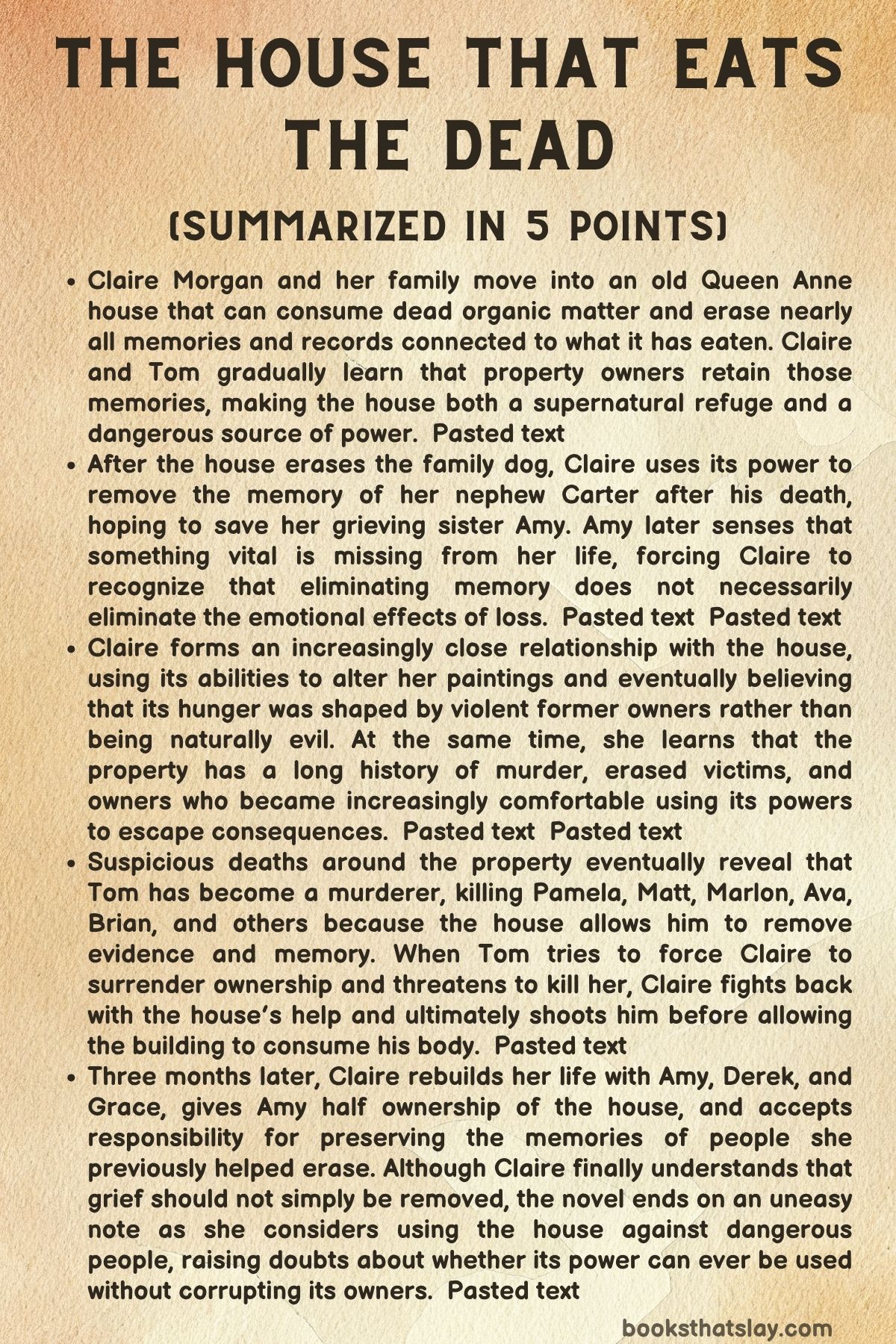
Summary
Claire Morgan and her husband Tom are searching for a new home when they tour a century-old Queen Anne house in the foothills overlooking the Santa Clara Valley. The property is beautiful but immediately strange: flowers dry despite sitting in water, freshly baked cookies taste old, and the rooms carry unusual pockets of heat.
The elderly owner, Pamela Chung, seems particularly interested in Claire and gives her a dried rose before they leave. Claire is drawn to the house because, despite its unsettling qualities, it makes her feel safer than any home has since childhood.
Claire has spent most of her life carrying the trauma of an electrical fire that killed her parents when she was ten. She rescued her younger sister Amy, but afterward she developed a deep distrust of houses and stability.
Her desire to leave San Francisco has also intensified because her teenage son Derek was violently assaulted by a stranger. When the realtor asks Claire and Tom to write a personal letter to Pamela, Claire secretly sends a much more intimate version than the one Tom approved, describing her history and why the house makes her feel protected.
Pamela accepts their offer without negotiation. For Claire, the decision feels significant because she acted independently rather than simply following Tom’s judgment.
After the family moves in with Derek, six-year-old Grace, and their dog King, objects begin deteriorating or disappearing. Food becomes stale almost instantly, cardboard boxes weaken, clothing vanishes, and Grace’s beloved stuffed bear disappears except for its eyes.
The most frightening discovery is that Derek and Grace no longer remember the toy ever existing. Claire realizes that the house does more than destroy objects; it appears capable of removing their existence from other people’s memories.
Claire begins documenting the disappearances, only for the house to destroy her written evidence. Eventually she forces Tom to witness meat disappearing, but even video recordings change afterward, making it appear that the vanished object was never present.
Experiments reveal an important rule. Dead organic matter can be consumed, while living creatures remain safe.
Tom quickly begins seeing practical possibilities in the house. Claire remains much more cautious, but her resistance weakens after King is struck and killed by a vehicle.
Rather than force their children to experience the loss, Tom persuades Claire to bring King’s body into the house. Once the house consumes him, photographs change and Derek and Grace completely forget that the dog ever existed.
Claire and Tom remain aware of him because they own the property. The experience shows Claire how easily grief can be eliminated, but it also demonstrates how disturbing that power can become.
At the same time, Claire returns to painting in an upstairs studio. The house consumes certain organic pigments from her work, producing surprising alterations that Claire could not have created alone.
She gradually begins treating the building as an artistic partner. For the first time in years, she feels connected to the independent artist she once was.
The house’s power becomes far more consequential when Amy’s son Carter dies in a swimming accident. Amy responds with overwhelming grief, drinking heavily and losing the ability to function.
Tom suggests feeding Carter’s ashes to the house so Amy will forget him. Claire initially considers the idea horrifying, but fear that Amy will destroy herself leads her to act.
She secretly removes Carter’s possessions and gives his ashes to the house. Amy forgets that she ever had a son and soon appears healthier, energetic, and capable of rebuilding her life.
Claire is disturbed by what she has done. She has relieved Amy’s suffering, but only by taking away her memories without her consent.
The experience convinces Claire that the family should sell the property. Yet the house begins reacting when they discuss leaving, damaging objects and altering Claire’s paintings until one depicts the Morgans and the house together like members of a single family.
Claire starts believing that the building is conscious. It may not merely possess supernatural properties; it may have preferences and emotional attachments.
During an open house, several disturbing prospective buyers appear. One later breaks into the property carrying a syringe and attacks Claire.
Tom shoots and kills him with startling confidence. The house consumes the corpse, eliminating the evidence, and the couple later discovers another murdered man inside the attacker’s vehicle.
They feed that body to the house as well. Realizing how dangerous the property could become in the wrong hands, Claire reluctantly agrees that selling may be even more dangerous than staying.
Pamela eventually confirms that previous owners have experienced the same phenomena. Owners retain memories of consumed things, while the outside world gradually loses memories and records connected to them.
She also reveals that she once had a family, although no one else remembers them. Her warnings suggest that the house has already participated in decades of death and erasure.
Rather than retreating, Claire becomes increasingly interested in understanding it. She experiments with different meats, studies its preferences, and trains it to alter her paintings in particular ways.
Her work becomes stronger, but she senses that the house also influences her emotions. Tom worries that her fascination is turning into obsession.
Derek develops his own connection with the house and admits that it communicates by removing letters and words. He believes it has helped him become more confident.
While Claire and Derek renovate the basement, they discover scorch marks and strange symbols beneath old coverings. Through images formed in Claire’s paintings, the house reveals the story of Swan, a violent former owner who murdered his wife and children and hid their bodies in the basement.
Swan apparently hurt and burned the house while teaching it to consume corpses. Claire begins believing that its appetite may have been conditioned rather than natural.
This interpretation changes her attitude. She starts thinking of the building as a damaged creature that might respond differently if treated with patience rather than cruelty.
Meanwhile, Amy begins sensing that something is missing from her life. Although Carter has disappeared from her conscious memory, unexplained belongings and emotional absences remain.
Claire continues lying to her, while secretly preserving a small object Carter made. She realizes that erasing memory does not necessarily erase the emotional shape left behind by love.
Claire also starts resisting the temptation to remove every death. When Grace’s goldfish dies, the family buries it normally so Grace can learn that sadness is survivable.
Claire applies the same principle to other deaths around them, including that of Tom’s father. She increasingly believes that grief has a necessary place in human life.
Her relationship with Tom grows more strained. Tom views suffering as something that should be managed efficiently and believes Amy lacked the strength to survive Carter’s death naturally.
The difference becomes part of a larger conflict over control. Claire begins recognizing how often Tom presents decisions in ways that make her believe she freely reached conclusions he had already shaped.
That insight becomes more important when Derek is badly beaten. Claire identifies Matt Green as the boy responsible and becomes obsessed with revenge.
She creates an opportunity to get Matt alone near the basement and seriously considers killing him. Yet when she finally confronts him, she realizes he is frightened, remorseful, and far less monstrous than she imagined.
Derek later explains that the conflict was connected to his relationship with Matt’s sister Cassie. Matt apologized, and the boys had already settled the matter.
Claire is horrified by how close her anger brought her to murder. She sees that possessing a house capable of removing consequences makes violent impulses much easier to rationalize.
The danger escalates when Claire discovers an unidentified corpse pushed through a basement window. Someone else clearly knows what the house can do and has begun using it to dispose of victims.
Grace reveals that she has also developed a relationship with the building. Through games involving warm and cold areas, she interprets images it creates by consuming tiny pieces of material.
Claire sees visions of many dead humans and animals from the house’s past. Among them are King, Carter, the intruders, and numerous strangers.
When another suspicious man attacks Claire and Tom, Tom kills him, and they feed him to the house. Claire initially wonders whether this man had been secretly depositing bodies, but his reaction suggests he may not be responsible.
Pamela then gives Claire a written account of her own family history. Pamela’s husband Robert became abusive after accidentally killing someone whose body the house erased.
Pamela eventually killed Robert. Their son Bob later became a serial murderer who repeatedly brought victims to the house, unaware of his previous killings because each victim disappeared from ordinary memory.
Bob eventually murdered his own sister, forcing Pamela to kill him as well. Her history demonstrates how the house can create a cycle in which violence becomes easier because memory and accountability constantly disappear.
Claire’s suspicion eventually shifts toward Ava Klein, a woman who has shown unusual fascination with the property. Ava reveals that she previously offered Tom eight million dollars for the house, an offer he never mentioned to Claire.
Claire reacts angrily and asserts her ownership. Soon afterward, however, Matt Green is murdered and left for the house to consume.
Claire cannot determine who killed him. Tom even suggests that Claire herself might have done it and forgotten or denied the act, showing how unstable their sense of guilt and evidence has become.
Desperate for help, Claire finally tells Amy the truth about Carter. Amy cannot retain ordinary demonstrations of the house’s abilities, but the emotional force of Claire’s confession reaches her.
Amy is furious that Claire decided she should not remember her own son. She makes Claire understand that removing grief also removed Amy’s right to decide how to live with it.
Soon afterward, Pamela disappears from history entirely. Claire concludes that the elderly woman willingly allowed herself to be consumed, perhaps hoping to join her erased family in the mysterious gray realm she believed existed beyond ordinary memory.
Claire returns to the coastal trailer where she and Amy once lived with Aunt Sara. Remembering Sara’s insistence that emotional wildness was preferable to living in numbness helps Claire reconnect with the part of herself that existed before Tom’s influence.
When Claire returns home, Derek reveals another crisis: Cassie is pregnant. He asks Claire not to tell Tom because he fears his father’s response.
The final truth begins emerging after a workplace party. Tom has become increasingly obsessed with defeating his rival Marlon for a promotion.
Later, Claire encounters Marlon’s partner Bill and discovers that Bill no longer remembers Marlon. She understands immediately that Marlon has been consumed by the house.
Claire then discovers that Ava has also vanished from all records. Terrified, she races home and finally finds Tom armed, drinking, and waiting for her.
Tom has drugged Derek and Grace. Brian Tanner, the craftsman helping renovate the house, is already dead because Tom feared he would reveal evidence of old murders found beneath the floor.
Tom confesses that he has killed Pamela, Matt, Marlon, Ava, Brian, the unidentified victim Claire discovered earlier, and others. What began as violence supposedly intended to protect the family has become something he enjoys because the house removes consequences.
He wants Claire to sign away her ownership. Once she is no longer an owner, he expects her to forget future victims and allow him to control their lives without opposition.
Claire refuses. Tom handcuffs her to one of the basement supports and prepares to kill her.
Unable to escape normally, Claire cuts her wrists against the cuffs and begs the house to help. The building responds by breaking part of its own structure, causing a collapse that separates her from Tom.
Amy arrives after receiving one of Claire’s old emergency signals and helps her escape. Tom attempts to burn the house down with alcohol.
Outside, he tries once more to persuade Claire that they can repair their marriage and erase everything that happened. Claire finally recognizes that his persuasion has always depended on presenting control as protection.
When Tom threatens the house with fire, Claire shoots him. She and Amy drag his body inside before the authorities arrive.
The damaged house initially cannot consume him, so Claire feeds it her own blood. It recovers enough to erase Tom, and Amy immediately forgets that he existed.
Three months later, Claire and the children live temporarily with Amy while the property is repaired. Because Derek and Grace no longer remember their father, Claire invents a gentler history in which Tom died years earlier.
Amy now believes Claire’s account of Carter and repeatedly asks her to describe the son she cannot remember. Claire accepts that retelling his life is part of the responsibility she owes her sister.
Derek and Cassie suffer a miscarriage. Claire briefly thinks about using the house to remove their pain but rejects the idea, finally accepting that their grief belongs to them.
When the restoration is completed, Claire, Amy, Derek, and Grace move back. Claire gives Amy half ownership so that she will have an equal partner who can perceive what the house does.
Claire’s artwork has also attracted professional attention, giving her the independent creative future she once abandoned. Yet the final direction of her relationship with the house remains morally uncertain.
Instead of using its powers to erase ordinary pain, Claire imagines luring dangerous people into the property and feeding them to it. She believes that she and Amy may be able to train the house toward a form of justice, but the history surrounding the property leaves open the disturbing question of whether anyone can repeatedly decide who deserves to disappear without eventually becoming corrupted by that power.
Characters
Claire Morgan
Claire is the central character of The House That Eats the Dead, and nearly every major moral question in the book is filtered through her changing relationship with the property. She begins as a woman whose identity has been shaped by trauma, motherhood, marriage, and a long retreat from the artistic independence she possessed when younger.
Her parents’ deaths taught her that safety can disappear without warning, while Derek’s assault strengthens her desire to protect her family from suffering. These experiences help explain why the house appeals to her even when its behavior is clearly unnatural.
Claire is repeatedly tempted by the ability to control loss. She allows King to be erased, chooses to erase Carter for Amy, considers killing Matt, hides deaths, and gradually becomes comfortable feeding the house.
Her moral growth does not follow a simple movement from wrongdoing to virtue. Instead, she becomes increasingly aware that the crucial issue is consent: people must be allowed to experience their own grief and make their own decisions about painful memories.
Claire’s artistic revival is equally important. Painting restores the version of herself that existed before domestic life reduced her identity primarily to wife and mother.
Her relationship with the house therefore becomes both dangerous and liberating. It enables morally troubling choices while helping her recover confidence, creativity, anger, and independence.
By the end, Claire defeats Tom partly because she finally recognizes the difference between protection and control. Yet her plan to use the house against dangerous people shows that she remains vulnerable to the same logic that corrupted previous owners.
Tom Morgan
Tom functions as both Claire’s husband and the central human antagonist of The House That Eats the Dead. Early in the novel he appears practical, successful, calm, and devoted to providing stability for his family.
Gradually, however, his confidence is revealed as a strong desire to direct other people. Derek accurately observes that Tom often leads Claire toward choices while making those decisions feel as though they originated with her.
The house intensifies Tom’s worst tendencies because it eliminates the consequences that normally restrain violent behavior. His willingness to erase King initially appears compassionate, and his proposal concerning Carter can also be presented as an attempt to rescue Amy.
The same reasoning soon expands until almost anyone can be classified as an obstacle. Professional rivals, troublesome teenagers, witnesses, curious outsiders, and even Pamela become disposable once Tom realizes that the world will forget them.
His workplace competition further exposes his need to dominate. He interprets relationships strategically, speaking about people as useful pieces in negotiations rather than as individuals with independent value.
Tom’s final attempt to remove Claire’s ownership reveals the full nature of his worldview. He does not merely want to protect her; he wants a version of Claire who cannot challenge his authority or remember what he has done.
Derek Morgan
Derek represents a younger and more cautious response to supernatural power in The House That Eats the Dead. Although he develops his own relationship with the house, he often demonstrates greater awareness of its influence than the adults around him.
The house helps Derek become more confident after the trauma of his assault. He learns to interpret its communication and enjoys the security it provides, but he deliberately spends time away because he recognizes that prolonged exposure changes people.
His handling of Matt contrasts sharply with Claire’s reaction. While Claire becomes consumed by fantasies of revenge, Derek speaks with Matt, explains the misunderstanding, accepts his apology, and moves forward.
This maturity exposes how far Claire has been affected by the house. Her son resolves a violent conflict through communication while she nearly commits murder in his name.
Derek’s relationship with Cassie also reveals his growing independence. His fear of telling Tom about the pregnancy shows that he recognizes the controlling side of his father before Claire fully accepts it.
Grace Morgan
Grace’s relationship with the supernatural world is unusually natural throughout The House That Eats the Dead. Because she is young, she does not approach the building through theories about ownership, morality, or control; she treats it almost like an unusual companion.
Her games involving warm and cold areas gradually reveal that she can communicate with the house in ways the adults cannot. She interprets its movements and visual patterns with an instinctive understanding that suggests children may perceive its personality more directly.
Grace also repeatedly demonstrates that erased memories may leave emotional traces. Her impulse to name her goldfish King suggests that forgotten relationships can survive beneath conscious awareness.
Her experience with the fish becomes crucial to Claire’s developing understanding of grief. By allowing Grace to mourn a small death instead of erasing it, Claire begins accepting that sadness is not automatically a problem requiring supernatural correction.
Grace therefore represents innocence surrounded by dangerous adult choices. Her easy bond with the house also raises a disturbing possibility: if Claire fails to establish ethical limits, the next generation may inherit both the property and its power.
Amy
Amy serves as Claire’s emotional counterpart and moral challenge in The House That Eats the Dead. The sisters are connected by childhood trauma, especially the fire that killed their parents and the unconventional years they later spent under Aunt Sara’s care.
Carter’s death turns Amy into the clearest example of the difference between ending suffering and violating another person’s autonomy. Claire sees Amy collapsing under grief and convinces herself that removing Carter from memory is an act of rescue.
Amy’s later reaction proves that the choice was not Claire’s to make. Even without conscious memories, she senses that her life contains an unexplained absence.
When Claire finally tells her the truth, Amy’s anger forces Claire to confront the moral cost of deciding which emotions another person should be allowed to experience. Grief belonged to Amy because Carter belonged to Amy.
Amy’s eventual partial ownership of the house therefore has symbolic importance. Claire no longer wants a partner who secretly guides her decisions; she chooses someone who can stand beside her with equal knowledge and authority.
Pamela Chung
Pamela is both Claire’s predecessor and a warning about what decades of life with the house can produce. Her unusual interest in Claire during the sale suggests that she recognizes qualities in Claire that make her suitable for the property.
Her personal history reveals how thoroughly supernatural erasure has destroyed her family. Robert’s violence, Bob’s murders, Caroline’s death, and Pamela’s own killings have disappeared from ordinary history even though Pamela remembers them.
Pamela understands that the house attracts people capable of violence, but she is not entirely reliable as a moral guide. She has also used its abilities and developed beliefs about a gray realm where consumed people may somehow continue to exist.
Her decision to disappear suggests exhaustion, guilt, loneliness, and a desire to reunite with the family whom the world can no longer remember. Pamela represents the possible future awaiting an owner who remains tied to the house for too long.
Carter
Carter has relatively little direct presence, yet his disappearance becomes one of the story’s central moral events. His death causes genuine devastation, especially for Amy, but Claire responds by trying to eliminate the devastation rather than allowing her sister to live through it.
Once Carter is consumed, explicit memory disappears while emotional traces remain. His belongings, the physical spaces created for him, and Amy’s unexplained sense of absence show that a person’s significance cannot be reduced entirely to conscious recollection.
The small Play-Doh elephant Claire preserves becomes especially meaningful. By keeping it, Claire resists Tom’s argument that erased people should simply be treated as though they never existed.
Brian Tanner
Brian Tanner is important because he offers Claire a model of masculinity and ownership very different from Tom’s. As a craftsman, he approaches the old house patiently and respects its materials instead of treating the property purely as an asset.
Claire notices that Brian seems to understand wood almost as something alive. His approach supports her belief that the house can respond to care rather than force.
Brian also becomes dangerous to Tom simply because he discovers physical evidence connected to earlier killings and considers involving the police. Tom murders him not because Brian has harmed the family, but because he might create consequences.
His death therefore marks the point at which Tom’s claim of protecting the family becomes impossible to defend. Brian is killed because accountability itself has become Tom’s enemy.
Ava Klein
Ava is initially presented as an unsettling outsider whose fascination with the property makes Claire suspicious. Her willingness to offer an extraordinary amount of money suggests that she understands, or at least strongly suspects, that the building possesses unusual abilities.
Her relationship with Claire is shaped by competition and mutual fascination. Claire sees Ava as a potential threat to her marriage, her ownership, and her unique connection with the house.
Ava nevertheless becomes another victim of Tom. Her disappearance demonstrates how easily Claire’s suspicions can distract her from the greater danger already inside her family.
Matt Green
Matt initially exists in Claire’s mind as the brutal teenager who attacked Derek. Her anger transforms him into a symbol of the violent threats she believes she must eliminate to protect her children.
Meeting him privately destroys this simplified image. Matt admits wrongdoing but also shows remorse, fear, and an ability to recognize that he lost control.
Claire’s near-murder of Matt becomes one of her most important moral failures because she almost kills a teenager based on incomplete information. His later murder by Tom shows what Claire might have become had she crossed that boundary herself.
Cassie Green
Cassie expands Derek’s life beyond the family and the house. His effort to keep her away from the property demonstrates that he wants at least one important relationship protected from its influence.
Her pregnancy creates another situation in which Tom’s controlling personality becomes significant. Derek’s first instinct is not to ask his father for support but to conceal the truth from him.
The later miscarriage reinforces the novel’s developing argument about grief. Claire could attempt to erase the pain, but she finally recognizes that Derek and Cassie must decide how to live with their own loss.
Swan
Swan represents the earliest clearly described source of deliberate cruelty toward the house. He murders his wife and children and uses the basement to conceal their bodies.
More importantly, Claire concludes that Swan may have trained the building through violence. By burning, branding, and hurting it while associating death with feeding, he potentially transformed a strange supernatural structure into the corpse-consuming entity encountered by the Morgans.
His history supports Claire’s belief that the house possesses learned behavior rather than fixed evil. Yet it also reminds her that training something does not guarantee permanent control over it.
Bob
Bob, Pamela’s son, demonstrates the extreme psychological danger created by erased consequences. He becomes a serial murderer who repeatedly brings victims to the house.
Because the dead are removed from memory, each killing effectively becomes detached from the previous one. He can continue murdering without the accumulating psychological and social consequences that might otherwise expose or restrain him.
His story anticipates Tom’s transformation. Both men discover that when victims disappear from memory and evidence, violence becomes easier to repeat.
Aunt Sara
Aunt Sara exists mainly through Claire’s memories, but her influence is essential to understanding “Chaos Claire.” After Claire and Amy lose their parents, Sara teaches them that emotional intensity and unpredictability are preferable to becoming numb.
Her philosophy helps Claire survive early trauma and later recover a version of herself that marriage has suppressed. Returning to memories of Sara helps Claire understand that stability without autonomy can become another form of confinement.
Sara’s influence ultimately contributes to Claire’s refusal to submit when Tom demands control of the house. The wildness Claire once regarded as something she needed to outgrow becomes part of what allows her to survive.
Themes
Grief, Memory, and the Right to Suffer
The House That Eats the Dead repeatedly asks whether removing grief is the same as healing it. The supernatural house offers an extraordinary temptation because it can eliminate not only physical remains but also memories, photographs, records, and much of the emotional pain connected to the dead.
King’s death first demonstrates how attractive this power can seem. Derek and Grace are spared the sadness of losing their dog, but the price is the destruction of an entire relationship that once formed part of their lives.
Carter’s erasure makes the ethical problem much more serious. Claire believes she is saving Amy from self-destruction, yet she makes a permanent decision about someone else’s grief without permission.
Amy’s later sense of absence shows that emotional reality is deeper than explicit memory. She cannot consciously remember Carter, but something within her still recognizes that a part of her life has disappeared.
Grace’s dead goldfish becomes an important corrective experience. Claire allows her daughter to mourn, teaching both Grace and herself that grief can be painful without being something that must be removed.
The same understanding guides Claire after Derek and Cassie lose their baby. She finally recognizes that love gives grief its meaning and that taking sorrow away can also mean taking away part of the relationship that created it.
Power Without Consequences
Much of the novel’s horror comes not from death itself but from the possibility of acting without accountability. Once the house consumes a victim, evidence disappears, memories change, and ordinary systems of justice become almost useless.
Tom’s development shows how quickly practical reasoning can become moral corruption under these conditions. His first uses of the house can be defended as attempts to protect loved ones, but every successful erasure lowers the barrier to the next act.
Eventually he no longer requires an immediate threat. Professional competition, inconvenient witnesses, unwanted outsiders, and private frustrations become sufficient reasons to kill.
Pamela’s family history shows that this pattern existed long before Tom. Bob repeatedly murders because the supernatural mechanism prevents each crime from accumulating into a remembered history.
Claire is also vulnerable to the same danger. Her plan to kill Matt demonstrates how easily a protective mother can begin treating supernatural power as permission to become judge and executioner.
The novel therefore suggests that consequences are not merely punishments imposed after wrongdoing. Memory, guilt, evidence, social judgment, and accountability are among the forces that help individuals recognize boundaries before they cross them.
Identity, Autonomy, and Control
Claire’s personal transformation is driven by a struggle over who gets to define her life. She begins as someone who has gradually abandoned the independent artist she once was in exchange for marriage, motherhood, wealth, and security.
Tom rarely appears controlling in an obvious way during the early stages of their relationship. His influence is effective precisely because he guides Claire toward decisions while allowing her to experience them as her own.
The house ironically becomes both a threat to Claire’s freedom and a means of recovering it. Painting with the building reconnects her to creativity, anger, confidence, and the unconventional personality Amy remembers as “Chaos Claire.”
Yet Claire initially repeats Tom’s controlling behavior when she erases Carter. She decides that she understands what Amy needs better than Amy could decide for herself.
Recognizing this parallel becomes essential to Claire’s growth. She must learn that protecting someone does not give her the right to determine what that person remembers, feels, or chooses.
Tom’s final demand that Claire surrender ownership makes the issue explicit. He wants authority over the property because control of memory would give him control over reality itself.
Claire’s refusal therefore becomes larger than a fight for survival. She is defending her right to remain an active participant in her own life rather than becoming someone whose reality is arranged by another person.
The Corruption of Good Intentions
The House That Eats the Dead repeatedly presents terrible decisions that begin with motives the characters can describe as compassionate, protective, or necessary. That structure makes the house dangerous because its power rarely demands immediate cruelty; it invites people to take one seemingly understandable step at a time.
Claire agrees to erase King because she wants to protect the children. She erases Carter because she wants to save Amy, hides corpses because she fears legal consequences, and nearly kills Matt because she believes she is defending Derek.
Tom follows an even more destructive version of the same progression. Protecting the family becomes eliminating threats, which becomes removing inconveniences, which eventually becomes killing whenever murder seems useful.
The history of Pamela, Robert, and Bob shows that the property has repeatedly encouraged owners to justify actions that would otherwise appear unacceptable. Once a person believes that supernatural erasure can produce a better outcome, the definition of what counts as necessary can expand without limit.
Claire believes she has learned enough to avoid repeating those mistakes. Her plan to use the house against dangerous predators reflects an attempt to create ethical purpose from destructive power.
Yet the ending deliberately leaves that confidence uncertain. Claire has already misjudged Matt and violated Amy’s autonomy, so her belief that she can reliably determine who deserves erasure carries the same danger that shaped previous owners.
The house may be trainable, but the deeper question is whether its owners can train themselves. The threat is not simply a hungry building; it is the human ability to turn fear, love, anger, and good intentions into reasons for doing things that would once have seemed impossible.