The Lion and the Deathless Dark Summary, Characters and Themes
The Lion and the Deathless Dark by Carissa Broadbent is a dark fantasy novel that explores the meaning of justice, the consequences of vengeance, and the struggle to preserve compassion in a world ruled by cruel gods and powerful vampires. The story follows Kyrene, a legendary warrior whose divine abilities make her nearly impossible to kill, but whose extraordinary strength cannot protect her from devastating personal losses. As she challenges the gods responsible for humanity’s suffering, she becomes involved with a dangerous vampire prince whose ambitions could change the world’s future.
Through brutal conflicts, complicated relationships, and difficult moral choices, the novel examines whether people shaped by violence can find redemption without abandoning their humanity.
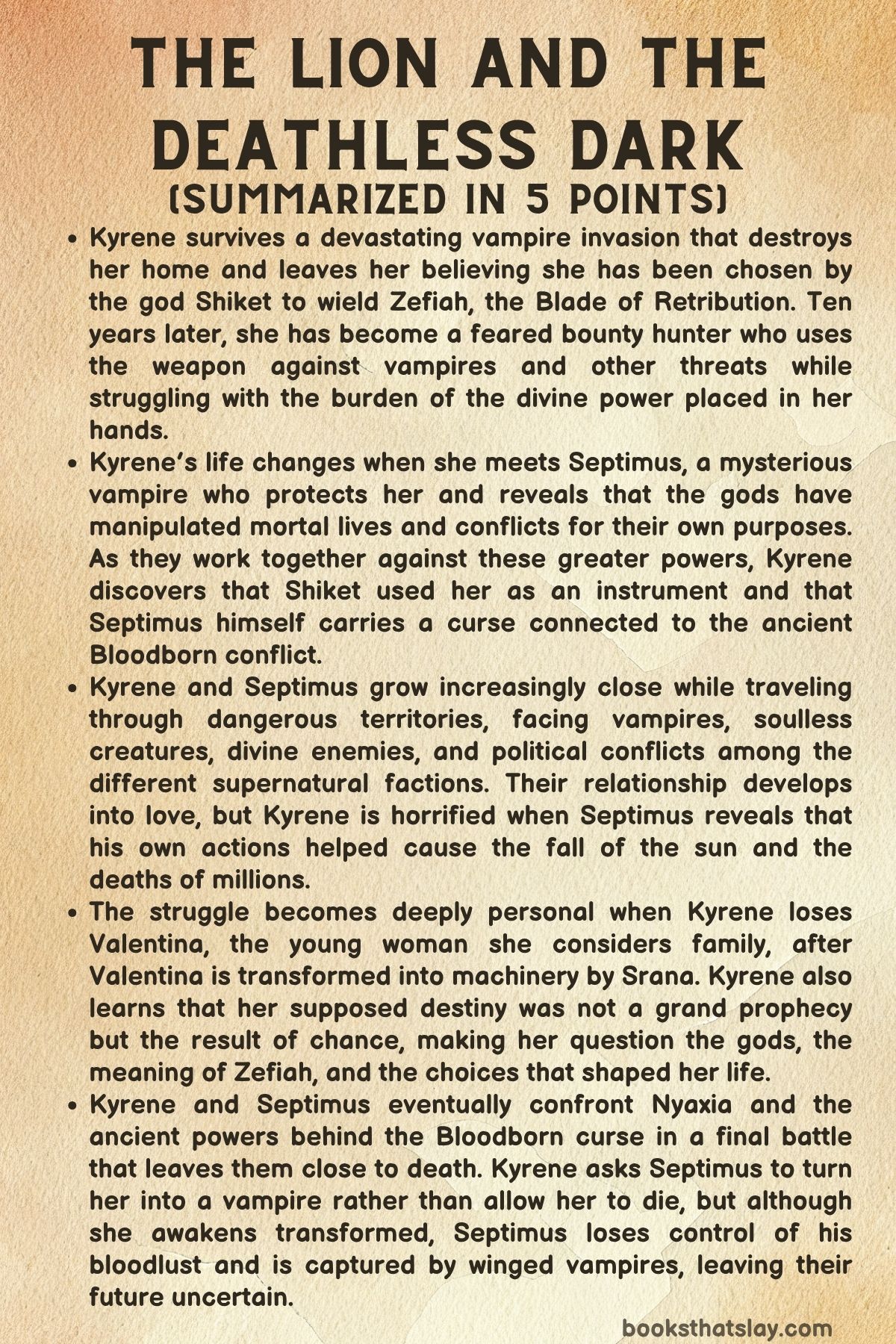
Summary
Ten years after the sun mysteriously disappears, humanity struggles to survive in a world dominated by vampires, supernatural creatures, and indifferent gods.
Among the survivors is Kyrene, a feared warrior known as the Vindica Ultis, who carries Zefiah, a divine sword associated with Shiket, the Goddess of Justice.
Zefiah grants Kyrene extraordinary strength, healing abilities, and protection from death. Although celebrated as a divine champion, she has become a cynical bounty hunter who often questions the morality of the goddess she serves.
Kyrene travels with three companions: Valentina, a talented young machinist suffering from a serious illness; Mirie, a compassionate priestess; and Marko, a powerful fighter.
During an assignment to capture a fugitive named Gaveer Iron, their group encounters imprisoned people who have been mutilated by cultists. When dangerous creatures called soulless approach, Kyrene abandons the prisoners to protect her companions.
She conceals her decision from Valentina, who regards her as a hero. However, the discovery of a pendant belonging to one of the prisoners eventually exposes the truth, devastating Valentina and creating a painful conflict between them.
Meanwhile, Kyrene encounters Septimus, a mysterious vampire who warns her that Nyaxia, the vampire goddess, has taken an interest in her. Despite their mutual hostility, Septimus demonstrates an unusual fascination with Kyrene and repeatedly intervenes when she faces danger.
Believing that her companions will be safer away from her, Kyrene sends them to Hegaella, a fortified human settlement. She gives Mirie a blessed gauntlet for protection before continuing alone toward her divine assignments.
Unfortunately, the gauntlet allows the Shadowborn vampires to track her companions. When Kyrene discovers this, she races toward Hegaella, only to find the fortress destroyed and its inhabitants massacred.
She discovers the bodies of Mirie, Marko, and Valentina among the dead. Overwhelmed by guilt, Kyrene summons Shiket and demands to know why the goddess allowed her devoted followers to perish.
Shiket responds with indifference, blaming Kyrene for neglecting her duties. Realizing that the goddess values punishment and obedience above human lives, Kyrene attacks her with Zefiah and kills her, nearly dying in the process.
Septimus subsequently rescues Kyrene and takes her to Glaea, an isolated kingdom. There, he reveals himself as a prince of the House of Blood and introduces her to Sylina, a queen possessing prophetic abilities.
Sylina shows Kyrene a possible future in which she destroys the gods of the White Pantheon. Septimus offers his resources to help make that future possible, and Kyrene accepts while privately intending to destroy Nyaxia and the vampires afterward.
Their partnership begins with Kyrene training under Atrius, Glaea’s formidable vampire king. However, their preparations are interrupted when Srana, the Goddess of Machinery, attacks with an army of deadly automatons.
Kyrene attempts to defeat Srana but is nearly killed. Septimus intervenes, and Sylina summons Nyaxia to distract the goddess, allowing Kyrene and Septimus to escape through a magical passage.
They unexpectedly emerge in Shadowborn territory, where Septimus appears to surrender Kyrene to Queen Egrette. His apparent betrayal leads to her imprisonment in Kastivai, a facility where humans are subjected to horrific experiments.
When rival Nightborn vampires attack the facility, Septimus reveals that he anticipated the conflict and uses the chaos to arrange their escape.
During their flight, Kyrene encounters imprisoned children and chooses to rescue them despite the danger. Her decision contrasts with her earlier abandonment of helpless prisoners and reveals a growing determination to act according to her conscience.
As they continue traveling together, Kyrene and Septimus develop an increasingly complicated relationship. Their arguments expose their similarities, particularly their willingness to justify terrible sacrifices in pursuit of larger objectives.
Septimus reveals that the Bloodborn suffer from an ancient curse that can transform them into uncontrollable monsters. His political ambitions are driven partly by his determination to free his people from this suffering.
Their journey leads them toward Estrys, a Bloodborn settlement containing a divine harp associated with Kajmar, the God of Pleasure.
Before reaching Estrys, they visit a pleasure temple where their attraction becomes impossible to ignore. An encounter with a vampire hunter interrupts their growing intimacy, forcing them to escape together.
When they finally reach Estrys, they discover another massacre. The slaughter of innocent Bloodborn and the destruction of people Septimus knew personally leave him devastated, allowing Kyrene to recognize the suffering hidden beneath his calculated exterior.
After recovering the harp, they become trapped in an illusion created by Kajmar and Ix, the Goddess of Fertility and Sexuality.
The gods offer Kyrene a perfect existence in which her losses can be undone. Although the temptation is powerful, she recognizes that accepting artificial happiness would mean surrendering her freedom.
Working together, Kyrene and Septimus turn the gods against each other. Septimus uses a divine weapon to weaken Ix, allowing Kyrene to kill her with Zefiah.
They then defeat Kajmar by using a string from his own magical harp to decapitate him. Their victory leaves both severely injured, and Nyaxia arrives shortly afterward.
Although Kyrene has an opportunity to attack the vampire goddess, Septimus persuades her to wait, suggesting that their larger strategy offers a greater chance of success.
Later, he reveals the full prophecy guiding his actions. According to its possible future, Kyrene must use Shiket’s remaining divine swords to kill Nyaxia, potentially restoring sunlight to the world.
Kyrene also learns that Septimus’s plans have involved manipulating events responsible for immense suffering. Nevertheless, her growing attachment to him deepens when she meets his young brother Alric and understands the personal reasons behind his ambitions.
When Nightborn forces attack the Bloodborn capital, Kyrene and Septimus flee toward Hegaella to retrieve the divine swords.
Their journey is complicated by Oraya, the Nightborn queen, who attacks Septimus. Kyrene defeats her temporarily, but the battle pushes Septimus dangerously close to surrendering to his curse.
Rather than abandon him, Kyrene allows him to drink her blood, restoring some of his control while nearly killing herself. Their growing trust becomes increasingly important as they confront further dangers.
At Hegaella, Srana captures them and reveals that she has transformed the massacre’s victims into mechanical servants.
Kyrene is horrified to discover Valentina’s corpse among the reanimated bodies. Refusing to let the goddess continue exploiting the dead, she and Septimus coordinate another attack and successfully destroy Srana.
With Nyaxia present, Kyrene attempts to fulfill the prophecy using one of Shiket’s remaining swords. However, the weapon shatters against Nyaxia, who also breaks Zefiah.
Nyaxia then exposes a secret Kyrene has concealed for ten years.
Kyrene was never Shiket’s original chosen champion. As a pregnant seventeen-year-old fleeing the vampire invasion, she sought help from the true Vindica Ultis, who cruelly refused to shelter her.
Desperate and furious, Kyrene killed the warrior and claimed Zefiah. The sword accepted her, but Shiket never recognized her as the original chosen hero.
This revelation destroys Septimus’s confidence in the prophecy. Nyaxia further punishes him by intensifying the Bloodborn curse before attacking Kyrene and leaving her apparently dead.
Kyrene survives through Zefiah’s remaining protection and mysterious divine intervention. After remembering Valentina’s courage, she rejects her desire to die and seeks another way to save Septimus.
She contacts Acaeja, the Goddess of Fate, who reveals the existence of an ancient prison beneath the Bloodborn palace.
The prison was constructed by King Thastias, an ancient Bloodborn ruler who betrayed Nyaxia while attempting to steal her divine power. Acaeja explains that Septimus can activate its magical chains if Nyaxia’s blood is spilled inside.
Kyrene returns to Septimus and confesses her deception. Although he remains deeply hurt, their shared determination to save his people eventually leads to reconciliation and the acknowledgment of their love.
Together with their allies, they enter the hidden temple, where they encounter the monstrous remains of Thastias. After a desperate confrontation, Kyrene and Septimus kill him, allowing Septimus to inherit powerful ancestral magic.
Nyaxia subsequently arrives and uses Septimus’s worsening curse against them. However, Kyrene refuses to kill him, instead firing Valentina’s miniature crossbow at the goddess.
The bolt produces a single drop of divine blood, enabling Septimus to activate the ancient chains and imprison Nyaxia.
Their victory is immediately overshadowed by Acaeja’s betrayal. The Goddess of Fate reveals that she secretly helped create the ancient prison and has manipulated events to eliminate competing gods.
Acaeja strips Nyaxia of her divinity and banishes her, intending to rebuild the world under her absolute control. She also refuses to remove the Bloodborn curse, condemning Septimus and his people to continued suffering.
Facing death, Kyrene asks Septimus to transform her into a vampire rather than surrender to despair.
Three months later, she awakens in a mountain refuge, having survived the transformation but lost her ability to communicate with or wield Zefiah.
She learns that Acaeja is destroying cities and reshaping the world, while Septimus has succumbed to his curse and disappeared.
Determined to rescue him and confront the new divine tyrant, Kyrene resolves to discover how a vampire might wield a sacred weapon.
Elsewhere, Septimus wanders as a monstrous predator, barely remembering his former life. When winged vampires finally capture him, a brief moment of clarity allows him to remember Kyrene’s name, leaving their future and the fate of the world unresolved.
Characters
Kyrene
Kyrene is the central protagonist of The Lion and the Deathless Dark, a warrior whose reputation as a divine champion conceals years of suffering, guilt, and moral uncertainty. Known as the Vindica Ultis, she possesses extraordinary abilities through her connection with Zefiah, yet her greatest struggles arise from the ordinary human emotions she cannot escape.
Her personality is defined by defiance, anger, dark humor, and an almost obsessive determination to survive. Having witnessed the destruction of her world at seventeen, she believes that compassion can become a dangerous weakness when protecting loved ones requires making terrible decisions.
This belief explains some of her cruelest actions, particularly her abandonment of helpless prisoners to save her companions. Although she attempts to justify such choices, her guilt reveals that she has never completely accepted the ruthless morality she outwardly embraces.
Her relationship with Valentina exposes another side of her personality. Despite claiming to be selfish and indifferent, she sacrifices money, personal comfort, and eventually her own safety to provide the young girl with opportunities she herself never enjoyed.
The deaths of her companions transform Kyrene’s understanding of justice. Initially, she directs her grief toward revenge against the gods, but her experiences gradually teach her that punishment alone cannot undo suffering or protect the innocent.
Her relationship with Septimus further complicates her moral development. She recognizes his capacity for cruelty because it resembles her own, yet she gradually learns to distinguish someone who has committed terrible acts from someone incapable of goodness.
The revelation that she killed the original chosen warrior also challenges her identity. Her apparent destiny becomes a burden of deception, forcing her to confront whether heroism depends on divine approval or personal conduct.
By the ending, Kyrene’s decision to become a vampire represents a fundamental change in her attitude toward life. Rather than seeking death after completing her vengeance, she chooses an uncertain future and accepts responsibility for continuing the struggle against oppression.
Septimus
Septimus is one of the most morally complicated characters in The Lion and the Deathless Dark, functioning simultaneously as Kyrene’s romantic counterpart, political strategist, and reluctant partner in rebellion. As a prince of the House of Blood, he possesses considerable influence, supernatural strength, and a remarkable ability to conceal his intentions.
His outward personality is characterized by charm, intelligence, arrogance, and carefully controlled humor. He frequently provokes Kyrene through flirtation and sarcasm, using their confrontations both to entertain himself and to conceal his growing emotional attachment.
Beneath this polished exterior lies a man consumed by the suffering of his people. The ancient Bloodborn curse threatens his family and kingdom, making his determination to overthrow Nyaxia far more personal than his calculated behavior initially suggests.
Septimus believes that achieving a better future may require sacrifices that would ordinarily be considered unforgivable. His willingness to manipulate political conflicts, exploit prophetic possibilities, and accept widespread suffering reveals the dangerous consequences of pursuing a noble objective without sufficient moral restraint.
His connection with Kyrene forces him to examine these contradictions. Although he initially treats her as an essential instrument of his plans, he gradually comes to value her independently of the prophecy.
His tenderness toward Alric and his distress over the destruction of Estrys reveal a deeply protective nature. These moments challenge the impression that he is emotionally detached from the consequences of his schemes.
When Kyrene’s concealed identity destroys his confidence in the prophecy, Septimus experiences both political and personal betrayal. Nevertheless, his decision to help her demonstrates that his love has become stronger than his desire to control every outcome.
His eventual surrender to the Bloodborn curse creates a tragic reversal of his lifelong ambitions. The man who devoted himself to saving his people becomes a victim of the very condition he sought to destroy, while the surviving fragment of his memory suggests that his humanity has not entirely disappeared.
Zefiah
Zefiah is the sentient divine sword whose relationship with Kyrene provides one of the most significant emotional and philosophical foundations of The Lion and the Deathless Dark. Created as an instrument of Shiket’s justice, the weapon possesses consciousness, extraordinary magical abilities, and the power to preserve its wielder’s life.
Initially, Zefiah appears devoted to divine authority and obedience. She frequently criticizes Kyrene’s neglect of her sacred responsibilities, believing that serving justice requires carrying out the commands of the goddess who created her.
However, her understanding of morality proves more complicated than simple loyalty. When Kyrene attacks Shiket, Zefiah participates in the rebellion, demonstrating that even a divine weapon can recognize wrongdoing within the authority it was created to serve.
Her relationship with Kyrene resembles a difficult but enduring partnership. Zefiah offers guidance, protection, criticism, and occasional tenderness, becoming a constant presence in a life repeatedly marked by loss.
The sword also represents the danger of mistaking vengeance for justice. Her frequent encouragement of Kyrene’s anger sometimes reinforces the destructive instincts that threaten to consume them both.
Their disagreement over whether to attack Nyaxia exposes Zefiah’s limitations. Although she understands courage and punishment, she struggles to accept strategic restraint when an immediate opportunity for revenge appears.
The revelation concerning the original Vindica Ultis ultimately becomes important to Zefiah’s development. She explains that previous wielders lost their compassion, whereas Kyrene’s continued capacity for grief and love makes her worthy of their bond.
When Kyrene becomes a vampire and loses access to Zefiah, the separation represents more than the loss of a supernatural weapon. It removes a companion who has helped define her identity for ten years, leaving her to discover whether she can remain heroic without divine protection.
Valentina
Valentina is one of the most emotionally significant figures in The Lion and the Deathless Dark, representing innocence, intelligence, hope, and the possibility of a future beyond continuous violence. Her extraordinary talent for machinery distinguishes her in a world where technological innovation exists alongside powerful supernatural forces.
Kyrene first encounters her as an enslaved child suffering from an illness that requires regular medication. After Valentina saves her life with a mechanical crossbow, Kyrene sacrifices her bounty to secure the girl’s freedom and provide her with necessary treatment.
Their relationship gradually develops into a bond resembling that between a mother and daughter. Although Kyrene rarely expresses affection openly, her decisions consistently demonstrate that Valentina’s well-being has become one of her greatest priorities.
Valentina admires Kyrene because she believes her rescuer embodies the principles of courage and justice. This idealized perception makes the discovery of Kyrene’s abandonment of innocent prisoners especially devastating.
Rather than accepting cruelty as an unavoidable part of survival, Valentina questions the moral compromises Kyrene has normalized. Her disappointment becomes an important force behind Kyrene’s eventual recognition that protecting loved ones cannot justify every harmful decision.
Valentina also possesses a youthful curiosity that contrasts with the despair surrounding her. Her enthusiasm for machines, interest in Quin, and determination to invent effective weapons reveal someone still capable of imagining a meaningful future.
Her death at Hegaella destroys Kyrene’s remaining sense of emotional security. Nevertheless, her influence continues through the miniature crossbow she created and the courage she demonstrated during her final moments.
When Kyrene later uses that weapon to wound Nyaxia, Valentina’s contribution becomes decisive. Although she is physically absent, her intelligence and refusal to surrender help accomplish what divine weapons and elaborate prophecies could not.
Mirie
Mirie represents moral stability, compassion, and the difference between genuine faith and unquestioning obedience. As a priestess associated with Shiket’s religion, she initially appears to embody the devotional expectations Kyrene has spent years resisting.
However, Mirie’s motivation for accompanying Kyrene is not religious ambition. She recognizes the wounded human being beneath the warrior’s reputation and chooses to support her without demanding perfection.
Her quiet persistence distinguishes her from followers who expect a divine champion to behave according to an idealized image. Even after witnessing Kyrene’s drinking, violence, and moral failures, Mirie remains committed to helping her.
This loyalty does not mean that Mirie approves of every decision Kyrene makes. Her compassion provides an alternative to the belief that survival requires complete emotional detachment.
Her relationship with Valentina also reveals her protective instincts. By saving the girl from a soulless, Mirie demonstrates that her religious beliefs are grounded in practical acts of courage rather than ceremonial declarations.
Mirie’s death becomes particularly significant because she remains faithful to goodness even after divine protection proves worthless. Her character establishes that ethical conviction can survive the failure of the institutions claiming to represent it.
For Kyrene, Mirie’s memory becomes a reminder that love does not necessarily require judgment or control. Sometimes it consists of recognizing another person’s suffering and choosing to remain beside them.
Marko
Marko is a physically powerful fighter whose aggressive personality initially makes him appear selfish, reckless, and emotionally uncomplicated. Kyrene recruits him after witnessing his determination during an underground fighting match, recognizing that his appetite for combat could prove useful in their dangerous work.
His relationship with Kyrene is primarily practical and occasionally physical. Their arrangement reflects a world where survival often depends on temporary alliances rather than conventional ideas of friendship.
Marko frequently behaves as though violence provides both entertainment and employment. His arrogance and apparent indifference make him an effective contrast to Mirie’s gentleness and Valentina’s innocence.
Nevertheless, his continued association with the group gradually reveals attachments that he rarely acknowledges. Although he may not possess Kyrene’s powerful sense of responsibility, he becomes part of the unconventional family she has created.
His final actions at Hegaella fundamentally change the reader’s understanding of him. Despite suffering catastrophic injuries, he continues attempting to reach and protect Valentina.
This sacrifice suggests that courage can exist beneath selfish behavior and that meaningful love does not always announce itself through tenderness. Marko ultimately demonstrates his character through the one decision that costs him everything.
Shiket
Shiket, the Goddess of Justice, embodies the corruption that occurs when divine authority becomes separated from moral responsibility. Although worshipped as a defender of justice, her conduct reveals a disturbing obsession with punishment, obedience, and personal prestige.
She grants her chosen warrior extraordinary power through Zefiah, establishing a relationship that appears sacred but operates according to strict expectations of service. Kyrene’s increasing resentment develops from recognizing that these expectations rarely address the suffering of ordinary people.
Shiket’s rivalry with other gods further undermines her reputation. Rather than directing her champion toward protecting humanity, she orders the punishment of former followers and demands gruesome trophies as evidence of obedience.
Her indifference becomes undeniable after the massacre at Hegaella. Instead of mourning the deaths of her worshippers, she blames Kyrene for neglecting her assignments and treats the catastrophe as an opportunity for renewed vengeance.
This response exposes the difference between justice as an ethical principle and justice as an instrument of authority. Shiket considers herself righteous because she possesses divine power, not because her actions are guided by fairness.
Her death is therefore more than the destruction of an individual antagonist. It challenges the assumption that gods possess moral legitimacy simply because mortals have been taught to worship them.
Nyaxia
Nyaxia is a powerful vampire goddess whose influence shapes the political conflicts, supernatural dangers, and historical suffering throughout the novel. She initially appears as a merciless ruler responsible for the destruction of human communities and the devastating curse afflicting the Bloodborn.
Her personality combines arrogance, intelligence, possessiveness, and an extraordinary capacity for cruelty. She often treats the suffering of mortals and vampires as an acceptable consequence of protecting her own power.
Her persecution of Kyrene reveals a particular enjoyment of psychological domination. Rather than simply killing her enemies, Nyaxia exploits their attachments, memories, and fears to demonstrate the apparent futility of love and resistance.
However, the revelation of King Thastias’s betrayal introduces another dimension to her character. Having once accepted shelter from the Bloodborn, she became the victim of an attempt to imprison and exploit her divine abilities.
This history does not excuse her subsequent cruelty, but it demonstrates that her violence emerges partly from experiences of betrayal and exploitation. Her punishment of entire generations reveals how personal suffering can become the justification for collective oppression.
Nyaxia’s relationship with Septimus is especially significant because she recognizes his rebellion as a continuation of his ancestor’s treachery. By intensifying the Bloodborn curse, she deliberately makes innocent descendants suffer for a conflict that began centuries earlier.
Her eventual imprisonment and loss of divinity appear to deliver long-awaited justice. Yet Acaeja’s involvement reveals that even Nyaxia has been manipulated by an authority more calculating than herself.
Acaeja
Acaeja, the Goddess of Fate, emerges as the ultimate architect of many of the conflicts in The Lion and the Deathless Dark. Initially presented as a mysterious divine figure possessing knowledge of possible futures, she appears capable of providing the guidance Kyrene and Septimus desperately need.
Her powers over the Threads of Fate allow her to observe possibilities and influence events across extraordinary periods of time. Unlike gods who openly rely upon physical strength, Acaeja exercises power through information, strategic intervention, and the manipulation of other people’s decisions.
Her apparent assistance becomes especially valuable when she reveals the ancient prison capable of restraining Nyaxia. By presenting herself as an ally against divine tyranny, she persuades Kyrene to participate in a plan whose consequences remain concealed.
The revelation that she helped King Thastias construct Nyaxia’s prison exposes the depth of her deception. Events that seemed unrelated are revealed as parts of a long-running effort to eliminate rival authorities.
Acaeja believes that uncontrolled freedom inevitably produces suffering. Her solution is to remake the world under a system where she alone determines which futures should become reality.
This ideology makes her especially dangerous because she does not necessarily perceive herself as cruel. She considers domination a form of protection and treats individual autonomy as an obstacle to universal stability.
Her refusal to remove the Bloodborn curse demonstrates the emptiness of her supposed benevolence. Although she possesses extraordinary abilities, she chooses to perpetuate suffering because Kyrene and Septimus might eventually challenge her authority.
Acaeja therefore represents tyranny disguised as order, transforming the struggle against cruel gods into a broader conflict over whether anyone should possess absolute control over existence.
Sylina
Sylina is the human queen of Glaea and a practitioner of prophetic magic associated with Acaeja. Her ability to examine possible futures makes her an essential figure in Septimus’s strategy against the gods.
She initially approaches Kyrene with caution, recognizing that sheltering someone responsible for killing a goddess could endanger her kingdom. Her responsibilities as a ruler require her to consider consequences beyond the personal ambitions of her allies.
Sylina’s magic reveals the possibility that Kyrene could destroy the White Pantheon. However, she also emphasizes that prophecy does not establish certainty, introducing an important distinction between foreknowledge and inevitability.
Her relationship with Atrius connects human and vampire leadership within Glaea. Together, they represent a political arrangement that challenges the assumption that the two species must always remain enemies.
Sylina repeatedly demonstrates courage by assisting Kyrene and Septimus despite the danger to her people. Her willingness to summon Nyaxia during Srana’s attack and later help locate the ancient prison establishes her importance as an active participant rather than a distant adviser.
However, her dependence upon the Threads of Fate also makes her position increasingly uncertain after Acaeja’s betrayal. The source of her prophetic abilities is connected to a goddess whose ambitions threaten the very freedom Sylina has attempted to defend.
Atrius
Atrius is the vampire king of Glaea and Septimus’s cousin, distinguished by his imposing appearance, formidable combat abilities, and disciplined personality. His leadership contrasts with Septimus’s preference for manipulation and carefully concealed intentions.
His first interaction with Kyrene is deliberately confrontational. By challenging her to combat, Atrius exposes the limitations of her abilities and demonstrates that killing gods will require more preparation than determination alone.
As her trainer, he emphasizes physical discipline, tactical awareness, and respect for superior opponents. His harsh methods are intended to prevent Kyrene from confusing confidence with genuine readiness.
Atrius also possesses a strong sense of responsibility toward his kingdom. When divine enemies threaten Glaea, he responds as a ruler concerned with protecting his people rather than an adventurer seeking personal glory.
His relationship with Sylina reveals the emotional burden of the Bloodborn curse. Despite his strength and authority, the worsening condition eventually makes it dangerous for him to remain near someone he loves.
By sheltering Kyrene after her transformation, Atrius becomes an important link between her former life and her uncertain future. His continued suffering demonstrates that removing Nyaxia from power has not automatically repaired the damage she inflicted.
Srana
Srana, the Goddess of Machinery, represents technological brilliance corrupted by absolute power and a complete disregard for individual dignity. Her body, composed of sophisticated mechanical structures, reflects her mastery over invention and artificial creation.
Her abilities make her exceptionally dangerous because she can produce armies of automatons capable of fighting with extraordinary strength and precision. Unlike human inventors such as Valentina, Srana treats innovation primarily as a means of expanding her authority.
Her fascination with Kyrene exposes her willingness to reduce living beings to useful materials. Rather than respecting the warrior’s independence, she imagines transforming her into an obedient mechanical instrument.
This attitude reaches its most disturbing expression at Hegaella, where Srana reconstructs the bodies of massacre victims as controlled machines. Her decision to use Valentina’s corpse demonstrates the complete absence of compassion governing her work.
Srana’s behavior also exposes the emptiness of progress when technical achievement is separated from ethical responsibility. Her creations are impressive, but their sophistication only increases the suffering they can inflict.
Her destruction through a weapon associated with her own divine power becomes an appropriate reversal. The goddess who attempted to control every creation is defeated when her inventions and ambition are turned against her.
Kajmar
Kajmar, the God of Pleasure, possesses supernatural influence over beauty, desire, illusion, and emotional gratification. Rather than ruling primarily through fear, he exploits the universal human desire to escape pain and experience happiness.
His power becomes particularly dangerous when he offers Kyrene an alternative existence in which sunlight returns and her loved ones survive. He understands that a promise of restored happiness may overcome defenses that physical violence cannot.
Kajmar’s personality is characterized by vanity, manipulation, and profound selfishness. Although he presents himself as a source of pleasure, his gifts require submission and the abandonment of independent judgment.
His relationship with Ix reveals the instability beneath their apparent intimacy. Once Septimus manipulates their suspicions, Kajmar proves willing to sacrifice his companion to preserve his own position.
His attempt to murder Septimus further demonstrates that desire becomes destructive when other individuals are treated merely as objects serving personal satisfaction.
Kajmar’s defeat is significant because Kyrene refuses to exchange reality for a comforting illusion. By using the divine harp against him, she also demonstrates that creativity and practical intelligence can overcome an enemy whose power initially appears overwhelming.
Ix
Ix, the Goddess of Fertility and Sexuality, appears alongside Kajmar as a divine figure capable of manipulating desire, emotional longing, and imagined happiness. Her powers exploit intimate human experiences, making her especially threatening to someone carrying Kyrene’s history of personal loss.
Her outward beauty conceals a willingness to use vulnerability as an instrument of domination. Like Kajmar, she offers fulfillment while demanding surrender to divine authority.
Ix becomes particularly cruel when she invokes Kyrene’s pregnancy losses. By turning private grief into a weapon, she demonstrates the difference between possessing influence over fertility and genuinely understanding the pain associated with it.
Her relationship with Kajmar is also built upon unstable loyalty. Their alliance collapses when the possibility of divine destruction makes each suspect the other of betrayal.
The circumstances of her death expose the fragility of divine superiority. Although she possesses immense supernatural power, she falls victim to the same fear, jealousy, and selfishness that she manipulates in mortals.
Her role adds another dimension to Kyrene’s struggle by confronting her with suffering that physical strength cannot repair and emotional wounds that vengeance alone cannot heal.
Queen Egrette
Queen Egrette is a powerful Shadowborn ruler whose cruelty and political authority make her one of Kyrene’s most feared enemies. Her involvement in the destruction of Vostis connects her directly to the traumatic events that shaped Kyrene’s early life.
Egrette exercises control through intimidation, magical domination, and the systematic exploitation of vulnerable people. Her association with Kastivai reveals an especially disturbing willingness to treat human suffering as material for experimentation.
Her inability to remember Kyrene as a survivor of Vostis exposes the difference between the experiences of perpetrators and victims. What permanently transformed Kyrene’s existence was apparently insignificant to the queen responsible for the destruction.
Egrette also demonstrates considerable political suspicion. Although Septimus presents himself as an ally, she remains reluctant to trust him and recognizes the dangers associated with allowing Kyrene access to Zefiah.
Her character represents institutionalized cruelty rather than violence committed in sudden anger. She demonstrates how oppressive systems become particularly difficult to resist when their rulers regard atrocities as ordinary instruments of governance.
Oraya
Oraya is the formidable queen of the Nightborn vampires and a significant opponent of Septimus and Kyrene. Her exceptional combat abilities, determination, and supernatural powers make her dangerous even to experienced warriors.
Unlike antagonists motivated primarily by personal cruelty, Oraya operates within the political conflicts dividing the vampire Houses. Her pursuit of Septimus suggests grievances and strategic objectives that extend beyond her immediate confrontations with Kyrene.
During the attack on Kastivai, she recognizes Septimus and attempts to prevent his escape. Their hostility reveals that his long-running plans have created enemies among powerful vampire factions.
Oraya’s later appearance at Hegaella demonstrates her persistence. She confronts Septimus directly and nearly defeats Kyrene, forcing the human warrior to rely on ingenuity and assistance rather than superior physical strength.
Her warning that Kyrene may not truly understand Septimus introduces an important challenge to the protagonist’s growing trust. Oraya reminds her that affection cannot erase the consequences of another person’s political decisions.
Although she functions as an adversary, her actions are rooted in a larger conflict whose participants possess competing loyalties and legitimate fears. This makes her more complicated than an enemy whose only purpose is destruction.
King Thastias
King Thastias is an ancient Bloodborn ruler whose betrayal of Nyaxia established the curse responsible for generations of suffering. Although much of his influence belongs to the distant past, his decisions continue shaping the lives of nearly every major vampire character.
He originally offered shelter to Nyaxia when she was vulnerable. However, resentment grew when he believed that the House of Blood had received fewer supernatural advantages than other vampire Houses.
His desire for greater power eventually overcame his obligations toward someone he had protected. By transforming her temple into a prison designed to exploit divine blood, he converted hospitality into an act of calculated betrayal.
The consequences of his actions extend far beyond his own punishment. Nyaxia curses his descendants, making innocent generations suffer for decisions in which they had no involvement.
His prolonged imprisonment gradually transforms him into a monstrous being almost entirely controlled by blood and hunger. This physical deterioration reflects the moral corruption that originally caused his downfall.
When Kyrene and Septimus finally kill him, they destroy both a terrifying enemy and a surviving embodiment of their world’s ancient injustices. His death also allows Septimus to inherit the Heir Mark previously denied to later Bloodborn rulers.
Alric
Alric is Septimus’s young brother, whose vulnerability provides an essential explanation for the vampire prince’s determination to destroy the Bloodborn curse. Although he does not participate extensively in the central battles, his presence gives emotional substance to a conflict otherwise dominated by politics and prophecy.
His innocence contrasts with the violence and manipulation surrounding his family. Unlike older Bloodborn who have endured years of deterioration, Alric represents someone whose future might still be protected.
Septimus’s tenderness toward him exposes a side of his personality that Kyrene rarely witnesses. The prince’s private concern for his brother is far removed from the controlled arrogance he displays during negotiations and combat.
When Nyaxia intensifies the Bloodborn curse, Alric begins displaying signs of its progression. His condition demonstrates that divine punishment makes no distinction between guilty rulers and innocent children.
Alric therefore represents the generations forced to inherit conflicts they did not create. His survival becomes one of the clearest measures of whether Septimus’s sacrifices can ultimately accomplish something worthwhile.
Calista
Calista is Septimus’s sister and a member of the Bloodborn royal family whose responsibilities become increasingly difficult as Nyaxia’s curse worsens.
Her character is primarily defined through familial duty and the survival of the younger generation. When Septimus orders her to take Alric away from the endangered capital, she becomes responsible for protecting someone whose future is threatened by forces far beyond his control.
Calista’s position reveals the emotional demands placed upon members of a ruling family during a crisis. Even those who are not directing political strategies must carry the consequences of decisions made by gods and kings.
Her presence also expands the understanding of Septimus’s motivations. The Bloodborn curse is not merely an abstract political problem but a direct threat to people who have relationships, responsibilities, and families.
Although the supplied account gives her a comparatively limited independent role, Calista contributes to the novel’s presentation of survival as a shared responsibility rather than the achievement of a single heroic individual.
Ilia
Ilia is a loyal member of Septimus’s guard whose dedication to the Bloodborn royal family becomes especially important during the kingdom’s collapse.
She initially responds to Kyrene’s return with suspicion and hostility, believing that her concealed identity and deception have endangered Septimus and his people. This reaction demonstrates that loyalty can involve defending someone against people they personally wish to forgive.
Ilia accompanies the expedition into the ancient temple, continuing to serve despite the increasing danger posed by the curse. Her willingness to participate establishes her courage and commitment to her duties.
Her final moments are tragic because the supernatural condition she has resisted eventually overwhelms her self-control. When she attacks Kyrene, Septimus is forced to help kill a guard who has remained faithful to him.
Ilia’s death demonstrates the particular cruelty of the Bloodborn curse. It transforms loyal individuals into threats against the people they wish to protect, leaving survivors burdened by decisions that should never have been necessary.
Angelika
Angelika is a powerful Bloodborn warrior and former friend of Septimus whose participation in the Kejari reveals the human cost of his larger political ambitions.
The Kejari is a deadly competition offering its victor a wish from Nyaxia. Angelika’s involvement demonstrates how dangerous opportunities can become instruments of political strategy when ordinary methods of achieving freedom appear impossible.
Her relationship with Septimus is particularly revealing because he discusses her as someone he genuinely knew and valued. Her participation was connected to his long-term plans, showing that the sacrifices he accepted were not always made by strangers.
Angelika’s significance lies partly in the tension between personal attachment and strategic calculation. Septimus’s willingness to involve someone close to him in a dangerous undertaking illustrates how completely his mission has come to dominate his judgment.
Although her individual experiences receive limited attention in the supplied account, she helps explain why Septimus carries so much emotional damage beneath his controlled behavior.
Erekkus
Erekkus is a Bloodborn figure whose fate at Estrys illustrates the horrifying consequences of the curse and the cruelty inflicted upon Septimus’s people.
When Kyrene and Septimus discover him, his body has undergone a grotesque transformation caused by uncontrolled blood magic. His appearance makes him seem more like a monster than the person Septimus once knew.
However, Septimus recognizes him and understands the suffering hidden beneath his altered form. By killing Erekkus, he performs an act of mercy that carries a profound personal cost.
Erekkus’s position near the hidden compartment containing Kajmar’s harp suggests the determination of Estrys’s defenders to protect the weapon despite overwhelming danger.
His death becomes another reminder that Bloodborn victims cannot be reduced to the violence their cursed bodies are capable of committing. He represents individuals whose identities and dignity have been destroyed by circumstances they could not control.
The Original Vindica Ultis
The original Vindica Ultis is Shiket’s first chosen warrior and one of the most consequential figures in the novel despite appearing primarily through the revelation of Kyrene’s past.
As the officially selected champion of justice, she possesses the status and resources that should allow her to protect people in desperate circumstances. Nevertheless, when the injured, pregnant Kyrene seeks shelter, the warrior refuses to help.
Her fear that Kyrene’s bleeding will attract vampires becomes the justification for abandoning a dying girl. Her demand for Kyrene’s possessions further exposes the selfishness beneath her supposedly sacred identity.
Kyrene’s violent retaliation results in the original champion’s death and the transfer of Zefiah. This encounter creates the false assumption upon which Septimus later builds his prophetic strategy.
The original warrior’s character demonstrates that divine selection does not guarantee moral worth. Her conduct also establishes one of the novel’s most important contradictions: the person officially chosen to embody justice fails to practice it when confronted with someone who needs protection.
Septimus’s Father
Septimus’s father, the Bloodborn king, represents the physical and emotional deterioration imposed upon generations of vampire royalty by Nyaxia’s curse.
When Kyrene encounters him, his body has become grotesquely transformed. Nevertheless, he continues using his formidable blood magic to defend the royal palace rather than surrendering to death.
His decision demonstrates both courage and the terrible price of prolonged survival. His continued existence offers protection to his people, but it also reveals how much individual dignity the curse can destroy.
The king’s condition foreshadows the fate Septimus fears for himself. It also explains why the prince considers the liberation of the Bloodborn important enough to justify years of political manipulation and dangerous sacrifice.
Although the king receives little direct development in the supplied material, his presence makes the inherited nature of the Bloodborn tragedy especially visible.
Miles
Miles is a Shadowborn soldier whose encounters with Kyrene demonstrate the psychological dangers posed by vampire mind magic.
During their first confrontation, he participates in hunting Kyrene and using supernatural influence to exploit her traumatic memories. His methods are particularly effective because they transform past suffering into an immediate source of fear.
Miles subsequently reappears during another attack involving soulless. His renewed pursuit suggests the persistence and organization of the Shadowborn campaign against Kyrene.
Septimus intervenes before Miles can fully overpower her, reinforcing the complicated pattern in which a vampire repeatedly protects Kyrene from members of another vampire House.
Miles functions primarily as an example of the Shadowborn’s methods of control. His ability to invade another person’s memories makes him a threatening opponent even without the political power possessed by Queen Egrette.
Johnus
Johnus initially appears as a wealthy patron at a pleasure temple, where Kyrene deliberately flirts with him to provoke jealousy in Septimus.
His attention allows Kyrene to test her attractiveness and regain a sense of confidence outside her usual identity as a warrior. However, she eventually realizes that her interest in him is secondary to her growing desire for Septimus.
The revelation that Johnus is secretly a vampire hunter transforms his role. Believing Kyrene is being manipulated by a dangerous predator, he attempts to kill Septimus.
His conduct introduces an ironic reversal in the novel’s treatment of enemies and allies. A human hunter who believes he is protecting another human becomes the immediate threat, while the vampire he attacks is someone Kyrene instinctively defends.
Johnus therefore exposes the inadequacy of judging morality entirely through species or established loyalties. His intentions may appear protective, but his incomplete understanding leads him into a conflict whose emotional significance he fails to recognize.
Quin
Quin is a teenage boy working at an inn who attracts Valentina’s interest during one of the group’s rare peaceful evenings.
His presence provides an important contrast to the dangerous responsibilities surrounding Kyrene’s companions. For Valentina, the possibility of ordinary teenage attraction represents a life not entirely defined by illness, violence, and survival.
Kyrene initially responds protectively to Valentina’s interest, while Mirie encourages her to permit the girl some normal happiness. This disagreement reveals Kyrene’s difficulty accepting that protecting someone also means allowing them independence.
Quin also becomes connected to a significant moral revelation when he gives Valentina a golden pendant associated with one of the prisoners Kyrene abandoned.
Although he has little knowledge of the emotional consequences, the gift exposes the truth Kyrene has attempted to conceal. Quin’s small role demonstrates how ordinary interactions can have lasting consequences within relationships built upon secrets.
Gaveer Iron
Gaveer Iron is a fugitive whose capture forms the objective of Kyrene’s early bounty-hunting assignment.
His importance lies less in his personal development than in the circumstances surrounding the pursuit. The financial reward offered for his capture is especially valuable because Kyrene needs money to purchase Valentina’s medicine.
The hunt exposes Kyrene’s willingness to make severe moral compromises while attempting to protect her companions. Her determination to secure the payment contributes to the dangerous situation in which she encounters cultists, imprisoned victims, and soulless.
Gaveer’s eventual death at Septimus’s hands also demonstrates the vampire prince’s ability to interfere with Kyrene’s activities before she understands his intentions.
As a character, Gaveer primarily serves to establish the economic pressures governing Kyrene’s choices and the connection between her professional work and personal responsibilities.
Duke Vinwest
Duke Vinwest is the wealthy nobleman responsible for offering the bounty on Gaveer Iron.
Although he remains a relatively distant presence, his role establishes the unequal distribution of resources within the devastated human world. Individuals with wealth and authority can employ dangerous specialists to pursue their interests while others struggle to obtain basic necessities.
For Kyrene, Vinwest’s reward represents the means to secure medicine for Valentina. His financial influence therefore indirectly shapes the decisions that expose Kyrene and her companions to considerable danger.
The duke functions as part of the social environment rather than a fully developed personal antagonist. His presence helps explain why a divinely empowered warrior continues accepting ordinary bounty-hunting contracts despite possessing abilities intended for a higher purpose.
Alarus
Alarus is Nyaxia’s deceased husband, whose history contributes to the emotional significance of Acaeja’s betrayal.
The revelation that Acaeja once had a close connection with Alarus suggests that the conflict between the two goddesses extends beyond ordinary political rivalry. Their shared history adds a personal dimension to the struggle for divine power.
Nyaxia’s response to Acaeja’s deception becomes more understandable when viewed against this background. She has not merely been defeated by a competing goddess but manipulated by someone connected to her own past and the memory of her husband.
The supplied account offers limited direct information about Alarus’s personality or actions, so his significance rests primarily upon his relationships and legacy.
Nevertheless, his presence reinforces the novel’s suggestion that divine conflicts are frequently motivated by personal grief, betrayal, and unresolved attachments rather than purely ideological differences.
Themes
Justice, Vengeance, and Moral Responsibility
Justice becomes increasingly difficult to distinguish from vengeance when those entrusted with enforcing moral order are themselves responsible for cruelty. In The Lion and the Deathless Dark, Kyrene’s experiences reveal how easily righteous anger can become destructive when it is separated from compassion.
Her relationship with Shiket establishes this conflict. Although the goddess claims authority over justice, her concern for punishment and obedience consistently outweighs her responsibility toward innocent lives.
Kyrene initially follows a similar pattern. She believes that protecting people she loves justifies abandoning others, treating moral compromise as an unavoidable requirement of survival.
The incident involving the imprisoned cult victims exposes the consequences of this reasoning. Kyrene saves her companions, but her decision contradicts the principles associated with her identity as a divine champion.
Her later rescue of imprisoned children demonstrates a change in her understanding of responsibility. Instead of calculating whose survival offers the greatest personal advantage, she chooses to act because vulnerable people deserve protection.
The destruction of the gods also raises questions about the limits of vengeance. Killing Shiket, Kajmar, Ix, and Srana punishes beings responsible for suffering, but their deaths do not automatically create a fairer world.
Acaeja’s subsequent rise demonstrates that replacing one cruel ruler with another cannot establish meaningful justice.
Ultimately, Kyrene’s development suggests that justice depends less upon punishment than upon the willingness to defend others, acknowledge mistakes, and resist becoming cruel while opposing cruelty.
Love, Grief, and Chosen Family
Kyrene’s relationships with Valentina, Mirie, and Marko reveal how meaningful human attachments can develop even within a world dominated by violence. Their companionship creates a sense of belonging that contrasts with the isolation associated with her divine responsibilities.
Each member of the group offers something different. Valentina awakens Kyrene’s protective instincts, Mirie provides acceptance without demanding perfection, and Marko contributes loyalty that becomes fully apparent only through his final sacrifice.
These relationships challenge Kyrene’s belief that emotional detachment is necessary for survival. Despite her attempts to present herself as selfish, her actions repeatedly demonstrate that she values her companions more than money, reputation, or personal comfort.
Their deaths become devastating because they destroy the family she has built through deliberate choices rather than inherited obligations.
Kyrene’s grief initially manifests as rage and self-punishment. She blames herself for sending them to Hegaella and becomes convinced that her survival has no meaning beyond revenge.
However, their influence continues shaping her decisions. Mirie’s compassion, Marko’s selflessness, and Valentina’s courage become qualities she gradually attempts to preserve within herself.
Her relationship with Septimus further develops this theme by presenting love as an experience involving trust, vulnerability, and the possibility of betrayal.
Their connection does not erase their moral failures or personal suffering. Instead, it challenges both characters to recognize another person’s humanity despite knowing the worst things they have done.
Love ultimately becomes a reason to continue living rather than merely another source of potential loss.
Fate, Free Will, and the Illusion of Prophecy
Prophecy creates a dangerous illusion of certainty in The Lion and the Deathless Dark, particularly when powerful individuals begin treating possible futures as instructions that must be followed regardless of their consequences.
Septimus’s ambitions are shaped by prophetic visions suggesting that Kyrene can destroy the White Pantheon and eventually defeat Nyaxia. His belief in these possibilities becomes strong enough to justify years of manipulation and sacrifice.
However, Sylina explains that fate contains countless branching outcomes. This distinction challenges the assumption that witnessing a possible future guarantees its eventual realization.
The revelation concerning Kyrene’s identity further undermines confidence in prophecy. Septimus constructs an enormous political strategy around someone he mistakenly believes to be the original chosen warrior.
His error exposes the danger of interpreting incomplete knowledge as absolute truth. Even extraordinary foresight cannot protect people from mistaken assumptions or deliberate deception.
Acaeja’s involvement introduces a more disturbing possibility. Rather than simply observing fate, she manipulates events and influences the choices of others to produce outcomes favorable to her ambitions.
Her determination to eliminate uncertainty reveals a fundamental hostility toward freedom. She believes suffering can be prevented only when individual choices are replaced by complete divine control.
Kyrene gradually becomes the opposite of this philosophy. Her most consequential decisions frequently emerge from refusing the paths others consider inevitable.
Her rejection of artificial happiness, refusal to kill Septimus, and decision to survive as a vampire demonstrate that the future remains open to unexpected choices.
The novel ultimately presents freedom as dangerous but essential, suggesting that a world without uncertainty would also be a world without genuine moral agency.
Divine Power, Oppression, and the Cycle of Violence
Divine authority repeatedly becomes a justification for exploitation in a world where gods possess immense power but face few meaningful consequences for abusing it. Their supernatural abilities allow them to impose personal desires upon entire civilizations.
Shiket demands obedience while neglecting her followers, Srana transforms living and dead bodies into machinery, and Nyaxia condemns generations of Bloodborn to suffer for an ancient betrayal.
These actions reveal a recurring pattern in which rulers confuse their own interests with the welfare of those beneath them.
However, the novel also demonstrates that oppression does not originate exclusively with gods. King Thastias attempts to exploit Nyaxia’s divine blood, while Septimus accepts widespread suffering as the price of pursuing his people’s liberation.
Both characters become examples of how those who experience injustice can reproduce similar cruelty when seeking power.
Nyaxia’s history is particularly important because she occupies the positions of victim and oppressor at different moments. Her imprisonment does not make her subsequent persecution of innocent descendants morally defensible.
Acaeja represents the most extreme form of this pattern. Claiming that freedom inevitably produces suffering, she attempts to establish a world governed entirely by her own judgment.
Her ambition demonstrates how the desire to prevent violence can become another justification for absolute control.
Kyrene’s continuing struggle therefore extends beyond defeating particular gods. She must confront the beliefs that allow powerful individuals to treat others as expendable.
The possibility of meaningful change depends upon breaking this cycle, refusing to justify cruelty through past suffering, and recognizing that authority without accountability inevitably threatens freedom.