The Lost Pilots Summary and Analysis
The Lost Pilots: The Spectacular Rise and Scandalous Fall of Aviation’s Golden Couple by Corey Mead is a historical nonfiction book that explores the extraordinary lives of pioneering aviators William Lancaster and Jessie Keith-Miller.
Set against the excitement of early aviation, the story follows their dangerous record-breaking flights, complicated romantic relationship, financial struggles, and involvement in a sensational murder trial. Their journey begins with an ambitious flight from England to Australia and eventually leads to tragedy in the Sahara Desert. Through personal correspondence, historical records, and courtroom testimony, Mead examines the relationship between fame, ambition, love, and human vulnerability while capturing a period when aviation offered unprecedented opportunities for adventure and independence.
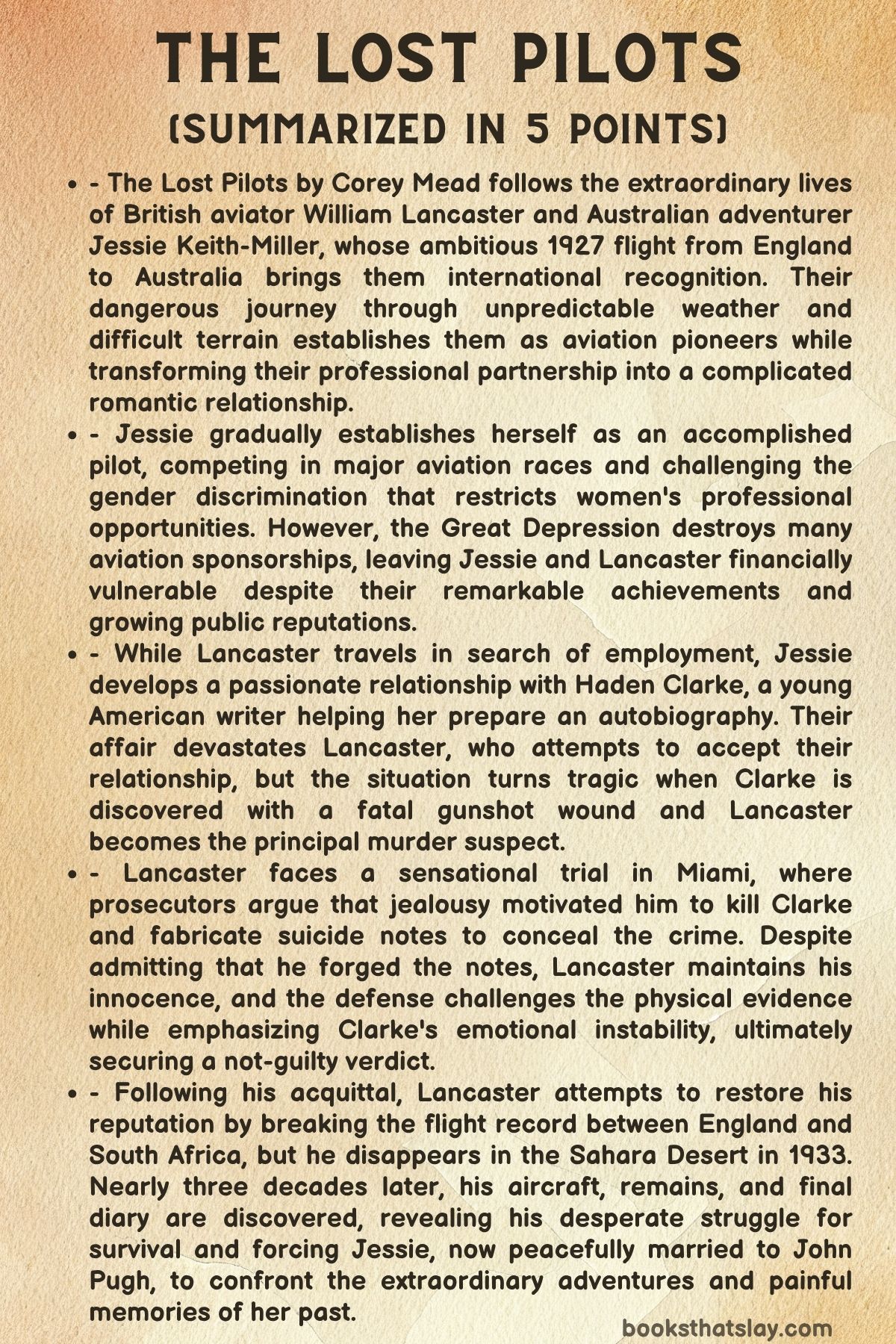
Summary
In 1932, the imposing Dade County Courthouse in Miami becomes the center of international attention as Captain William Lancaster, a celebrated British aviator, prepares to stand trial for murder. The man accused of killing young American writer Haden Clarke had once been admired for his adventurous flights across continents, but his reputation now hangs in the balance.
At the center of the controversy is Jessie Keith-Miller, an accomplished Australian aviator who had once been Lancaster’s lover and flying partner. Her subsequent romantic involvement with Clarke creates a complicated situation involving jealousy, deception, and conflicting loyalties, turning a private tragedy into a sensational public spectacle.
The story returns to 1927, when Jessie arrives in London seeking freedom from an unhappy marriage and a life constrained by social expectations. Born in Australia in 1901, she endured an unsettled childhood, repeated family relocations, and several devastating losses, including the deaths of her father and younger brother.
Jessie married journalist Keith Miller when she was young, but their incompatible personalities and expectations gradually destroyed their relationship. Determined to create a different future, she earns money selling carpet sweepers and travels to England with her friend Margaret Starr, hoping to discover opportunities unavailable in her former circumstances.
At a London party, Jessie meets Captain William Lancaster, a British pilot planning an ambitious flight from England to Australia in a lightweight aircraft. Inspired by the remarkable achievements of aviators such as Charles Lindbergh, Lancaster dreams of establishing a new aviation record despite lacking sufficient financial resources.
Jessie immediately recognizes an opportunity to participate in an adventure that could transform her existence. After learning that Lancaster has neither adequate financing nor a fully developed plan, she offers to contribute half the expenses in exchange for accompanying him.
Lancaster initially resists the proposal because of the physical dangers and the potential scandal of traveling with a married woman. However, Jessie’s enthusiasm, determination, and financial support eventually persuade him to accept her as his partner.
The two begin preparing their Avro Avian aircraft, named the Red Rose in honor of Lancaster’s mother. Jessie successfully obtains sponsorships and financial assistance while undertaking flying lessons, quickly demonstrating that she possesses remarkable aptitude for aviation.
Lancaster brings considerable experience from his military flying career, including service during the First World War and with the Royal Air Force. Although his technical knowledge and confidence are valuable, his adventurous temperament and willingness to take unnecessary risks occasionally complicate their preparations.
On October 14, 1927, they depart London’s Croydon Airport, beginning a hazardous journey that will test their abilities and strengthen their emotional connection. Their route takes them across Europe, the Mediterranean, North Africa, and the Middle East, where unpredictable weather, mechanical difficulties, and limited resources threaten their progress.
Jessie gradually becomes more than a passenger, helping maintain the aircraft, performing mechanical tasks, and taking control during portions of the flights. The journey allows her to establish an independent identity within an aviation community that frequently questions women’s suitability for dangerous flying assignments.
Their expedition includes receptions hosted by military personnel, meetings with aviation enthusiasts, and encounters with landscapes that few travelers have experienced from the air. These moments of excitement are frequently interrupted by exhaustion, poor visibility, violent turbulence, and the possibility of an emergency landing.
As the journey progresses, Lancaster and Jessie develop romantic feelings despite both being married. Their attachment creates emotional complications because openly acknowledging the relationship could threaten their sponsorships, reputations, and professional prospects.
On December 19, they reach Calcutta after traveling approximately 8,500 miles, setting a significant distance record for a lightweight aircraft. Jessie also earns recognition for traveling farther by airplane than any woman before her, confirming that she is becoming an important figure in early aviation.
Their ultimate destination remains Australia, however, and the remaining journey presents additional dangers. During the final approach toward Darwin, the Red Rose encounters intense rain and violent turbulence that make survival seem uncertain.
Believing they might die, Lancaster writes Jessie a brief farewell message acknowledging their efforts and the possibility that their expedition will end in disaster. They eventually survive the storm and land at Darwin on a waterlogged airfield, completing an extraordinary accomplishment.
Their successful arrival transforms Lancaster and Jessie into international celebrities, opening doors to publicity, sponsorships, and new aviation opportunities. Nevertheless, the growing attention also places their unconventional relationship under increasing scrutiny, particularly because neither has formally ended their marriage.
The couple eventually travels to the United States, where aviation has become an enormously popular public attraction. They encounter famous pilots, attend aviation gatherings, and establish connections with promoters who appear capable of supporting their future careers.
Jessie increasingly pursues achievements separate from Lancaster, determined to prove herself as a professional aviator rather than merely his companion. In 1929, she participates in the Women’s Air Derby alongside prominent female pilots, including Amelia Earhart, confronting demanding conditions and the ever-present danger of fatal accidents.
Her success continues through the National Air Races, where she wins a women’s fifty-mile competition and earns further recognition. She also participates in the Ford Reliability Tour, finishing eighth overall and becoming the only female entrant to complete the demanding event.
These accomplishments establish Jessie as a respected aviation personality whose skills can compete with those of experienced male pilots. Meanwhile, Lancaster’s professional circumstances deteriorate following a serious crash and the loss of important financial support.
The stock market collapse of October 1929 brings additional hardship as the Great Depression devastates the aviation industry. Manufacturers struggle, sponsorships disappear, and independent pilots find it increasingly difficult to earn a reliable living.
Jessie continues pursuing record-breaking flights across the United States, briefly restoring publicity and commercial interest. Lancaster increasingly acts as her manager and business representative, although their financial security remains uncertain.
During one dangerous flight toward Miami, Jessie disappears from expected communication routes after encountering severe weather. Lancaster becomes deeply distressed and helps organize a search, but she survives after making an emergency landing on Andros Island in the Bahamas.
The incident strengthens her public reputation for courage while exposing the insecurity underlying the couple’s lifestyle. Their survival depends on taking extraordinary risks, yet even successful flights no longer guarantee financial rewards.
By 1931, Lancaster and Jessie are living under severe financial pressure, desperately searching for opportunities that might restore their fortunes. They relocate to Miami, where aviation promoters Mark Tancrel and Jack Russell offer the possibility of employment through a proposed commercial enterprise called Latin-American Airways.
Lancaster becomes increasingly suspicious of the venture’s unreliable financing and questionable activities. Meanwhile, Jessie receives an opportunity to publish an autobiography, leading to the arrival of Haden Clarke, a young American writer who offers to help prepare her manuscript.
Clarke initially impresses both aviators with his charm, intelligence, and apparent professional experience. However, Lancaster soon leaves Miami to investigate potential aviation work, and the prolonged separation begins undermining his relationship with Jessie.
While Lancaster struggles with dishonest business associates and insufficient money, Jessie grows increasingly dissatisfied with their romantic partnership. She still cares for him deeply but gradually realizes that her feelings have changed into affection and friendship rather than passionate love.
Clarke provides the companionship and attention she has been missing, and their relationship becomes romantic. The situation grows increasingly complicated when Clarke reveals that he has syphilis, while additional dishonesty concerning his marriage, age, and professional background raises questions about his reliability.
Eventually, Jessie and Clarke confess their relationship to Lancaster through letters, announcing their intention to marry. Lancaster is devastated but responds with surprising restraint, expressing hope for their happiness while requesting that they postpone the wedding until his return.
When Lancaster arrives in Miami, the atmosphere becomes unbearably tense. Clarke is troubled by jealousy, guilt, financial uncertainty, and the discovery that his own divorce cannot proceed as quickly as he had anticipated.
Shortly afterward, Clarke is discovered with a fatal gunshot wound to his head. Lancaster claims that Clarke shot himself, but investigators become suspicious after discovering apparent suicide notes that handwriting examination identifies as forgeries.
Lancaster admits preparing the notes, explaining that he wanted to protect Jessie from scandal. His actions nevertheless provide prosecutors with evidence suggesting deliberate concealment, and he is arrested for Clarke’s murder.
The resulting trial attracts enormous public attention, with newspapers emphasizing the romantic triangle and portraying Jessie as a woman whose unconventional behavior has brought destruction upon two men. Prosecutors argue that jealousy motivated Lancaster to murder Clarke, while the defense highlights Clarke’s instability and the lack of direct evidence identifying Lancaster as the shooter.
Jessie testifies in Lancaster’s defense, enduring humiliating questions about her relationships and personal life. Lancaster also takes the witness stand, admitting his emotional suffering and the fabrication of the notes while maintaining that he had never intended to harm Clarke.
The defense challenges the handling of physical evidence and introduces medical testimony consistent with suicide. Although the prosecution repeatedly emphasizes Lancaster’s suspicious behavior, his apparent honesty and composed manner gradually win sympathy from spectators.
After approximately four hours of deliberation, the jury finds Lancaster not guilty. His acquittal produces enthusiastic celebrations, but neither his freedom nor the favorable verdict can restore the professional stability and personal happiness that existed before Clarke’s death.
Lancaster and Jessie eventually leave America, and their lives move in different directions. Determined to rebuild his reputation through another remarkable aviation achievement, Lancaster prepares to challenge the flight record between England and South Africa.
With financial assistance from his parents, he acquires the Southern Cross Minor and departs England on April 10, 1933. Despite warnings about dangerous conditions, he continues into the Sahara Desert, where his aircraft disappears.
For decades, his fate remains unknown until French military personnel discover the wreckage and his preserved body in 1962. A surviving diary reveals that Lancaster lived for days after crashing, enduring hunger, dehydration, extreme heat, and fading hopes of rescue.
His final writings describe his suffering, reflections on past mistakes, and continuing affection for the people who shaped his life. Meanwhile, Jessie has married British aviator John Pugh and established a quieter existence in England.
The discovery forces her to confront a past she had largely left behind. Encouraged by John, she eventually helps make Lancaster’s final diary public, allowing the world to understand his last struggle and bringing the extraordinary story of their partnership to a deeply tragic conclusion.
Key People
Jessie Keith-Miller
Jessie Keith-Miller is one of the central figures in The Lost Pilots, representing independence, ambition, emotional complexity, and the struggle against restrictive social expectations. Her transformation from an unhappy young wife into an internationally recognized aviator demonstrates her determination to pursue a life defined by personal achievement rather than conventional domestic responsibilities.
Jessie’s early experiences establish the emotional foundation of her personality. Family instability, bereavement, an unsatisfactory marriage, and unsuccessful pregnancies contribute to her desire to escape circumstances that make her feel powerless.
Her decision to travel to England demonstrates considerable initiative and courage. Rather than waiting for opportunities to appear, she earns the necessary money herself and embraces the uncertainty of starting a new life.
Jessie’s partnership with Lancaster becomes a defining experience because it allows her to develop technical skills, professional confidence, and recognition within a male-dominated industry. She refuses to remain merely an attractive companion and gradually establishes herself as an accomplished pilot capable of succeeding independently.
Her emotional relationships reveal a more complicated personality. Although she develops a strong attachment to Lancaster, her feelings eventually change, and she struggles to reconcile loyalty to him with her attraction to Haden Clarke.
Jessie’s relationship with Clarke also exposes her vulnerability to emotional excitement and promises of a different future. Nevertheless, her refusal to abandon Lancaster during his murder trial demonstrates that her changing romantic feelings do not destroy her sense of loyalty.
Later, her marriage to John Pugh reflects a significant change in priorities. After years of extraordinary adventures and instability, Jessie accepts a quieter domestic existence while continuing to carry the memories of the people and experiences that shaped her identity.
Captain William Lancaster
Captain William Lancaster is the central tragic figure in The Lost Pilots, embodying courage, determination, romantic devotion, and the potentially destructive consequences of excessive ambition. His extraordinary flying accomplishments establish him as a pioneering aviator, yet his personal life reveals someone deeply vulnerable to rejection and professional disappointment.
Lancaster’s military background provides him with confidence, technical knowledge, and a willingness to accept danger. These qualities make him an effective pilot, but his adventurous temperament sometimes prevents him from recognizing when caution would serve him better.
His partnership with Jessie initially offers the possibility of professional success and emotional fulfillment. He admires her independence and abilities, gradually developing an attachment that becomes central to his understanding of happiness.
However, Lancaster struggles when Jessie’s professional achievements begin surpassing his own. His damaged career and financial difficulties undermine his confidence, leaving him increasingly dependent on their relationship for emotional stability.
The discovery of Jessie’s affair with Clarke exposes the intensity of Lancaster’s devotion. Although devastated, he attempts to present himself as generous and understanding, demonstrating remarkable restraint alongside unmistakable desperation.
His decision to fabricate suicide notes becomes the clearest example of his flawed judgment. Even if his stated intention was to protect Jessie, the deception creates serious doubts about his credibility and nearly costs him his freedom.
Lancaster’s final flight reveals the same determination that once made him successful. His refusal to abandon an ambitious schedule despite warnings ultimately leads to his disappearance in the Sahara.
The diary discovered decades later provides an intimate portrait of a man confronting death, regret, and the consequences of his choices. His story becomes tragic not because he lacks courage, but because courage alone cannot protect him from the dangers created by his decisions.
Haden Clarke
Haden Clarke is a deeply complicated figure in The Lost Pilots, whose charm, insecurity, dishonesty, and emotional instability contribute significantly to the book’s central tragedy. Initially introduced as a promising young writer, he appears capable of helping Jessie transform her aviation experiences into a successful autobiography.
Clarke’s intelligence and engaging personality allow him to establish trust quickly with both Jessie and Lancaster. His presence initially seems beneficial because the couple desperately needs income and sees the proposed book as a valuable opportunity.
However, his relationship with Jessie gradually becomes romantic, creating a serious conflict with Lancaster. Clarke offers the emotional attention Jessie feels she has lost, but his own behavior suggests considerable insecurity beneath his confident exterior.
His dishonesty about his age, professional experience, and marital circumstances undermines the reliability of his personal identity. His admission that he has syphilis introduces another source of anxiety into his proposed marriage.
Clarke becomes increasingly fearful that Lancaster will reclaim Jessie’s affection, especially when the aviator prepares to return to Miami. His jealousy and emotional volatility contribute to the tense atmosphere preceding his death.
His fatal gunshot wound remains the central mystery surrounding the murder trial. The defense portrays his difficulties as possible reasons for suicide, while prosecutors argue that Lancaster killed him out of jealousy.
Clarke’s character illustrates the dangers of building relationships upon uncertain promises and concealed truths. His death permanently changes the lives of everyone involved, while the competing explanations surrounding it prevent him from being understood through a single interpretation.
Annie Maud Mervyn-Colomb (Kiki)
Kiki is an important supporting figure in The Lost Pilots, representing the domestic responsibilities and established social expectations that conflict with Lancaster’s adventurous lifestyle. As his wife and the mother of his children, she remains connected to a part of his life that he cannot simply abandon.
Her relationship with Lancaster becomes strained as his partnership with Jessie develops into a romantic attachment. Although she visits America and witnesses aspects of his new circumstances, their marriage remains unresolved.
Kiki’s religious convictions and concern for her children’s financial security complicate the possibility of divorce. These concerns provide a practical counterpoint to Lancaster’s belief that personal happiness can justify dramatic changes in his circumstances.
Unlike Jessie, whose identity is closely associated with movement and independence, Kiki represents continuity, obligation, and family responsibility. Her circumstances also reveal the emotional consequences of Lancaster’s choices for those who are not directly involved in his aviation adventures.
John Pugh
John Pugh represents stability, understanding, and emotional maturity in The Lost Pilots, appearing during the later period of Jessie’s life. A British aviator, he shares her connection to aviation while offering a relationship that differs considerably from the uncertainty surrounding Lancaster and Clarke.
Jessie’s marriage to John in 1936 signals her growing preference for a more peaceful and dependable existence. Their relationship provides an environment in which she can withdraw from the dangerous and publicly scrutinized lifestyle that defined her earlier years.
John’s significance becomes especially clear after Lancaster’s remains and diary are discovered. Rather than treating Jessie’s emotional response as a threat to their marriage, he recognizes the historical importance of the material and encourages her to share it publicly.
His response demonstrates generosity and emotional confidence. Through his understanding, Jessie is able to acknowledge her past without abandoning the stable life she has created.
Keith Miller
Keith Miller, Jessie’s first husband, represents the conventional marital relationship from which she desperately wants to escape. A journalist whom she marries at a young age, he belongs to an earlier stage of her life marked by emotional dissatisfaction and restricted opportunities.
Their incompatible personalities and ambitions gradually undermine the marriage. While Jessie increasingly seeks adventure and independence, their relationship fails to provide the freedom she considers essential.
Keith’s eventual decision to initiate divorce proceedings formally acknowledges a separation that has existed for years. His role is significant because the collapse of this marriage helps explain Jessie’s determination to resist traditional expectations.
William Gentry Shelton
William Gentry Shelton is a friend and business acquaintance whose promises of professional opportunities influence Lancaster and Jessie’s movements during their financial difficulties. He encourages their hopes of establishing a successful aviation enterprise, although his assistance repeatedly fails to produce the expected results.
Shelton’s character reflects the uncertain professional relationships surrounding independent aviators during the Depression. His optimistic proposals offer temporary encouragement but also contribute to Lancaster’s repeated disappointments.
He becomes particularly significant during Lancaster’s separation from Jessie. Understanding more about the developing romantic situation than Lancaster initially does, Shelton attempts to prevent his friend from responding impulsively.
His involvement shows how friendship can provide emotional support without necessarily resolving the practical problems affecting someone’s life.
Mark Tancrel
Mark Tancrel is an aviation promoter associated with Latin-American Airways, the proposed commercial venture that attracts Lancaster during his desperate search for employment. He represents the promise of opportunity within an industry increasingly damaged by economic instability.
The arrangements surrounding the enterprise appear unreliable, with confusing financial commitments and uncertain business plans. Although the account does not establish Tancrel’s responsibility for every questionable development, his association with the venture places him within an atmosphere of professional uncertainty.
His importance lies primarily in how the business proposal draws Lancaster away from Miami. The resulting separation contributes indirectly to the breakdown of Lancaster’s relationship with Jessie.
Jack Russell
Jack Russell is another figure associated with Latin-American Airways, playing a particularly important role in Lancaster’s frustrating attempt to secure aviation employment. His involvement in the venture raises concerns about financial reliability, operational plans, and potentially illegal transportation activities.
Lancaster becomes increasingly suspicious that the proposed operations could involve smuggling across the Mexican border. Russell’s conduct contributes to disagreements that eventually persuade Lancaster to abandon the enterprise.
Russell represents the risks faced by financially desperate professionals who must rely upon uncertain business associates. His role also demonstrates how Lancaster’s professional difficulties intensify the personal crisis developing in Miami.
James Carson
James Carson is one of Lancaster’s principal defense attorneys during the murder trial. His responsibility is to counter the prosecution’s suggestion that jealousy provided Lancaster with a motive to kill Haden Clarke.
Carson emphasizes Lancaster’s character, his apparent willingness to acknowledge mistakes, and the absence of direct evidence proving that he fired the fatal shot. He also presents Clarke’s emotional difficulties as circumstances supporting the possibility of suicide.
His closing argument seeks to transform Lancaster’s unusual behavior from evidence of guilt into evidence of misguided loyalty. Carson’s role is important because he understands that the jury must evaluate not only the physical evidence but also the defendant’s credibility.
James Lathero
James Lathero is another attorney representing Lancaster in the Miami murder proceedings. His presence contributes to the organized legal defense of a man facing an accusation that has attracted intense international attention.
Although the account provides fewer details about his individual arguments than those of Carson, Lathero belongs to the legal team responsible for confronting the prosecution’s interpretation of the evidence. His role emphasizes the importance of professional legal assistance when public opinion and circumstantial evidence threaten to overwhelm a defendant.
Vernon Hawthorne
Vernon Hawthorne is the state attorney who subjects Lancaster to demanding cross-examination during the trial. He approaches Lancaster’s claims with skepticism, focusing particularly on contradictions, financial dealings, emotional jealousy, and the forged suicide notes.
Hawthorne attempts to establish that Lancaster’s expressions of generosity toward Jessie and Clarke conceal stronger and more destructive feelings. His questioning repeatedly challenges the defendant’s claim that he accepted the couple’s relationship peacefully.
The prosecutor also introduces Lancaster’s private diary to expose his emotional distress and questionable statements. However, Lancaster’s candid responses sometimes generate sympathy instead of the damaging admissions Hawthorne hopes to obtain.
Hawthorne represents the prosecution’s effort to construct a convincing account of murder from circumstantial evidence. His role illustrates how courtroom arguments can depend heavily upon competing interpretations of personal behavior.
Dr. Albert Hamilton
Dr. Albert Hamilton is a forensic expert whose testimony becomes important to Lancaster’s defense. He examines medical evidence concerning Clarke’s fatal gunshot wound and argues that its characteristics are consistent with a weapon being pressed directly against the head.
His interpretation strengthens the possibility that Clarke died by suicide rather than murder. However, Hamilton’s professional history includes controversies that raise questions about the reliability of his expertise.
His appearance demonstrates how scientific testimony can significantly influence a criminal trial even when the expert’s authority is disputed. The competing interpretations of the physical evidence also expose the limitations of forensic investigation during the period.
J. V. Haring
J. V. Haring is the handwriting expert whose examination of the apparent suicide notes becomes crucial to the murder investigation. His conclusion that the notes are forgeries directly undermines Lancaster’s initial account of the circumstances surrounding Clarke’s death.
The finding leads Lancaster to acknowledge that he fabricated the documents himself. Although Lancaster claims that his intention was to protect Jessie, the discovery creates a serious problem for his defense.
Haring’s significance comes from his ability to identify an inconsistency that transforms the direction of the investigation. His work demonstrates how apparently minor documentary evidence can influence the interpretation of an entire criminal case.
Ernest Huston
Ernest Huston is an attorney whose testimony raises important questions about the handling of physical evidence. He describes seeing a police officer wrap the bloody pistol in a handkerchief, potentially compromising evidence that might otherwise have helped clarify who handled the weapon.
His testimony supports the defense’s argument that the investigation contains significant procedural weaknesses. By drawing attention to possible contamination, Huston helps establish uncertainty surrounding the prosecution’s physical evidence.
His role illustrates the importance of proper investigative procedures and the difficulty of reconstructing a fatal incident when potentially valuable evidence has been mishandled.
Judge Atkinson
Judge Atkinson presides over Lancaster’s highly publicized murder trial. His responsibilities include managing courtroom proceedings, evaluating legal arguments, and determining which evidence the jury may consider.
Although he allows the trial to continue despite defense challenges, his later remarks about Lancaster are unusually favorable. He expresses admiration for the integrity he believes is revealed in the defendant’s private diary.
These comments contribute to the atmosphere of sympathy surrounding Lancaster. Atkinson’s role demonstrates how the conduct and expressed opinions of judicial authorities can influence perceptions of a defendant, particularly during a sensational public trial.
Margaret Starr
Margaret Starr is Jessie’s friend and traveling companion during her early journey to England. Her involvement belongs to the period when Jessie is actively seeking independence from her unhappy marriage and the limitations of her previous life.
Although Margaret does not occupy a central position in the later events, her presence helps establish that Jessie’s decision to leave Australia is part of a deliberate effort to change her circumstances. She represents companionship during the uncertain beginning of Jessie’s transformation.
Lavender
Lavender is an acquaintance of Haden Clarke whose connection to the young writer becomes relevant during the murder trial. Accounts of their friendship and travels through Florida provide additional information about Clarke’s life before his involvement with Jessie.
These details contribute to the defense’s attempt to establish Clarke as a troubled individual whose personal difficulties might help explain his death. Lavender’s importance is therefore primarily evidentiary, offering another perspective on the deceased writer’s background.
Elinor Smith
Elinor Smith is a young American pilot whose encounters with Lancaster demonstrate the close connections among prominent aviators during the period. Her flight with Lancaster results in an unexpected landing in New Jersey, temporarily alarming authorities before the pair return safely.
Although her role is relatively brief, she represents the emerging generation of women pursuing recognition in aviation. Her appearance also reinforces the idea that dangerous and unpredictable experiences were common even among capable pilots.
Amelia Earhart
Amelia Earhart appears as an important historical contemporary of Jessie, representing the growing public recognition of female aviators. Her participation in prominent aviation events, including the Women’s Air Derby, establishes the competitive professional environment in which Jessie seeks recognition.
Earhart’s accomplishments also provide context for the obstacles faced by women in aviation. Through her presence, the narrative places Jessie’s achievements within a broader movement of female pilots challenging assumptions about courage, technical ability, and professional competence.
Themes
Ambition, Adventure, and the Cost of Human Achievement
The desire to accomplish something extraordinary shapes the lives of Lancaster and Jessie from the beginning of The Lost Pilots. Their determination to fly from England to Australia reflects an era when aviation offered opportunities for individual distinction, technological progress, and the conquest of seemingly impossible distances.
For both aviators, achievement becomes closely connected to personal identity. Flying allows them to escape ordinary expectations and establish reputations based on courage, independence, and professional ability.
However, their adventures repeatedly demonstrate that ambition carries significant risks. Unpredictable weather, mechanical limitations, exhaustion, and inadequate financial preparation expose them to potentially fatal circumstances.
Lancaster’s personality particularly illustrates the dangerous relationship between determination and recklessness. His refusal to surrender difficult objectives helps him accomplish remarkable feats, but the same quality makes him reluctant to accept limitations.
The contrast between success and failure becomes increasingly significant as their careers develop. Their early record-breaking flight produces admiration and professional opportunities, whereas later attempts to maintain public relevance expose them to worsening financial and physical dangers.
Lancaster’s final expedition provides the clearest expression of this conflict. Determined to restore his reputation after the murder trial, he pursues another ambitious record despite limited resources and warnings about the Sahara’s dangerous conditions.
His disappearance demonstrates that courage cannot eliminate physical realities. The qualities that once secured his fame ultimately contribute to the circumstances of his death.
The book therefore presents ambition as both an essential source of human progress and a potentially destructive force when personal identity becomes inseparable from extraordinary achievement.
Love, Loyalty, and Emotional Betrayal
Love in the story is neither simple nor permanently fixed. The relationships among Lancaster, Jessie, and Clarke reveal how affection can change over time, creating difficult conflicts between personal happiness, emotional responsibility, and loyalty.
Lancaster and Jessie’s relationship begins through shared adventure and mutual admiration. Their experiences in dangerous circumstances create an unusually strong attachment, allowing romantic feelings to develop alongside professional trust.
However, their partnership gradually changes as financial difficulties and personal disappointments accumulate. Jessie’s growing professional independence contrasts with Lancaster’s declining career, creating emotional distance even though their loyalty to each other survives.
Jessie’s relationship with Clarke represents her desire to rediscover excitement and romantic passion. Although she continues to care for Lancaster, she recognizes that remaining with him solely from obligation would contradict her commitment to personal freedom.
Clarke’s involvement introduces a different expression of love, characterized by insecurity, jealousy, and fear of abandonment. His anxieties become increasingly intense as he worries that Lancaster’s return might destroy his future with Jessie.
Lancaster’s response to their relationship creates one of the story’s central contradictions. He experiences profound suffering but attempts to behave generously toward the two people whose decisions have devastated him.
His fabrication of suicide notes further complicates the meaning of loyalty. Whether understood as a misguided attempt to protect Jessie or as suspicious conduct, the deception demonstrates how emotional attachment can distort judgment.
Jessie’s unwavering support during Lancaster’s trial shows that romantic separation does not necessarily end personal devotion. Their relationship survives in a different form, even though its earlier possibilities have disappeared.
Ultimately, the story suggests that love cannot be measured solely through romantic possession. Loyalty may continue after passion ends, but strong affection does not automatically prevent betrayal, misunderstanding, or tragedy.
Gender Expectations, Independence, and Public Reputation
Jessie’s experiences reveal the restrictive social environment confronting women who sought independence during the early twentieth century. Her determination to become an aviator challenges assumptions that women should prioritize marriage, domestic responsibilities, and socially acceptable behavior over professional ambition.
From her early life, Jessie demonstrates dissatisfaction with expectations that limit her choices. Her unsuccessful marriage reinforces her belief that conventional domestic arrangements may prevent her from establishing an independent identity.
Aviation provides an alternative through which she can demonstrate competence and pursue recognition. However, her professional development occurs within an industry where women frequently encounter doubts about their physical abilities, technical knowledge, and emotional judgment.
Her accomplishments in competitive flying directly challenge these prejudices. By completing demanding races and establishing significant records, she demonstrates that achievement depends upon preparation, determination, and ability rather than gender.
Nevertheless, public recognition does not free her from conventional moral judgment. Her romantic relationship with Lancaster attracts scrutiny because both remain married, making her private decisions vulnerable to criticism.
The murder trial exposes this inequality most clearly. Newspaper coverage repeatedly emphasizes Jessie’s sexual relationships and portrays her as morally responsible for the tragedy, even though she is not the person accused of murder.
Her testimony subjects her to humiliating questions about her intimate life. The attention directed toward her relationships frequently threatens to overshadow her accomplishments as an aviator.
This treatment reveals the contradiction surrounding celebrated women of the period. Society admires Jessie for challenging physical limitations while condemning her for challenging established standards of female behavior.
Her experiences demonstrate that professional achievement does not necessarily guarantee social freedom. The independence she pursues requires continual resistance against the expectations imposed upon her by institutions, journalists, and public opinion.
Fame, Mortality, and the Persistence of the Past
Public recognition initially appears to promise freedom, opportunity, and lasting achievement. Yet The Lost Pilots gradually reveals how quickly fame can become unstable and how little protection public admiration provides against personal suffering.
Lancaster and Jessie become celebrities because their early accomplishments capture the imagination of people fascinated by aviation. Their successful journey represents courage and technological possibility, making them symbols of an exciting new age.
However, public attention depends upon continuing achievements and changing circumstances. As the Great Depression destroys sponsorship opportunities, the reputation they have earned becomes increasingly difficult to convert into financial security.
Their experience shows that fame does not guarantee economic independence. Even celebrated pilots must compete for employment, negotiate unreliable business arrangements, and risk their lives to maintain public interest.
The murder trial transforms their celebrity into something considerably more destructive. Newspapers treat their private relationships as entertainment, turning emotional suffering and a young man’s death into material for public consumption.
Lancaster’s acquittal restores his freedom but cannot completely erase the scandal. His subsequent determination to establish another aviation record suggests that he hopes a new accomplishment will replace the accusations associated with his name.
His disappearance in the Sahara introduces the theme of mortality with particular force. The aviator who once conquered enormous distances becomes helpless in an isolated landscape where professional reputation and previous achievements offer no practical advantage.
The discovery of his body and diary decades later transforms the meaning of his disappearance. Rather than remembering him only as a celebrated pilot or murder defendant, readers encounter a vulnerable human being struggling against dehydration, loneliness, and approaching death.
For Jessie, the discovery demonstrates that the past cannot always be permanently separated from the present. Although she has established a stable marriage and withdrawn from public life, Lancaster’s final writings revive emotions connected to their extraordinary shared experiences.
The publication of the diary provides a form of historical remembrance that extends beyond scandal and celebrity. Lancaster’s final testimony preserves his humanity, while Jessie’s willingness to share it acknowledges the continuing importance of their relationship.
The story ultimately examines the difference between public reputation and personal legacy. Fame may disappear or become distorted, but the emotional consequences of human relationships and the records people leave behind can survive long after their lives have ended.