The Otherwhere Post Summary, Characters and Themes
The Otherwhere Post by Emily J. Taylor is a fantasy mystery set in a world where letters can cross between worlds even when people cannot. Seven years after the magical Written Doors burned and stranded survivors, Maeve Abenthy lives under an alias in the foggy city of Gloam, carrying a single love letter from her dead mother and the stigma of her father’s name—branded a murderer.
When a letter arrives that should be impossible, claiming her father was framed, Maeve gambles everything to infiltrate the elite Otherwhere Post and uncover who destroyed her family, what really happened the day Inverly fell, and why the past refuses to stay buried.
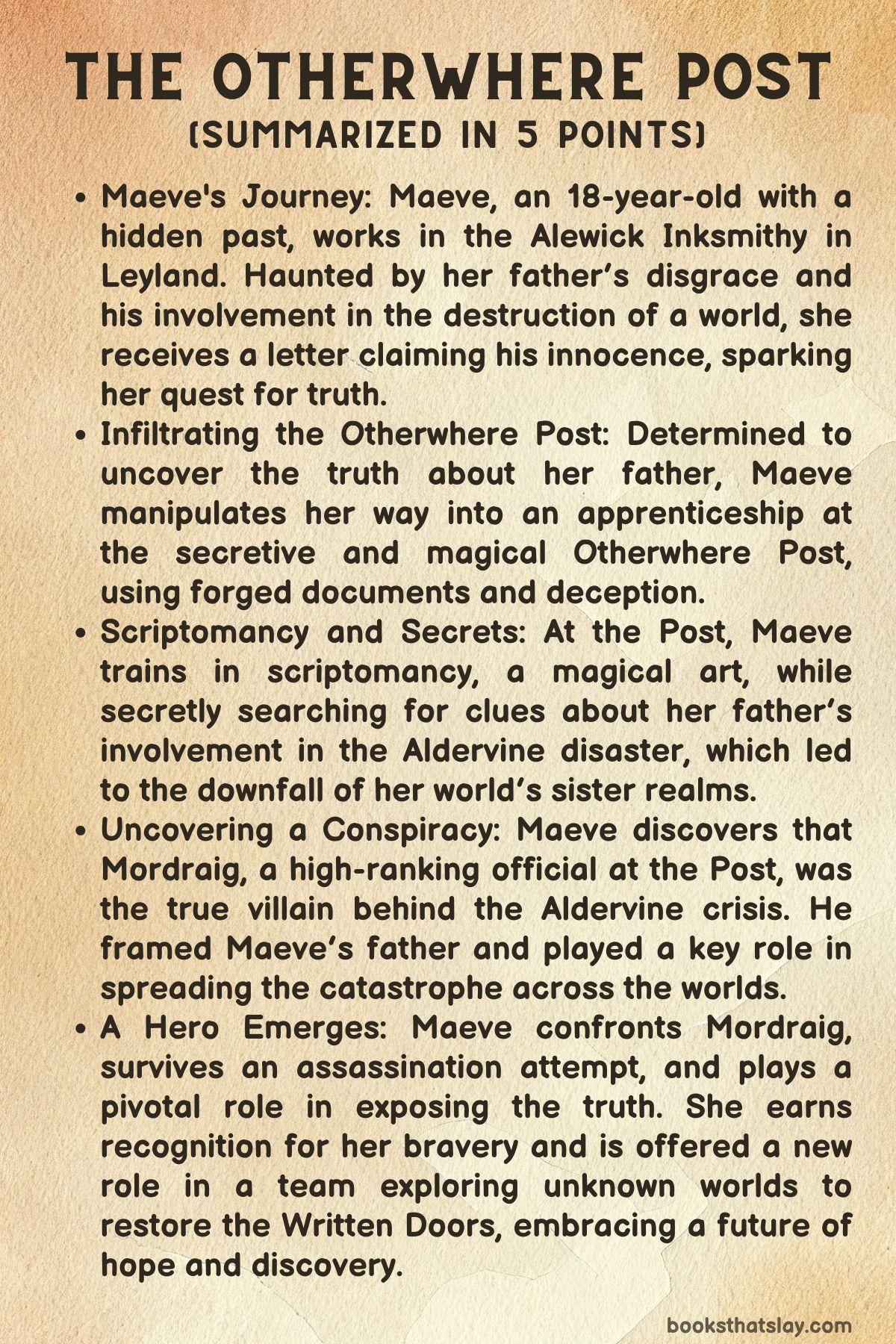
Summary
Maeve Abenthy survives by staying small and staying hidden. In Gloam, Leyland, she works under the name Isla at the Alewick Inksmithy, saving every coin for a one-way escape to the southern coast.
Her mother died when Maeve was a baby. Her father, Jonathan Abenthy, is remembered as a brutal killer blamed for a catastrophe that destroyed another world.
Maeve carries two relics of the life she lost: an old love letter her mother once wrote to her father, and the fear that if anyone connects Maeve to Jonathan, she will be dragged into punishment meant for him.
On a storm-wrecked evening, a stranger stops Maeve in the street and hands her a sealed envelope stamped with the pigeon emblem of the Otherwhere Post. The mail should not be able to find her—no one should even know she is alive.
Inside is a letter addressed to “Maeve,” insisting the writer knew her father and that Jonathan confessed a secret before he died: he was innocent. The message orders Maeve to meet at a specific place and date, but Maeve notices something worse—its postmark is seven years old, sent months after the Written Doors burned.
That same disaster sealed off Inverly forever and left only couriers of the Otherwhere Post able to cross between worlds using rare training in scriptomancy.
Maeve cannot ignore the claim of her father’s innocence. If it is true, then everything she has built her life around—shame, fear, flight—was based on a lie.
She tries to trace the anonymous letter by questioning an otherwhere courier in town, but he refuses. Desperate, Maeve does something reckless: she pelts him with a bar of soap to force him to stop, then pretends she was only a witness.
The courier vanishes through a courier-only black door, leaving Maeve with one clear conclusion: if she wants answers, she needs access to the Post itself.
She finds a notice about the courier apprenticeship examination, only days away. Passing means immediate transport to the Otherwhere Post for a year of instruction.
Maeve returns her train ticket south, buys modest clothes, forges credentials, and takes her chance. At the exam hall, constables check documents, and Maeve learns applicants must also have official transcripts.
Cornered, she spots a wealthy red-haired candidate, Eilidh Hill, who resembles her enough to copy. Maeve stages a convincing deception, frightening Eilidh into believing she has been disqualified, then steals her folio and papers.
In a moment of guilt, Maeve gives Eilidh all her remaining money so she can get home—an act that leaves Maeve with almost nothing but the stolen identity.
When the selected candidates are transported, Maeve is nearly trampled by a black horse in the fog and hits her head. The driver is the same courier she assaulted with soap.
He recognizes her immediately. His name is Tristan, and he is sharp, irritated, and impossible to fool for long.
Still, he checks her injury, reads her stolen paperwork, and—after noticing instructor notes Maeve never saw—decides to take her to the Post anyway. Inside the carriage, wedged among crates of letters, Maeve is handed a required text called “The Scriptomancer’s Companion,” a reminder that she has stepped into a system with its own rules and punishments.
At the Otherwhere Post, Maeve is brought before the stewards who govern the institution. Steward Eamon Mordraig, a severe man with a black cane, admits her as an apprentice.
Before any training begins, Maeve must read a “memory-scribed” warning sealed in an envelope. The moment she opens it, the hall dissolves and she is forced to experience the day Inverly fell from another person’s body.
She sees the Aldervine—a lethal green growth—spreading through Blackcaster Station, pricking victims into a nightmare sleep where they waste away while still alive. She also relives the moment her great-aunt Agatha saved young Maeve by shoving her out of a charging horse’s path, dying instantly.
Maeve sees herself carried away by an unknown scriptomancer she cannot identify. When the memory ends, Maeve collapses, shaken and bleeding, and learns the account belonged to Postmaster Onrich Byrne, the last man to escape Inverly alive.
Maeve is assigned to meet Byrne at once. In his freezing office, she watches Tristan clash with him in a tense exchange that reveals their relationship: Byrne is Tristan’s father.
Byrne questions Maeve—introduced as Eilidh Hill—and despite Tristan’s objections, assigns Tristan as Maeve’s mentor, forcing him into closer involvement with both the apprenticeship program and Maeve’s lies. Afterward, Tristan confronts Maeve in private at a grim landmark called the abyss, once used for executions.
He tells her he knows she is an impostor and that Byrne will destroy her if he discovers the fraud. Maeve admits she came because of an anonymous letter tied to her father.
Tristan demands proof she belongs in the Post, so Maeve writes in Old Leylish runes with practiced skill. Tristan, impressed and intrigued, agrees to cover for her—so long as she does not bring danger down on him.
Their forced partnership turns messy fast. In a tower tied to Molly Blackcaster, founder of scriptomancy and creator of the Written Doors, Tristan shows Maeve an arcthiometer that reveals currents of arcane magic in the air.
Strange ink-staining creatures called drear moths flit through the shadows. Maeve’s guarded world tilts again when another blank envelope slips from her bag.
Tristan tears it open despite her panic, and instead of a threat it contains a stolen love letter enhanced with sense scribing that makes the reader feel the writer’s desire. The compulsion hits both Maeve and Tristan hard, pushing them into intimate contact they neither chose.
Maeve breaks it off before they go too far, humiliated and furious at the violation. Tristan steadies her and lets her sleep, but the incident leaves a charged unease between them—part distrust, part curiosity, part something neither wants to name.
Before dawn, Maeve steals Tristan’s ring of keys and sneaks into restricted records, hunting anything linked to Jonathan Abenthy. She finds an incident report from the year the Doors burned: her father’s name, and his roommate—Fion Claryman.
Maeve tears out the page and flees into a forbidden room, where she discovers a contained Aldervine specimen preserved by Molly Blackcaster. Contact with the room triggers buried memories: the man who carried her from the station smelled like her father and wore a crematory ash satchel, confirming her rescuer was connected to scriptomancy.
An archivist named Sibilla catches Maeve and orders her to deny she was ever there.
Soon after, Maeve’s secret starts hurting other people. An Oxblood letter—an ink-weaponized threat—attacks her roommate Nan, forming an ink arm that chokes her.
Maeve uses crematory ash to dissolve it, realizing someone is warning her to leave and is willing to injure innocents to force it. Terrified, Maeve disappears from the Post for two weeks to chase Claryman, learning he is now a professor in Barrow.
When she finally corners him during a reception, Claryman pulls a knife on her, suspecting a trap. Maeve proves who she is—the child he saved from the chaos—and he relents.
Claryman confirms Jonathan could not have released the Aldervine on the day Inverly fell. Jonathan was with him at lunch.
Jonathan had been working on a secret “Silver Scribing,” based on old journals, intended to make scriptomancy safe without crematory ash. After the disaster, officials searched their room for Jonathan’s rose-covered journal.
Claryman tried to defend Jonathan with written notes, but they vanished overnight and were replaced by a threatening letter that forced him into silence and exile. He gives Maeve a sealed memory scribing and reveals the most damning detail: Jonathan was murdered, his throat slit, then framed as the culprit.
Claryman also admits he hid Jonathan’s rose journal somewhere in the Second Library, warning Maeve not to expose him.
Maeve returns to the Post still hiding what she learned, but Tristan senses the danger closing. She finally gives him one truth—her real first name, Maeve—and the way he repeats it tells her it matters more than she expected.
When constables tighten surveillance, Maeve and Tristan decide to go to the Second Library to confront Sibilla and retrieve the hidden journal. Tristan brings scribed books he has created—dangerous manifestations written into pages—and gives Maeve crematory ash for protection.
At the library, the plan collapses into chaos. Officers flood the building.
Tristan triggers a monstrous ink construct as a diversion, then uses another scribed book to trap pursuing officers in living ink. Maeve runs alone to find Sibilla, finally forcing answers about her father.
Sibilla confesses she knew Maeve’s mother, Aoife, and that she helped Jonathan access restricted archives in grief. She admits the Silver Scribing worked—but it was forbidden, written onto skin.
Before she can say more, the Aldervine attacks and kills Sibilla in front of Maeve, spreading through shelves and threatening to escape the building.
Maeve discovers the Aldervine specimen case has been shattered and the vine is loose. She realizes Sibilla wasn’t the villain—her hands show no ink stains, no signs of being a scriptomancer capable of Oxblood letters or such a release.
Outside the library’s glass doors, officials gather, including Nan, stewards, and Byrne. Maeve refuses to open the door because the vine is testing the seams.
Then she sees a tendril worming through a gap, as if someone planned to blame her for unleashing it. In a desperate move, Maeve grabs the vine with her bare hand and rips it free.
The vine recoils, and the infestation withdraws, but Maeve collapses into Aldervine sleep, her palm marked by punctures oozing green and blood.
Maeve wakes days later under guard, weak and aching, held while officials decide whether she is criminal or scapegoat. Tristan stays close, furious at the treatment she’s receiving.
Maeve begins to piece together what happened and realizes the vine reacted when it touched the ash on her skin. She calls for Steward Mordraig, hoping the stewards will listen.
In Mordraig’s rooms, Maeve finds clues that don’t fit—herbal-scented ink from a drear moth matching the stain on her palm, suggesting the Aldervine is not a plant at all but a form scribing made real.
Then the truth snaps into place. Maeve finds Mordraig’s cane broken, a bottle labeled Oxblood ink, and the corpse of Fion Claryman hidden away.
Mordraig appears and admits everything. He engineered the disaster years ago: Molly Blackcaster created the Aldervine specimen to study it and built the Written Doors to control movement and prevent infestation, making crematory ash the only reliable defense.
Mordraig hated what the Doors represented and wanted power restored to the College and the Post. He used Jonathan’s Silver Scribing to protect himself while releasing a piece of Aldervine to spark panic and destroy the Doors.
When Jonathan survived too long and threatened the plan, Mordraig murdered him and framed him. He intended Maeve to be blamed too.
Mordraig drugs Maeve and tries to stage her death as an escape by throwing her from a window. Maeve survives, aided by coffee scribings that keep her awake and resist the poison.
Letters arrive as she recovers in hospital: Mordraig is arrested, evidence ties him to Oxblood ink, and the Postmaster confirms a diary found among Mordraig’s belongings proves the Aldervine is advanced form scribing. Cornered, Mordraig confesses, including how he lined the library’s exterior with ash to ensure Maeve would be blamed.
Sixteen weeks pass. Maeve heals slowly from broken bones and Aldervine damage, sustained by coffee scribings.
She receives her father’s journals and her mother’s letters, finally holding proof that Jonathan Abenthy was not the monster history named. Across the worlds, hope rises: with the Silver Scribing, officials can plan ways to reclaim Inverly and repair what was lost.
Tristan returns through a courier door to bring Maeve back to the Post. Byrne offers Maeve a place as an otherwhere courier and proposes a new division meant to travel beyond the known worlds to gather what’s needed to restore the Written Doors.
Maeve accepts, and Byrne gives her a courier key.
In the courtyard, a new statue stands beside Molly Blackcaster’s fountain: Jonathan Abenthy in a courier cloak, the Silver Scribing visible on his forearms, honoring his name at last. Later, Tristan reveals he has successfully written the Silver Scribing onto himself using ink mixed with crematory ash, proving he can withstand what once destroyed worlds.
He asks Maeve to sit and roll up her sleeve—inviting her into a future where she no longer has to run, where she can carry her name openly, and where the next letters they deliver may lead to doors no one has ever seen.
Characters
Maeve Abenthy
Maeve Abenthy is the story’s emotional and moral center: a young woman shaped by secrecy, grief, and a stubborn instinct to survive. She lives under an alias because her father’s public reputation as a murderer has made her identity feel like a death sentence, and that fear governs nearly every decision she makes—from how she earns money to how she speaks, where she walks, and what truths she dares to share.
Yet Maeve is not merely running; she is also carrying. The brittle love letter from her mother becomes a private anchor, proof that tenderness once existed in her family and a reminder that she is not defined by the horror attached to her surname.
Her defining contradiction is that she distrusts institutions and authority, yet she is drawn into the heart of the most powerful institution in her world because it is the only place with the access she needs. That tension fuels her boldest choices: impersonating another girl, forging a path into the Otherwhere Post, stealing keys, tearing pages from records, and repeatedly risking exposure.
Importantly, Maeve’s competence is not flashy heroism but hard-earned skill—her literacy in Old Leylish runes, her careful handwriting, her ability to read people and improvise under pressure. Even when she makes morally thorny choices, the narrative frames them as survival strategies born from long practice in scarcity and fear.
Over time, Maeve’s arc shifts from self-protection to purposeful action: she begins by trying to escape Gloam and ends by accepting a courier key and a future that involves rebuilding what was lost. Her body becomes a battleground—Aldervine poison, near-permanent ink marks, shattered bones—yet she repeatedly proves she can endure and still choose hope.
By the end, Maeve embodies reclamation: of her name, her father’s truth, and her own right to belong in the world that once tried to erase her.
Tristan Byrne
Tristan begins as an obstacle—an annoyed courier with sharp instincts—but quickly reveals himself as one of the book’s most layered figures, defined by proximity to power and quiet rebellion against it. As Postmaster Byrne’s son, Tristan is trapped in a role he did not design: he is expected to obey, represent the Post, and submit to institutional priorities even when they conflict with his conscience.
That pressure shows up as cynicism, irritability, and a defensive wit that keeps people at distance, but underneath is a person starving for agency. Tristan’s relationship with scriptomancy is especially revealing: he resists scribing beyond basic work, suggesting trauma or guilt tied to what happened “last year,” yet he also cannot stop himself from experimenting, building safeguards, and eventually mastering the Silver Scribing.
This contradiction makes him compelling—he is both fearful of what the system can do and fascinated by what writing can create. His bond with Maeve evolves from suspicion to protectiveness to intimacy, and what makes it believable is that it is rooted in recognition: he sees her as someone else living under threat, and she sees in him someone who has access yet feels imprisoned.
Their forced encounter with the sense-scribed love letter is significant not because of the heat of the moment, but because it exposes how desire and vulnerability can be weaponized through writing—something Tristan understands too well. Tristan’s protectiveness often comes out sideways—anger, blocking doors, demanding truth—but it is still protection, especially when he diverts his father’s attention and later risks himself inside the Second Library.
By the end, Tristan’s decision to write the Silver Scribing onto his own body is both defiance and devotion: defiance of the Post’s monopolies and secrets, and devotion to a future where Maeve is not powerless again. He becomes the person who chooses to turn inherited authority into earned responsibility.
Postmaster Onrich Byrne
Onrich Byrne embodies institutional coldness, but he is not a simple villain; he is a man who has survived catastrophe by hardening into function. As Postmaster, he represents the state’s grip on communication, travel, and knowledge, and his office—freezing, foul-smelling, and emotionally hostile—mirrors the environment he cultivates: control, discomfort, compliance.
His leadership style depends on intimidation and leverage, whether he is scolding Tristan, questioning Maeve’s background, or collaborating with ministers who treat the Post as a strategic resource. Yet Byrne’s complexity shows in the way he balances secrecy with pragmatism.
He assigns Tristan as Maeve’s mentor not out of kindness but because he sees usefulness and risk management; he wants her close, monitored, and productive. At the same time, Byrne is not blind to truth.
After Mordraig’s exposure, Byrne’s letters demonstrate an ability to act on evidence and shift policy, and his later invitation to Maeve and Tristan signals a leader willing to reshape the institution when the old story collapses. What makes Byrne interesting is that his morality is institutional rather than personal: he cares about outcomes, stability, and control more than individual suffering, yet he can be pushed toward accountability when the facts become undeniable.
He is the embodiment of a system that can adapt—but only after it is forced.
Steward Eamon Mordraig
Eamon Mordraig is the narrative’s architect of betrayal, a character whose menace lies in patience, intellect, and ideology rather than brute violence. Initially, he appears as a stern steward running an apprenticeship program, someone who speaks in the language of warnings and tradition.
That mask works because it aligns with the Post’s culture: secrecy, rules, and controlled knowledge. Mordraig’s true nature, however, is revealed as a form of fanaticism—an obsession with scriptomancy’s place in the world and resentment toward the Written Doors for changing the College’s power and relevance.
His crimes are not impulsive; they are strategic, committed in service of a belief that the ends justify any cruelty. The Aldervine catastrophe is his manufactured apocalypse, designed to create panic, destroy the Doors, and rewrite the future in a way that restores his preferred order.
The intimacy of his betrayal is especially brutal: he cultivated Jonathan Abenthy’s trust, learned about the Silver Scribing, and then murdered and framed him when it became convenient. That choice turns grief into a weapon, not only against Jonathan but against Maeve, whom Mordraig expects to be the perfect scapegoat.
Even when cornered, his confidence does not crack; he simply escalates, drugging Maeve, staging narratives, and attempting to kill her in a way that preserves his control over the story. Mordraig represents the darkest side of scholarship: knowledge divorced from empathy, ambition disguised as duty, and the willingness to turn the world into collateral for a theory.
Sibilla
Sibilla is a tragic figure—an archivist whose devotion to knowledge and love pulls her into a web she cannot survive. She initially functions as a gatekeeper of secrets, appearing at the moment Maeve trespasses into restricted space and forcing her into silence, which makes Sibilla seem complicit or threatening.
Later, her confession reframes her as someone driven by loyalty and grief: she loved Aoife, cared about Jonathan after Aoife’s death, and believed the archives could provide answers or safety. Her role in the Silver Scribing’s history is morally complicated because she did help Jonathan access forbidden materials, but her motivation is not domination; it is care, fascination, and perhaps the longing to be part of something meaningful in a world that is shrinking.
Sibilla’s death is one of the book’s sharpest turns because it functions like a verdict—someone who knows too much is removed before she can fully control the narrative. The details that follow, especially the realization that her hands show no signs of scriptomancy labor, are crucial because they strip her of villain status and expose how easily suspicion can attach to women on the margins of power.
Sibilla’s tragedy is that she was close enough to truth to be dangerous, but never powerful enough to be protected.
Nan
Nan is Maeve’s closest human tether to ordinary life and a reminder of what Maeve risks destroying when danger follows her. She is practical, loyal, and emotionally perceptive, providing Maeve a fragile sense of home even while Maeve keeps essential truths hidden.
Nan’s importance grows when the threat becomes literal: the Oxblood letter’s ink-arm attack on her body proves that Maeve’s problems are not contained within her own skin. That moment forces Maeve into one of her most painful choices—leaving to protect someone she loves—showing that Maeve’s capacity for care is as strong as her instinct for survival.
Nan is also quietly brave; she continues to communicate, to act, and later to help shape public narrative by ensuring Maeve’s article runs with recognition of what she did. In a world where institutions distort truth, Nan becomes part of the counterforce: the ordinary person who helps the real story survive.
Shea
Shea functions as a disciplined, hard-edged presence aligned with authority, but her actions suggest a more complicated loyalty than simple obedience. She appears in moments of surveillance and enforcement, connected to constabulary pressure and the tightening net around Maeve.
Yet Shea also becomes an intermediary who communicates crucial information and moves within the system in a way that can either end Maeve or save her. Her involvement in the diversion inside the Second Library highlights her competence and willingness to follow a risky plan, even when the situation is unstable and dangerous.
Shea’s character reads as someone trained to distrust chaos, but forced into a reality where the official story is repeatedly proven wrong. Whether she fully sympathizes with Maeve or simply responds to evidence, Shea represents the possibility that even people inside enforcement structures can shift when confronted with undeniable wrongdoing.
Mr. Braithwaite
Mr. Braithwaite, owner of the Alewick Inksmithy, is a small but resonant character who shows how grief and loneliness shape the ordinary world outside the Post. Strict and rigid, he initially seems like another figure of constraint in Maeve’s life, but his strictness is intertwined with loss—his continued mourning for Una hardens him into routine, rules, and emotional distance.
His conversation about Una’s presence in Inverly on the day it was destroyed also makes him an inadvertent bridge into Maeve’s buried past, proving how trauma echoes through unrelated lives. Braithwaite’s role underscores one of the story’s quiet truths: catastrophe is communal, and people carry it in different forms—some in fear, some in obsession, some in small rituals that keep them upright.
Una Braithwaite
Una is absent in the present timeline but present as a haunting influence, representing the many lives touched by Inverly’s destruction. Her connection to that day gives weight to Braithwaite’s grief and helps establish the scale of loss across Leyland.
She becomes part of the book’s atmosphere of mourning: the idea that even those who were not at the center of the disaster still live with its aftermath as a daily ache.
Jonathan Abenthy
Jonathan Abenthy is the story’s most important “absent” character: a man who exists in rumor, in fear, and in the scattered remains of what he wrote and meant. Publicly, he is remembered as a twisted murderer who caused disaster; privately, through Maeve’s eyes and later through evidence, he becomes something else—grieving, determined, and dangerously close to a truth others wanted buried.
His work on the Silver Scribing positions him as both innovator and threat: someone attempting to make scriptomancy safer, more ethical, and less dependent on crematory ash, which would shift power structures and undermine the Post’s control. Jonathan’s death, staged as guilt, is the core injustice Maeve is trying to correct, and the revelation that he was murdered because he knew too much reframes him as a victim of institutional sabotage rather than a monster.
For Maeve, Jonathan is also deeply personal: she fears his legacy but also longs for him to be innocent because that would return her own life to possibility. By the end, his posthumous restoration—his statue, his journals returned, the Silver Scribing visible—shows that truth can be delayed but not permanently erased.
Aoife
Aoife, Maeve’s mother, appears through memory and the love letters that Maeve carries, and those fragments are powerful precisely because they contrast with the world’s cruelty. Aoife represents softness, intimacy, and a version of Maeve’s inheritance untouched by scandal.
Her friendship with Sibilla and her request that Sibilla check on Jonathan after her death show that Aoife’s care extended beyond her own life, and that she understood the fragility of the people she loved. Aoife’s letters are not only sentimental artifacts; they are Maeve’s proof that love can be real even when history becomes violent, and that identity can hold more than one story.
Agatha
Agatha, Maeve’s great-aunt, appears most vividly in the memory scribing and functions as a symbol of protective love interrupted by catastrophe. Her death—sudden, brutal, and witnessed through the helplessness of memory—marks a foundational trauma for Maeve and crystallizes the horror of that day.
Agatha’s final act, shoving the child Maeve out of harm’s way, makes her a figure of sacrifice, the kind of ordinary hero the world rarely records. She is one of the reasons Maeve’s survival feels weighted with obligation and guilt: Maeve lives because someone else absorbed the blow.
Fion Claryman
Fion Claryman is a crucial truth-bearer whose fear shows how thoroughly the Post and its allies can silence dissent. As Jonathan’s former roommate, he is positioned close enough to the origin of the accusations to dismantle them, but he has been kept in a long exile by threats and coercion.
His initial hostility—knife to Maeve’s throat—reads not as cruelty but as survival paranoia built over years of being hunted by invisible forces. Once Maeve proves who she is, Fion becomes careful, almost clinical, offering testimony that reorders the entire moral landscape: Jonathan had an alibi, Jonathan was searching for Maeve, Jonathan was murdered, and the evidence was manipulated.
Fion’s choice to hide the rose journal rather than expose it immediately reveals how terror reshapes ethics; he preserves truth but cannot safely release it. His death later, discovered in the steward’s domain, confirms the stakes of knowledge in this world: if you hold proof, you become disposable.
Steward Tallowmeade
Tallowmeade is a vivid example of institutional strangeness and the eerie intimacy stewards have with ink, tools, and ritual. His physical presentation—inkpots worn like ornaments—makes him feel like a living extension of the Post’s machinery, someone who has surrendered personal identity to craft and duty.
While not the primary antagonist, he operates as part of the structure that normalizes secrecy and controlled access, and his presence in high-tension scenes reinforces the sense that the Post is always watching. He also becomes part of the apparatus that responds after disaster, which complicates him: he is an instrument of the system, but not necessarily its mastermind.
Eilidh Hill
Eilidh Hill is both person and symbol: an individual young woman caught in a rigged system and a mirror reflecting Maeve’s hunger for escape. She is wealthy enough to access preparation and presentation, yet vulnerable enough to be manipulated by a confident lie at exactly the wrong moment.
Her resemblance to Maeve is not just convenient; it highlights how identity can be swapped in a society where paperwork, class, and surface impressions matter more than truth. Eilidh’s brief interaction with Maeve also exposes Maeve’s conscience: even while stealing Eilidh’s place, Maeve gives her money so she can get home, suggesting Maeve is not comfortable with cruelty even when desperate.
Eilidh represents the moral cost of infiltration and the structural inequities that make Maeve’s fraud feel like the only available door.
Mrs. Findlay
Mrs. Findlay plays a small but telling role as a figure of ordinary community surveillance—the kind that can be harmless gossip or lethal exposure depending on who is being watched. Her noticing Maeve and Maeve’s quick purchase of shaving lather show how carefully Maeve must manage suspicion in everyday spaces.
Characters like Mrs. Findlay illustrate that fear is not only enforced by officials; it also lives in neighbors, shopkeepers, and casual attention.
Molly Blackcaster
Molly Blackcaster is a mythic presence woven into architecture, tools, and ideology, functioning almost like a patron saint of scriptomancy whose legacy is contested. As founder of scriptomancy and creator of the Written Doors, she represents the possibility of immense creation through writing, but her work also carries unintended consequences—drear moths, magical residue that still feeds on arcane currents, and the existence of the Aldervine specimen she contained.
Different characters invoke Molly to justify conflicting visions: reverence for tradition, fear of what she unleashed, resentment that her Doors reshaped the world. Her legacy becomes the battleground for the future, because the question is not only what Molly made, but who gets to control what comes next.
Cathriona
Cathriona is referenced through the confiscated journal and through the weight of what that journal implies: that writing can hold dangerous truths and that institutions will seize narrative control when threatened. Even without extensive on-page presence, Cathriona’s journal functions as a pressure point between Maeve and Tristan—something Maeve needs and something Tristan’s father controls.
Cathriona represents the vulnerability of private knowledge in a world where the Post claims ownership over stories.
Themes
The Struggle for Identity and Legacy
One of the primary themes in The Otherwhere Post is the exploration of identity, particularly in relation to Maeve’s past and her family’s tarnished legacy. Maeve’s life is overshadowed by the disgrace of her father, who was wrongfully accused of a crime.
This legacy haunts Maeve, and much of her journey revolves around reclaiming her father’s innocence and discovering who she truly is. Her decision to enter the Otherwhere Post as an apprentice, under an assumed identity, showcases her desperate need to distance herself from the shadows of her past.
This theme delves into the complexities of self-discovery, the pressure of inherited legacies, and the desire to define one’s own path despite societal judgment.
Power and Control Within Hidden Systems
The novel presents a deep investigation into hidden systems of power, particularly through the lens of the Otherwhere Post. This institution holds immense influence over multiple worlds, yet it is shrouded in secrecy and bureaucratic control.
As Maeve navigates the Post, she discovers the intricate layers of political and magical power that govern its operations. The role of scriptomancy and the mysterious nature of the Written Doors symbolize control, both literal and figurative, over various realities.
This theme also touches on how power is maintained and manipulated by those in positions of authority, such as the Postmaster and Steward Mordraig. Their dark secrets reveal the extent to which individuals can go to protect or corrupt the systems they control.
The interplay of trust, betrayal, and the pursuit of truth is central to this theme.
The Intersection of Magic and Technology
Another compelling theme in The Otherwhere Post is the relationship between magic and technology, represented through the practice of scriptomancy and the creation of the Written Doors. The magic in this world is not portrayed as purely fantastical; rather, it operates alongside technology, creating a system that bridges the two.
Scriptomancy, the magical art of manipulating written symbols to alter reality, suggests a deep connection between knowledge, language, and power. The creation and destruction of the Written Doors further illustrate this theme, as they represent both the potential for connectivity between worlds and the devastating consequences of uncontrolled power.
Maeve’s journey to understand and manipulate this magical technology reveals the fine line between mastery and destruction. It also brings attention to the ethical implications of using such power.
The Burden of Truth and Consequences
Throughout the novel, the theme of truth and its consequences weighs heavily on Maeve. Her quest to uncover her father’s innocence forces her to confront uncomfortable truths, not only about the world around her but also about herself.
The truth is a double-edged sword—while it can bring justice and clarity, it also carries immense personal risk. Maeve’s investigation into the true cause of the Aldervine disaster leads her to uncover betrayals that could destroy everything she has fought for.
This theme explores how the pursuit of truth is often fraught with danger and sacrifice. Uncovering hidden secrets can have far-reaching consequences, both for the individual and for society at large.
Revolution and the Rebuilding of Worlds
The theme of revolution—both personal and societal—emerges as Maeve moves from uncovering the truth about her father to becoming an active participant in reshaping the future of the Post. Her journey mirrors a larger narrative of societal change, as the exposure of Mordraig’s corruption signals the need for reform within the institution.
The new initiative to combat Aldervine through Silver Scribing reflects an attempt to heal and rebuild after years of deceit and destruction. This theme is not limited to the political or institutional level but extends to Maeve’s own personal growth.
Her ability to open doors to new worlds represents the possibility of new beginnings, not just for her but for the fate of the worlds connected by the Post. The theme of revolution, therefore, encompasses both the internal transformation of Maeve and the external societal shifts that she helps catalyze.