The Pumpkin Bride Summary, Characters and Themes
The Pumpkin Bride by Fiona Buttercup is a fantasy romance that combines fairy-tale magic, second-chance love, royal conspiracies, and the charm of an autumn countryside.
The novel follows Sir Bram Duncan, a knight transformed into an orc through a cruel magical curse, and Princess Marigold Ashford, the woman who believes he died years earlier. When Marigold escapes an unwanted royal marriage and unexpectedly finds shelter on Bram’s pumpkin farm, their lives become connected once again. Through their developing relationship, the story explores love beyond physical appearances, the importance of personal freedom, the consequences of pride, and the courage required to choose happiness.
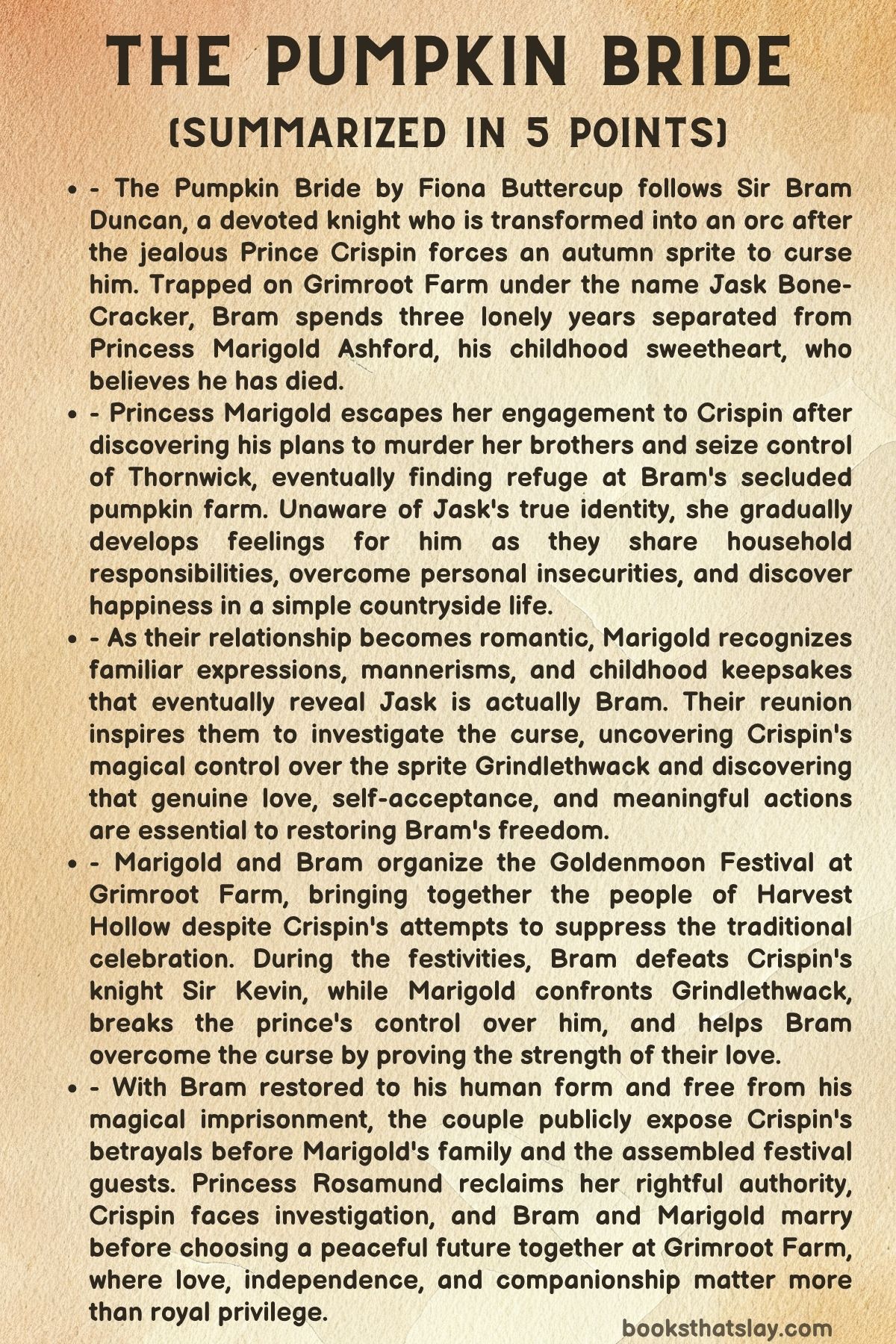
Summary
Sir Bram Duncan is a respected knight serving Prince Crispin of Harvest Hollow, but his greatest ambition is to marry Princess Marigold Ashford of Thornwick, his childhood sweetheart. Despite their deep affection, Bram believes his modest background makes him an unsuitable husband for a princess, and he hopes that acquiring wealth and noble status will finally make him worthy of her.
His opportunity appears when Crispin sends him into Windfall Woods to find the legendary Lantern Oak, an enchanted tree that produces valuable golden acorns. The prince promises Bram a noble title if he succeeds, convincing the knight to undertake the dangerous mission despite his longstanding distrust of magic.
Bram’s fears originate from his childhood, when a wish made at the Whispering Well was followed by the mysterious disappearance of his parents. Nevertheless, he climbs the Lantern Oak, gathers the golden acorns, and correctly answers a riddle posed by an autumn sprite.
Instead of rewarding Bram, Crispin reveals his jealousy of the knight’s popularity, achievements, and attractiveness. Using his secret control over the sprite, the prince orders Bram to be transformed into an enormous green-skinned orc, even though the knight has committed no wrongdoing.
The curse forces Bram to remain within the boundaries of Grimroot Farm and prevents him from revealing his true identity without supposedly causing another person’s death. Crispin steals his locket containing Marigold’s portrait and arranges for everyone to believe that Sir Bram Duncan has died.
Three years pass, during which Bram lives under the name Jask Bone-Cracker, cultivating pumpkins and maintaining his isolated farm. His frightening appearance discourages visitors, leaving the traveling carter Alfred among the few people willing to maintain regular contact with him.
Meanwhile, Marigold has endured years of mourning while gradually becoming engaged to Prince Crispin. She initially accepts the proposed marriage because Thornwick requires political, military, and financial assistance, but her growing familiarity with Crispin exposes his selfishness and cruelty.
Her situation becomes intolerable when she overhears him plotting to murder her brothers, Rowan and Beckett, imprison her in Scarlet Spire, and seize control of Thornwick’s valuable mineral resources. Recognizing that the marriage threatens her entire family, she secretly warns Rowan and escapes Brambleton Castle.
Marigold possesses a magical ability called minimancy, which allows her to shrink objects and living creatures. She uses this power to conceal her belongings and her cat, Fuzzle, before entering Windfall Woods disguised as an ordinary traveler.
After spending the night in the forest, Marigold awakens to the sounds of Crispin’s hunting dogs approaching. Desperate to escape capture, she discovers a secluded pumpkin farm and seeks refuge in its cottage, never imagining that its intimidating orc inhabitant is actually Bram.
Bram recognizes Marigold immediately and is overcome by the impossible return of the woman he still loves. However, his curse makes revealing himself dangerous, and he initially attempts to send her away rather than risk her life.
When Crispin arrives with armed knights, Bram conceals Marigold’s presence and provides a misleading explanation for the scent his hunting dogs have followed. Marigold uses minimancy to shrink herself and hide from the soldiers, surviving their destructive search of the cottage.
Although Bram insists that she should leave, Marigold refuses to abandon someone who has risked his safety to protect her. She begins repairing the damage caused by Crispin’s soldiers and offers to help with everyday responsibilities around the farm.
Their arrangement gradually becomes a source of comfort for both characters. Marigold discovers that the apparently fearsome Jask is intelligent, considerate, talented, and unusually sensitive, while Bram finds himself enjoying the companionship he has been denied for three years.
When Bram injures his hand while repairing a fence, Marigold uses her medical knowledge to treat the wound. She insists on remaining until he recovers, giving them additional time to become acquainted under circumstances very different from their former royal lives.
Bram teaches Marigold to cook, care for animals, and perform agricultural work, while she introduces useful applications of her minimancy. Their developing partnership transforms Grimroot Farm from a place of solitary survival into a home filled with conversation, cooperation, and growing affection.
During their conversations, Marigold speaks openly about losing Bram and the devastation she experienced after receiving news of his supposed death. Bram listens helplessly, understanding for the first time how his disappearance affected her and regretting the pride that originally drove him away from Thornwick.
Marigold also explains that she never considered his humble origins an obstacle to their marriage. Her words force Bram to recognize that his determination to earn wealth and status arose from his own insecurities rather than from any demand she placed upon him.
As their closeness increases, Marigold notices unsettling similarities between Jask and Bram, including familiar expressions, mannerisms, and gestures. Nevertheless, she dismisses her suspicions, believing that grief has caused her to search for traces of her lost sweetheart in another man.
Their peaceful existence is threatened when a supernatural creature called a Leshy disguises itself as Rowan and attacks Marigold. Bram rescues her, reinforcing her trust in him and exposing the dangers still surrounding the farm.
Later, a violent thunderstorm triggers Marigold’s childhood fear of lightning, and Bram comforts her with the familiarity of someone who has known her for years. Their embrace leads to a passionate kiss, but Bram’s attempt to stop their intimacy causes an argument about personal freedom and the right to make independent decisions.
Marigold accuses him of behaving like the men who have repeatedly attempted to control her future. Her criticism reminds Bram of how his earlier decision to leave Thornwick ignored her wishes, and he begins acknowledging the damage caused by his habit of deciding what is best for others.
After a period of separation and reflection, they reconcile and become lovers. Their relationship develops into a genuine domestic partnership, although Bram’s concealed identity continues to create emotional difficulties.
Marigold eventually suggests organizing the canceled Goldenmoon Festival at Grimroot Farm, believing that ordinary families deserve their traditional celebration despite Crispin’s selfish priorities. She also hopes that welcoming visitors will help Bram overcome his isolation and establish friendships within the kingdom.
Bram reluctantly agrees, and preparations begin with assistance from Alfred and Elenor Brewster, a local tavern owner. The festival becomes an opportunity to unite the community while quietly challenging Crispin’s authority.
An important change occurs on Marigold’s birthday when she discovers a small wooden unicorn that Bram carved for her during their childhood. Recognizing the object and remembering his familiar expressions and a distinctive scar, she realizes that Jask Bone-Cracker is actually Sir Bram Duncan.
Despite the curse’s warning, Marigold survives discovering his identity, revealing that its restrictions contain a loophole. Bram finally explains Crispin’s betrayal, and the reunited lovers begin searching for a way to restore his freedom.
Marigold visits the Lantern Oak and learns that Crispin controls its sprite by knowing his true name. She also discovers that genuine love, demonstrated through actions rather than declarations, is essential to breaking Bram’s curse.
Meanwhile, Marigold develops another magical ability called trueface, which briefly reveals hidden aspects of people’s identities. When she uses it on Bram, his appearance shifts between human and orc, forcing him to confront his uncertainty about who he has become.
Rowan eventually arrives at Grimroot Farm and reunites with his sister and childhood friend. With help from Sir Coby Goodwin, he undertakes a mission to contact Princess Rosamund, Crispin’s older sister, who has been prevented from exercising her rightful authority.
The Goldenmoon Festival attracts hundreds of visitors, allowing Bram to experience acceptance and companionship after years of isolation. However, the celebration is interrupted when Sir Kevin arrives to capture Marigold, forcing Bram to defend her with his extraordinary orc strength.
Marigold escapes to the Lantern Oak, where she uses the sprite’s true name, Grindlethwack, and explains that her relationship with Bram has demonstrated patience, forgiveness, sacrifice, and unconditional acceptance. When Bram finally acknowledges that he deserves her love, the curse is broken, allowing him to choose his appearance and leave the farm.
Bram chooses to regain his human form because it connects him to memories of his parents, then proposes marriage to Marigold. She also releases Grindlethwack from Crispin’s control, refusing to exploit the magical creature’s vulnerability.
Returning to the festival, the couple publicly expose Crispin’s crimes before King Matthias, Queen Elowen, and the assembled guests. Rosamund arrives to reclaim her authority, Crispin faces investigation, and Marigold’s parents gladly approve her marriage to Bram.
The couple marries beneath a tree at Grimroot Farm, surrounded by their family, friends, and the community they have brought together. The following morning, they begin married life in the peaceful countryside, finally free to choose their future together as the season’s first snowfall covers their beloved pumpkin fields.
Characters
Sir Bram Duncan / Jask Bone-Cracker
Sir Bram Duncan is the principal male character in The Pumpkin Bride, and his transformation from an ambitious knight into an isolated orc forms the emotional foundation of the novel. His experiences examine how pride, insecurity, and social expectations can prevent people from recognizing their inherent worth.
Before his transformation, Bram is an accomplished knight who believes that proving himself through wealth, military achievements, and noble status is necessary to marry Princess Marigold. Although she never demands these accomplishments, his conviction that he is socially inferior drives him away from the relationship that matters most to him.
Bram’s determination initially appears admirable because he wants to build a secure future with the woman he loves. However, it also reveals his inability to accept that Marigold should have an equal voice in determining their future.
His transformation into an orc intensifies these insecurities by stripping away the physical appearance, reputation, and social position upon which he once depended. Forced to live as Jask Bone-Cracker, he becomes accustomed to rejection and begins associating his frightening appearance with personal unworthiness.
Nevertheless, his years at Grimroot Farm reveal qualities that his former pursuit of prestige obscured. He becomes a skilled farmer, cook, craftsman, and caretaker, developing a practical and independent existence despite the cruelty of his circumstances.
Marigold’s unexpected arrival challenges his isolation and forces him to confront emotions he has spent years suppressing. His efforts to protect her demonstrate his courage, but his repeated attempts to make decisions on her behalf reveal that his controlling tendencies have not entirely disappeared.
Their disagreements become essential to his emotional development because Marigold refuses to accept protection at the expense of autonomy. Bram gradually realizes that loving someone requires respecting their choices, even when those choices involve uncertainty or danger.
His greatest transformation occurs when he finally recognizes himself as deserving of Marigold’s affection. By accepting his worth independently of appearance and achievement, Bram breaks the emotional limitations that have sustained his suffering.
Although he ultimately chooses to regain his human body, that decision does not negate his growth as an orc. Instead, it represents his freedom to decide what identity means to him, allowing his former and present experiences to become parts of a complete life.
Princess Marigold Ashford
Princess Marigold Ashford is the central female character in The Pumpkin Bride, representing independence, emotional resilience, and the determination to protect personal freedom against political and social pressure. Her journey begins with an escape from a dangerous engagement but develops into a broader struggle to decide how she wants to live.
Marigold has spent years mourning Bram, believing that the man she loved died while serving Prince Crispin. This loss has profoundly affected her, but it has also encouraged her to develop medical knowledge, study various subjects, and become more aware of her own capabilities.
Her agreement to marry Crispin initially demonstrates her willingness to sacrifice personal happiness for the welfare of Thornwick. However, once she discovers his intentions toward her brothers, she recognizes that accepting his authority would endanger the very people she hopes to protect.
Unlike conventional princesses who depend entirely upon rescuers, Marigold actively participates in securing her survival. She uses minimancy, practical knowledge, determination, and quick thinking to escape danger and adapt to unfamiliar situations.
Her experiences at Grimroot Farm are especially important because they allow her to discover an identity separate from royal privilege. Learning to cook, care for animals, harvest produce, and complete household chores gives her a sense of achievement that court life never provided.
Marigold’s developing relationship with Jask also demonstrates her willingness to look beyond appearance and social prejudice. She recognizes his kindness, intelligence, and sensitivity long before discovering that he is Bram.
Her insistence on making her own romantic decisions becomes one of her defining qualities. She challenges Bram whenever his protective instincts become controlling, refusing to allow love to become another form of confinement.
Marigold’s magical development complements her emotional growth, particularly when she discovers trueface and begins understanding its capacity to reveal concealed identities. Her decision to free Grindlethwack rather than control him further demonstrates that her compassion extends beyond those she personally loves.
By the conclusion, Marigold has become a woman capable of defending her family, confronting political corruption, and choosing a peaceful marriage without abandoning her principles. Her happiness comes from the freedom to shape her own life rather than from fulfilling the expectations attached to her title.
Prince Crispin
Prince Crispin serves as the principal antagonist in The Pumpkin Bride, embodying jealousy, entitlement, political corruption, and the destructive desire for control. His actions create the central conflicts surrounding Bram’s transformation, Marigold’s escape, and the political instability affecting Harvest Hollow and Thornwick.
Crispin initially appears to possess the privileges associated with royal authority, but his insecurity becomes apparent through his resentment of Bram. Rather than respecting the knight’s accomplishments, he interprets Bram’s popularity and attractiveness as personal threats.
His decision to have Bram transformed into an orc demonstrates his willingness to destroy another person’s life merely to satisfy his wounded pride. By stealing Bram’s locket and circulating false information about his death, Crispin also inflicts years of suffering upon Marigold.
His proposed marriage to Marigold is motivated primarily by ambition rather than genuine affection. He intends to exploit Thornwick’s resources, eliminate her brothers, and confine her once she becomes politically inconvenient.
Crispin’s treatment of Grindlethwack further exposes his abusive relationship with power. By discovering the sprite’s true name, he converts a magical creature into an unwilling instrument of his schemes.
His cancellation of the Goldenmoon Festival reveals a similar disregard for ordinary citizens. Public traditions matter less to him than celebrations designed to glorify his own authority.
Ultimately, Crispin’s downfall occurs when the people he has manipulated begin working together. His inability to command Grindlethwack after Marigold frees the sprite illustrates the collapse of the coercive power upon which his influence depends.
Grindlethwack
Grindlethwack is the autumn sprite associated with the Lantern Oak, and his role in The Pumpkin Bride complicates the distinction between magical villainy and forced obedience. Although he performs the curse that transforms Bram, the story eventually reveals that his actions are controlled by Prince Crispin.
As a magical being, Grindlethwack possesses extraordinary powers involving transformation, enchantment, and supernatural restrictions. His playful temperament and preference for riddles initially make him seem unpredictable, but his behavior is governed by rules that even his magic cannot easily escape.
His true name is especially important because it gives Crispin the ability to force his obedience. Consequently, the sprite becomes another prisoner of the prince’s ambition, despite appearing far more powerful than the humans around him.
Grindlethwack’s interactions with Marigold reveal his capacity for humor, curiosity, and moral judgment. Her willingness to approach him thoughtfully rather than immediately demand revenge gradually changes their relationship.
He ultimately recognizes the authenticity of Bram and Marigold’s love and removes the curse once its emotional conditions have been satisfied. His decision to let Bram choose his restored appearance acknowledges that genuine freedom involves control over one’s own identity.
After Marigold releases him from Crispin’s authority, Grindlethwack becomes an ally rather than an adversary. His assistance with the wedding and his later efforts to tidy the farm demonstrate his desire to repair the harm caused by his unwilling participation in the prince’s schemes.
Prince Rowan Ashford
Prince Rowan Ashford is Marigold’s twin brother and an important supporting character in The Pumpkin Bride, representing family loyalty, political responsibility, and the value of trustworthy relationships. His involvement becomes essential once Marigold discovers that Crispin intends to murder him and Beckett.
Although Rowan initially remains away from Grimroot Farm, his communication with Marigold gives her reassurance that someone within her family understands the danger. Their coded correspondence also demonstrates the trust and familiarity developed through their shared upbringing.
When Rowan finally arrives at the farm, he initially struggles to believe that the enormous orc standing before him is his childhood friend Bram. His eventual recognition of Bram through a familiar expression from their youth restores an important connection between the knight and his former life.
Rowan’s concerns about Marigold marrying an orc reflect the pressures surrounding royal marriage traditions and succession. However, his objections arise from the practical consequences of her decision rather than from Crispin’s selfish desire for control.
His willingness to accompany Coby to contact Princess Rosamund demonstrates his courage and political judgment. By participating directly in the effort to expose Crispin, Rowan moves beyond personal protection and helps defend the stability of both kingdoms.
Sir Coby Goodwin
Sir Coby Goodwin is Bram’s former squire, now serving as a knight under Prince Crispin. His character illustrates the difficult position of someone whose professional obligations place him in the service of a ruler he increasingly distrusts.
Coby recognizes Bram despite the physical transformation and expresses regret that he could not prevent the original curse. His apology demonstrates that he has carried a sense of responsibility for events over which he possessed little control.
Unlike Crispin’s more obedient followers, Coby distinguishes loyalty to the kingdom from loyalty to an individual ruler. He remains committed to Harvest Hollow while recognizing that its prince has abused his authority.
His assistance becomes increasingly significant as the danger to Grimroot Farm grows. He agrees to monitor Sir Kevin, facilitate secret communication, and investigate the original conditions surrounding Bram’s curse.
Coby also helps establish contact with Princess Rosamund, contributing to the political developments that eventually undermine Crispin’s regency. His actions demonstrate that moral courage can require challenging authority rather than blindly obeying it.
Alfred
Alfred is the traveling carter who maintains regular contact with Bram during his years of isolation. His friendliness and willingness to trade with an orc distinguish him from the people who avoid Grimroot Farm because of Bram’s appearance.
Although Alfred initially serves a practical function by transporting pumpkins to market, he gradually becomes an important connection between the farm and the wider community. His visits bring news about Harvest Hollow, including growing dissatisfaction with Crispin’s leadership.
Alfred accepts Marigold’s assumed identity as Meg and develops an easy friendship with her. His presence contributes to the increasingly welcoming atmosphere of the cottage and provides moments of ordinary social companionship.
He also helps spread information about the Goldenmoon Festival and introduces possibilities for expanding the farm’s commercial activities. Through Alfred, the novel demonstrates how everyday kindness and practical cooperation can help overcome social isolation.
Elenor Brewster
Elenor Brewster is a tavern owner whose involvement helps connect Grimroot Farm to the commercial and social life of Harvest Hollow. She recognizes economic opportunities in the products Bram and Marigold create.
Her interest in Marigold’s cider, Crankle’s Finest, demonstrates the possibility of turning the couple’s domestic accomplishments into a source of sustainable income. She also appreciates Bram’s cooking and encourages him to recognize the commercial value of his baking skills.
Elenor’s enthusiasm for the Goldenmoon Festival establishes her as a supporter of community traditions. She assists with musicians, refreshments, and preparations, helping transform Marigold’s proposal into a successful public gathering.
Although she is not involved directly in the central romance, her practical generosity illustrates the importance of community support. She represents the ordinary citizens whose lives can improve when leaders and neighbors cooperate rather than pursue selfish interests.
Princess Rosamund
Princess Rosamund is Crispin’s older sister and the rightful royal authority whose absence has allowed him to exercise political power. Her situation reveals that Crispin’s ambition has extended beyond his treatment of Bram and Marigold.
Initially, Rosamund lives away from court at Scarlet Spire, and her withdrawal from political affairs raises suspicions about the circumstances surrounding her condition. The eventual revelation that Crispin used Grindlethwack to incapacitate her confirms that his betrayal includes members of his own family.
Rosamund becomes particularly important when Bram realizes that removing Crispin requires restoring legitimate government rather than merely exposing his personal cruelty. Her return offers a lawful alternative to his corrupt regency.
When she arrives at the Goldenmoon Festival, Rosamund immediately assumes responsibility for addressing her brother’s misconduct. Her decision to have Crispin returned to Brambleton Castle for investigation demonstrates her commitment to accountability and orderly political authority.
Sir Kevin
Sir Kevin serves as captain of the palace guard and one of Crispin’s most obedient supporters. His actions demonstrate how corrupt rulers depend upon subordinates willing to carry out questionable commands.
Kevin becomes especially threatening when he attempts to retrieve Marigold from Grimroot Farm. Rather than acknowledging her independence, he threatens to portray Bram as a monstrous kidnapper, exploiting the prejudice associated with his orc appearance.
His confrontation with Bram highlights the difference between authority exercised through intimidation and strength exercised for protection. Although Kevin attacks, Bram defeats and disarms him without taking his life.
Kevin’s defeat also becomes an important moment in Bram’s acceptance of his transformed body. The physical abilities he previously considered evidence of his misfortune allow him to protect the woman he loves.
Bastien
Bastien is a young boy who has recently moved to the cemetery near Grimroot Farm with his widowed mother, Matilda. His innocence, curiosity, and openness distinguish him from adults whose judgments are influenced by established fears and prejudices.
Marigold first encounters Bastien when his runaway hoop nearly strikes her. Her unexpected use of trueface briefly makes him appear as an adult wearing a faint crown, suggesting that her magic can reveal possibilities or hidden aspects of identity that remain unexplained.
Bastien later provides one of the most important clues in the novel when he remembers hearing the autumn sprite singing near a fairy ring. His recollection allows Marigold to discover Grindlethwack’s true name.
Although Bastien is a minor character, his accidental contribution helps free the sprite and undermine Crispin’s control. His role emphasizes that essential knowledge can come from unexpected sources, including children whom powerful adults might overlook.
Matilda
Matilda is Bastien’s widowed mother and the caretaker of the nearby cemetery. Her circumstances suggest a woman rebuilding her life while raising a child and fulfilling the responsibilities of her work.
Her interaction with Bram becomes important when he needs to communicate with Coby without leaving the magically restricted farm. Matilda agrees to deliver his message through Elenor Brewster’s tavern, providing practical assistance without demanding unnecessary explanations.
Her willingness to help illustrates the growth of Bram’s relationships beyond his earlier isolation. Alongside Bastien, she represents the ordinary neighbors whose involvement gradually transforms Grimroot Farm into part of a wider community.
Garrick Hale
Garrick Hale is the royal falconer and one of Bram’s former friends. Although his appearances are limited, his specialized skills make him an important part of the discreet communication network organized against Crispin.
Garrick trains magically guided falcons capable of carrying messages along ley lines. This ability allows Bram and Coby to establish a warning system without openly revealing their cooperation.
The falcon signal becomes especially important when Sir Kevin approaches Grimroot Farm during the Goldenmoon Festival. Garrick’s role demonstrates how friendship, professional expertise, and coordinated action can help protect individuals threatened by political abuse.
King Matthias Ashford
King Matthias is Marigold’s father and the ruler of Thornwick. His role reflects the difficult relationship between dynastic expectations, political agreements, and the personal happiness of royal children.
The proposed marriage between Marigold and Crispin initially appears connected to Thornwick’s need for military and financial assistance. However, Matthias ultimately rejects the arrangement once the prince’s intentions toward his family become known.
His acceptance of Bram demonstrates that he values his daughter’s happiness more than the social distinctions that once troubled the knight. By supporting their immediate marriage, Matthias helps remove one of the imagined barriers that originally separated the lovers.
Queen Elowen Ashford
Queen Elowen is Marigold’s mother and a figure associated with maternal support, royal authority, and concealed magical knowledge. Her most significant contribution comes when she reveals that she also possesses magic.
Elowen identifies Marigold’s newly developed ability as trueface, explaining its power to expose hidden elements of a person’s identity. This revelation helps establish that Marigold’s magical gifts are part of a broader familial inheritance.
Like Matthias, Elowen is horrified by Crispin’s schemes against their children and withdraws support for the proposed marriage. Her approval of Bram helps demonstrate that genuine parental love can accommodate choices that differ from traditional expectations.
Prince Beckett Ashford
Prince Beckett is one of Marigold’s brothers and a prospective victim of Crispin’s political conspiracy. Although he has little direct involvement in the events at Grimroot Farm, his threatened life provides a major reason for Marigold’s escape.
Crispin’s plan to eliminate Beckett and Rowan demonstrates the ruthlessness of his ambition and clarifies the stakes of his intended marriage. Beckett therefore represents the family responsibilities that prevent Marigold from treating her situation as a purely personal romantic dilemma.
His limited presence also reinforces the importance of Marigold’s willingness to act before the prince can carry out his plans.
Sir Patrick
Sir Patrick is associated with Bram and Rowan’s childhood training, and his influence survives through a familiar reprimand remembered by both men. Although he does not participate directly in the central events, this shared memory becomes important when Rowan struggles to recognize Bram.
Bram repeats one of Patrick’s expressions, allowing Rowan to identify the personality and history concealed beneath the orc’s transformed appearance. Patrick’s indirect contribution therefore reinforces the importance of shared experiences in establishing personal identity.
Brother Oswald
Brother Oswald is the religious official who agrees to conduct Bram and Marigold’s wedding during the Goldenmoon Festival. His role is brief but significant because he helps convert the couple’s long-awaited reunion into a publicly recognized marriage.
His willingness to officiate immediately allows the ceremony to occur while their families, friends, and community supporters are gathered together. The wedding represents the final transition from a relationship constrained by secrecy and political pressure to one openly celebrated by others.
Fuzzle
Fuzzle is Marigold’s beloved cat, who accompanies her when she escapes from Brambleton Castle. Marigold uses minimancy to make transporting him easier, demonstrating her attachment to him and her ability to apply magic to ordinary problems.
Fuzzle’s recognition of Bram despite his orc appearance provides an early indication that the knight’s underlying identity has survived his transformation. His instinctive familiarity contrasts with the uncertainty experienced by the human characters.
Although Fuzzle is not central to the political conflict, his behavior supports the novel’s emphasis on recognition and affection that extend beyond physical appearances.
Paloma
Paloma is one of Bram’s farm animals, a pig whose presence contributes to the warmth and occasional comedy of life at Grimroot Farm. She also becomes unexpectedly important during the confrontation with Sir Kevin.
When Kevin attacks Bram during the Goldenmoon Festival, Paloma charges the knight and helps knock him down. Her intervention assists Bram in protecting Marigold and defending the farm.
Paloma’s actions demonstrate that the ordinary world Bram has built during his imprisonment is not merely a place of confinement. It has become a home filled with relationships, routines, and unexpected sources of loyalty.
The Leshy
The Leshy is a dangerous supernatural forest creature that impersonates Rowan to deceive and abduct Marigold. Its ability to assume a familiar appearance makes it particularly threatening because it exploits her trust and longing for her brother’s arrival.
Marigold attempts to escape using minimancy, but the creature’s resistance to her power exposes the limitations of her magical abilities. Bram’s intervention saves her and reinforces the importance of their growing partnership.
Although the Leshy’s appearance is relatively brief, the encounter adds danger to the magical setting and demonstrates that not every supernatural being follows the same rules. It also foreshadows the importance of distinguishing genuine identity from deceptive appearances.
Themes
Love Beyond Physical Appearance and Social Status
Love develops as a process of recognizing another person’s character rather than judging worth through appearance, wealth, or social position. In The Pumpkin Bride, this idea becomes central to Bram and Marigold’s relationship because the circumstances that originally separated them are connected to Bram’s belief that he must become socially worthy of her.
Before his transformation, Bram measures his suitability as a husband through accomplishments, noble status, and financial security. His desire to earn these advantages makes him vulnerable to Crispin’s manipulation and ultimately leads to the magical catastrophe that separates him from Marigold.
His transformation into an orc removes the qualities he once believed defined his desirability. However, it also provides an opportunity for Marigold to develop affection for him without knowing his former identity.
Marigold’s growing love for Jask demonstrates that the same qualities she admired in Bram remain present beneath his altered appearance. His intelligence, kindness, humor, generosity, and willingness to care for others matter more to her than whether he possesses the appearance of a handsome knight.
The novel also examines the difference between being loved and believing oneself worthy of love. Even after Marigold discovers his identity, Bram fears that she secretly prefers his human body, showing how deeply rejection has affected his confidence.
The curse finally breaks when Bram accepts that he deserves her love, revealing that emotional self-acceptance is essential to his liberation. His final choice to regain his human appearance is therefore an expression of personal freedom rather than a requirement for romantic happiness.
Freedom, Autonomy, and the Right to Choose
Personal freedom influences nearly every major conflict in the novel, from Marigold’s escape from her arranged marriage to Bram’s confinement within Grimroot Farm. Both characters must confront circumstances in which powerful individuals attempt to determine their futures without their consent.
Marigold’s engagement to Crispin represents the dangers of reducing a person’s life to a political arrangement. Although she initially accepts the marriage for the benefit of Thornwick, the discovery of Crispin’s murderous intentions reveals the extreme consequences of surrendering personal authority to an untrustworthy ruler.
Her escape becomes an act of resistance against a system that prioritizes dynastic advantage over individual well-being. Nevertheless, her struggle for independence continues after reaching the farm because Bram repeatedly attempts to protect her by controlling her decisions.
These disagreements reveal that possessiveness can exist even within an affectionate relationship. Marigold insists that meaningful love requires trust and respect rather than unilateral decisions made under the assumption that one person understands another’s needs better.
Bram’s magical imprisonment presents a parallel example of restricted freedom. Although he creates a comfortable and productive life at Grimroot Farm, his inability to leave means that the property remains a prison until he can choose whether to stay.
Grindlethwack’s circumstances extend this theme beyond human relationships, since Crispin’s knowledge of his true name allows the prince to compel his obedience. Marigold’s decision to free the sprite rather than become his new master illustrates the ethical importance of respecting another being’s autonomy.
By the conclusion, the characters’ happiness depends not simply on obtaining what they desire but on gaining the freedom to make meaningful choices about their identities, relationships, and futures.
Identity, Transformation, and Self-Acceptance
Physical transformation provides the most visible expression of the novel’s exploration of identity, but the deeper changes occur within the characters’ understanding of themselves. The Pumpkin Bride examines whether identity depends upon outward appearance, social position, personal history, or the qualities that remain consistent through changing circumstances.
Bram’s transformation forces him to abandon the public identity he developed as an accomplished knight. Under the name Jask Bone-Cracker, he must learn to survive without the recognition, admiration, and opportunities that once defined his place in society.
His experiences as a farmer reveal abilities and sources of satisfaction that his former ambitions never encouraged him to appreciate. Cooking, working the land, making cider, and maintaining a peaceful household become expressions of competence and creativity rather than evidence of social failure.
However, Bram initially struggles to recognize these achievements as valuable because he remains attached to the image of the man he believes he should have become. His uncertainty intensifies when Marigold’s trueface magic reveals his human and orc forms together.
The magical effect suggests that neither appearance completely defines him, because both represent genuine experiences that have shaped his identity. Accepting this complexity becomes essential to his emotional development.
Marigold experiences a comparable transformation without undergoing the same physical curse. By leaving royal life and discovering satisfaction in agricultural work, she recognizes abilities and desires that existed beneath her identity as a princess.
Her developing magical powers reinforce this process by revealing that identity can contain possibilities not yet fully understood. Ultimately, both characters discover that transformation does not necessarily destroy the self; it can also provide the opportunity to recognize qualities previously concealed by expectations.
Pride, Power, and Moral Responsibility
Pride functions as both a personal weakness and a source of destructive political behavior throughout the story. The difference between Bram’s insecurity-driven pride and Crispin’s authoritarian arrogance reveals how similar impulses can produce very different consequences depending upon whether individuals accept responsibility for their actions.
Bram’s pride initially appears through his determination to achieve wealth and noble status before marrying Marigold. Although motivated partly by love, his ambition prevents him from trusting her judgment and recognizing that she already considers him worthy.
His subsequent suffering exposes the consequences of allowing insecurity to govern important decisions. Through his relationship with Marigold, he gradually learns to apologize, reconsider his assumptions, and accept assistance from others.
Crispin represents a more destructive expression of pride because he believes his desires justify controlling and harming other people. His jealousy of Bram leads to an unjust curse, while his ambition for political dominance produces schemes involving imprisonment, manipulation, and attempted murder.
His treatment of Grindlethwack demonstrates the corruption that results when power is exercised without moral restraint. By compelling the sprite’s obedience, Crispin treats another conscious being as a tool rather than acknowledging its independent wishes.
The contrast between Crispin and the protagonists becomes especially clear during the Goldenmoon Festival. While Crispin cancels the traditional celebration to serve his own interests, Bram and Marigold organize a gathering that benefits ordinary citizens and strengthens community relationships.
The resolution emphasizes that legitimate authority depends upon responsibility and accountability rather than intimidation. Rosamund’s return, Crispin’s investigation, and Marigold’s refusal to control Grindlethwack demonstrate that ethical leadership requires respecting the freedom and dignity of others.
Ultimately, the novel presents humility as the ability to recognize personal limitations, correct mistakes, and acknowledge that genuine strength does not require domination.