The Rouse by China Miéville Summary, Characters and Themes
The Rouse by China Miéville is a supernatural horror novel that combines a mother’s struggle with bereavement, military secrecy, and the disturbing possibility that death is not the end of consciousness.
The story follows Maur Towns, whose determination to understand her son’s mysterious death draws her into a hidden conflict involving revenants, experimental technologies, and rival organizations attempting to control the dead. Moving between intimate family memories and decades of clandestine operations, the novel examines parental love, grief, exploitation, and the boundaries of human knowledge. It ultimately asks whether the living have any right to summon, command, or interfere with those who have died.
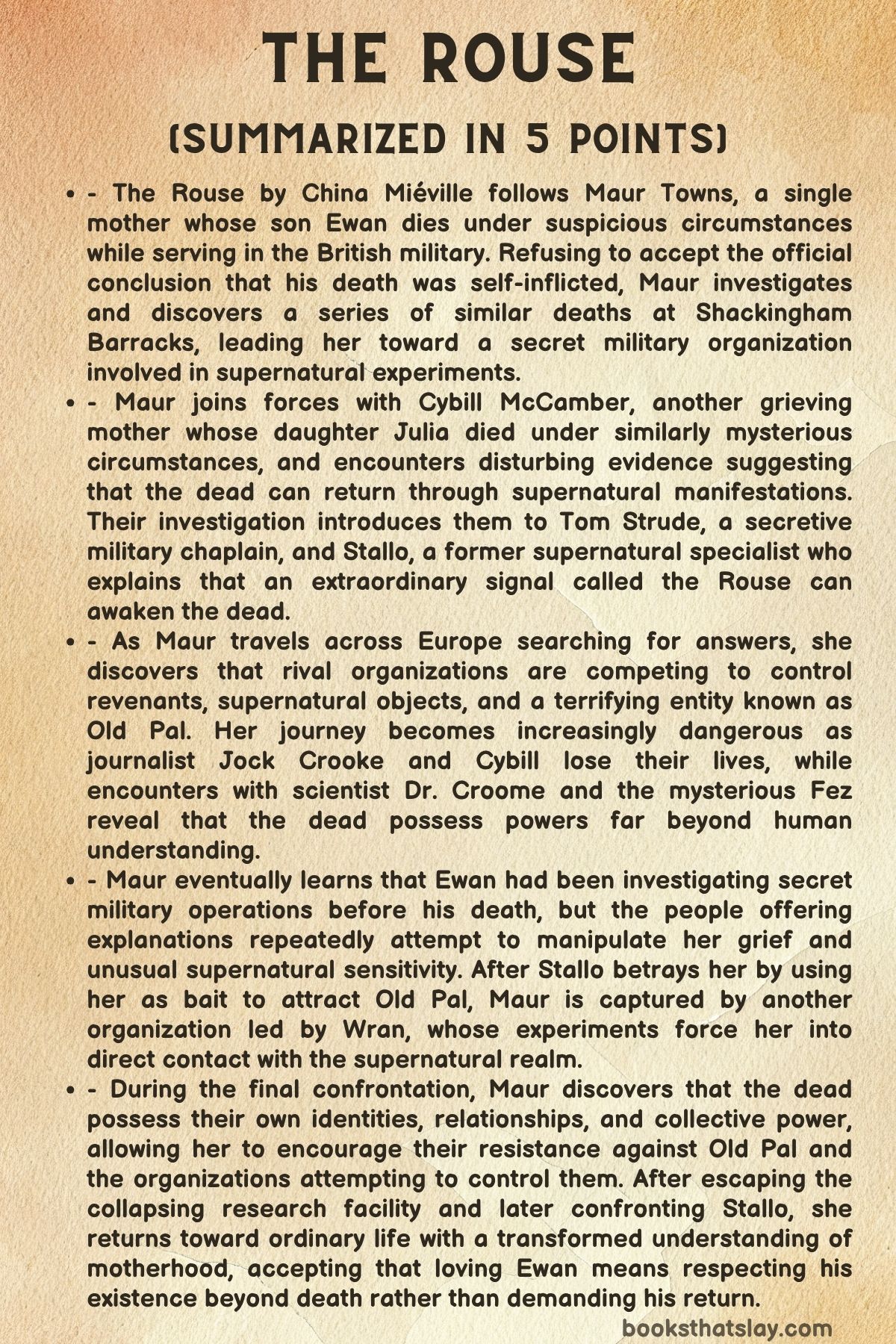
Summary
In 1973, nineteen-year-old Maur Towns discovers that she is pregnant and decides to leave university to raise her child. Despite her father’s concerns, the uncertainty surrounding the baby’s father, Guy, and her limited financial resources, she moves to London, determined to establish an independent life.
Maur shares accommodation with Sara, a politically active filmmaker, and becomes involved in the city’s artistic community while taking temporary jobs. Her pregnancy gradually makes independence more difficult, and after disputes over rent and housing, she gives birth to a son, Ewan, whose arrival transforms her understanding of love and responsibility.
Raising Ewan proves both rewarding and exhausting, particularly because Maur must balance motherhood with financial insecurity, romantic relationships, and disappointed artistic ambitions. Her father, sister Rhona, and friends provide occasional support, but she often feels alone in making decisions that will influence her son’s future.
As Ewan grows, he develops an independent, imaginative personality, becoming fascinated by climbing, exploration, and physical challenges. Maur admires his curiosity but worries about his increasingly secretive behavior, particularly when he begins resisting authority and withdrawing from family life.
Their relationship deteriorates during his adolescence, and Ewan eventually leaves home for extended periods. A serious crisis brings him into medical care, but even Maur’s promise to bring him home cannot prevent him from disappearing again.
Years later, Ewan returns as a physically confident young man who has joined the RAF Regiment. Although Maur opposes military intervention and worries about the dangers of his career, their reunion allows them to recover some of the affection damaged by earlier conflicts.
His subsequent military service takes him into dangerous circumstances, including operations associated with the former Yugoslavia. During his visits home, Maur notices his growing secrecy, unusual questions about her safety, and apparent concern about matters he cannot explain.
Her worst fears are realized when military representatives arrive to inform her that Ewan has died. The announcement destroys the future she had imagined and leaves her struggling to understand how her son’s life could have ended so abruptly.
Maur identifies Ewan’s injured body and learns that he was found dead in woodland at Shackingham Barracks. Investigators conclude that his death was self-inflicted, but the presence of two gunshots and unanswered questions about his final activities convince Maur that the official explanation is inadequate.
Determined to uncover the truth, she attends hearings, challenges military authorities, and demands further investigation. Her search introduces her to journalist Jock Crooke, who has been examining suspicious deaths involving other service members stationed at Shackingham.
Among those cases is the death of eighteen-year-old Julia McCamber, whose circumstances bear disturbing similarities to Ewan’s. Maur becomes close to Julia’s mother, Cybill, and the two women join other bereaved families in demanding an independent inquiry.
Their campaign produces public attention but little meaningful progress, particularly when parliamentary proceedings fail to secure a full investigation. Maur becomes increasingly suspicious that the military is protecting information far more serious than individual misconduct.
An extraordinary development occurs when Cybill discovers that a letter associated with Julia contains passages of distorted, apparently impossible language. The document connects their investigation to Nicholas Teller, a former military officer whose behavior suggests that he knows more about the suspicious deaths than he wishes to reveal.
Maur and Cybill visit Teller’s house, where they encounter an inexplicable presence moving through the building. The figure appears to violate ordinary physical reality, forcing the women to flee and reconsider everything they believe about their children’s deaths.
Their experiences attract the attention of Tom Strude, a military chaplain who previously presented himself as an ally of the bereaved families. Strude reveals that he belongs to a secret organization familiar with supernatural manifestations associated with the dead.
According to Strude, certain deceased individuals can return through events called revenance, and trained specialists have developed methods for encountering them. He introduces the possibility that Cybill might communicate with Julia, offering the grieving mother a prospect she cannot easily refuse.
A carefully arranged experiment at Cybill’s house attempts to establish contact through familiar objects and unusual equipment. However, the procedure is interrupted by an armed stranger, and the resulting violence forces Maur and Cybill into a dangerous world of competing supernatural investigators.
The stranger, who eventually identifies himself as Stallo, claims to be a former member of the secret organization. He explains that the group has been studying the Rouse, a specialized signal associated with awakening the dead, but that its operations have become increasingly dangerous.
Stallo believes that powerful supernatural forces are operating beyond the organization’s control. Although Maur distrusts him, she gradually accepts that he possesses knowledge essential to understanding the disturbances surrounding Ewan and Julia.
Alongside Maur’s experiences, the story traces the historical development of the secret military program through Steven Allardyce and other specialists. Their operations in Malaya, Oman, Africa, and elsewhere reveal how governments developed techniques for detecting, summoning, and weaponizing revenant phenomena.
The investigators collect extraordinary objects called apports, experiment with protective materials, and discover that certain sounds and physical arrangements can influence manifestations. Scientists such as Dr. Croome help establish this hidden discipline, although the increasingly violent experiments reveal serious limitations in human understanding.
Maur’s investigation brings her into contact with records gathered by Jock, references to mysterious military operations, and accounts of a woman known as the Azeri. Stallo identifies this woman as an exceptionally dangerous figure involved in acquiring supernatural objects and communicating with powerful entities.
The fugitives travel through France and seek assistance from Dr. Croome, who confirms that the secret organization has suffered internal disputes and catastrophic failures. Croome also introduces the possibility of an emerging collective of supernatural entities associated with a threatening force called Old Pal.
Maur begins to understand that the dead may not return as recognizable versions of their former selves. Their identities can become altered, fragmented, or absorbed into larger supernatural structures, making attempts at reunion potentially disastrous.
As the group moves between temporary refuges, Jock is killed during an attack involving a manifestation resembling Julia. His death demonstrates the enormous danger of the forces pursuing them and exposes the terrible possibility that a dead loved one might become an instrument of violence.
Stallo subsequently leads Maur and Cybill to an isolated settlement controlled by Dila, whose community possesses unusual protective mechanisms. These defenses are associated with Rak, a man who collected obsolete machinery and believed that certain technological remnants could resist supernatural forces.
The settlement’s secrecy is compromised when Dila’s son, Vam, reveals information to outsiders. Armed attackers arrive, and during a desperate helicopter escape, Cybill is wounded and falls from the aircraft, leaving Maur devastated by another loss.
Maur and Stallo continue traveling through France, searching for objects and knowledge capable of resisting Old Pal. During an encounter in the woods, Maur survives an attack with the apparent assistance of an unidentified supernatural presence and discovers a naturally pierced stone that may possess protective properties.
Stallo recognizes that Maur has developed an unusual sensitivity to revenant activity. Her connection with the altered letter and the mysterious presence protecting her suggests that she can communicate with supernatural forces in ways even experienced specialists cannot fully explain.
Their journey eventually takes them to Norway, where Stallo investigates an abandoned installation containing obsolete radio equipment and supernatural materials. He hopes that forgotten technologies may provide evidence of earlier attempts to confront the force pursuing them.
However, their refuge is attacked, and Maur falls into the hands of Tom Strude. He accuses Stallo of manipulating her and suggests that the former soldier may be responsible for the deaths of Ewan and Julia.
Strude attempts to exploit Maur’s longing for her son by promising the possibility of communication. Recognizing the manipulation, Maur attacks him, escapes, and decides that she can no longer depend upon either man’s version of events.
Traveling independently through Europe, she investigates Ewan’s final activities and eventually meets an elderly comedian whose performances had attracted her son’s attention. His frightened recollections suggest that Ewan was involved in investigating supernatural disturbances and may have encountered the mysterious Azeri.
Maur ultimately arranges a meeting with the woman, who introduces herself as Fez. Fez explains that Old Pal is not merely a supernatural weapon but an immensely dangerous entity capable of influencing, consuming, or manipulating manifestations of the dead.
She also describes the Void Army, a collective associated with Old Pal, and suggests that Maur’s altered letter may contain communications from multiple supernatural sources. Although Fez offers information unavailable elsewhere, Maur realizes that she too may intend to exploit her extraordinary sensitivity.
Escaping Fez’s concealed settlement in Guyana, Maur undertakes a difficult journey back toward Europe. Her increasing awareness of supernatural presences convinces her that the conflict is approaching a decisive confrontation and that she must determine her own involvement.
Maur eventually confronts Stallo again and questions him about Ewan’s death. He denies murdering her son, claiming that Ewan had approached him because he was troubled by secret military operations and had discovered evidence of a returning supernatural threat.
Although Maur temporarily considers cooperating with Stallo, she discovers that he has prepared an elaborate experiment designed to attract Old Pal. His true motivation is increasingly personal: he resents the creature’s indifference toward him and wants to force another confrontation.
Stallo incapacitates Maur and restrains her inside an industrial building, using her supernatural sensitivity as the central element of his trap. The experiment unleashes forces beyond his control, overwhelming Maur and exposing the destructive consequences of his obsession.
When Maur regains consciousness, she is imprisoned inside a secret research facility controlled by Wran. He questions her about Fez, Old Pal, and the altered letter while subjecting her to invasive experiments intended to exploit her abilities.
Maur encounters a transformed Tom Strude, whose unnatural existence demonstrates how revenant technology can reduce people to controllable instruments. She learns that the rival organizations are competing not simply for political influence but for authority over an entire dimension of existence.
During an elaborate operation, Maur’s consciousness separates from ordinary physical reality. She enters a realm inhabited by the dead, where she discovers that supernatural existence is more complex than the military’s methods of classification and control suggest.
Rather than demanding Ewan’s return, Maur attempts to communicate with the dead as independent beings capable of making their own decisions. She recognizes that they may possess collective power sufficient to resist Old Pal and those seeking to exploit them.
The dead respond to her intervention, and supernatural manifestations overwhelm the military installation. As the struggle disrupts the machinery and defeats the organization’s control, Maur frees herself and begins escaping through the collapsing facility.
She encounters animals imprisoned for experiments and releases them, refusing to abandon other living creatures to the same exploitation she has endured. After a difficult escape, she emerges outside, believing that Old Pal has been driven away by the collective intervention of the dead.
Years later, Maur confronts Stallo and explains that his understanding of Old Pal was fundamentally mistaken. His obsession with commanding or challenging the entity prevented him from recognizing that the dead themselves possessed the capacity to resist it.
Maur permits a supernatural presence to confront Stallo, who disappears into a realm where he may face the consequences of his actions. Even then, she leaves open the possibility that he might escape, refusing to make revenge the sole purpose of her survival.
The novel closes with Maur contemplating a return to ordinary life and the difficult possibility of reconnecting with friends she abandoned during her investigation. She accepts that she cannot recover Ewan or understand every circumstance of his death, but she has learned that loving the dead need not mean controlling them.
Characters
Maur Towns
Maur Towns is the central protagonist of The Rouse, a woman whose life is shaped by motherhood, bereavement, determination, and the struggle to recover personal independence. Her transformation from a young single mother into someone capable of confronting powerful supernatural organizations provides the novel with its principal emotional and narrative development.
As a young woman, Maur is intelligent, artistic, stubborn, and eager to establish a life beyond her father’s expectations. Her decision to leave university and raise Ewan demonstrates considerable independence, although her determination frequently exceeds her practical ability to manage difficult circumstances.
Her relationship with Ewan reveals both her tenderness and her limitations. She loves him intensely but struggles with his growing independence, occasionally allowing fear, impatience, and disappointment to complicate their relationship.
Following Ewan’s death, Maur’s refusal to accept the official explanation becomes an expression of maternal responsibility. She believes that discovering what happened to him is one final obligation she can fulfill, even when her investigation threatens her relationships and personal safety.
Her encounters with Stallo, Strude, Fez, and Wran force her to question the motives of people who claim superior knowledge. Over time, she learns to distinguish cooperation from obedience and recognizes that grief makes people particularly vulnerable to manipulation.
Maur’s greatest development occurs when she stops treating communication with Ewan as the only meaningful outcome of her investigation. Instead, she recognizes that the dead possess interests and experiences independent of the people who mourn them.
Her ultimate achievement is not the recovery of her son but the reclamation of her own moral agency. By refusing to exploit the dead, she establishes an ethical position that powerful institutions have repeatedly abandoned.
Ewan Towns
Ewan is the emotional center of The Rouse, even though much of his life is presented through Maur’s memories and the fragments of information she uncovers after his death. His development from an imaginative child into a secretive soldier demonstrates the painful distance that can emerge between a parent and an adult child.
During childhood, Ewan possesses a curious, sometimes solitary temperament and becomes fascinated by climbing, physical exploration, and places beyond ordinary attention. His attraction to risk worries Maur, who cannot always distinguish natural independence from genuinely dangerous behavior.
His adolescence is marked by conflict, emotional withdrawal, and periods of separation from his mother. These difficulties prevent their relationship from becoming an idealized portrait of unconditional harmony, making Maur’s later regret particularly complicated.
Joining the RAF Regiment gives Ewan a sense of purpose and confidence that he had struggled to establish earlier. Nevertheless, the secrecy surrounding his military duties increases the emotional distance between him and Maur.
His apparent involvement in investigating supernatural operations suggests that he had begun questioning the organization to which he belonged. His attempts to obtain information may also explain the anxiety and guarded behavior Maur notices during their final encounters.
Ewan represents a person whose identity cannot be completely reconstructed through another individual’s memories. Even as Maur learns more about his activities, she must accept that portions of his inner life will remain inaccessible to her.
Cybill McCamber
Cybill is one of the most emotionally significant characters in The Rouse, serving as both Maur’s companion and a contrasting example of how bereaved parents respond to the possibility of communicating with their children.
Like Maur, Cybill has lost a child under suspicious military circumstances. Her daughter Julia’s death makes her determined to challenge official explanations and support demands for a more thorough investigation.
Cybill’s relationship with Maur grows from their shared experiences of institutional disappointment and parental grief. Their friendship provides emotional support at a time when both women feel increasingly isolated from ordinary society.
However, their responses to supernatural contact gradually diverge. Cybill becomes increasingly willing to accept extraordinary risks because she believes that Julia may still be capable of communicating with her.
Her determination is understandable, but it also makes her susceptible to manipulation by individuals who possess specialized knowledge. She repeatedly struggles to distinguish evidence of Julia’s survival from manifestations that may only imitate her daughter.
Cybill’s eventual death during the helicopter escape is especially devastating because she has become a second source of personal attachment for Maur. Her fate demonstrates that the pursuit of impossible reunions can expose the living to further irreversible losses.
Stallo
Stallo is one of the most morally ambiguous figures in The Rouse, combining extraordinary knowledge, practical courage, emotional instability, and a dangerous obsession with supernatural power. He begins as a potential rescuer but gradually becomes one of the principal sources of danger confronting Maur.
His background within the secret military organization gives him extensive experience with revenance, apports, protective rituals, and specialized combat techniques. He understands dangers that ordinary people cannot perceive and initially appears better equipped than anyone else to protect Maur and Cybill.
Nevertheless, his behavior is consistently shaped by secrecy and a need to control information. He frequently presents his decisions as necessary for survival while withholding details that might allow others to make independent judgments.
His attachment to his animal companion reveals a capacity for tenderness and grief that complicates his otherwise ruthless conduct. The animal’s death briefly exposes his vulnerability and demonstrates that his professional expertise has not eliminated ordinary emotional needs.
Stallo’s relationship with Old Pal eventually reveals the destructive nature of his ambitions. He becomes offended by the entity’s indifference toward him, interpreting its withdrawal as a personal rejection rather than an opportunity to escape danger.
His decision to use Maur as bait exposes his willingness to sacrifice another person’s autonomy for the sake of his own ambitions. By the conclusion, his technical knowledge has become inseparable from arrogance, resentment, and moral failure.
Julia McCamber
Julia McCamber is a young soldier whose suspicious death connects Maur and Cybill to the larger military conspiracy. Although Julia is already dead when the central investigation develops, her apparent manifestations play an important role in exposing the disturbing nature of revenance.
Her death resembles Ewan’s in ways that raise serious questions about the official explanations. The similarities encourage the bereaved families to cooperate and investigate the activities taking place at Shackingham Barracks.
Julia’s possible return becomes a source of hope for Cybill, but the manifestations associated with her are frightening and difficult to interpret. The supernatural figure resembling a young female soldier eventually appears during the attack that kills Jock.
Julia’s role demonstrates the uncertainty surrounding identity after death. The possibility that something bears her appearance without preserving her recognizable humanity challenges the assumption that supernatural contact necessarily restores a lost relationship.
Tom Strude
Tom Strude is a military chaplain whose apparently sympathetic behavior conceals his involvement in a secret organization studying the dead. His religious position initially gives him an appearance of moral authority, which he uses to establish relationships with grieving families.
He possesses detailed knowledge of revenance and understands that Maur and Cybill have encountered phenomena beyond ordinary explanation. His ability to provide information makes him influential, but his evasiveness and unauthorized intrusion into Maur’s home expose his manipulative nature.
Strude repeatedly attempts to persuade Maur that cooperation with his organization is the safest available option. He exploits her desire to understand Ewan’s death and suggests that access to her son may depend upon accepting his demands.
His accusations against Stallo contain information that Maur cannot easily dismiss, complicating the distinction between truthful disclosure and psychological manipulation.
His eventual appearance as a transformed, controllable figure demonstrates the dangers inherent in the organization’s practices. A man who once claimed authority over the dead becomes an example of what happens when that authority is turned against an individual.
Jock Crooke
Jock Crooke is an investigative journalist whose work provides Maur with evidence that Ewan’s death belongs to a broader pattern of suspicious military incidents. His research connects the deaths at Shackingham to individuals and organizations operating beyond ordinary public scrutiny.
Initially, Jock approaches the case as a problem involving institutional secrecy and potential misconduct. He examines records, develops contacts, and searches for connections that official investigators have overlooked.
As supernatural phenomena become increasingly apparent, his confidence deteriorates. He struggles to reconcile his professional reliance on evidence with discoveries that contradict the assumptions underlying conventional investigation.
His reluctance to share certain details about Ewan also creates tension with Maur. She feels betrayed whenever she learns that someone else possesses information about her son that has been withheld from her.
Jock’s death during a supernatural attack marks an important turning point. His investigative skills are valuable, but they cannot protect him from forces that operate outside his previous understanding of reality.
Fez, the Azeri
Fez is a mysterious woman known as the Azeri, whose reputation emerges through conflicting accounts of supernatural operations and international rivalries. She becomes particularly important when Maur discovers that The Rouse involves competing explanations of the same extraordinary forces.
Her controlled demeanor, extensive resources, and secretive network establish her as someone capable of operating independently of conventional military institutions. She possesses information about Old Pal, the Void Army, and Ewan’s possible involvement with supernatural investigations.
Unlike some of the military specialists, Fez understands that Old Pal cannot simply be treated as an obedient instrument. She recognizes its destructive capacity and explains that the entity possesses influence over other supernatural manifestations.
However, her knowledge does not make her entirely trustworthy. She is interested in Maur’s unusual abilities and appears willing to restrict her freedom to obtain information.
Fez represents a sophisticated form of manipulation in which intellectual authority becomes a means of control. Her explanations help Maur understand the conflict, but they also demonstrate why no single powerful figure should be allowed to determine the truth.
Wran
Wran is a senior figure associated with the secret research establishment that imprisons Maur after Stallo’s failed experiment. His importance lies in his ability to transform supernatural knowledge into an organized system of surveillance, experimentation, and coercion.
He presents his organization’s activities as necessary responses to an extraordinary threat. Nevertheless, his refusal to explain its objectives and his invasive treatment of Maur reveal a willingness to sacrifice individual freedom.
Wran is particularly interested in Maur’s relationship with supernatural entities and the information contained in the altered letter. His questioning suggests that he regards her less as a human being than as an unusually valuable research subject.
The controlled revenant version of Strude demonstrates the practical consequences of Wran’s work. Under his authority, even the boundary between life and death becomes something that can be manipulated through machinery.
His eventual loss of control exposes the limitations of treating the dead as an exploitable resource.
Dr. Croome
Dr. Croome is an elderly scientist whose research helped establish the methods used by the secret military organization. She represents the intellectual ambition that made supernatural experimentation possible and the ethical uncertainty that accompanies such work.
Her expertise concerns apports, revenant manifestations, protective mechanisms, and the interaction between supernatural forces and physical objects. Her isolated residence contains defensive systems demonstrating that her research has practical applications.
Croome offers Maur valuable information about the organization’s history and internal disagreements. Nevertheless, her explanations are often incomplete, and her detached manner suggests that decades of research have diminished her sensitivity to the suffering involved.
Her warnings about Old Pal and the emerging supernatural collectives reveal an awareness that established theories are increasingly inadequate.
She is not simply an indifferent scientist, but someone whose professional investment in understanding the dead has created serious moral blind spots.
Steven Allardyce
Steven Allardyce is a central figure in the historical narrative concerning the development of Britain’s clandestine supernatural program. His military experiences connect conventional imperial conflict with the discovery and exploitation of forces associated with death.
His service in Malaya and Oman exposes him to violence and extraordinary events that challenge ordinary explanations. These experiences attract the attention of secretive officials interested in individuals capable of confronting supernatural disturbances.
Allardyce gradually becomes involved in specialized operations requiring unconventional weapons, unusual forms of perception, and experimental methods. His training demonstrates how military discipline can be adapted to confront entities that do not obey ordinary physical rules.
His relationships and attempts to preserve personal attachments contrast with the secrecy of his professional life. Through his experiences, the novel explores how prolonged exposure to extraordinary violence can isolate individuals from ordinary human relationships.
Nicholas Teller
Nicholas Teller is a former military officer whose connection with the altered letter makes him an important early suspect in Maur and Cybill’s investigation.
His frightened and defensive behavior suggests that he possesses knowledge about dangerous circumstances surrounding the military deaths. Rather than providing clear answers, he attempts to keep the women away from his home.
The supernatural disturbance they encounter inside his house indicates that Teller himself may be endangered by the forces involved. His fear complicates Maur’s initial suspicion that he is simply someone protecting military secrets.
Teller represents the vulnerability of individuals who become involved in extraordinary operations without retaining control over their consequences.
Dila
Dila is the leader of an isolated community whose survival appears connected with unconventional supernatural defenses. Her authority, practical judgment, and reluctance to become involved in Stallo’s conflict distinguish her from the more obsessive investigators.
She recognizes that providing refuge to the fugitives could endanger everyone living under her protection. Her hesitation reflects an understanding of communal responsibility that Stallo frequently overlooks.
Dila’s relationship with her son Vam is particularly important because his actions compromise the settlement’s security. The resulting attack exposes the fragility of the protections upon which her community depends.
Her anger after Cybill’s death comes from the recognition that reckless decisions can destroy the safety of people who never chose to participate in the conflict.
Vam
Vam is Dila’s son and an intermediary associated with the network of supernatural practitioners that Maur and Stallo attempt to contact. He is confident, suspicious, and willing to challenge Stallo’s authority.
His initial caution suggests that he understands the dangers of revealing information to outsiders. Nevertheless, his later disclosure of the settlement’s location exposes the community to attack.
Vam’s actions have devastating consequences, including Cybill’s death. His character illustrates how misplaced confidence and poor judgment can undermine even carefully constructed systems of protection.
His strained relationship with Dila also demonstrates the conflict between personal independence and responsibility toward a larger community.
Rak
Rak is an unconventional investigator whose interests combine spiritual beliefs, historical memory, military symbolism, and obsolete technology. His unusual theories initially appear eccentric but gradually become important to understanding supernatural defenses.
He collects remnants of early aviation equipment and other technological objects because he believes their histories may carry extraordinary significance.
His protective arrangements appear to possess genuine power, particularly during the helicopter escape. Their partial failure demonstrates that apparently irrational traditions may preserve useful knowledge that modern institutions have overlooked.
Rak represents an alternative understanding of the supernatural, one that does not depend entirely upon official scientific or military classifications.
Old Pal
Old Pal is a powerful supernatural entity whose influence extends across the boundary separating living people from the dead. It functions as a central antagonistic presence, although its nature and motivations remain difficult for the human characters to understand.
Unlike ordinary revenants, Old Pal appears capable of manipulating, weakening, or consuming other manifestations. Its connection with the Void Army suggests that its power involves collective supernatural structures rather than isolated hauntings.
The entity becomes the object of competing efforts by Stallo, Fez, Wran, and other specialists. Each approaches it according to personal ambitions or institutional interests.
Old Pal’s significance in The Rouse extends beyond its destructive abilities because it exposes the arrogance of those who assume that supernatural power must exist for human use.
Its eventual defeat or removal through collective resistance challenges the belief that extraordinary threats can only be overcome by more powerful systems of command.
Des
Des is an important figure in Maur and Ewan’s family history, particularly during the difficult years of Ewan’s childhood and adolescence. His relationship with Maur offers emotional companionship but cannot provide the stability necessary to sustain their partnership.
Maur eventually recognizes that her affection for Des is insufficient for a lasting relationship. Nevertheless, he continues to occupy a meaningful place in her personal history.
His willingness to help during later periods of uncertainty demonstrates that relationships can retain value after their romantic possibilities have ended.
Des represents the imperfect but significant support networks surrounding Maur throughout her life.
Sonya
Sonya is one of Maur’s closest friends and serves as a connection to ordinary life before the supernatural investigation begins.
She occasionally challenges Maur’s interpretation of Ewan’s behavior, particularly when questioning whether the adults around him have provided sufficient stability. Her perspective reminds Maur that maternal devotion does not guarantee flawless judgment.
Following Ewan’s death, Sonya remains connected with Maur even as grief and obsession gradually isolate her.
The possibility of reconnecting with Sonya becomes important near the conclusion because it represents Maur’s chance to reclaim ordinary friendship and a future not entirely defined by bereavement.
Shaun
Shaun is one of Maur’s romantic partners during her adulthood and remains intermittently involved in her life. Their relationship reflects Maur’s continuing need for affection and companionship beyond her identity as Ewan’s mother.
Although the relationship does not provide a permanent resolution to her personal difficulties, Shaun becomes part of the network of people concerned about her welfare.
His role helps establish that Maur’s life contains relationships and emotional responsibilities separate from her son. The eventual disruption of these connections demonstrates how completely grief can dominate someone’s existence.
Rhona Towns
Rhona is Maur’s sister and an important source of emotional support during her pregnancy and early motherhood. Their shared childhood history creates a connection shaped by the premature death of their mother.
Their conversations reveal the continuing influence of that loss upon the family’s emotional life. Rhona provides Maur with someone who understands both their father’s personality and the absence of maternal guidance.
Although she remains a secondary character, her presence helps explain why Maur approaches motherhood with such a powerful mixture of devotion and insecurity.
Maur’s Father
Maur’s father is a cautious, concerned parent who questions her decision to leave university and raise a child without financial security. His reaction demonstrates the generational expectations Maur must resist while establishing independence.
He is not presented simply as an authoritarian figure. His concern reflects genuine uncertainty about his daughter’s future and the difficulties she is likely to encounter.
The family’s history of bereavement also shapes his relationships with his daughters. His presence reminds readers that Maur’s experience of grief began long before Ewan’s death.
Guy
Guy is Ewan’s father, a young academic whose departure for Vienna leaves Maur facing pregnancy without the stable partnership she might have expected.
His absence is important because it establishes the circumstances in which Maur must make her earliest decisions about parenthood.
Although Guy does not become a major participant in the subsequent events, his limited involvement contributes to the emotional and practical isolation surrounding Ewan’s upbringing.
Sara
Sara is a Portuguese filmmaker and political activist who shares accommodation with Maur during her early years in London. She represents the artistic and political environment that initially attracts Maur to independent adult life.
Their relationship becomes strained when Maur’s pregnancy and financial difficulties prevent her from meeting her obligations. Sara’s demands for rent expose the limits of informal solidarity when practical responsibilities become unavoidable.
Her role demonstrates the collision between youthful aspirations and material hardship.
Chrissie
Chrissie is a friend who provides Maur with temporary accommodation when her housing arrangements deteriorate during pregnancy.
Although her involvement is relatively brief, her assistance becomes important at a moment when Maur has few reliable options.
Chrissie’s presence demonstrates that small acts of personal support can have considerable importance during periods of instability.
Maisie
Maisie appears in the historical narrative as an important personal connection within the lives of those involved in secret supernatural operations.
Her artistic and literary interests contrast with the military environment surrounding the investigators. Her relationships also reveal the difficulty of maintaining intimacy when professional responsibilities require extensive secrecy.
Maisie’s presence shows that the investigators possess ordinary ambitions, attachments, and emotional vulnerabilities despite their extraordinary occupations.
Hook
Hook is a military intelligence figure associated with the recruitment and direction of specialists investigating supernatural phenomena.
His ability to arrange Allardyce’s detention and return to specialized service demonstrates the considerable authority exercised by the secret organization.
Hook represents the institutional mechanisms through which individual experiences of extraordinary events are transformed into military obligations.
Bowler
Bowler is one of the specialists associated with the historical operations of the secret military unit. His participation in experiments and investigations helps establish the collaborative nature of the organization’s research.
He appears in situations involving unusual objects, manifestations, and discussions about the expanding capabilities of the program.
His role demonstrates how supernatural experimentation gradually becomes normalized within a professional military community.
Don
Don is an old acquaintance of Ewan whose difficult encounter with him shortly before his death becomes significant to Maur’s investigation.
According to information Jock obtains, Ewan appeared agitated during their meeting, while Don was visibly distressed. The circumstances suggest that Ewan’s final activities may have involved information or experiences he could not discuss openly.
Don’s role illustrates how fragments of another person’s life can remain concealed even from close family members.
O’Leary
O’Leary appears in an earlier historical episode involving travel through a tropical forest and an encounter with an unfamiliar community.
His disappearance and the traces he leaves behind introduce the idea that human beings can become entangled with the supernatural through encounters they do not fully understand.
His brief story also broadens the historical scope of the novel, suggesting that mysterious relationships between death, violence, and the physical environment existed long before modern military investigations.
Themes
Grief, Motherhood, and the Limits of Love
Grief transforms Maur’s understanding of motherhood from an everyday responsibility into an enduring relationship with someone who is physically absent. Throughout The Rouse, her memories of raising Ewan reveal that parental love contains affection, impatience, disappointment, uncertainty, and regret.
Maur’s loss is particularly difficult because her relationship with Ewan was never entirely harmonious. Their conflicts during his adolescence and his later emotional secrecy leave her with questions that death makes impossible to resolve through ordinary conversation.
Her determination to investigate his death initially appears to be a continuation of maternal responsibility. She believes that discovering the truth is something she still owes him, even when others encourage her to accept official conclusions.
However, the supernatural possibilities she encounters create a deeper moral problem. If Ewan continues to exist in some altered form, Maur must decide whether her desire to reach him is an expression of love or an attempt to satisfy her own emotional needs.
Cybill’s pursuit of Julia provides a contrasting example of this conflict. Her willingness to risk everything for contact with her daughter demonstrates how the promise of reunion can become irresistible when ordinary forms of closure are unavailable.
The novel ultimately suggests that love cannot justify unrestricted claims upon another individual’s existence. Maur’s development depends upon recognizing that Ewan does not belong to her simply because she is his mother.
Her eventual refusal to summon him for personal reassurance represents a difficult form of acceptance. She continues loving him without insisting that death must be reversed or that his continuing existence must provide answers to her questions.
Power, Institutional Secrecy, and the Exploitation of Death
The secret military organizations transform supernatural phenomena into strategic resources, treating the dead as sources of intelligence, weapons, and experimental material. Their activities demonstrate how institutions can extend established systems of authority into areas where ethical understanding remains dangerously incomplete.
The history of the organization reveals that supernatural research develops alongside colonial conflict, intelligence operations, and military intervention. Its discoveries are repeatedly evaluated according to their usefulness rather than their consequences for the beings involved.
This approach allows extraordinary violence to become part of routine professional activity. Scientists develop specialized instruments, soldiers learn unconventional combat techniques, and officials establish procedures for manipulating manifestations without adequately considering whether the dead possess independent rights.
Maur’s treatment by Strude, Stallo, Fez, and Wran demonstrates how institutional power operates upon the living as well. Her grief and supernatural sensitivity make her valuable to organizations that repeatedly disregard her consent.
These groups often justify their behavior by claiming that their knowledge enables them to confront an exceptionally dangerous threat. However, their competing ambitions and failures suggest that possessing specialized expertise does not guarantee moral judgment.
The treatment of animals within Wran’s research facility extends this criticism beyond human exploitation. Maur’s decision to release the imprisoned creatures emphasizes the importance of recognizing suffering wherever institutional power has made it invisible.
The defeat of Old Pal further challenges the organizations’ assumptions. Their elaborate machinery and systems of command prove less effective than cooperation among beings they have consistently underestimated.
By exposing the limitations of centralized authority, the novel questions whether knowledge pursued through domination can ever provide genuine understanding.
The Boundary Between Life and Death
Death in The Rouse is not presented as a simple transition from consciousness to permanent absence. Instead, the novel imagines a reality in which remnants of personality, memory, physical objects, and collective experience may persist beyond ordinary human existence.
The manifestations encountered by Maur repeatedly challenge familiar ideas about ghosts. Some possess recognizable human features, while others appear fragmented, physically distorted, or associated with objects and spaces rather than complete bodies.
These differences create uncertainty about what survival after death actually means. A figure resembling Julia may appear, but its resemblance does not prove that the consciousness within it remains identical to the young woman Cybill remembers.
The altered letter becomes an important symbol of this uncertainty. Its changing language suggests that communication between the living and dead may involve multiple sources whose identities cannot be easily separated.
The organization’s scientific methods attempt to classify these experiences through signals, instruments, specialized materials, and controlled experiments. Yet the more its members learn, the more obvious it becomes that their categories are inadequate.
Maur’s journey into the realm of the dead fundamentally changes her understanding of supernatural existence. She encounters beings whose relationships, experiences, and forms of collective awareness exceed anything described by the investigators.
The novel consequently questions the human tendency to interpret unfamiliar existence according to familiar emotional expectations. Survivors want the dead to remain recognizable because recognizable identities promise reassurance.
However, the persistence of consciousness may also involve transformations that the living cannot understand or comfortably accept. Respecting the dead requires acknowledging the possibility that their existence has become something beyond human possession or interpretation.
Autonomy, Resistance, and the Right to Exist Independently
Maur’s struggle for autonomy begins long before she encounters supernatural forces. As a young woman, she rejects expectations concerning education, marriage, and motherhood, insisting upon the right to determine the direction of her own life.
Nevertheless, her independence is repeatedly challenged by financial hardship, family responsibilities, and emotional attachments. Raising Ewan teaches her that loving another person requires negotiation between competing needs rather than absolute control.
After his death, this conflict becomes more extreme. Military investigators attempt to dictate what she should believe, while supernatural specialists repeatedly insist that her safety depends upon surrendering decisions to them.
Stallo’s betrayal represents the clearest violation of her independence. By restraining Maur and using her as bait for Old Pal, he reduces her identity to a function within his personal ambitions.
Fez and Wran employ different methods but operate according to similar assumptions. They believe that Maur’s extraordinary abilities make her useful enough to justify restricting her freedom.
Her repeated escapes therefore represent more than physical survival. Each one demonstrates her increasing refusal to accept that superior knowledge or apparent authority gives another person ownership over her choices.
This struggle eventually expands beyond Maur herself. When she encounters the dead as beings with independent interests, she recognizes that their autonomy matters just as much as her own.
The collective resistance against Old Pal challenges systems that depend upon control, coercion, and the assumption that powerful individuals must determine everyone else’s fate.
Maur’s return to ordinary life completes this development without suggesting that suffering has been erased. She remains a bereaved mother, but she is no longer defined entirely by the demands of grief or the ambitions of those seeking to exploit it.
Her achievement is the discovery that genuine freedom does not require absolute power over others. It requires the ability to make meaningful choices while recognizing that other beings possess the same right.