The Silent Appeal Summary, Characters and Themes
The Silent Appeal by Janice Hallett is a mystery novel that explores the destructive consequences of deception, obsession, betrayal, and hidden relationships within a close-knit amateur theatrical community.
Set primarily in the English village of Lower Lockwood, the story follows the Fairway Players as they prepare to perform Agatha Christie’s The Hollow, only for their production to become connected to a real murder. Through emails, messages, personal records, and legal correspondence, the novel gradually exposes the secrets behind a seemingly straightforward criminal conviction. What begins as an investigation into one woman’s confession develops into a complicated examination of justice, human relationships, and the difference between guilt and responsibility. It’s the 2nd book of the Appeal series.
Summary
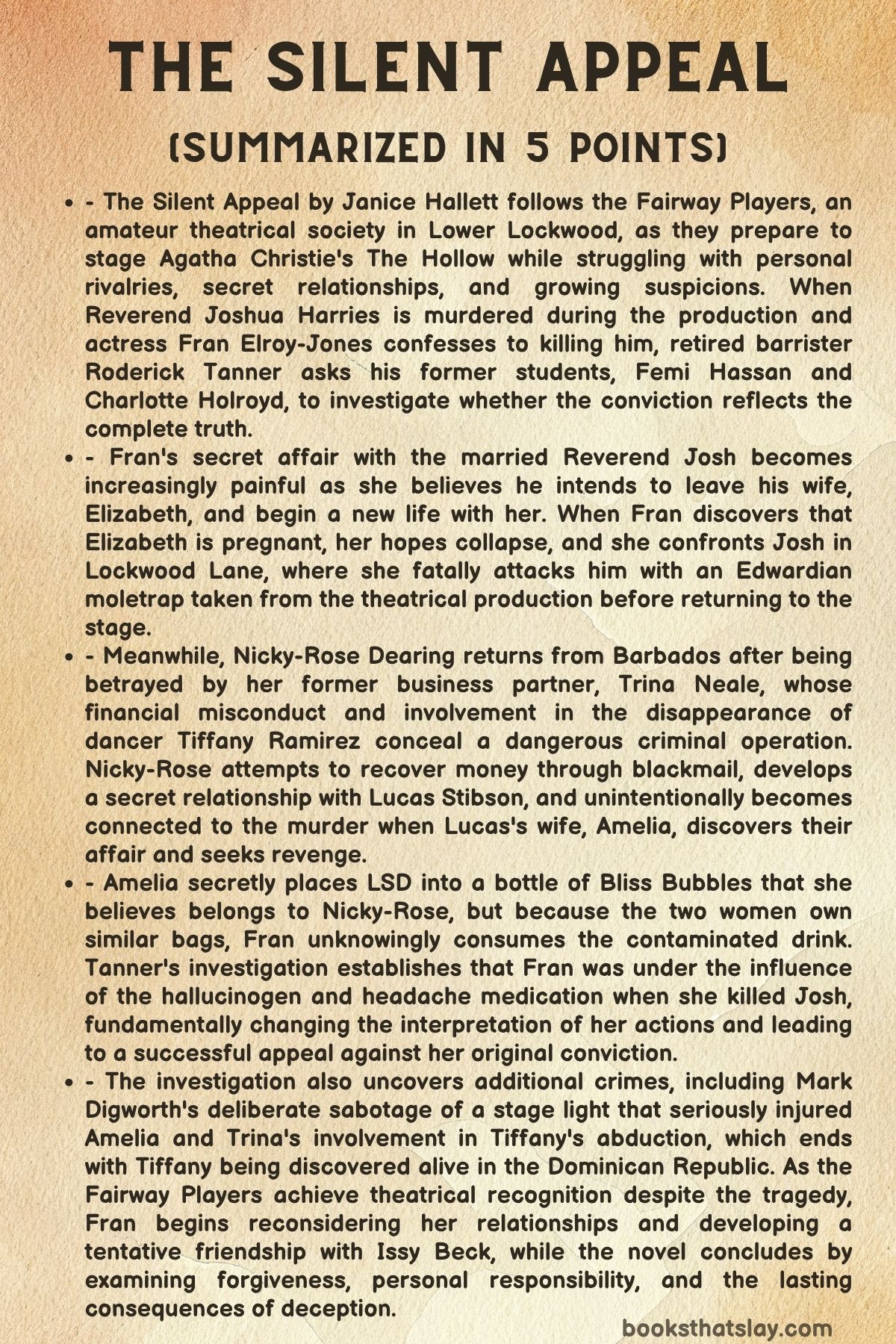
The story begins in September 2025 when retired barrister Roderick Tanner contacts two of his former students, Femi Hassan and Charlotte Holroyd, seeking their assistance with an unusual murder case. A woman has confessed to killing a man and received a lengthy prison sentence, but her legal representative believes that crucial circumstances surrounding the crime have been overlooked.
Tanner provides the students with an extensive collection of correspondence involving the Fairway Players, an amateur theatrical society in Lower Lockwood. He encourages them to examine not only what people have written but also what their communications conceal, emphasizing that the absence of information can sometimes be more revealing than an explicit statement.
The events leading to the murder begin in January 2025, when Kevin MacDonald announces that the Fairway Players will stage Agatha Christie’s The Hollow. Kevin plans to direct the production, while his wife, Sarah-Jane, will serve as producer, and both hope that their efforts will achieve recognition at the National Amateur Drama Awards.
The announcement immediately generates disagreements about casting, costumes, theatrical accuracy, and artistic decisions. Longstanding members, including Celia Halliday, express strong opinions, while others compete for prominent roles and recognition.
The group’s domestic stability is also disturbed by the unexpected arrival of Sarah-Jane’s younger sister, Nicky-Rose Dearing, who returns from Barbados after approximately twenty years abroad. Her sudden appearance during Kevin’s fiftieth-birthday celebration surprises everyone, especially her mother, Carol, who knows little about the circumstances that have brought her home.
Nicky-Rose previously operated Twin Star Entertainment, a company supplying performers to cruise ships, alongside her former friend and business associate Katrina “Trina” Neale. Their partnership has collapsed amid accusations of financial exploitation, dishonesty, and possible criminal wrongdoing.
Although Nicky-Rose initially refuses to explain her difficulties, private communications establish that Trina had concealed essential details about the company’s ownership and finances. Nicky-Rose discovers that she was never officially recognized as a director or shareholder, despite believing that she had helped build the business.
Meanwhile, auditions introduce several important newcomers to the theatrical society. Fran Elroy-Jones, an established member known for her generosity, encourages Amelia Stibson, her husband Lucas, and Georgia Taccuso to participate.
Fran is cast as Lady Lucy Angkatell, while Amelia secures the desirable role of Henrietta. Georgia receives the part of Gerda Cristow but becomes increasingly dissatisfied with the character’s apparent foolishness, eventually withdrawing and allowing former member Isabel “Issy” Beck to replace her.
Issy’s return creates discomfort for Fran, who remembers their previous relationship very differently from Issy. While Issy believes they once shared a close friendship, Fran recalls obsessive behavior serious enough to involve a restraining order.
Fran also develops an intimate relationship with Reverend Joshua Harries, the local vicar, who is married to Elizabeth. What begins as emotional companionship becomes an affair, and Fran gradually convinces herself that Josh intends to leave his unhappy marriage and establish a future with her.
At the same time, Amelia struggles with tensions inside her marriage. Georgia is supposedly Lucas’s cousin and has been staying in their cramped apartment, but her continued presence creates resentment because Lucas consistently refuses to establish reasonable boundaries.
The Fairway Players organize a charity sleepout at St. Barnabas Church Hall to raise money for people experiencing homelessness. The event, initially imagined as a relatively simple fundraiser, becomes an elaborate gathering involving food, entertainment, games, and overnight accommodation inside the hall.
During the evening, Reverend Josh tells a ghost story about Crispin Tully and mysterious deaths associated with Lockwood Lane. The tale introduces an unsettling atmosphere that later acquires significance when real violence occurs in the same location.
Shortly after the participants fall asleep, a heavy stage light drops from its rigging and strikes Amelia’s leg. She suffers a severe injury requiring hospital treatment and surgery, while the society struggles to understand how the equipment became dangerously insecure.
Issy uses her former nursing experience to assist Amelia. She also observes several suspicious activities that night, including Nicky-Rose leaving with Kevin and Fran secretly entering a concealed passage leading from the church hall into Lockwood Lane.
Following Fran through the passage, Issy discovers her kissing Reverend Josh and realizes that their relationship has been developing in secret. She keeps this information to herself, although her continued interest in Fran’s private life becomes increasingly intrusive.
Amelia’s injury threatens the production because she is unable to move comfortably, but she remains determined to perform. Fran generously exchanges accommodation with Amelia, Lucas, and Georgia, allowing them to occupy her spacious apartment while she moves into their smaller home.
This arrangement eventually becomes another source of resentment. Fran discovers that Georgia has been receiving financial assistance from her mother despite presenting herself as destitute, and she begins questioning why she has repeatedly sacrificed her own comfort to help others.
As opening night approaches, Nicky-Rose becomes increasingly involved in directing rehearsals and assisting Kevin with his accounts. Her professional expertise improves the production, but her closeness to Kevin makes Sarah-Jane suspicious, particularly when other members report seeing him engaged in private conversations.
Sarah-Jane begins fearing that her husband is having an affair, possibly with Fran. Unknown to her, the romantic correspondence that appears to connect Kevin with Nicky-Rose conceals a different relationship: Nicky-Rose has been communicating with Lucas, whose number she deliberately saved under Kevin’s name.
Nicky-Rose simultaneously pursues revenge against Trina, demanding a large sum of Barbadian dollars in exchange for documents connected to the disappearance of Tiffany Ramirez, a dancer employed through Twin Star. Tiffany vanished from a Caribbean cruise ship, and the documents suggest that Trina knows considerably more about the incident than she has admitted.
Nicky-Rose recruits Issy to help conduct the exchange, taking advantage of her desire for friendship and acceptance. Their arrangement coincides with the final preparations for the theatrical production, when the cast is already struggling with personal conflicts and mounting anxiety.
Fran’s emotional condition also deteriorates. She experiences headaches, takes medication left over from an earlier production, and becomes increasingly dependent on Josh’s assurances that he will eventually separate from Elizabeth.
Shortly before opening night, information emerges indicating that Elizabeth is pregnant. This revelation destroys Fran’s belief that Josh’s marriage has effectively ended and forces her to recognize that he has been misleading her about their future.
On June 5, the Fairway Players prepare to perform before an audience that includes a National Amateur Drama Awards judge. Meanwhile, Issy meets Trina at a coffee shop, exchanging an envelope for a bag of money as part of Nicky-Rose’s arrangement.
Trina subsequently comes to the attention of Inspector David Lascelles, who is investigating Tiffany’s disappearance, and is arrested after drugs are found in her possession. Nicky-Rose collects the money and prepares to disappear from Lower Lockwood.
Backstage, Amelia discovers compromising messages on Lucas’s phone and realizes that his relationship with Nicky-Rose has been concealed from her. Overwhelmed by humiliation and anger, she secretly places a tab of LSD into a bottle of Bliss Bubbles in a bag she believes belongs to her husband’s lover.
However, the bag actually belongs to Fran, who owns one similar to Nicky-Rose’s. Fran unknowingly drinks the contaminated beverage while already taking medication for her headaches, leaving her increasingly vulnerable to severe psychological disturbance.
During the performance, Fran behaves unusually and removes an Edwardian moletrap from the stage. She also takes a starter pistol that was intended to create a convincing gunshot during the fictional murder.
At the interval, she leaves through the hidden passage and meets Reverend Josh in Lockwood Lane, where their relationship reaches a violent confrontation. Fran attempts to use the starter pistol, but when it fails to function as she expects, she strikes Josh with the moletrap and fatally injures him.
Remarkably, Fran returns to the stage and continues performing. Her behavior becomes unusually animated and unpredictable, but the audience interprets this transformation as an impressive artistic performance rather than evidence of her disturbed mental condition.
The visiting judge, Bella Moretti, later discovers Josh’s body in the lane, prompting a police investigation. Despite the shocking crime, Kevin insists that the production should continue, and the company struggles to maintain its theatrical obligations while confronting the possibility that someone among them is responsible.
After the production ends, Fran voluntarily approaches the police and confesses to killing Josh. She explains that she delayed surrendering because she did not want to ruin the theatrical run.
Fran subsequently pleads guilty to murder and receives a life sentence with a minimum term of twenty years. The court interprets her conduct as evidence of premeditation, emphasizing the weapons, her return to the stage, and her delayed confession.
However, Tanner believes the accepted explanation is incomplete. Working through the correspondence, Femi and Charlotte initially consider several possible suspects, including Josh’s wife, Elizabeth, and other members whose romantic or financial conflicts might have provided motives.
Their investigation eventually establishes that Fran did kill Josh but may not have been acting in an ordinary, unimpaired mental state. By carefully comparing the messages, they identify the mistaken handbag and reconstruct Amelia’s decision to contaminate what she believed was Nicky-Rose’s drink.
The discovery of involuntary LSD intoxication dramatically changes the interpretation of Fran’s actions. Her combination of emotional devastation, medication, and an unknowingly consumed hallucinogen raises serious doubts about whether her original confession and conviction accurately reflected her responsibility.
The investigation also exposes the larger criminal operation behind Tiffany Ramirez’s disappearance. Trina had become involved with dangerous drug traffickers after Twin Star encountered serious financial difficulties, and Tiffany was abducted because her own drug-dealing activities threatened another criminal enterprise.
Documents that Issy secretly preserved during the money exchange eventually become valuable evidence against those responsible. Tiffany is later discovered alive in the Dominican Republic, where she has been forced into a criminal drug-processing operation, and is reunited with her family.
The earlier lighting accident is also resolved when Mark Digworth, Karen Payne’s boyfriend, admits sabotaging the equipment because he wanted Karen to replace Amelia in the leading role. His dangerous scheme results in a ten-year prison sentence.
In February 2026, Fran’s appeal succeeds, with the court recognizing that her confession was unsafe in light of the newly discovered circumstances. Her sentence remains subject to further legal consideration, but the original interpretation of her actions can no longer be accepted without qualification.
By September 2026, the surviving characters have begun rebuilding their lives. Amelia has separated from Lucas, Georgia has given birth to his daughter, and Nicky-Rose remains abroad, seeking independence after apologizing to Sarah-Jane for taking her passport.
Fran remains imprisoned while awaiting the consequences of her successful appeal, but she begins a tentative friendship with Issy and reflects on the dangers of obsessive love. The Fairway Players continue performing and eventually win several theatrical awards, including recognition for their props, an irony made especially striking by the murder weapon.
The novel closes with Tanner sharing an account of a mysterious shadow seen in Lockwood Lane, recalling Josh’s earlier ghost story. Although the central mystery has been explained, the final correspondence leaves an atmosphere of uncertainty surrounding human motives, forgiveness, and the lingering consequences of past actions.
Characters
Fran Elroy-Jones
Fran Elroy-Jones is the central tragic figure in The Silent Appeal, a woman whose compassion, emotional vulnerability, and desire for companionship eventually place her at the center of a devastating crime. As an established member of the Fairway Players, she is respected for her theatrical abilities and willingness to help people who are struggling.
Fran repeatedly places other people’s needs ahead of her own, particularly when she welcomes Lucas, Amelia, and Georgia into the society and subsequently exchanges apartments with them. Her generosity demonstrates genuine concern, but it also exposes her inability to establish boundaries when others take advantage of her kindness.
Her relationship with Reverend Joshua Harries reveals a different dimension of her personality. Although she understands that Josh is married, she convinces herself that their relationship represents a genuine opportunity for lasting happiness and that his marriage is effectively over.
Fran’s emotional dependence becomes increasingly destructive as she accepts his vague promises and interprets his reluctance to leave Elizabeth as a temporary obstacle. Her discovery that Elizabeth is pregnant forces her to confront the extent of Josh’s dishonesty, destroying the future she has imagined.
The circumstances surrounding Josh’s murder make Fran’s situation particularly complicated. She physically commits the killing, but the revelation that she had unknowingly consumed LSD creates serious questions about her psychological condition and the extent of her criminal responsibility.
Her confession also demonstrates her willingness to accept guilt without understanding every factor that influenced her actions. The court initially interprets her behavior as evidence of deliberate cruelty, overlooking the possibility that her altered mental state had profoundly affected her judgment.
Fran’s eventual reflections suggest considerable personal growth. She recognizes the dangers of obsessive attachment, begins reconsidering her relationships, and demonstrates forgiveness by allowing Lucas and Georgia to remain in her apartment as tenants.
Her developing friendship with Issy also indicates that she has become more willing to reconsider people and situations that previously frightened or disappointed her. Through Fran, the novel explores how a fundamentally caring individual can become responsible for terrible violence under extraordinary circumstances.
Nicky-Rose Dearing
Nicky-Rose Dearing is one of the most complicated characters in The Silent Appeal, combining professional confidence and resourcefulness with deep emotional wounds resulting from betrayal. Her unexpected return from Barbados introduces a series of mysteries involving financial misconduct, international drug trafficking, and personal relationships.
Having spent approximately twenty years abroad, Nicky-Rose returns to Lower Lockwood without explaining why she abandoned the business and life she established overseas. Her secrecy creates distance between her and her family, particularly Sarah-Jane, who wants to help but cannot understand the extent of her difficulties.
Nicky-Rose’s relationship with Trina Neale explains much of her emotional instability. She believed they had built Twin Star Entertainment together, only to discover that Trina had denied her ownership rights and manipulated financial arrangements while she was receiving psychiatric treatment.
Despite these experiences, Nicky-Rose retains considerable professional ability. Her understanding of theatrical production makes her valuable to Kevin, and she quickly becomes an influential figure within the Fairway Players.
However, her determination to obtain compensation from Trina leads her into morally questionable territory. She uses incriminating documents as leverage, arranges a substantial cash exchange, and recruits Issy to participate in a dangerous plan.
Nicky-Rose also becomes romantically involved with Lucas, further complicating an already troubled marriage. Her decision to disguise his telephone number under Kevin’s name demonstrates her willingness to conceal uncomfortable truths even while condemning Trina’s dishonesty.
Her departure from England represents both an escape from responsibility and an attempt to regain control over her life. Although her actions hurt those closest to her, the novel presents her as a woman struggling to recover from severe exploitation rather than someone defined entirely by her mistakes.
Isabel “Issy” Beck
Issy Beck is one of the most psychologically interesting characters in The Silent Appeal, particularly because her longing for friendship creates both personal difficulties and unexpected opportunities to uncover the truth. Her return to the Fairway Players initially appears to offer a chance to reconnect with familiar people and rebuild her social life.
Issy’s interpretation of relationships frequently differs from the experiences of those around her. She believes Fran was once a close friend, even though Fran remembers their earlier association as sufficiently disturbing to involve a restraining order.
Her repeated attempts to contact Fran reveal a difficulty recognizing emotional boundaries. The friendship bracelet she secretly places in Fran’s bag symbolizes her desire for closeness but also demonstrates why Fran finds her attention unsettling.
Issy becomes particularly vulnerable to Nicky-Rose’s influence because she mistakes practical interest for genuine personal affection. Nicky-Rose encourages her to report gossip and assist with the confrontation against Trina, knowing that Issy is eager to feel valued.
Nevertheless, Issy possesses considerable strengths. Her previous nursing experience enables her to respond effectively when Amelia is injured, and her careful observations reveal activities that other members overlook.
Her decision to preserve documents from the exchange with Trina ultimately contributes to the investigation into Tiffany Ramirez’s disappearance. This makes her more than an eccentric observer, establishing her as someone whose independent choices can produce meaningful consequences.
Issy’s relationship with Fran changes toward the end of the book. Their tentative friendship suggests that personal growth may involve recognizing earlier mistakes, accepting boundaries, and discovering healthier forms of emotional connection.
Amelia Stibson
Amelia Stibson represents the destructive consequences of humiliation and uncontrolled resentment in The Silent Appeal. Initially introduced as a talented newcomer to the Fairway Players, she obtains the desirable role of Henrietta while trying to maintain an increasingly unhappy marriage.
Amelia’s domestic circumstances become difficult because Georgia lives with her and Lucas in an apartment that is already too small. She interprets Georgia’s behavior as unreasonable and intrusive, although she does not initially understand the true nature of Georgia’s relationship with her husband.
Her serious leg injury during the charity sleepout adds physical suffering to her emotional difficulties. Despite requiring surgery and assistance, Amelia remains determined to continue performing, demonstrating resilience and considerable commitment to the production.
Fran’s offer to exchange apartments gives Amelia greater comfort during her recovery. However, this arrangement also allows Lucas and Georgia to continue concealing their relationship while benefiting from Fran’s generosity.
Amelia’s discovery of Lucas’s involvement with Nicky-Rose becomes the decisive turning point in her character’s story. Feeling betrayed, she attempts to punish Nicky-Rose by placing LSD into a bottle of Bliss Bubbles, apparently without considering the wider consequences.
The mistaken identification of Fran’s bag transforms Amelia’s act of revenge into a contributing factor in Josh’s death. Although she does not intend to poison Fran or arrange Josh’s murder, her decision demonstrates how a moment of vindictiveness can produce consequences far beyond its original target.
Her eventual separation from Lucas represents an important acknowledgment that her marriage cannot continue. Amelia remains a morally complex figure because she is simultaneously a victim of betrayal and someone whose own actions cause devastating harm.
Reverend Joshua Harries
Reverend Joshua Harries is the local vicar whose secret relationship with Fran becomes central to the murder investigation. Publicly, he occupies a position associated with moral guidance, compassion, and spiritual responsibility.
His interactions with Fran initially appear supportive, particularly because she frequently feels burdened by the responsibility of helping others. Their developing emotional intimacy eventually becomes a romantic affair, despite Josh’s marriage to Elizabeth.
Josh’s greatest failing is his unwillingness to confront the consequences of his choices. He allows Fran to believe that his marriage is effectively finished while avoiding concrete commitments about separation.
The revelation that Elizabeth is pregnant exposes the contradiction between Josh’s private assurances and his continuing family life. For Fran, this discovery is devastating because it undermines the foundation of the relationship she has trusted.
Josh’s murder is the direct result of a violent confrontation, although the circumstances surrounding Fran’s involuntary intoxication complicate the question of responsibility. His character illustrates how dishonesty can damage multiple relationships, particularly when an individual uses emotional ambiguity to avoid difficult decisions.
Lucas Stibson
Lucas Stibson is a deceptive and self-interested character whose actions contribute to several of the novel’s central conflicts. Although he initially appears to be Amelia’s supportive husband, his behavior gradually reveals a pattern of dishonesty, selfishness, and manipulation.
Lucas allows Georgia to remain in their cramped home while presenting her as a relative who requires assistance. In reality, she is his girlfriend, and their relationship continues while Amelia remains unaware of the betrayal.
His involvement with Nicky-Rose demonstrates that his dishonesty extends beyond a single affair. The romantic messages Amelia discovers become particularly important because they provoke the retaliation that results in Fran consuming LSD.
Lucas is also involved in illegal drug-related activities, explaining his access to the substance used in the accidental poisoning. His connection to criminal behavior places him within a larger network of exploitation and irresponsible decisions.
One of Lucas’s defining characteristics is his willingness to let other people bear the consequences of his choices. Amelia suffers emotionally, Fran sacrifices her living arrangements, and Georgia remains dependent on his uncertain promises.
His eventual criminal proceedings and the collapse of his marriage reveal the consequences of a life built around concealed relationships. Lucas represents the danger of habitual dishonesty, especially when personal betrayal exists alongside serious illegal activity.
Georgia Taccuso
Georgia Taccuso initially appears to be an unpleasant and demanding young woman who has become an unwelcome presence in Amelia and Lucas’s home. Her hostility, lack of domestic contribution, and apparent dependence create continuing tension.
Her claim to be Lucas’s cousin conceals the fact that they are romantically involved. This deception allows Georgia to occupy an unusually intimate place within Amelia’s marriage while avoiding direct confrontation.
Georgia’s dissatisfaction with her role in The Hollow also reveals her sensitivity to perceived insults. She struggles to separate fictional characterization from personal criticism and eventually withdraws from the production.
Her financial circumstances further complicate her portrayal. Although she claims to lack adequate resources, Fran discovers that Georgia receives regular financial support from her mother.
The revelation of Georgia’s pregnancy confirms the seriousness of her relationship with Lucas and the extent of the deception surrounding Amelia. By the novel’s conclusion, she has given birth to their daughter, Celeste.
Georgia’s character illustrates the selfishness that can emerge when personal desires are pursued without regard for the people who will be harmed. Her position is not entirely secure, but her willingness to participate in Lucas’s lies makes her an active contributor to the damage inflicted on Amelia.
Sarah-Jane MacDonald
Sarah-Jane MacDonald is Kevin’s wife, Nicky-Rose’s older sister, and the producer of the Fairway Players’ production. She is energetic, organized, and accustomed to managing the practical demands of both family life and community activities.
Her dedication becomes particularly visible when she transforms Kevin’s modest charity sleepout into an elaborate event requiring considerable preparation. This enthusiasm demonstrates her competence but also reveals her need to remain actively involved in every important decision.
Nicky-Rose’s return disturbs Sarah-Jane’s sense of security. Although she is pleased to have her sister nearby, she becomes increasingly uncomfortable when Nicky-Rose develops a strong working relationship with Kevin.
Her suspicions of marital infidelity emerge from a combination of gossip, secrecy, and her fear of becoming unnecessary. She interprets Kevin’s behavior through the anxieties created by her changing role within the theatrical society.
Despite these insecurities, Sarah-Jane remains deeply concerned about her sister’s well-being. Her later discovery of Nicky-Rose’s psychiatric difficulties helps her understand that the events in Barbados were considerably more serious than ordinary business disagreements.
Sarah-Jane’s character demonstrates how a person who appears confident and controlling can nevertheless struggle with feelings of exclusion, insecurity, and uncertainty about family relationships.
Kevin MacDonald
Kevin MacDonald is the enthusiastic but frequently overwhelmed cochair of the Fairway Players and director of The Hollow. His ambition to win recognition at the National Amateur Drama Awards motivates many of his decisions.
Kevin approaches the production with considerable determination, but his attempts to satisfy the society’s competing personalities often create additional conflicts. His disagreements with Celia and other cast members demonstrate the difficulty of leading a group in which personal loyalty matters almost as much as artistic achievement.
His relationship with Nicky-Rose becomes a source of suspicion because he increasingly depends on her professional expertise. However, the apparent evidence of romantic involvement is misleading, and his association with her is primarily connected to theatrical and practical matters.
Kevin also attempts to support Fran when her performance begins deteriorating. His private conversations with her are misinterpreted as evidence of an affair, emphasizing how easily gossip can distort apparently innocent behavior.
His determination to continue the play after Josh’s murder may initially appear insensitive, particularly because the community is deeply shocked. Nevertheless, it reflects his intense commitment to the theatrical society and his belief that the group should complete its work.
The production’s eventual success, including Kevin’s award for directing, provides an ironic contrast to the tragedy surrounding it. He achieves the professional recognition he desires, but only after the production becomes associated with devastating events.
Katrina “Trina” Neale
Trina Neale is Nicky-Rose’s former business partner and one of the principal figures responsible for the international criminal activities revealed in the novel. Her relationship with Nicky-Rose demonstrates how financial dependence and misplaced trust can enable prolonged exploitation.
Trina initially presents the end of their professional partnership as an amicable separation. Private communications reveal a much darker reality involving concealed ownership arrangements, financial wrongdoing, and the betrayal of promises.
Her decision to deny Nicky-Rose’s legal position within Twin Star is particularly damaging because Nicky-Rose had devoted years to the enterprise. The situation becomes more disturbing when evidence emerges that Trina manipulated financial arrangements while Nicky-Rose was undergoing psychiatric treatment.
Trina’s involvement in Tiffany Ramirez’s abduction establishes that her misconduct extends far beyond business dishonesty. Facing pressure from drug traffickers, she participates in a scheme that sacrifices a vulnerable employee to protect her own financial interests.
Her fear of incriminating documents explains why she eventually agrees to Nicky-Rose’s demands for cash. Her arrest, extradition, and subsequent injuries while imprisoned represent the collapse of the security she attempted to preserve through deception.
Trina is characterized by her readiness to place self-preservation above loyalty and moral responsibility. Her actions create consequences that spread far beyond her relationship with Nicky-Rose.
Tiffany Ramirez
Tiffany Ramirez is the missing dancer whose disappearance forms the foundation of the novel’s secondary criminal mystery. Although she is absent from much of the immediate action in Lower Lockwood, her fate is essential to understanding Nicky-Rose and Trina’s conflict.
Tiffany worked aboard the Voyager Eclipse after obtaining employment through Twin Star Entertainment. The investigation into her disappearance produces contradictory descriptions of her personality, experience, and personal background.
These inconsistencies initially make it difficult to establish what happened to her. The later revelation that she was involved in selling cocaine aboard the ship complicates the earlier impression that she was simply an innocent employee.
However, her participation in illegal activity does not justify the violence and exploitation she subsequently experiences. Trina’s cooperation with criminals leads to Tiffany’s abduction and confinement within a dangerous drug-processing operation.
Tiffany’s eventual discovery in the Dominican Republic transforms her story from an apparent disappearance into an extraordinary account of survival. Her reunion with her family and subsequent publishing opportunities demonstrate her determination to reclaim control over her experiences.
She also represents the difficulty of assigning simple moral categories to individuals caught within criminal networks. Her experiences include both questionable personal decisions and severe victimization.
Roderick Tanner
Roderick Tanner serves as the intellectual guide to the investigation in The Silent Appeal, encouraging Femi Hassan and Charlotte Holroyd to reconsider a murder conviction that initially appears straightforward. As a retired barrister, he possesses the legal experience necessary to recognize weaknesses in the accepted interpretation of Fran’s confession.
Rather than providing answers directly, Tanner challenges his former students to examine the available documents and construct theories from the evidence. His repeated emphasis on what remains unspoken establishes the investigative approach that ultimately exposes the overlooked poisoning.
Tanner’s health difficulties, including serious heart problems, force Femi and Charlotte to continue much of their work independently. His reduced involvement makes their developing judgment increasingly important.
His character represents the value of careful legal reasoning and intellectual humility. By questioning the apparent certainty of a confession, he demonstrates that justice depends on examining circumstances rather than accepting convenient explanations.
Femi Hassan
Femi Hassan is one of Tanner’s former students and an important participant in the effort to reconsider Fran’s conviction. His investigation requires him to evaluate a large collection of messages whose apparent meaning frequently changes when compared with other evidence.
Working alongside Charlotte, Femi identifies possible motives involving romantic jealousy, financial exploitation, and personal revenge. The investigators initially consider explanations that appear plausible but cannot account for every significant detail.
Femi’s willingness to revise earlier assumptions becomes particularly important when the evidence begins pointing toward the accidental drugging of Fran. His character demonstrates that effective investigation requires flexibility rather than unwavering confidence in an initial theory.
Through Femi, the novel also emphasizes the importance of collaboration. His exchanges with Charlotte and Tanner gradually reveal connections that would be difficult to recognize from isolated documents.
Charlotte Holroyd
Charlotte Holroyd works alongside Femi in examining the correspondence associated with Fran’s conviction. Her role is significant because the mystery requires patient reconstruction of personal relationships, timelines, and inconsistencies across many separate communications.
Charlotte participates in developing alternative explanations for Josh’s murder, including the possibility that Elizabeth discovered her husband’s affair. These theories reveal how misleading incomplete evidence can become when investigators rely too heavily on assumptions about motive.
As the investigation progresses, Charlotte helps reconsider the significance of Fran’s unusual behavior during the performance. The eventual reconstruction demonstrates the importance of connecting medical, emotional, and circumstantial evidence.
Charlotte represents intellectual persistence and the willingness to recognize mistakes. Her partnership with Femi reinforces the novel’s suggestion that truth is often uncovered through discussion, disagreement, and repeated examination.
Mark Digworth
Mark Digworth is Karen Payne’s boyfriend and the person responsible for sabotaging the stage-lighting equipment that seriously injures Amelia. His actions initially remain concealed beneath the appearance of ordinary concern for Karen’s theatrical ambitions.
Mark believes Karen deserves the role of Henrietta and becomes willing to endanger others to improve her chances. By interfering with the equipment, he attempts to create circumstances in which Amelia can no longer perform.
The resulting accident demonstrates the extreme consequences of his resentment and distorted loyalty. Amelia suffers serious injuries, while everyone sleeping beneath the stage equipment is placed at risk.
Mark’s eventual confession establishes that the accident was not an unfortunate technical failure. His ten-year prison sentence recognizes the seriousness of his deliberate actions.
His character illustrates how possessive loyalty and personal ambition can become dangerous when they are separated from moral judgment.
Karen Payne
Karen Payne is a member of the Fairway Players who receives the relatively minor role of Doris despite hoping for a more substantial opportunity. Her disappointment reflects the competitive atmosphere within the society and the importance members attach to theatrical recognition.
Karen’s relationship with Mark becomes central to the earlier stage-light mystery. Although Mark presents himself as someone who wants to support her ambitions, his actions reveal a willingness to commit serious crimes in pursuit of what he believes she deserves.
Karen’s eventual discovery of troubling information about his behavior forces her to confront the difference between genuine support and destructive interference.
Her character demonstrates how ordinary disappointment can become connected to dangerous circumstances through another person’s extreme interpretation of loyalty.
Elizabeth Harries
Elizabeth Harries is Reverend Josh’s wife, whose presence is essential to understanding the emotional conflict that precedes his murder. Although much of her importance is established through other characters’ communications, her marriage becomes the central obstacle to Fran’s imagined future.
Josh’s assurances that his relationship with Elizabeth is effectively finished encourage Fran to believe that their affair can eventually become legitimate. However, Elizabeth’s pregnancy reveals that the marriage is considerably more active than Fran has been led to believe.
Elizabeth is also briefly considered a possible suspect when Femi and Charlotte investigate whether she discovered the affair. This theory reflects the uncertainty surrounding Josh’s private life rather than establishing her involvement in the killing.
Her character represents the often-overlooked suffering of people whose lives are affected by secret relationships. Even though the story focuses on Fran’s emotional devastation, Elizabeth is also betrayed by Josh’s dishonesty.
Carol Dearing
Carol Dearing is Sarah-Jane and Nicky-Rose’s mother and an important presence within the MacDonald family. Her relationships with her daughters reveal the emotional complications created by Nicky-Rose’s unexplained return.
Carol is initially surprised by her younger daughter’s arrival and concerned about the circumstances she refuses to discuss. Her limited understanding of Nicky-Rose’s experiences reflects the distance that has developed during the years her daughter spent abroad.
Carol also resents being expected to look after Sarah-Jane and Kevin’s daughter, Samantha, instead of pursuing her own theatrical interests. Her decision to audition for another production establishes her desire for independence and personal fulfillment.
Her support for Sarah-Jane’s suspicions about Kevin demonstrates how parental concern can unintentionally strengthen misunderstandings. Carol is protective of her family, but her interpretations are not always supported by the evidence.
Celia Halliday
Celia Halliday represents the demanding, outspoken members of the Fairway Players who are deeply invested in the society’s traditions and standards. She frequently challenges Kevin’s artistic choices, contributing to the ongoing disagreements surrounding the production.
Her criticisms suggest strong opinions about theatrical quality and a reluctance to accept decisions that contradict her expectations. Kevin’s accidental circulation of an insulting message about her publicly intensifies their conflict.
Celia’s presence contributes to the atmosphere of rivalry and wounded pride within the group. Although she is not central to the murder itself, her behavior helps establish a community in which apparently minor grievances can acquire considerable emotional importance.
Denise Malcolm
Denise Malcolm is a practical contributor to the Fairway Players whose involvement in theatrical equipment becomes important to the murder investigation. She proposes using a starter pistol to create a convincing gunshot for The Hollow.
The decision initially appears to be a reasonable attempt to improve the production’s realism. However, the weapon later becomes part of Fran’s confrontation with Josh, demonstrating how an ordinary theatrical object can acquire unexpected significance.
Denise’s work with the props team also contributes to the society’s eventual artistic success. She and Marianne Payne receive recognition for their props, creating an uncomfortable irony because the Edwardian moletrap used in the real murder had been admired for its authenticity.
Marianne Payne
Marianne Payne is Karen’s mother and a member of the Fairway Players involved in the practical arrangements for the production. Her concern for Karen’s theatrical opportunities reflects the personal investment that family members develop in the society’s activities.
Her work with Denise on the props demonstrates that the production depends on people whose contributions take place largely behind the scenes. Their eventual award recognizes the skill and dedication involved in constructing a convincing theatrical environment.
Marianne’s character also highlights the ordinary domestic relationships surrounding the more serious conflicts. The ambitions of parents, partners, and performers create tensions that extend beyond the stage.
Emma Crooks
Emma Crooks is a member of the theatrical community whose observations contribute to the misunderstandings surrounding Kevin’s private life. She reports seeing Kevin and Fran meeting privately, encouraging Sarah-Jane to suspect an affair.
Although Emma’s observations appear significant, they lack the context necessary to establish what the meetings actually mean. Kevin’s conversations with Fran are connected to her difficulties rather than the romantic relationship Sarah-Jane fears.
Emma illustrates how information can become misleading without being entirely fabricated. Her role reinforces the danger of interpreting private behavior through gossip and suspicion.
Stuart Kinsella
Stuart Kinsella is Nicky-Rose’s former boyfriend, whom she contacts while attempting to recover from the collapse of Twin Star Entertainment. She hopes he can support her allegations involving forged financial documents and misconduct.
His importance comes primarily from his connection to Nicky-Rose’s earlier life in Barbados. He represents a potential source of evidence about events that the people in Lower Lockwood understand only imperfectly.
Through Stuart, the novel establishes that Nicky-Rose’s experiences extend beyond the immediate conflict with Trina. Her attempts to seek assistance demonstrate how difficult it has become for her to prove what happened and obtain restitution.
Inspector David Lascelles
Inspector David Lascelles is the investigator associated with Tiffany Ramirez’s disappearance. His work connects the financial conflict involving Twin Star Entertainment to a broader criminal investigation.
His involvement becomes especially significant when Trina arrives for the planned exchange with Issy. Her subsequent arrest brings the criminal network surrounding Tiffany’s disappearance closer to exposure.
Lascelles represents the official investigative process operating alongside Nicky-Rose’s private attempts to obtain compensation. Whereas she pursues money and personal vindication, the police investigation is concerned with uncovering criminal conduct.
Bella Moretti
Bella Moretti is the National Amateur Drama Awards judge who attends the Fairway Players’ opening-night performance. Her presence increases the importance of the evening for Kevin and the rest of the company.
Bella witnesses a performance in which Fran’s unusually animated behavior is interpreted as theatrical brilliance. The audience’s favorable response becomes especially disturbing because Fran has just committed a fatal act.
Bella subsequently discovers Josh’s body in Lockwood Lane and contacts the emergency services. Her role connects the public celebration of theatrical achievement with the discovery of actual violence.
Sharon Collins
Sharon Collins is Roderick Tanner’s secretary and assists in organizing the material necessary for the investigation. She provides information about the individuals connected to the Fairway Players and Twin Star Entertainment.
Although she does not occupy a prominent position in the central mystery, her administrative contribution is important because the investigation depends on identifying relationships among numerous people.
Sharon represents the practical work required to make a complicated legal investigation manageable. Her presence helps establish the documentary structure through which Femi and Charlotte reconsider the case.
Samantha MacDonald
Samantha MacDonald is Kevin and Sarah-Jane’s young daughter, whose childcare arrangements become a source of family tension. Her dependence on the adults around her creates practical demands that interfere with theatrical ambitions.
Carol’s frustration at being treated as the automatic babysitter illustrates how domestic responsibilities are distributed unequally within the family. Samantha herself is not a participant in the central conflicts, but her presence reveals the pressures beneath the adults’ relationships.
John O’Dea
John O’Dea is a member of the Fairway Players who receives recognition for his supporting performance in The Hollow. His award contributes to the society’s eventual success at the National Amateur Drama Awards.
Although the available account provides little detail about his personality or private life, his achievement helps establish that the theatrical production succeeds artistically despite the tragedy surrounding it.
His character represents the continuing collective identity of the Fairway Players. The society remains capable of recognizing talent and celebrating artistic achievement even after experiencing serious disruption.
Crispin Tully
Crispin Tully is a figure within the ghost story Reverend Josh tells during the charity sleepout. The legend concerns a wealthy landowner whose household becomes associated with mysterious deaths involving his wife and two other women.
Although Crispin is not an active participant in the contemporary events, his story provides a disturbing parallel to the romantic conflicts developing among the Fairway Players. Its association with Lockwood Lane creates an atmosphere of danger before Josh is killed there.
The final account of an unexplained shadow in the lane recalls the earlier legend. Crispin’s narrative therefore contributes to the novel’s suggestion that places can retain unsettling associations long after the events that created them.
Themes
Deception, Secrecy, and the Difficulty of Establishing Truth
Deception shapes nearly every important relationship in The Silent Appeal, creating a world in which apparently reliable information frequently conceals a different reality. The characters often communicate through messages and emails that reveal only what they are willing to acknowledge, leaving investigators to reconstruct the truth from contradictions and omissions.
Sarah-Jane’s suspicions about Kevin demonstrate how easily secrecy can produce false conclusions. His private conversations and Nicky-Rose’s misleading telephone records appear to suggest romantic infidelity, yet the actual circumstances involve different relationships and motives.
Lucas’s behavior provides a more deliberate example of dishonesty. By presenting Georgia as his cousin while concealing their affair, he constructs a false domestic arrangement that allows him to continue betraying Amelia.
Nicky-Rose’s relationship with Trina exposes the potentially devastating financial consequences of deception. Trina hides the truth about ownership and financial arrangements, exploiting years of trust for personal advantage.
Even Fran’s relationship with Josh depends on misleading assurances. His portrayal of his marriage encourages Fran to imagine a future that the circumstances do not support.
The documentary structure reinforces this theme by requiring readers to question the apparent meaning of every communication. Statements may be technically accurate while withholding essential information, and innocent behavior can appear suspicious when removed from its proper context.
Ultimately, the discovery of Fran’s accidental intoxication demonstrates that truth cannot always be established through confession alone. The novel suggests that genuine understanding requires attention to circumstances, contradictions, and information that individuals themselves may not possess.
Obsessive Love, Emotional Dependence, and Betrayal
Romantic attachment repeatedly becomes destructive when characters confuse emotional desire with entitlement, certainty, or personal identity. Several relationships develop around unrealistic expectations, concealed affairs, and the unwillingness to acknowledge uncomfortable truths.
Fran’s relationship with Reverend Josh provides the clearest example of emotional dependence. She believes that his affection offers the possibility of lasting companionship, gradually organizing her expectations around his promised separation from Elizabeth.
When she discovers that Elizabeth is pregnant, Fran loses not only confidence in Josh but also the imagined future that has sustained her. Her emotional devastation becomes especially dangerous because she is unknowingly experiencing the effects of LSD.
Issy’s attachment to Fran explores obsession outside a conventional romantic relationship. Her insistence that they share a special friendship persists despite Fran’s discomfort, showing how a desperate need for affection can prevent someone from recognizing another person’s boundaries.
Lucas’s relationships with Amelia, Georgia, and Nicky-Rose reveal a different form of emotional selfishness. Rather than becoming dependent on one person, he repeatedly pursues his own desires while allowing others to suffer the consequences.
Amelia’s response to betrayal demonstrates how humiliation can transform emotional pain into vindictiveness. Her decision to drug someone she believes is her husband’s lover turns private resentment into a dangerous act.
The novel does not present love itself as inherently destructive. Instead, it examines what happens when attachment becomes inseparable from possessiveness, dishonesty, insecurity, and the refusal to accept another person’s independence.
Healthy relationships require boundaries, mutual responsibility, and honest communication. Without these qualities, affection can become a source of suffering for both the individuals involved and those around them.
Justice, Moral Responsibility, and the Limits of Confession
The distinction between committing a harmful act and possessing full responsibility for it lies at the center of The Silent Appeal. Fran’s conviction initially appears justified because she voluntarily confesses, acknowledges the killing, and behaves in ways that seem to indicate deliberate planning.
However, the later discovery of involuntary drug intoxication forces a reconsideration of the evidence. Fran physically kills Josh, but her mental condition has been altered by a substance she never intended to consume.
Her use of theatrical weapons, unusual behavior onstage, and delayed confession initially support the prosecution’s interpretation of premeditated violence. When the poisoning is revealed, those same actions must be examined within a substantially different psychological context.
The novel questions whether a confession can establish the whole truth when the person confessing does not understand every circumstance affecting their behavior. Fran’s willingness to accept responsibility is not proof that her original account accurately describes her mental state.
Amelia’s role creates an additional moral complication. She intends to harm Nicky-Rose but mistakenly drugs Fran, setting in motion events she neither anticipates nor directly controls.
Mark’s deliberate sabotage offers a contrast because his actions are planned to achieve a specific outcome through dangerous interference. His punishment emphasizes the importance of intention, foreseeable consequences, and personal accountability.
Tanner’s investigation demonstrates why legal judgment must remain open to reconsideration when new evidence emerges. His approach values careful reasoning over convenient certainty, suggesting that justice requires more than identifying who performed the fatal act.
Fran’s successful appeal does not erase Josh’s death or eliminate the suffering caused by her actions. It establishes that punishment must be based on an accurate understanding of the circumstances rather than an incomplete interpretation of guilt.
Community, Social Expectations, and the Possibility of Forgiveness
The Fairway Players function as a small community in which artistic collaboration coexists with rivalry, gossip, ambition, and personal resentment. Their production brings together people whose lives might otherwise remain separate, creating relationships that offer both support and opportunities for conflict.
Kevin’s determination to achieve theatrical recognition illustrates the importance of shared ambition. His commitment keeps the production moving, but it also creates tension when the demands of performance compete with the emotional needs of individual members.
Fran initially embodies the community’s generous possibilities. She welcomes newcomers, helps people through personal difficulties, and sacrifices her own comfort to support Amelia during her recovery.
Yet her experiences also demonstrate the danger of expecting one person to provide unlimited assistance. Lucas and Georgia benefit from her generosity while failing to acknowledge the burden their situation places on her.
The group’s tendency toward gossip further complicates its supportive identity. Misunderstandings about Kevin, Fran, and Nicky-Rose spread because members interpret private behavior through speculation rather than direct communication.
Despite these weaknesses, the theatrical society survives the murder and continues producing plays. Its eventual awards suggest that collective creativity remains possible even after relationships have been damaged by tragedy.
Forgiveness becomes particularly important in Fran’s later development. Her decision to allow Lucas and Georgia to remain in her apartment indicates a willingness to move beyond resentment, even though their actions contributed to her suffering.
Her developing friendship with Issy similarly suggests that difficult relationships can sometimes change when people reconsider their earlier judgments. Neither woman can undo the past, but both demonstrate an interest in creating a different future.
The novel treats forgiveness as a difficult process rather than an automatic resolution. Harmful actions still have consequences, and reconciliation does not require pretending that betrayal or violence never occurred.
Through the survival of the Fairway Players and the gradual changes in individual relationships, the story suggests that communities are defined not by the absence of conflict but by their capacity to confront wrongdoing, acknowledge suffering, and continue living with greater understanding.