The Unheld Summary, Characters and Themes
The Unheld by Luke Larkin is a supernatural western centered on loneliness, grief, family failure, and the dangerous desire to recover what has been lost.
Set around the isolated frontier town of Plainsend, the novel follows twelve-year-old Charlie Webber as increasingly unnatural animals appear across the countryside and people begin disappearing. Her encounter with collector Theodore Elias, followed by the arrival of Paveameohtse and members of a secretive investigative Society, reveals that the disturbances belong to a much older phenomenon. At its center is a creature that understands human beings through absence and offers them comforting illusions in exchange for surrender.
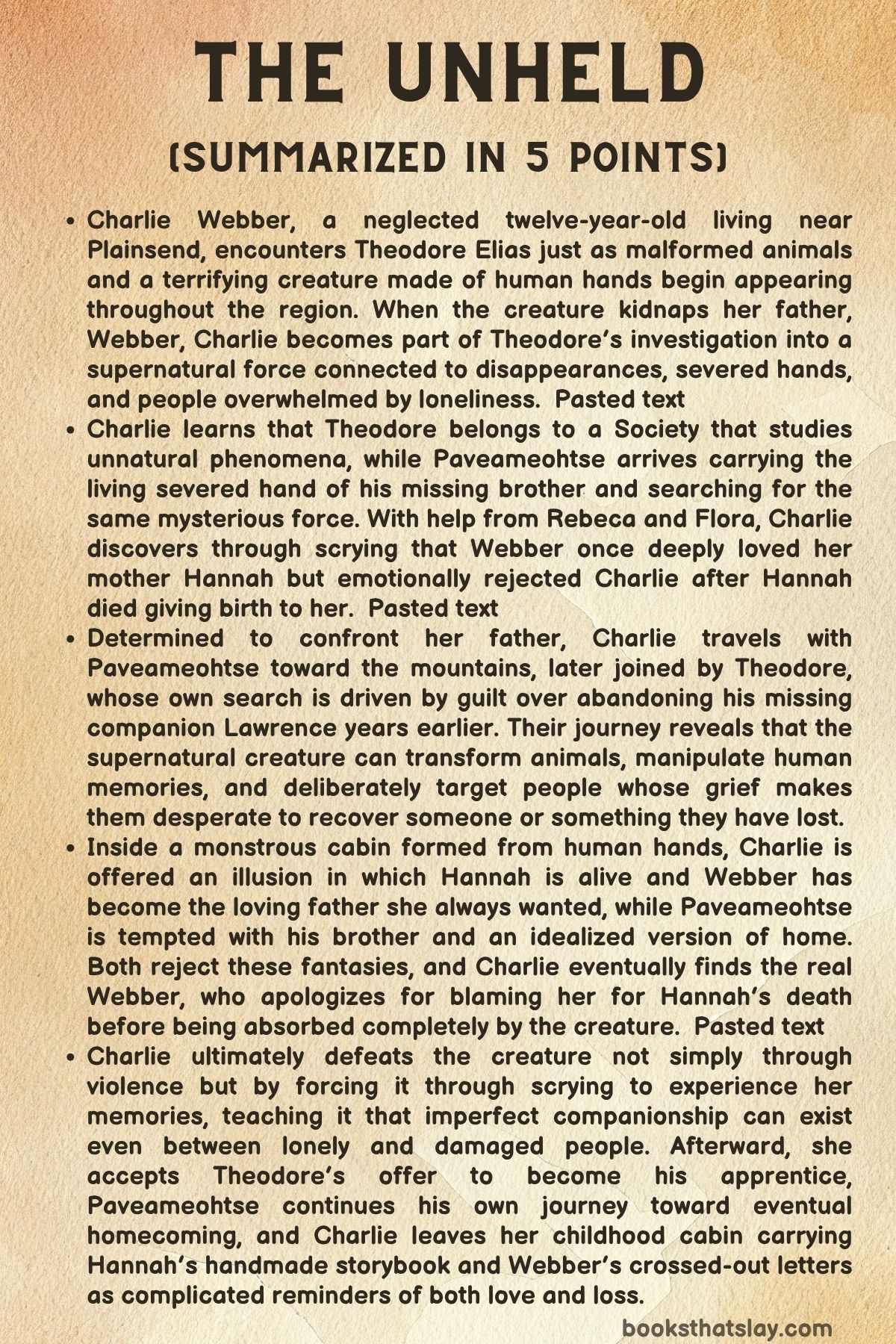
Summary
Charlie Webber lives in poverty with her emotionally distant father on the outskirts of Plainsend. Strange changes have been spreading across the region: familiar wildlife is vanishing while malformed creatures appear in its place, including headless coyotes, unusual birds, hollow mountain lions, and other animals whose bodies seem to have been altered by an impossible force.
Charlie has grown accustomed to being treated as an outsider. The townspeople see her as dirty and nearly feral, while her father, Webber, provides food and shelter but almost no emotional warmth; during a visit to town, Charlie meets Theodore Elias, an elegant collector whose curiosity about abnormal objects makes him unlike anyone she has known.
Theodore has opened a Curioshop in Plainsend after leaving New York and the mysterious Society with which he is associated. He is not merely collecting oddities, however, because he has traveled west while searching for Lawrence, a former companion who disappeared while investigating phenomena similar to those now affecting Plainsend.
When Charlie tells Theodore that Webber owns a four-winged owl, Theodore visits their cabin and purchases it. He also sees headless chickens that remain alive despite their condition, convincing him that the abnormalities around Plainsend are connected to something far beyond ordinary mutation.
Charlie secretly hopes Theodore’s money might give her a way to escape her current life. Her mother’s red storybook has long provided one of her few comforts, while Webber’s rare attempts to teach her to read remain among the closest moments the two have ever shared.
One night Charlie discovers something completely different from the altered animals. A creature composed of numerous human hands appears near the family’s shed, and after Charlie shoots at it, Webber pursues it because he immediately begins thinking about how much money such a creature might bring.
Webber successfully captures the hand-creature and brings it into Plainsend. Rather than recognizing the danger, he turns the discovery into a public spectacle, inviting townspeople to pay for the opportunity to see it at his homestead.
During the gathering, Charlie receives something she has wanted for years when the drunken Webber suddenly embraces her and treats her affectionately. Yet the experience becomes painful because she understands that his tenderness depends on alcohol and the attention of the crowd rather than a lasting change in their relationship.
The creature itself behaves strangely around Charlie. Its mass of hands repeatedly forms gestures and shapes that seem directed specifically toward her, leading Theodore to suspect that she matters to whatever intelligence controls it.
The next morning Charlie reaches toward her sober father, hoping he might repeat the affection he showed the previous night. Webber does not understand what she wants, and the rejection intensifies years of resentment.
In anger Charlie frees the captive creature so that Webber cannot profit from it. The beast immediately seizes her, but rather than simply attacking, it offers her different hands until it produces one that feels like the gentle mother Charlie has spent her childhood imagining.
Charlie begins following willingly. Webber finally fires at the beast, but his shot tears two fingers from Charlie’s hand, after which he attacks the creature directly and is dragged into the forest.
Theodore rescues Charlie and cares for her injuries. Although he suggests that Webber’s final attack may have been an attempt to save her, Charlie refuses to let one desperate action erase years of neglect.
A memory from Charlie’s childhood explains why the creature’s imitation of her mother is so powerful. During the only earlier hunting trip she took with Webber, Charlie discovered an abandoned forest cabin where a woman’s voice called her Charlotte, claimed to have given her the red book, and spoke with the affection Charlie associated with her dead mother.
Webber reacted with terror when he discovered Charlie there. His refusal to explain the cabin reveals that the supernatural presence had touched their family long before the creature openly appeared around Plainsend.
After Webber’s disappearance, Theodore and Charlie discover one of his severed hands at the cabin. Theodore recognizes the pattern because other people taken by the same phenomenon have left behind hands that seem to function as both evidence and invitations.
Another traveler, initially known as Patton, possesses a similar living hand belonging to his missing brother. His real name is Paveameohtse, and he has crossed the country following the hand after being exiled from his Northern Cheyenne community over events connected to his brother’s apparent death.
Paveameohtse’s past is shaped by painful divided loyalties. He worked with the Indian Police during a period of hunger and coercive control, eventually arresting his own brother while serving a system that harmed the people he loved.
Theodore’s former mentor, Rebeca Osorio, soon arrives with her young apprentice, Flora. Through them, Charlie learns that Theodore belongs to a Society dedicated to studying strange phenomena and that such investigation depends upon careful observation, specialized tools, and dangerous practices such as scrying.
Scrying allows someone to enter another person’s memories through blood and physical contact. When Rebeca examines Charlie’s memories, she discovers evidence that the hand-creature has repeatedly focused its attention on Charlie rather than merely attacking at random.
The danger soon reaches Plainsend directly when a wolf altered by human hands attacks the saloon. Bartley, the saloon keeper who had reassured Charlie that she belonged in Plainsend, is killed, while Theodore is badly wounded.
The creature again seeks Charlie. A second one of Webber’s hands appears from the wolf’s mouth, strengthening the idea that the beast is attempting to communicate rather than simply destroy.
Charlie eventually uses Rebeca’s scrying equipment on Webber’s severed hand. She experiences her father’s past from inside his memories and discovers the life he had before she was born.
Webber once struggled desperately to learn to read from Hannah Foster, gradually remaining near her because he had fallen in love with her. They married, built a home, and prepared happily for their child, while Hannah created the red storybook that would later become Charlie’s most treasured possession.
Hannah died giving birth to Charlie. Webber’s grief transformed into resentment, and Charlie sees him confess at the mysterious forest cabin that he never wanted his daughter without Hannah and blamed the surviving child for the loss of his wife.
The memories also show that Webber’s feelings were never completely empty. Teaching Charlie to read with Hannah’s book repeated the way Hannah once taught him, suggesting that even his limited attempts at fatherhood carried traces of the woman he loved.
The supernatural force interrupts the memory and shows Charlie the forest cabin where Webber has been taken. She decides to follow, not because she has forgiven him, but because she wants the opportunity to confront him while he is still alive.
Charlie and Paveameohtse travel toward the mountains and encounter a railroad camp whose surviving workers have been trapped by repeated attacks from abnormal creatures. An enormous moose with human hands attacks the camp, but Charlie and Paveameohtse discover that one of Theodore’s Society instruments, a resonating tuning fork, can seriously harm the creature.
Theodore eventually catches up with them. Charlie confronts him over his own past, forcing him to admit that when Lawrence pursued the phenomenon years earlier, Theodore failed to follow.
Lawrence’s severed hand eventually reached Theodore, but Theodore waited so long that it stopped moving. His journey to Plainsend has therefore been driven by the knowledge that fear prevented him from acting when Lawrence might still have been recoverable.
Charlie, Paveameohtse, and Theodore enter a forest transformed by wildfire smoke and finally reach an impossible clearing. Human arms rise from the earth, and the abandoned cabin has become a living structure apparently formed from flesh and hands.
Inside, the creature does not rely primarily on physical violence. It creates individualized worlds designed around each person’s deepest loneliness.
Charlie sees Hannah alive and loving, with a perfect version of Webber completing the family she always wanted. The fantasy almost succeeds because it provides every form of affection missing from her childhood.
A changed version of Hannah’s story about a girl and a dragon exposes the danger, however. Charlie realizes that the creature selects lonely people because their desire for connection makes them willing to surrender themselves.
Paveameohtse receives a different temptation. He sees his brother alive within an idealized version of home untouched by forced settlement, hunger, his police service, or the arrest that divided them.
He recognizes that the vision is false precisely because it erases responsibility and consequence. Rather than allowing the creature to rewrite the past, he accepts that his brother is dead and that no perfect version of history can undo their final conflict.
Theodore initially hesitates outside the cabin, repeating the same pattern that destroyed his chance to follow Lawrence. This time he enters, choosing to risk himself rather than leave Charlie and Paveameohtse to face the creature alone.
Charlie eventually finds Webber inside the structure. He is alive but weakened, with both arms gone, and father and daughter finally speak openly about the pain between them.
Webber apologizes for blaming Charlie for Hannah’s death and admits that she deserved a better father. Charlie understands the grief that shaped his behavior but refuses to pretend that understanding cancels the damage he caused.
Their conversation gives both of them something that years of silence denied them. Before the structure absorbs Webber completely, he tells Charlie that he loves her and directs her toward letters hidden inside his mattress.
Using the scrying ring on the creature’s countless hands, Charlie experiences memories from people absorbed across generations. She witnesses displacement, enslavement, murder, separation, forced removal, abandoned families, and many other forms of loss.
The creature therefore proves to be more than a predator hiding in the forest. Its body has accumulated the suffering of people whose loneliness and grief made them vulnerable to its offers.
Charlie discovers that being directly seen through scrying causes the hands to recoil. After Paveameohtse helps create an escape, Charlie nevertheless refuses to leave Theodore behind.
She finally offers herself in exchange for Theodore and Paveameohtse. Once they are released, she takes Webber’s hand and reverses the creature’s usual relationship with human memory.
Instead of letting the beast show her what she wants, Charlie allows it to experience her mind. She forces it to feel her hunger, resentment, isolation, affection, ordinary routines, grief, and the complicated bond she shared with Webber.
The creature experiences something it has never properly understood. Charlie and Webber were both lonely, yet even their damaged relationship sometimes contained companionship, such as the quiet memory of Charlie reading while her drunken father fell asleep nearby.
Nothing in that memory repairs the family. Its importance lies in showing that imperfect human presence can matter even when it fails to satisfy every longing.
That discovery breaks something in the creature’s endless hunger. The monstrous structure eventually becomes an ordinary cabin again, and the strange force disappears.
Charlie awakens several days later having lost her left hand. She learns that Hannah’s red book was never a published collection but something her mother personally wrote for her, providing unmistakable evidence that Hannah loved the daughter she would never live to raise.
Theodore survives and finally buries Lawrence’s severed hand, accepting that preserving it had become a way of avoiding grief. When Charlie visits him, he admits that he originally treated her as a useful connection to his investigation and that her courage exposed his own failures.
Charlie refuses to accept his shame as the complete truth because Theodore also helped save her. Their relationship changes when he accidentally calls her his apprentice and then formally offers her that position.
Paveameohtse leaves after recognizing that his brother is truly gone. He does not treat the creature’s disappearance as automatic forgiveness for his earlier choices, choosing instead to complete his exile before eventually returning to his people.
Charlie later returns to her childhood cabin with Theodore. She acknowledges that Webber’s late apology cannot repair the years behind them, yet his failures do not prevent her from grieving him.
Inside the mattress she finds the letters Webber mentioned. They are addressed to Charlie, but almost every sentence has been crossed out, leaving behind evidence of a man who repeatedly tried to speak to his daughter and repeatedly defeated himself before the words could reach her.
Charlie leaves carrying Hannah’s storybook and Webber’s unreadable letters. One inheritance gives her the love she had always questioned, while the other preserves the painful reality of a father whose feelings existed but were too damaged to become the care she needed.
Characters
Charlie Webber
Charlie is the emotional center of The Unheld, and her development depends on the difference between wanting love and accepting the imperfect forms in which human attachment sometimes exists. At twelve, she is already unusually self-reliant because poverty, isolation, and Webber’s emotional neglect have forced her to perform responsibilities that should never have belonged entirely to a child.
Her roughness is partly defensive. Charlie fights when mocked, handles weapons, hunts, repairs clothing, and speaks bluntly because vulnerability has rarely brought her comfort, yet beneath that toughness is a child intensely sensitive to every sign that she may be wanted.
Her longing for her mother provides the creature with its strongest means of influencing her. Charlie does not merely miss Hannah as a real person; she has built an imagined mother capable of supplying tenderness, protection, and reassurance that Webber cannot provide.
Her feelings toward Webber are equally complicated. She can be furious with him, reject the expectation that she must save him simply because he is her father, and still desperately want him to choose her over money, grief, or his memories of Hannah.
Charlie’s greatest growth occurs when she stops treating love as something that must erase pain. Seeing Webber’s memories helps her understand him without excusing him, allowing compassion and anger to exist together.
Her confrontation with the creature demonstrates the same maturity. Instead of accepting a perfect fantasy, Charlie ultimately chooses damaged relationships, uncertain futures, and genuine people whose love will always carry limitations.
Webber
Webber is one of the most tragic figures in The Unheld because his failures as a father emerge from grief without being justified by it. He once possessed warmth, humor, ambition, and deep love for Hannah, making his later emotional withdrawal even more painful.
Hannah’s death during Charlie’s birth leaves Webber unable to separate his daughter from the moment his wife died. Rather than processing that loss, he turns Charlie into a living reminder of what he believes was taken from him.
His parenting therefore operates at the level of survival rather than affection. He feeds Charlie, teaches her practical skills, and once teaches her to read, but he withholds the reassurance and physical tenderness she repeatedly needs.
The reading lessons reveal the contradiction within him. By teaching Charlie through Hannah’s red book, Webber unconsciously passes Hannah’s love forward, even while insisting through his behavior that Charlie should expect little from him.
His final apology matters because it is sincere, but the novel does not treat it as a complete repair. Charlie can understand that her father loved her in a damaged and limited way while still recognizing that he failed her throughout most of her childhood.
The crossed-out letters offer the clearest symbol of Webber’s character. He repeatedly tries to communicate, repeatedly destroys his own words, and leaves Charlie with evidence of emotion rather than the emotional presence she needed while he was alive.
Theodore Elias
Theodore initially appears in The Unheld as the opposite of Plainsend’s suspicious townspeople. Strange objects excite rather than frighten him, and his elegant appearance, extensive travel, unusual knowledge, and willingness to take Charlie seriously expose her to a world larger than the one she has known.
His curiosity, however, contains a serious weakness. Theodore can transform danger into intellectual fascination because observation allows him to remain emotionally removed from the consequences of what he studies.
Lawrence’s disappearance exposes this flaw. Theodore spends years telling himself that preserving hope is different from acting, when the deeper truth is that fear prevented him from following someone he loved.
His relationship with Charlie forces that habit to change. He first approaches her because she is useful to his search, but concern gradually replaces calculation, especially after he recognizes how consistently adults have failed to protect her.
Theodore nevertheless makes mistakes even while caring for her. He sometimes confuses protection with authority, trying to tell Charlie what she must do rather than listening to the reasons behind her choices.
By the end, his offer to make Charlie his apprentice represents mutual transformation. Charlie gains education, travel, and a dependable adult connection, while Theodore accepts responsibility for another person in a way that requires participation rather than observation.
Paveameohtse
Paveameohtse, initially introduced as Patton, brings a different history of displacement, responsibility, and guilt into The Unheld. Even the use of “Patton” reveals how much of his identity has been shaped by navigating white institutions, because the name exists for other people’s convenience rather than expressing who he is within his own community.
His service with the Indian Police places him inside a morally painful contradiction. He accepts work partly because wages and food matter during desperate conditions, yet the position requires him to enforce restrictions against the same people whose suffering he shares.
The arrest of his brother becomes the defining wound of his life. When his brother later disappears and a living severed hand remains behind, Paveameohtse becomes consumed by the possibility that following it might provide rescue, explanation, or redemption.
His encounter with the creature forces him to reject an easier version of forgiveness. The illusion offers his brother alive in a world where historical destruction and personal mistakes can simply disappear, but Paveameohtse understands that such perfection would require abandoning reality.
He eventually accepts that his brother is dead without interpreting that acceptance as personal absolution. Even after the creature disappears, he chooses to respect the period of exile imposed upon him rather than declaring himself forgiven.
His ending restores his true name and a renewed idea of home. He recognizes that home cannot simply mean recovering an untouched past; it can also mean carrying identity forward until returning becomes possible.
Rebeca Osorio
Rebeca represents discipline within the Society and provides an important contrast to Theodore’s impulsive fascination with unusual phenomena. Where Theodore is theatrical and emotionally evasive, Rebeca approaches the supernatural through method, evidence, restraint, and an awareness of consequences.
Her mastery of scrying comes with visible costs. Repeatedly entering other people’s memories has damaged her own, demonstrating that knowledge within this world always demands something from the person seeking it.
Rebeca’s relationship with Theodore combines irritation, authority, concern, and long familiarity. She recognizes patterns in him that he would prefer to disguise, particularly his habit of letting guilt become an excuse for hesitation.
Her treatment of Charlie is demanding because she takes the girl seriously. Instead of assuming childhood means incapacity, Rebeca asks what Charlie knows, what she has observed, and what skills she possesses.
She also offers a model of mentorship that Charlie has never experienced. Education under Rebeca may be strict, but it exists because an adult believes a young person can learn, contribute, and eventually exercise judgment.
Flora
Flora initially represents almost everything Charlie lacks. She has clean clothing, Society training, access to specialized knowledge, an adult mentor, and an established place within a larger organization.
This creates tension between the girls because Charlie interprets Flora’s confidence as another reminder of her own exclusion. Flora, however, quickly proves that she is more complicated than the privileged apprentice Charlie first imagines.
Both girls are shaped by disrupted relationships with their mothers. Charlie’s mother is dead and survives through imagination and a book, while Flora has a living mother whose identity and presence have largely been withheld from her.
Their developing friendship gives Charlie her first meaningful peer connection. Flora restrains Charlie when necessary, tends her injuries, argues against reckless choices, lends her boots, and gradually becomes someone who can disagree with Charlie without rejecting her.
Flora also shows Charlie what apprenticeship can mean. Her presence helps transform the Society from Theodore’s mysterious background into a possible future built around learning and belonging.
Hannah Foster
Hannah is physically absent from almost the entire novel, yet her influence reaches nearly every part of Charlie’s emotional life. Charlie initially knows her through Webber’s sleep-talk, imagination, the red storybook, and the supernatural figure that borrows Hannah’s appearance.
The memories revealed through scrying show Hannah as patient, educated, affectionate, and central to Webber’s transformation as a young man. Teaching him to read becomes the beginning of their relationship, later echoed when Webber teaches Charlie.
Her death creates the central rupture in the Webber family. Charlie grows up believing that she may somehow be responsible for Hannah’s absence, while Webber allows his grief to reinforce that fear through emotional distance.
The discovery that Hannah personally wrote the red storybook changes Charlie’s understanding of herself. The book proves that Hannah anticipated her child, imagined stories for her, and loved her before birth.
Hannah therefore becomes more than the perfect mother imagined by Charlie or imitated by the creature. Through her own writing, she leaves Charlie something authentic that does not depend upon supernatural fantasy.
Lawrence
Lawrence is essential to understanding Theodore even though he is absent from the immediate action. His disappearance defines the difference between Theodore’s preferred image of himself and the person Theodore actually became when confronted with serious danger.
Lawrence pursued the phenomenon with increasing obsession after studying patterns of disappearance, abnormal creatures, and communities marked by suffering. When he eventually followed the force directly, Theodore failed to accompany him.
The later arrival of Lawrence’s severed hand gives Theodore another opportunity to act. Instead, he waits until the hand becomes still, allowing the possibility of rescue to become another source of guilt.
Lawrence therefore functions as both lost companion and moral memory. Theodore’s decision to enter the cabin after Charlie and Paveameohtse reflects his refusal to repeat the abandonment that has haunted him for years.
Burying Lawrence’s hand at the end finally separates remembrance from denial. Theodore can honor the person he lost without preserving a decaying remnant as a substitute for accepting death.
The Beast
The beast is the supernatural center of The Unheld, but it becomes increasingly difficult to describe it as a conventional monster. Its changing forms include masses of human hands, altered wolves, malformed moose, corrupted wildlife, severed hands, human imitations, and finally an entire living structure.
Its greatest weapon is not physical strength but psychological recognition. The beast studies absence and understands that people often become most vulnerable when they are offered exactly what grief has taught them to desire.
Charlie is offered her mother and an affectionate father. Paveameohtse is offered his brother and an undamaged homeland, while the creature’s long history suggests countless previous victims received equally personal invitations.
Its limitation is that it understands longing better than relationship. It assumes loneliness can only be answered by complete satisfaction and therefore cannot initially comprehend imperfect companionship.
Charlie’s reversed scrying forces it to experience emotional life from inside an actual human consciousness. The memory of Charlie reading beside Webber teaches it that two people can remain wounded, dissatisfied, and lonely while still giving one another a form of presence.
Its disappearance therefore follows understanding rather than simple destruction. Whether it dies, changes, disperses, or becomes something else remains uncertain, but Charlie believes it may finally have learned another way to exist.
Bartley
Bartley plays a relatively small but emotionally important role in Charlie’s life. As the Plainsend saloon keeper, he represents a community that Charlie has assumed views her only through the reputation of her father and the poverty of their household.
His reassurance that she belongs in Plainsend affects her because belonging has rarely been stated so plainly to her. He acknowledges her as part of the town rather than treating her as an inconvenience attached to Webber.
His death during the hand-wolf attack gives the conflict a personal cost. The beast does not threaten only distant missing people or dysfunctional families; it destroys members of the ordinary community that has only just begun to open itself to Charlie.
Wen
Wen emerges among the surviving railroad workers after the group has been reduced by repeated attacks from malformed creatures. His experience demonstrates how the supernatural disturbance has spread beyond Plainsend into communities already trapped by dangerous working conditions and coercive authority.
After the controlling overseer dies, Wen assumes responsibility for the two younger workers Charlie informally thinks of as John and Joe. His willingness to care for them creates a small example of family formed through choice rather than blood.
Charlie notices this immediately because she has spent her childhood lacking reliable care within her biological family. Wen quietly demonstrates that responsibility can grow from circumstance, compassion, and commitment.
Warren
Warren is another survivor of the railroad camp whose injuries testify to the prolonged struggle against the altered animals. The explosions heard from Plainsend were not evidence of successful railroad construction but desperate defensive measures, and Warren bears the physical consequences of that reality.
His later kindness toward Charlie matters because it arrives without bargaining. Giving her food and remaining nearby during her recovery helps her recognize that people can care about her survival even when they gain nothing from doing so.
Warren therefore contributes to the gradual expansion of Charlie’s idea of community. Her future does not need to depend entirely upon one failed parent or one replacement guardian.
John and Joe
The two younger railroad workers, whom Charlie thinks of as John and Joe, remain less individually developed than the central characters, but their presence has thematic importance. Charlie notices their neglected condition because it resembles aspects of her own childhood.
Seeing Wen take responsibility for them shows her that vulnerable children do not necessarily have to face hardship alone. The small family forming among the railroad survivors provides another alternative to the damaged household Charlie has always considered normal.
Paveameohtse’s Brother
Paveameohtse’s unnamed brother exists largely through memory, guilt, and the severed hand that guides Paveameohtse westward. His resistance to oppressive conditions places him in conflict with the institutional role Paveameohtse has accepted.
Their relationship becomes inseparable from Paveameohtse’s shame over arresting someone he loved while enforcing rules he did not truly support. The brother’s disappearance leaves Paveameohtse unable to determine whether he is pursuing rescue, forgiveness, punishment, or proof of what actually happened.
The creature exploits this uncertainty by producing a version of the brother willing to forgive everything. Paveameohtse’s refusal of that fantasy honors the real man more fully because it preserves his anger, his choices, and the unresolved complexity of their relationship.
Ansel
Ansel appears within Theodore’s account of earlier investigations and helps establish that the phenomenon existed long before Charlie encountered it. He is a grieving young man whose family has died, making him precisely the kind of isolated person the beast knows how to approach.
His disappearance and the severed hand left behind provide an earlier version of the pattern later repeated with Lawrence, Webber, and Paveameohtse’s brother. Through Ansel, the book shows that the beast’s methods are systematic rather than unique to the people gathered around Plainsend.
Themes
Loneliness, Connection, and the Need to Be Seen
Loneliness in The Unheld is not simply the absence of other people. Charlie lives beside her father yet feels unwanted, Webber remains trapped inside grief while raising a daughter, Theodore surrounds himself with objects and Society knowledge while refusing to confront Lawrence’s loss, and Paveameohtse travels toward his brother while separated from his community.
The beast survives because it recognizes these emotional absences and offers apparently complete solutions. It gives Charlie a loving mother, gives Paveameohtse his brother and home, and repeatedly adopts forms calculated to make people choose fantasy over the painful limitations of reality.
Charlie defeats that logic by showing the creature that loneliness and companionship can coexist. Her memory of reading while Webber sleeps nearby contains no miraculous reconciliation, yet the two people occupy the same imperfect human moment.
That distinction becomes the novel’s deepest challenge to the creature. Genuine connection does not always cure grief, erase resentment, restore the dead, or satisfy every emotional need, but it can make loneliness bearable without requiring a person to surrender reality.
Charlie’s future reflects that principle. Theodore, Flora, Rebeca, Paveameohtse, and the people of Plainsend cannot replace Hannah or transform Webber into the father Charlie wished he had been, but together they prove that belonging can be built from many incomplete relationships.
Grief Without Erasure
Grief repeatedly becomes dangerous when characters try to preserve the lost person so completely that they cannot continue living honestly. Webber allows Hannah’s death to define his relationship with Charlie, Theodore keeps Lawrence’s severed hand rather than accepting what its stillness means, and Paveameohtse crosses enormous distances because his brother’s living hand allows hope to remain unresolved.
The beast uses this resistance to finality. It does not merely imitate dead or missing people; it offers a world in which loss itself can be cancelled.
Charlie eventually rejects that bargain because recovering an ideal mother would require abandoning everything she has actually lived through. Paveameohtse similarly understands that a brother who forgives without anger and a homeland untouched by violence would not represent true restoration but the destruction of memory.
Webber’s death gives Charlie the most personal version of this lesson. His late apology cannot produce the childhood she should have had, and her anger does not prevent her from missing him.
The novel therefore allows grief to remain contradictory. Mourning someone does not require declaring that person good, forgiving every failure, or pretending that love and injury cannot occupy the same relationship.
Responsibility, Guilt, and the Limits of Redemption
Many characters carry guilt, but the story repeatedly distinguishes guilt from meaningful responsibility. Theodore’s shame over Lawrence initially leaves him passive, Webber’s grief becomes an excuse for emotional withdrawal, and Paveameohtse’s remorse over his brother threatens to turn his entire life into punishment.
Charlie forces the people around her to confront the difference between feeling guilty and acting differently. Theodore cannot change what happened to Lawrence, but he can enter the cabin when Charlie and Paveameohtse need him rather than repeating his earlier retreat.
Webber cannot repair Charlie’s childhood in one final conversation. His apology matters because he finally acknowledges the harm accurately, yet the story refuses to convert confession into automatic forgiveness.
Paveameohtse likewise refuses easy absolution. Even after learning that the supernatural creature played a role in his brother’s disappearance, he does not decide that outside forces erase his own choices.
Redemption therefore appears as an ongoing practice rather than a single moment of pardon. Characters move forward by accepting consequences, changing their behavior, and carrying memory without allowing shame to become another form of self-centered escape.
Home, Identity, and Chosen Belonging
Home changes meaning repeatedly throughout The Unheld. Charlie begins with a physical cabin that provides shelter but little emotional security, while Paveameohtse carries memories of a homeland transformed by forced settlement, hunger, institutional control, and displacement.
The beast exploits the desire to return. Its illusions present home as a place where history can be reversed, dead relatives restored, mistakes erased, and relationships perfected.
Both Charlie and Paveameohtse eventually understand that such a home cannot exist without denying reality. Paveameohtse recognizes that the world remembered from childhood was already shaped by forces older than himself, while Charlie realizes that even the loving family presented by the beast is false because it requires Hannah to be alive and Webber to become someone he never was.
Charlie ultimately refuses to burn the Webber cabin because she no longer needs to destroy the past in order to leave it. The building can remain while she chooses a different future through apprenticeship, travel, education, friendship, and a wider community.
Paveameohtse reaches a parallel understanding when he decides to carry home within himself until he can return. In both cases, belonging becomes something created through memory, responsibility, identity, and chosen relationships rather than something guaranteed by geography or blood.