The Unknown by Riley Sager Summary, Characters and Themes
The Unknown by Riley Sager is a psychological horror thriller about ambition, guilt, performance, exploitation, and the dangerous stories people construct around unexplained events.
The novel follows struggling actress Marin Keane after she unexpectedly receives the leading role in a film being prepared on New Avalon, an isolated Vermont island associated with a century-old disappearance. What begins as an extraordinary professional opportunity becomes a carefully engineered nightmare involving staged hauntings, buried histories, sexual misconduct, revenge, and murder. By repeatedly challenging the distinction between acting and reality, the story makes nearly every character both performer and audience to someone else’s deception.
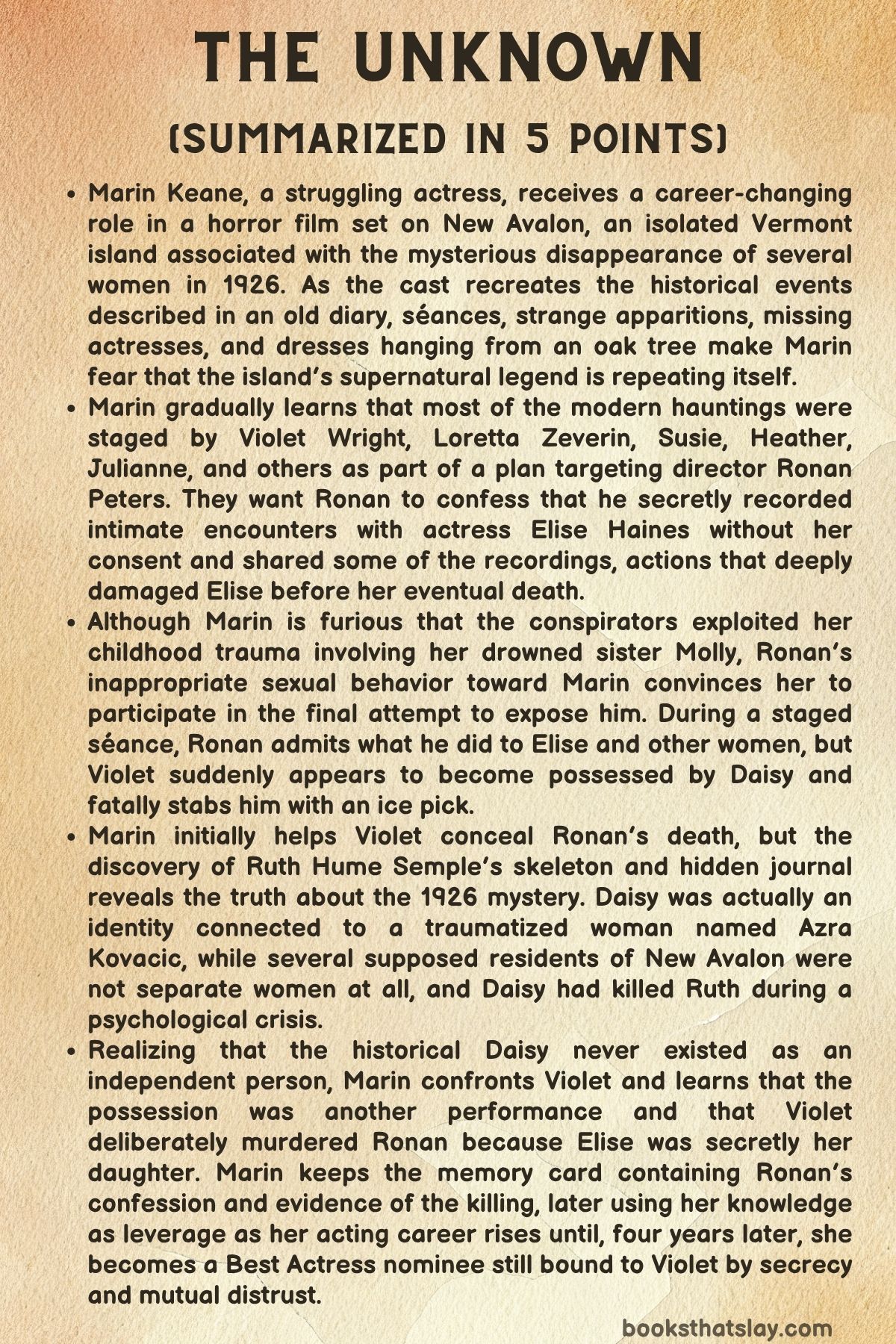
Summary
Marin Keane is a struggling actress working as a waitress in New York when her agent unexpectedly sends her to audition for acclaimed director Ronan Peters. Ronan is preparing a horror film about New Avalon, a remote island in Vermont where several women supposedly vanished in 1926 after participating in séances and contacting an entity called Azra.
Rather than giving Marin an ordinary audition, Ronan asks about her childhood and invites her to tell him something frightening. Marin discusses seeing what she believed was a ghost but avoids revealing the full story of her older sister Molly, whose death has shaped much of her life.
Marin is astonished when she receives the role. She is replacing Lindy Garrett, an actress who supposedly left the production, and she soon learns that the cast will spend several days living on New Avalon before filming begins.
Producer Loretta Zeverin escorts Marin to the island, where boatman Pete recounts the legend surrounding New Avalon. In 1926, Ruth Hume Semple and several women living there disappeared, leaving behind dresses hanging from an oak tree and an incomplete diary associated with a young woman named Daisy.
Even before Marin reaches shore, Lindy sends her a warning telling her not to go onto the island. Marin is frightened but chooses professional opportunity over caution.
On New Avalon, Ronan explains his unusual preparation process. The actresses must live as the women supposedly did in 1926, wear period clothing, surrender their phones, stay in primitive cottages, and immerse themselves in the historical circumstances behind the film.
Marin meets the other actresses: respected veteran Julianne Brown, television performer Heather Benchley, former child star Susie Hutchinson, and legendary actress Violet Wright. Marin is especially intimidated by Violet, although Violet treats her kindly, while Susie immediately views Marin as an inexperienced outsider who has somehow received a career-changing opportunity.
Marin soon discovers that Daisy, the woman she is playing, is not a minor character. Daisy is the central figure in the screenplay, meaning Marin has been given an enormous responsibility despite having almost no significant film experience.
Ronan provides her with a transcript of Daisy’s surviving diary. According to the document, Daisy came to New Avalon hoping that Ruth Hume Semple and the other women would understand her supposed ability to communicate with spirits.
The diary describes strange protective symbols around the island, séances, unexplained disturbances, and an increasingly threatening presence known as Azra. After one séance, the women become convinced that something dangerous has entered their lives.
The modern cast soon reenacts the historical séance as part of Ronan’s immersive process. At first, some frightening effects are revealed to be manufactured by Ronan and production assistant Brad, angering Heather and making Marin question how far Ronan will go for authentic performances.
Loretta then suggests attempting another séance without the tricks. During this session, the glass moves across letters and produces names connected to dead people in the participants’ lives.
Julianne sees the name Dean, belonging to her deceased first husband. Violet reacts to Frank, her late father, while Marin is shocked when the glass spells Molly even though she believes no one knows her sister’s name.
The glass also spells Elise, causing Ronan to react violently and end the séance. Marin then hears a mysterious voice telling her that she will be last, while Susie later admits that she heard a voice saying she would be first.
Brad suddenly becomes ill, and Loretta takes him to the mainland. She does not return, leaving the others stranded without reliable transportation or communication.
Unexplained sounds continue around Marin’s cottage. She also begins seeing a soaking-wet figure resembling Molly, exactly as Marin remembers seeing her after Molly drowned during childhood.
The next morning, Susie disappears. Her clothing appears hanging high in the oak tree, precisely matching the historical legend and the events described in Ronan’s screenplay.
A digital camcorder discovered in the forest contains footage of Susie secretly recording Ronan in her cottage before later entering the woods alone. Her final recording shows a dark figure rushing toward her before the camera falls.
The group becomes increasingly divided over whether the threat is human or supernatural. Marin suspects Lindy because the former actress knew the screenplay, feared the island, and had been present near the dock when Marin arrived.
Heather disappears next while Marin is communicating with her across the island using flashlight signals. Shortly afterward, Heather’s dress joins Susie’s in the oak.
Julianne becomes convinced that Azra is responsible. Violet admits sensing her dead father, Julianne describes feeling Dean nearby, and Marin finally explains Molly’s death and the childhood apparitions that followed.
Molly drowned in the family swimming pool when Marin was four. The loss devastated Marin’s parents and left Marin growing up beneath the emotional weight of a dead sister she could never replace.
Julianne and Violet carry comparable guilt involving their dead loved ones. Julianne had asked Dean for a divorce shortly before his fatal accident, while Violet regrets choosing an acting opportunity instead of returning home to see her dying father.
The group begins considering whether the apparent spirits are exploiting guilt rather than genuinely representing the dead. Soon afterward, Julianne enters a trance-like state, claims Dean is waiting outside, runs into the mist, and disappears.
With Susie, Heather, and Julianne gone, Marin, Violet, and Ronan become the apparent final survivors. They decide that another séance may be their only way of confronting whatever is happening.
Before the séance occurs, Marin’s perception of Ronan changes drastically. He mistakenly calls her Elise, kisses her without permission, and begins touching her until she pushes him away.
Marin instinctively apologizes because she fears that rejecting a famous director could damage her career. The incident forces her to recognize how unequal their relationship really is.
Marin then discovers occult books and a hidden phone among Violet’s possessions. Combined with Violet and Loretta’s longstanding fascination with New Avalon, the discovery makes Marin suspect that at least part of the nightmare has been deliberately created.
Her suspicion is confirmed when she confronts the supposed ghost of Molly and realizes that the figure is actually Susie in disguise. Susie, Heather, and Julianne are all alive.
Violet explains that Brad’s illness, Loretta’s departure, the disappearances, the hanging dresses, the camcorder footage, and many supernatural incidents were staged. Marin was deliberately kept ignorant because her genuine terror would make the deception more believable.
The actual target is Ronan.
Elise Haines was a young actress involved with him. Ronan secretly recorded sexual encounters without her consent and circulated at least one recording among other men.
After learning what had happened, Elise suffered severe personal and professional consequences and later died from an overdose. Violet, Loretta, Susie, Heather, and Julianne all knew Elise and created the New Avalon scheme to frighten Ronan into admitting what he had done.
Marin is furious because they exploited her trauma surrounding Molly merely to make their deception convincing. She initially refuses to participate in the final phase of their plan.
While alone in her cottage, however, Marin accidentally discovers five missing pages from Daisy’s diary hidden behind the baseboard. The pages radically change what she understands about the historical mystery.
Daisy describes increasingly disturbing memory lapses and eventually realizes that the Darkness she fears appears to resemble herself. Ruth attempts to convince Daisy that the violent events she attributes to an outside force are actually connected to her own actions.
During their final confrontation, Daisy attacks Ruth with a knife, kills her, hides her body, and creates evidence designed to suggest that Ruth disappeared mysteriously. The supposedly supernatural history of the island begins to appear psychological rather than paranormal.
Meanwhile, Ronan’s conversation with Marin about his unwanted advances confirms her new understanding of him. Rather than recognizing what he did wrong, he seems primarily concerned with whether Marin will expose him and continues assuming that sexual possibilities between them remain open.
Marin therefore agrees to help Violet obtain Ronan’s confession. During the planned séance, Marin and Violet are supposed to manipulate the glass so that Elise’s name appears and Ronan becomes frightened enough to admit the truth.
The séance does not proceed according to plan. The glass repeatedly spells Daisy even though neither Marin nor Violet appears to be controlling it.
Violet suddenly becomes violently ill and then begins behaving like someone else. Her voice, movements, and knowledge change, and she identifies herself as Daisy.
Marin exposes the entire conspiracy in front of Ronan in an attempt to determine whether Violet is merely acting. Ronan learns that the missing women are alive, but Violet continues behaving as though she does not understand what Marin is revealing.
Under pressure, Ronan finally admits secretly recording Elise without her knowledge. He acknowledges doing similar things to other women and sharing recordings, although he repeatedly minimizes his actions and refuses to accept responsibility for the damage he caused.
The apparent Daisy then takes an ice pick and attacks Ronan. Violet repeatedly stabs him until he dies.
Moments later, Violet seemingly returns to herself and claims to remember nothing. Marin initially accepts the possibility that something inexplicable happened because Violet’s transformation was extraordinarily convincing.
Knowing that police are unlikely to believe a possession defense, Marin helps Violet conceal the killing. They throw Ronan’s body from the cliffs, clean the parlor, destroy evidence, and discard the camcorder containing both his confession and the murder recording.
Yet unexplained noises continue beneath Marin’s cottage. Following the sound, Marin removes floorboards and discovers a century-old skeleton along with another journal.
The remains belong to Ruth Hume Semple.
Ruth’s journal reveals that the accepted history of New Avalon is fundamentally wrong. New Avalon was not primarily a spiritualist commune but a private refuge where Ruth attempted experimental psychological treatments for women who might otherwise have been imprisoned or institutionalized.
Her final patient was a severely traumatized young woman named Azra Kovacic, who had killed her abusive father. Azra presented multiple identities or perceived personalities, with Daisy becoming the dominant one.
Katrina, Jonquil, and Phoebe were not separate women at all. They existed within Azra’s psychological reality.
The séances were actually therapeutic or hypnotic sessions through which Ruth attempted to reach Azra beneath the Daisy identity. As Ruth gradually removed the imagined companions from the therapeutic environment, Daisy interpreted their disappearance as evidence that a murderous supernatural force was taking them.
The dresses hanging in the oak were part of Ruth’s attempts to reinforce the disappearance of these identities. Eventually Daisy resisted Ruth’s efforts, murdered her, buried her beneath the cottage, and created the legend that would survive for a century.
Only Ruth and Azra were real participants in the final historical events. Most importantly, Daisy was never an independent woman who could have returned as a ghost.
Marin immediately understands the implication: Violet could not have been possessed by the historical Daisy.
She confronts Violet at the dock. Violet abandons the supernatural explanation and admits that she deliberately adopted Daisy’s personality during the séance because Ronan’s confession created the opportunity she had been waiting for.
Violet then reveals why Elise mattered so deeply to her. Elise was her daughter.
Violet had concealed the relationship publicly because Elise had been born from an affair with a married man, although mother and daughter remained connected privately. Violet therefore viewed Ronan not simply as a predator who harmed another actress but as the man whose actions helped destroy her daughter’s life.
Marin announces that she intends to reveal the murder, but Violet believes she has already destroyed the evidence needed to prove it. The diaries and camcorder are gone, and Ronan’s body has been positioned to make his death appear accidental.
Marin then reveals that she removed the camcorder’s memory card before Violet threw the device into the lake. The recording of Ronan’s confession and the circumstances surrounding the séance therefore still exist.
Violet asks Marin what she wants in exchange for remaining silent. Marin responds that she wants what she has always wanted: to become known.
Four years later, Marin has achieved extraordinary success and attends the Academy Awards as a Best Actress nominee. Ronan’s death has officially been ruled an accident, and his reputation as a celebrated filmmaker has survived because the full truth about his conduct was never released publicly.
Violet and Loretta have helped Marin advance professionally, while the memory card gives Marin continuing leverage over Violet. Their connection is therefore built not on trust but on mutually dangerous knowledge.
The historical mystery also retains one final uncertainty. Marin finds a 1931 photograph of a Toronto woman named Zara McCutcheon whose appearance closely resembles Ruth’s drawing of Azra.
The rearrangement of Azra’s name and the daisy worn in the photograph suggest that Azra may have survived New Avalon after killing Ruth. The novel therefore ends by refusing to make every mystery completely certain.
As Marin waits at the Academy Awards for the announcement of Best Actress, she has transformed from an unknown waitress into exactly what she once desired: someone whose name the world recognizes. Yet her success rests partly on silence, coercive leverage, concealed murder, and the compromises she once believed fame would free her from.
Characters
Marin Keane
Marin is the central consciousness of the novel and the character through whom uncertainty becomes both frightening and psychologically revealing. The Unknown presents her as someone desperate for professional recognition but also deeply vulnerable to situations in which powerful people determine whether she will remain invisible or finally matter.
Her childhood was defined by Molly’s drowning and by the emotional collapse of her parents afterward. Because she grows up beneath the memory of an idealized dead sister, Marin develops a complicated relationship with attention: she fears being overlooked, yet she also carries an almost desperate desire to become visible.
Acting gives her a way to satisfy that desire. Becoming another person allows her to escape the identity of the surviving daughter while also giving her the possibility of being watched, admired, and remembered.
Her decision to remain on New Avalon despite multiple warnings therefore comes from more than simple ambition. Marin understands that opportunities of this magnitude rarely reach unknown actresses, and she fears that leaving would mean returning to a life in which nobody knows her name.
This insecurity also affects her relationship with Ronan. She initially interprets his attention as validation, believing that his faith in her talent proves that she belongs beside established actresses such as Violet.
When Ronan crosses a sexual boundary, Marin’s immediate concern about offending him reveals how thoroughly professional hierarchies have shaped her instincts. She recognizes discomfort but simultaneously calculates what resistance might cost her.
Marin’s development becomes especially significant once she discovers that Violet and the others have manipulated her. The staged Molly apparition is not simply a frightening trick; it turns the most intimate trauma of Marin’s childhood into equipment for someone else’s plan.
Her eventual participation in the final scheme against Ronan is therefore morally complicated. She is no longer the uninformed victim of a performance but someone consciously choosing deception because she has concluded that Ronan’s behavior deserves exposure.
The ending completes this moral transformation without presenting it as uncomplicated victory. Marin obtains fame, but she does so partly by withholding evidence of murder and using that evidence as leverage over Violet.
Her final ambition has therefore been fulfilled at considerable ethical cost. She becomes known, yet the person who becomes famous is also someone capable of accepting secrets, bargains, and compromises that the earlier Marin might have found shocking.
Violet Wright
Violet initially appears to represent everything Marin hopes to become: respected, controlled, extraordinarily talented, and powerful enough to move through the film industry without obvious insecurity. In The Unknown, that public image gradually proves to be only one of several roles Violet knows how to perform.
Her treatment of Marin is often generous, which makes the later revelation of her manipulation more troubling. Violet can show genuine warmth while simultaneously participating in a plan that uses Marin’s deepest grief as a weapon.
Her acting ability becomes central to the final deception. When Violet appears to transform into Daisy during the séance, Marin has difficulty deciding whether the event is supernatural precisely because Violet is capable of inhabiting another identity with extraordinary conviction.
That talent ultimately becomes the perfect instrument for murder. Violet does not merely pretend to be Daisy for theatrical effect; she uses performance to create an explanation for killing Ronan and then continues the performance afterward by claiming to remember nothing.
Elise’s identity as Violet’s daughter transforms Violet’s motives. Her actions are not simply those of an actress helping friends punish an abusive filmmaker but those of a mother seeking revenge against the man she believes contributed to her daughter’s destruction.
That grief does not make Violet’s behavior morally simple. She participates in psychological cruelty toward Marin, constructs a dangerous deception, murders Ronan after obtaining his confession, and then expects others to preserve the story she has created.
Violet therefore demonstrates how grief can coexist with calculation. She is capable of love, loyalty, manipulation, violence, and extraordinary self-control without any one quality canceling the others.
Her final relationship with Marin is especially revealing. Each woman possesses information that could ruin the other, turning their later professional connection into a quiet system of mutual dependence and distrust.
Ronan Peters
Ronan initially appears to be the brilliant filmmaker capable of recognizing talent that everyone else has overlooked. The Unknown gradually dismantles that image by showing how artistic authority can become inseparable from personal entitlement.
His method directing provides an early warning. Ronan believes that fear, uncertainty, and discomfort can produce better performances, allowing him to justify manipulative behavior as artistic necessity.
Because he occupies a position of enormous professional power, younger actresses cannot interact with him as equals. Marin’s attraction to him is complicated by the fact that he controls a career opportunity capable of changing her life.
His sexual advance toward Marin exposes this imbalance clearly. Ronan behaves as though mutual attraction can be assumed, while Marin worries that rejecting him could have professional consequences.
The revelations about Elise show that this behavior belongs to a broader pattern. Ronan secretly records sexual encounters without consent and admits that other women have also been subjected to similar conduct.
What makes his characterization especially disturbing is his refusal to understand himself as responsible. Even when confronted, he minimizes his actions and treats the consequences suffered by Elise as disproportionate rather than acknowledging the violation at their center.
His confession demonstrates the difference between admitting facts and accepting responsibility. Ronan can acknowledge what he did while still constructing a version of events in which he remains detached from the harm that followed.
His death therefore occurs immediately after the collapse of the protective story he has built around himself. Yet the later preservation of his public reputation adds another bitter irony: even after death, the celebrated director remains more publicly protected than the women he exploited.
Daisy Rue / Azra Kovacic
The historical mystery at the heart of The Unknown depends on the assumption that Daisy Rue and Azra are separate figures. The discovery that Daisy is actually an identity associated with Azra overturns nearly everything Marin and the audience have been encouraged to believe about New Avalon.
Azra’s early life is marked by extreme abuse from her father. After killing him, she comes into Ruth’s care, carrying psychological injuries that Ruth attempts to understand using the limited concepts available during the period.
The personality known as Daisy becomes a protective structure through which Azra experiences reality. Katrina, Jonquil, and Phoebe appear to function similarly, giving form to different aspects of a fractured psychological world.
From Daisy’s perspective, these women are completely real. Their disappearances therefore feel like murders, while Ruth’s therapeutic attempts appear to confirm the existence of a hostile force.
This makes Daisy both dangerous and tragic. Her interpretation of events is false, yet it emerges from genuine terror, trauma, and confusion rather than calculated dishonesty.
Her identification of the Darkness as something external allows her to separate herself psychologically from violent actions. Missing time, disturbing dreams, and evidence she cannot explain all suggest behavior occurring outside Daisy’s conscious awareness.
Ruth’s death marks the catastrophic endpoint of this process. Daisy interprets Ruth as aligned with the threatening presence and kills the person attempting to restore Azra’s awareness.
The possibility that Azra later survives complicates the historical conclusion. If Zara McCutcheon is indeed Azra, then the young woman escaped the island and continued living beyond the moment that became legend.
Ruth Hume Semple
Within The Unknown, Ruth is first presented through mythology as a spiritualist leader associated with séances, occult practices, and the mysterious disappearances on New Avalon. Her journal eventually replaces that legend with a far more complicated portrait.
Ruth is deeply interested in psychological suffering and attempts to create a private environment where troubled women can receive care rather than punishment. This makes New Avalon less a supernatural commune than an experimental refuge.
Her intentions toward Azra appear compassionate. She recognizes that the young woman has endured extraordinary abuse and tries to reach an identity buried beneath the personality calling herself Daisy.
At the same time, Ruth’s methods are experimental and potentially destabilizing. Using séances and staged disappearances as therapeutic instruments may make sense within her theory, but these methods also reinforce Daisy’s belief that an external evil is destroying people around her.
Ruth therefore embodies both care and dangerous certainty. She wants to help Azra but believes strongly enough in her own approach to continue even when Daisy interprets the process as terrifying persecution.
Her death becomes the foundation of the New Avalon legend. Because her body remains hidden beneath the cottage, the historical record transforms therapeutic tragedy into supernatural mystery.
The discovery of Ruth’s journal restores her voice after a century of misunderstanding. It also demonstrates how easily incomplete evidence can turn a complicated human event into folklore.
Susie Hutchinson
Susie initially appears antagonistic because she resents Marin’s sudden arrival and openly questions why an inexperienced actress has received such a valuable role. Her hostility reflects professional insecurity rather than simple cruelty.
As a former child star, Susie understands how quickly attention can disappear. Marin’s unexpected promotion represents the instability of an industry in which one actress’s opportunity often comes from another actress losing hers.
Her disappearance becomes the first major event that convinces Marin the historical pattern is repeating. Susie’s supposed abduction is especially convincing because she participates directly in creating the camcorder footage and later impersonates Molly.
That impersonation reveals the most troubling side of her participation in Violet’s scheme. Even if Susie believes the larger goal is justified, she agrees to use Marin’s dead sister as material for psychological manipulation.
Once the deception is exposed, Susie shifts from apparent victim to active conspirator. This reversal reflects the novel’s continuing interest in acting, because Susie has been performing fear and victimhood while Marin has been treating those performances as reality.
Heather Benchley
Heather is among the most openly skeptical members of the cast. She resists Ronan’s manipulative methods early and objects when he secretly stages frightening effects during the first séance.
This skepticism makes her apparent disappearance more powerful. If even Heather can be taken by whatever is haunting New Avalon, Marin has less reason to believe rational resistance offers protection.
Her flashlight disappearance is one of the conspiracy’s most effective illusions because Marin believes she is watching Heather almost continuously. The event creates the impression that ordinary physical explanations are becoming impossible.
Heather later turns out to have been a willing participant in the revenge plot. Like Susie, she therefore occupies both victim and conspirator roles, demonstrating how carefully Violet and Loretta have constructed the experience around Ronan and Marin.
Her willingness to participate appears rooted partly in solidarity with Elise and anger toward Ronan. Yet she also accepts methods that traumatize an uninformed person, making her morally less straightforward than her earlier objections to Ronan’s manipulation might suggest.
Julianne Brown
Julianne brings maturity and emotional history to the group. Her guilt regarding Dean’s death gives the staged supernatural events personal power because she already carries unresolved feelings about asking him for a divorce shortly before he died.
Her willingness to believe that Azra may be real develops gradually. Unlike Heather’s skepticism, Julianne becomes increasingly open to the possibility that guilt and grief have made the survivors vulnerable to something they cannot understand.
Her apparent trance before disappearing is one of the most convincing performances in the conspiracy. By insisting that Dean is waiting outside, she creates exactly the kind of emotionally specific haunting Marin has already experienced with Molly.
Julianne’s role therefore shows how personal information can be transformed into persuasive psychological theater. Fear becomes convincing not because the illusion is technologically sophisticated but because it targets memories people already distrust themselves for carrying.
Once her participation is revealed, Julianne also becomes part of the moral ambiguity surrounding Violet’s plan. She helps seek accountability for Elise while simultaneously exploiting Marin’s emotional vulnerability.
Loretta Zeverin
Loretta operates mostly behind the scenes, but her influence over events is considerable. She helps establish the immersive production environment, participates in the larger scheme against Ronan, and uses her supposed departure with Brad to increase the group’s isolation.
Her absence is particularly effective because it removes the person most associated with practical production authority. Once Loretta leaves, the remaining characters lose transportation, communication, and an obvious connection to the outside world.
Loretta’s relationship with Violet also suggests considerable planning before Marin arrives. The conspiracy depends on knowledge of Ronan’s screenplay, the island’s geography, the actresses’ cooperation, and carefully prepared effects, meaning Loretta has helped turn New Avalon into an elaborate controlled environment.
Her willingness to involve Marin without informed consent places her alongside Violet in the novel’s moral problem. Seeking evidence against a powerful man becomes entangled with reproducing some of the same patterns of manipulation and power imbalance that the conspirators condemn.
Elise Haines
Elise never appears alive in the main action, yet she is one of the story’s most consequential figures. Her name destabilizes Ronan during the séance long before Marin understands why it matters.
Her experience exposes the darker reality behind Ronan’s professional charm. He secretly records their sexual encounters and shares private material without her consent, turning intimacy into something he can control and distribute.
The aftermath damages Elise both personally and professionally. Her later overdose becomes the emotional foundation for Violet’s desire for revenge, although Ronan refuses to acknowledge a meaningful connection between his actions and her suffering.
The revelation that Elise is Violet’s daughter changes the entire motivation behind the New Avalon conspiracy. What initially looks like collective retaliation becomes deeply connected to a mother’s unresolved grief and fury.
Elise therefore remains absent yet structurally central. Nearly every major modern event on the island ultimately traces back to what happened to her.
Molly Keane
Molly’s death defines Marin long before New Avalon. Because she drowned when Marin was very young, Marin grows up with memories that combine personal loss, childhood perception, and the emotional reactions of grieving parents.
The apparitions Marin believes she saw after Molly’s death become one of the earliest sources of her uncertainty about the supernatural. She never completely decides whether Molly truly appeared or whether grief produced the experiences.
Violet’s conspiracy exploits this uncertainty by having Susie impersonate Molly. The cruelty of the act lies in turning an unresolved childhood memory into a deliberate instrument of fear.
Yet Marin eventually develops a gentler interpretation of Molly’s possible presence. Rather than treating the childhood apparition as something threatening, she allows herself to imagine that Molly may have been watching over her.
That shift matters because Marin stops allowing the memory to function only as evidence of fear. Molly becomes connected with grief that Marin can finally interpret without automatically turning it into danger.
Brad Brillstein
Brad initially appears to be an ordinary production assistant managing practical details on New Avalon. He collects phones, assists with the immersive setup, and helps Ronan create mechanical effects during the early séance.
His supposed illness becomes one of the conspiracy’s most useful devices. By appearing seriously unwell, Brad gives Loretta a plausible reason to leave the island and removes two practical members of the production at once.
The later revelation that his medical emergency was staged confirms how extensively the environment has been controlled. Even apparently spontaneous events have been rehearsed to make Ronan and Marin feel abandoned.
Brad is therefore less psychologically developed than the principal characters, but his role is essential to the mechanics of deception.
Pete
Pete introduces Marin to the history and reputation of New Avalon while transporting her toward the island. His stories about the disappearances immediately establish a threatening atmosphere before Marin even reaches the cast.
Because he knows the island well and has connections to its history, he briefly becomes a possible suspect once the disappearances begin. Marin and the others consider whether someone familiar with hidden access points could be moving around without being detected.
Nothing substantial ultimately connects Pete to the modern conspiracy or the historical violence. His importance lies instead in representing the way local legends survive through repeated storytelling.
Lindy Garrett
Lindy functions as an early warning that Marin repeatedly struggles to interpret. She was originally cast as Daisy but became frightened enough by New Avalon to leave the production, after which Marin received the role.
Her urgent message telling Marin not to visit the island immediately makes her mysterious. Later, when Marin recognizes Lindy as the woman she saw near the dock, suspicion grows that she may be hiding somewhere nearby.
Lindy becomes a plausible explanation because she knows the screenplay and has an apparent motive for resentment. Marin can therefore construct a complete human theory around her even without strong evidence.
The suspicion eventually proves wrong, but Lindy’s role demonstrates Marin’s desperate need for a rational suspect. Once supernatural explanations become frightening, identifying a jealous former actress provides temporary psychological relief.
Themes
Performance, Identity, and the Construction of Reality
Performance operates far beyond the film being prepared on New Avalon. In The Unknown, nearly every major revelation depends on somebody controlling how another person interprets reality, making acting a psychological force rather than merely a profession.
Marin begins as an actress desperate to prove that she can convincingly become someone else. Yet throughout the island experience, she repeatedly fails to recognize when other people are acting around her.
Susie performs fear before disappearing. Heather stages an impossible vanishing. Julianne performs trance-like grief. Violet performs possession so convincingly that Marin helps conceal a murder.
Ronan also performs a version of himself. He presents himself as an artistic visionary who recognizes authentic talent, while his private conduct reveals entitlement and a repeated willingness to violate boundaries.
The historical story reflects the same instability in a different form. Daisy appears to be a separate woman until Ruth’s journal reveals her as an identity associated with Azra, while other supposed residents may have existed only within Azra’s psychological experience.
Identity therefore becomes something that can be created, inhabited, believed, and used defensively. The distinction between pretending and believing is repeatedly weakened until even Marin cannot reliably tell whether behavior is staged, psychologically produced, or supernatural.
The ending extends this idea into Marin’s success. She finally becomes a celebrated public figure, but her new identity rests partly on secrets and calculated silence.
The actress who once feared being unknown has effectively constructed herself through performance both on screen and in life. Fame does not reveal some pure version of Marin; it gives her a more powerful role to inhabit.
Guilt, Grief, and the Need to Give Loss a Meaning
Grief repeatedly creates experiences that characters interpret as supernatural because the dead remain psychologically present. Marin sees Molly, Julianne senses Dean, Violet appears connected to Frank, and Ronan reacts violently when Elise’s name appears.
Each haunting is tied not merely to bereavement but to unresolved guilt. Marin grows up believing that her existence cannot compensate for Molly’s absence, Julianne associates Dean’s death with the divorce she had requested, and Violet regrets missing the chance to see her father before his death.
Violet’s grief over Elise becomes even more destructive. Unlike the earlier guilt surrounding Frank, her loss of Elise produces anger directed toward a specific living person.
The revenge scheme allows Violet to give that grief structure. Instead of accepting Elise’s death as something she cannot change, Violet creates a world in which Ronan can be frightened, exposed, judged, and ultimately killed.
The historical narrative provides a darker parallel. Azra’s traumatic relationship with her abusive father contributes to the identities and frightening perceptions through which she experiences New Avalon.
The Darkness becomes a way of explaining actions she cannot consciously accept as her own. Externalizing terror allows violence to appear as something attacking her rather than something emerging through her.
The novel therefore treats grief as an active force shaping interpretation. People need explanations for unbearable loss, and when ordinary explanations seem inadequate, they may create ghosts, demons, conspiracies, or moral missions.
Marin’s eventual decision to imagine Molly as protective rather than threatening suggests a less destructive possibility. The memory of the dead can remain powerful without controlling the living through fear.
Power, Exploitation, and Complicity
Power determines who can act freely and who must calculate the consequences of resistance. Ronan’s position as an acclaimed director gives his personal choices professional significance because actresses know that displeasing him could affect their careers.
Marin experiences this directly after rejecting his sexual advance. Her immediate apology shows how power can operate without an explicit threat; Ronan does not need to say that refusal will damage her career because the structure of their relationship already makes that possibility imaginable.
Elise’s experience represents a far more serious abuse of the same entitlement. Ronan uses intimacy as something he can record and share without meaningful consideration of consent.
His response when confronted is equally revealing. He admits actions while resisting responsibility for consequences, showing how powerful people can preserve positive self-images by separating behavior from the harm it causes.
Yet The Unknown refuses to place manipulation exclusively on Ronan’s side. Violet, Loretta, and the other women oppose his exploitation while creating their own system in which Marin is denied essential information and used without consent.
They believe their objective justifies keeping her terrified. This creates an uncomfortable parallel: people fighting an abusive exercise of power begin making decisions on behalf of another vulnerable person.
Marin eventually enters the same moral territory. She helps conceal Ronan’s death and later uses evidence of Violet’s crime as leverage to secure professional advancement.
By the ending, power has not disappeared; it has changed hands. Marin is no longer the powerless unknown actress at the dock, but her new authority depends partly on possessing information that others desperately need her to keep secret.
The theme therefore complicates simple divisions between victim and perpetrator. Suffering can explain later choices without automatically making those choices ethical.
Truth, Storytelling, and the Creation of Legends
New Avalon demonstrates how easily incomplete evidence can become an authoritative story. Dresses in a tree, a missing diary, abandoned buildings, and local rumors create a legend of five vanished women and a supernatural entity that survives for a century.
The legend feels convincing because each piece appears to support the others. Once people accept the basic assumption that five women lived on the island, later clues are interpreted within that framework.
Ruth’s journal shows how radically wrong the framework is. Katrina, Jonquil, and Phoebe may never have existed independently, Daisy was not who later historians believed she was, and New Avalon was not the occult community preserved in popular memory.
The modern conspiracy reproduces the same process deliberately. Violet and the others give Marin enough physical evidence to construct a supernatural explanation for herself.
They do not need to dictate every conclusion. Once Marin accepts certain assumptions, she begins connecting sounds, disappearances, apparitions, diary passages, and historical parallels into a coherent frightening story.
Ronan similarly protects himself through storytelling. He interprets his treatment of Elise as less serious than others claim and constructs a version of events in which her later suffering does not belong to him.
Even the public account of Ronan’s death becomes another manufactured narrative. Society remembers an accidental fall and an abandoned cursed film because the people who know more choose silence.
The ending leaves the same process active around Azra. A later photograph suggests she may have survived, but certainty remains impossible.
Facts exist, but access to them depends on surviving documents, witnesses, interpretation, and whoever controls what is preserved. The story ultimately suggests that mysteries often endure not because truth is absent, but because human beings continually turn fragments of truth into narratives that serve fear, ambition, protection, revenge, or survival.