Tom Lake Summary, Characters and Themes
Tom Lake by Ann Patchett is a novel that moves between the past and present to tell the story of Laura, a woman whose youthful dreams of acting and romance gave way to a quieter but more enduring life. Set against the backdrop of a Michigan cherry orchard during the COVID-19 pandemic, the book unfolds as Laura recounts her past to her three grown daughters while they work together on the farm.
Through stories of small-town auditions, Hollywood opportunities, and a fleeting romance with a man who would later become a famous actor, Patchett explores memory, family, and the ways choices—both deliberate and accidental—shape the course of a life.
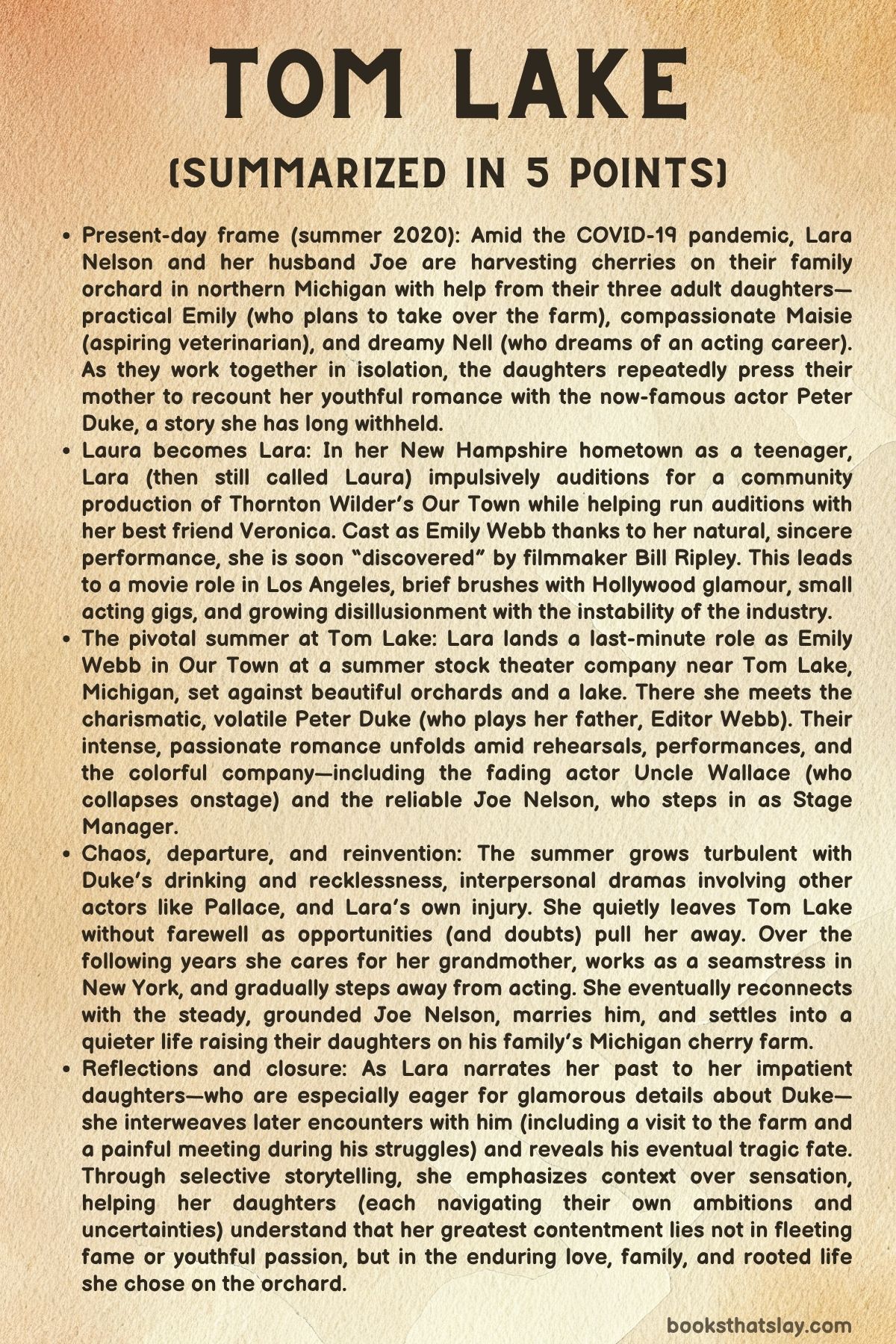
Summary
Laura begins her story as a teenager in New Hampshire, when she and her best friend Veronica are assigned to manage auditions for a local production of Our Town. Watching community members stumble through monologues, Laura is struck by the realization that perhaps she could do better.
Though she had never thought of acting as her path, she impulsively auditions under the name “Lara” and surprises herself with her natural performance. This decision opens the door to a series of opportunities that will change her life.
Her story, told decades later to her daughters Emily, Maisie, and Nell, shifts between her early ambitions and her present life on the family farm. The daughters press for details about Peter Duke, a charismatic actor Laura once knew intimately.
Eager for the story of glamour and fame, they often interrupt their mother, wanting her to skip to Duke, but Laura insists on moving through her life in sequence.
Laura explains how she pursued acting beyond high school, taking parts in college productions before being spotted by Bill Ripley, a filmmaker who encouraged her to audition for a movie in Los Angeles. She was swept into Hollywood life, complete with handlers, screen tests, and a small apartment, but while she was praised for her natural presence, the film she worked on stalled.
Other small roles followed, but the glamour soon gave way to disillusionment.
The narrative moves to Tom Lake, a summer theater company in Michigan, where Laura landed the role of Emily Webb in Our Town after another actress dropped out. It was there that she met Peter Duke, who played Editor Webb.
Their chemistry was immediate, and they fell into a passionate relationship. To her daughters listening years later, this is the heart of the story—their mother’s romance with a man who would later become a famous star.
Life at Tom Lake was intense and charged with both artistic and emotional energy. The company rehearsed and performed, surrounded by orchards and the quiet beauty of the lake.
Laura recalls the legendary but fading actor Uncle Wallace, who collapsed onstage during a performance, and the scramble that followed as Joe Nelson—who would eventually become her husband—stepped into the role of Stage Manager. At the time, however, Laura was still involved with Duke.
Their relationship was reckless, marked by his drinking and volatility, but it burned brightly.
The summer spiraled into chaos. Duke’s brother Sebastian fought with him over Pallace, another actress, and Duke’s self-destructive behavior deepened.
When Laura injured her foot, she found herself bedridden as Ripley came to recruit her once more. She left Tom Lake quietly, slipping away without saying goodbye to Duke.
Ripley went on to champion Duke’s career, setting him on the path to stardom, while Laura herself realized she no longer wanted the life of an actress.
She recalls her return to New Hampshire, where she cared for her grandmother until her death. Later, she worked as a seamstress in New York, slowly rebuilding her life outside the theater.
Eventually, she reconnected with Joe Nelson, who had once stepped into that role at Tom Lake. Their friendship deepened into love, and they married, settling on Joe’s family’s cherry farm in Michigan.
Together they raised their three daughters, building a life that was quieter but deeply rooted.
Laura admits to her daughters that Duke reappeared in her life twice after their summer together. Once, he visited the farm in 1997, curious but unsettled by her new life with Joe and children.
The second time was years later, when he was in a rehabilitation center outside Boston. Their encounter was painful and strange, marked by his brokenness and her realization that she had long since moved past him.
Sebastian, steady and kind, drove her home that night, helping her see the finality of that chapter.
Duke eventually drowned off Capri, and Sebastian later visited the Nelson farm to help bury his brother’s ashes beneath a tree. Laura reflects on how Duke had once tried to buy part of the farm, seeking permanence in the place that meant so much to him.
Yet the land remained with the Nelsons, carried forward through their labor and love.
As the story winds back to the present, Laura and her daughters continue the work of cherry picking, their conversations moving between frustration, admiration, and reflection. Each daughter is navigating her own path: Emily rooted in the land, Maisie pursuing veterinary medicine, and Nell chasing the dream of acting.
Laura’s stories, full of chance, heartbreak, and change, offer them glimpses of how life can take unexpected turns.
For Laura, the story of Tom Lake is not only about her youthful romance with Duke or her brief brush with fame. It is about choices made, paths abandoned, and the life she built with Joe and her daughters.
Though her past was marked by ambition and moments of intensity, she finds peace in the orchard, with the steady rhythms of family and farm work. In telling her daughters about her past, she offers them both a history and a reminder that happiness often comes not from what might have been but from the life one builds day by day.
Tom Lake ends with Laura’s recognition that her greatest happiness lies not in the glamour of acting or the memory of Duke, but in the enduring love of her husband and the presence of her daughters. Her past, with all its complexities, has led her here, to a life that may seem ordinary but is filled with meaning and contentment.
Characters
Laura (Lara)
Laura stands at the heart of Tom Lake, both as a narrator and as the character whose life choices ripple across generations. As a teenager, she never considered acting as a serious path until she was drawn into an audition almost by accident.
Her natural ability to approach performance with sincerity rather than exaggeration becomes a quiet revelation that sets her apart. Laura’s transformation into “Lara” is more than a change of name; it signals her step into an identity shaped by ambition, risk, and reinvention.
Her time in Hollywood is marked by modest success and lingering uncertainty, as she wrestles with the demands of fame and the ephemeral nature of opportunity. Yet her most profound journey lies not in stardom but in stepping away from it, choosing instead a life of steadiness with Joe on the cherry orchard.
As an adult recounting her past, she is reflective and deliberate, resisting her daughters’ attempts to sensationalize her experiences with Peter Duke. For Laura, memory is not only a story to be told but a lesson in humility, regret, resilience, and the unglamorous beauty of building a family and a farm.
Veronica
Veronica begins as Laura’s closest confidante, bound by small-town camaraderie and shared adolescence. However, Veronica’s trajectory diverges sharply from Laura’s when acting slips out of her grasp due to family obligations and personal circumstance.
Her involvement with Jimmy—whom Laura also briefly loves—fractures the friendship, leaving behind unspoken wounds and betrayals. Veronica embodies the sacrifices of youth: the person whose dreams are curtailed not by lack of ability but by circumstance.
In Laura’s memories, she remains a reminder of choices not made, of the bitterness of lost companionship, and of how the hunger for freedom often clashes with familial duty.
Jimmy
Jimmy is first introduced as a promising George in Our Town, whose natural charm and ease make him stand out from a crowd of awkward hopefuls. To Laura, he represents both the spark of possibility and the fragility of youthful entanglements.
His brief relationships with both Laura and Veronica underscore the tensions of adolescent desire, loyalty, and betrayal. Jimmy does not evolve into the kind of lasting figure that Laura or Duke becomes, but he serves as a pivotal marker in Laura’s story: a reminder of the impermanence of early love and the ways it can reshape friendships forever.
Joe Nelson
Joe is the quiet center of Laura’s later life, her husband and anchor on the Michigan farm. Though his presence in her youthful memories at Tom Lake is peripheral, his eventual reappearance provides the stability she longs for after the turbulence of acting and relationships with Duke.
Joe is not dramatic or dazzling in the way Duke is, but he embodies constancy, responsibility, and devotion. His willingness to step into a role in Our Town when needed foreshadows his lifelong role: filling in gaps, saving the farm, and building a life with Laura.
His practicality—even directing commercials to secure financial stability—contrasts with the recklessness of Duke, making clear why Laura ultimately chose him. Joe represents the theme of rootedness, the grounded counterpart to Laura’s fleeting brushes with glamour.
Peter Duke
Peter Duke is the magnetic, volatile star who looms large in both Laura’s past and her daughters’ imaginations. When Laura meets him at Tom Lake, he is on the cusp of fame, reckless yet brilliant, captivating both onstage and off.
Their passionate relationship is intense and destabilizing, marked by his charisma and his destructive habits. For Laura, Duke is a figure of youthful infatuation and heartbreak, someone she once loved deeply but ultimately could not anchor herself to.
His later visits—first to the farm and then from rehab—expose both his enduring pull and his brokenness. Duke symbolizes the dangers of unchecked ambition and self-indulgence, embodying the allure of fame and the tragedy of its costs.
Even in death, his memory haunts Laura’s family, though she insists on stripping him of the myth her daughters crave.
Sebastian Duke
Sebastian, Peter’s steadier brother, plays a quieter but significant role. Where Duke is wild and self-destructive, Sebastian is grounded and reliable.
His presence at Tom Lake and later in Laura’s life provides moments of clarity, especially during the fraught hospital encounter that helps Laura finally release her attachment to Duke. Years later, his visit to the Nelson farm to bury Duke’s ashes marks a closing of the circle, as he becomes a custodian of memory and reconciliation.
Sebastian represents an alternate path—a version of life not consumed by spectacle but shaped by endurance and kindness.
Pallace Clarke
Pallace Clarke is another actor at Tom Lake, whose chaotic and self-destructive tendencies mirror those of Duke but without his brilliance. She becomes part of the entanglements that disrupt the summer, caught in drunkenness, romantic confusion, and collapse.
Though she lacks the star power of Duke, Pallace embodies the instability and fragility of theater life. For Laura, she serves as both a cautionary presence and a reminder of how easily ambition can dissolve into ruin when coupled with recklessness.
Emily Nelson
Emily, Laura’s eldest daughter, is firmly rooted in the farm, committed to carrying forward the family’s agricultural legacy. She embodies steadiness, practicality, and devotion to place.
Her choice to remain on the land reflects both love and responsibility, echoing Laura’s eventual embrace of rootedness. Emily often challenges her mother’s stories, impatient for the sensational elements but ultimately embodying the grounded values Laura cherishes.
Maisie Nelson
Maisie, the middle daughter, channels her energy into veterinary medicine, a vocation tied to care and responsibility. Her bond with her difficult dog Hazel mirrors her compassionate nature, suggesting her instinct to nurture even the unruly.
Maisie provides a counterpoint to her sisters, less concerned with glamour or legacy and more with service and devotion. She is emblematic of the ways Laura’s daughters inherit not just stories but dispositions shaped by love and work.
Nell Nelson
Nell, the youngest, is drawn most directly to her mother’s past in acting, fascinated by both the glamour and the heartbreak. Her struggles to find opportunities in theater reflect Laura’s own early uncertainty, but unlike her mother, Nell approaches acting with hunger rather than accident.
Her impatience with Laura’s modesty and her eagerness to hear about Duke underscore her yearning for stardom. Nell embodies the generational tension of ambition: the desire to carve out a life beyond the orchard, even as her mother insists that fulfillment lies elsewhere.
Uncle Wallace (Albert Long)
Uncle Wallace is a faded television actor whose illness and collapse during a performance at Tom Lake mark one of the most harrowing episodes of Laura’s youth. His decline, tied to alcoholism, contrasts starkly with the vitality of younger actors like Duke.
Wallace embodies both the fragility of performers and the inevitability of decline, a reminder that brilliance is fleeting. For Laura, his collapse crystallizes the precariousness of the life she once thought she wanted, reinforcing her later decision to leave acting behind.
Themes
Identity and Self-Discovery
Laura’s journey in Tom Lake begins with an act of boldness—auditioning for Our Town despite never considering herself an “actor.” This moment is the first spark of self-discovery, as she realizes her instincts and sincerity carry a power that others’ rehearsed performances lack. From that point forward, her life becomes a series of experiments in identity: she tries on the role of actress, briefly inhabits the glitter of Hollywood, then sheds it to return to a quieter, more rooted existence on the farm.
Her story highlights the fluidity of identity and how circumstances, choices, and chance encounters can steer its direction. The name change from Laura to Lara symbolizes both youthful reinvention and a deeper desire to imagine possibilities beyond the small town she comes from.
Yet, later in life, she insists on returning to her given name and embracing the stability of family life, showing that true identity lies not in performance but in self-acceptance. Her daughters’ questioning of her past—especially Nell’s yearning for an acting career—also forces Laura to reexamine who she was and who she has become, bridging the distance between the ambitious young woman she once was and the mother and farmer she now is.
The novel suggests that identity is never static but constantly renegotiated between the self and the roles others want us to play.
Memory, Storytelling, and Perspective
The structure of Tom Lake rests on memory—how it is told, what is omitted, and what meaning it holds for those listening. Laura recounts her life to her daughters, but the act of storytelling is not passive; it is selective, shaped by what she chooses to reveal and what she withholds.
The daughters, impatient with her detours, want a version of the past that aligns with their curiosity about Duke’s fame, but Laura insists that context matters—that stories cannot be reduced to their most glamorous elements. This dynamic underscores how memory is less about factual recounting and more about interpretation, shaping how both teller and listener understand the past.
Moreover, the very act of narrating across generations shows the transmission of experience: Laura’s daughters are forced to grapple with how their mother’s past shapes their own present, whether through inherited ambition, frustration, or grounding in the family farm. By contrasting the filtered, curated nature of Laura’s memory with the raw curiosity of her daughters, the novel explores the tension between lived truth and narrated truth.
It suggests that storytelling is not only about preserving the past but also about guiding the next generation in interpreting their own choices.
Ambition, Fate, and Chance
The theme of ambition pulses throughout the novel, embodied most directly in Laura’s foray into acting and her entanglement with Duke. Her decision to audition, her journey to Hollywood, and her role at Tom Lake all stem as much from serendipity as from talent.
Unlike Nell, who consciously pursues a career in theater, Laura seems almost swept into opportunities—yet this does not diminish their impact on her life. The delays, failures, and eventual shelving of her Hollywood film serve as reminders of the precarious nature of ambition, where chance often outweighs effort.
Duke himself embodies both the allure and the danger of ambition. His rise to fame contrasts with Laura’s decision to walk away, yet his destructiveness and restlessness suggest that ambition fulfilled does not necessarily lead to peace.
For Laura, fate seems to steer her toward the orchard and family life rather than the stage or screen. Still, she recognizes that her daughters must wrestle with the same balance between aspiration and circumstance.
The novel suggests that ambition is both a fuel for self-discovery and a risk, dependent as much on timing and luck as on talent or desire.
Love, Loss, and Relationships
At its core, Tom Lake is also a meditation on love in its many forms: romantic, familial, and platonic. Laura’s early friendships, particularly with Veronica, highlight the fragility of bonds when betrayal and competing desires intervene.
Her relationships with Jimmy and Duke mark youthful, impulsive love—intense but ultimately unsustainable. Duke, in particular, represents the intoxicating but corrosive power of romance built on passion and ego.
These experiences, painful as they were, lay the groundwork for Laura’s eventual choice of Joe, a steadier, more enduring love rooted in mutual respect and shared work. The love she cultivates on the farm, both with her husband and her daughters, contrasts sharply with the fleeting intensity of her earlier romances.
Loss, too, pervades the novel—whether in the collapse of relationships, the death of Uncle Wallace, the fading of her grandmother, or the ghosting by Duke. Yet loss is not treated as tragic finality but as a shaping force, one that teaches resilience and directs her toward a fuller life.
By juxtaposing youthful love with mature devotion, the novel underscores the ways in which relationships evolve, fracture, and endure across a lifetime.
Generational Continuity and Change
The interplay between Laura and her daughters embodies the theme of generational continuity and divergence. Emily’s choice to remain on the farm reflects continuity, grounding herself in the land and tradition, while Maisie channels her care into animals, blending her upbringing with her professional path.
Nell, however, resists the orchard’s pull, hungry for the life her mother once brushed against—auditions, acting, and artistic fulfillment. This dynamic creates both tension and admiration, as the daughters grapple with what it means to inherit not only a farm but also a family history marked by ambition and romance.
Laura’s storytelling becomes a bridge, allowing her daughters to understand that their choices—whether rooted in tradition or in risk—are part of a larger cycle of generational reckoning. The novel underscores that each generation must decide what to carry forward and what to leave behind, balancing respect for the past with the pursuit of individual dreams.
By framing the daughters’ questions against their mother’s memories, Tom Lake highlights how history echoes but never fully repeats, shaping and reshaping each new life.