Until the World Falls Down Summary, Characters and Themes
Until the World Falls Down by Jordan Lynde is a dark romantic fantasy that explores the human yearning for love, power, and redemption. It follows Eleanora “Nell,” a woman betrayed by those closest to her, whose desperate wish to be loved draws her into the grasp of Enver—a supernatural being bound by shadows, secrets, and a curse.
What begins as a story of heartbreak and revenge transforms into one of endurance, courage, and rediscovery of self-worth. Through an intricate world of illusions, labyrinths, and lost souls, Lynde examines the thin line between love and possession, and how true freedom often comes from confronting one’s own darkness.
Summary
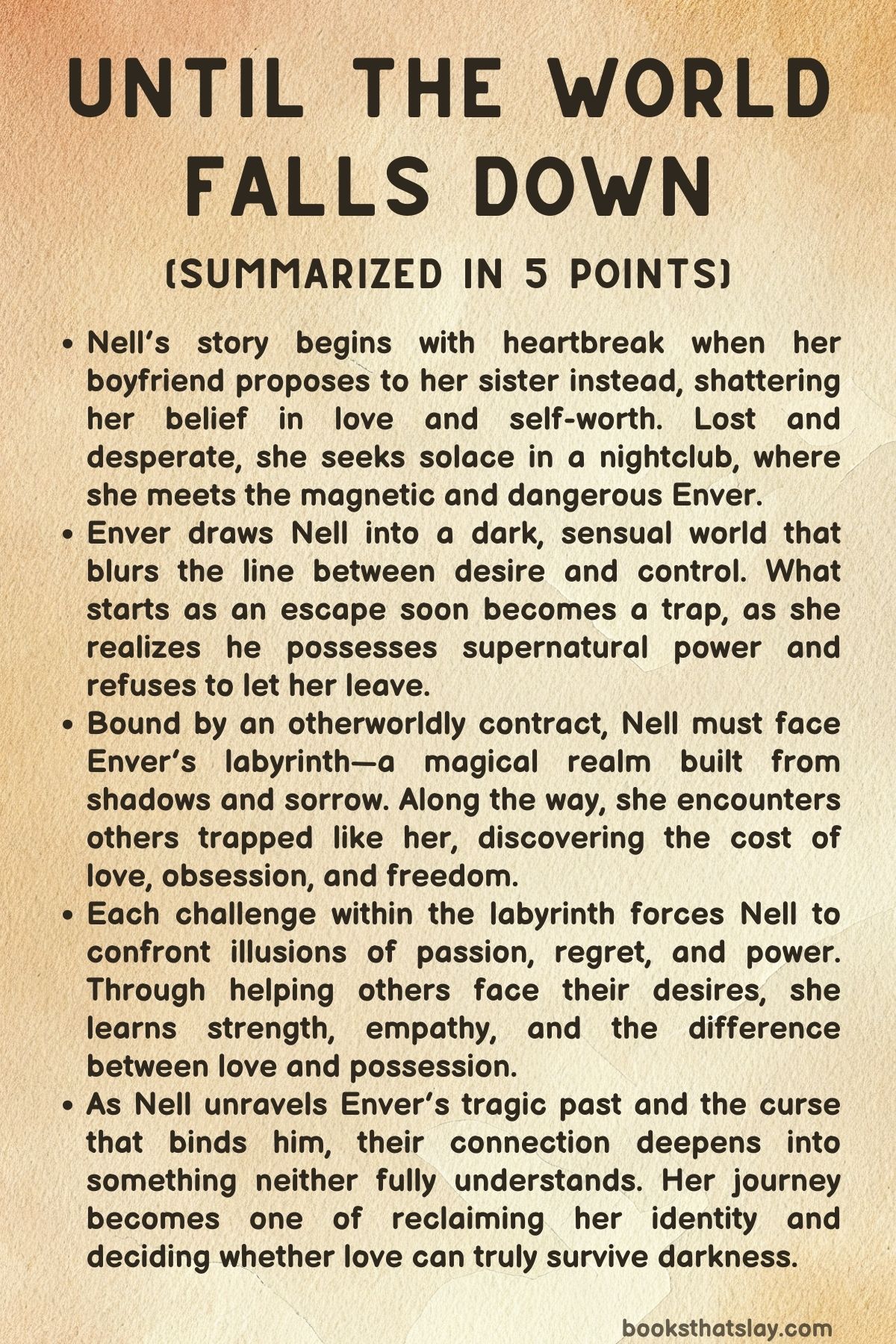
The novel opens with a haunting encounter in which Enver, a mysterious man, senses a woman’s pain and is irresistibly drawn to her. He finds her in a crowded club and, captivated by her despair, decides to claim her.
His actions are deliberate, almost predatory, as he sets his sights on her with the intent of possession.
The story then turns to Eleanora “Nell,” a designer seeking peace from her hectic life. She visits the library, joyfully telling her friend Liana that her boyfriend Julian might propose—she has found an engagement ring hidden in his drawer.
Dressed elegantly and full of hope, she leaves to meet him, dreaming of a perfect future. Her anticipation collapses when she finds Julian with her estranged sister, Veronica.
What she thinks is a celebratory meeting turns into betrayal when she sees Veronica wearing the same ring. Julian reveals their engagement and mocks Nell, calling her desperate and unlovable.
Veronica echoes the cruelty, blaming Nell for her own failed relationships. Even their mother sides against her.
Shattered, Nell flees the café, her dreams destroyed.
Back home, grief consumes her. The smell of Julian lingers, suffocating her.
In despair, she dresses again, leaves her house, and drives until she finds herself outside a nightclub. Inside, she drinks heavily, whispering that she’ll do anything to be loved.
Enver appears—dark, magnetic, and knowing. Their connection is immediate and dangerous.
He calls her perfect and seduces her with words and touch, leading her through a hidden doorway into an otherworldly chamber. Their encounter becomes intense, both physical and emotional.
In the heat of passion, Enver makes her promise to give herself to him, binding her unknowingly to something she doesn’t understand.
When Nell awakens, she is still in his castle—a vast, gothic mansion that feels alive. Enver greets her with unnerving affection and dominance.
He refuses to let her leave, insisting she belongs to him. Strange things occur—lights respond to his will, shadows move like living beings.
Terrified but entranced, Nell submits again to his control. Enver declares she will stay forever, and Nell realizes she has entered a world beyond human understanding.
Enver’s power becomes clear when she tries to escape and falls into a dark void. Shadowy tendrils seize her and return her to him.
He tells her she has already agreed to stay by saying “yes” during their night together. A shadow ring binds them, marking a supernatural contract.
He explains that to earn her freedom, she must survive his labyrinth, a magical maze that tests the soul. Few ever succeed; those who fail become his eternal servants.
Determined not to surrender, Nell enters the labyrinth. The maze is both physical and psychological, twisting through illusions and fears.
She meets Isla, another trapped woman, who warns her that Enver is ancient and cursed. Each time someone conquers the labyrinth, he regains a lost emotion.
With Isla’s help, Nell finds her way into the castle, where Enver confronts her again—tempting and cruel in equal measure. When she touches his chest and feels no heartbeat, she realizes he has no heart at all.
Enver vanishes, leaving her to continue alone.
As Nell explores the castle, she meets a servant whose mind has been erased by Enver’s power. She finds a pendant with a fractured red stone that radiates warmth.
This pendant becomes her guide. Passing through another door, Nell enters a sunlit realm where she meets Neima, a mermaid princess struggling with forbidden love for Queen Paloma.
Neima wants to prevent their relationship to avoid future heartbreak, but Nell convinces her that love’s worth lies in its risks. Neima reconciles with Paloma, and Nell earns another fragment of the red gemstone before being pulled back to the castle.
Nell learns from Isla that Enver’s servants are failed labyrinth challengers. Isla claims she seeks revenge on him and that the labyrinth is his punishment.
Despite the growing darkness, Nell presses forward. She then faces a powerful illusion—her ex-boyfriend Julian appears, remorseful and loving.
The reunion seems real until his demeanor changes, revealing the illusion’s sinister nature. The impostor becomes a shapeshifting being named Morgan, a desire-feeding creature who manipulates others through lust.
Nell resists its power, helping Morgan reconcile with a human named Karim, whom it had been draining. Her compassion earns her another piece of the pendant and deeper understanding of the labyrinth’s lessons.
Returning to Enver’s decaying castle, Nell meets Isla again, who seeks a “key” to escape. She manipulates Nell into confronting Enver for information.
During their next meeting, Nell seduces Enver to uncover the secret, only to realize he feels genuine sorrow and loneliness. He confesses he both wants to keep her and set her free.
Nell forgives him but chooses to finish the labyrinth. Enver begins to change—his cruelty softens, revealing traces of humanity.
The next stage leads Nell into a tower where she encounters Rielle, a sorceress cursed alongside a man named Silas. Silas, trapped in dragon form, once betrayed Rielle in an attempt to protect her kingdom.
Through Nell’s intervention, they confront their shared pain, and Rielle breaks part of the curse. Each encounter teaches Nell something about love, sacrifice, and freedom, preparing her for the truth behind Enver’s past.
The final revelations unfold when Nell witnesses Enver’s origin. Centuries earlier, he loved a woman named Evangeline, daughter of a powerful sorcerer, Solomon.
Their forbidden love angered Solomon, who viewed Enver—a being of shadow—as dangerous. When Evangeline was poisoned by Kayn, Solomon’s ally, Enver was framed for her death.
In grief, Solomon cursed him, ripping out his heart and imprisoning him in a shadow labyrinth for eternity. Enver’s heart was sealed within Evangeline’s body, ensuring his suffering would never end.
Isla, revealed to be Evangeline’s sister, vowed revenge.
When Nell discovers this truth, she realizes her labyrinth is tied to Enver’s redemption. Evangeline, alive but stripped of memory, exists within his world.
Nell helps restore her memories, and Evangeline remembers their love. The final piece of Nell’s pendant turns out to be Enver’s heart.
When she tries to help, Enver’s shadows lose control, threatening to consume them all. Nell calms him by declaring her love, and Evangeline restores his heart, breaking Solomon’s curse.
Enver remembers everything—his love, his sins, his pain—and embraces Evangeline one last time. Nell, heartbroken but self-aware, accepts that love cannot be built on captivity.
Nell wakes back in her world, where a week has passed. Julian and Veronica confront her, but she finally stands up to them, rejecting their manipulation.
She quits her toxic job and begins anew, determined to love herself without seeking validation from others. When she returns to the club where she first met Enver, she waits in vain until his shadow touches her again.
Enver, now free, tells her his heart belongs to her. He asks her to join him in his realm.
Choosing love on her own terms, Nell accepts, and the two vanish together.
In the epilogue, Enver narrates from his restored castle. He is whole but scarred, his heart beating again, his shadows restless yet tamed by love.
With Nell beside him, he promises never to lose her, knowing that redemption has come not from breaking curses but from learning to love and be loved without control.
Characters
Eleanora (Nell)
Eleanora, known as Nell, is the emotional core of Until the World Falls Down, embodying vulnerability, strength, and transformation. At the beginning of the story, she is a woman consumed by the ideal of romantic perfection—believing her worth is tied to being loved.
Her discovery of Julian’s betrayal and her sister’s complicity shatters this illusion, leaving her desperate and hollow. This moment of collapse becomes the catalyst for her descent into Enver’s world, both literally and symbolically.
Nell’s character evolves from someone who seeks validation through others to a woman who learns to reclaim her agency. Her encounters within the labyrinth mirror her internal struggle—each challenge reflecting aspects of desire, pain, and healing.
Though initially submissive to Enver’s control, Nell gradually becomes his equal, capable of empathy and defiance in equal measure. By the novel’s end, she transcends victimhood, choosing love on her own terms rather than out of desperation.
Her decision to return to Enver after gaining her independence highlights not dependence, but conscious choice—a reclamation of self.
Enver
Enver is a complex figure, at once a dark romantic hero and a tragic victim of his own curse. His introduction presents him as a predatory presence—mysterious, powerful, and dangerously alluring.
Yet beneath this façade lies a centuries-old torment, rooted in betrayal and the loss of his heart to Evangeline. Cursed to live without emotion, Enver oscillates between cruelty and longing, dominance and tenderness.
His control over Nell is not merely physical but symbolic of his internal struggle to feel again. Throughout Until the World Falls Down, Enver’s character arc mirrors Nell’s: while she learns to assert control over her destiny, he learns to surrender to genuine emotion.
His relationship with Nell becomes a path to redemption, forcing him to confront his own darkness and guilt. Even after his heart is restored, his duality persists—his love for Nell coexists with the remnants of his rage and pain.
Enver’s final state is one of uneasy peace, where love does not erase his shadows but humanizes them, making him both lover and survivor of his curse.
Evangeline
Evangeline serves as both a ghost of the past and the embodiment of lost innocence within Until the World Falls Down. Her story reveals the tragic origin of Enver’s curse and provides emotional depth to his torment.
Poisoned by deceit and political manipulation, Evangeline’s death marks the point where love becomes entangled with punishment and vengeance. When she reappears later in the novel as one of Enver’s hollow servants, her restoration through memory becomes a crucial act of closure.
Evangeline’s forgiveness allows both herself and Enver to transcend their suffering, but it also underscores her selflessness—she releases him to love Nell, even though he once belonged to her. She is the bridge between past and present, representing love that endures beyond pain yet refuses to chain itself to bitterness.
Her reawakening is not a resurrection of romance, but of grace; she becomes a silent guardian of Enver’s redemption.
Isla
Isla is a mirror to Nell—another woman trapped in Enver’s labyrinth, consumed by her own vengeance and grief. Initially portrayed as a wary ally, Isla’s bitterness contrasts sharply with Nell’s compassion.
Her revelation that she was connected to Enver’s past, as Evangeline’s sister, transforms her from guide to moral counterpoint. While Nell learns forgiveness, Isla embodies the destructive potential of resentment.
Her desire to escape or destroy Enver reflects the inability to move past trauma. Isla’s complexity lies in her dual nature: victim and villain, guide and deceiver.
Through her, the novel explores how pain, when left unresolved, can twist love into hatred. She is ultimately a cautionary figure—proof that liberation comes not through revenge, but through letting go.
Morgan
Morgan is one of the most fascinating side characters in Until the World Falls Down, representing the theme of desire as both hunger and loneliness. As a desire-feeding entity, Morgan initially appears monstrous—feeding on human longing through illusion and manipulation.
Yet their interaction with Nell reveals a creature yearning for connection rather than domination. Nell’s compassion forces Morgan to confront their own moral decay and rediscover empathy.
The relationship between Morgan and Karim is one of the novel’s tenderest subplots, a story of love transcending form and fear. Morgan’s redemption parallels Enver’s, showing that even those who consume love can learn to nurture it.
Their arc transforms the idea of monstrosity into a reflection of unmet need, suggesting that love, when freely given, can heal even the most corrupted souls.
Julian
Julian functions as the human catalyst for Nell’s transformation. His betrayal is not merely romantic—it dismantles her faith in the idea of perfect love.
Cold, narcissistic, and emotionally manipulative, Julian embodies superficial affection and moral cowardice. His engagement to Nell’s sister Veronica exposes the cruelty hidden beneath charm.
When he later appears in the labyrinth as an illusion conjured by Morgan, Julian’s presence serves as a psychological test for Nell. Her ability to reject the false comfort of his apology marks her true emotional growth.
Julian, though a secondary figure, symbolizes the hollow love that Nell must overcome to reach authenticity.
Veronica
Veronica, Nell’s sister, represents jealousy, insecurity, and the perversion of familial bonds. Her betrayal is especially painful because it strikes from within the intimacy of sisterhood.
Veronica’s actions stem from long-standing resentment—she envies Nell’s optimism and emotional openness. Her cruelty, cloaked in self-righteousness, mirrors their mother’s manipulative tendencies.
While she lacks the supernatural weight of other characters, Veronica’s realism makes her betrayal more visceral. In the broader moral landscape of Until the World Falls Down, she stands for the mundane evil of envy and self-justified betrayal.
Liana
Liana, though a minor character, is crucial in grounding Nell’s journey. As the librarian who first interacts with Nell, she symbolizes normalcy and friendship—a reminder of the world outside the labyrinth.
Her later reappearance, encouraging Nell to rebuild her life, bookends Nell’s emotional arc. Liana represents the quiet, steady strength of human connection that does not demand or consume, contrasting sharply with the consuming passions of Enver’s realm.
She is the voice of reality and healing, embodying hope beyond fantasy.
Solomon
Solomon is both executioner and moral enigma within Until the World Falls Down. As Evangeline’s father and Enver’s punisher, he wields divine authority with devastating consequence.
His decision to curse Enver—to rip out his heart and imprison him in eternal darkness—is driven by grief, pride, and a distorted sense of justice. Yet his punishment extends beyond vengeance; it corrupts the balance between love and retribution.
Solomon’s character reflects the dangers of unchecked righteousness—his inability to distinguish punishment from protection creates generations of suffering. Through him, the novel questions the morality of divine power and the futility of vengeance disguised as justice.
Kayn
Kayn is the orchestrator of tragedy, a manipulative force whose actions ignite the chain of curses that define Enver’s story. His poisoning of Evangeline and deceit toward Solomon expose his calculating cruelty.
Motivated by jealousy and self-interest, Kayn thrives on others’ ruin. Yet his villainy is not purely demonic—it stems from an obsession with control and moral superiority.
Kayn’s success in turning love into chaos underscores the novel’s central motif: that evil often wears the guise of righteousness. His presence lingers long after his deeds, shaping the emotional scars carried by Enver, Evangeline, and even Isla.
Rielle and Silas
Rielle and Silas form one of the labyrinth’s most poignant subplots. Their cursed love story mirrors Enver and Evangeline’s, serving as a reflective echo of what happens when passion and pride collide.
Rielle, a sorceress betrayed and imprisoned, represents trust broken by fear, while Silas, the dragon-bound lover, embodies remorse and the destructive nature of protection taken too far. Through Nell’s intervention, their fractured relationship becomes a lesson in vulnerability and forgiveness.
The resolution of their conflict within the labyrinth reinforces the novel’s recurring idea that love’s true power lies not in possession, but in understanding and release.
Themes
Love and Possession
Love in Until the World Falls Down emerges as both salvation and destruction, a force capable of tenderness yet easily corrupted by control and obsession. The story begins with Nell’s yearning for love, an emotion she idealizes as redemptive and pure.
However, her encounter with Enver exposes the darker counterpart to this ideal. Enver’s affection manifests through dominance and ownership; his desire to keep Nell “forever” transforms love into a consuming possession.
The novel examines how the longing to be loved can blur boundaries between affection and captivity. Nell’s initial submission to Enver stems from emotional devastation, showing how vulnerability can lead to surrender under the illusion of intimacy.
Yet, as the story progresses, love becomes a battlefield of wills—one seeking connection, the other seeking control. Through Enver’s curse and his inability to feel, love also becomes a path to redemption, forcing him to confront his own emptiness.
By the novel’s end, love reclaims its healing potential when Enver regains his heart and Nell learns self-worth. The transformation of their bond—from dominance to mutual devotion—reflects the evolution of love from a craving to be claimed into a conscious choice to share and rebuild.
Lynde portrays love as neither inherently good nor evil but as an elemental force that mirrors the emotional state of those who wield it. In this duality, love becomes both a weapon and a cure, capable of binding souls or freeing them.
Power and Control
The novel presents power as a pervasive undercurrent shaping every relationship, from romantic entanglements to supernatural confrontations. Enver’s control over shadows and his dominion within the labyrinth symbolize not only his supernatural might but also the imbalance that defines his relationship with Nell.
His command of the physical world contrasts sharply with his emotional impotence; though he controls everything around him, he cannot master his need for connection. The labyrinth itself serves as a physical manifestation of control—it traps participants, tests their limits, and bends their will to Enver’s design.
Nell’s journey through it becomes a rebellion against subjugation, a fight to reclaim her autonomy. Even outside the supernatural realm, control defines her life: Julian manipulates her emotions, her sister Veronica asserts superiority, and her mother condones betrayal.
Each instance exposes societal and personal structures that strip agency from women under the guise of love or protection. As Nell faces these dynamics, her resistance transforms from survival into empowerment.
Enver’s power, once oppressive, becomes a mirror reflecting his own imprisonment by the curse that binds him. In the end, true liberation occurs when both surrender their need to dominate—Nell by releasing her fear of dependence and Enver by relinquishing his claim over her.
Power, in Lynde’s narrative, evolves from a means of possession into a test of humanity: those who use it to control others are doomed to isolation, while those who wield it with compassion rediscover their freedom.
Identity and Transformation
Throughout Until the World Falls Down, identity is fluid, fractured, and constantly reconstructed through experience and emotion. Nell begins as a woman defined by others—her boyfriend, her family, her social expectations.
Her entire sense of self revolves around being worthy of love, making her devastation at Julian’s betrayal an existential collapse. The labyrinth becomes her crucible of transformation, forcing her to confront her fears, desires, and illusions.
Each encounter—whether with Morgan, Isla, or Enver—challenges her to redefine what love, strength, and identity truly mean. Through helping others within their own labyrinths, Nell pieces together fragments of her own self-worth, realizing that compassion and independence can coexist.
Her transformation is not a simple awakening but a continuous negotiation between vulnerability and resilience. Enver’s identity, too, is shaped by loss and curse.
Stripped of his heart, he becomes an embodiment of repression, existing without empathy or memory. When Nell restores his humanity, his identity reshapes from predator to partner, revealing that transformation requires both confrontation and forgiveness.
By the conclusion, identity becomes inseparable from choice—the freedom to forgive, to love without submission, and to accept one’s flaws. Lynde uses this metamorphosis to illustrate that identity is not static but earned through endurance, reflection, and the courage to rebuild after destruction.
Redemption and Forgiveness
Redemption in the novel arises from pain, guilt, and the willingness to confront one’s past. Enver’s journey from cursed immortal to redeemed lover embodies the struggle for forgiveness—both from others and from oneself.
His centuries of torment reflect the emotional paralysis born from guilt and self-loathing. Through Nell, he is forced to relive his sins and rediscover compassion.
Their relationship becomes a moral reckoning rather than a romantic escape. Nell, too, seeks redemption—not for wrongdoing but for the perceived failure to be “enough.
” Her arc is one of self-forgiveness, of recognizing that worth is not contingent on being desired. As she aids others within the labyrinth, she symbolically grants them the redemption she once denied herself.
Each success mends a part of her own spirit, preparing her to face Enver not as a victim but as an equal. When Evangeline’s story resurfaces, redemption takes on a generational weight, binding the living and the cursed.
Enver’s final act of regaining his heart signifies the triumph of remorse over vengeance and the restoration of emotional wholeness. Forgiveness becomes the key to freedom, not through denial of pain but through understanding it.
Lynde portrays redemption as a mutual process—no character achieves it alone. It demands empathy, acknowledgment, and the courage to face the consequences of love turned destructive.
The Labyrinth as a Metaphor for the Human Psyche
The labyrinth in Until the World Falls Down serves as more than a physical or magical challenge—it functions as an intricate metaphor for the human mind. Every corridor, illusion, and test reflects the entrapments of fear, longing, and regret that define the inner self.
For Nell, the labyrinth is a mirror of her subconscious, confronting her with the emotional illusions she has built—idealized love, denial of betrayal, and dependence on validation. Each trial forces her to dismantle these constructs and emerge more self-aware.
The encounters with Morgan, Isla, and Rielle externalize psychological conflicts: desire versus restraint, loyalty versus self-preservation, love versus illusion. Similarly, for Enver, the labyrinth is both prison and punishment—a manifestation of guilt and isolation, reminding him of the emotions stripped away with his heart.
The endless, shifting passages echo the disorientation of trauma and the struggle to find coherence within chaos. By surviving the labyrinth, Nell symbolically reclaims control over her fragmented psyche, transforming despair into clarity.
When she helps others find their way, she proves mastery over her emotional labyrinth as well. The structure embodies Lynde’s commentary on healing: that self-discovery is not a straight path but a winding journey through darkness.
Every wrong turn reveals another hidden truth, and escape is possible only when one stops running from the self.