Warrior Princess Assassin Summary, Characters and Themes
Warrior Princess Assassin by Brigid Kemmerer is a sweeping fantasy tale of loyalty, betrayal, and unexpected love set against the backdrop of warring kingdoms. The story follows Princess Marjoriana of Astranza, a woman torn between duty and desire, and King Maddox Kyronan of Incendar, a feared ruler burdened by his own fiery magic.
As political alliances crumble and assassins move in the shadows, Marjoriana must decide between saving her people and following her heart. The novel blends courtly intrigue, forbidden romance, and moral complexity, revealing how strength is often found not in battle, but in compassion, trust, and sacrifice.
Summary
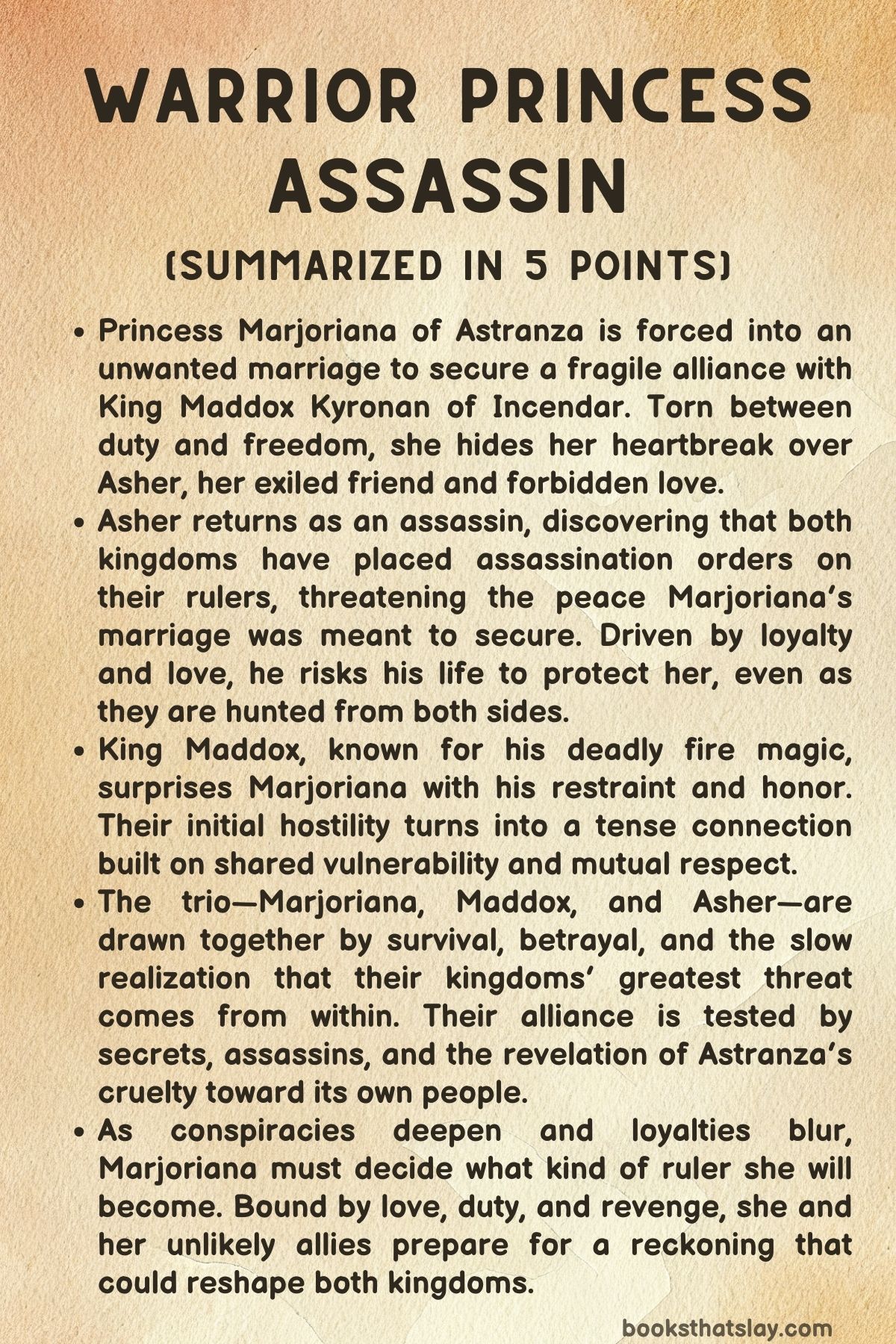
Princess Marjoriana of Astranza faces a grim future as she prepares for her arranged marriage to King Maddox Kyronan of Incendar, a ruler notorious for wielding deadly fire magic. Her brother Dane and father insist the union is Astranza’s only hope for survival against the threat of Draegonis, yet Marjoriana sees it as a sentence to a man she fears and despises.
Her heart still belongs to Asher, her childhood friend and secret love, who was exiled years ago after his mother was executed for treason. The kingdom’s fires are doused to avoid drawing Maddox’s attention, leaving the palace cloaked in cold darkness as Marjoriana’s fate is sealed.
Late at night, Asher reappears in her chamber, revealing that he is now an assassin with the Hunter’s Guild. He warns her about her father’s failing health and the danger surrounding her, but when she begs him to help her flee, he refuses, reminding her that her duty lies with her people.
They share a painful goodbye kiss before he disappears, leaving behind a maid’s disguise and a note offering escape. Torn between love and loyalty, Marjoriana chooses duty, resolving to meet her destiny head-on.
Disguised as a maid the next morning, Marjoriana sneaks through the palace to glimpse the Incendrian delegation’s arrival. Among the soldiers, she encounters a man whose calm authority unsettles her.
Their exchange brims with tension and curiosity—unbeknownst to her, this soldier is King Maddox himself, traveling incognito to gauge his new allies. Maddox, hardened by war and years of distrust, views Astranza’s extinguished fires as a calculated insult.
Yet despite his anger, he feels an unexpected pull toward the courageous young woman who dares to challenge him.
When Maddox’s true identity is revealed, Marjoriana is mortified. The two share a strained introduction before Asher’s story unfolds elsewhere: he returns to the Hunter’s Guild only to find assassination orders targeting both Maddox and Marjoriana.
Horrified, he realizes someone from both kingdoms intends to sabotage the fragile peace. Determined to protect her, Asher sets out for Astranza once again.
At the palace, Dane continues to manipulate Marjoriana, but Maddox demands a private audience with her. Despite her fear, Marjoriana agrees.
To her surprise, Maddox disarms himself and speaks with candor. He insists he will not force her into marriage and even promises to protect her from Dane, declaring that any harm to her will be treated as an act of war.
His quiet honor and self-restraint begin to challenge her assumptions. When he shows her that he suppresses his own fire magic out of respect for Astranza’s fears, her hatred softens into curiosity.
They exchange true names—he allows her to call him Ky, and he calls her Jory—marking the first spark of trust between them.
That fragile peace is shattered when Asher climbs through her window to warn her of the dual assassination orders. He begs her to run, but she refuses to abandon her kingdom or the alliance.
When Dane interrupts, Asher hides in the rafters, overhearing the prince’s cruelty. After Dane departs, Asher and Jory argue again until she reluctantly agrees to flee—but insists they must take King Maddox with them.
Their plan collapses when Asher ambushes Maddox in his chambers, believing it the only way to save Jory. A violent fight erupts, ending with Asher killing one of Maddox’s soldiers before they are all forced to escape together.
Their uneasy alliance leads them to a remote inn, where Maddox, Jory, Asher, and loyal companions take shelter. The king keeps Asher chained as a prisoner after his attack, yet his actions reveal compassion beneath his severity.
When the innkeeper exposes the cruel branding laws of Astranza, Jory realizes her kingdom’s corruption runs deeper than she knew. Later, when Maddox demands to see Asher’s injuries, the truth of Asher’s torment surfaces—he was enslaved, abused, and marked as property after exile.
The revelation devastates Jory, who begs his forgiveness. Though their past cannot be undone, the moment draws the three closer through shared vulnerability.
That night, Hunters sent to finish the assassinations strike. Asher and Maddox fight side by side, saving Jory’s life.
The attack confirms a conspiracy involving both kingdoms. At dawn, they flee toward Incendar, where Maddox’s soldiers meet them with alarm.
Crossing the border marks a turning point: Jory begins to see Maddox as a protector rather than a monster, and Asher, though scarred by betrayal, starts to trust the man he once tried to kill.
In Incendar’s capital, Maddox brings them to his sister Victoria, a gentle soul with unstable fire magic. Her existence is a secret even from his closest allies, as her power flares dangerously when she’s distressed.
During their visit, Jory accidentally disrupts Victoria’s work, prompting Maddox to reveal his fears—that her uncontrolled magic may be causing the wildfires ravaging their land. Tension between Maddox and Asher finally boils over into physical confrontation, but it transforms into mutual respect and buried attraction.
Seeking calm, they retreat to the Hall of Stars, an open-roofed chamber glowing with molten pathways and reflected starlight. There, truth and desire merge.
Jory confesses her father’s impending death and Astranza’s desperate need for Incendar’s army. She offers her kingdom’s grain in exchange for military aid.
Maddox agrees, provided that Asher remains safely under his protection. What begins as negotiation turns into intimacy as Jory invites both men into shared closeness.
Their connection becomes physical and emotional, built on consent, honesty, and the breaking of boundaries forged by politics and pain. Afterward, quiet vulnerability replaces fear, binding them in trust.
The peace is shattered once again when assassins infiltrate the palace. Maddox’s flames destroy one attacker, but a dying woman warns that Astranza’s prince is bargaining with Draegonis to overthrow both rulers.
Ky rushes to protect his sister, while Asher shields Jory through the chaos. They discover that Lady Charlotte, one of Jory’s attendants, has been aiding Dane’s plot.
Cornered, she confesses Astranza’s betrayal but is killed before revealing everything. Her death leaves Jory grief-stricken and enraged.
In the aftermath, Maddox confirms that Astranza’s dealings with Draegonis mean war. Jory makes a bold declaration: she will overthrow her brother and claim her father’s throne to preserve their alliance and protect both realms.
Maddox pledges his support, while Asher—once a hunted outcast—offers his blade and cunning. His closing words seal their shared fate: they do not need an army to kill a prince—they need a Hunter.
The story concludes with the three united not by duty, but by conviction. Each bears scars of betrayal and love, yet together they form an alliance born of choice rather than command.
Warrior Princess Assassin ends on the promise of war, vengeance, and hope, with Jory, Ky, and Asher standing at the threshold of destiny—bound not by fear, but by fire, loyalty, and the will to change their world.
Characters
Princess Marjoriana (Jory)
Princess Marjoriana of Astranza, known to those closest to her as Jory, stands at the heart of Warrior Princess Assassin as a figure of courage, compassion, and inner conflict. She begins as a young royal torn between her duty to her kingdom and her personal longing for freedom and love.
Forced into a political marriage to an enemy king, Maddox Kyronan, she becomes the embodiment of sacrifice—willing to give up her happiness to secure peace for her people. Her early defiance toward her brother Dane and the oppressive expectations of royal life showcase her unyielding spirit.
Yet beneath her pride and resistance lies a profound empathy, especially for the oppressed and those burdened by pain, as seen in her unwavering concern for Asher.
Jory’s evolution throughout the novel is deeply emotional and moral. Disguising herself as a maid symbolizes both rebellion and transformation—she steps out of privilege to understand the suffering of those around her.
Her encounter with Maddox, and later her growing alliance with him, reveals her ability to see humanity even in those branded as monsters. The complexity of her relationship with Asher—torn between guilt, love, and loss—reveals a woman learning to reconcile affection with responsibility.
By the end, Jory emerges not only as a princess or a pawn in politics but as a leader in her own right, prepared to challenge her brother and rewrite her kingdom’s future through conviction and empathy.
King Maddox Kyronan (Ky)
King Maddox Kyronan of Incendar is a man forged by fire—both literally and emotionally. Feared across kingdoms as a ruthless conqueror who wields flames capable of annihilation, he carries the scars of a ruler forced to make brutal choices for survival.
Yet Warrior Princess Assassin steadily dismantles his fearsome reputation to reveal a deeply wounded man haunted by guilt, loss, and loneliness. His restraint upon entering Astranza, refusing to use his fire magic despite the bitter cold, signals his yearning to be more than a weapon.
Maddox’s humanity shines in the quiet moments: his protectiveness toward Jory, his tenderness with his sister Victoria, and his willingness to earn trust rather than demand it.
Ky’s dynamic with Jory marks a pivotal emotional journey. Initially suspicious and distant, he comes to admire her bravery and integrity.
His insistence on equality in their marriage contract and his vow to defend her from Dane show a stark contrast to the brutal image his enemies paint. With Asher, his relationship is charged with tension that transforms into reluctant respect and unexpected intimacy.
Through these bonds, Maddox evolves from a hardened ruler into a man rediscovering vulnerability and hope. By the novel’s end, he stands as both warrior and protector, willing to burn down the corruption around him not for power—but for those he loves.
Asher
Asher represents the soul of Warrior Princess Assassin—the haunted survivor whose pain and strength shape much of the story’s emotional depth. Once a palace servant and Jory’s childhood friend, he is now a branded assassin of the Hunter’s Guild, marked by betrayal, exile, and the cruelty of the Astranzan system.
His life of enslavement and exploitation has scarred him deeply, and his return into Jory’s world reignites both affection and anguish. Torn between love and loyalty, Asher embodies moral ambiguity: a killer who yearns to protect, a victim who refuses pity, and a man who cannot decide if redemption is even possible.
His interactions with Maddox and Jory form the emotional triangle at the core of the novel—not of jealousy, but of shared trauma and cautious trust. Asher’s instinct to protect Jory leads him into direct conflict with Maddox, yet it’s in this confrontation that both men begin to understand one another.
The intimacy shared among the three, both physical and emotional, transcends conventional bonds; it becomes an act of healing and equality. Asher’s eventual choice to fight alongside them against corruption, declaring that what they need is “a Hunter,” transforms him from a tool of destruction into an agent of justice.
His arc is one of reclamation—of identity, agency, and love.
Prince Dane of Astranza
Prince Dane serves as the oppressive force driving much of Jory’s internal and external conflict. Cold, manipulative, and power-hungry, Dane’s control over his sister mirrors his ruthless political ambition.
His decision to marry Jory off to Maddox underlines his pragmatic cruelty—he views people, even family, as means to an end. Yet his cruelty is not without cause; he is shaped by the paranoia and decay of a kingdom dependent on fading magic.
His actions are motivated by a desperate need to preserve Astranza’s power and his own control, even at the cost of his humanity.
In contrast to Maddox’s moral growth and Jory’s compassion, Dane represents the stagnation of corruption and fear. His execution of Asher’s mother and his willingness to sacrifice alliances reveal a man consumed by insecurity masked as strength.
By the story’s climax, Dane’s secret dealings with Draegonis expose his true nature—a traitor to both his people and his family. He stands as the perfect foil to Jory: where she chooses compassion over domination, he clings to control at the expense of all else.
Victoria Kyronan
Victoria, Maddox’s sister, is a poignant study of innocence trapped within danger. Her untrained fire magic and fragile mental state make her both a source of affection and anxiety for her brother.
Through her, the novel explores the themes of vulnerability and misunderstood power. Maddox’s tenderness toward her humanizes him, revealing his deep protective instincts and guilt over her condition.
Victoria’s art—her glass-and-steel tile arrangements—symbolizes her attempt to create beauty and order in a world defined by chaos.
Her presence also reflects the dangers of unregulated magic and the way societies exploit or fear those who are different. While she remains mostly in the background, her character embodies the moral heart of Incendar—a land scarred by fire but still capable of light.
Lady Charlotte
Lady Charlotte, though initially appearing as a loyal companion to Jory, becomes one of the most tragic figures in the novel. Her betrayal is rooted not in malice but in desperation and coercion, manipulated by Dane to act as a pawn in his schemes.
Her duplicity leads to disastrous consequences, yet her final confession—dying in Jory’s arms—redeems her as a victim of political manipulation. Charlotte’s arc highlights the recurring theme of loyalty twisted by fear and the impossibility of purity in a corrupt system.
Her death not only shatters Jory’s sense of safety but also marks the irrevocable break between Astranza and its royal heirs.
Captain Sevin Zale (Sev)
Sevin Zale provides a balance of humor and loyalty amidst the darkness of Warrior Princess Assassin. As Maddox’s captain and confidant, he represents the camaraderie and rough affection of soldiers who’ve survived countless battles together.
His teasing nature and sharp observations bring levity to tense scenes, but beneath the humor lies deep loyalty and understanding of his king’s burdens. He respects Jory’s courage and subtly supports Maddox’s growing affection for her.
Sevin’s pragmatism and steady presence ground the story’s volatile dynamics, reminding both Maddox and the reader that leadership requires not only power but humanity.
Themes
Duty and Sacrifice
In Warrior Princess Assassin, the tension between personal desire and political obligation shapes nearly every major choice the characters make. Princess Marjoriana embodies this theme from the beginning, when she learns that her father’s declining health threatens Astranza’s survival and that her marriage to Maddox Kyronan is the only means to secure the kingdom’s future.
Her decision to surrender her freedom for the sake of her people marks a deep act of sacrifice, one that exposes the rigid expectations placed on women in positions of power. The story traces how this duty transforms her identity—from a sheltered princess rebelling against her brother’s tyranny to a ruler who accepts the cost of leadership.
The novel also mirrors this sense of sacrifice in Maddox, who carries the burden of being feared by his own subjects and by foreign lands because of his destructive fire magic. He deliberately suppresses his powers to prevent harm, symbolizing his effort to atone for a violent legacy he did not entirely choose.
Both characters must learn that leadership is not only about authority but about bearing the weight of choices that destroy personal happiness. Their union, initially forced, becomes a test of whether sacrifice can evolve into mutual respect and trust, showing that duty, though painful, can forge resilience and unity when guided by compassion rather than coercion.
Power and Oppression
The novel explores power as both a political instrument and a deeply personal force that defines relationships. Astranza and Incendar represent two extremes of control: one suppresses magic and emotion to maintain order, while the other wields elemental fire that can annihilate entire armies.
Within this political tension lies the domestic tyranny of Prince Dane, whose abuse of Marjoriana mirrors the authoritarianism of his realm. Power in this story corrupts when used to dominate rather than to protect.
The branding and enslavement of Astranza’s citizens—most strikingly seen through Asher’s scars and servitude—illustrate how institutional cruelty becomes normalized when justified as law. Maddox’s internal conflict with his magic further complicates the idea of control; his struggle to contain his power reflects a fear of becoming the monster others already believe him to be.
The intersection of personal trauma and political violence reveals that real strength lies not in suppression or destruction but in empathy and self-restraint. Through Marjoriana’s evolving perception of power—from fear of her brother to the courage to challenge him—the novel critiques hereditary and patriarchal rule, asserting that true leadership arises from justice and accountability rather than inherited dominance.
Love and Redemption
Love in Warrior Princess Assassin is portrayed not as a fleeting passion but as a force capable of reshaping guilt, anger, and trauma. The relationship between Marjoriana and Asher begins as a tender remnant of childhood affection and matures into a confrontation between who they were and who they have become.
Their bond is laced with betrayal, secrecy, and longing, but it remains grounded in shared pain. Asher’s suffering as a branded slave and assassin forces Marjoriana to face the consequences of her kingdom’s cruelty.
Their reconciliation becomes an act of moral redemption, allowing her to recognize that love demands acknowledgment of the past rather than denial of it. Maddox’s growing affection for both Marjoriana and Asher expands the idea of redemption beyond romance; his connection to them offers him a chance to reclaim humanity lost through years of war and fear.
The intimacy they share is less about desire and more about healing—an affirmation that broken people can still build something whole. Together, they embody the belief that forgiveness and trust can emerge even in the aftermath of betrayal and violence, suggesting that love, when rooted in honesty, has the power to undo cycles of vengeance.
Identity and Transformation
Throughout the novel, every major character grapples with fragmented identity. Marjoriana hides behind disguises—literally when posing as a maid, and figuratively when suppressing her anger and grief under the façade of royal duty.
Asher bears the marks of both victim and predator, caught between being the boy who loved her and the assassin trained to kill. Maddox, the feared Fire King, constantly balances between protector and destroyer.
Their identities are shaped by the expectations imposed upon them: the dutiful princess, the weaponized slave, the monstrous king. As the story unfolds, identity becomes an act of rebellion against these labels.
Marjoriana’s journey toward self-realization culminates not in romantic fulfillment but in political agency, when she vows to challenge Dane and claim her own throne. The transformation of each character is not a clean redemption arc but a gradual confrontation with truth—accepting flaws, guilt, and fear as part of their humanity.
By the end, identity is no longer something inherited or imposed; it is something earned through self-awareness and courage. The novel’s portrayal of transformation underscores that freedom begins when individuals stop allowing others to define their worth.
Trust and Betrayal
Betrayal runs through every layer of Warrior Princess Assassin—between kingdoms, siblings, lovers, and comrades. Astranza’s alliance with Incendar, meant to ensure peace, is built upon deceit, with assassination orders issued from both sides.
Dane’s manipulation of his sister and his willingness to trade lives for power exemplify political treachery, but the most devastating betrayals are personal. Asher’s secret mission to kill Maddox and Marjoriana shatters her faith in him, while her concealment of royal corruption deepens his mistrust.
Yet the novel reframes betrayal as a catalyst for truth. When these lies unravel, they force the characters to confront what loyalty truly means.
Trust, therefore, becomes revolutionary—an act of defiance in a world where deception is the norm. The uneasy alliance among Marjoriana, Maddox, and Asher represents a fragile but transformative trust built from shared wounds.
Their cooperation against Dane and Draegonis shows that even those bound by hatred or fear can forge solidarity when united by survival and integrity. Through this theme, the story examines how betrayal, while destructive, can also strip away illusion and reveal the foundation of genuine connection.
War, Justice, and the Cost of Peace
The constant shadow of war drives every political and emotional conflict in the novel. The looming threat of Draegonis, the fragile alliance between Astranza and Incendar, and the internal corruption within both kingdoms reveal that peace is often achieved through morally ambiguous choices.
Maddox’s restraint from using fire magic in Astranza reflects his understanding that peace demands discipline, not dominance. Marjoriana’s willingness to marry a feared enemy shows that justice sometimes requires personal sacrifice.
The deaths of loyal guards, assassins, and even innocents like Charlotte illustrate that the price of political stability is often human suffering. The novel refuses to romanticize warfare; instead, it presents it as a grim inevitability born from pride, fear, and desperation.
Yet amid the devastation, it offers a vision of peace forged through collaboration and empathy. When Marjoriana declares her intent to challenge Dane and ally with Incendar, she redefines justice as not vengeance but restoration—a promise to rebuild rather than destroy.
The theme concludes the novel’s moral journey: peace cannot exist without truth, and justice cannot thrive without compassion.