West Point To Wall Street Summary and Analysis
West Point To Wall Street by Omar Ritter is a memoir about resilience, leadership, trauma, and reinvention.
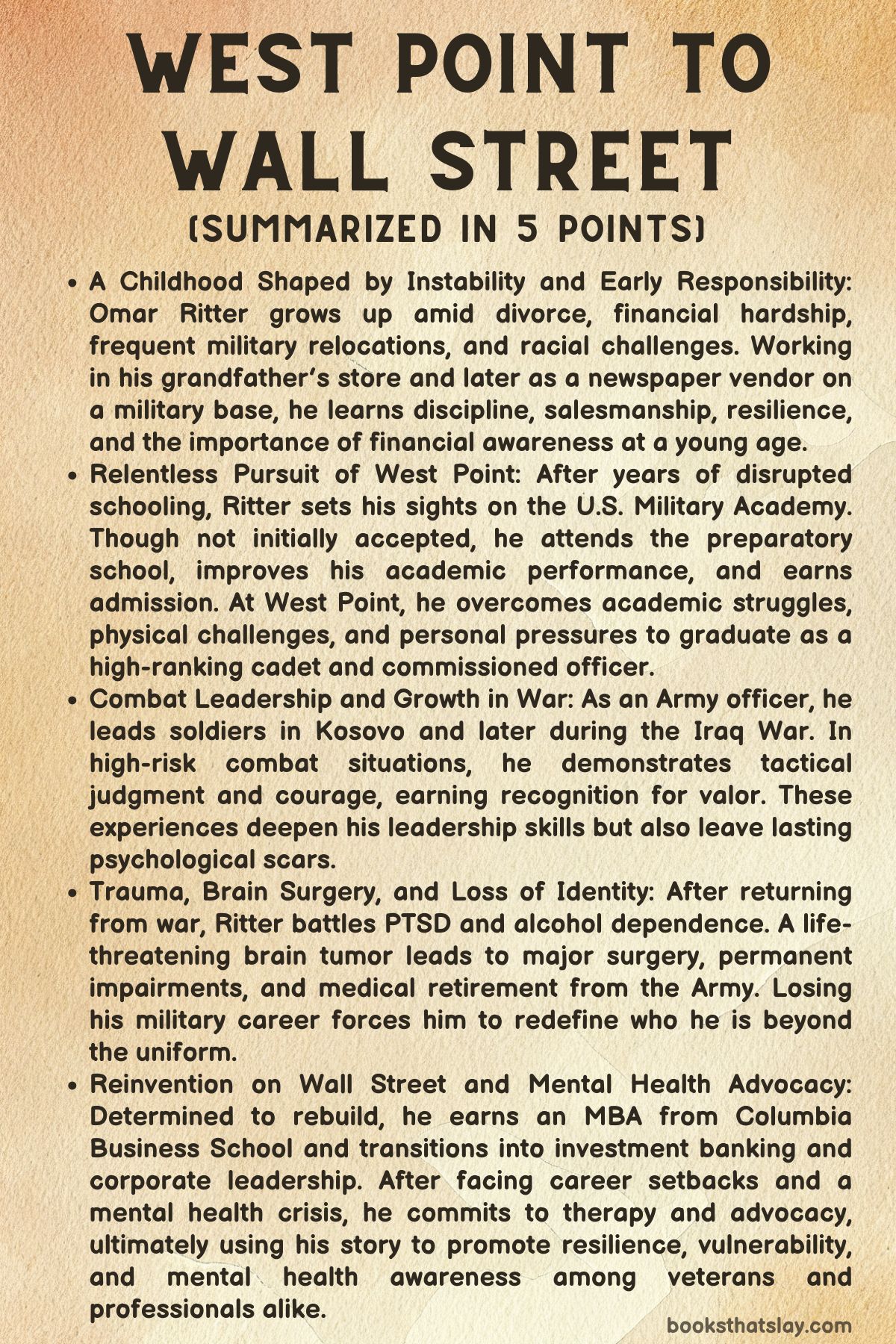
Ritter traces his life from a childhood shaped by divorce, frequent moves, and financial instability to his acceptance into West Point and eventual service as a combat leader in Iraq. After surviving war and earning distinction as an Army officer, he faces another battle: a life-threatening brain tumor that ends his military career. Forced to redefine himself, he enters the world of business and finance, confronting PTSD, identity loss, and personal setbacks. The book reflects on discipline, ambition, struggle, and the courage required to seek help and rebuild.
Summary
Omar Ritter begins his story with early memories of a stable family life that collapses when his parents divorce. At five years old, he watches the safety of his childhood disappear into arguments and uncertainty. His father, a strict Army officer, and his mother, an overworked government accountant, can no longer sustain their marriage. After the divorce, Ritter and his brothers leave Germany and move to South Carolina with their mother. The transition is painful. They live in a small house with extended family, share cramped space, and struggle financially. Ritter misses his father despite his rigid discipline, remembering the music, big dreams, and structured routines that once defined their days.
In South Carolina, he finds grounding in his grandparents’ community. His grandfather runs a small convenience store that becomes a training ground for Ritter’s early education in money, work ethic, and responsibility. He sweeps floors, stocks shelves, and eventually handles the cash register. Watching his grandfather extend credit to struggling neighbors teaches him that financial discipline and generosity can coexist.
When his grandfather dies from cancer related to military service, the family learns that much of his savings were hidden in cash and ultimately lost. The lesson about mistrust, planning, and financial systems leaves a lasting mark.
Ritter faces racial tension and social isolation in childhood. As the only Black Cub Scout without married parents, he feels out of place. When other boys build derby cars with their fathers, he works alone. He loses races, endures teasing, and eventually quits. At school, he works hard academically, winning a spelling bee despite limited support at home. Praise is inconsistent, but he continues pushing forward.
His life changes again when he and his brothers are sent to live with their father in Kentucky without warning.
Their father, now a drill sergeant, runs the household with military precision. The boys live in a small trailer and sleep on couches. Financial necessity pushes Ritter to become a newspaper vendor on base. Under the mentorship of a retired sergeant, he learns salesmanship, persistence, and strategic thinking. He increases profits by studying customer behavior, building relationships, and sometimes giving away free papers to influential soldiers. Competition with other vendors sharpens his drive. For the first time, he sees how effort and creativity can directly produce income.
Frequent Army transfers continue to disrupt his adolescence. Moves between Germany, Colorado, Louisiana, and Ohio interrupt friendships and academic consistency. He works to transform himself physically through sports, pushing past injuries and self-doubt.
Though not always the star athlete, he commits to discipline and steady academic performance. His ambition crystallizes around attending West Point, which represents stability, honor, and opportunity.
He is not accepted directly into West Point but earns a place at the United States Military Academy Preparatory School. Rather than choosing easier scholarship paths, he commits fully to this goal.
At the preparatory school, he benefits from structure, academic rigor, and mentorship that were missing in his earlier schooling. He studies relentlessly, retakes standardized tests, and improves his scores dramatically. His persistence pays off when he receives his appointment to West Point.
West Point tests him physically, mentally, and emotionally. The rigid hierarchy and constant correction create relentless pressure. Plebes endure strict rules, limited sleep, and heavy academic demands under the Thayer Method, which requires mastery of material before class. His early grades suffer, but he adapts by forming disciplined study groups. Over time, his GPA improves significantly.
Physical training is equally punishing. He struggles in swimming qualification and boxing matches but refuses to quit. Though he joins the football team, severe migraines threaten his future.
Watching others lose their positions due to medical issues, he hides his pain for as long as possible. Eventually, he leaves football to protect his academic standing. During this time, his mother battles a brain tumor, adding emotional strain. Despite these challenges, he graduates ranked in the top tier of his class, earns leadership recognition, and selects Armor as his branch.
As a young officer, Ritter commands a tank platoon at Fort Stewart. He insists on accountability when conducting inventory, earning respect from seasoned soldiers. He invests time in understanding their personal struggles and solving financial and administrative problems. His leadership philosophy centers on trust and preparation.
His first deployment takes him to Kosovo on a NATO peacekeeping mission. There, he confronts the aftermath of ethnic violence. His unit confiscates weapons, controls riots, and supports humanitarian efforts.
He oversees towns, ensuring safe water and security. The responsibility matures him quickly. The September 11 attacks occur during this deployment, signaling that more dangerous missions are ahead.
After additional training, his unit deploys to Kuwait and then Iraq in 2003. As executive officer of a cavalry troop, he manages logistics and equipment accountability before combat operations begin. Once in Iraq, his unit conducts reconnaissance missions ahead of main forces.
In Samawah, he leads his convoy into hostile fire. Recognizing signs of an ambush near a bridge, he orders a tactical withdrawal, likely preventing heavy casualties. His leadership earns him a Bronze Star with valor and promotion to captain. Later reassigned to administrative duties, he continues supporting frontline units until the end of the deployment.
Returning home, Ritter finds that war has changed him. He becomes hyperalert, withdrawn, and prone to anger. Alcohol becomes his coping mechanism. Despite maintaining professional performance, his personal life deteriorates. A severe case of pneumonia forces him to slow down, but deeper issues remain unresolved.
Assigned to West Point as an admissions officer, he regains purpose by mentoring future cadets. Then debilitating headaches return. After persistent medical advocacy, doctors discover a large brain tumor requiring immediate surgery. The eighteen-hour procedure leaves him partially paralyzed, deaf in one ear, and struggling to walk and swallow. Doctors warn that many impairments will be permanent. He pushes through painful rehabilitation, motivated by family and faith. Though he regains mobility, he is medically retired from the Army. The loss of his military identity devastates him.
Determined to rebuild, he pursues business school.
After intense preparation, he earns admission to Columbia Business School. Still recovering physically, he competes with classmates who possess years of financial experience. He secures an investment banking internship and enters Wall Street, working extreme hours.
The pace intensifies his PTSD and anxiety. Layoffs during the financial crisis force another transition. In Kansas, isolated and struggling, he reaches a breaking point and contemplates suicide. A friend’s call interrupts him, and he reaches out for crisis support, beginning therapy.
Over time, Ritter rebuilds. He moves, advances into senior corporate roles, marries, and becomes a father. Yet trauma lingers.
The suicide of a former soldier and other losses push him to confront his mental health fully. He accepts a formal PTSD diagnosis and commits to consistent treatment.
In later years, he channels his experiences into advocacy. Speaking openly about trauma, leadership, and vulnerability, he encourages veterans and professionals alike to seek help. His journey from unstable childhood to decorated officer, from brain surgery survivor to business executive, becomes a testament to discipline and reinvention. Ultimately, he concludes that true strength includes admitting weakness, asking for support, and choosing to move forward despite scars that never fully disappear.
Key People
Omar Ritter
In West Point To Wall Street, Omar Ritter stands at the center of the narrative as both subject and observer of his own evolution.
His character is defined by discipline forged in instability. As a child, he is sensitive and searching, trying to understand divorce, relocation, and racial tension while craving structure and approval. His early exposure to financial hardship and responsibility at his grandfather’s store plants in him an entrepreneurial instinct and an appreciation for accountability. As an adolescent and young adult, ambition becomes his driving force. West Point symbolizes order and merit, and he embraces its rigor even when it overwhelms him.
In combat, he demonstrates measured courage, strategic thinking, and calm under pressure, especially when recognizing the danger of an ambush in Iraq. Yet beneath his outward competence lies vulnerability. After war, his hypervigilance, drinking, and emotional withdrawal reveal the psychological toll of leadership and violence. His brain tumor strips away his physical strength and military identity, forcing him to rebuild from a place of fragility.
In business, he channels the same endurance and competitiveness that once fueled his military career. Ultimately, his defining trait becomes not toughness alone but the willingness to confront trauma and seek help, reframing strength as self-awareness and growth.
Ritter’s Father
Ritter’s father represents authority, discipline, and the rigid expectations of military culture. As an Army noncommissioned officer and later drill sergeant, he values structure, cleanliness, obedience, and toughness. In Ritter’s early childhood, he embodies both excitement and fear: he fills the house with music and big dreams yet enforces strict routines that create tension within the marriage.
After the divorce, his parenting style remains uncompromising.
When the boys move in with him, the home resembles a barracks, governed by inspection standards and strict rules. Though emotionally distant, he provides exposure to military life that ultimately shapes Ritter’s aspirations. His father’s insistence on accountability and resilience becomes foundational to Ritter’s later success, even as it contributes to emotional distance.
The father’s presence is complex; he is neither purely nurturing nor purely harsh. Instead, he reflects the paradox of military leadership carried into family life, offering opportunity and pressure in equal measure.
Ritter’s Mother
Ritter’s mother is characterized by endurance and sacrifice. A government accountant balancing multiple jobs after divorce, she struggles to provide stability for three sons with limited resources. Her decision to leave the marriage reflects both exhaustion and determination to create a healthier environment.
Though often overwhelmed, she remains a steady emotional presence in Ritter’s life. Her support, even when stretched thin, instills in him empathy and awareness of financial hardship. Later, her battle with a brain tumor mirrors Ritter’s own medical crisis years afterward, deepening the emotional resonance of his health struggle. She represents quiet resilience rather than overt authority.
While she cannot shield her children from instability or frequent relocations, her persistence models responsibility and care under pressure.
Granddaddy J.D.
Granddaddy J.D. functions as Ritter’s earliest mentor in work ethic and community responsibility. As the owner of a small convenience store, he teaches practical lessons about money, savings, and generosity. He balances discipline with compassion, extending credit to neighbors in need while emphasizing careful financial planning.
Through observing him, Ritter learns that leadership is not only about authority but also about service. The grandfather’s distrust of banks and reliance on cash savings reveal generational anxieties shaped by systemic inequities. His death and the subsequent loss of hidden savings serve as a formative lesson in financial systems and vulnerability.
Emotionally, he provides warmth and affirmation during a turbulent childhood. His influence echoes later in Ritter’s approach to leadership, blending accountability with care for those under his responsibility.
Ronald Ritter
Ronald, the older brother, embodies both protection and complication. As the eldest, he absorbs pressure differently and at times rebels against authority. His behavioral struggles contribute to the decision to move the boys back to their father’s household.
Teachers and peers often associate Omar with Ronald’s reputation, forcing Omar to fight assumptions and establish his own identity. Ronald’s trajectory highlights how siblings respond differently to instability and discipline. His presence in the narrative underscores themes of comparison, responsibility, and the burden of family perception.
While not extensively detailed, his impact on Omar’s adolescence is significant, shaping how Omar approaches reputation and self-definition.
Khatib Ritter
Khatib, the younger brother, often appears as someone Omar feels responsible for protecting. When Ronald leaves after disciplinary issues, Omar steps into a more active guardian role for Khatib. This dynamic cultivates early leadership instincts rooted in care rather than rank.
Khatib’s quieter presence contrasts with Ronald’s volatility, and his dependence reinforces Omar’s sense of duty. Through this relationship, Omar learns that leadership begins in family, long before it is formalized in military structure.
Lee Busroll
Lee Busroll, the retired sergeant who hires Ritter as a newspaper vendor, represents entrepreneurial mentorship within a military setting. He provides Ritter with a practical education in sales, competition, and strategy. Lee recognizes Ritter’s potential and rewards initiative, fostering confidence through measurable results. His creation of sales rankings and incentives introduces Ritter to performance metrics and merit-based advancement.
Under Lee’s guidance, Ritter refines communication skills and learns how relationships can influence outcomes. Lee’s influence bridges Ritter’s early lessons from his grandfather to later corporate experiences, reinforcing the idea that disciplined effort produces opportunity.
Major John Roseborough
Major John Roseborough serves as a mentor during Ritter’s time at West Point. His guidance extends beyond military instruction into character development.
By supporting Ritter’s leadership ambitions and involvement in establishing a fraternity chapter, he validates Ritter’s identity within an institution where minority representation can feel limited.
Roseborough models balanced leadership that combines competence with cultural awareness. His mentorship reinforces Ritter’s belief that leadership includes lifting others and building community within rigid institutions.
Captain Jason Marc Hancock
Captain Hancock, Ritter’s troop commander during the Iraq War, exemplifies confident and sometimes unconventional leadership. He balances high expectations with bold decision-making, such as the spontaneous trip to Las Vegas intended to reset morale during training.
By appointing Ritter as executive officer, Hancock signals trust in his capabilities. Under Hancock’s command, Ritter refines his understanding of operational coordination and command responsibility.
Hancock’s style illustrates how effective leaders must combine discipline with adaptability, reinforcing lessons Ritter carries into both corporate and advocacy roles.
Pete, Shawn, and Walter
These fellow officers become Ritter’s closest companions after returning from Iraq. They share unspoken understanding shaped by combat experience. Their bond centers on adrenaline-fueled activities, socializing, and heavy drinking. While they offer camaraderie and temporary relief, they also enable avoidance of deeper emotional healing.
Through these friendships, Ritter’s postwar coping patterns become clear. The group dynamic highlights how veterans may seek connection in ways that mask unresolved trauma. They represent solidarity but also the risk of collective denial.
Ritter’s Soldiers
Throughout his deployments, Ritter’s soldiers function as both responsibility and motivation. As a platoon leader, he is accountable for their safety, discipline, and welfare. Their trust becomes central to his identity as an officer. Moments such as inventory disputes, humanitarian missions in Kosovo, and firefights in Iraq reveal mutual testing and respect.
The soldiers’ later struggles, including one former subordinate’s tragic death, weigh heavily on Ritter and intensify his commitment to mental health advocacy. They symbolize the human cost of leadership and the enduring bond between commander and unit.
Ritter’s Grandmother
When Ritter moves to Cincinnati during high school, his grandmother provides strict oversight in yet another unfamiliar environment. Her home is structured and disciplined, echoing his father’s standards but lacking the same aspirational tone. Though emotionally distant in the narrative, she provides stability during another transitional period.
Her presence reinforces the theme that structure can feel both protective and constraining.
Analysis of Themes
Identity and Reinvention
From childhood through corporate leadership, identity in West Point To Wall Street is never fixed; it is tested, stripped, rebuilt, and tested again. Omar Ritter grows up navigating fractured family structures, racial tension, financial instability, and constant geographic relocation. Each move forces him to adjust who he is in order to survive socially and emotionally. As a child in South Carolina, he is the boy without a present father at scouting events.
In Kentucky, he becomes the disciplined son of a drill sergeant. In Germany and later in American high schools, he alternates between outsider and achiever. These shifting environments prevent him from anchoring his identity in location or peer approval. Instead, ambition slowly becomes the stable core around which he organizes himself.
West Point further reconstructs his sense of self. The academy’s system intentionally breaks down individuality in order to rebuild cadets as officers. Ritter learns obedience, endurance, and intellectual rigor, internalizing the Army’s values as a defining framework.
Combat in Iraq deepens this identity. Leadership under fire, recognition for valor, and responsibility for soldiers create a powerful self-image: protector, commander, warrior. When a brain tumor abruptly ends his military career, that identity collapses. Medical retirement removes not only his profession but also the structure that shaped his adulthood. The psychological shock is profound because the uniform had become synonymous with self-worth.
Business school and Wall Street demand yet another reinvention. Ritter must translate military discipline into corporate competence while competing with peers who possess financial backgrounds he lacks.
This transition exposes how fragile externally constructed identities can be. Over time, he arrives at a more integrated understanding of himself—one not solely dependent on rank, physical strength, or title. His eventual advocacy for mental health reflects a mature identity grounded in honesty rather than performance. Reinvention, in his story, is not cosmetic adaptation; it is the painful reconstruction of meaning after loss.
Discipline, Structure, and Control
Structure dominates Ritter’s life from early childhood. His father’s military background imposes strict rules, cleanliness standards, and rigid expectations. Even after divorce, that influence lingers. Discipline becomes both a burden and a survival mechanism. As a boy selling newspapers on a military base, he learns that consistency, timing, and presentation drive results. He refines his sales pitch, studies customer patterns, and builds networks. What might seem like a small entrepreneurial job becomes an early education in self-management.
At West Point, structure intensifies. The academy’s academic system requires mastery before instruction, placing responsibility squarely on the cadet. Sleep deprivation, physical testing, and constant correction eliminate excuses. Ritter initially struggles, but he adapts by creating study routines and peer accountability systems.
Control over time, habits, and energy becomes essential. He learns that discipline is not about harshness; it is about preparation. That lesson proves critical in Iraq, where logistics, communication, and readiness determine survival. As executive officer, he manages equipment accountability and operational systems with precision. His ability to enforce order during chaotic combat situations reflects years of conditioning.
Yet the narrative also exposes the limits of control. PTSD, alcoholism, and the brain tumor represent forces beyond willpower. Ritter’s instinct is to push harder, maintain fitness, and hide weakness. When migraines threaten his place at West Point, he conceals symptoms. After returning from Iraq, he masks emotional instability with professional competence. The tumor shatters the illusion that discipline can command biology. Recovery requires a different kind of structure—medical routines, therapy sessions, and emotional transparency. Eventually, he reframes discipline not as domination over self but as commitment to healing. Control evolves from external performance to internal regulation.
Leadership and Responsibility
Leadership in West Point To Wall Street is portrayed as both privilege and weight. Early experiences in his grandfather’s store introduce Ritter to responsibility on a small scale. Handling money, interacting with customers, and observing generosity create a model of community-centered authority.
Later, as a tank platoon leader, responsibility becomes life-altering. He is accountable not only for multimillion-dollar equipment but for the lives and welfare of soldiers. Conducting inventory against resistance from experienced subordinates teaches him that authority must be backed by fairness and competence.
In Kosovo and Iraq, leadership takes on moral dimensions. Ritter’s unit confiscates weapons, mediates tensions, and supports civilians. He witnesses the aftermath of ethnic violence and recognizes that military power must be paired with restraint. During combat in Samawah, his decision to withdraw from a potential ambush highlights situational awareness and courage under pressure. Leadership is shown not as aggression but as judgment. The Bronze Star with valor symbolizes recognition, yet the narrative emphasizes responsibility over glory.
Later assignments broaden his view of leadership beyond combat. As an admissions officer at West Point, he influences young students’ futures. In corporate roles, he manages teams and strategic decisions. However, his struggles with PTSD reveal that leaders are not immune to vulnerability. The suicides of former soldiers reinforce the silent burdens many carry. By choosing to speak openly about mental health, Ritter redefines leadership as the willingness to confront stigma. Authority becomes less about command presence and more about example. Through his journey, leadership emerges as service sustained by integrity and self-awareness rather than status.
Trauma, Mental Health, and Survival
War leaves marks that remain long after deployment ends. Upon returning from Iraq, Ritter experiences hypervigilance, anger, isolation, and dependence on alcohol. These symptoms illustrate how trauma embeds itself in daily behavior. Loud noises trigger fear responses; crowded spaces create tension. Outward success hides internal fragmentation. His high physical fitness and professional competence delay recognition of deeper issues. This masking reflects a broader military culture where endurance is prized and vulnerability discouraged.
The brain tumor compounds trauma. Physical impairments following surgery—paralysis, deafness, difficulty swallowing—force confrontation with mortality and limitation. Medical retirement intensifies psychological strain because it strips away purpose. Without the Army’s structure, unresolved memories resurface. His descent in Kansas, culminating in a moment with a pistol, reveals how untreated trauma can escalate toward self-destruction. A simple phone call interrupts that trajectory, underscoring how fragile survival can be.
Therapy and formal diagnosis mark a turning point. Accepting PTSD challenges internal narratives of toughness. Consistent treatment and medication do not erase memories but provide tools for managing them. Ritter’s eventual advocacy demonstrates growth from denial to ownership. Trauma in his story is not a temporary obstacle; it is an enduring condition requiring maintenance. Survival involves community, professional help, and self-compassion. By acknowledging mental health publicly, he confronts stigma within both military and corporate environments, reframing psychological care as strength rather than weakness.
Ambition, Achievement, and the Cost of Success
Achievement drives Ritter from childhood. Winning a spelling bee, leading newspaper sales, and striving for West Point admission reflect a persistent hunger to excel. This ambition offers direction amid instability. West Point becomes a symbol of legitimacy and upward mobility. Academic improvement and athletic endurance validate his belief that effort can reshape destiny. Recognition such as top academic honors and military decorations reinforce this worldview.
However, ambition carries costs. The relentless pace of West Point and later Wall Street demands physical and emotional sacrifice. Ninety-hour workweeks in investment banking mirror the exhaustion of military training. Success becomes tied to productivity, leaving little room for reflection. Alcohol initially serves as a reward and later as escape. Layoffs during the financial crisis reveal the fragility of professional status. External validation proves unstable.
The narrative questions the assumption that achievement guarantees fulfillment. Ritter reaches prestigious milestones—captain, Bronze Star recipient, Columbia Business School graduate, corporate executive—yet continues to battle internal unrest. Only when ambition aligns with purpose, such as mentoring others and advocating for mental health, does he experience deeper satisfaction. The book suggests that achievement without emotional grounding can become hollow. Sustainable success requires balance between drive and well-being.
Faith, Family, and Legacy
Family relationships shape Ritter’s worldview from the beginning. Divorce introduces instability, yet extended family in South Carolina offers grounding. His grandfather’s lessons about money and generosity influence his later financial career. Even brief moments, such as gifting a radio to his great-grandmother despite her dismissive remark, reveal a desire for connection across generational divides.
His parents’ contrasting influences—his father’s discipline and his mother’s perseverance—combine to form his character. During his brain surgery, a vivid dream involving his late grandfather symbolizes continuity of legacy. Whether interpreted spiritually or psychologically, the experience strengthens his resolve to survive. Family becomes motivation during rehabilitation, as he pushes through pain with loved ones in mind.
Later, marriage and fatherhood transform his understanding of responsibility. Watching friends and former soldiers succumb to despair intensifies his commitment to presence and stability within his own household. Legacy shifts from medals and promotions to emotional availability. By speaking openly about trauma, he aims to create a culture where future generations, including his children, can confront hardship without shame. Family in West Point To Wall Street functions not only as background but as anchor, reminding him that achievement matters most when it supports enduring relationships.