Witches of Honeysuckle House Summary, Characters and Themes
Witches of Honeysuckle House by Liz Parker is a cozy-leaning paranormal story set in small-town Burdock Creek, where magic behaves like weather: comforting when it’s gentle, dangerous when it turns. Florence Caldwell lives above the bookstore she rescued, Ink & Pages, a place with its own odd intelligence and protective charm.
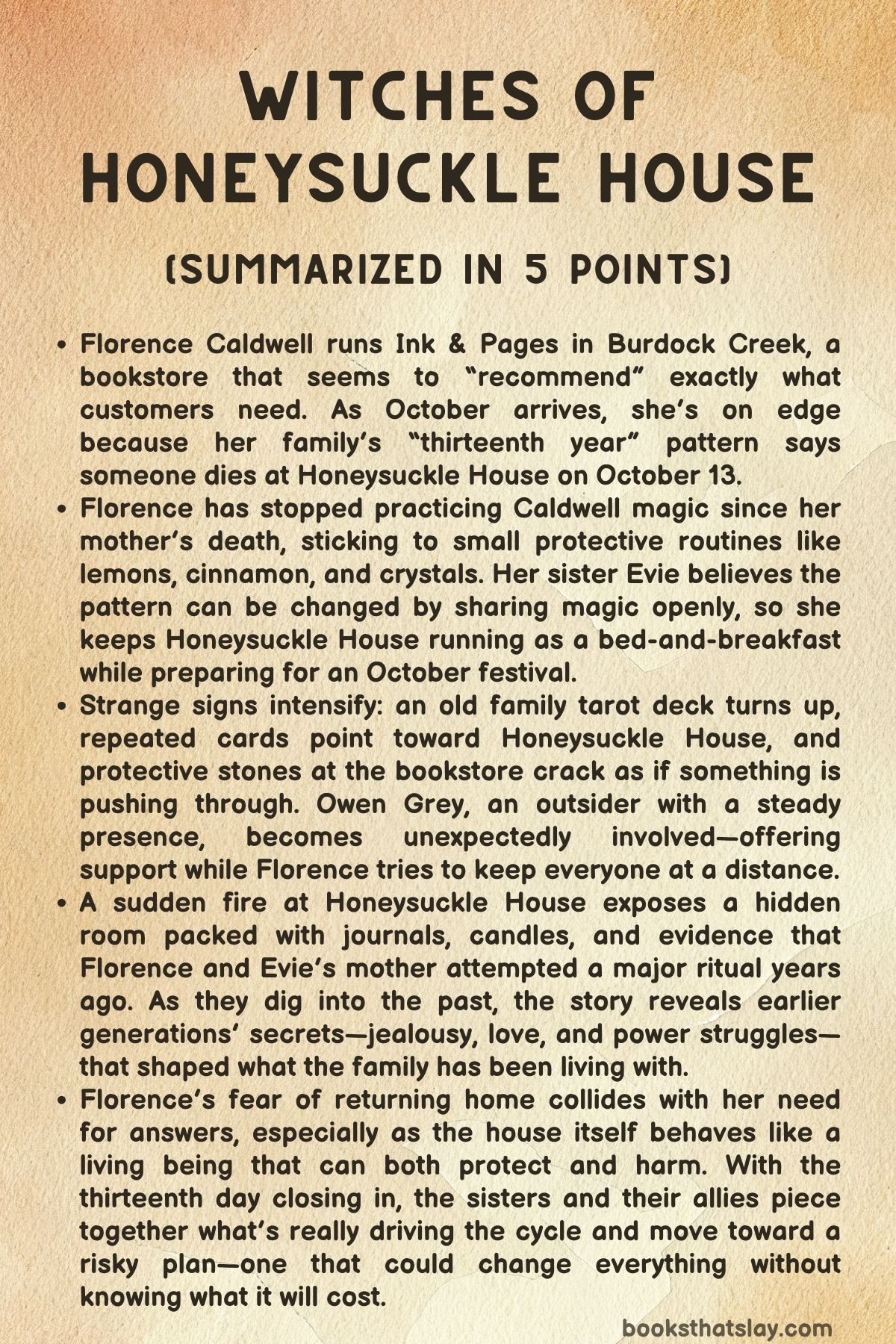
But October brings dread. In her family, someone dies every thirteen years on October thirteenth at their ancestral home, Honeysuckle House. Florence swore off Caldwell magic after her mother’s death, while her sister Evie believes the only way out is to use their power openly and differently. As signs escalate—violent house “pranks,” alarming tarot draws, and a sudden fire—the Caldwells are forced to face what their inheritance really is.
Summary
Florence Caldwell has built a careful life above Ink & Pages, the bookstore she saved from shutting down in Burdock Creek. The shop seems to sense what customers need, guiding hands to the right stories at the right time.
Florence pretends this is coincidence, but she also keeps quiet safeguards in place: lemons tucked out of sight, cinnamon at the threshold, crystals among the shelves. She tells herself these are habits, not magic.
She can’t afford to believe in more than that, not with October arriving.
October is dangerous for the Caldwells. For generations, someone in the family has died on October thirteenth at Honeysuckle House, their Victorian home on the edge of town.
Florence’s mother, Linda, was the last to die, thirteen years earlier. Florence is sure the only way to survive is to stay away from the house and avoid using Caldwell magic altogether.
Her best friend, Angela Rider, tries to distract her with coffee, pastries, and local gossip, including news of Owen Grey, a newcomer working at Honeysuckle House during the honey harvest. Angela notices Owen’s interest in Florence, but Florence refuses to make room for romance when the date on the calendar feels like a trap.
Across town, Florence’s sister Evie Caldwell prepares Honeysuckle House for its busy festival week. Evie runs the home as a bed-and-breakfast and sells candle magic to locals, believing the family’s mistake was secrecy and hoarding.
She’s convinced the curse can be broken through openness and balance rather than denial. With her daughter Clara nearby, Evie sets a protective working: a black candle ringed with salt, names written and burned for protection.
Almost immediately, something in the house goes wrong. Guests complain that a bed physically threw a pregnant woman onto the floor.
Evie is shaken because the house has always been mischievous, but it was never supposed to harm anyone.
At Ink & Pages, Owen arrives for a tarot lesson with Angela. Angela persuades him to read for Florence, pointing out Florence isn’t the one handling the cards.
Owen chooses a deck that is already open—a deck Florence recognizes with a shock of grief as her great-aunt’s. The first card is the Four of Wands, illustrated with Honeysuckle House.
Owen notes Florence’s birthday falls on the thirteenth, a detail that hits too close. When Owen pulls cards for himself, the Two of Cups appears, bound with honeysuckle vines, and Angela teases him.
Then Owen draws a clarifier: The Tower, showing Honeysuckle House burning. The air in the store shifts.
Lights flicker. The black tourmaline near the front door cracks cleanly in half, as if the store’s protection has been overwhelmed.
Angela rushes to Honeysuckle House to warn Evie. Evie admits the house has been escalating—locking guests out, switching spices, turning small annoyances into real threats.
When Angela shows her the deck and the repeated Four of Wands, Clara grabs the cards, shuffles, and reveals the Four of Wands again. Clara insists the house wants Florence to come home.
Evie sends Clara to spend the day at Ink & Pages, partly for safety and partly to keep her away from the house’s current mood. Clara loves the bookstore and worries Florence is lonely, so she sneaks into Florence’s hidden reading nook and builds a small spell circle.
She lights a candle she made for friendship and healing and asks for a friend for Florence and guidance for the house. The candle burns down too fast, then dies.
Soon after, a black kitten appears as if summoned by the request. Clara names him Ink.
Florence is startled, suspicious, and unwilling to admit what this means, but she feeds the kitten and agrees to keep him temporarily.
Owen returns with a replacement piece of tourmaline and offers practical help—lemons, cat food, whatever Florence needs. Florence finds one of her hidden lemons has gone moldy in an instant, a sign the negativity around her is spiking.
Evie arrives, sees the kitten, and clashes with Florence about the curse. Florence demands Evie shut down the bed-and-breakfast and cancel the festival.
Evie refuses, arguing that fear and avoidance have only fed the problem. Their fight is interrupted by sirens.
Evie receives a call and goes pale: Honeysuckle House is on fire.
Evie races back with Clara and Angela, while Florence stays behind, frozen by terror at the thought of returning. At the house, firefighters contain the blaze quickly, but the damage is strange—too clean, too localized, almost like a deliberate opening.
Inside, Clara slips past everyone, convinced the fire is her fault because of the candle she burned at the bookstore. In the attic, she finds water everywhere, Evie’s black candle overturned, and a charred path leading to a doorway-shaped hole in a wall.
She steps on broken glass and bleeds, stunned because the house usually protects her. Evie and Angela find her, tend the cut, and peer through the opening into a hidden room filled with candles, herbs, journals, and a tarot deck: Linda Caldwell’s secret space.
Evie opens a journal dated thirteen years earlier and finds notes describing a complex ritual involving black and brown candles, crystals, string-bound objects, a doorknob used as an anchor, and burned tarot cards. Clara recognizes objects tied to their family, including a doorknob and half-heart necklaces Evie and Florence once wore.
The hidden room’s existence reframes Linda’s death, suggesting she was working on something that the family never understood—and that the house itself kept concealed.
As the present-day mystery deepens, the story reveals the roots of the curse through earlier generations. In 1960, young sisters Regina and Violet Caldwell survive a car crash that kills their parents when honeysuckle vines surge to pull the girls free.
Thirteen years later, Regina—possessive and frightened of losing Violet—casts a spell meant to keep love away from her sister. Violet is in love with Tillie Grey, and the relationship is a threat to Regina’s control.
Regina’s jealousy becomes cruelty; she even tries to pressure Tillie’s family into forcing her out of town. Violet counters Regina’s magic, but Regina refuses to let go.
Tillie dies suddenly in the bath, and the house reacts with violent grief—shaking, turning faucets on like sobbing. The truth is worse than an accident: Regina’s spell is revealed as a siphoning working.
She intended to steal Violet’s power, and Tillie’s death becomes the sacrifice that completes the transfer. Thirteen years later, when the stolen power begins to fail, Regina casts again.
Violet returns to the house, drawn by guilt and the need to stop her sister, only to be killed when the house is forced—through the spell’s structure—to become the instrument of violence. The pattern continues into Regina’s daughter Linda’s life.
Linda eventually understands what Regina has been doing and attempts to stop it with her own desperate working. Regina dies, but the binding and siphoning mechanisms remain in place, set to repeat across generations.
In the present, Florence finally stops running from the question and begins searching for answers. Ink & Pages responds to her need in its own way, pushing her toward the truth.
With Owen’s steady presence, Florence confronts the trauma of her childhood: Linda’s abuse, both physical and magical, and the fear that closeness endangers everyone she loves. Florence attempts to drive to Honeysuckle House and breaks down near the final turn, but Ink the kitten appears unexpectedly, grounding her.
Later, Owen helps her breathe through the panic, and Florence makes it back to the place she’s avoided for years.
Once inside, the house recognizes her. Honeysuckle vines shift as if welcoming her, and the air is thick with memory—warmth from before things went wrong, and fear from what followed.
Florence finds Evie in the attic, tearing into the wall and pursuing her own plan. The sisters argue bitterly, reopening old wounds about their mother, their father, and the ways they each survived.
The house seems to react to their conflict like a living thing in pain.
Florence and Evie piece together the journals and the ritual’s logic: what Linda attempted wasn’t simple protection. The ingredients, the tarot cards chosen, and the missing pieces point to a siphoning spell still active—one that has been draining their magic and demanding an offering every thirteen years.
They realize Linda’s death may have been accepted as the offering even though her attempt failed, leaving the cycle intact. Most importantly, they recognize the timing: the danger doesn’t end at midnight; it completes at the end of the thirteenth day, meaning they still have time to act.
A new tarot pull points them toward clarity and decisive action. Florence and Evie decide on a cord-cutting working to sever themselves—and Ink & Pages—from Honeysuckle House before the siphoning finishes.
It will save their magic and stop the deaths, but it will also end the living presence of the house, which has loved them in its distorted way for generations.
Clara overhears and panics. She loves the house and believes it can still be saved.
In the storm, she steals the journal and tries to redo the siphoning setup herself, intending to offer Ink by making him vanish rather than die. At the last moment she can’t go through with it.
Evie, Florence, Angela, and Owen reach her in the attic. Florence tells Clara her earlier candle already helped by bringing Florence home and revealing the hidden room, making a safer choice possible.
Together, they complete the cord-cutting. Clara, whose magic is not as entangled, is the one who can light what the adults cannot.
As the working burns through the string and divides what was bound, the honeysuckle vine that reaches through the window withers. The house grows quiet, its presence fading like a breath released.
Florence and Evie feel their magic surge back—stronger, clean, and finally their own.
Morning comes, and October thirteenth ends without tragedy for the first time in living memory. The town celebrates the festival, unaware of how close the Caldwells came to another loss.
In the aftermath, Florence and Evie return to the workshop and dip a new candle together, choosing a color for healing and forgiveness. The house no longer moves on its own; the light switch is simply a light switch now.
Yet small signs remain—curtains lifting, a soft creak in the wood—as if the building, freed from the old binding, might someday wake again in a gentler way.
Characters
Florence Caldwell
Florence is the emotional center of Witches of Honeysuckle House: a woman who has built her entire adult life around controlled containment—of grief, fear, and magic. She lives above Ink & Pages not just because it is practical, but because the bookstore becomes her substitute “safe house,” a place she can curate and protect in ways she could never protect her childhood home.
Her refusal to practice Caldwell magic reads, on the surface, like principle, but it is really survival; magic is inseparable from her mother’s violence and from the family pattern of loss, so abstinence becomes Florence’s way to keep the world from noticing her, touching her, or taking someone she loves. Even her small protective habits—lemons, cinnamon, crystals—reveal the contradiction that defines her: she rejects magic as a system while still clinging to it as a comfort object.
Florence’s arc is not about becoming powerful; it is about reclaiming agency over what power means, separating inheritance from harm. Her panic attacks on the road to Honeysuckle House show how trauma lives in the body, not in logic, and her progress comes when she allows support (Owen, Ink, eventually Evie) without interpreting closeness as a death sentence.
By the end, when she helps choose the cord-cutting that saves her family at the cost of the house’s spirit, she is finally making a clean choice for herself rather than living as a hostage to prophecy and anniversary.
Evie Caldwell
Evie is Florence’s mirror and foil: where Florence equates secrecy with safety, Evie equates openness with healing. She runs Honeysuckle House as a bed-and-breakfast and hosts a festival because she refuses to let fear shrink the family into hiding, but that defiance has a cost—she sometimes treats risk as proof of courage, and she can become stubborn when she feels judged.
Evie’s worldview is shaped by the discovery of her mother’s journal and the possibility that hoarding magic created imbalance; she turns that theory into a mission, “sharing” through candle work and community prosperity. Yet her arc complicates the idea that good intentions are enough: the house can be harmed, can harm others, and can be manipulated by forces older than her optimism.
Evie’s greatest vulnerability is that she wants to be the one who fixes things, especially for Florence; when she begins preparing protective work while her power weakens, it’s a sign that she is repeating a family pattern—taking responsibility for systems that were built to consume her. Her most important growth is relational rather than mystical: she learns that saving the family does not mean winning an argument with Florence, and that protecting Clara sometimes requires letting Clara feel grief and choice.
In the end, Evie’s willingness to say goodbye to the house’s living presence is her most mature form of “sharing”—she shares power back to herself and her sister instead of sacrificing them to a place.
Clara Caldwell
Clara embodies the story’s question of what a “good” witch is when magic has been tangled with coercion for generations. She is earnest, imaginative, and deeply empathic, but also dangerously confident in the idea that love automatically makes magic safe.
Her friendship-and-healing candle is a child’s spell in intention, yet it becomes a catalyst because the world she lives in is already primed with unstable bindings; Clara learns, painfully, that you can light a candle with kindness and still feed a machine built on hunger. She also functions as the narrative’s moral hinge: she loves Honeysuckle House as a living being, not as a symbol, and therefore she refuses the clean logic of “cut it off and move on” until she understands what that truly means.
Her decision to attempt the siphoning setup is not villainy; it is grief-driven bargaining, the child’s urge to undo a funeral before it happens. What makes Clara compelling is that she is not merely protected by adults—she is given responsibility at the crucial moment, because only she can light the divided candle and complete the cord-cutting.
That act is both heartbreaking and empowering: she becomes the first Caldwell in the present line to practice magic with informed consent rather than fear or compulsion. By choosing not to harm Ink and by helping sever the bond cleanly, she becomes the family’s proof that power can be tender without being naive.
Angela Rider
Angela is the stabilizing social heart of the present-day cast: a best friend who refuses to let Florence disappear into isolation and who refuses to let the Caldwells’ supernatural crisis become an excuse for emotional neglect. Her coffee-and-pastry check-ins are not filler; they establish Angela as someone who practices care as a daily discipline.
She also serves as a bridge character—between Florence and Owen, between Ink & Pages and Honeysuckle House, between fear and action—because she is willing to talk about what others avoid. At the same time, Angela is not a passive helper; she has her own courage and her own stakes, particularly when the narrative implies a prior spell nearly took her as an “offering.” That revelation reframes Angela’s loyalty as something more radical than friendly concern: she is choosing to stay close even when closeness has historically put people in danger around this family.
Angela’s presence also keeps the story honest; she can tease romance and tarot meanings, but she is also the one who shows up to warn Evie, tends to Clara, and moves information where it needs to go. She represents chosen family as a counterspell to inherited curses.
Owen Grey
Owen enters as a potential romance, but his deeper function is as a safe witness—someone outside the Caldwell line who can hold their story without automatically reproducing its rules. His tarot lessons and willingness to read for Florence create a loophole that lets Florence approach magic without immediately feeling contaminated by it.
The detail that he chooses a deck that is already open, and that it turns out to be her great-aunt’s, positions Owen as someone being guided by forces he does not control, yet he does not exploit that role; he stays grounded, offers practical help (tourmaline replacement, errands), and consistently prioritizes Florence’s consent. His Two of Cups pull and the clarifying Tower image visually tie him to both intimacy and catastrophe, which is exactly Florence’s dilemma: love feels like a doorway to loss.
Owen’s most meaningful scenes are not mystical but emotional—helping Florence breathe through panic on the final bend to Honeysuckle House, listening to her history of abuse without turning it into spectacle, and offering presence rather than fixes. The later family-history connections deepen his relevance by tying the Grey line into the old tragedies, but the story avoids making him the “solver.” Instead, Owen models a different masculinity than the one implied by patriarchal secrecy and reputation: he is careful, noncoercive, and willing to stand beside power he does not own.
Ink
Ink, the black kitten, is more than a cute familiar; he is the narrative’s embodiment of mercy arriving uninvited. He is summoned by Clara’s spell, but he chooses Florence—turning up at her most vulnerable moment and physically interrupting the panic spiral with comfort.
That matters because Florence’s trauma is tied to a home that attacked and controlled bodies; Ink is touch that does not demand, closeness without punishment. He also becomes a test of Clara’s limits: when she tries to set up a sacrifice that makes him “disappear,” her breakdown shows the difference between abstract ritual and real harm.
Ink’s role is to force characters to confront what their magic costs, in living terms, not symbolic ones. In a story where houses and candles can become instruments of violence, Ink is the small, breathing reminder that protection is supposed to protect someone.
Honeysuckle House
Honeysuckle House is written as a conscious being with fear, grief, and an instinct to protect that can mutate into violence when bound and siphoned. It is not merely “haunted”; it experiences memory, panic, and physical limitation, trying to douse fire with moon water, shifting its structure to contain damage, and “weeping” through faucets.
The house’s tragedy is that it loves the Caldwells but does not understand the human moral lines that make love safe; it can interpret separation as abandonment and respond like a wounded animal. Over generations, it is also repeatedly forced into complicity—Regina’s spells and Linda’s unfinished ritual make the house an instrument that harms the very people it wants to keep.
That violation creates a profound ambiguity: when deaths happen, the house is both culprit and captive, both predator and victim. The climax resolves this ambiguity through sacrifice: the family severs themselves, and the house’s living presence fades, which reads like euthanizing a suffering creature that cannot stop hurting others.
Yet the ending’s small signs—curtains fluttering, light flickers—suggest the building might one day awaken differently, implying that “home” can be reborn when it is no longer fed by coercion and inherited pain.
Linda Caldwell
Linda is the most haunting human presence in the family line because she embodies the way victimhood can curdle into harm when power and trauma feed each other. As a child under Regina’s cruelty, Linda is bruised, thin, and used as a component in spells she does not understand; she grows up inside an ecosystem where love is transactional and magic is extraction.
Her later abuse of Florence and Evie—physical and magical—cannot be excused, but it becomes legible as the legacy of being taught that control is the only form of safety. The “Once upon a time” workaround to avoid spell-muffling implies she enforced silencing magic that prevented direct speech about the curse, which is chilling because it turns narrative itself into a controlled resource.
Linda’s secret room and journal show her trying, at least at one point, to solve what was happening—yet her solution appears to involve binding and anchoring, repeating the family habit of trapping power instead of freeing people. Her death beneath the chandelier is both tragedy and indictment: even in her final attempt to manage the system, the system consumes her.
In the present, Linda’s remnants (journals, components, the half-heart necklaces, the doorknob) become the map that her daughters must reinterpret, not to redeem her, but to end what she could not.
Regina Caldwell
Regina is the story’s clearest portrait of magical abuse as emotional possession. Her love for Violet is real, but it is the kind of love that refuses to accept separate personhood, so it becomes jealousy, sabotage, and ultimately predation.
The candle spell—“May no man love my sister”—is revealing not only for its cruelty but for its framing: Regina tries to make Violet’s life smaller so that Regina will feel safer. Her threats to Joshua and her willingness to weaponize reputation show that she uses social structures as readily as supernatural ones.
Most damning is her siphoning logic: when her stolen power begins to flicker every thirteen years, she treats other lives as fuel, rationalizing sacrifice as necessity. Regina represents the family curse in its most human form: the choice to turn fear of abandonment into a system that guarantees abandonment for everyone else.
Even when the house is blamed, the narrative ultimately points to Regina as the architect of the mechanism that forced the house to harm—she is the one who taught love to speak in the language of taking.
Violet Caldwell
Violet is the counterpoint to Regina’s possessiveness: she is steadfast, loving, and brave enough to confront both family and house. Her love with Tillie is tender but also politically dangerous in its era, and Violet carries the burden of secrecy with a kind of weary dignity.
Her hidden truth about her father’s drinking and the crash shows her complexity: she will protect the dead’s memory even when the truth might be safer, and that choice foreshadows how family secrets become structural rot. Violet’s greatest tragedy is that she is repeatedly forced into impossible choices—between her sister and her lover, between honesty and protection, between staying and fleeing—and her death by impalement is not just horror but symbolism: she is literally pinned by the house and the spellwork that claims to be “protection.” Yet Violet’s voice survives through letters and journals, making her a posthumous guide.
She becomes the ancestor who finally names what happened, enabling Florence and Evie to stop inheriting guesses and start inheriting truth.
Tillie Grey
Tillie is often positioned as the “intruder” in Regina’s story, but the narrative treats her as a person with agency, artistry, and an open-hearted steadiness that Violet can finally rest inside. Her painted tarot decks are important: she translates the house into images, turning fear into interpretive language, and she creates a deck meant for Regina as a peace offering—an act of generosity that makes her death feel even more cruel.
Tillie’s bath scene is intimate and domestic, emphasizing that what Violet wants is not drama but ordinary love, and Tillie’s sudden death in that setting underlines the story’s thesis that curses do not only strike at grand moments; they target the quiet places where people finally feel safe. Later, the revelation that Regina’s spell likely killed Tillie reframes Tillie as the first true sacrifice of the siphoning mechanism.
She becomes the emotional price tag of Regina’s obsession, and the grief that shapes everything afterward.
Joshua Grey
Joshua serves as a moral alarm bell in the 1960 storyline: he recognizes threat, calls it what it is, and refuses to be intimidated. His confrontation with Regina reveals the limits of her control outside her own house, and his protective stance toward Tillie grounds the Grey family as people rather than plot devices.
Joshua also represents the town’s social reality—reputation, gossip, the danger of exposure—yet he uses that awareness to protect rather than to police. By warning Violet and Tillie and suggesting they leave, he articulates the practical solution that love often needs in hostile environments.
Even when Violet refuses, Joshua’s presence clarifies that Violet’s later tragedies are not caused by a lack of options; they are caused by the supernatural machinery Regina insists on maintaining.
Helen Caldwell
Helen appears briefly, but she is foundational as the mother whose death and absence shape the house’s earliest grief. The crash that kills Helen and Christopher is the first catastrophe tied to Honeysuckle House’s vines surging into action, and that detail matters: it establishes the house as protective long before it becomes dangerous.
Helen’s role is less about personality on-page and more about what her loss does to everyone left behind, especially to a sentient home that cannot process mourning like a human can. In the family mythos, Helen becomes the origin point of the house’s attachment—proof that love and loss were braided into the property from the start.
Christopher Caldwell
Christopher functions alongside Helen as the lost parent whose death creates the sisters’ orphaned bond and sets the emotional conditions for Regina’s possessiveness. The crash scene, with the house saving the girls but not the parents, is a brutal lesson in partial protection: magic can intervene, but it chooses or fails in ways that leave survivors with warped narratives of blame.
Christopher’s implied drinking later echoed in Robert’s crash-related secrets creates a pattern of flawed human choices being swallowed by supernatural explanations, which is central to the book’s tragedy—people reach for “curse” when the truth is often a knot of grief, secrecy, and harm.
Barb
Barb, the diner waitress, is a small but meaningful figure because she signals the existence of quiet allies in a time and place that could easily be portrayed as uniformly hostile. Her supportive presence gives Violet and Tillie a pocket of normalcy and acceptance, which makes their relationship feel less like an isolated fantasy and more like a life that could have been sustainable if not for Regina’s interference.
Barb’s role reinforces that community can be protective, even when the larger culture is dangerous.
Ron Cooke
Ron Cooke, the firefighter, represents the grounded, procedural world colliding with supernatural crisis. His advice about not letting guests sleep in the damaged turret and offering remediation contact information adds realism and raises the stakes: the house’s danger is not only mystical but also practical liability.
He is also a reminder that the Caldwells are not alone in town; there are professionals and systems that can respond to emergencies, even if they cannot see the true cause. His presence helps the story avoid trapping the family in a purely magical bubble.
Robert
Robert is central in the hidden-history layer because he embodies how “ordinary” harm and magical harm can overlap. His death is initially framed through suspicion and accusation, but later revelations suggest his crash involved drinking, echoing earlier generational patterns.
As Linda’s husband, he is also positioned as the next intended offering in Regina’s planning, which turns him into both a person and a resource in the family’s predatory spell economy. The shifting narrative around Robert highlights one of the book’s sharpest ideas: curses thrive when truth is buried, because buried truth can be shaped into whatever story best serves power.
Themes
Inherited fear and the cost of survival
Florence’s life in Witches of Honeysuckle House is shaped by the kind of fear that becomes a family heirloom, passed down as carefully as recipes and names. The “thirteenth year” pattern turns October into a countdown, so every normal choice—where to sleep, who to love, whether to return home—feels like it could trigger loss.
Florence’s refusal to practice magic is not just a personal preference; it reads as an emergency measure, a way to survive inside a story that has taught her survival means giving things up. Her protective habits in the bookstore—lemons, cinnamon, crystals—show how trauma often creates rituals that look practical on the surface but are really negotiations with dread.
The panic attacks on the road to Honeysuckle House make clear that the danger is not only supernatural; the body remembers what the mind tries to outargue. The book also refuses the easy idea that fear is irrational.
Florence has evidence, history, and a mother whose abuse made home unsafe long before any candle spell went wrong. This theme becomes especially sharp when Florence avoids romance, not because she dislikes closeness, but because affection has become associated with collateral damage.
Even when the curse’s mechanics are explained, the emotional truth remains: inherited fear teaches a person to confuse isolation with protection. What makes Florence’s arc powerful is that she does not “get over” fear by dismissing it; she learns to move through it with support, information, and a new understanding of what the family has been trapped inside.
Home as a living force that can nurture or harm
Honeysuckle House is not a neutral setting in Witches of Honeysuckle House; it behaves like a presence with desires, memory, and limits. That turns the idea of “home” into something unstable—capable of comfort, capable of violence, capable of guilt.
The house wants to hold the Caldwells together, and in earlier moments it even saves lives, yet it also becomes the container where control and obsession are amplified. The unsettling part is not only that the house can move objects or lock doors; it is that it reacts emotionally, as if fear and grief are structural materials.
Its attempts to protect can become coercive, and its attachment can become possession. When the house harms guests, it signals that whatever balance once existed has shifted; the protective behavior has started slipping into reckless behavior, like a guardian that no longer understands its own strength.
The fire sequence underscores that the house is frightened too, and that fear can lead to damage even without malicious intent. Yet the story also shows that the house can be forced, manipulated, and trapped by human choices—Regina’s siphoning work and Linda’s unfinished ritual turn the building into a tool and a prison at the same time.
This creates a nuanced idea of home: it is shaped by the people inside it, but it also shapes them back. The final decision to sever the bond is not simply abandoning a building; it is choosing safety over a relationship with a place that has become dependent, unpredictable, and dangerous.
The quiet afterward—manual light switches, ordinary creaks—suggests that a home can be mourned even when leaving is the healthiest option, because what is lost is not just architecture but the fantasy that home will always know how to love without hurting.
Sisterhood, rivalry, and the struggle for emotional autonomy
The emotional core of Witches of Honeysuckle House rests on sisters who love each other and still become each other’s wounds. Florence and Evie represent two survival strategies: withdrawal versus confrontation.
Their arguments are painful because both are protecting something real—Florence protecting life by reducing risk, Evie protecting meaning by refusing to let fear decide the family’s future. The book uses their conflict to show how trauma can split a family into competing moral frameworks, where each person believes they are being responsible and experiences the other as reckless.
This modern sisterhood echoes the earlier fracture between Regina and Violet, where devotion turns into entitlement. Regina’s obsession is especially revealing: she treats closeness as ownership, and her magic becomes a method of enforcement when persuasion fails.
Violet’s love for Tillie becomes the line Regina refuses to accept, because it proves Violet has a self outside the sister bond. In both generations, the central fight is about autonomy—who gets to choose love, who gets to set boundaries, who is allowed to build a life that does not revolve around the family’s most anxious member.
The story also refuses to romanticize reconciliation as instant harmony. Florence and Evie do not resolve decades of damage through one conversation; they move forward because circumstances force honesty, because evidence clarifies what they are truly fighting, and because their protective instincts finally align.
The candle they dip together at the end lands as a practical symbol: not a grand declaration, but a shared action that proves cooperation is possible. Sisterhood here is shown as labor—choosing not to repeat the old pattern of control, choosing forgiveness without excusing harm, and choosing to let each other be separate people who still belong to one another.
Power, control, and the ethics of using magic
Magic in Witches of Honeysuckle House functions like a moral amplifier: it makes intentions real, faster, and with consequences that cannot be talked away later. Florence’s refusal to practice after her mother’s death shows a deep suspicion that power is inherently risky, especially when grief and fear are involved.
Evie’s approach argues the opposite—that refusing power can be its own kind of harm when it leaves a problem unchallenged. This debate becomes more complex as the book reveals that the worst damage did not come from magic used openly to protect, but from magic used secretly to control.
Regina’s work is not framed as “too much power,” but as power directed toward ownership of another person’s choices. Her spell to prevent love is the clearest example of coercion disguised as care: it is rooted in the belief that her bond with Violet should outrank Violet’s consent.
The siphoning ritual extends that logic into exploitation, turning family members into fuel. The repeated use of offerings, anchors, and burned tarot cards makes the ethics tangible: someone always pays, and the bill is often sent to the most vulnerable person in the room.
Linda’s story adds another layer—her attempt to stop the cycle can be read as protection, but the secrecy and complexity also show how easily “protection” becomes another locked system that future generations inherit without understanding. By the time Evie and Florence decide on cord-cutting, the ethical question is no longer whether magic should be used, but what it means to use power in a way that prioritizes consent, transparency, and harm reduction.
The final ritual asks for a hard form of integrity: saving the living may require letting the house’s living presence end. That choice is not presented as purity; it is presented as responsibility.
Magic becomes ethical when it stops trying to own outcomes and starts trying to restore agency to the people trapped by prior choices.
Cycles of sacrifice and the illusion of “necessary” loss
The thirteen-year deaths create a structure where tragedy starts to look scheduled, almost bureaucratic, and that normalizes the idea that someone must be lost to keep the system running. Witches of Honeysuckle House shows how a repeating pattern can turn grief into expectation, and expectation into compliance.
Earlier generations quietly adjust around the cycle—secrets, rituals, avoidance—because challenging it seems impossible or too costly. Regina’s escalation reveals how sacrifice becomes a shortcut: when her stolen power begins to flicker, she reaches for another offering rather than facing the reality that power taken from others cannot stay stable.
What is chilling is that sacrifice is not only physical death; it is also the sacrifice of truth, of freedom, of relationships, of childhood safety. Linda sacrificing Regina to end a spell highlights the moral ambiguity of survival in cursed systems: sometimes the only available exit is an act that still feels like a violation of what should be right.
In the present, Florence has been sacrificing her life in smaller ways—refusing romance, refusing home, refusing her own gifts—because it seems like the only way to keep people alive. The book’s resolution reframes “necessary loss.” The family does not defeat the curse by paying it on time; they defeat it by refusing the logic that demands payment at all.
Cord-cutting rejects the myth that balance requires a body. It also challenges the seductive idea that if you just do the ritual correctly, the system will reward you with peace.
Instead, peace arrives through ending the system, even when ending it means grieving what was once loved. The thirteenth passing without tragedy matters because it breaks the psychological spell as much as the magical one.
It proves that the future does not have to be negotiated with fear, and that patterns only stay “fated” when people are trapped into repeating the choices that feed them.
Healing through chosen bonds and ordinary care
Alongside curses and ritual work, Witches of Honeysuckle House builds a quieter argument: healing often begins in small, chosen acts that feel almost mundane. Ink & Pages “knowing” what customers need mirrors the human need beneath the magic—being seen without being controlled.
Angela’s steady presence models support that is practical rather than dramatic: coffee, pastries, rides, showing up even when Florence is difficult to reach. Owen’s role is similarly grounded; he does not treat Florence’s fear as a mystery to solve or a weakness to mock, but as a reality to accommodate with patience.
The kitten Ink is a compact version of this theme. He arrives through a spell, but what matters is not spectacle; it is the way care becomes a bridge back to feeling safe.
Feeding a stray, carrying him during a panic attack, making room for a small life—these acts push against Florence’s belief that closeness kills. Clara represents another side of chosen bonds: a child trying to protect adults with the tools she has, learning that love without guidance can still be dangerous, and that responsibility includes admitting when you are scared.
The story also suggests that healing is communal. The final safety is not achieved by a lone savior but by a small network—sisters, friend, partner, child—working with honesty and shared risk.
Even the town festival becomes part of that repair, not because celebration erases the past, but because it restores the possibility of gathering without dread. By ending with Florence and Evie dipping a candle together, the book emphasizes recovery as repetition of a new kind: returning to the workshop, returning to each other, returning to magic without secrecy and without coercion.
Ordinary care becomes the counterspell to inherited fear, because it teaches the nervous system and the heart the same lesson: connection can be safe, and love can exist without demanding a sacrifice.