You Dreamed of Empires Summary, Characters and Themes
You Dreamed of Empires by Álvaro Enrigue is a bold historical novel that reimagines the meeting between Hernán Cortés and Moctezuma in Tenochtitlan. Rather than treating conquest as a fixed march toward an inevitable ending, the book lingers inside one unstable day, where diplomacy, fear, ambition, drugs, ritual, translation, and political calculation shape every gesture.
Enrigue writes the encounter with irony and sharp intelligence, showing both the Spanish and the Mexica as confused, strategic, vain, frightened, and deeply human. The result is an alternate vision of history that asks how much of empire depends on accident, language, timing, and performance.
Summary
The novel opens with attention to language, sound, and the difficulty of bringing the world of ancient Mexico into English. The author makes clear that he is less interested in perfect linguistic accuracy than in preserving the music, warmth, and emotional force of Nahuatl names and terms.
This concern with language becomes central to the story itself, because nearly every political decision depends on translation, misunderstanding, tone, and the gaps between what is said and what is understood.
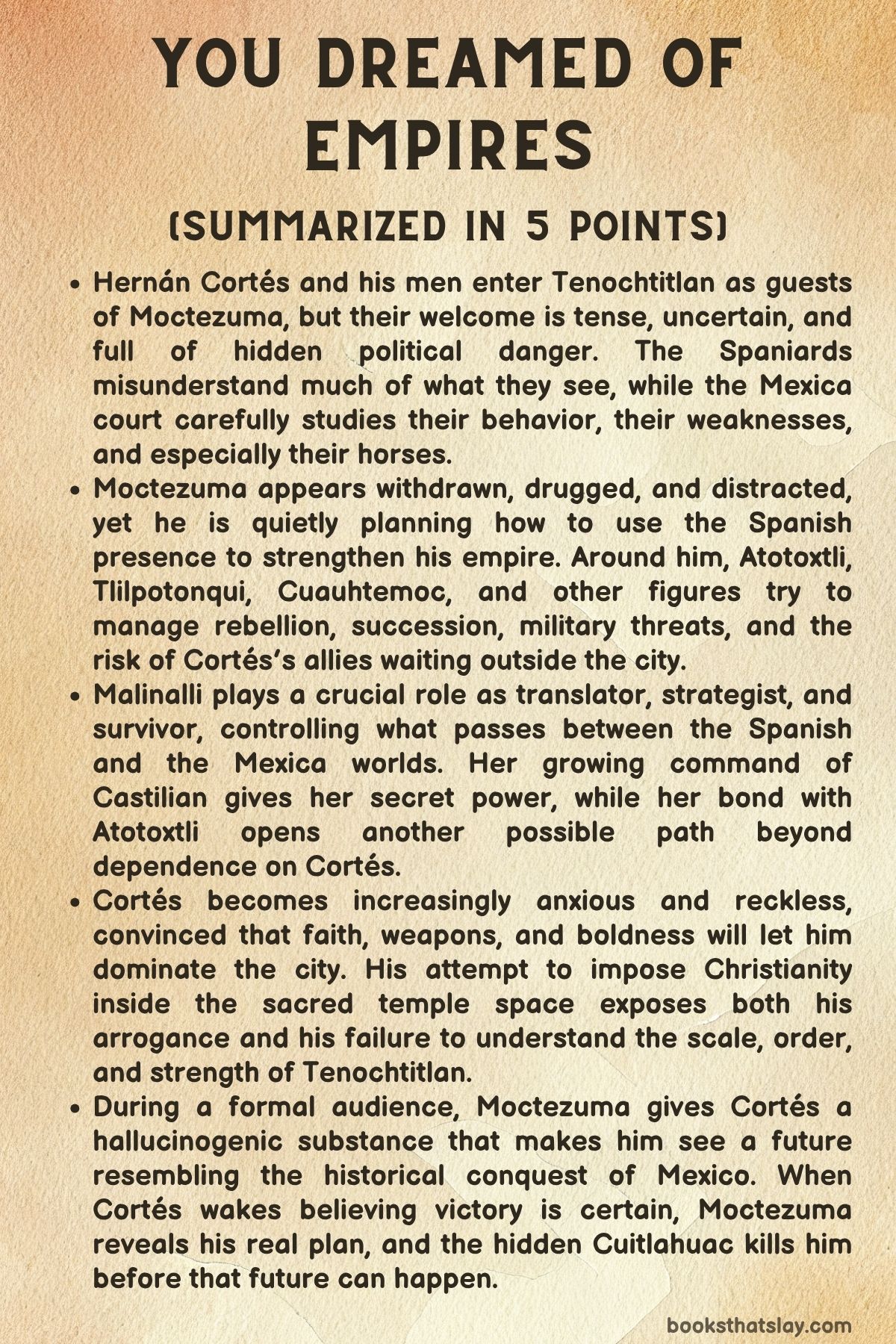
The main action begins after Hernán Cortés and his men have entered Tenochtitlan, the magnificent capital of the Mexica world. They are housed in the Old Houses of Axayacatl, a palace prepared for them by Moctezuma.
The Spaniards are invited to a ceremonial lunch, but the meal is tense from the start. Captain Jazmín Caldera sits beside terrifying priests whose bodies bear the signs and smells of ritual sacrifice.
He struggles to eat, while Cortés silently commands him to behave. Princess Atotoxtli, Moctezuma’s sister and symbolic wife, presides with sharp attention.
The translators, Malinalli and Jerónimo de Aguilar, control the fragile flow of meaning between the two sides, sometimes softening words and sometimes hiding them completely.
Atotoxtli quickly realizes that the Spanish presence cannot be treated as a simple visit. Cortés boasts that his Indigenous allies remain nearby at Iztapalapa, while the Mexica officials try to deny or soften the danger.
When Caldera confirms the location of the Tlaxcalteca forces, Atotoxtli leaves the meal and rushes to confront Moctezuma. Her anger reveals the larger crisis: the empire is under pressure from rebellious territories, shifting alliances, religious anxieties, and internal suspicion.
Moctezuma, meanwhile, has withdrawn from public duties, spending much of his time in a nightshirt, taking hallucinogenic mushrooms, and avoiding the direct exercise of rule.
Moctezuma is not presented as foolish or passive. He is strange, weary, intelligent, and dangerous.
He has invited the Spaniards into the city because he wants to acquire what they possess, especially their horses. To him, the horses represent military possibility, not divine mystery.
Yet his retreat from visible command has made his closest officials nervous. Tlilpotonqui, the cihuacoatl and practical ruler of Tenochtitlan, senses that the city is close to disorder.
He worries about the absent prince Cuitlahuac, the Tlaxcalteca army nearby, the unstable city of Texcoco, and Moctezuma’s habit of withholding crucial information.
The palace itself becomes a maze of uncertainty. Caldera and other Spaniards try to find the horses and become lost in corridors, courtyards, and mirrored spaces.
Badillo, Cortés’s quiet stable hand, has led the animals into an orchard, not understanding that Tenochtitlan has no stables because it has no horses. The animals graze peacefully while political panic gathers around them.
The Spaniards, despite their weapons and arrogance, often appear ridiculous and exposed. They do not understand the city, its customs, or the scale of the society that has received them.
Malinalli occupies one of the most powerful positions in the book. Sold as a child and later given to the Spanish after a military defeat, she has become indispensable because she speaks multiple languages.
To the Mexica elite, her command of an older form of Nahuatl gives her prestige; to Cortés, her translation gives him access to power. She knows that survival depends on reading each side accurately.
She also understands that Cortés’s ambitions may be redirected. Rather than merely serving him, she considers how she might use him, and how the city might change her fate.
As Moctezuma sleeps after taking mushrooms, the silence required by his nap spreads across the palace and the city. His sleep becomes a sign of imperial power and imperial paralysis at once.
When he wakes, the city wakes with him through bells, drums, birds, dogs, neighborhoods, markets, soldiers, and enemies. This rhythm shows the vast reach of his office, but also the danger of a ruler whose private habits now shape public life.
After the nap, tension increases. Tlilpotonqui faces complaints from trade leaders and officials who fear that Moctezuma has lost control.
Atotoxtli visits Moctezuma and tries to persuade him to use Xochitl, a young servant he has condemned, as a spy instead of killing her. Moctezuma refuses to show softness, but he sends Atotoxtli to approach Malinalli and assess the horses.
Atotoxtli and Malinalli slowly form a bond. Their conversation is careful, political, and personal.
Atotoxtli offers Malinalli a place in the palace and the restoration of her birthright, but Malinalli chooses to remain with the Spaniards for the moment, because that position still gives her leverage.
The novel also follows Cortés as anxiety turns into religious aggression. He decides to march to the Great Temple and install Christian icons.
His confidence fades when he and his men confront the immensity of the temple precinct and the skull rack, a public architecture of sacrifice and mortality. Aguilar recognizes the danger of insulting the city’s sacred spaces, but Cortés persists.
Meanwhile, Moctezuma, under the guidance of priests and hallucinogens, seeks divine counsel. The priests advise waiting, but Moctezuma eventually receives permission to trust his instincts rather than the official signs.
Caldera, dressed as a Colhua lord, slips out into the city and sees Tenochtitlan with awe. Its markets, canals, engineering, order, and beauty exceed anything he knows in Europe.
His wandering shows the city not as a backdrop for conquest, but as a complete civilization with its own intelligence and discipline. Atotoxtli notices his movement and decides to preserve him, since he may be useful in managing the horses after the Spaniards are eliminated.
As evening arrives, Moctezuma prepares for an audience with Cortés. Tlilpotonqui fears he is about to be removed or killed, especially after repeated references to a mysterious story about an ant.
His son Tlacaelel has been drawn into the emperor’s plan, and Tlilpotonqui gradually understands that Moctezuma has been acting through silence and indirection. At the audience, the Spaniards are forced to surrender their weapons.
The ceremony places them under Mexica rules, despite Cortés’s attempt to project authority.
Moctezuma receives Cortés, Malinalli, and Aguilar in the throne room. He is relaxed, commanding, and curious.
Cortés speaks of Jesus, Christianity, Pentecost, and sacred language. Moctezuma listens with real interest and compares Christian figures to Mexica gods and divine mothers.
When the conversation turns to the miracle of speaking in unknown tongues, Moctezuma proposes that he and Cortés communicate directly through a powerful hallucinogen called cactus-of-tongues. Cortés accepts the challenge.
The drug sends Cortés into a vast vision. He sees moments from his past, then a future in which he imprisons Moctezuma, destroys treasure, brings smallpox, returns with greater force, and helps bring about the fall of Tenochtitlan.
The vision stretches forward through colonization, war, independence, and history until it reaches the reader’s present. Cortés wakes convinced that he has seen proof of his destined victory.
But this expected historical future does not occur. When the drug’s effect ends, the language barrier returns.
Moctezuma gives a command Cortés cannot understand. From a wall painted deep blue, Cuitlahuac emerges, having been hidden there all along.
He kills Cortés swiftly and brutally. Moctezuma then orders the next moves: Cuauhtemoc will deploy the Eagle Warriors, Tlacaelel will help lead the defense, Tlilpotonqui will be shifted to the Council, and Cuitlahuac will secure the courtyard where the horses are kept.
The mystery of the ant is resolved as a principle of silent guidance: the ant does not speak, but shows the way. Moctezuma leaves the palace as warriors converge, his tiara slightly crooked, and history has been changed.
Characters
Moctezuma
Moctezuma is the central force of uncertainty in the book. He appears withdrawn, drugged, melancholy, and evasive, yet he is never merely weak.
His retreat from public life hides a mind still capable of strategy, cruelty, and long-range calculation. He understands the Spanish not as gods but as assets, especially because of their horses.
His obsession with acquiring those animals reveals his military imagination and his awareness that empires survive by absorbing useful forces before rivals can claim them. At the same time, Moctezuma’s dependence on ritual substances and priestly signs makes him unreliable to those around him.
He can be tender, as when memory briefly softens him, and immediately brutal, as when he condemns Xochitl for disobedience. His power lies in silence, coded messages, and theatrical timing.
By the end, his apparent passivity is revealed as concealment. He has allowed others to underestimate him, and his final command proves that he has been arranging events from behind the haze.
Hernán Cortés
Hernán Cortés is ambitious, theatrical, insecure, and dangerously convinced of his own importance. He wants authority not only over his men but over meaning itself.
Whenever he encounters a world he does not understand, he tries to rename it, convert it, or reduce it to a stage for his destiny. His religious language is sincere in one sense, but it is also bound to conquest, self-glorification, and violence.
He repeatedly fails to understand Mexica protocol, from court behavior to sacred space, and his blunders expose the limits of his intelligence. Yet he is not stupid.
He is opportunistic, bold, and skilled at turning ambiguity into advantage. His treatment of Malinalli reveals his fear of losing control over the person who makes his authority possible.
His drug-induced vision gives him the future of conquest as prophecy, but the book reverses that certainty. Cortés dies because he mistakes vision for guarantee and never truly understands the room he is standing in.
Malinalli
Malinalli is one of the most intelligent and politically alert figures in the story. Her role as translator makes her indispensable, but the book refuses to reduce her to a tool of Cortés or a passive witness to history.
Her life has been shaped by betrayal, enslavement, adaptation, and survival. Because of this, she reads power with unusual precision.
She knows when to speak, when to soften a message, when to hide meaning, and when to let others misread her. Her growing knowledge of Castilian gives her a secret advantage, and her decision to conceal it shows her instinct for self-protection.
Her relationship with Atotoxtli opens a possible future beyond Cortés, but she does not rush into dependence on another court. Malinalli’s strength comes from patience, memory, and linguistic command.
She lives between worlds, but she is not lost between them. She studies each side and considers how to turn danger into a path forward.
Princess Atotoxtli
Atotoxtli is sharp, proud, politically experienced, and emotionally more direct than Moctezuma. As his sister and symbolic wife, she occupies a strange position inside the imperial household: intimate with power, yet often forced to work around it.
She notices danger quickly, especially the threat posed by the Tlaxcalteca army near the city and the weakness created by Moctezuma’s withdrawal. Her anger is not impulsive foolishness; it is the frustration of someone who understands the stakes and sees others moving too slowly.
She also has a practical mind. Her proposal to use Xochitl as a spy, her approach to Malinalli, and her decision to preserve Caldera all show her ability to think beyond honor and punishment.
Atotoxtli’s bond with Malinalli is one of the book’s most important cross-cultural relationships because it is built on mutual recognition rather than fantasy. She sees Malinalli as a political actor, not simply Cortés’s interpreter.
Tlilpotonqui
Tlilpotonqui is the exhausted administrator of an empire nearing crisis. As cihuacoatl, he handles the daily operation of Tenochtitlan: petitions, trade disputes, military concerns, council politics, and public order.
He represents the machinery of government that continues even while Moctezuma drifts away from open rule. His tragedy is that competence does not equal control.
He knows many parts of the crisis but not enough of the hidden plan. His fear that Moctezuma has lost trust in him gives his scenes a painful tension.
He is loyal, proud, and capable of ruthless action, as seen when he orders the killing of the blademakers’ leader to restore order. Yet he is also vulnerable, especially in relation to his son Tlacaelel.
The repeated mystery of the ant exposes his limits: he is a man trained to manage visible systems, but Moctezuma’s strategy depends on silence. His survival at the end feels like both mercy and demotion.
Jazmín Caldera
Jazmín Caldera is the Spanish captain most capable of seeing Tenochtitlan with wonder rather than only fear or greed. He is cautious, observant, and more intellectually flexible than many of his companions.
At lunch, his disgust nearly overcomes him, but his obedience to Cortés also proves his discipline. His later wandering through the palace and city places him in the role of witness.
Unlike Cortés, he does not immediately convert difference into insult. He notices engineering, order, beauty, and scale.
His admiration for the city gives the book a way to measure Spanish ignorance against the reality before them. Caldera is not innocent; he remains part of the expedition.
But he has enough imagination to understand that Tenochtitlan is not a primitive space waiting for European meaning. Atotoxtli’s decision to preserve him suggests that his practical knowledge of horses and his capacity to observe may give him value after Cortés’s fall.
Jerónimo de Aguilar
Jerónimo de Aguilar is a translator, survivor, priest, outsider, and cultural hybrid. His years among the Maya have transformed his body, habits, and understanding.
The Spaniards recognize him as one of their own only uneasily, because his tattoos, bathing customs, sexuality, and comfort with Indigenous life disturb their categories. He is valuable because he helps connect Castilian, Maya, and Nahuatl through Malinalli, but his deeper importance lies in his ability to see the Spanish from a distance.
He often understands danger before Cortés does, especially when sacred spaces and city geography are involved. Aguilar’s humor is dry, and his comments cut through Spanish vanity.
He knows that stories later written about great events may sound like fantasy, and this awareness makes him one of the book’s most self-aware figures. He belongs everywhere and nowhere, which allows him to recognize absurdity on both sides without fully escaping the violence around him.
Cuauhtemoc
Cuauhtemoc is the image of disciplined force. As Moctezuma’s son-in-law and a leading general, he represents the military future of the empire.
His stillness is not emptiness but control. He waits, watches, and acts only when action matters.
His willingness to issue a call to arms shows that he is prepared to move beyond formal permission when the survival of the city demands it. At the same time, he is not a simple warrior.
He understands alliance politics and the strategic use of the Tlaxcalteca lords against Texcoco. He criticizes Tlilpotonqui not out of disrespect alone, but because he sees the older official failing to know what he should know.
Cuauhtemoc’s presence gives the story a sense of restrained violence. He does not need long speeches to command attention.
His role near the end confirms that Moctezuma’s plan requires not only cunning but immediate military execution.
Cuitlahuac
Cuitlahuac is absent for much of the book, and that absence becomes one of the story’s strongest sources of tension. Officials ask where he is, rumors gather, and his disappearance suggests murder, betrayal, or secret maneuvering.
Because he is Moctezuma’s brother and a key figure in succession, his unexplained absence destabilizes everyone’s reading of events. The final reveal transforms him from missing prince into hidden weapon.
Painted into the wall and concealed in plain sight, he embodies the strategy of the ant: silent, patient, unseen, and decisive. His killing of Cortés is swift and physical, cutting through the layers of speech, translation, religion, and hallucination that fill the throne room.
Cuitlahuac matters because he turns Moctezuma’s plan into fact. While others debate signs, alliances, and meanings, he performs the act that changes history.
His character is defined less by psychological exposure than by timing, loyalty, and lethal purpose.
Tlacaelel
Tlacaelel, the son of Tlilpotonqui, stands at the point where family, succession, and statecraft meet. His name connects him to the founder who helped turn a small settlement into an empire, and that inheritance weighs on his role.
He is drawn into Moctezuma’s secret planning, which leaves his father frightened and confused. The distance between father and son shows the cost of political life, where affection has been buried beneath office, protocol, and suspicion.
Tlacaelel’s quiet participation in the throne room confirms that Moctezuma sees him as part of the next governing order. He is also the person through whom the lesson of the ant reaches Tlilpotonqui.
This makes him more than a successor; he is a messenger of a different political method. Where his father depends on visible procedure, Tlacaelel learns from hidden motion.
His future is linked to continuity, but also to a changed understanding of power.
Badillo
Badillo brings a quieter, almost comic form of importance to the story. As Cortés’s stable hand, he lacks the rank and rhetoric of the captains, yet he possesses a rare gift for handling horses.
This makes him crucial in a city where horses are unknown and politically valuable. His calm relationship with the animals contrasts with the panic and calculation of nearly everyone else.
He does not grasp the full imperial significance of what he guards, and his inability to count the horses properly adds humor, but his practical competence still matters. In a world of court rituals, military threats, and sacred signs, Badillo represents embodied knowledge.
He understands animals through touch, patience, and habit. Moctezuma and Atotoxtli recognize that the horses may shape the future of warfare, but Badillo is the one who can actually manage them.
His modest role becomes strategically significant because empire can depend on such overlooked skills.
Xochitl
Xochitl’s brief presence reveals the cruelty and emotional blindness of palace power. She is related to Moctezuma and has served him closely for years, yet he does not even know her name.
Her failure to summon guards against Atotoxtli comes from family loyalty and human attachment, not treason. Moctezuma’s response is chilling because it turns a private act of mercy into a public punishment.
When Xochitl confronts him with the fact that he has never recognized her as a person, she exposes the moral emptiness that can grow around absolute authority. Her scene is small compared with the imperial crisis, but it is essential because it shows how large systems consume intimate lives.
Xochitl is not a major political actor, yet her treatment clarifies what is at stake in the palace. Power here is not abstract.
It reaches servants, relatives, and young women whose lives can be ended to preserve appearance.
Pedro de Alvarado
Pedro de Alvarado is a harsh presence even when he is not always central to the immediate action. He represents the most openly violent and arrogant side of the Spanish expedition.
Caldera’s contempt for him reveals tensions within Cortés’s own camp, where rank does not necessarily indicate moral worth or intelligence. Alvarado’s later role in the vision of the historical future, especially his massacre and his killing of Moctezuma, marks him as a figure of reckless brutality.
He lacks Cortés’s strategic polish and Malinalli’s intelligence, but he possesses the capacity for sudden violence that can destroy fragile arrangements. In the book, he helps show that conquest is not driven only by grand plans.
It is also driven by men who act from fear, greed, impatience, and contempt. Alvarado’s presence darkens the Spanish side because he makes clear how quickly hospitality can become slaughter once restraint disappears.
Tecuixpo
Tecuixpo appears within the royal gathering as Moctezuma’s daughter and Cuauhtemoc’s wife, and her position reflects the dynastic logic of the Mexica elite. Though she is not given the same range of action as Atotoxtli or Malinalli, her presence matters because she represents continuity through marriage, bloodline, and succession.
The throne room audience is not only a meeting between Cortés and Moctezuma; it is also a staged display of the ruling family and the future structure of authority. Tecuixpo’s role inside that tableau shows how women in the imperial household could embody political relationships even when they were not the ones speaking most loudly.
Her marriage to Cuauhtemoc links her to the military future of the empire, while her identity as Moctezuma’s daughter ties her to the existing order. She stands at the intersection of family and state, reminding readers that imperial politics is also domestic politics.
Metztli
Metztli, Tlilpotonqui’s head secretary, is a figure of administrative violence. He works within the machinery of government, carrying messages, managing appearances, and enforcing his master’s decisions.
His actions show how bureaucracy and force operate together. When Tlilpotonqui needs order restored among the trade leaders, Metztli physically pins the blademakers’ leader and later receives the private order to kill him.
This makes him more than a clerk. He is an extension of state power at ground level.
Metztli also moves through restricted spaces and delivers summons, helping connect the palace’s hidden political lines. His character shows that imperial rule depends on people who can translate command into action without hesitation.
He does not need a large inner life on the page to be important. His efficiency, obedience, and physical readiness reveal the practical structure beneath ceremony.
The Chamber-Shaman
The chamber-shaman serves as Moctezuma’s guide through altered states, ritual timing, and priestly counsel. He is both caretaker and enabler.
He understands the strength of the substances Moctezuma requests and warns him when the danger becomes severe, yet he still participates in the process that carries the emperor toward the decisive audience. His presence shows the closeness between governance, ritual, and intoxication in the novel’s imagined court.
He brings messages from the priests, explains the auspices, and helps Moctezuma navigate hallucination inside the secret passageways. At the same time, he is not the final authority.
Moctezuma listens, resists, and ultimately chooses his own instinct. The chamber-shaman’s importance lies in his proximity to the emperor’s private self.
He sees Moctezuma collapsed, disoriented, needy, and visionary, which means he witnesses the fragile human condition beneath imperial performance.
Themes
Power as Performance and Concealment
Power in You Dreamed of Empires is rarely direct. It depends on clothing, posture, ritual silence, seating arrangements, veils, food customs, formal greetings, and the management of who is allowed to speak.
Cortés believes power means weapons, horses, armor, religious certainty, and bold declarations. Moctezuma understands a different kind of power: the ability to shape a room before one enters it, to make enemies follow protocol, to hide intent behind delay, and to let others misread silence as weakness.
The throne room scene makes this contrast clear. The Spaniards must surrender weapons, cover their heads, lower their eyes, and wait for permission.
Their military confidence is placed inside a ceremony they do not control. Tlilpotonqui’s fear also shows how hidden power can unsettle even insiders; he cannot tell whether Moctezuma is protecting him, replacing him, or preparing his death.
The recurring ant image captures this mode of rule. The ant does not explain itself, yet it finds the way.
The book treats power as something often most effective when it is quiet, indirect, and misunderstood until the final moment.
Translation, Language, and Control
Language is never neutral in the story. Every exchange between the Spanish and the Mexica passes through layers of translation, and each layer creates opportunities for control.
Malinalli and Aguilar do more than carry words from one language to another; they choose tone, emphasis, omission, and timing. Their choices can calm a room, protect a speaker, mislead an authority, or reshape political possibility.
Malinalli’s secret understanding of Castilian is especially important because it gives her access to conversations Cortés assumes are closed to her. This hidden knowledge changes the balance between them.
Cortés wants to command through speech, but he depends on someone whose mind he cannot fully govern. Moctezuma is fascinated by sacred language and the idea of Pentecost because language promises a way past ordinary limits.
The cactus-of-tongues scene turns this desire into a dangerous experiment, briefly making Cortés believe he has crossed into divine communication. Yet when the drug fades, incomprehension returns.
The book suggests that empire depends not only on armies but on who controls meaning, who is heard, and who is misunderstood.
History, Chance, and Alternate Possibility
The novel challenges the feeling that history had to happen in only one way. Cortés’s hallucinated future resembles the known conquest: imprisonment, massacre, disease, retreat, battle, colonization, and the eventual fall of Tenochtitlan.
By presenting that future as a vision rather than an accomplished fact, the story separates historical memory from narrative inevitability. Cortés wakes believing that victory is guaranteed, but his confidence is exactly what blinds him.
The actual ending turns on timing, secrecy, and a hidden figure painted into a wall. This shift does not deny the violence of history; instead, it asks readers to notice how much of history depends on fragile conditions.
A different command, a different interpretation, a different survival, or a different death can change the direction of centuries. The book also draws attention to the act of writing history.
Aguilar jokes that future readers may treat real events as fantasy, and the novel itself plays with that idea. What counts as history often depends on who survives to narrate it, whose version becomes official, and which possibilities are forgotten.
Empire, Violence, and Civilization
The contrast between Spanish assumptions and Tenochtitlan’s reality exposes the arrogance at the heart of empire. Cortés and his men arrive with Christian certainty, hunger for wealth, and a habit of treating unfamiliar customs as proof of inferiority.
Yet the city they enter is orderly, engineered, clean, beautiful, and administratively complex. Its markets, canals, neighborhoods, guilds, temples, and political offices reveal a society operating at a high level of organization.
The book does not romanticize Mexica power; sacrifice, public execution, political fear, and ruthless discipline are part of its world. But it refuses the colonial claim that Spanish violence represents civilization while Indigenous violence represents savagery.
The massacre at Cholula, Cortés’s religious aggression, and Alvarado’s later brutality show that Spanish conquest carries its own forms of horror, often disguised as faith or destiny. Tenochtitlan’s skull rack shocks the Spaniards, but their own actions are no less violent.
The theme forces a harder judgment: civilization cannot be measured by who claims divine approval, nor by who writes the final account. It must be measured against the lives power consumes.