Something in the Walls Summary, Characters and Themes
Something in the Walls by Daisy Pearce is a psychological horror novel about grief, guilt, superstition, and the damage hidden inside families and communities. The story follows Mina Ellis, a young child psychologist still haunted by the death of her brother, as she is drawn into the case of Alice Webber, a teenage girl in a Cornish village who appears to be possessed or cursed.
What begins as an investigation into possible trauma becomes a dangerous search for truth, as Mina finds that the village’s fear of witches may be hiding something far more human, violent, and real.
Summary
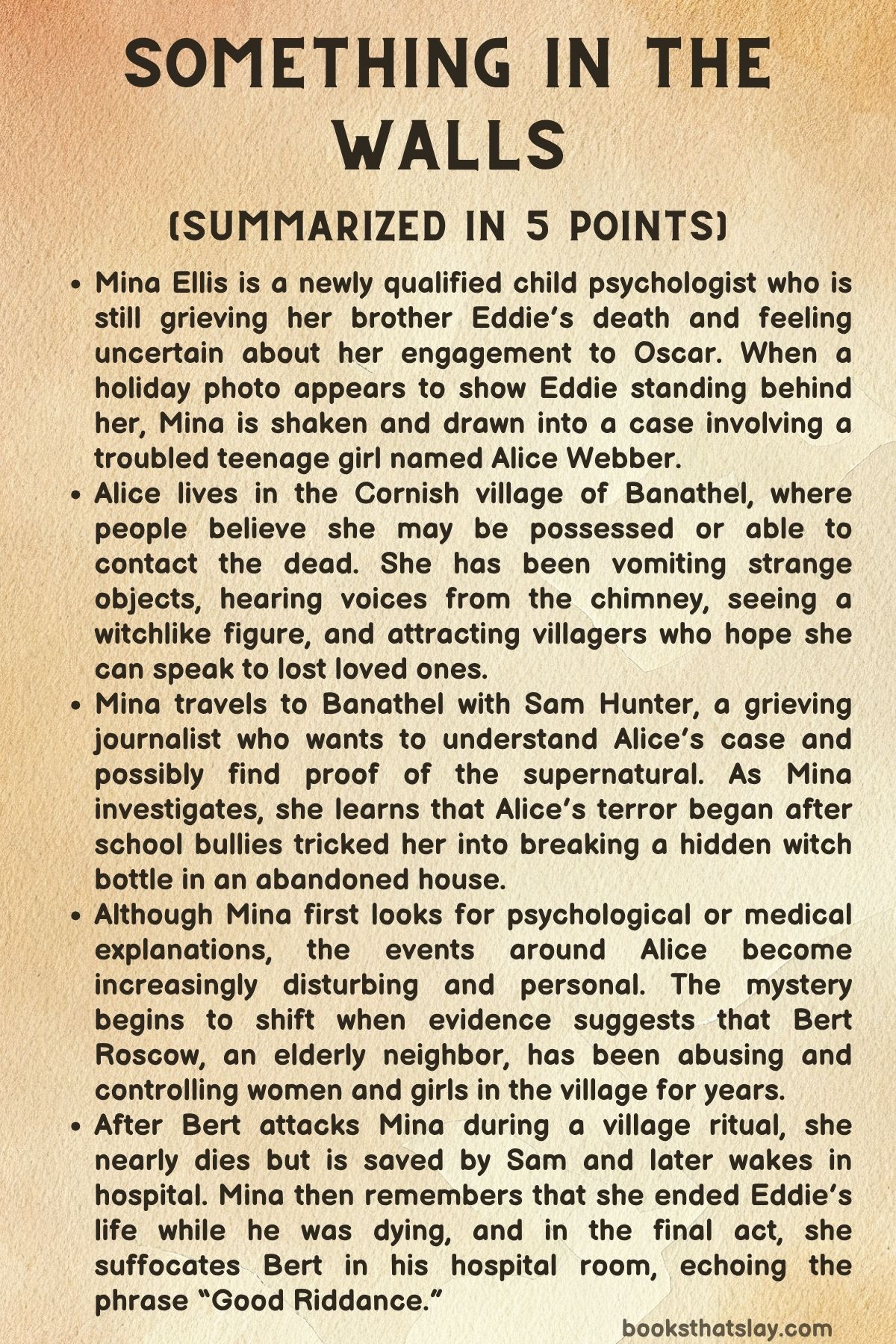
Mina Ellis is newly qualified as a child psychologist, but her own mind feels far from settled. She is engaged to Oscar, yet she is uneasy about the life they are building together.
A recent pregnancy scare leaves her anxious, and although the test is negative, the experience sharpens her doubts about marriage, family, and her ability to move forward. Mina is still carrying the weight of her brother Eddie’s death six years earlier.
His loss has shaped her choices, her fears, and the way she sees herself, even though she tries to act as if she is managing.
Her fragile sense of control breaks when she finds a holiday photograph from Crete. In the picture, behind her, there is a blurred figure who appears to look exactly like Eddie.
Since Eddie is dead, the image frightens her and brings back grief she has never fully faced. Oscar does not take the photograph seriously.
He suggests it is a trick of light, a coincidence, or a sign that Mina needs more help with her bereavement. He encourages her to go back to her support group, but his reaction makes Mina feel more alone.
At the bereavement group, Mina meets Sam Hunter, a journalist who is grieving the death of his young daughter, Maggie. Sam is investigating a strange case in Banathel, a Cornish village where a teenage girl named Alice Webber has become the subject of frightening local rumors.
Alice has suffered disturbing symptoms. She has vomited hair and pins, heard voices and noises from the chimney, seen a witch with an upside-down face, and claimed that the dead are trying to speak through her.
Sam has also captured a whisper on his recording device saying “Good riddance.” The phrase unsettles Mina because it connects to memories she has tried to bury about Eddie.
Mina agrees to help Sam look into Alice’s case, though she lies to Oscar about where she is going. She travels with Sam to Banathel during an oppressive heat wave.
The village is small, suspicious, and full of old beliefs. Hagstones hang in doorways to keep witches away, and many locals seem ready to believe that Alice has become a channel for something beyond the living world.
Mina and Sam stay with Alice’s family: her mother Lisa, her father Paul, her sister Tamsin, and her younger brother Billy. The Webber house is tense, crowded, and shadowed by fear.
Outside, villagers begin gathering, leaving objects and messages because they believe Alice can pass words to the dead.
Mina approaches Alice as a professional. She tries to understand what has happened without accepting the supernatural explanation too quickly.
Alice tells her that everything began after a group of girls from school lured her to an abandoned house on Tanner’s Row. They forced her, as part of a cruel prank, to reach into a chimney and retrieve a hidden witch bottle.
Alice dropped it and broke it. After that, she believed she had released something evil.
Mina considers possible explanations: trauma, suggestion, illness, bullying, stress, or mass hysteria. She knows fear can shape the body and that children and teenagers can express pain in strange ways when they cannot speak about it directly.
But the events around Alice become harder to explain. Recordings capture voices that should not be there.
Alice speaks in ways that feel unlike her ordinary self. Black liquid leaks from the chimney.
Wasps appear with an almost purposeful menace. Alice also seems to know private facts about Mina’s past, especially things connected to Eddie.
Mina tries to stay rational, but the case begins pressing against the hidden parts of her own memory. The more Alice talks, the more Mina feels that the girl may somehow be reaching into the truth Mina has avoided.
The village’s reaction grows more hostile. Alice becomes both a curiosity and a threat.
People want comfort from her supposed ability to speak with the dead, but they also fear what she represents. When Vicky, one of the girls connected to Alice’s bullying, collapses after a wasp sting, suspicion deepens.
Then another boy linked to the cruelty against Alice dies, and the village turns more openly against her. Rumor becomes accusation.
Alice is treated less like a suffering teenager and more like a danger that must be contained or punished.
Inside the Webber family, pressure builds. Paul becomes increasingly invested in proving that the haunting is real.
His motives are complicated. He wants answers, but he also hopes the case might help the family escape their house and their poverty.
Sam, grieving Maggie, is drawn toward the possibility that the dead can communicate. For him, Alice’s case offers the painful hope that death may not be final.
Mina sees this and worries that Sam’s grief is shaping what he wants to believe. At the same time, she is not immune to the same need.
Eddie’s presence, or the idea of it, has begun to haunt every part of her investigation.
Mina’s search leads her to Bert Roscow, the elderly neighbor who lives near the Webbers. Bert appears strange, unpleasant, and deeply tied to the village’s older fears.
Mina discovers a hidden basement in his home containing witch-hunting objects, including a pricking tool and a ritual dress. These objects suggest that someone has been using the language of witchcraft not only as superstition but as a form of control.
The terrifying image of the witch begins to look less like proof of a haunting and more like a mask for abuse.
Fern, a local shopkeeper, later uncovers photographs that reveal the deeper horror. Bert has abused girls and women, including Alice, and likely Lisa and Fern as well.
The memory gaps, the fear, the symbols, and the stories about witches all begin to point toward Bert’s manipulation. He has used the village’s old beliefs to frighten and silence his victims.
The supposed haunting is connected to real violence. Alice’s symptoms are not simply signs of possession or madness; they are the body and mind’s response to trauma.
During the village’s Riddance ritual, the fear around Alice and Mina erupts. Bert turns on Mina and tries to expose her as a witch.
The ritual becomes violent. He drags Mina into the pond and tries to tear out her tongue, as if he can silence her in the same way he has silenced others.
Mina nearly drowns, but Sam rescues her. The attack marks the collapse of the village’s false story.
The evil everyone has been naming as witchcraft is revealed through Bert’s actions.
Mina wakes in hospital six days later. She learns from Fern that Sam saved her life, Alice and her family have fled, Oscar has left her, and Bert survived but was badly burned.
Mina also receives the Crete photograph back from Alice. On it is a message: “He 4gives U.” The words force Mina to confront the truth she has hidden from herself.
She finally remembers what happened when Eddie was dying. He was suffering, and Mina removed his oxygen mask.
Then she smothered him with a pillow while telling him about the day they fell through the ice. The memory explains the guilt that has followed her for years and the terrible power of the phrase “Good riddance.” Mina’s grief has never been only sorrow.
It has also been guilt, love, fear, and the knowledge that she ended her brother’s life.
After this revelation, Mina makes one final choice. Injured but determined, she goes to Bert’s hospital room.
There, she suffocates him and whispers, “Goodbye, Bert. Good Riddance.” The act mirrors her memory of Eddie but carries a different meaning.
With Eddie, Mina’s action came from a tangled place of mercy, fear, and guilt. With Bert, it is an act of revenge and judgment.
The story ends with Mina no longer able to hide from what she is capable of, leaving the reader with a disturbing question about justice, guilt, and whether ending evil can ever free the person who commits the final act.
Characters
Mina Ellis
Mina Ellis is the central character of Something in the Walls, and her role in the book is shaped by grief, guilt, denial, and a desperate need to understand what is real. At the beginning, she appears to be a rational and professionally trained child psychologist, someone who wants to explain Alice Webber’s strange behavior through trauma, suggestion, illness, or hysteria rather than through superstition.
However, Mina’s rationality is fragile because she is carrying unresolved pain from the death of her brother, Eddie. The blurred figure in the Crete photograph unsettles her because it forces her to confront the possibility that her past is not buried as securely as she wants to believe.
Her engagement to Oscar also reveals her emotional uncertainty, as she is not fully at peace with the future he represents.
Mina becomes increasingly complex as the story develops because her investigation of Alice also becomes an investigation of herself. She wants to help Alice, but she is also drawn to Banathel because the haunting seems connected to Eddie and to something she has repressed.
Her professional instincts often clash with her fear, especially when Alice appears to know private details about her life. Mina’s journey is not simply about proving or disproving the supernatural; it is about being forced to face the truth she has avoided.
The final revelation that she removed Eddie’s oxygen mask and smothered him transforms her from a grieving sister into a morally troubling figure. Her killing of Bert at the end shows how deeply the village’s violence and the idea of “riddance” have entered her mind.
Mina is sympathetic because she is wounded and frightened, but she is also disturbing because her trauma leads her toward an act of deliberate revenge.
Alice Webber
Alice Webber is one of the most important and vulnerable characters in the book because she stands at the center of the village’s fear, superstition, cruelty, and hidden abuse. At first, she seems like a girl trapped inside a supernatural nightmare.
Her vomiting of hair and pins, her claims about voices in the chimney, her vision of a witch with an upside-down face, and her belief that the dead want to speak through her all make her appear possessed or haunted. However, as the story develops, Alice becomes less a symbol of witchcraft and more a victim of manipulation, bullying, and abuse.
The broken witch bottle becomes a powerful image of the way fear can be planted in a child’s mind and then used to control her.
Alice’s character also exposes the cruelty of the community around her. Instead of protecting her, the village turns her suffering into a spectacle.
People gather outside her house, leave messages, and treat her as a medium rather than as a frightened teenage girl. Her former friends’ prank at Tanner’s Row shows how adolescent cruelty can become psychologically devastating, especially when it connects with older local legends.
Alice is not simply a passive victim, though. She has moments of eerie knowledge and emotional power, especially in her connection with Mina.
Her message on the photograph, “He 4gives U,” suggests that she understands Mina’s guilt and perhaps offers her a form of release. In Something in the Walls, Alice represents how easily a damaged girl can be turned into a monster by people who refuse to see her pain.
Sam Hunter
Sam Hunter is a grieving journalist whose desire for truth is inseparable from his need to believe that death may not be final. He introduces Mina to Alice’s case and becomes the person who pulls her into Banathel, but his motives are not purely professional.
Sam is mourning his daughter, Maggie, and his grief makes him vulnerable to the possibility that Alice can contact the dead. His Dictaphone recording of the whisper saying “Good riddance” gives the investigation a frightening urgency and connects his search for answers with Mina’s buried trauma.
Sam’s character is compelling because he moves between skepticism, obsession, and genuine compassion. As a journalist, he is interested in the story, but as a father, he is emotionally invested in the supernatural possibility.
His grief over Maggie makes him want Alice’s abilities to be real, because that would mean some connection with the dead is possible. This desire clouds his judgment, but it also makes him deeply human.
Unlike many people in the village, Sam does not simply exploit Alice as a spectacle. He becomes protective, especially toward Mina, and his rescue of her during the Riddance ritual shows his courage and loyalty.
Sam’s role in the book is to show how grief can make people search for meaning in terrifying places, but also how love and responsibility can survive inside that grief.
Oscar
Oscar represents the ordinary life Mina is supposed to want but cannot fully accept. As her fiancé, he offers stability, routine, and a future away from the chaos of grief and obsession.
However, his relationship with Mina is marked by emotional distance. When Mina shows him the Crete photograph, he dismisses her fear and encourages her to return to her bereavement group.
His response may be practical, but it also reveals that he does not truly understand the depth of her trauma or the force of Eddie’s memory in her life.
Oscar is not portrayed as a villain, but he is limited in his ability to reach Mina. He belongs to the world of rational explanations and conventional recovery, while Mina is being pulled toward secrets, guilt, and unresolved violence.
Her decision to lie to him about going to Banathel shows that their relationship lacks honesty and trust. Oscar’s eventual departure after Mina’s near-death experience suggests that their engagement was already fragile and perhaps built on the hope that Mina could become someone more emotionally settled than she really is.
His character is important because he highlights the gap between Mina’s outward life and her inner reality.
Eddie Ellis
Eddie Ellis is dead before the main events of the story, but he is one of the most powerful presences in the book. He exists in Mina’s memories, guilt, hallucinations, and fears.
At first, he appears to be the beloved brother whose death shattered Mina’s life. The photograph from Crete seems to show him standing behind her, and this image immediately destabilizes her.
Eddie becomes a haunting figure, not necessarily because he is a ghost, but because Mina has never truly faced what happened when he died.
As the truth emerges, Eddie’s role becomes more tragic and morally complicated. He was dying, and Mina’s final act toward him can be interpreted through grief, mercy, desperation, or horror.
She removed his oxygen mask and smothered him while speaking about a shared childhood memory, which makes the moment both intimate and deeply disturbing. Eddie’s importance lies in the way he embodies Mina’s unresolved guilt.
He is not only a lost sibling; he is the secret around which Mina’s identity has formed. The message that he forgives her becomes crucial because it gives Mina a kind of emotional permission to stop running from the truth, though it does not erase the darkness of what she did.
Maggie Hunter
Maggie Hunter, Sam’s deceased daughter, does not appear directly in the present action, but her absence shapes Sam’s choices throughout the story. She is the emotional wound behind his fascination with Alice Webber.
Because Sam has lost a child, the possibility that the dead can communicate through Alice becomes intensely personal to him. Maggie represents the kind of loss that can make a person vulnerable to belief, even when that belief is frightening or irrational.
Maggie’s role also parallels Eddie’s role in Mina’s life. Both are dead loved ones whose memories drive the living into Banathel’s disturbing world.
Through Maggie, the book shows that grief does not only create sadness; it can create obsession, hope, denial, and recklessness. Sam’s longing for some sign from his daughter makes him more willing to consider supernatural explanations.
Maggie therefore functions as a silent but powerful force in the story, revealing how the dead continue to shape the actions of those left behind.
Lisa Webber
Lisa Webber is Alice’s mother, and her character reflects the exhaustion, fear, and helplessness of a parent watching her child become the center of public hysteria. She is trapped in a household where Alice’s suffering grows more terrifying and where the village’s attention becomes increasingly invasive.
Lisa’s position is painful because she must deal not only with Alice’s illness or possession-like behavior, but also with the pressure of neighbors, rumors, and her own family’s instability.
As more is revealed about Bert Roscow, Lisa becomes connected to the deeper pattern of abuse beneath the witchcraft narrative. The suggestion that she may also have been one of Bert’s victims gives her character a hidden sorrow.
Her fear is not only fear for Alice but possibly fear rooted in her own past. Lisa represents how abuse can move through generations when it is hidden by silence, superstition, and community denial.
Her eventual flight with her family suggests a desperate attempt to escape not just the house, but the entire system of fear surrounding them.
Paul Webber
Paul Webber is Alice’s father, and his response to the strange events reveals both desperation and weakness. At first, he is part of a family under pressure, trying to survive Alice’s frightening condition and the village’s growing obsession with her.
However, Paul becomes increasingly interested in proving the haunting, partly because he thinks it could help the family escape their house. This makes his character morally uneasy because Alice’s suffering begins to become useful to him.
Paul is not shown as purely cruel, but he is deeply flawed. His desire to prove the supernatural may come from fear and financial desperation, yet it risks turning his daughter’s trauma into evidence for his own purposes.
Instead of fully protecting Alice from the attention surrounding her, he becomes drawn to the possibility that the haunting could provide a way out. Through Paul, the book explores how desperation can distort parental responsibility.
He is a man under pressure, but his choices show how easily adults can fail children when fear, pride, and self-interest take control.
Tamsin Webber
Tamsin Webber is Alice’s sibling, and although she is not as central as Alice, her presence helps show the wider damage caused by the events in the Webber household. A haunting, whether real or psychological, does not affect only the person at its center.
It changes the entire family atmosphere. Tamsin lives inside a home filled with fear, suspicion, strange noises, public attention, and emotional instability.
Her role reminds the reader that Alice’s suffering spreads outward and shapes the childhoods of the other children in the family.
Tamsin also represents the quieter victims of family crisis. While Alice becomes the focus of the village’s fascination, Tamsin must exist in the shadow of that attention.
The fear surrounding the chimney, the rumors about witchcraft, and the growing hostility toward the Webbers all create a threatening environment for her. Her character is important because she shows that when a community turns a child into a symbol, the entire family becomes trapped in that symbol’s consequences.
Billy Webber
Billy Webber, like Tamsin, is part of the younger generation endangered by the fear surrounding Alice. His role in the story emphasizes the vulnerability of children inside a household that has become both a private nightmare and a public spectacle.
Even if Billy is not the direct target of the haunting claims, he is still surrounded by the emotional consequences of them. The home that should protect him becomes unstable, watched, and invaded by rumor.
Billy’s character helps deepen the sense that the Webber family is being consumed by forces larger than any one person. He is part of the domestic reality behind the sensational events.
While outsiders focus on Alice’s supposed powers, Billy’s presence reminds the reader that this is also a family crisis involving frightened children. His importance lies in the way he broadens the emotional cost of the story, showing that superstition, abuse, and public hysteria do not damage only their main victim.
Bert Roscow
Bert Roscow is one of the darkest characters in the book because he represents hidden violence disguised beneath local tradition and superstition. As the elderly neighbor, he initially belongs to the background of Banathel’s strange village culture, but the discovery of his basement reveals the truth beneath the haunting narrative.
His collection of witch-hunting objects, including the pricking tool and ritual dress, connects him to a history of controlling, punishing, and terrorizing women and girls. He is not merely a believer in old superstitions; he uses them as instruments of power.
Bert’s abuse of girls and women, including Alice and likely Lisa and Fern, makes him the human monster behind much of the story’s fear. The witch figure, the gaps in memory, and Alice’s terror all begin to look less like evidence of the supernatural and more like signs of trauma caused by Bert’s manipulation.
His attempt to expose Mina as a witch during the Riddance ritual shows that he is still committed to the old logic of accusation and punishment. He tries to silence Mina physically by tearing out her tongue, which symbolically reveals his need to control women’s voices and truths.
Bert’s death at Mina’s hands is disturbing because he deserves exposure and punishment, but Mina chooses private vengeance. He is the embodiment of the book’s central horror: the real evil is not necessarily in the walls, but in the people protected by silence.
Fern
Fern is a crucial character because she helps uncover the truth that the village would rather hide. As a local shopkeeper, she seems at first to be part of Banathel’s everyday life, but she becomes much more important when she finds photographs proving Bert’s abuse.
Her discovery shifts the story away from pure supernatural terror and toward the reality of exploitation, memory, and trauma. Fern helps reveal that the witchcraft narrative has been covering up human violence.
Fern also appears to be connected personally to Bert’s abuse, which gives her role emotional weight. She is not simply a source of information; she is likely another survivor of the same hidden pattern.
Her conversation with Mina after the hospital stay is important because she becomes a bearer of truth. She tells Mina what happened after the ritual, including Sam’s rescue, the Webbers’ escape, Oscar’s departure, and Bert’s survival.
Fern represents survival, memory, and the difficult act of naming what has been hidden. Her character shows that truth often comes from those who have been dismissed or wounded, not from the official voices of the community.
Vicky
Vicky is Alice’s former friend, and her character represents the cruelty and social pressure that help trigger Alice’s breakdown. She is connected to the prank at Tanner’s Row, where Alice is lured into retrieving the witch bottle from the chimney.
This act may seem like childish bullying on the surface, but in the context of Banathel’s superstitions and Alice’s vulnerability, it becomes deeply damaging. Vicky’s role shows how peer cruelty can become part of a larger system of fear.
Her later collapse from a wasp sting intensifies the village’s belief that Alice is dangerous or cursed. Instead of making people reflect on their treatment of Alice, Vicky’s suffering becomes another reason for the community to turn against her.
Vicky is important because she shows how guilt, fear, and superstition can twist social relationships. She begins as someone who harms Alice, but after her collapse, she also becomes part of the cycle of panic that traps Alice further.
Alice’s School Friends
Alice’s school friends function as a collective force of cruelty, pressure, and betrayal. Their prank at Tanner’s Row is one of the key events behind Alice’s terror.
By making her reach into the chimney and retrieve the witch bottle, they exploit both local superstition and Alice’s vulnerability. Their actions show how children and teenagers can reproduce the fears and cruelties of the adult world around them.
They may not fully understand the damage they cause, but their behavior helps open the door to Alice’s collapse.
As a group, they also reveal the social isolation that surrounds Alice. Friendship becomes unsafe, and the people who should be her peers become part of the threat against her.
Their cruelty connects with the larger village culture, where rumor and spectacle matter more than care. The school friends are important because they show that Alice is attacked from multiple directions: by superstition, by adults, by hidden abuse, and by the betrayal of people her own age.
The Villagers of Banathel
The villagers of Banathel act almost like a collective character in the story. They represent the power of superstition, rumor, and communal fear.
Their use of hagstones, their belief in witches, and their gathering outside the Webber house create an atmosphere where Alice’s suffering becomes public property. Instead of responding to her as a child in distress, they treat her as a supernatural figure who might speak to the dead or bring danger upon them.
The villagers are frightening because their behavior shows how ordinary people can become cruel when they believe they are protecting themselves. They leave objects and messages for Alice, but their attention is not truly compassionate.
It turns her into a spectacle and increases the pressure on her family. During the Riddance ritual, the village’s old beliefs become openly violent, allowing Bert to target Mina as a witch.
The villagers’ role is essential because they show that evil in the story is not limited to one abuser. It is also sustained by a community willing to believe legends instead of confronting human wrongdoing.
Themes
Grief, Guilt, and the Need for Forgiveness
Mina’s grief is not presented as a clean sadness but as something tangled with fear, denial, and hidden guilt. Eddie’s death has shaped her entire emotional life, affecting her engagement, her work, and her ability to trust her own mind.
The photograph from Crete forces her to confront what she has tried to bury, because the blurred figure seems to turn grief into something visible and accusing. Her connection with Sam also grows from loss, but their grief moves in different directions: Sam wants proof that death is not final, while Mina wants to escape the truth of what death has made her remember.
The message “He 4gives U” becomes important because it offers the forgiveness Mina cannot give herself. In Something in the Walls, grief is not only about missing the dead; it is also about surviving the memories attached to them and facing the possibility that love and harm can exist in the same painful moment.
Superstition, Fear, and Collective Hysteria
Banathel becomes a place where fear spreads faster than truth. The villagers’ belief in witches, hagstones, rituals, and cursed objects creates an atmosphere where Alice’s suffering is quickly turned into a supernatural spectacle.
Instead of asking what has happened to her, people decide what she represents. Their fear gives them permission to stare, judge, accuse, and finally attack.
Alice becomes less a vulnerable girl and more a symbol onto which the village projects its old beliefs and private anxieties. The heat wave strengthens this mood, making the setting feel trapped, tense, and unstable.
The broken witch bottle works as a trigger, but the real danger comes from how easily people accept a frightening explanation when it suits their fears. The story shows that superstition can become harmful when it replaces compassion.
Once the community decides Alice is connected to evil, her pain is no longer treated as a cry for help but as evidence against her.
Abuse, Silence, and the Control of Women
The haunting gradually points toward something more human and more disturbing than the supernatural: Bert’s abuse and the silence around it. The witch story hides the real violence done to girls and women, turning victims into suspicious figures instead of protecting them.
Alice’s illness, Lisa’s fear, Fern’s memories, and the hidden objects in Bert’s basement all suggest a pattern of control that has lasted for years. Bert’s power depends on secrecy, shame, and the village’s willingness to believe old stories rather than face ordinary cruelty.
His use of witch-hunting objects shows how violence against women can be disguised as punishment, tradition, or moral correction. The attempted attack on Mina makes this theme brutally clear, because Bert tries to silence her physically by targeting her tongue.
The story argues that the real monster is not a ghost in the chimney but a man protected by fear, disbelief, and the community’s failure to listen to women.
Rationality, Belief, and the Limits of Explanation
Mina enters Banathel determined to explain Alice’s condition through psychology, trauma, illness, suggestion, or mass hysteria. Her training gives her a way to stay calm, but the events around Alice repeatedly challenge that confidence.
Voices on recordings, private knowledge about Eddie, black liquid, wasps, and Alice’s strange behavior all push Mina toward uncertainty. The tension comes from the fact that neither rational explanation nor supernatural belief feels fully safe.
Sam’s grief makes him eager to believe, while Mina’s guilt makes her afraid of believing. The story does not simply reject reason; instead, it shows that reason can fail when people use it to avoid emotional truth.
At the same time, belief can become dangerous when it feeds obsession or public panic. Mina’s journey depends on accepting that some answers are psychological, some are social, and some are buried in memory.
The greatest truth she uncovers is not whether ghosts exist, but what she has refused to admit about herself.