Separation of Church and Hate Summary and Analysis
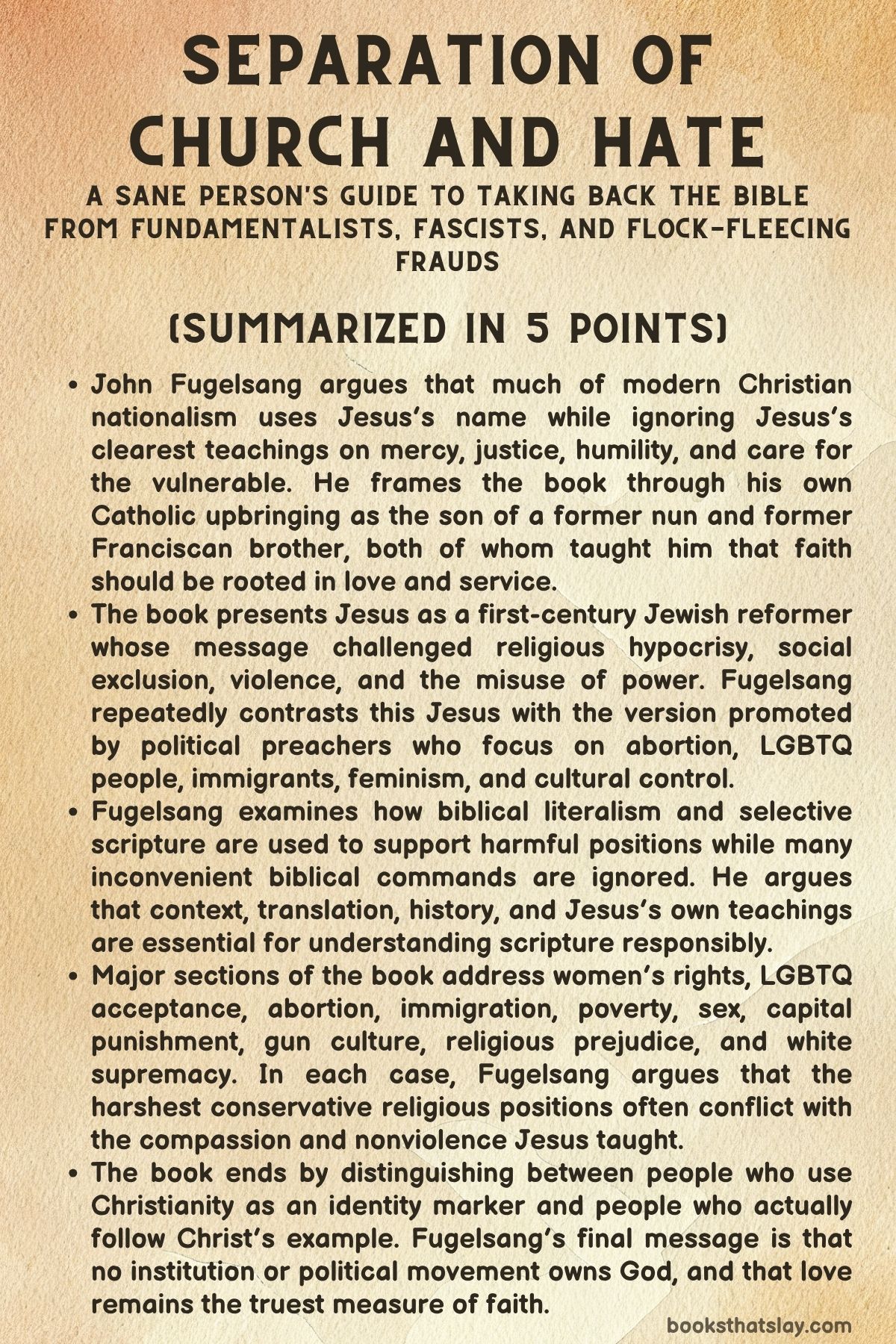
Separation of Church and Hate is a nonfiction work by John Fugelsang that challenges the way Christian nationalism and right-wing religious politics use the Bible to justify exclusion, prejudice, and power. Fugelsang writes from a personal, comic, and critical perspective, shaped by his upbringing as the son of a former nun and a former Franciscan brother.
The book argues that many public claims made in Jesus’s name are far removed from Jesus’s teachings on mercy, poverty, nonviolence, justice, and love. It is both a critique of religious hypocrisy and a call to recover a more compassionate Christianity.
Summary
Separation of Church and Hate begins with John Fugelsang’s family history, using the story of his parents to frame the book’s central concern: the difference between living by love and using religion as a tool of control. His mother entered religious life as a nun and served in difficult conditions, including work connected to illness and poverty.
His father became a Franciscan brother after an earlier working-class life. They met through Catholic service, formed a connection through letters, left their vows, married, and built a family.
Fugelsang presents their choice not as a rejection of faith, but as an act of love that continued their spiritual journey in another form.
Growing up in a devout Catholic household, Fugelsang learned Christianity as compassion, service, justice, and care for the vulnerable. This understanding clashed with the televised Christianity he later saw promoted by political preachers and conservative religious figures.
Instead of focusing on the poor, the sick, the imprisoned, or the excluded, many of these voices centered their religion on opposition to abortion, feminism, LGBTQ people, immigrants, and secular culture. Fugelsang argues that this public version of Christianity often ignores Jesus while claiming to defend him.
The book’s central argument is that Jesus of Nazareth was a Jewish teacher whose message challenged religious hypocrisy, social hierarchy, greed, violence, and exclusion. Fugelsang emphasizes that Jesus was not a white American culture-war figure, but a Middle Eastern Jew under Roman occupation.
His ministry centered on love of God and love of neighbor. He associated with outsiders, protected the vulnerable, challenged public displays of false piety, rejected retaliation, and taught that societies would be judged by how they treated the hungry, the sick, prisoners, and strangers.
Fugelsang returns often to the Sermon on the Mount and the command to love enemies as the moral core of Christianity.
The book also contrasts Jesus with Paul. Fugelsang acknowledges Paul’s importance in spreading Christianity across the Roman world, especially among Gentiles, but argues that Paul’s writings shaped later church structures and ethical rules in ways that sometimes differ from Jesus’s direct teachings.
Paul’s letters became central to Christian theology, including teachings about faith, church order, gender roles, and sexuality. Fugelsang points out tensions within Paul’s writings: he restricts women in some passages, yet praises female leaders elsewhere.
The book suggests that many Christians treat Paul’s letters as though they carry the same authority as Jesus’s words, even when the two appear to emphasize different things.
From there, Fugelsang turns to Christian nationalism and fundamentalism. He describes these movements as marked by certainty, selective literalism, and a desire for cultural dominance.
He challenges the idea that America was founded as a Christian nation, noting that the Constitution does not establish Christianity and that the First Amendment prevents an official national religion. He also criticizes dominionist ideas that encourage Christians to take control of major areas of society.
Against this hunger for power, Fugelsang places Jesus’s humility, refusal of worldly kingdoms, and suspicion of religious elites.
A major part of the book attacks biblical literalism. Fugelsang argues that many people who claim to read the Bible literally are highly selective.
They ignore rules about food, clothing, Sabbath observance, divorce, and many forms of ancient punishment, while choosing certain passages to condemn modern groups. He also discusses contradictions, translation issues, oral tradition, and the long process through which biblical texts were copied and canonized.
His point is not that the Bible has no value, but that treating every passage as equally direct and literal can lead to authoritarian thinking and moral cruelty.
The book then applies this method to debates about women. Fugelsang describes the patriarchal world of the Bible, where women were often treated as property, excluded from authority, and burdened with purity rules.
He contrasts that background with Jesus’s behavior toward women. Jesus teaches women, speaks with women publicly, defends women from shame and violence, includes women in his ministry, and treats them as moral and spiritual agents.
Fugelsang argues that later Christian traditions often reduced women’s authority, particularly through church teachings and patriarchal interpretations.
The same approach appears in the discussion of LGBTQ people. Fugelsang argues that Jesus never directly condemns homosexuality and that many anti-LGBTQ arguments rest on selective readings of ancient texts.
He reconsiders stories and verses often used against gay people, including Sodom and Gomorrah, Levitical laws, and Paul’s Greek terms in letters. He notes that Sodom’s sin is described elsewhere as arrogance, cruelty, and neglect of the poor.
He also stresses that words translated in modern Bibles have complex histories and may refer to exploitative practices rather than loving relationships. The larger ethical question, for Fugelsang, is whether Christians are following Jesus’s command to love neighbors without judgment.
The book also challenges modern anti-abortion politics. Fugelsang argues that Jesus never mentions abortion and that the Bible does not contain a clear ban on it.
He reviews the history of evangelical attitudes, showing that many conservative Protestant groups were not uniformly anti-abortion before the late twentieth century. He connects the rise of anti-abortion politics to broader conservative mobilization, including reactions to civil rights and fights over tax exemptions for segregated schools.
Fugelsang examines biblical passages often used in abortion debates and argues that several do not support the claim that fetal life has the same legal status as born life. He also criticizes anti-abortion politics that disregard the health, poverty, and suffering of women and children after birth.
Immigration is another major concern. Fugelsang argues that the Bible repeatedly commands kindness to strangers, because Israel itself was once a foreigner in Egypt.
He presents Jesus’s teachings, especially the Good Samaritan and the judgment of nations based on welcoming strangers, as direct challenges to anti-immigrant hostility. He criticizes the use of Romans to defend harsh government policies, including family separation, and rejects dehumanizing language for migrants.
For Fugelsang, Christian ethics require border policy to be discussed through human dignity rather than fear.
The book’s economic argument centers on poverty. Fugelsang points out that scripture speaks constantly about care for the poor, debt forgiveness, generosity, fair treatment of workers, and suspicion of wealth.
He criticizes political Christianity that defends tax cuts for the wealthy while attacking welfare, healthcare access, and social programs. He reinterprets verses commonly used to shame poor people, arguing that they are taken out of context.
Jesus’s healings, teachings, and warnings about wealth become the standard against which Fugelsang judges modern policy.
Fugelsang also addresses sex, capital punishment, guns, religious prejudice, and white supremacy. He argues that many Christian traditions have produced unnecessary sexual shame through misreadings and purity obsessions.
He rejects the death penalty as incompatible with Jesus’s mercy, forgiveness, and own execution by the state. He challenges gun culture by arguing that Jesus’s words about swords are taken out of context and that his response to violence was rejection, not escalation.
He also condemns Christian anti-Semitism, Islamophobia, hatred of atheists, and racist theology. In each case, he returns to Jesus’s love of neighbor as the controlling principle.
The book closes by distinguishing between those who wear Christianity as identity and those who actually follow Christ’s teachings. Fugelsang acknowledges the harm done by Christian institutions but also honors believers who fought slavery, segregation, poverty, war, and exclusion.
He argues that no church or political movement owns God, Jesus, the Bible, or America. The final message is personal and moral: his parents’ decision to leave religious orders and marry was not a failure of faith.
It was a choice for love, and for Fugelsang, love remains the only religion that always works.
Key Figures
John Fugelsang
John Fugelsang is the central voice of the book, functioning as narrator, critic, son, comic observer, and moral challenger. In Separation of Church and Hate, he writes from inside Christianity’s cultural world rather than from outside it, which gives his critique a personal force.
His authority does not come from presenting himself as a theologian, but from his upbringing, his familiarity with scripture, and his anger at seeing Jesus used to defend cruelty. Fugelsang’s personality is marked by humor, impatience with hypocrisy, and a strong attachment to the Jesus of the Gospels.
He is not attacking faith itself; he is attacking the public misuse of faith. His method is confrontational but also practical, since he wants readers to know how to respond when scripture is weaponized in debates about politics, sexuality, poverty, race, and identity.
He also reveals vulnerability through family memory, especially in his reflections on his parents and grandfather. That personal grounding prevents the book from becoming only an argument.
Fugelsang appears as someone trying to protect the best parts of the religion that shaped him from those he believes have distorted it.
Mary Margaret Fugelsang
Mary Margaret, Fugelsang’s mother, represents a form of Christianity rooted in service, sacrifice, and quiet moral discipline. Her decision to enter the convent after high school shows a young woman drawn to commitment and religious purpose.
Her work with the sick and vulnerable, including service connected to Malawi, places her faith in action rather than slogans. She is important not simply because she was once a nun, but because she embodies the kind of Christianity the book respects: practical compassion, humility, and courage.
Her later decision to leave religious life and marry Jack is not presented as betrayal. Instead, it becomes part of the book’s argument that love can be a sacred calling too.
Mary Margaret’s life also complicates narrow ideas of obedience. She gives herself fully to religious discipline, then later chooses family and partnership without abandoning the values that shaped her.
In the story, she becomes a living answer to rigid religion: a person may change paths and still remain guided by grace, service, and love.
Jack Fugelsang
Jack Fugelsang, also known during religious life as Brother Boniface, is one of the book’s strongest examples of faith as movement rather than fixed status. His background as a butcher before joining the Franciscans gives him a grounded, working-class quality, while his later role as a teacher and coach suggests warmth, discipline, and public usefulness.
His relationship with Mary Margaret begins in illness and correspondence, but grows through intellect, care, and shared moral life. Jack’s persuasion of Mary Margaret to leave the convent could have been framed as rebellion against God, yet the book presents it as a different kind of obedience: a response to love and life.
He teaches his son that Christianity means compassion and justice, not domination. Near the end of the book, his explanation that the same voice that led him into religious life later led him out of it becomes one of the clearest statements of the book’s spiritual philosophy.
Jack is not a failed religious man; he is a man whose faith matures beyond institutional boundaries.
Jesus of Nazareth
Jesus stands at the moral center of the book, not as a distant religious symbol but as the standard by which every political claim is tested. The Jesus presented here is Jewish, poor, colonized, compassionate, and confrontational toward religious hypocrisy.
He is not passive, but his strength is expressed through mercy, truth, and protection of the vulnerable rather than force. Fugelsang emphasizes Jesus’s concern for the poor, the sick, prisoners, women, foreigners, and social outsiders.
This makes Jesus a deeply challenging figure for any movement that seeks power while neglecting mercy. In Separation of Church and Hate, Jesus is also a corrective to selective Bible use.
When conservative religious arguments depend on punishment, exclusion, or cultural control, Fugelsang returns to Jesus’s words about love, forgiveness, humility, and judgment. Jesus’s character in the book is radical because he refuses the boundaries that religious and political systems create.
He speaks to women, touches the unclean, praises outsiders, rejects retaliation, and places human need above public piety. His authority comes from moral clarity, not institutional power.
Paul of Tarsus
Paul is presented as one of the most influential and complicated figures in the story of Christianity. Fugelsang does not deny Paul’s importance; in fact, Paul’s missionary work, Roman citizenship, and ability to communicate with Gentile communities helped transform a Jewish reform movement into a world religion.
Yet the book treats Paul with caution because his writings became a foundation for church structures and rules that often overshadow Jesus’s direct teachings. Paul is complex because he expands Christianity while also contributing to ideas later used to restrict women, condemn sexuality, and emphasize faith in ways that can reduce the importance of works.
His contradictions matter. He praises women such as Phoebe, Priscilla, and Junia, yet other passages associated with him limit women’s speech and authority.
He preaches spiritual equality, yet his writings have been used to uphold hierarchy. In the book, Paul is less villain than turning point.
He represents the moment when Jesus’s movement begins to become an institution, and with that shift come both survival and distortion.
Christian Nationalists and Fundamentalists
Christian nationalists and fundamentalists function as a collective antagonist in the book. They are not treated as one identical group, but as overlapping movements united by certainty, selective scripture, and the pursuit of cultural control.
Fugelsang presents them as people who often claim to defend Christianity while ignoring the parts of Jesus’s teaching that would challenge their politics. Their character is defined by contradiction.
They may claim biblical literalism while ignoring many biblical rules; claim to defend life while supporting guns or the death penalty; claim family values while excusing cruelty toward migrants, women, LGBTQ people, and the poor. Their power comes from turning religion into identity and grievance.
Fugelsang is especially concerned with how they use fear: fear of demographic change, secularism, feminism, queer people, immigrants, and loss of dominance. In the book, they are dangerous not because they are religious, but because they replace humility with certainty and compassion with control.
They reveal how faith can be reshaped into a political weapon when love of neighbor is treated as optional.
Jerry Falwell, Pat Robertson, and Public Religious Conservatives
Figures such as Jerry Falwell and Pat Robertson represent the rise of a media-driven political Christianity that shaped Fugelsang’s understanding of what had gone wrong in American religion. They appear not as private believers, but as public voices who helped move Christianity into culture-war politics.
Their importance lies in the way they changed emphasis. Instead of foregrounding care for the poor, forgiveness, humility, or peace, they helped make abortion, feminism, LGBTQ rights, welfare, and national identity central religious battlegrounds.
Fugelsang presents these figures as part of a broader movement that taught many Americans to associate Christianity with resentment and exclusion. They also show the power of television, fundraising, and political messaging in remaking religious priorities.
Their role in the book is symbolic as much as historical. They are examples of what happens when Christianity becomes a brand of moral panic.
Through them, Fugelsang critiques a version of faith that speaks loudly about sin in others while remaining quiet about greed, racism, cruelty, and public hypocrisy.
Leonard Fugelsang
Leonard, Fugelsang’s paternal grandfather, is one of the book’s most human and troubling figures. He is remembered as loving, loyal, hardworking, and tender toward his wife, yet also deeply prejudiced against Black people, Jews, and Puerto Ricans.
This contradiction makes him important. Leonard shows how racism can live inside ordinary family life, even among people who are religious, affectionate, and capable of care.
Fugelsang does not flatten him into a monster, nor does he excuse him. Instead, Leonard becomes a painful example of the divided human heart.
His Catholic devotion did not automatically free him from bigotry, which supports the book’s larger argument that religious identity is not the same as moral transformation. His final encounter with a Filipino priest complicates his story further.
Near death, Leonard accepts the priest’s presence, prays with him, and expresses gratitude. This moment does not erase the harm of his prejudice, but it suggests the possibility of change even at the end of life.
Leonard’s character gives the book emotional honesty because he brings the argument about racism into the intimate space of family.
Mary Magdalene
Mary Magdalene is treated as a figure whose historical and spiritual importance has often been reduced by patriarchal tradition. The book emphasizes that the Bible does not identify her as a prostitute, despite centuries of Christian teaching and art that presented her that way.
This distortion matters because it shows how women’s authority can be weakened through sexualized reputation. Mary Magdalene’s actual role is far more powerful: she is a committed follower of Jesus, present at moments when male disciples fail or flee, and associated with the first witness of the resurrection in key Christian tradition.
In the book, she represents both female discipleship and the danger of later institutional storytelling. Her character exposes how religious communities may honor women symbolically while denying them authority in practice.
Fugelsang uses her to challenge the assumption that women were marginal to Jesus’s movement. Mary Magdalene’s importance lies in her faithfulness, courage, and witness.
She stands as evidence that the earliest Christian story gave women a central place, even if later church structures often tried to narrow that place.
Danya Ruttenberg, Dillon Naber Cruz, and Progressive Religious Voices
Rabbi Danya Ruttenberg, theologian Dillon Naber Cruz, and other progressive religious voices serve as interpretive guides throughout the book. They are not characters in a fictional sense, but they function as intellectual and moral companions in the argument.
Their presence helps Fugelsang show that scripture can be read with context, humility, history, and compassion. Ruttenberg’s contributions are especially important in discussions of Jewish interpretation, abortion, Sodom, and selective Christian use of Hebrew scripture.
She helps challenge readings that flatten ancient texts into modern political slogans. Cruz’s role is significant in discussions of biblical interpretation, literalism, and love without qualification.
These figures strengthen the book because they prevent Fugelsang’s critique from being merely personal opinion. They show that serious faith can coexist with scholarship, doubt, justice, and openness.
As a group, they represent a religious alternative to fundamentalist certainty. Their character function is to make room for belief that is thoughtful rather than rigid, morally serious rather than punitive, and grounded in care rather than control.
Themes
Love as the Measure of Real Faith
Faith is judged in the book by how closely it resembles love in action. Fugelsang repeatedly contrasts religious identity with religious practice, showing that calling oneself Christian means little if the result is cruelty, exclusion, or indifference to suffering.
His parents’ story establishes this theme from the beginning. Their decision to leave religious orders and marry could be seen by institutional religion as broken obedience, but Fugelsang frames it as an act shaped by love, growth, and spiritual honesty.
That idea becomes the standard for the entire work. Love is not sentimental here; it has political, social, and moral demands.
It requires care for the poor, welcome for strangers, mercy toward sinners, protection of women, rejection of racism, and refusal to treat LGBTQ people as enemies. Separation of Church and Hate argues that love is not a decorative part of Christianity but its central test.
Whenever religious people use scripture to justify harm, Fugelsang asks whether that use reflects the Jesus who fed, healed, forgave, welcomed, and defended the vulnerable. The answer, for him, determines whether faith is alive or merely a costume for power.
The Danger of Selective Scripture
Selective scripture use is shown as one of the main ways religion becomes harmful. Fugelsang is not arguing that the Bible should be ignored; he is arguing that it should not be handled dishonestly.
Many of the religious positions he criticizes depend on lifting a verse out of its historical, literary, or theological setting while ignoring surrounding commands that would be inconvenient. This pattern appears in arguments about women, sexuality, poverty, immigration, guns, abortion, and the death penalty.
A person may cite Leviticus against gay people while eating forbidden foods, wearing mixed fabrics, or rejecting other laws from the same tradition. A politician may cite Romans to demand obedience to immigration policy while ignoring the Bible’s repeated commands to welcome strangers.
Someone may quote Paul against welfare while ignoring Jesus’s direct concern for the poor. Fugelsang treats this not as harmless inconsistency but as moral manipulation.
Selective reading allows people to make scripture say what their politics already wanted to say. The theme is especially powerful because it shifts the debate from whether a person respects the Bible to whether they are using it with integrity, context, and compassion.
Christianity, Power, and National Identity
The book is deeply concerned with what happens when Christianity becomes tied to dominance rather than service. Fugelsang argues that Christian nationalism changes the faith by making cultural control seem like religious duty.
Instead of following a teacher who rejected worldly kingdoms, blessed the meek, warned against public piety, and sided with the powerless, Christian nationalists seek influence over government, education, media, family, and public life. The result is a religion that wants authority more than transformation.
This theme is especially clear in the discussion of America’s founding. Fugelsang challenges the claim that the United States was created as a formally Christian nation and emphasizes the secular structure of the Constitution and the protection against established religion.
The danger is not merely historical error; it is the use of that error to exclude people who do not fit a preferred religious or racial identity. When Christianity fuses with nationalism, outsiders become threats, and neighbors become enemies.
Fugelsang argues that this directly contradicts Jesus’s ethic, which expands the circle of concern rather than narrowing it. The book presents true faith as humble service, not possession of the state.
Mercy Against Punishment and Exclusion
Mercy is treated as a radical force because it challenges systems built on punishment, shame, and fear. Fugelsang applies this theme to the death penalty, sexual morality, abortion, immigration, poverty, and religious difference.
In each case, he argues that many public Christians begin with condemnation while Jesus begins with human need. The woman threatened with stoning becomes a key model: Jesus does not deny moral seriousness, but he refuses execution, public humiliation, and self-righteous violence.
That pattern reappears in the book’s rejection of capital punishment, where Fugelsang argues that killing people removes the possibility of repentance and transformation. It also appears in discussions of sex and gender, where shame has often been treated as holiness.
Mercy does not mean the absence of ethics; it means ethics guided by humility and awareness of shared weakness. Fugelsang is especially critical of religious movements that demand harsh consequences for others while asking grace for themselves.
The theme asks readers to consider whether their faith produces restoration or fear. For Fugelsang, Christianity loses its moral center when it becomes more eager to punish than to heal, more eager to exclude than to welcome, and more eager to win than to forgive.